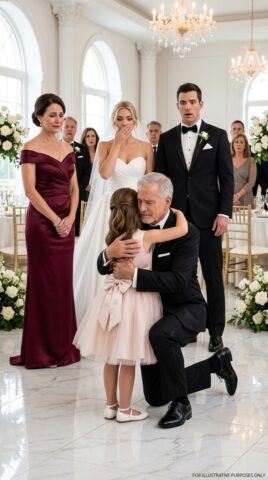
“I came home early. Devon is marrying Rochelle in my backyard.”
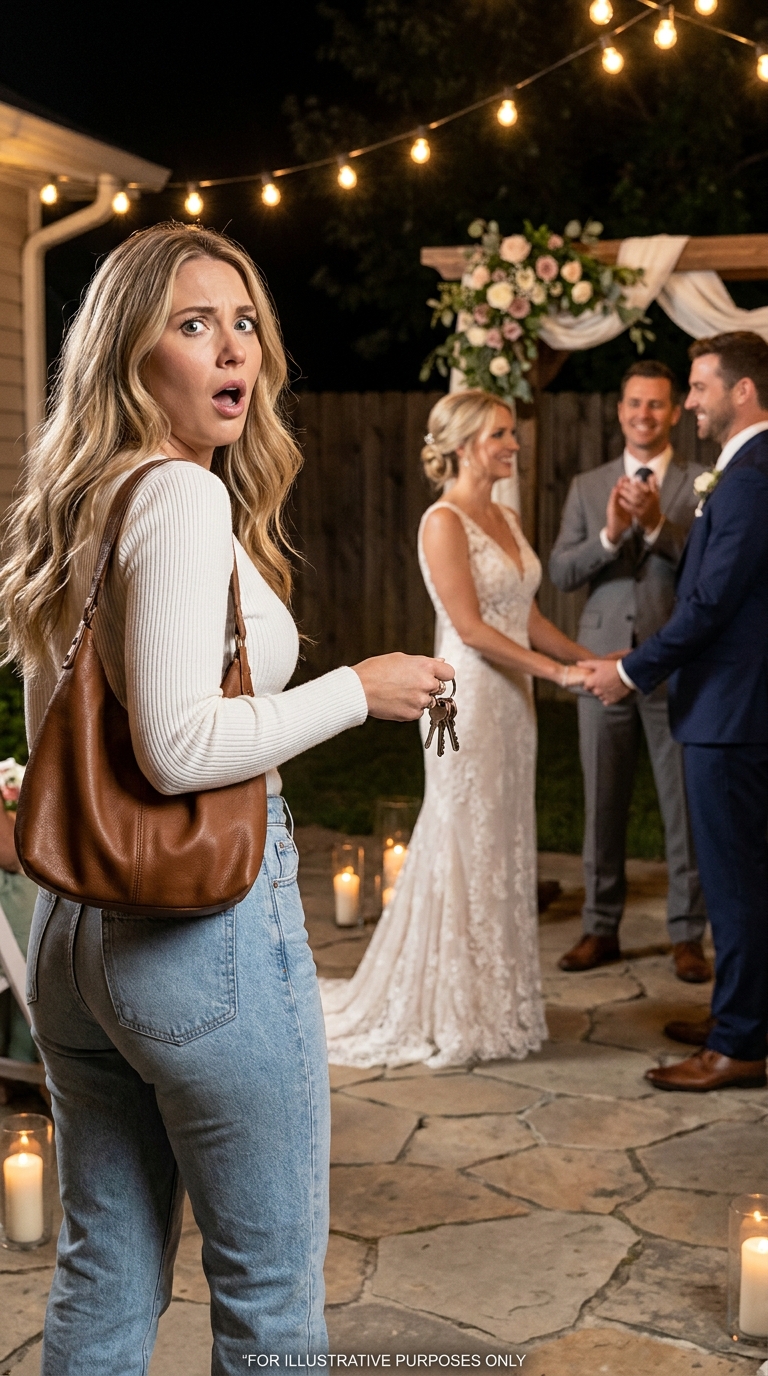
There was one second of silence.
Then Patricia said, “Do not touch anything. Do not sign anything. Do not let him speak to you alone unless your phone is recording. I’m coming.”
Outside, the guests murmured. Chairs scraped. Someone was crying. Someone else was whispering too loudly.
The back door opened.
Devon came in alone, tie loosened, face pale, words already spilling out before the door closed behind him.
“Tanya, listen. I know what this looks like, but I need you to hear me out. I was going to tell you. I swear I was going to tell you. This got complicated, and I didn’t know how to stop it, but what you and I have—”
I raised one hand.
He stopped.
“Get everyone out of my yard.”
“Tanya, please—”
“Right now.”
Something shifted in his face. He had prepared for tears. Maybe rage. Maybe pleading. He had not prepared for instructions.
He went back outside.
I stood at the kitchen window and watched the wedding collapse.
It took fifteen minutes.
Guests gathered purses, avoided my windows, and walked through my side gate in uncomfortable clusters. Rochelle stood near my rose bushes, her train dragging through the grass, arguing with someone I did not recognize. She looked toward the kitchen once.
I did not look away.
When the yard was empty, Minister Harold Banks knocked softly on the back door.
I opened it.
He stood there holding his Bible in both hands. “Tanya, I owe you an apology.”
“You knew whose house this was.”
His face crumpled slightly.
“You’ve eaten at this table,” I said. “You’ve asked me about my students in this kitchen.”
He swallowed. “Rochelle told me arrangements had been made.”
“And you believed that because it was convenient.”
He had no answer.
I closed the door.
Then I walked outside.
The arch still stood. The chairs sat crooked now, abandoned in rows. A bridal bouquet lay on the grass near the aisle, white roses tied with ribbon.
I picked it up.
For a moment, I just held it.
Then I walked to the trash bin by the gate and dropped it in.
Part 2
When I came back inside, Devon was sitting at my kitchen table like a man waiting to be sentenced.
I stood across from him.
“How long?” I asked.
He rubbed his jaw. “Tanya—”
“How long?”
His eyes shifted.
That was when the last soft part of me cracked clean down the middle. Not because of the cheating. Not even because of the wedding. Because he was still deciding how much truth I deserved.
“About a year,” he said.
A year.
A year of sleeping in my bed while building a life with my best friend. A year of kissing me goodnight with another woman’s perfume probably still in his car. A year of using my house like a storage unit for his lies.
I nodded once.
Not forgiveness.
Confirmation.
Patricia arrived forty-five minutes later with a folder, a laptop bag, and a new deadbolt still in its packaging.
She walked in, looked at Devon, and said, “You need to leave.”
Devon tried to stand taller. “This is between me and Tanya.”
Patricia set the folder on the counter. “Not anymore.”
He looked at me. “Baby, don’t do this.”
That word. Baby.
It sounded filthy in his mouth.
“My key,” I said.
He blinked.
“My house key, Devon.”
For a moment, I thought he would refuse. Then he reached into his pocket and placed it on the counter. The small metallic sound it made against the tile felt louder than all the wedding music combined.
He picked up his jacket and walked out with the clothes on his back.
I locked the door behind him.
Patricia and I installed the new deadbolt ourselves. It took forty minutes, one screwdriver, three wrong turns, and a tutorial by a man online who kept saying, “This part is easy,” when it was not. Patricia held the flashlight. I tightened the screws.
There is something holy about fixing a door after someone tried to turn your life into a hallway.
When the new lock clicked into place, I felt something settle inside me.
Mine.
Patricia made coffee and opened her laptop at the kitchen table.
“I found something before I came,” she said.
I sat down slowly.
“What kind of something?”
“The kind that means Devon has more problems than a ruined wedding.”
She turned the screen toward me.
At the top of a lease agreement were two names.
Devon Cross.
Rochelle Banks.
The address was for an apartment across town.
The date was fourteen months earlier.
Fourteen months.
My relationship had not been dying behind my back. It had been dead and staged for over a year. Devon had been coming to my house two or three nights a week to keep me from noticing he lived somewhere else. He had kept just enough clothes in my closet, just enough groceries in my fridge, just enough warmth in his voice.
“Two-bedroom apartment,” Patricia said. “Both names. Utilities connected. Furniture delivery receipts. This was not an affair. This was a household.”
I stared at the screen until the words blurred.
Then Patricia slid another page toward me.
My stomach tightened before I read it.
A retail credit application.
My name on the co-signer line.
A signature that looked almost like mine.
Almost.
But I knew my signature. I had signed the same way since eighth grade, with a loop in the T and a long crossbar that tilted left. This signature had studied mine, but it had not lived in my hand.
“I didn’t sign this,” I said.
“I know.”
“What did it pay for?”
Patricia’s voice stayed calm. “Furniture. Utilities. Around twenty-two hundred dollars.”
The room seemed to tilt.
The credit score I had protected for ten years. The money I saved by packing lunches, buying used cars, skipping vacations, paying every bill on time. He had used it to furnish a home with Rochelle.
“And the $3,800?” I asked.
Patricia looked at me with a softness I rarely saw on her face.
“Security deposit. First month. Some furnishings.”
I did not cry.
I wanted to. But the grief was so big it could not find an exit.
“There’s one more thing,” Patricia said.
She pulled up a change-of-address record. Six weeks earlier, Devon had listed my house as his primary residence with the DMV and one financial institution.
Six weeks earlier.
The same week I saw the white dress box in his trunk.
“He was preparing a residency claim,” Patricia said. “If this went badly, he could argue he lived here. Make removing him harder. Make you go through a legal process.”
I leaned back in my chair.
That was the moment heartbreak became something sharper.
Devon had not simply betrayed me.
He had prepared to trap me in the aftermath.
I looked toward the hallway, toward the door with the new deadbolt.
“What do we do?”
Patricia closed the laptop. “Tomorrow morning, we file a police report.”
Monday came gray and humid.
I wore black slacks, a cream blouse, and sensible flats, the clothes I wore to parent conferences when someone’s father came in angry and left embarrassed. Patricia arrived at seven-thirty with copies of everything. We were about to leave when my phone rang.
Rochelle.
I stared at her name.
Patricia looked up. “Record it.”
I did.
I answered without speaking.
Rochelle rushed into the silence.
“Tanya, I know you probably hate me right now, and I understand that. I do. I am so sorry. I never wanted you to find out like that.”
I closed my eyes.
Not I never wanted to hurt you.
I never wanted you to find out like that.
She kept talking, words tumbling over one another. She said she loved Devon. She said it had not been planned. She said emotions were complicated. She said I had always seemed so stable, so complete, so impossible to compete with.
That stopped me.
“Compete with?” I asked.
She inhaled. “You don’t understand what it’s like, Tanya. You always had everything. The house, the job, the respect. People look at you like you’re the good one. The safe one. I spent years feeling like the extra person standing next to you.”
“And Devon made you feel chosen.”
Silence.
Then, softly, “Yes.”
I almost laughed.
Not because it was funny.
Because the alternative was making a sound I might not recover from.
“Rochelle,” I said, “I was scared every day.”
“What?”
“Every day. That I wasn’t pretty enough in the way that gets noticed. That I wasn’t exciting enough. That people loved what I did for them more than they loved me. I was scared, too.”
She did not answer.
“I just didn’t let it make me cruel.”
She started crying then. I could hear it. A small, wet sound designed to pull me back into the role I had played for twelve years.
I did not go.
“You wore a wedding dress in my backyard,” I said. “You let your uncle stand under my lights and marry you to my boyfriend. You sent announcements with my roses in the pictures. Do not call me again unless it is through an attorney.”
“Tanya, please—”
I ended the call.
Nine minutes and fourteen seconds.
Patricia held out her hand. I forwarded the recording to her.
At the police station, a detective named Angela Morris reviewed the file without theatrics. She had tired eyes, neat braids, and the plain patience of a woman who knew the difference between drama and evidence.
The forged signature mattered. The credit account mattered. The financial trail mattered. The change-of-address paperwork mattered.
“This is identity fraud,” she said. “We’ll proceed.”
I signed the report with my real signature.
The one Devon had tried to steal and failed to understand.
By Wednesday evening, Devon was on my porch.
I saw him through the peephole before he knocked. No tie. No jacket. Sleeves rolled up like he had come to look humble.
I opened the door but did not step aside.
He smiled sadly. “Can we talk?”
“No.”
His smile weakened. “Tanya, I made the worst mistake of my life.”
“No, Devon. A mistake is forgetting milk. You created a second life.”
He looked down. “I was confused.”
“You were organized.”
That landed.
“I love you,” he said.
Once, those words would have opened every door in me. Now they just stood there uselessly, like a key to a house that had burned down.
“You signed a lease with Rochelle fourteen months ago,” I said. “You used my loan for your apartment. You forged my name on a credit application. You changed your address to my house so you could make yourself hard to remove.”
His face changed with each sentence.
Not because he was ashamed.
Because he realized I knew.
“Patricia will send your attorney the amount you owe. The loan, the credit damage, filing fees, legal costs. You will sign a document relinquishing any residency claim to this address permanently.”
“Tanya, if we could just handle this privately—”
I closed the door.
Through it, he said my name once.
I did not answer.
The next day, I called the human resources department at Devon’s company. I kept my voice calm and factual. I informed them that my name had been used as a professional reference without my knowledge and that Devon Cross was connected to an active fraud report. I did not insult him. I did not exaggerate. Truth, I was learning, did not need decoration.
Patricia later told me his promotion review had been paused.
I did not celebrate.
I simply slept better that night.
As for Rochelle, I did not call the school district. I did not spread rumors. I did not need to.
She had mailed the evidence herself.
Wedding announcement cards had gone out before the ceremony. Thick paper. Glossy photos. Devon and Rochelle smiling under my string lights, standing in front of my rose bushes, inside my fence.
People recognized the yard.
Teachers recognized it. Church members recognized it. Neighbors recognized it. The story traveled not like gossip, but like weather. Quietly at first, then everywhere.
Minister Harold Banks was removed from three upcoming weddings and the spring revival schedule. Dorothy, who claimed she was “too old for mess,” somehow knew every deacon within a fifty-mile radius and had made exactly four calls.
“I didn’t say anything ugly,” she told me.
“I’m sure.”
“I only asked questions.”
That was Dorothy’s specialty. Questions sharp enough to cut rope.
Devon’s attorney contacted Patricia within the week.
He wanted to negotiate.
Patricia laughed once when she told me, not because it was funny, but because some men still believed accountability was a starting offer.
On day twenty-nine, the cashier’s check arrived.
Exact amount.
No note.
I deposited it at my bank on a Thursday afternoon. The teller smiled, stamped the receipt, and handed it back like it was any other transaction.
That was how that chapter ended.
Not with thunder.
With a number moving back where it belonged.
Part 3
I met Rochelle one last time because I needed to look her in the face and say what I had spent two weeks saying to the ceiling.
We chose a coffee shop near my school, one where the barista knew my order and nobody knew hers. That was not accidental. I had spent twelve years meeting Rochelle in the center of her storms. This time, she could step into my weather.
I arrived early, sat in the back corner with my coffee, and waited.
She came in seven minutes late.
Of course she did.
She looked smaller than I remembered. Not physically. Rochelle was still beautiful, still polished, still wearing earrings that caught the light. But something about her had folded inward. She sat across from me and put both hands around her cup without drinking.
“I know I hurt you,” she said.
“Yes.”
Her eyes filled immediately. “I don’t even know how to explain it.”
“Try.”
She swallowed. “I was jealous of you.”
There it was.
Twelve years hiding in four words.
“You made everything look easy,” she said. “Your house, your classroom, your family. People trusted you. Men respected you. I always felt like I was chasing something you already had.”
I looked at her carefully. “And that made you feel entitled to take from me?”
“No.” She shook her head fast. “No, not entitled. Just… Devon saw me. He chose me.”
“He was living in my house while he chose you.”
Her cheeks flushed.
“I know.”
“Did you?”
She started to cry. This time, I did not hand her a napkin.
“I kept thinking he would tell you,” she whispered. “Then he kept saying it wasn’t the right time. And then the wedding got close, and I thought after it was done, everyone would just have to accept it.”
I leaned back.
That sentence was the cleanest thing she had given me.
There was no love story in it. No destiny. No uncontrollable passion.
Just a plan to injure me so completely that I would be too tired to object.
“I want you to hear me,” I said.
She looked up.
“I was not fearless. I was not complete. I was not some woman standing above you with everything figured out. I was lonely. I was insecure. I was tired. I wondered all the time if I was too plain, too practical, too easy to leave.”
Her face crumpled.
“But I loved you,” I said. “And when I felt small, I did not punish you for standing near me.”
“Tanya—”
“No. You don’t get to interrupt this part.”
She closed her mouth.
“You didn’t take Devon because he was better. You took him because he was available to the worst part of you. And he took you because you made his selfishness feel romantic.”
The coffee shop hummed around us. Milk steamed. A chair scraped. Someone laughed near the window. Ordinary life continued, which felt both cruel and comforting.
“I’m not here to forgive you,” I said. “I’m here to return you to yourself. What you do with that is not my responsibility anymore.”
I stood.
She reached for my hand.
I stepped back.
That small movement did what a thousand speeches could not. Her hand hung there for a second, then dropped.
I walked out and did not look back.
For weeks after that, pieces of news found me without my asking.
Rochelle was no longer invited to Friday lunches. The group texts quieted around her. Parents who once greeted her warmly at school pickup now gave her polite, distant smiles. She still had her job. She still had her life. But she no longer had the soft protection of being seen as harmless.
Devon’s life narrowed, too.
His promotion disappeared. Two business contacts pulled away. His apartment with Rochelle became, according to a mutual friend who did not know when to stop talking, unbearable. Trust was hard to build inside a relationship founded on deception. Who could have guessed?
They split before summer.
When I heard, I was standing in the grocery store holding a bag of apples.
My friend said, “Did you hear Devon and Rochelle are done?”
I looked at the apples.
One had a bruise near the stem.
“No,” I said.
“You okay?”
I put the bruised apple back. “Yes.”
And I was.
That surprised me more than anything.
I expected satisfaction. Maybe relief. Maybe the sharp sweetness people call revenge. Instead, there was only space. Clean, empty space where pain used to sit.
I went home and made dinner.
Life did not become beautiful all at once.
That is not how healing works, no matter what people write on throw pillows.
For a while, I moved through my house like I was meeting every room again. The kitchen where Devon begged. The hallway where I heard his footsteps leave. The backyard where Rochelle stood in white. Some mornings I woke up angry enough to shake. Some nights I missed the man I thought Devon was, which made me furious with myself until Dorothy reminded me grief is not a receipt you can return just because the product was defective.
“You loved the version he sold you,” she said over the phone. “That love was real on your end. Don’t let his fraud make you ashamed of your honesty.”
Dorothy had a way of saying things that made arguing feel childish.
So I stopped trying to heal prettily.
I cried when I needed to. I changed the locks on every side door. I froze my credit. I met with a financial counselor Patricia recommended. I pulled Devon’s things from my closets and boxed them without ceremony. Patricia drove them to his attorney’s office because she said if Devon wanted closure, he could find it in a cardboard box next to a receptionist.
In May, I took down the last of the wedding lights.
Then I put them back up differently.
Lower.
Warmer.
Closer together.
Devon had always said the old arrangement looked more “open for entertaining.” I realized I had been arranging my own backyard for guests who never stayed to clean up.
Now I arranged it for me.
I bought two Adirondack chairs, a small firepit, and a clay planter shaped like a sleeping fox because it made me smile in the store. I planted lavender near the steps. I cut the roses back hard even though it scared me. The gardening videos said roses needed pruning to grow stronger.
I trusted the roses.
By August, my tutoring program started.
It had been an idea I kept postponing for years. After-school reading support for kids who were slipping quietly through the cracks, the ones whose parents worked late or did not answer emails or could not afford private help. I had always told myself I was too busy, too tired, too financially stretched.
Then my life burned down and I discovered how much time I had been spending maintaining someone else’s lies.
Fourteen students came the first Thursday. A local nonprofit donated supplies. My principal gave me the old science room and told me she was proud of me in a voice that nearly broke me. The children ate granola bars, argued over pencils, and read out loud with the shy courage that makes teaching worth every bad meeting and broken copier.
I drove home exhausted every Thursday night.
The good kind of exhausted.
The kind that means you spent yourself on something that deserved you.
In September, I painted the backyard fence terracotta.
The paint color was called Tuscan Ember, which sounded ridiculous and perfect. Devon had once told me warm colors made small spaces feel loud. I rolled the first stripe across the fence and laughed out loud.
Good, I thought.
Let it be loud.
Let everything that survived me be loud.
Dorothy introduced me to a man in October. His name was Aaron Miller, a high school history teacher from a town forty minutes south. I told her I was not ready. She said she was not asking me to marry him, only to eat food near him.
Aaron was quiet, but not empty. There is a difference. He listened without waiting for his turn to be impressive. At dinner, he told me a story about accidentally teaching an entire lesson with his shirt inside out, and I laughed so hard I had to put my fork down.
He did not ask about Devon.
I appreciated that.
Later, when I did tell him a little, he did not say he would never hurt me. Men say that too easily. Instead, he said, “I’m sorry someone made your home feel unsafe.”
That was the first sentence a man had said to me in months that did not require me to shrink.
We took things slowly.
Slowly was nice.
By November, the house felt like mine again.
Not the way it had on the first night with the air mattress and my grandmother’s quilt. That version of mine had been hopeful, innocent, untested. This was different. Stronger. The kind of mine that had been challenged and had answered.
On a Thursday evening, I sat at my kitchen table grading essays while a cedar candle burned on the counter. Outside, the terracotta fence glowed under the porch light. The rose bushes had new growth, stubborn and green, reaching out from the places I had cut them back.
I thought about the woman I had been in the doorway that day, overnight bag on her shoulder, watching betrayal happen under her own lights.
I wanted to reach back to her.
Not to warn her. It was too late for warning.
I wanted to tell her she would not collapse the way they expected.
I wanted to tell her that silence could be power. That a closed door could be mercy for yourself. That sometimes the most dramatic thing a woman can do is refuse to perform her pain for people who came dressed to celebrate it.
My phone buzzed.
A text from Dorothy.
You eating?
I smiled.
Yes, ma’am.
A second later, she replied.
Don’t lie to old women.
I got up, warmed leftovers, and ate standing at the counter, looking out at the backyard.
My backyard.
My string lights.
My roses.
My fence painted the color I wanted.
Some things become yours when you buy them. Some become yours when you build them. And some only become fully yours after someone tries to take them and fails.
I turned off the kitchen light and stood for a moment in the soft glow from outside.
For the first time in a long time, the house was quiet without feeling empty.
I locked the door.
The deadbolt slid into place with a solid, beautiful click.