Julian stared at the ring as though it had risen from a grave.
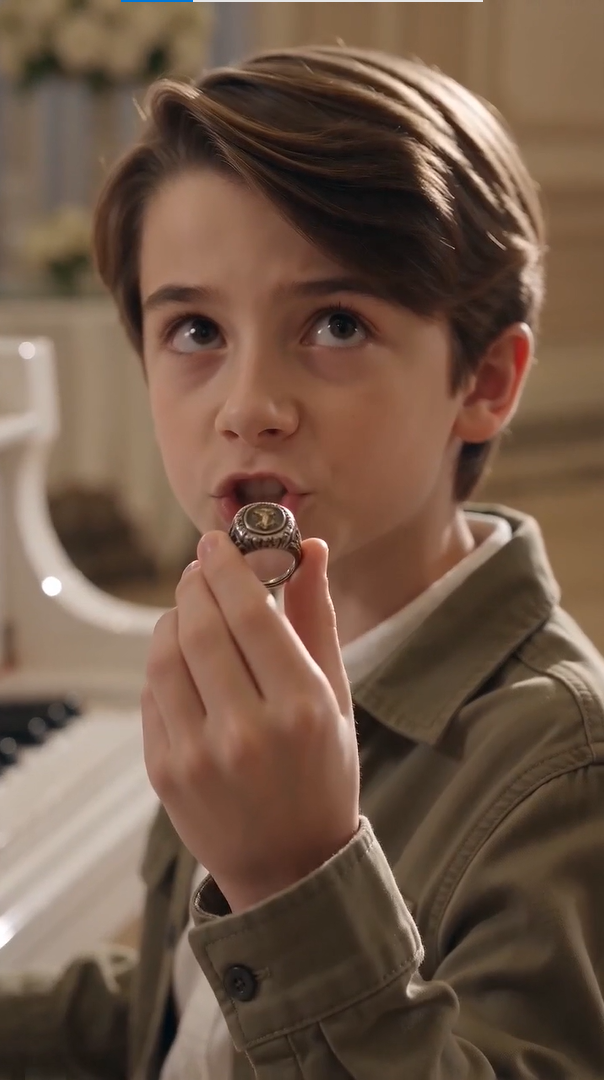
It carried the Ashford family crest, a tiny carved swan beneath a blue stone.
He had given it to Isabel eighteen years earlier, on the night he promised he would marry her despite his family’s rage.
Isabel had been a music tutor in his father’s house.
Poor, gentle, and pregnant with his child.
Then came the fire.
Celeste, his childhood friend, had been the one to find him afterward. She brought him a burned blanket and told him Isabel and the baby had not survived.
Julian had married her years later, believing grief was the only love he had left.
Now a starving boy sat at his piano wearing Isabel’s eyes.
Julian picked up the ring with shaking fingers.
“What is your name?”
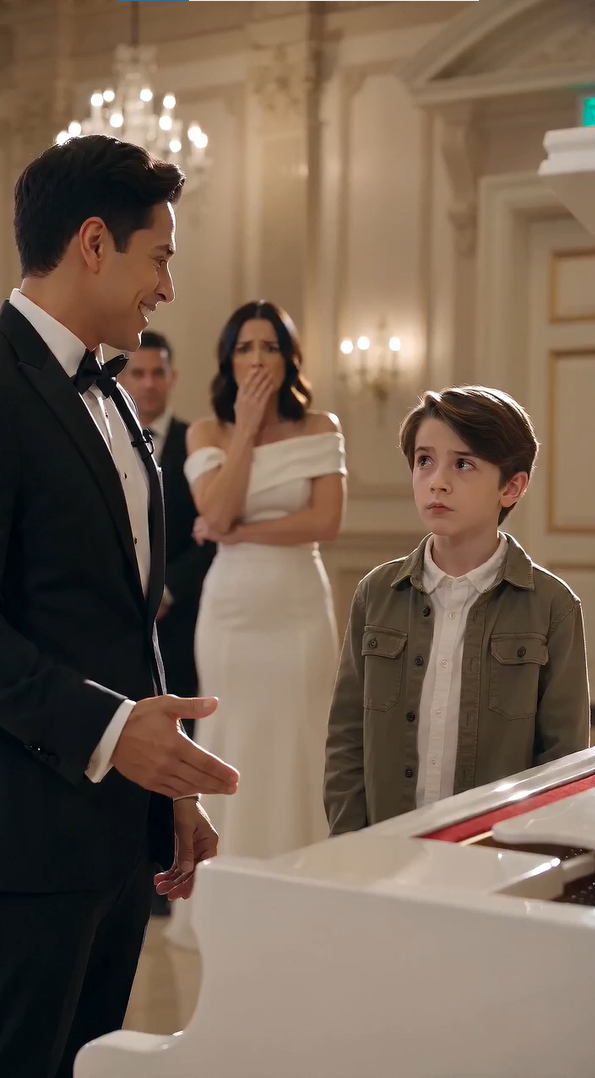
“Leo.”
His breath broke.
That was the name he and Isabel had chosen for their baby.
Celeste stepped forward sharply.
“Julian, this is a trick. A street boy found a stolen ring and memorized a melody from somewhere.”
Leo’s face tightened with hurt.
“My mother never stole anything.”
Julian turned toward his wife.
“How would he know the song?”
Celeste’s red lips parted.
No answer came.
Leo reached into his jacket again and removed a folded letter, its paper creased and stained at the edges.
“She wrote this when she got too sick to work,” he said. “She told me not to come here unless she died, because the woman in this house would hurt me too.”
A murmur swept through the guests.
Julian took the letter.
He recognized Isabel’s handwriting before he read a single word.
My beloved Julian, if our son reaches you, then I have failed to keep carrying the truth alone.
His knees weakened.
The fire did not kill me. Celeste locked the nursery door after taking our baby, believing I would die inside. I escaped through the servant stairwell and found Leo before she could send him away. When I tried to reach you, she showed me your wedding announcement and promised that if I spoke, our child would disappear forever.
Julian’s face crumpled.
He looked up at Celeste, barely able to breathe.
“You set the fire?”
Celeste backed away.
“Isabel was going to take everything from me!”
The room erupted in shocked gasps.
Leo flinched at her voice and gripped the piano bench.
Celeste’s composure collapsed into fury.
“You loved a nobody. You were going to ruin your name for a servant girl and a child no one wanted!”
Julian crossed the room so slowly that Celeste stepped back with every movement.
“I wanted them.”
His voice broke.
“I spent eighteen years mourning them.”
Leo stared down at the keys, tears dropping silently onto his hands.
“My mother said you might not believe me,” he whispered. “She said rich people are good at forgetting poor people.”
Julian turned toward him, devastated.
“No, Leo.”
But the boy’s pain had finally found words.
“She cleaned floors while she was sick. She skipped meals so I could eat. And every night, she played your song on a broken keyboard and told me my father would have loved me if he knew I was alive.”
Julian covered his mouth, sobbing now.
Celeste rushed toward the door.
Two guests blocked her before she could escape.
Julian did not even look at her again.
He crossed to the piano and slowly knelt beside the boy.
Up close, he could see the cracked skin on Leo’s fingers, the hollow tiredness beneath his eyes, the small silver scar at his brow, the same mark his newborn son had carried in Julian’s memories, now grown into the face of the child Isabel had protected in secret.
“I should have found you,” Julian cried.
Leo looked at him through wet lashes.
“Mom waited for you.”
Those words broke him completely.
Julian lowered his forehead onto the boy’s dirty hand.
“I am sorry. I am so sorry.”
Leo did not move for a long moment.
Then his small voice trembled.
“She died thinking she wasn’t enough for you.”
Julian lifted Isabel’s ring and pressed it against his heart.
“She was the best part of my life.”
The boy began to cry openly now.
“I don’t have anywhere to go tonight.”
Julian reached for him carefully, giving him time to pull away.
Leo did not.
He collapsed into his father’s arms with a sob so raw that the entire hall fell silent.
Julian held him against his tuxedo, one hand cradling his tangled hair, the other gripping the ring and the letter that had returned his son too late to save the woman he loved.
“You are coming home with me,” he whispered.
Leo pulled back just enough to look at him.
“Can I bring Mom’s keyboard?”
Julian closed his eyes, tears pouring freely.
“We will bring everything she touched.”
Behind them, Celeste was led from the glittering hall she had spent eighteen years ruling through a lie.
Julian sat at the white piano with Leo beside him.
The boy’s hand trembled as he touched the keys again.
“Mom always stopped before the ending,” he whispered. “She said only you knew it.”
Julian placed his hand beside his son’s.
Together, they played the final notes Isabel had waited her whole life to hear again.
And beneath the golden chandeliers, the poor child everyone had laughed at finished his mother’s song in the arms of the father she had never stopped loving.
When the final note faded, nobody clapped.
Not because the music was not beautiful.
Because it was too painful to turn into applause.
The guests stood frozen beneath the chandeliers, with champagne glasses in their hands and shame in their eyes.
They had laughed when Leo first sat at the piano.
They had whispered about his torn coat.
They had watched Celeste smile as if a hungry child was entertainment.
Now they stared at him like the whole Ashford mansion had become a courtroom.
Julian kept his arm around Leo.
The boy was trembling so hard his shoulder shook against Julian’s chest.
A guard appeared near the doorway.
Then another.
Celeste’s voice rose from the hall outside.
“Take your hands off me! I am Mrs. Ashford!”
Julian closed his eyes at the name.
Mrs. Ashford.
For years, he had given that name to a woman who had burned the life he should have had.
He turned toward the closest guard.
“Do not let her leave.”
The guard nodded.
One of the older guests, Lord Harrow, stepped forward, his face pale.
“Julian, this is serious. We should call the authorities.”
Julian looked at him.
“No,” he said. “We should have called them eighteen years ago.”
The words cut through the room.
Several people looked away.
They remembered Isabel.
Of course they did.
They remembered the young music tutor with soft hands and a voice like rain on glass. They remembered how she used to walk quietly through the Ashford halls carrying sheet music against her chest. They remembered how Julian had looked at her, as if all the money in the world had become useless beside one smile.
And they remembered how easily they had believed she was gone.
How easily they had accepted the story.
Poor girl.
Tragic fire.
Ashford scandal avoided.
Now her son sat at the piano in borrowed light, proving that silence had been a crime too.
Leo wiped his face quickly, embarrassed by his tears.
Julian saw it and gently caught his wrist.
“You do not have to hide that here.”
Leo’s lips trembled.
“Mom said crying in rich houses makes people uncomfortable.”
Julian’s breath broke.
“Then let them be uncomfortable.”
The boy looked at him.
Something passed between them.
Not trust.
Not yet.
Trust was too big for one night.
But something smaller.
A thread.
A beginning.
Sirens sounded in the distance.
Leo stiffened.
Julian felt it instantly.
“What is it?”
Leo shook his head.
“Nothing.”
Julian lowered his voice.
“Leo.”
The boy swallowed.
“When sirens came in our street, Mom made me hide under the bed. She said if anyone asked, my name was not Leo.”
Julian closed his eyes.
Every detail was another wound.
Every habit in this child was proof of what Isabel had endured alone.
“You will never have to hide your name again,” Julian whispered.
Leo stared at the piano keys.
“What if she comes back?”
“Celeste?”
Leo nodded.
Julian looked toward the door.
“She cannot hurt you now.”
Leo’s face hardened with a pain too old for his age.
“People always say that after someone already has.”
Julian had no answer.
So he did not lie.
“You’re right,” he said softly. “Then I will say something else. I will stay close. I will listen. And if you are afraid, you can tell me.”
Leo looked at him carefully.
As if those words sounded strange.
As if nobody had ever offered him fear without punishment.
The police arrived minutes later.
The music hall filled with uniforms.
Statements were taken.
The letter was sealed in an evidence bag.
The ring was photographed.
Guests spoke in low voices, some eager to help now that helping cost them nothing.
Celeste stood near the marble doorway between two officers, her face stripped of its elegance.
She was still beautiful.
That almost made it worse.
Evil did not always arrive with a twisted face.
Sometimes it wore pearls.
Sometimes it married the grieving man.
Sometimes it sat at the head of the table for eighteen years and smiled at the portrait of the woman it had tried to erase.
When an officer asked Celeste if she wanted to make a statement, she lifted her chin.
“That letter proves nothing.”
Leo flinched at her voice.
Julian stood at once.
Celeste looked past the officer and fixed her eyes on him.
“Julian, think. Think about what you’re doing. This child could be anyone.”
Julian picked up Isabel’s ring and held it toward her.
“You know this ring.”
Her face tightened.
He stepped closer, but stopped before the officers could stop him.
“You brought me a burned blanket. You told me Isabel died. You told me our baby died. You stood beside me at a funeral with an empty coffin and held my hand.”
Celeste’s eyes flashed.
“I held you together.”
“No,” Julian said. “You held the lie together.”
Her face twisted.
“You would have thrown everything away for her.”
Julian’s voice fell.
“I should have.”
The room went quiet.
Celeste stared at him like those three words were worse than any arrest.
“I was your equal,” she whispered.
He shook his head.
“You were near me. That is not the same.”
Her mouth opened.
No words came.
For once, there was no clever answer.
No polished cruelty.
No smile sharp enough to cut.
Only the truth, standing behind Julian in a torn coat.
The officers led her out.
This time, she did not shout.
She looked back once.
Not at Leo.
Not at the letter.
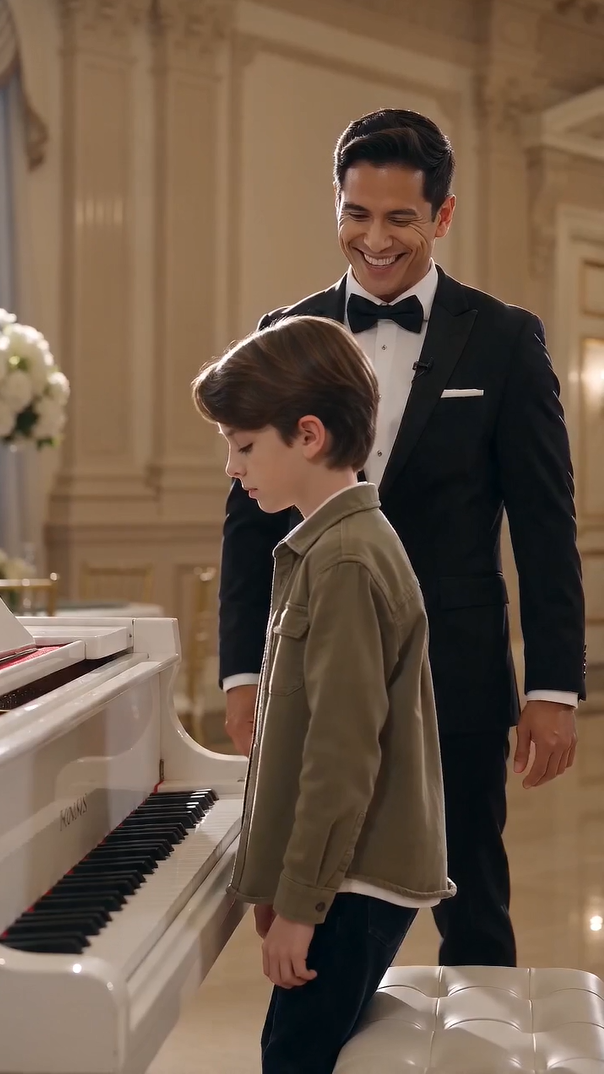
At the piano.
The white piano Isabel used to play during summer evenings while Julian pretended to read and listened to every note.
Celeste had hated that piano.
Julian realized it now.
She had never once touched it.
The door closed behind her.
The hall finally breathed.
Julian turned back to Leo.
The boy looked smaller now.
Exhausted.
His courage had carried him into the mansion, through the song, through the confession.
Now it was leaving him.
“Are they going to take me somewhere?” Leo asked.
Julian knelt again.
“No.”
“They always ask where my guardian is. I don’t have one anymore.”
Julian’s face crumpled.
“You have me.”
Leo looked down.
“You just met me.”
“No,” Julian whispered. “I lost you eighteen years ago. I just found you tonight.”
Leo’s eyes filled again.
He tried to hold it back.
Failed.
Julian opened his arms slowly.
The boy stepped into them.
This time, he stayed longer.
Long enough for the guests to understand that the Ashford heir had not returned wearing silk or a family crest.
He had returned hungry, grieving, and holding his mother’s last letter.
Later that night, Julian took Leo to the small room where Isabel had once taught music.
The room had not been used in years.
Celeste had closed it after their wedding, saying it held too much sadness.
Julian had let her.
Now he hated himself for it.
Dust covered the shelves.
Old sheet music sat in a cabinet.
The window faced the garden where Isabel used to stand after lessons, waiting for Julian to pass by so they could steal five minutes of ordinary happiness.
Leo stood at the doorway and did not enter.
Julian looked back.
“What is it?”
The boy’s voice was small.
“Did she stand here?”
Julian nodded.
“Yes.”
Leo touched the doorframe.
“My mother used to describe this room.”
Julian’s heart twisted.
“She remembered it?”
Leo looked around.
“She said the windows were tall and the floor creaked near the piano stool.”
Julian walked to the old rug and pressed his foot down.
A soft creak answered.
Leo’s face broke.
“She was right.”
He stepped inside then.
Slowly.
Like entering a memory that did not belong to him but had been handed down through hunger and song.
Julian opened a cabinet and pulled out a faded book of music.
Isabel’s handwriting filled the margins.
Small notes.
Finger marks.
Corrections.
A tiny heart beside one unfinished melody.
Leo came closer.
“That’s her writing.”
Julian nodded.
“She used to correct me in the margins.”
Leo looked at him.
“You played badly?”
Julian laughed through tears.
“Terribly.”
For the first time, Leo almost smiled.
It was small.
Barely there.
But Julian saw it.
And that tiny almost-smile felt like more mercy than he deserved.
A footman appeared at the door.
“Sir, the police are asking if the boy needs medical attention.”
Julian looked at Leo.
The boy immediately stiffened.
“I’m fine.”
His face said he was used to saying that.
Julian crouched.
“When did you last eat?”
Leo looked away.
“I had bread yesterday.”
Julian closed his eyes.
Yesterday.
He forced himself to keep his voice gentle.
“Then we start with food. Then a doctor. Then sleep.”
Leo’s eyes darted to him.
“Will I have to sleep alone?”
Julian’s chest tightened.
“No. I can sit outside your room. Or inside it. Or wherever you want.”
Leo looked embarrassed.
“I’m not a baby.”
“No,” Julian said. “You’re a boy who had a terrible night.”
Leo looked at the floor.
“My whole week was terrible.”
Julian swallowed.
“Then we will not measure courage by whether you can sleep alone.”
The boy looked at him again.
That thread between them grew another inch.
In the kitchen, the staff moved quietly, shocked into tenderness.
No one asked Leo too many questions.
A cook placed soup in front of him, then bread, then warm milk.
Leo stared at the food.
Julian sat beside him.
“It’s yours.”
Leo nodded but did not touch it.
Julian waited.
Finally, the boy picked up the bread and slipped half into his coat pocket.
Julian saw it.
His throat closed.
He pretended not to.
Leo ate slowly, guarding the bowl with one hand, as if someone might take it if he looked away.
The cook turned her face to the stove and wiped her eyes with her apron.
Julian watched his son eat soup like a survivor and hated every chandelier in the house.
All of it had stood here for eighteen years.
The gold.
The crystal.
The polished floors.
The silver candlesticks.
And while it shone, Isabel had been cleaning floors to buy medicine.
His son had been hiding bread in his pocket.
After the doctor examined Leo, he spoke to Julian privately in the corridor.
“He is undernourished,” the doctor said carefully. “Not beyond recovery, but serious. Exhaustion, untreated chest infection, old injuries. His hands show strain from work and cold exposure.”
Julian leaned against the wall.
Old injuries.
Work.
Cold exposure.
Words too clean for a child’s life.
“Can he stay here tonight?”
“Yes. But he needs steady food, warmth, follow-up care, and emotional support. I would also recommend a legal guardian be appointed immediately.”
Julian looked through the open door.
Leo was sitting on the edge of the bed in a guest room, holding Isabel’s letter like it was the only thing keeping him in place.
“I am his father.”
The doctor’s face softened.
“Then start by being steady.”
Steady.
Not dramatic.
Not loud.
Not grand.
Steady.
Julian nodded.
That night, Leo slept in a room larger than any place he had ever lived.
He did not sleep in the bed at first.
Julian found him curled on the rug beside it.
The blanket was pulled around his shoulders.
His boots were still on.
The bread from dinner was hidden under his pillow.
Julian stood in the doorway, pain burning behind his ribs.
He did not wake him.
He sat in the chair near the door and stayed there until morning.
Every time Leo startled awake, Julian was there.
Every time the boy’s eyes searched the room in panic, Julian said softly, “You’re safe. I’m here. Your name is Leo Ashford. No one is taking you.”
The first time, Leo said nothing.
The second time, he whispered, “Ashford?”
Julian’s eyes filled.
“If you want it.”
Leo turned his face toward the pillow.
“I don’t know.”
“That’s all right.”
The boy was quiet for a long time.
Then he asked, “What was her name here?”
“Your mother?”
Leo nodded.
Julian’s voice softened.
“Isabel Vale.”
Leo closed his eyes.
“She kept your name from me, but not hers.”
“What do you mean?”
“She used to say, ‘Your father lives in a house full of swans, but your mother comes from a valley. Remember both, Leo. A bird needs sky, but it also needs ground.’”
Julian covered his mouth.
Isabel.
Even in hiding, even in fear, she had given their son a language for belonging.
He leaned forward.
“She was always better than all of us.”
Leo opened his eyes.
“She said you were kind.”
Julian looked down.
“I was not kind enough.”
“She said you were young.”
“That is not the same as innocent.”
Leo looked at him for a long time.
Then he whispered, “She still loved you.”
Julian wept silently in the chair.
The next morning, sunlight moved across the room.
Leo woke to find Julian still there.
He sat up slowly.
“You stayed?”
Julian’s body ached, but he smiled.
“Yes.”
“All night?”
“Yes.”
Leo touched the bread under the pillow, then looked ashamed.
Julian shook his head gently.
“You can keep it there if you need to.”
The boy blinked.
“You’re not angry?”
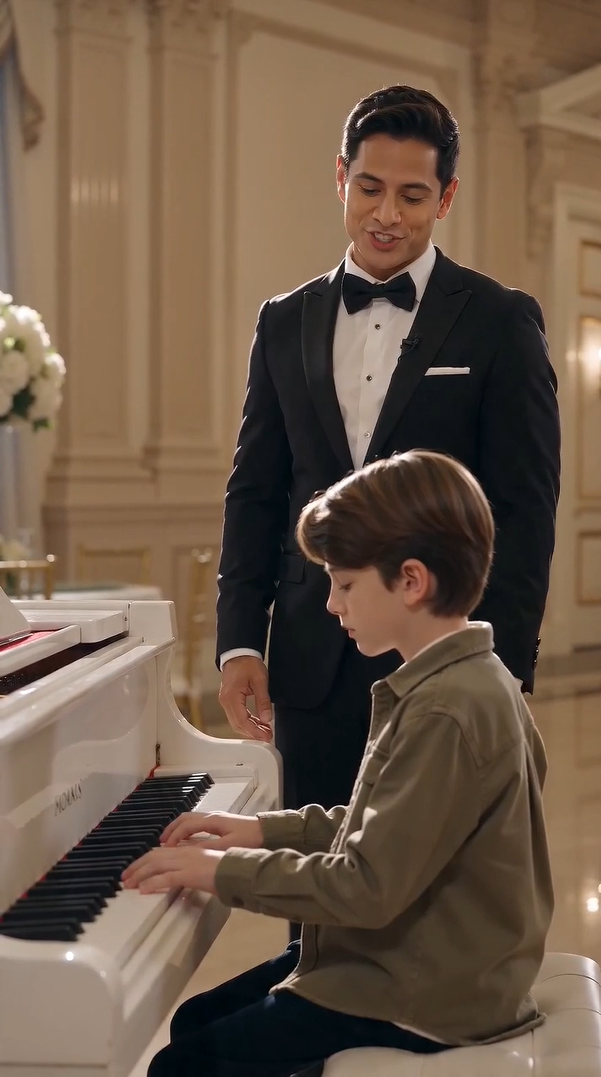
“No.”
“People get angry when you take extra.”
Julian stood slowly and walked to the small table by the window.
He placed a basket there.
Bread.
Fruit.
Biscuits.
Wrapped cheese.
“This basket stays here,” he said. “No one will touch it unless you want them to. You do not have to ask.”
Leo stared at the basket.
His eyes filled, but he turned away fast.
“I’m not hungry.”
Julian nodded.
“All right.”
A few minutes later, while Julian pretended to look through a drawer, Leo took an apple.
That was the first small victory.
The second came when he removed his boots before breakfast.
The third came when he asked where Isabel’s keyboard was.
Julian had sent men with Leo’s directions before dawn.
By noon, they returned with two trunks, a small wooden box, a folded blanket, and the broken keyboard.
Leo ran to it before he remembered to be careful.
He touched the cracked keys.
“They brought it.”
Julian stood behind him.
“I said we would bring everything she touched.”
Leo looked at him.
“People say things.”
Julian nodded.
“They do.”
“But you did it.”
Julian could barely speak.
“Yes.”
The trunks were carried to Isabel’s old music room.
Leo opened them himself.
Inside were simple dresses, worn shoes, medicine bottles, folded letters, and stacks of handwritten music.
One small notebook fell open.
Julian recognized the melody.
Their melody.
The one Isabel had played the night he gave her the ring.
On the first page, she had written:
For Julian, if he ever hears the truth.
Leo sat on the floor with the notebook in his lap.
“She wrote your name a lot.”
Julian sat across from him.
“I wrote hers too.”
“Where?”
Julian hesitated.
Then he stood and walked to the wall beside the window.
He pressed the corner of an old wooden panel.
It shifted.
Leo stared as Julian opened a hidden compartment and pulled out a small box.
Inside were Isabel’s old notes.
A dried violet.
A ribbon from her hair.
A tiny folded paper with Leo’s name written in both their handwriting, long before he was born.
Julian handed it to him.
Leo touched the paper as if it might crumble.
“You kept it?”
Julian nodded.
“I thought it was all I had left.”
Leo’s lip trembled.
“Mom thought you forgot.”
Julian closed his eyes.
“I never forgot.”
Leo looked down.
“She didn’t know.”
“I know.”
The worst part was not that Isabel had died.
It was that she had died believing the lie had won.
That evening, Julian stood before the portrait gallery.
The Ashford ancestors stared down in oils and gold frames.
Men with cold eyes.
Women with pearls.
Generations of wealth watching him like judges.
At the center of the hall hung Celeste’s portrait.
Elegant.
Perfect.
False.
Julian ordered it removed.
The staff froze.
He looked at them.
“Take it down.”
No one argued.
When the wall was empty, Julian carried Isabel’s small framed photograph from the music room and hung it there himself.
It was not grand.
It was a simple picture taken in the garden, Isabel laughing at something outside the frame.
The frame looked too small against the huge wall.
Julian stepped back.
Leo stood beside him, holding the blue-stoned ring.
“It looks lonely,” the boy whispered.
Julian nodded.
“Then we’ll add more.”
“What?”
“Her music. Her story. Her name.”
Leo looked up.
“People will know?”
Julian’s voice shook.
“Everyone will know.”
The truth began moving through the city by morning.
Not as gossip.
As evidence.
Celeste was arrested.
The old fire records were reopened.
A retired servant came forward after seeing Isabel’s photograph in the paper.
Then another.
Then a former stable boy, now an old man, admitted he had seen Celeste near the nursery with a lantern that night.
A nurse from a charity clinic brought records showing Isabel had arrived after the fire with burns on her hands and a newborn in her arms.
Letters Isabel had tried to send Julian were found in a solicitor’s storage box, unopened, returned after Celeste claimed Julian wanted no contact.
Every document was another ghost stepping into daylight.
Julian read them all.
Every line.
Every date.
Every place where Isabel had reached for him and been blocked.
Leo sat near him sometimes, silent.
Other times he left the room and went to the kitchen, where the cook had started keeping broth warm at all hours.
Healing did not arrive like a grand ending.
It came in fragments.
Leo learning that he could sleep with the lamp on.
Leo taking two slices of bread and not hiding either.
Leo asking if the piano was really his to play.
Leo flinching when doors slammed.
Leo waking from nightmares and calling, “Mom,” then looking ashamed because Isabel was gone.
The first time it happened, Julian came running.
Leo was sitting up in bed, shaking.
“I forgot,” the boy whispered.
Julian sat beside him.
“You forgot what?”
“That she died.”
Julian’s chest tore open.
He wanted to say something wise.
Something fatherly.
Nothing came.
So he said the only truth he had.
“I forget too.”
Leo looked at him.
“You didn’t see her die.”
“No,” Julian whispered. “But I woke every morning for eighteen years and remembered wrong.”
Leo stared at him.
Then, slowly, he leaned against Julian’s side.
Not all the way.
Just enough.
Julian stayed still.
He would have let his own bones ache for hours before disturbing that small act of trust.
The funeral for Isabel was held three weeks later.
Not the false funeral from eighteen years ago.
A real one.
No empty coffin.
No lies.
No Celeste standing beside him in black silk.
This time, Isabel’s ashes were brought from the small charity cemetery where she had been buried under a misspelled name.
Leo had found the grave himself two days after she died.
He had placed stones around it so he could find it again.
Julian almost collapsed when he saw it.
Isobel Vail.
Wrong letters.
Wrong name.
Wrong life.
He paid for the stone to be replaced, but Leo stopped him before the workers removed it.
“Can we keep part of it?” he asked.
Julian looked at him.
“Why?”
Leo touched the old stone.
“Because she was alone here. I don’t want to pretend she wasn’t.”
So a small piece of the original stone was placed beside the new grave.
The new headstone read:
Isabel Vale
Beloved Mother
Beloved Composer
Beloved Beyond Lies
On the day of the service, half the city came.
Some came because they had loved her music.
Some came because they were ashamed.
Some came because scandal pulls people the way fire does.
Leo stood beside Julian in a borrowed black suit.
It did not fit perfectly.
He refused to let anyone fuss over it.
Julian held the blue-stoned ring in his hand.
Leo held the old keyboard ribbon Isabel had tied around the broken handle.
When it was time to speak, Julian walked to the front.
For a long moment, he could not look at the crowd.
Then he looked at Leo.
His son stood there, thin and brave, carrying the last eighteen years in his eyes.
Julian began.
“I loved Isabel Vale before I had the courage to deserve her.”
The cemetery went silent.
“I was told she died in a fire. I believed it because grief made me weak and privilege made me blind.”
His voice shook.
“While I mourned her in this city, she was alive. She was raising our son. She was poor. She was threatened. She was sick. And still, she gave him music. She gave him my name. She gave him love where I gave him absence.”
Leo’s face crumpled.
Julian continued, tears falling openly now.
“I cannot stand here and call this a tragedy only. That would make it sound like something happened to us by chance. This was done by people. It was protected by silence. It was made possible by a world that believed Isabel could be erased because she was poor.”
A few people lowered their heads.
Julian looked at the grave.
“Isabel, you were enough. You were always enough. If love could travel backward, I would send it to every night you thought you were alone.”
He pressed the ring to his lips.
“But since it cannot, I will spend what remains of my life making sure the world knows you were here.”
He stepped back.
Leo looked terrified when Julian asked if he wanted to speak.
But then the boy moved forward.
He stood at the front, swallowed hard, and looked at the grave.
“My mom used to say rich people had big houses because they needed room for their secrets.”
A soft, broken sound moved through the crowd.
Leo kept going.
“She didn’t have a big house. We had one room sometimes. Sometimes less. But she still kept a corner for the keyboard.”
He wiped his face with his sleeve.
“She said music makes a place bigger.”
Julian covered his mouth.
Leo’s voice broke.

“When she got sick, she told me not to be angry if my father didn’t believe me. She said grief can make people scared of the truth.”
He looked at Julian.
“But he believed me.”
Julian wept.
Leo looked back at the grave.
“I wish she had seen it.”
The crowd was crying now.
Leo took a breath.
“I don’t know how to say goodbye to her. So I won’t. I’ll just keep playing.”
He stepped away from the microphone and sat at the small piano Julian had brought to the cemetery.
Not the white grand piano.
Not the polished symbol of the Ashford house.
Isabel’s broken keyboard.
The sound crackled when he pressed the first key.
A few notes were uneven.
But when Leo began to play, no one moved.
It was Isabel’s unfinished song.
The one she had played every night.
The one she had stopped before the ending.
Julian joined him for the final notes.
Father and son played beside her grave, one carrying memory, the other carrying truth.
This time, the song did not end in a ballroom.
It ended where Isabel could finally be named.
After the funeral, Leo did not cry until they returned home.
He walked into the music room, placed the keyboard on the floor, and stared at it.
Then he sank to his knees.
Julian knelt beside him.
Leo whispered, “I don’t know how to be without her.”
Julian pulled him close.
“Then you don’t have to know today.”
The boy sobbed into his father’s chest.
Julian held him and understood that finding Leo was not the end of grief.
It was the beginning of shared grief.
Before, they had each been alone with a version of Isabel.
Julian had loved a ghost.
Leo had loved a mother who was always looking over her shoulder.
Now they had to love the truth.
The trial came months later.
Celeste arrived in court dressed in black, her face pale but composed.
She still looked like the woman society had trusted.
That bothered Julian more than he expected.
People like Celeste rarely looked like villains.
They looked like invitations.
Like refinement.
Like the right family.
Like the safe choice.
But when the letter was read aloud, her beauty had nowhere to hide.
The court heard Isabel’s words.
They heard witness statements.
They heard about the locked nursery door.
The lantern.
The letters.
The threats.
The false wedding announcement Celeste had shown Isabel.
They heard how Celeste paid men to watch the poor neighborhoods where Isabel hid.
They heard how she made sure Julian never received a single message.
Celeste’s lawyer tried to paint Isabel as desperate.
Unstable.
Jealous.
Leo’s hands clenched in his lap.
Julian placed his hand over his son’s.
Leo did not pull away.
When Leo was called to testify, Julian stood halfway out of his seat before stopping himself.
He wanted to protect him from every stare.
But Leo looked back once and shook his head.
“I can do it,” he whispered.
Julian sat down slowly.
Leo walked to the stand.
He looked too small there.
Too young to carry what adults had broken.
The lawyer asked him whether his mother had ever told him to hate Celeste.
Leo answered, “No.”
“Did she tell you to hate the Ashford family?”
“No.”
“Did she tell you that Julian Ashford abandoned her?”
Leo looked at his father.
Then back at the lawyer.
“No. She said he had been lied to.”
The lawyer frowned.
“So your mother still loved a man who never came for her?”
Leo’s face went white.
Julian’s breath stopped.
The judge looked ready to interrupt, but Leo answered first.
“Yes.”
His voice trembled.
“She loved him because she remembered who he was before everyone else told her who she was allowed to be.”
The courtroom went still.
Celeste looked down.
For the first time, she looked less angry than defeated.
Leo continued, though no one had asked him to.
“My mother died poor, but she did not die bitter. That’s why I’m angrier than she was.”
Julian covered his eyes.
The lawyer had no more questions.
When Julian took the stand, Celeste finally looked at him.
For years, she had been his wife.
His companion.
The person across from him at breakfast.
The woman who knew which tie he wore to board meetings.
The woman who had touched his shoulder every anniversary of the fire and said, “You must stop blaming yourself.”
Now he knew she had not been comforting him.
She had been guarding the lie.
The prosecutor asked, “Mr. Ashford, did Celeste Ashford ever tell you Isabel Vale or your child might have survived?”
Julian looked at Celeste.
“No.”
“Did she ever give you Isabel’s letter?”
“No.”
“Did you ever instruct Celeste to keep Isabel away from you?”
His voice broke.
“No.”
“Did you love Isabel Vale?”
Julian closed his eyes.
Then he opened them and looked at Leo.
“Yes.”
The prosecutor softened.
“Do you love your son?”
Leo’s lips parted.
Julian’s voice trembled.
“I loved him when he was a name whispered over Isabel’s hand. I loved him when I thought he was dead. I love him now as a boy who had to walk into my house carrying proof of his own life. And I will love him for every day I am given after this.”
Leo cried silently.
Celeste looked away.
She was found guilty.
Arson.
Attempted murder.
Kidnapping related offenses.
Fraud.
Coercion.
Conspiracy.
The words were legal.
Clean.
Too small.
But they were something.
When the sentence was read, Celeste finally turned to Julian.
“You would have hated poverty,” she whispered.
Julian looked at Leo.
Then back at her.
“No,” he said. “I hate what wealth allowed you to do.”
Her eyes filled with fury.
Then she was led away.
This time, there was no glittering hall behind her.
No guests to impress.
No Ashford name to hide inside.
Just a woman in chains, leaving the room where her lie had finally run out of music.
After the trial, reporters crowded the courthouse steps.
Julian tried to lead Leo to the waiting car, but the boy stopped.
Julian looked down.
“Are you all right?”
Leo shook his head.
“No.”
Julian’s face tightened.
Leo looked toward the cameras.
“But Mom’s name is still being said like a scandal.”
Julian understood.
He turned to the reporters.
The shouting grew louder.
“Mr. Ashford!”
“Leo!”
“Do you forgive Celeste?”
“What happens to the Ashford estate now?”
Julian raised a hand.
The noise lowered.
He looked at Leo first.
“Do you want to speak?”
Leo swallowed.
Then nodded.
Julian stood beside him, close enough for support but not close enough to cover him.
Leo faced the cameras.
“My mother’s name was Isabel Vale,” he said.
His voice shook, but the crowd quieted.
“She was not a scandal. She was not a servant girl who wanted too much. She was a musician. She was a mother. She was the person who kept me alive when powerful people wanted me gone.”
Julian’s eyes filled.
Leo held up the ring.
“She gave me this because she said one day truth needs something small enough to carry and strong enough not to break.”
The cameras clicked.
Leo looked at Julian.
Then back at the reporters.
“My father didn’t forget us. He was lied to too.”
Julian lowered his head.
Leo continued.
“But being lied to doesn’t bring back the years. So now we have to live with the truth. And I want people to remember my mother for her music, not for what was done to her.”
He stepped back.
Julian placed one hand gently on his shoulder.
Then Julian spoke.
“The Ashford Foundation will be renamed today. It will no longer serve as a social club for families who confuse charity with reputation. It will fund music education for children who cannot pay, legal support for domestic workers facing abuse, and housing for women and children escaping threats.”
A murmur rose.
Julian looked into the cameras.
“The first building will be Isabel House.”
Leo looked up, startled.
Julian’s voice broke.
“It will have a music room in every wing.”
Leo began crying again.
The clip spread across the city before sunset.
People called it redemption.
Julian hated that word.
Redemption sounded too easy.
Too clean.
As if a speech could balance eighteen years.
As if money could purchase back Isabel’s nights of fear.
As if a foundation could replace a mother.
It could not.
But it could open doors she had been denied.
That would have to be the work.
Not forgiveness.
Work.
The Ashford mansion changed after that.
Not all at once.
At first, it only felt emptier.
Celeste’s rooms were cleared.
Her portraits removed.
Her clothes boxed and taken away.
The ballroom stayed closed for months because Leo could not pass it without hearing the guests laughing.
Julian did not force him.
The dining room table, built for twenty-four people, was replaced by a smaller one near the garden windows.
Leo chose the chairs.
None matched.
Julian did not care.
The servants were no longer made to stand silently against walls during meals.
Leo hated being watched while eating, so Julian changed the house rules.
No one was to hover.
No one was to treat him like a prince.
No one was to touch his food, move his things, or enter his room without knocking.
The first week, Leo still hid bread.
The second, he hid fruit.
The third, he stopped hiding food but kept checking the basket.
By the sixth week, Julian found the basket half full.
He stood in the hallway and cried where Leo could not see him.
In time, Leo began sleeping in the bed instead of on the rug.
He still kept the lamp on.
Julian still sat outside his room some nights.
Sometimes they spoke through the door.
Sometimes they didn’t.
One night, Leo asked, “Did you really choose my name?”
Julian sat with his back against the wall.
“Yes.”
“Why Leo?”
“Your mother wanted a name that sounded brave.”
Leo was quiet.
Then he said, “I don’t feel brave.”
Julian smiled sadly in the dark.
“Most brave people don’t.”
Another night, Leo asked, “Would you have married her?”
Julian closed his eyes.
“Yes.”
“Even if your family hated it?”
“I had already decided.”
“Then why didn’t you do it before the fire?”
The question was not cruel.
That made it worse.
Julian answered honestly.
“Because I thought we had time.”
Behind the door, Leo said nothing.
Julian pressed his head against the wall.
“I was wrong.”
The silence stretched.
Then Leo whispered, “Mom thought you were coming that night.”
Julian’s tears fell in the dark.
“I was.”
“What happened?”
“My father locked me in the library after we argued. By the time I got out, the fire had started.”
Leo opened the door then.
Just a little.
Julian looked up.
The boy stood in his nightshirt, eyes wet.
“She never knew that.”
“I know.”
Leo looked at him.
“I wish she did.”
Julian nodded.
“So do I.”
The boy hesitated.
Then he sat beside Julian in the hallway.
Neither moved toward the other.
They just sat shoulder to shoulder outside a room that no longer had to be a hiding place.
That was how much of their bond formed.
Not in grand embraces.
In hallways.
At breakfast.
In music.
In small permissions.
Leo began lessons again, though he did not need many.
His hands knew music like a second language.
But Julian hired not the most famous teacher, but the kindest one.
A gray-haired woman named Mrs. Elian, who had once studied with Isabel.
The first time she saw Leo play, she covered her mouth.
“He plays like her,” she whispered.
Leo stopped.
Julian watched fear cross his face.
“Is that bad?”
Mrs. Elian shook her head, tears in her eyes.
“No, child. It is a gift.”
Leo looked at the keys.
“She said gifts are heavy if no one helps you carry them.”
Mrs. Elian sat beside him.
“Then we will carry it properly.”
That became another beginning.
Months later, Isabel House opened in the old west wing of the Ashford estate.
The wing had once been used for guest suites no one needed.
Now it held warm rooms, a kitchen, offices for legal help, and three music classrooms.
Julian insisted on no marble plaques with his name.
Only one sign above the entrance.
Isabel House
For the ones told they did not belong
On opening day, Leo stood beside him at the door, wearing a dark jacket and Isabel’s ring on a chain around his neck.
Children arrived slowly at first.
Some with parents.
Some with caseworkers.
Some with shoes too thin for the cold.
Leo watched them carefully.
He recognized the way they stood near walls.
The way they touched food but waited to be told it was free.
The way they looked at pianos like pianos belonged to other people.
A little girl with tangled hair stopped near the music room.
“Can I touch it?” she whispered.
Leo looked at the piano.
Then at her.
“Yes.”
She touched one key.
The note rang out.
Her eyes widened.
Leo smiled.
“That one is yours now.”
Julian heard him from the doorway and had to turn away.
The first concert at Isabel House was held six months later.
No chandeliers.
No guests in jewels.
No one laughing at torn coats.
Just folding chairs, nervous children, tired mothers, staff members, teachers, and a few old friends who had loved Isabel before the Ashford name swallowed her story.
Leo played last.
He walked to the piano and froze.
Julian stood near the wall, ready to step forward if he needed.
Leo looked at him.

Julian nodded once.
Not pushing.
Just there.
Leo sat.
On the piano rested Isabel’s notebook.
The melody waited.
For years, it had been unfinished.
Then finished in a ballroom full of shame.
Now Leo played it in a room built from truth.
The song sounded different this time.
Less like grief.
More like breath.
When he reached the final notes, Julian joined him on the bench.
The children watched, wide-eyed.
Father and son played together.
Not perfectly.
Not polished for society.
Human.
When the final note faded, the room stayed quiet for one second.
Then applause came.
Leo flinched.
Julian whispered, “This one is safe.”
Leo looked at the people standing.
No mockery.
No cruelty.
No Celeste.
Only children clapping like the music had opened something inside them.
Leo smiled.
A real smile.
Julian saw Isabel in it and almost broke.
After the concert, Leo found Julian in the garden.
The old swan fountain had been cleaned.
The blue stone in Isabel’s ring caught the evening light.
Leo sat beside his father on the bench.
“Do you think she heard it?”
Julian looked toward the music room windows.
“I don’t know.”
Leo nodded.
Then he whispered, “I hope she knows I’m not hungry anymore.”
Julian’s breath caught.
He put one arm around his son.
Leo leaned into him.
Fully this time.
“I think she knows,” Julian said.
A year passed.
Then two.
The mansion became less of a monument and more of a home.
Leo grew taller.
His cheeks filled out.
His hands healed, though the cracks left faint lines across his fingers.
He kept Isabel’s broken keyboard in the music room, not because he needed it, but because it had survived with them.
Julian kept the small piece of her first grave beside the piano.
Not hidden.
Not polished.
A reminder that truth had not always been treated gently.
The ballroom reopened only when Leo asked.
Julian was surprised.
“Are you sure?”
Leo nodded.
“I don’t want that room to belong to her.”
He did not say Celeste’s name.
He rarely did.
So the ballroom was changed.
The golden curtains came down.
The long donor tables were removed.
The white piano stayed, but now it faced the doors.
The first event held there was not a gala.
It was a free recital for students from Isabel House.
Some played badly.
Some forgot notes.
One boy cried halfway through and started again.
No one laughed.
Leo stood in the back with Julian.
At the end, a small child bowed so deeply he almost fell.
The room erupted in applause.
Leo leaned toward Julian and whispered, “This is better.”
Julian smiled.
“Yes.”
Later that night, when everyone had gone, Leo walked to the white piano.
He sat down and played the unfinished song again.
Julian stood by the door.
He did not interrupt.
When Leo finished, he looked at his father.
“I used to be angry that you didn’t find us.”
Julian nodded slowly.
“I know.”
“I still am sometimes.”
“I know.”
Leo looked at the keys.
“But I’m also angry at myself because I like being here.”
Julian’s chest tightened.
“Leo.”
The boy’s eyes filled.
“It feels like I’m leaving her behind when I’m happy.”
Julian crossed the room and sat beside him.
“No,” he said softly. “Your happiness is not a betrayal of your mother.”
Leo wiped his face.
“It feels like it.”
Julian thought of Isabel’s smile.
Her fierce gentleness.
The way she had loved music too much to keep it locked inside pain.
“She carried you through hunger so you could live,” Julian said. “Not so you could feel guilty for surviving.”
Leo leaned over the keys, crying silently.
Julian placed a hand on his back.
“Grief is allowed to sit with us,” he whispered. “But it does not get to play every note.”
Leo laughed through tears.
“That sounds like something she would say.”
Julian smiled sadly.
“She taught me most of my best lines.”
The third year after Leo came home, Julian found a sealed envelope inside Isabel’s notebook.
It had been tucked into the back cover, so thin and worn it had become part of the binding.
On the front, in Isabel’s handwriting, were two words.
For Leo.
Julian did not open it.
He carried it to the garden, where Leo was helping a little student practice scales.
When the lesson ended, Julian handed him the envelope.
Leo stared at it.
“What is it?”
“I think your mother wrote it for you.”
Leo went still.
For a long moment, he did not take it.
Then he sat on the bench beneath the old trees and opened it with trembling hands.
Julian stepped away.
Leo shook his head.
“Stay.”
So Julian stayed.
Leo unfolded the letter.
My brave boy,
If you are reading this, then I could not stay as long as I promised. I am sorry. Mothers are supposed to keep promises better than this.
Leo covered his mouth.
Julian sat beside him.
Leo kept reading through tears.
I need you to know something. You were never a burden. Not when I ran with you through smoke. Not when I worked with fever. Not when I gave you the last piece of bread and pretended I had eaten already. Every hard day with you was still better than any easy life without you.
Julian closed his eyes.
Leo’s hands shook around the paper.
If you find your father, do not let my pain become a wall between you. I loved him. I was angry too, but love and anger can live in the same chest. Ask him the truth. Let him ask you yours. Do not become rich in a way that forgets hunger. Do not become poor in a way that forgets beauty. Play music where people tell you silence is safer.
Leo was sobbing now.
The last lines nearly took his breath.
And if one day you are happy in the house where I was hurt, do not feel guilty, my son. That will mean the lie did not win.
Leo lowered the letter.
For a long time, neither he nor Julian moved.
Then Leo leaned forward, folded in half by grief and relief.
Julian held him.
This time, Leo clung back without hesitation.
“She knew,” Leo cried.
Julian pressed his cheek against his son’s hair.
“Yes.”
“She knew I would feel bad.”
“She knew you.”
Leo cried harder.
The letter changed something.
Not all at once.
But slowly.
Leo laughed more after that.
Played louder.
Stopped apologizing for taking up space.
He still missed her every day.
But he no longer treated joy like theft.
Years later, when Leo was twenty-five, the city held a memorial concert for Isabel Vale.
Not in the Ashford ballroom.
In the city’s largest public hall.
The same hall that had once rejected Isabel because the Ashford scandal made her name dangerous.
Now her name was printed above the doors.
The Isabel Vale Memorial Concert
Works restored and performed by Leo Ashford Vale
Leo had chosen both names.
Ashford, because Julian was his father.
Vale, because Isabel was his ground.
Julian sat in the front row, older now, his hair silver at the temples.
In his hand, he held the same blue-stoned ring.
The hall filled with people from every part of the city.
Students from Isabel House.
Former servants.
Old musicians.
Families who had once eaten dinner in rooms where no one listened to them.
Reporters came too, but this time they did not come for scandal.
They came for music.
Leo stepped onto the stage.
Tall now.
Still with Isabel’s eyes.
Still with the faint scar at his brow.
For a second, Julian saw the hungry boy at the white piano.
Then he saw the man Leo had become.
Leo sat at the grand piano and looked out at the audience.
“My mother used to stop before the ending,” he said.
A soft hush moved through the hall.
“For years, I thought endings were things people took from us. But I have learned that sometimes an ending is not given back. Sometimes you have to write one with what survived.”
Julian’s eyes filled.
Leo looked at him.
“My father helped me find the final notes.”
Then he began to play.
Isabel’s song rose into the hall.
But it was no longer only the song of a woman betrayed.
It carried hunger.
Fire.
A locked door.
A mother running with a baby.
A boy sleeping beside a broken keyboard.
A father kneeling beside a piano.
A lie dragged into the light.
A house opened to children who had been told no.
When the final notes came, Leo did not play them alone.
From the side of the stage, children from Isabel House entered carrying violins, cellos, flutes, and small handbells.
They joined him.
The melody widened.
What had once belonged to two lovers now belonged to everyone Isabel had unknowingly saved.
Julian wept openly.
He did not care who saw.
When the music ended, the hall stood.
The applause was not polite.
It was thunder.
Leo stood and bowed.
Then he turned toward the empty chair beside the piano.
On it sat Isabel’s old music notebook, her blue ribbon, and the cracked photograph from the garden.
Leo bowed to the chair.
The applause softened.
Julian pressed the ring to his heart.
After the concert, Leo found him backstage.
For a moment, they only looked at each other.
Then Julian said, “She would be so proud of you.”
Leo smiled, eyes wet.
“I think she would be proud of us.”
Julian broke at that.
Leo hugged him.
Not like a frightened boy.
Like a son.
Julian held him close.
“I missed too much,” he whispered.
Leo pulled back.
“Yes.”
Julian accepted the word.
Leo continued.
“But you stayed for what was left.”
Julian nodded, tears falling.
“I tried.”
“You did.”
Those two words gave Julian something close to peace.
Not forgiveness for the past.
Nothing could clean the past.
But peace for the years they had not wasted after the truth came.
That night, after the hall emptied, father and son returned to the Ashford house.
The mansion no longer felt like a place built to impress strangers.
It had children’s drawings in the music wing.
Mismatched chairs in the dining room.
Warm lamps instead of cold chandeliers.
A basket of food in every room at Leo’s request, because no child at Isabel House would ever wonder if eating needed permission.
They walked together to the portrait gallery.
Isabel’s photograph no longer looked small.
Around it were other frames now.
Programs from student concerts.
Letters from children.
A picture of Leo at eighteen, sitting at the white piano with Julian beside him.
A picture of Isabel House on opening day.
A copy of Isabel’s line, written large in her own hand.
Play music where people tell you silence is safer.
Leo stood before it.
Julian stood beside him.
“Do you ever wish we could erase this house?” Leo asked.
Julian thought about it.
“Yes.”
Leo looked at him.
“Then why didn’t we?”
Julian looked around at the walls.
“Because your mother was hurt here. But now children are helped here. I think that matters.”
Leo nodded slowly.
“Mom would say we changed the key.”
Julian smiled.
“She would.”
Leo reached into his coat and took out the ring.
He had carried it for the concert.
He placed it in Julian’s palm.
Julian frowned.
“What are you doing?”
Leo closed his father’s fingers around it.
“You gave it to her first.”
“She gave it to you.”
Leo nodded.
“And now I want it here.”
He pointed to the frame beneath Isabel’s photograph.
“With her.”
Julian’s eyes filled.
Together, they opened the small glass case.
Inside were Isabel’s blue ribbon, the first page of her song, and the folded note with Leo’s name written before he was born.
Leo placed the ring beside them.
The blue stone caught the light.
For the first time, it did not look like evidence.
It looked like a promise finally allowed to rest.
Julian touched the glass.
“I’m sorry, Isabel,” he whispered.
Leo stood close.
Then he added softly, “We finished the song.”
Outside, rain began to fall against the windows.
Julian remembered another night.
Fire.
Smoke.
A lie.
A burned blanket placed into his hands.
A life ending because he believed what grief told him to believe.
Then he looked at his son.
Living.
Breathing.
Standing beside him.
No lie had managed to erase him.
No fire had burned away Isabel’s love.
No locked door had stopped her song from finding the one man who needed to hear it.
Years later, people would still speak of that night in the Ashford hall, when a starving boy sat at a white piano and played a melody that cracked open eighteen years of lies.
Some would talk about the scandal.
Some would talk about Celeste.
Some would talk about the ring.
But Julian never told it that way.
When children at Isabel House asked how the music room began, he would point to the portrait on the wall.
Then to Leo, teaching small hands how to find middle C.
And he would say, “It began with a woman who loved through fear, a boy who carried her song, and a truth that refused to stay buried.”
Leo would pretend not to hear.
But sometimes, when the room emptied and the evening light fell across the keys, he would sit at the piano and play Isabel’s melody one more time.
Julian would sit beside him.
Not to finish it anymore.
It was finished.
He sat because love, once stolen, must be chosen again and again.
And in that house, where grief had once echoed through locked rooms, Isabel’s song kept playing.
Not as a cry for help.
Not as proof.
Not as a goodbye.
But as home.