The woman’s knees almost gave out.
The biker didn’t look back at her.
He kept his eyes on the man in the suit.
“I asked if you’re looking for our mother.”
The man laughed once, nervous and angry.
“She doesn’t have sons.”
The woman’s lips trembled.
“I did.”
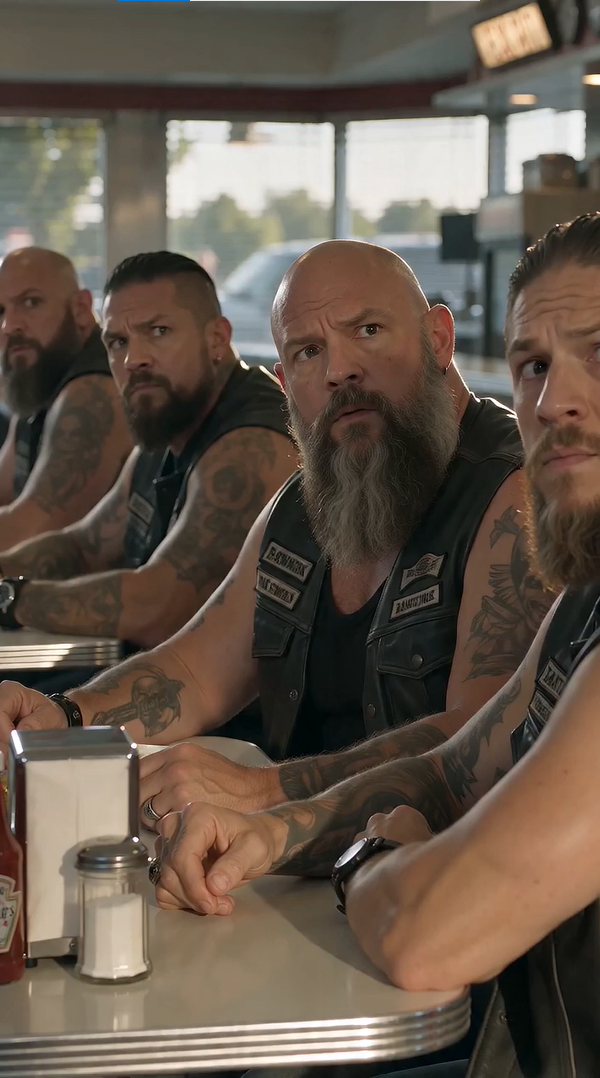
The whole diner went silent.
The biker slowly turned his head.
“What do you mean?”
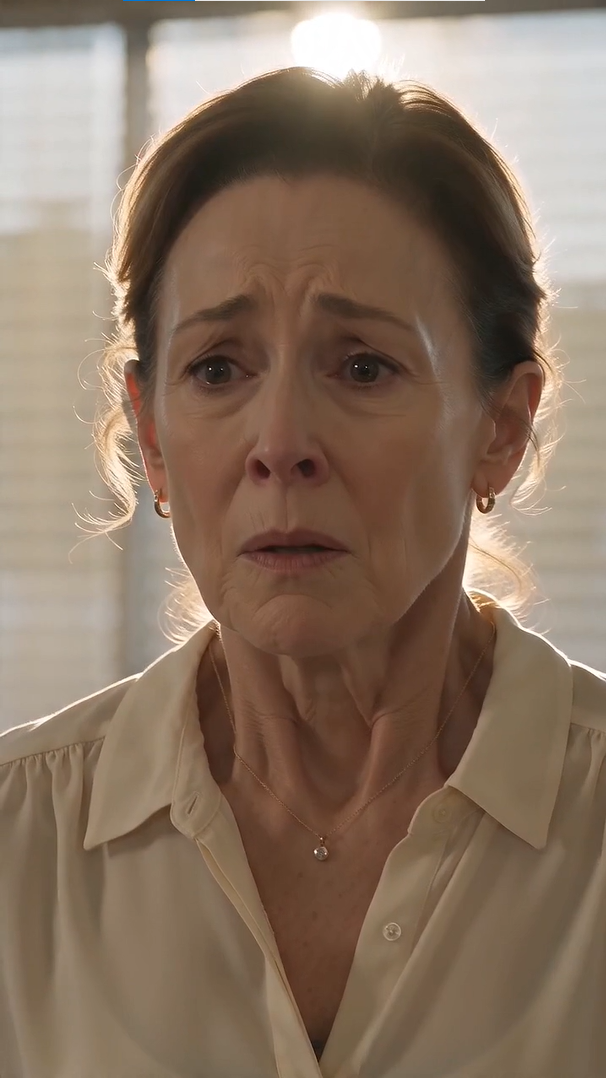
She looked at his face like she was afraid to hope.
“I had two boys,” she whispered. “Years ago. They were taken from me after my husband died. His family said I was too poor to raise them.”
The biker’s hard expression flickered.
The man in the suit stepped forward.
“Enough. You’re coming with me.”
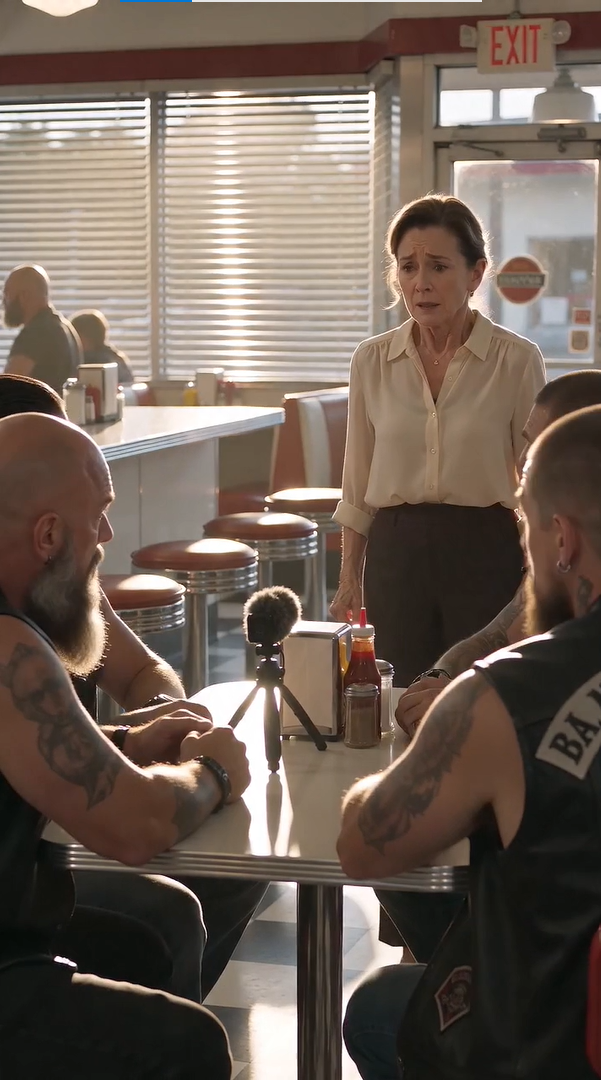
The biker raised one hand, stopping him without touching him.
The woman’s voice broke.
“My oldest had a scar under his chin. He fell off a red bicycle when he was six.”
The biker froze.
His hand moved slowly to his beard.
Under it, near his chin, was a thin old scar.
The other bikers stopped breathing.
The woman reached into her blouse pocket with shaking fingers and pulled out a faded photograph.
Two little boys stood beside a red bicycle, smiling with missing teeth.
The main biker took the photo.
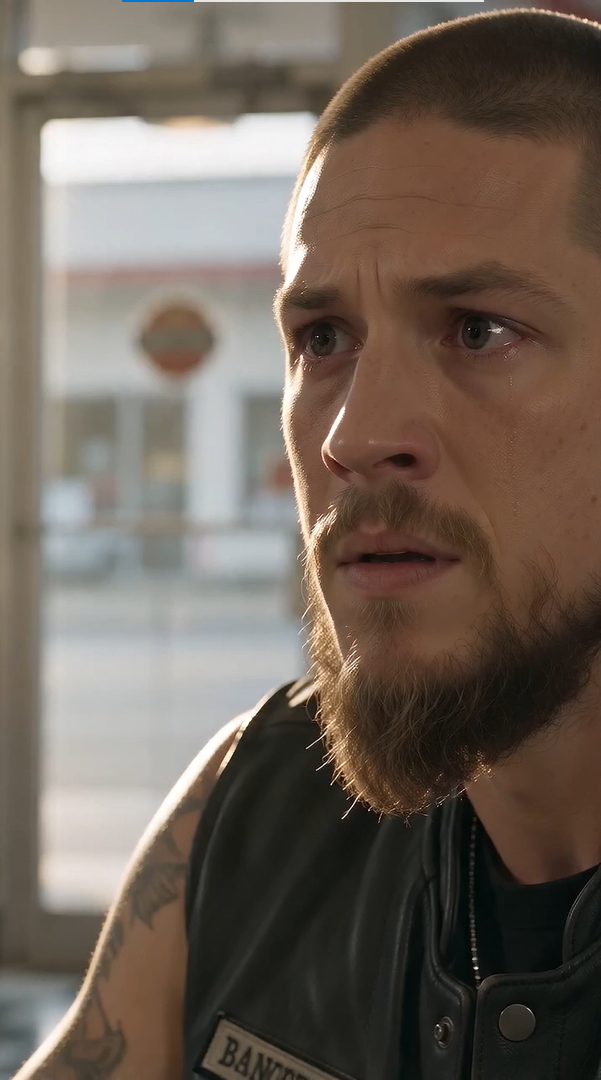
His face collapsed.
“That’s me.”
The man in the suit went pale.
The woman covered her mouth.
“And your brother,” she whispered, pointing at the biker beside him.
The second biker stared at the picture, eyes filling.
The man in the suit backed toward the door.
“She’s lying.”
The woman finally looked at him.
“No. Your family lied. They told my sons I abandoned them. They told me they died.”
The main biker turned toward the man.
For the first time, his voice shook.
“You knew?”
The suited man said nothing.
That silence answered everything.
The woman reached for the biker’s hand.
“I didn’t need you to pretend,” she whispered. “I just needed someone to stand beside me.”
The biker held the photo tighter, tears breaking through his rough face.
Then he stepped closer and said, “You don’t have to ask strangers anymore, Mom.”
The word broke her.
Not because it was loud.
Because it was soft.
Because it came from the mouth of a man whose face had been hardened by years of surviving without her, and still, somewhere inside him, a little boy had recognized the woman who once kissed his scraped chin.
She reached for him with both hands.
Then stopped.
Like she was afraid she had lost the right to touch him.
The biker saw it.
His face twisted.
“Don’t,” he whispered.
Her hands trembled in the air.
“I don’t know if I’m allowed.”
The second biker made a sound like he had been punched.
The main biker stepped forward and folded her into his arms.
The whole diner watched a woman who had spent half her life grieving dead sons hold a living one for the first time in twenty-two years.
She clung to his leather vest.
He bent his head against her shoulder.
For a moment, he was not a frightening man with tattoos and a road-worn face.
He was six years old again.
Bleeding under his chin.
Crying for his mother.
And she was finally there.
The second biker stood frozen, still holding the photo.
His eyes moved over the little boy beside the red bicycle.
The smaller child.
The child with one shoe untied and a grin too big for his face.
His own face.
The woman looked at him over the main biker’s shoulder.
“My little one,” she whispered.
His mouth trembled.
He shook his head once, like he wanted to reject it before it hurt him too much.
“They told us you left.”
The woman pulled away from the oldest and turned to him.
“No.”
“They said you chose money.”
“No.”
“They said you signed us away.”
Her face crumpled.
“I signed nothing.”
The second biker’s eyes filled with years of rage.
“They said you didn’t come back.”
“I came every week.”
The diner went silent again.
She wiped her tears with shaking fingers.
“I went to that house every week until they moved you. Your grandfather had guards at the gate. Your uncle told me you were better off without me. Then one day he told me there had been an accident. He said both my boys were gone.”
The main biker turned slowly toward the man in the suit.
“Uncle?”
The suited man swallowed.
His polished calm was cracking now.
The woman nodded, her voice barely holding.
“He was your father’s brother.”
The second biker stared at him.
The man in the suit lifted both hands.
“You were children. You don’t understand what happened.”
The main biker’s voice dropped.
“Then explain it.”
The uncle’s eyes darted toward the door.
Two bikers moved in front of it.
Not touching him.
Just standing.
The kind of standing that said running would be a bad idea.
The uncle forced a laugh.
“Look at her. Look at this place. She was a waitress with no money, no family, no education. My brother died and left two sons with a woman who couldn’t even pay rent.”
The woman flinched.
The main biker saw it.
His jaw tightened.
The uncle continued, louder now, trying to win back the room.
“My father did what any responsible family would do. He took the boys into a proper home.”
The second biker laughed once.
A broken, bitter sound.
“A proper home?”
He stepped closer.
“You mean the boarding school where they locked us in separate dorms and told us crying was weakness?”
The uncle looked away.
The second biker’s voice shook harder.
“You mean the house where nobody came when I had nightmares?”
The woman covered her mouth.
The main biker looked at his brother.
“You had nightmares?”
The younger brother swallowed.
“I used to see Mom at the gate.”
The woman sobbed.
The younger brother looked at her.
“I thought I made it up.”
She shook her head fast.
“No. I was there. I screamed your names until they dragged me away.”
The main biker pressed one hand over his mouth, trying to hold himself together.
All those years.
All that anger.
All the times he had told himself he did not care.
All the nights he had hated a woman who had been standing outside a gate, begging for him.
The uncle stepped back again.
“My father is dead. You can’t blame me for what he did.”
The woman looked at him with wet eyes.
“You came to my apartment yesterday.”
The bikers turned toward him.
The uncle’s face tightened.
The woman continued.
“You told me the old estate was being sold. You said there were papers I had to sign because my husband left my name on something before he died.”
The main biker looked at his mother.
“What papers?”
She pulled a folded envelope from her worn purse.
Her hands shook so badly the younger brother took it gently from her.
Inside were legal documents.
Property release forms.
Inheritance waivers.
A line for her signature.
The main biker read the top page.
His face darkened.
The younger brother looked over his shoulder.
“What is it?”
The main biker looked at their uncle.
“You needed her signature to sell Dad’s land.”
The uncle said nothing.
The older brother’s voice became colder.
“You took her sons. Told her they were dead. Told us she abandoned us. And now you came back because you still needed her name.”
The uncle snapped, “That land belongs to my family.”
The woman whispered, “I was his wife.”
The uncle turned on her.
“You were a mistake he made before he understood his place.”
The room reacted at once.
Chairs scraped.
A waitress gasped.
One of the older bikers muttered something under his breath and moved closer.
But the main biker did not raise his fist.
That made him more frightening.
He only stepped in front of his mother.
“She was his wife,” he said quietly. “And she is our mother.”
The uncle laughed, but it sounded weak now.
“You think this changes anything? You two are grown men. You have no proof.”
The younger brother lifted the photograph.
“We have this.”
The uncle sneered.
“A picture proves nothing.”
The mother wiped her face.
“I have letters.”
The uncle froze.
The main biker turned to her.
“What letters?”
She looked down at her purse.
“I wrote to you both every birthday. Every Christmas. Every first day of school. I never knew where you were, so I sent them to your grandfather’s house.”
Her voice broke.
“They always came back unopened.”
She reached into her bag and pulled out a bundle tied with blue thread.
The paper was yellowed.
The corners soft.
The bundle had been opened and closed so many times it looked like it was held together by grief alone.
The younger brother took one letter.
His name was written across the front in a careful hand.
Not the name people called him now.
His childhood name.
The one nobody knew except family.
“Nicky,” he whispered.
His tough face folded.
He looked at the older biker.
“She called me Nicky.”
The older brother took another letter.
His hands shook when he saw his own name.
Matthew.
Not Matt.
Not the name on his driver’s license.
Matthew.
The name his mother had used when he fell asleep against her lap.
He opened the letter slowly.
His mother reached out like she wanted to stop him.
“I wrote that when you turned ten,” she whispered.
Matthew read the first line.
My sweet boy, today you are ten, and I don’t know if you still remember my face.
His breath broke.
He could not read the rest.
He folded the letter against his chest and closed his eyes.
Nicky opened his letter too.
He read only a few words before tears slipped down into his beard.
The uncle watched the scene with growing panic.
“Emotional nonsense won’t stand in court.”
Matthew opened his eyes.
“Court?”
His voice was calm now.
Too calm.
“Good idea.”
He pulled out his phone.
The uncle stiffened.
“What are you doing?”
“Calling the police.”
The uncle barked a laugh.
“For what? Hurt feelings?”
Matthew looked at the property papers.
“Coercion. Fraud. Threats. Maybe kidnapping, depending on how much history your family buried.”
The uncle’s eyes flashed.
“You really think the police will believe two bikers and a woman who spent years cleaning tables?”
A voice came from behind the counter.
“I will.”
Everyone turned.
The diner owner, a gray-haired woman with flour on her apron, stepped out with a phone in her hand.
“I recorded him dragging her by the arm outside before your boys came in.”
The mother looked shocked.
The owner’s voice softened.
“You looked scared, honey. I had a feeling.”
The uncle’s face lost color.
Another man in a booth raised his phone.
“I recorded from the moment the big guy asked him about his mother.”
A waitress lifted hers.
“Me too.”
The room changed again.
It was no longer a diner full of strangers.
It was a room full of witnesses.
The uncle looked around, finally understanding that the woman he had cornered had walked into the one place where silence would not protect him.
Sirens sounded in the distance.
The mother looked toward the door and began to tremble.
Matthew turned to her at once.
“What is it?”
She shook her head.
“I’m sorry. I know I should be happy. I am. I just…”
Her voice collapsed.
“Every time someone came in uniform, they took something from me.”
Nicky stepped closer.
“No one is taking us.”
She looked at him.
He swallowed hard, fighting tears.
“They already did. They don’t get to do it twice.”
Matthew placed the photo carefully into his vest pocket.
Then he put one arm around his mother’s shoulders.
She leaned into him as if her body had been waiting twenty-two years for permission to rest.
The police entered minutes later.
The uncle tried to speak first.
Of course he did.
Men like him always believe the first voice owns the truth.
He told them he was protecting a confused woman.
He said the bikers had threatened him.
He said there was a misunderstanding about family property.
But the diner owner handed over her video.
The waitress handed over hers.
The men in the booths gave statements.
The paperwork was photographed.
The letters were bagged carefully.
And when the officer asked the mother if she wanted to make a complaint, she looked at the floor.
For a second, old fear returned.
The fear of rich people.
Family names.
Locked gates.
Documents she did not understand.
Men who smiled while destroying her life.
Then Matthew took her hand.
Nicky stood on her other side.
Not speaking for her.
Just standing.
The way she had asked.
The mother lifted her head.
“Yes,” she said.
Her voice shook.
But it was hers.
“I want to make a complaint.”
The uncle stared at her with disgust.
“You ungrateful woman.”
Matthew moved half a step forward.
The officer stopped him with a look.
Matthew stopped.
Barely.
His mother squeezed his hand.
“I’m not afraid of him anymore,” she whispered.
Matthew looked down at her.
Something in his face broke again.
Because he realized she was not only saying it to the uncle.
She was saying it for the little boys who had once been too small to protect her.
The uncle was taken outside.
He was not dragged.
He was not beaten.
He simply walked out between two officers while every person in the diner watched him lose the power he had worn like a suit.
As he passed Matthew, he said under his breath, “You’ll regret this.”
Matthew looked at him.
“I already regret twenty-two years.”
The uncle said nothing after that.
When the police cars left, the diner stayed quiet.
No one knew what to do after a miracle.
Not a clean miracle.
Not the kind with music and sunlight.
A messy one.
A diner table covered in old letters, legal papers, coffee cups, and tears.
The mother sat in a booth between her sons.
At first, none of them spoke.
What could they say?
How do you begin after twenty-two stolen years?
Do you start with birthdays?
With the day they were taken?
With the lies?
With the years they survived by pretending they did not need anyone?
The mother reached toward the letters.
“I don’t expect anything from you,” she said quietly.
Both men looked at her.
She kept her eyes on the table.
“I know you have lives. I know I’m a stranger now. I know blood doesn’t erase pain.”
Her lips trembled.
“I just wanted to know you were alive.”
Nicky looked away, jaw shaking.
Matthew stared at the table.
“I hated you,” he said.
The mother closed her eyes.
“I know.”
His voice cracked.
“No. I really hated you.”
“I know.”
“I used to think if I ever saw you, I’d ask why we weren’t enough.”
The mother covered her mouth.
Matthew’s eyes filled.
“And now I find out you were asking the same thing.”
She broke then.
She bent forward, sobbing into her hands.
Matthew looked terrified of her grief.
Like he did not know whether he was allowed to comfort the woman he had spent years blaming.
Nicky was the first to move.
He slid closer and put his arm around her.
Awkwardly.
Stiffly.
Like a man who had forgotten how to be held and was learning both sides at once.
The mother leaned into him and cried harder.
Matthew stared for one more second.
Then he wrapped his arms around both of them.
The three of them sat in the booth with the old photograph between them, grieving the same years from different sides.
The diner owner wiped her eyes and turned away.
The waitress set three cups of coffee on the table without asking.
Then she placed a slice of pie beside the mother.
“On the house,” she whispered.
The mother looked up, embarrassed.
“I can pay.”
The owner shook her head from behind the counter.
“Not today.”
Nicky gave a broken laugh.
“Mom always liked apple pie.”
Matthew looked at him.
“You remember that?”
Nicky shrugged, wiping his face.
“Barely.”
The mother stared at him.
“I made it every Sunday.”
Matthew’s face softened with pain.
“I remember cinnamon.”
The mother smiled through tears.
“I used too much.”
Nicky shook his head.
“No. It was perfect.”
They sat there until the sun lowered outside the diner windows.
Piece by piece, the years began to speak.
Matthew told her about the boarding schools.
About running away at fifteen.
About finding work in garages.
About buying his first motorcycle because speed felt better than sadness.
Nicky told her he followed Matthew because he was the only person who still felt like home.
The mother listened to every word like it was holy.
She did not interrupt.
She did not defend herself.
She did not ask them to forgive quickly.
When it was her turn, she told them about the years after they were taken.
The cheap rooms.
The cleaning jobs.
The nights she walked to their grandfather’s gate until security changed shifts.
The first time a returned letter came back stamped undeliverable.
The day their uncle said they had died in a school bus accident.
Matthew’s hands clenched so hard his knuckles went white.
Nicky stood up and walked outside.
The mother flinched.
Matthew started to rise.
But Nicky came back after a minute, wiping his face with both hands.
“I’m okay,” he said, though he clearly wasn’t.
Then he sat down beside her again.
“I just needed air.”
The mother nodded.
“Take all the air you need.”
That small sentence made him cry again.
Because nobody had ever given him room to fall apart.
By night, Matthew insisted on driving her home.
She tried to refuse.
“My apartment is small.”
“We’re not judging your apartment.”
“It’s not in a good area.”
Matthew looked at her.
“Mom, we grew up in places with locked doors and clean floors. That didn’t make them safe.”
She had no answer to that.
So she let them follow her.
They rode their motorcycles slowly behind the taxi, like guards escorting something precious.
When they reached her building, Matthew looked up at the cracked windows and broken front light.
His face tightened.
“You live here?”
She gave a tired smile.
“It’s better than some places I’ve had.”
Nicky looked at the dark stairwell.
“Not anymore.”
She turned to him.
“What?”
Matthew shook his head slightly, warning his brother not to rush her.
Nicky swallowed his anger.
“I mean, not alone tonight.”
The mother looked between them.
“You don’t have to stay.”
Matthew’s voice softened.
“We know.”
She searched his face.
“You have families?”
He hesitated.
“No wife. No kids.”
Nicky shook his head.
“Same.”
The mother looked down.
“I used to pray you had someone.”
Matthew’s throat tightened.
“We had each other.”
She nodded, tears returning.
“Thank God for that.”
Inside her apartment, the men grew quiet.
It was tiny.
Clean.
Worn.
A small table.
A narrow bed.
One plant on the windowsill.
And photographs everywhere.
Not new photographs.
Old ones.
Two boys on a bicycle.
Two boys eating cake.
Two boys asleep on a sofa.
Two boys standing beside their father before he died.
Matthew walked to the wall like his legs had turned to stone.
Nicky picked up a small frame.
It showed him as a toddler, face covered in jam.
His mouth trembled.
“You kept us.”
The mother stood near the door, twisting her fingers.
“I had nothing else.”
Matthew touched a photograph of himself at six, chin bandaged, sitting on her lap.
The red bicycle leaned behind them.
He remembered almost nothing.
Then suddenly he remembered her smell.
Soap.
Cinnamon.
Laundry dried in the sun.
He turned around.
“Can I ask you something?”
“Anything.”
“What are our real names?”
The question broke her in a new way.
She stepped closer slowly.
“You don’t remember?”
Matthew shook his head.
“They changed them after boarding school. Said our old names sounded childish.”
The mother pressed one hand to her chest.
She looked at him first.
“Mateo.”
His breath caught.
“Mateo?”
She nodded.
“Your father chose it. He said you kicked like a fighter before you were even born.”
A tear slipped down his cheek.
Then she looked at Nicky.
“And you were Nicolas. But you hated the full name. You would stomp your foot and say, ‘I’m Nicky.’”
Nicky laughed through a sob.
“That sounds like me.”
She smiled.
“It was very much you.”
Matthew whispered the names under his breath.
Mateo.
Nicolas.
Not new names.
Buried names.
Names waiting under the lies.
The mother went to a drawer and pulled out a small metal box.
Inside were two hospital bracelets, a lock of baby hair tied in thread, a tiny toy car, and a key.
Matthew looked at the key.
“What’s that?”
She picked it up.
“The key to the last home we had together.”
Her voice softened.
“After they took you, I kept it. Foolish, I know. The apartment was rented to someone else years ago.”
Nicky shook his head.
“Not foolish.”
Matthew took the key gently.
“It means you expected us to come home.”
She looked at him.
“I never stopped.”
That night, the brothers slept in chairs near the door.
Their mother told them not to.
They ignored her.
Nicky fell asleep first, boots still on, arms crossed over his chest.
Matthew stayed awake longer.
His mother sat on the bed, watching them like she was afraid sleep would take them away again.
He noticed.
“I’m not leaving,” he said quietly.
She looked embarrassed.
“I know.”
“No, you don’t.”
Her eyes filled.
He leaned forward.
“Mom.”
The word still felt strange in his mouth.
But right.
“We’re not leaving tonight.”
She nodded, crying silently.
Only then did she lie down.
For the first time in twenty-two years, she slept with both her sons under the same roof.
The next morning, she woke to the smell of burnt toast.
For one confused second, she thought she was young again.
Her husband alive.
Her boys small.
The kitchen noisy.
Then she opened her eyes and saw two grown bikers arguing over a toaster that had clearly lost a fight.
Nicky held a pan.
Matthew held a butter knife.
Smoke drifted near the ceiling.
Their mother sat up slowly.
“What are you doing?”
Nicky turned, guilty.
“Breakfast.”
Matthew muttered, “Attempted breakfast.”
She stared at them.
Then she began to laugh.
Not politely.
Not carefully.
A real laugh.
It shook her whole thin body.
The brothers looked at each other.
Then they laughed too.
For a few seconds, the apartment was not a place full of grief.
It was a home making noise again.
After breakfast, Matthew called a lawyer.
A real one.
Then another.
Then a private investigator.
Nicky called contacts from motorcycle clubs across three states, people who owed him favors, people who knew how to find records that rich families thought were buried.
Their mother sat at the table, overwhelmed.
“You don’t have to fight them,” she said.
Matthew looked at her.
“Yes, we do.”
“I don’t want you hurt because of me.”
Nicky leaned forward.
“We were hurt because we didn’t know you.”
She went quiet.
Matthew’s voice softened.
“This is not revenge, Mom. It’s truth.”
And truth, once those men started digging, came faster than anyone expected.
Records showed the boys had never been formally adopted.
Guardianship papers had been filed under emergency claims after their father’s death.
The mother’s signatures were missing.
Then copied.
Then forged.
School forms listed her as deceased.
Medical forms listed her as unknown.
Letters she had sent were found in storage boxes at the old estate, unopened, some still tied in rubber bands.
The uncle had known.
The grandfather had ordered it.
Several lawyers had looked away.
Money had done what money often does.
Made cruelty look official.
The case became bigger than one family.
It became headlines.
Two sons stolen from living mother.
Inheritance fraud exposes decades-old family lie.
Bikers reunite with mother in diner confrontation.
The brothers hated the headlines.
Their mother hated them more.
She did not want fame.
She wanted the years back.
But years do not come back.
So they fought for what could.
Her name was restored to the estate records.
The forged papers were challenged.
The uncle was charged with fraud, intimidation, and conspiracy related to the property scheme.
Older crimes were harder, buried under dead men and expired limits, but the truth was put into court documents.
Sometimes that is the only grave a lie gets.
A public one.
The first hearing was brutal.
The uncle arrived in a dark suit, still trying to look important.
He stared at the mother as if she were dirt on his shoe.
But this time, she did not sit alone.
Mateo sat on her right.
Nicolas sat on her left.
Behind them sat twenty-seven bikers in leather, silent as stone.
The judge looked over his glasses once and said nothing.
The uncle’s lawyer tried to paint her as unstable.
Bitter.
Poor.
Confused.
Mateo’s hands curled into fists.
His mother gently touched his arm.
“I’m okay,” she whispered.
Then she took the stand.
Her voice shook at first.
But with each question, it grew stronger.
She told the court her husband had loved his sons.
She told them she had been grieving when his family arrived with papers she could not understand.
She told them she was told to rest, then told the boys were visiting relatives, then told she was unfit, then told they were gone forever.
The lawyer asked, “Why did you not fight harder?”
The courtroom went silent.
Her face turned pale.
For a moment, shame tried to climb back onto her shoulders.
Then she looked at her sons.
Mateo’s eyes were wet.
Nicolas nodded once.
She turned back to the lawyer.
“I was twenty-six years old. My husband was dead. My children were taken. The people who took them had money, lawyers, guards, and my grief in their hands.”
Her voice broke, but she did not stop.
“I fought as hard as a broken woman could fight.”
No one moved.
The lawyer looked down.
He had no more questions.
Later, Mateo took the stand.
When asked how the lie had affected him, he stared at the table for a long time.
Then he said, “I grew up thinking the first woman who loved me had thrown me away. That changes how you let the whole world love you.”
His mother covered her mouth.
Nicolas testified after him.
He tried to act strong.
He failed halfway through.
“I used to dream she came to the gate,” he said. “I thought it was just a kid wanting a mother. But she was there.”
He wiped his face angrily.
“She was there.”
The uncle never apologized.
Not once.
Even when the forged signatures were shown.
Even when the returned letters were placed on the evidence table.
Even when one retired guard admitted the mother had come for months and had been ordered removed.
The uncle only said, “Our family did what it thought was best.”
Mateo looked at him from across the room.
“No. Your family did what it thought it could get away with.”
That line made the papers the next day.
But the mother didn’t care about headlines.
She cared about what happened after.
After court, they drove to the cemetery where her husband was buried.
She had not been there in years.
The family had moved his body to their private plot and never told her.
Now she stood before his stone with both sons beside her.
Her hand shook as she touched his name.
“I brought them back,” she whispered.
Mateo lowered his head.
Nicolas placed the faded photo on the grass.
The red bicycle.
The missing teeth.
The boys their father had loved.
For a long time, none of them spoke.
Then their mother said, “He would have looked for you until his feet broke.”
Mateo wiped his eyes.
“Was he good?”
She smiled through tears.
“Yes.”
Nicolas swallowed.
“Did he love us?”
She turned to him, shocked by the question.
“Oh, baby.”
The word slipped out before she could stop it.
Nicolas’s face crumpled.
She took his face in her hands.
“He loved you so much. He used to come home from work covered in dust, and the first thing he did was ask where his boys were.”
Mateo closed his eyes.
Their mother looked at both of them.
“You were not unwanted. Not for one second.”
Nicolas cried openly then.
Mateo put one arm around him.
Their mother wrapped her arms around both.
Three people stood by a grave, mourning a father, a husband, and a family stolen by pride.
But they were also standing together.
And that mattered.
Months passed.
The legal fight continued, but life also began to grow around it.
The brothers moved their mother out of the small apartment.
She argued for days.
They let her argue.
Then they rented a little house with a porch, two bedrooms, and a kitchen big enough for Sunday pie.
She said it was too much.
Nicky, who had begun letting her call him Nicolas again only when she was emotional, said, “Good. You deserve too much.”
Mateo fixed the porch steps.
Nicolas painted the kitchen yellow because she once said yellow curtains made rooms feel less lonely.
The first night in the house, she stood in the doorway with her hands pressed to her mouth.
“I don’t know how to live in a place this quiet,” she whispered.
Mateo carried in a box of dishes.
“Don’t worry. He snores.”
Nicolas shouted from the hallway, “Lies.”
She laughed.
Then cried.
Then laughed again.
Healing was like that.
Messy.
Embarrassing.
Out of order.
Some days were beautiful.
Some days were cruel.
Some days Mateo would call her Mom without thinking, and her whole face would light up.
Other days he would pull away when she reached for him, not because he didn’t love her, but because a body abandoned by lies does not learn trust overnight.
Some nights Nicolas slept on the porch because closed rooms still made him feel trapped.
His mother would leave a blanket beside the door and not ask questions.
Some mornings she would wake afraid the house was empty.
Then she would hear Mateo cursing at the coffee machine, or Nicolas singing badly in the bathroom, and she would sit on the edge of the bed and cry quietly into her hands.
Not from sadness.
From the terror of happiness arriving late.
One Sunday, she made apple pie.
She used too much cinnamon.
On purpose.
Mateo took one bite and closed his eyes.
Nicolas pointed his fork at him.
“You remember?”
Mateo nodded slowly.
“I remember.”
Their mother froze.
“What?”
Mateo looked at the pie.
Then at her.
“You humming.”
Her lips parted.
“In the kitchen?”
He nodded.
“And Dad laughing because Nicky had flour on his face.”
Nicolas looked up.
“I did?”
Their mother’s tears fell before she could answer.
“Yes.”
Mateo pressed his fork down.
“I thought that memory was a dream.”
She came around the table and kissed his hair.
He let her.
That was the first time.
He sat still, eyes closed, as his mother kissed the top of his head like he was six years old again.
Nicolas looked away, crying into his pie.
The brothers brought their motorcycle club to dinner one month later.
Their mother cooked for all of them.
A ridiculous amount.
Rice.
Chicken.
Bread.
Pie.
Enough food for an army.
The bikers arrived loud and hungry, then grew strangely polite when they saw her nervous smile.
One by one, they called her ma’am.
By the end of the night, they were calling her Mama Rosa because one of them asked her name and Nicolas answered proudly before she could.
Rosa.
Her name moved through the house like it had been waiting to be spoken with love.
At the end of dinner, the oldest biker, a scarred man with gray in his beard, stood and raised a glass.
“To the mother who came back.”
Rosa shook her head.
“No,” she said softly.
Everyone looked at her.
She turned to Mateo and Nicolas.
“I didn’t come back. I never left.”
The room went quiet.
Then Mateo raised his glass.
“To the mother who never left.”
Every glass lifted.
Rosa cried into her napkin while twenty-seven bikers pretended not to cry with her.
The uncle’s case ended the following spring.
He lost the sale.
Lost the estate claim.
Lost the polished life he had built on buried papers.
Part of the recovered money went to Rosa.
She didn’t want it at first.
“It feels dirty.”
Mateo nodded.
“It is.”
Nicolas leaned back in his chair.
“So we wash it.”
She looked confused.
The brothers had already made plans.
Not for revenge.
For repair.
They used part of the settlement to open a small legal aid fund for parents fighting wrongful guardianship, custody fraud, and family intimidation.
Rosa insisted on one condition.
“No one has to prove they are rich enough to love their child.”
That became the sentence on the wall.
The Red Bicycle Fund
For families separated by power, poverty, and lies
Underneath was the faded photograph.
Two boys.
One bicycle.
A mother just outside the frame, taking the picture.
On the opening day, Rosa stood before a room full of people who knew what it meant to be dismissed.
Poor mothers.
Fathers with worn hands.
Grandparents raising children.
Young women holding folders of court papers they barely understood.
Rosa stepped to the microphone.
Her sons stood behind her.
Not in front.
Not speaking for her.
Beside her.
She looked at the crowd, then down at her notes.
Her hands shook.
Mateo leaned close.
“You don’t have to.”
She nodded.
“I do.”
Then she lifted her head.
“My sons were taken from me because people decided poverty meant I had no love worth respecting.”
The room went still.
“They told my boys I left. They told me my boys died. For twenty-two years, I lived with a grave in my chest.”
Nicolas wiped his eyes.
Rosa continued.
“I am not here because everything is fixed. You cannot return a child’s first day of school. You cannot return birthdays. You cannot return the nights a mother sleeps with baby shoes under her pillow because she has nothing else to hold.”
Her voice broke.
But she kept going.
“I am here because truth came late, but it came. And when it came, my sons stood beside me.”
She turned toward them.
Mateo’s rough face was wet.
Nicolas was crying openly.
Rosa smiled through her tears.
“So this place is for anyone who has been told they are too poor, too weak, too late, or too small to fight for their family.”
She touched the photo on the wall.
“Love is not measured by the size of your house. It is measured by who keeps looking when everyone tells them to stop.”
The room stood.
Applause filled the hall.
Rosa stepped back, overwhelmed.
Mateo wrapped one arm around her.
Nicolas wrapped the other.
This time, when she stood between her sons, she did not feel like a woman being protected by strangers.
She felt like a mother who had finally been returned to her own life.
Years passed.
The diner became sacred to them.
Not officially.
No plaque.
No ceremony.
Just a booth near the window where three people had begun again.
Every year on the day they found each other, Rosa, Mateo, and Nicolas returned to that booth.
The owner always served apple pie.
Too much cinnamon.
Always.
The first year, they cried more than they ate.
The second year, they laughed at old stories.
The third year, Mateo brought a small red bicycle charm and placed it on the table.
Rosa picked it up with trembling fingers.
“What is this?”
He shrugged, embarrassed.
“For your keychain.”
Nicolas rolled his eyes.
“He spent an hour picking it.”
Mateo glared at him.
Rosa held the tiny bicycle to her heart.
“I love it.”
Mateo looked away, but his ears turned red.
By the fifth year, the booth had become a place of noisy memories.
The brothers argued.
Rosa fussed over their jackets.
The diner owner told new waitresses, “That family right there was born twice.”
And maybe they were.
Once in a small house full of cinnamon and laughter.
Again in a diner full of witnesses.
Rosa grew older.
Her hair silvered.
Her hands became more fragile.
But her house stayed full.
Motorcycles lined the street every Sunday.
The kitchen smelled of pie.
There were birthdays with too many candles.
Christmas mornings with stockings labeled Mateo and Nicolas, even though the men complained they were too old.
Rosa ignored them.
She had missed too many Christmas mornings to care about their pride.
One winter night, Mateo found her sitting by the window, holding the old returned letters.
He sat beside her.
“Bad night?”
She nodded.
“I was thinking of the first birthday I missed.”
He took the letter from her hand.
The one marked Matthew, age seven.
He had read it many times now.
Still, it hurt.
Rosa looked at him.
“Do you ever wonder who you would have been if they hadn’t taken you?”
Mateo stared out at the snow.
“Yes.”
“Do you hate me for not stopping them?”
He turned to her.
“No.”
Her eyes searched his.
“Truly?”
He took her hand.
“I hate them for making you ask that.”
She cried then.
Quietly.
He pulled her against his shoulder.
“You found us,” he whispered.
“It took too long.”
“You found us.”
“I missed everything.”
He closed his eyes.
“Then stay for what’s left.”
She held his hand tighter.
“I will.”
Near the doorway, Nicolas stood in the dark, listening.
He wiped his face with his sleeve.
Then he walked in and dropped onto the other side of her.
“Are we crying without me?”
Rosa laughed through tears.
Mateo groaned.
“Here he goes.”
Nicolas leaned his head on his mother’s shoulder.
“I’m sensitive now. It’s your fault.”
Rosa kissed his hair.
“I’ll take the blame.”
The three of them sat by the window as snow covered the porch, quiet and safe, while the world outside kept moving.
Years before, a rich family had decided Rosa was too poor to keep her sons.
But they had never understood something simple.
Love does not disappear because powerful people rename it.
A mother does not stop being a mother because a gate is locked.
A child does not stop needing the truth because someone gives him a new bed and a new story.
And a family, once stolen, can still find its way back through the smallest things.
A scar under a beard.
A faded photograph.
A red bicycle.
A stranger’s hand in a diner.
Only they were never strangers.
Not really.
They were a mother and her sons, separated by lies, carried by memory, and returned by the kind of truth that waits years for the right room to hear it.
And every time Rosa looked at those two grown men sitting at her table, laughing too loudly, eating too much pie, calling her Mom like the word had never been stolen, she silently thanked the moment she had walked into that diner afraid.
Because she had asked for someone to stand beside her.
And God had sent back her sons.