My Husband Had Two Kids With His Secretary. I Stayed Quiet… Until The Doctor Asked One Question.
My husband thought I was too polite to notice the perfume on his shirts, too tired to question his “business trips,” and too broken to fight back. He was wrong on every count. I had known about his secretary, his children, and his lies for eight years.
Then a doctor asked one question.
PART 1
“You’re a barren little housemaid with a wedding ring. Don’t confuse that with being a wife.”
My mother-in-law said it in my living room while holding my coffee mug like she owned that too.
David sat on the leather sectional, scrolling through his iPhone, thumb moving over the screen like my humiliation was background noise. His suit jacket was still on. His tie was loosened. His expensive shoes were on my clean rug.
Martha Mitchell crossed her legs, her Chanel bag beside her, and smiled at me like she had just delivered a clever line at a country club luncheon.
“Mom,” David said without looking up, “don’t start.”
But he said it lazily.
Not to defend me.
To keep dinner from getting inconvenient.
I stood near the kitchen island with a dish towel folded in my hands. Pot roast cooled on the counter. The dishwasher hummed. Outside, a delivery driver pulled away from our suburban townhouse in northern Virginia, headlights sliding across the blinds.
I looked at Martha.
Then I looked at David.
And I said, “You’re right. I’m sorry.”
Martha blinked once, then gave a satisfied little laugh.
David exhaled.
That was when I knew they both believed I was stupid.
Not wounded. Not patient. Not strategic.
Stupid.
Eight years later, that mistake would cost David his career, his money, his mistress, his mother’s respect, and the two children he kept calling his “real family.”
But that night, I let them enjoy the room.
I had learned something important a few days earlier.
It happened in the laundry room, under a buzzing fluorescent light, while I was checking David’s suit pockets before taking them to the dry cleaner.
Out of the inner pocket fell a photograph.
Not a receipt.
Not a business card.
A photograph.
David was sitting on a bench at Six Flags, grinning like a man who had never lied in his life. On his lap sat a little boy with his same sharp chin. Beside him was Khloe Sanders, his executive secretary, with one arm around a little girl wearing Minnie Mouse ears.
The four of them looked like a Christmas card.
The kind people mail to relatives with matching sweaters and fake joy.
I stood there for a full minute with the washing machine thumping beside me.
Then I put the photo in a drawer.
I did not confront him.
Not that night.
Not the next morning.
Not when he came home smelling like Khloe’s vanilla perfume.
Not when he started “working late” every Friday.
Not when his passenger seat kept moving back because Khloe was taller than me.
The old version of me might have thrown the picture across the dining table and demanded answers.
The old version of me might have cried in the driveway while David backed out in his black BMW, pretending not to see me.
But the old version of me died quietly the night he came home, tossed his jacket over a chair, and said, “Starting this month, I’m cutting your household money in half.”
I looked up from the stove.
“What?”
“The company is tightening budgets,” he said. “Everyone’s making sacrifices.”
That was a lie.
David worked as a senior manager at a pharmaceutical company that had just announced record profits. He had bought himself a new Apple Watch the week before. He had taken Khloe to The Capital Grille two nights earlier. I knew because his AmEx statement came to the house.
He didn’t know I checked the mail first.
“It’s not hard, Claire,” he said. “Clip coupons. Shop at Costco. Skip the organic nonsense.”
I was a former registered nurse. I had managed trauma charts, medication schedules, insurance battles, and families falling apart in hospital hallways.
But in David’s mind, I was just the woman who stocked the fridge and ironed his shirts.
So I nodded.
“Okay.”
He frowned, almost disappointed I hadn’t made it entertaining.
That same week, Martha came by “for leftovers,” which meant she wanted free dinner and an audience.
I tried one careful sentence.
“David has been out late a lot. I’m worried about him.”
Martha smiled before I finished.
“Men with important jobs have important demands,” she said. “A wife should understand that. Especially a wife who hasn’t given him children.”
There it was.
Clean. Sharp. Rehearsed.
David didn’t stop her.
He kept scrolling.
That was when I understood Martha knew about Khloe. She knew about the children. She had probably held them, bought them toys, called them her grandchildren.
I was the only person in that house expected to play dumb.
Fine.
I played dumb beautifully.
For eight years.
Every fall, David’s executive health screening results arrived in the mail. Thick envelopes. Lab panels. Imaging summaries. Specialist notes. He never opened them.
“File that somewhere,” he’d say, dropping the envelope on the counter beside his Starbucks cup.
So I did.
I filed every page.
Not in the office.
Not in the kitchen drawer.
In a locked binder at the bottom of my dresser.
Because eight years earlier, before I found the photograph, David had walked out of a follow-up appointment at Metropolitan Hospital. He claimed he had an urgent work meeting.
He didn’t.
He went to meet Khloe.
I stayed behind and listened to Dr. Harrison explain what David had refused to hear.
David carried a rare genetic marker. It would likely never hurt him. He could jog, work, cheat, drink bourbon, and look perfectly healthy.
But if he had biological children, they needed specialized testing before puberty.
Without early monitoring, the condition could trigger fast.
The words were clinical.
The meaning was brutal.
David’s body might never betray him.
But it could destroy his children.
For eight years, I tried to hand him consent forms. He tossed them into trash cans, tore one in half, and called me dramatic.
For eight years, I visited Dr. Harrison alone, carrying David’s unopened results in a tote bag from Target.
Every time, Dr. Harrison asked, “Claire, are you sure you don’t want a divorce attorney?”
Every time, I answered, “I’m sure.”
Then I asked the same question.
“Will those children be okay?”
They weren’t mine.
Their mother had taken my husband, my marriage, my holidays, my place beside him at office events.
But those children had done nothing.
So I kept the records.
I kept the consent forms.
I kept the proof.
And one rainy November afternoon, the envelope came with a red stamp across the front.
IMMEDIATE FOLLOW-UP REQUIRED.
David threw it on the dinner table like it had insulted him.
“What the hell is this?”
I set down his plate.
“You should go.”
He snorted. “I go to the gym five days a week. I’m not wasting PTO because some hospital wants to bill my insurance.”
Martha, who had let herself in with her spare key, leaned over the paper.
“Oh, Claire,” she said, “what have you been feeding him? Frozen lasagna and resentment?”
David laughed.
I wiped a drop of spilled water off my wrist.
“Maybe the doctor has a reason.”
David’s fork hit the plate.
“Here’s the reason. You’re bored. You’re paranoid. And you need to stop making my life harder because yours didn’t turn out the way you wanted.”
Martha patted his shoulder.
“My son is successful. Healthy. Respected. If anything happens to him, what exactly do you contribute?”
I looked at the red stamp again.
The countdown had started.
And David was still mocking the clock.
PART 2
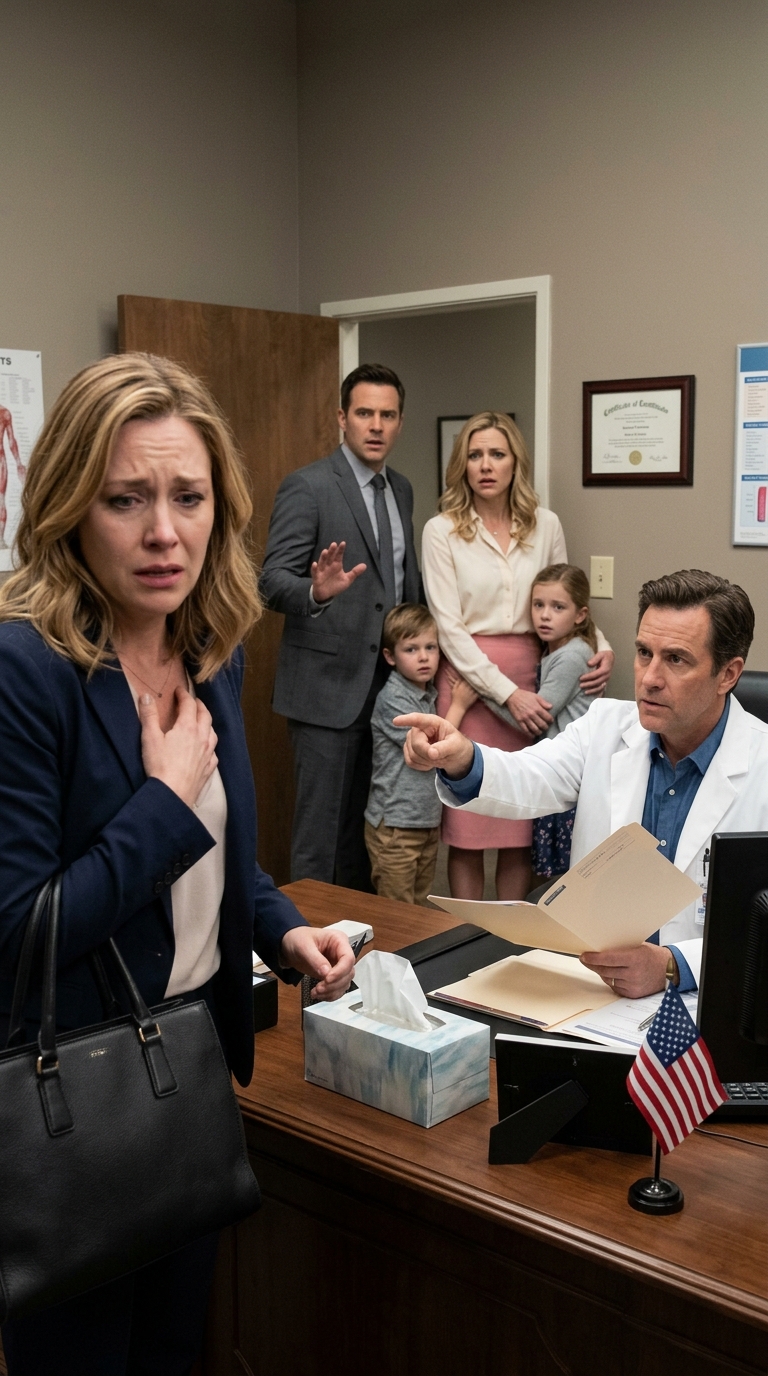
The doctor did not ask David if he felt sick.
He asked, “Mr. Mitchell, do you have any biological children?”
David told me later that the question hit him harder than any diagnosis could have.
He had gone to Metropolitan Hospital ready to perform.
He wanted to intimidate Dr. Harrison, accuse me of inventing medical drama, then drive straight to Khloe’s apartment for dinner with “his real family.”
He even wore his navy suit.
The one he said made him look like “the adult in every room.”
At 2:00 p.m., he walked into Dr. Harrison’s office with his phone in his hand and a smirk on his face.
“I’m busy,” he said. “So let’s skip the hospital theater.”
Dr. Harrison slid a file across the desk.
“Eight years ago, you left before receiving critical genetic counseling.”
David laughed.
“Ancient history. I’m not sick.”
“No,” Dr. Harrison said. “You are not.”
David leaned back.
“Great. Then we’re done.”
Dr. Harrison folded his hands.
“The issue is not your health. The issue is your biological children.”
David froze.
For eight years, he had hidden Khloe and those kids behind late meetings, fake golf weekends, and hotel receipts he thought I never found.
Now a doctor had put a spotlight on the one subject David could not explain without exposing himself.
“I don’t have children,” David said.
Dr. Harrison looked at him for a long second.
Then he opened another folder.
“Your wife has spent eight years asking whether the children from your affair could be protected.”
David stopped breathing normally.
The smirk disappeared.
Dr. Harrison continued.
“She never asked me how to punish you. She never asked how to ruin your secretary. She asked about testing, consent, symptoms, treatment windows, and emergency protocols.”
David stood up.
“This conversation is over.”
“No,” Dr. Harrison said. “It is just beginning.”
PART 3
While David was being introduced to the truth, his mother was sitting in my living room with divorce papers.
Martha slapped the green-bordered petition on my coffee table like she was serving a warrant.
“Sign it,” she said. “David is done carrying you.”
I looked at his signature.
Neat. Confident. Notarized.
Of course.
David could never just ask for a divorce like a decent adult. He had to send his mother with paperwork and insults, as if I were an old couch being removed before the new furniture arrived.
Martha leaned back, pleased with herself.
“Don’t expect some big settlement. You don’t have kids. You don’t have leverage. Honestly, Claire, at your age, you should be grateful he tolerated this arrangement as long as he did.”
I picked up my iced tea.
The glass was sweating onto a Target coaster.
“Did David tell you to say that, or did you write your own material?”
Her mouth tightened.
“There she is. Finally found a little attitude.”
“No,” I said. “Just asking for billing purposes.”
She ignored that.
“I’ve met Khloe,” Martha said. “She’s young, pleasant, respectful. She knows how to support a man instead of hovering over him like a nurse with a clipboard.”
I almost smiled.
A clipboard would have saved her grandchildren years ago.
“She gave him two children,” Martha continued. “A boy and a girl. Beautiful kids. They look like Mitchells.”
She said Mitchells like it was a royal bloodline instead of a family that argued over Costco rotisserie chicken.
“They are his future,” she said. “You are his past.”
I looked at the divorce petition again.
For years, I had imagined this moment in different ways.
Maybe I would shout.
Maybe I would throw his clothes onto the lawn.
Maybe I would take the photograph from my drawer and make Martha look at the evidence she already knew.
But the room felt oddly practical.
A table.
A pen.
A legal document.
A woman who thought cruelty was strategy.
I said, “When does he want me out?”
“End of the month.”
“Generous.”
“You should be careful,” Martha said. “David has lawyers. Real ones. Not strip-mall attorneys with bus bench ads.”
I set down my glass.
“Martha, did he tell you what happened at the hospital eight years ago?”
Her face shifted.
Just a flicker.
“What hospital?”
“Metropolitan.”
“I don’t know what you’re talking about.”
That was a lie. Maybe she didn’t know the details, but she knew enough to avoid the door.
Before she could stand, my phone buzzed.
A message from Dr. Harrison.
David has been informed. He may come home agitated. Keep documents secure.
I placed the phone facedown.
Martha noticed.
“Is that your little lawyer?”
“No,” I said. “Just someone who understands paperwork.”
She stood, snatching her bag.
“You always were strange. Too quiet. Too controlled. Men don’t want a woman who acts like a locked filing cabinet.”
“Funny,” I said. “David has been using me as one for years.”
She rolled her eyes and headed for the door.
“Sign the papers, Claire. Walk away with dignity, if you can still afford any.”
The door slammed behind her.
I sat alone in the living room, the divorce petition on the table and the locked binder beside me.
At 3:37 p.m., David’s BMW screeched into the driveway.
A car door slammed.
Footsteps hit the porch.
The front door flew open hard enough to smack the wall.
“Where is it?” David shouted.
I looked up from the sofa.
“Welcome home.”
His tie was crooked. His face had the pale, shiny look of a man whose body had just learned how panic works.
“Don’t do that calm little act with me,” he snapped. “Where’s the binder?”
I touched the black binder beside me.
“You mean the one you told me to file somewhere?”
He lunged for it.
I moved it out of reach.
“Sit down.”
“I don’t take orders from you.”
“No,” I said. “You ignore warnings from me. Orders would have required listening.”
His hand shook.
“You knew about Khloe.”
“Yes.”
“You knew about the kids.”
“Yes.”
“And you hid this medical thing to trap me.”
I opened the binder.
“No. I tried to tell you.”
“Bull.”
I pulled out the first consent form.
Pediatric Genetic Testing Authorization.
His name printed at the top.
“This was eight years ago. I put it on your desk.”
He stared.
I placed another one down.
“This was six years ago. You threw it out with a Chipotle receipt.”
Another.
“This was three years ago. You tore it in half because the Cowboys game was on and I was ‘blocking the TV.’ I taped it back together.”
David’s jaw worked, but nothing useful came out.
“You needed to sign as the biological father,” I said. “Khloe needed to appear as the custodial guardian. Without both of you, the hospital could not test them.”
He grabbed the form.
“Fine. I’ll sign now.”
I let him pick up the pen.
Then I said, “And then you’ll tell Khloe why you are signing it.”
The pen stopped.
“She doesn’t need every detail.”
“She needs every detail.”
“No, she doesn’t.”
“She is their mother.”
He pointed at me.
“You’re going to explain it to her.”
I stared at him.
For one second, I thought I had misheard.
Then he kept talking.
“You’ll tell her you intercepted the hospital mail. You’ll say you were jealous and unstable. You’ll say I found out today and came straight to help.”
I laughed once.
Not loud.
Just enough to make him flinch.
“You want me to take the blame for the disease you ignored, the children you hid, and the affair you had with your employee?”
“I’ll pay you,” he said fast. “Real money. You can have the savings account. I’ll even keep you on the health insurance for a while.”
“How touching. A man offering benefits while committing fraud. Hallmark should make a card.”
His face twisted.
“Don’t get cute. I can ruin you. I know attorneys. I know judges. You think anyone will believe the bitter infertile wife over me?”
I removed one final envelope from the binder.
“Probably not if I only had feelings.”
I placed it on the table.
“But I have records.”
He looked at the envelope.
“What is that?”
“Open it.”
He did.
Inside was a certified state record from the Office of Vital Records.
Voluntary Acknowledgment of Paternity.
David’s name.
The boy’s name.
The girl’s name.
Dates.
Signatures.
A state seal stamped in ink that did not care about his ego.
David stared at it like the page had bitten him.
“How did you get this?”
“Public records request,” I said. “With the right forms. America loves forms.”
“You had no right.”
“You had a whole second family while still married to me. Maybe sit this round out on rights.”
He stumbled back.
“I can undo it.”
“No, David. You can’t just return children like a jacket from Nordstrom.”
His eyes moved fast over the page.
“If Khloe sues you, she gets child support. Medical costs. Possibly more, once her attorney sees you knew about the genetic risk and failed to act.”
“She wouldn’t do that.”
“She will when she learns you planned to dump her and the kids to protect your job.”
He went still.
“I didn’t say that.”
“Not yet,” I said. “But you were about to.”
For the first time in twenty-two years, David looked small in the house he thought he controlled.
Then his phone rang.
Khloe.
He stared at the screen and did not answer.
It rang again.
I tilted my head.
“Your real family is calling.”
“Shut up.”
The front door opened.
Martha stepped in, holding a plastic Tupperware lid.
“I grabbed the wrong—”
She stopped.
Documents covered the table. David stood in the middle of the room looking like he had aged ten years in one afternoon.
Martha pointed at me.
“What did you do to my son?”
David said, “Mom, don’t.”
But Martha was already reaching for her phone.
“I’m calling the police.”
“Don’t!” David shouted.
That scared her more than anything I could have said.
I turned the binder toward her.
“Martha, before you call anyone, look at what your precious Mitchell bloodline actually inherited.”
She refused at first.
Then she saw the red stamp.
Genetic counseling.
Pediatric risk.
Urgent monitoring.
Her face changed line by line as she read.
“No,” she said.
David looked at the floor.
Martha slapped him so hard the sound cracked through the room.
“You knew?”
“I didn’t know it was serious.”
“You knew?”
“I didn’t want Khloe to panic.”
“You didn’t want your secretary to panic, but you were fine letting my grandchildren walk around with a medical bomb in their bodies?”
David backed away.
Then his phone rang again.
Khloe.
Martha snatched it off the table and answered.
“Khloe, this is Martha.”
David lunged.
“No!”
Martha turned away from him.
Then her face drained.
“What do you mean he collapsed?”
David stopped moving.
Martha gripped the phone with both hands.
“Which hospital?”
She listened.
Then she looked at David like he was no longer her son, but a bad investment she had recommended to everyone.
“We’re coming.”
David whispered, “No.”
Martha grabbed his arm.
“Yes. And if that boy dies because you were protecting your LinkedIn profile, I will bury you myself.”
The door slammed behind them.
I stood in the wreckage of paper, glass, and eight years of silence.
For the first time, the binder stayed open.
I didn’t need to hide it anymore.
PART 4
Khloe found out her perfect man was garbage under fluorescent hospital lights.
That was the part David never planned for.
He loved restaurants with dim lighting, hotel lobbies with marble floors, private office lunches, and corporate conferences where everyone called him “Mr. Mitchell.”
He did not love pediatric emergency rooms.
He did not love nurses asking direct questions.
He did not love clipboards.
And he definitely did not love Dr. Harrison walking out of the treatment area with the exact calm David had mocked for years.
I was not at the hospital that night.
I learned the details later from Dr. Harrison, from my attorney, and from the lawsuit Khloe filed so aggressively that even Martha stopped using the word “classy” around her.
Khloe was sitting on a plastic chair in the pediatric waiting area, still in work clothes, mascara smeared under one eye, her daughter curled beside her with a vending machine packet of Goldfish crackers.
Her son had collapsed at home after complaining of chest pain.
The ambulance took him to Metropolitan.
Because Dr. Harrison had kept my yearly consultation notes, the pediatric genetics team knew what to check. They stabilized him fast.
Not luck.
Preparation.
Mine.
When Dr. Harrison explained that the episode matched the early onset of a hereditary condition, Khloe looked at David.
“What does he mean, hereditary?”
David tried the corporate voice.
The one he used on conference calls when a product delay needed to sound like innovation.
“Let’s not jump to conclusions.”
Dr. Harrison did not blink.
“Mr. Mitchell was informed of this risk eight years ago.”
Khloe stood.
“Excuse me?”
David lifted both hands.
“It was vague.”
“It was not vague,” Dr. Harrison said.
Martha sat down hard.
Khloe stared at David.
“You knew our children could get sick?”
“I didn’t know it would happen.”
“That is not the same as no.”
Her voice carried down the hallway.
People looked over.
David lowered his voice.
“Khloe, not here.”
She laughed, sharp and ugly.
“Oh, now you care where things happen? You had no problem making babies with your secretary while your wife cooked Thanksgiving dinner.”
He flinched.
That line hit him because it was true.
One Thanksgiving, David told me he had to fly to Chicago for an emergency meeting. I roasted a turkey for two people. Martha came over, complained the stuffing was too dry, packed three containers, and left.
David was at Khloe’s apartment eating sweet potato casserole with his children.
I had seen the grocery charge.
I said nothing.
At the hospital, Khloe asked Dr. Harrison, “How did you know what to test for?”
Dr. Harrison opened a folder.
“Claire Mitchell brought updated records every year.”
Khloe’s mouth opened, then closed.
“She knew?”
“Yes.”
“And she helped?”
“She tried repeatedly to get proper consent. She had no legal authority to authorize testing herself.”
Khloe turned on David.
“You told me she was clueless.”
David wiped his mouth with the back of his hand.
“She is.”
Dr. Harrison’s voice hardened.
“Your son received timely treatment tonight because Claire Mitchell was not clueless.”
The hallway went quiet enough for the vending machine buzz to sound loud.
Khloe looked at David as if someone had wiped his face clean and revealed the mold underneath.
“You piece of trash.”
“Khloe—”
“No. Don’t use my name like you’re asking me to pass salt.”
“Listen to me.”
“I heard you.”
David froze.
Khloe held up her phone.
“Your mother answered, and the call stayed connected. I heard you say you could cut ties with us because the kids weren’t legally yours. I heard you talk about severance money like we were fired interns.”
Martha covered her mouth.
David looked at his mother.
“You kept the call on?”
Martha whispered, “I didn’t know.”
Khloe stepped closer.
“You legally acknowledged both children, David. My attorney already has copies. You think I didn’t keep paperwork? I was your secretary. I organized your lies for a living.”
That was when David understood the woman he thought would worship him had learned from him.
Khloe was not helpless.
She was furious, scared, and holding receipts.
By sunrise, she had called a family attorney.
By Monday morning, the company’s HR department had received a formal complaint.
By Wednesday, David was on administrative leave.
The corporate ethics board did not appreciate the optics.
Senior pharmaceutical manager.
Affair with subordinate.
Two children.
Known genetic risk.
Failure to disclose.
Attempt to abandon financial responsibility after medical emergency.
It was the kind of scandal that made executives stop using first names in emails.
David tried to spin it.
He told HR it was a private family matter.
HR asked why his private family matter involved a direct-report employee, concealed benefits questions, potential medical liability, and an emergency involving a child he had legally acknowledged.
He tried to blame me.
That ended fast.
My attorney sent copies of the consent forms, my dated notes, the hospital records, the torn document I had taped back together, and Martha’s signed statement after she finally realized David had nearly sacrificed her grandchildren to protect his title.
Martha turned on him with the speed of a woman protecting a family name she had spent decades polishing.
Khloe sued for child support and medical expenses.
My attorney filed for divorce, spousal support, and a forensic review of marital assets.
That review found the apartment deposits, the private-school payments, the Disney trips, the jewelry purchases, the emergency credit card, and the “consulting reimbursements” that were actually dinners with Khloe.
David had used marital funds to build his second life.
That fact did not make the judge sentimental.
At our first hearing, David wore a gray suit and looked annoyed, like divorce court was a delayed flight.
His attorney tried to paint me as vindictive.
“Mrs. Mitchell waited years,” he said. “One could argue she weaponized silence.”
My attorney, Sandra Bell, stood calmly.
Sandra was sixty, silver-haired, and had the energy of a woman who had made arrogant men regret speaking since 1989.
“She waited,” Sandra said, “because she lacked legal authority over the children and repeatedly attempted to alert Mr. Mitchell. We have documentation. What Mr. Mitchell calls silence was, in fact, him refusing to read.”
The judge looked over his glasses at David.
“Mr. Mitchell, did you discard these consent forms?”
David shifted.
“I don’t recall every piece of mail over eight years.”
Sandra placed enlarged copies on the screen.
One form had his handwriting across the top.
STOP WITH THIS NONSENSE.
The courtroom went still.
The judge read it.
Then he looked at David.
“Memory improved?”
David’s face tightened.
That clip never made social media, but I replayed it in my head for a week.
Not because I needed revenge.
Because for once, a man in a suit had to answer a direct question without a wife cleaning up behind him.
The settlement came after David lost his job.
“Resigned for personal reasons,” the company announced.
Everyone knew what that meant.
Khloe’s attorney secured child support and a medical expense order so large David had to sell the BMW, liquidate part of his investment account, and move into a rented condo near a strip mall with a mattress on the floor.
Martha stopped inviting him to Sunday dinner after he tried to borrow money from her church friends.
Khloe did not take him back.
She focused on the children.
The boy stabilized with early treatment and monitoring. His sister began preventive care before symptoms started.
I sent Dr. Harrison one email.
Thank you for keeping the file ready.
He replied with one sentence.
You gave them time.
That was enough.
David tried calling me after the settlement conference.
I was in the parking lot, standing beside my used Lexus SUV, holding a Starbucks iced coffee Sandra had bought me because she said every woman deserved caffeine after watching a man discover consequences.
David’s name flashed on my screen.
I answered on speaker.
“Claire,” he said. His voice sounded thin. “We need to talk.”
“No, we don’t.”
“I made mistakes.”
“You made a second household.”
“I was under pressure.”
“You had a mistress and a mother who packed leftovers while calling me defective. That is not pressure. That is a hobby.”
He breathed hard.
“I lost everything.”
I looked across the parking lot at the courthouse steps.
Men in suits. Women holding folders. A little boy chasing a pigeon near a bench while his mother told him to stay close.
“No,” I said. “You lost what you stole.”
He was quiet.
Then he said the thing men like David always say when the bill arrives.
“What about forgiveness?”
I took one sip of coffee.
“Try customer service.”
Then I hung up.
PART 5
The day my divorce was finalized, David asked the judge if he could keep the house.
The judge looked at the asset report, then looked at David.
“No.”
One word.
Cleanest sentence I had heard in twenty-two years.
The townhouse was ordered sold. My share came first, including repayment for marital funds David spent on Khloe’s apartment, gifts, trips, and the secret life he had financed while telling me to buy cheaper groceries.
David left court without looking at me.
Martha followed him, not as a proud mother, but as a woman walking behind a scandal she could not bleach out of the family name.
Khloe passed me near the elevator.
For a second, neither of us spoke.
Then she said, “The kids are doing better.”
I nodded.
“Good.”
She looked down at the folder in my hand.
“I don’t know how to thank you.”
“You don’t have to,” I said. “Just make sure they get checked.”
“I will.”
The elevator opened.
She stepped inside.
Before the doors closed, she said, “For what it’s worth, he lied to both of us.”
“No,” I said. “He lied to himself first. We just got billed for it.”
She almost smiled.
Then she was gone.
I walked out of the courthouse alone.
No dramatic speech.
No shaking hands.
No begging anyone to see my value.
My Uber was waiting by the curb, and my phone buzzed with a message from Sandra.
Funds cleared. You’re free.
I looked back once at the courthouse doors.
For eight years, David thought my silence meant defeat.
He never understood.
I was not waiting to break.
I was waiting for the truth to need a witness.