Ethan said nothing.
Daniel’s expression changed.
“Then you already know what kind of family you’re in.”
The end began on a Tuesday afternoon in Margaret Whitmore’s private study.
The room overlooked Lake Michigan. Everything in it was expensive, old, and arranged to make visitors feel temporary. Margaret sat behind her father’s mahogany desk with a file closed beneath her hand.
She did not ask Ethan to sit.
“Emma Carter,” she said.
Ethan’s stomach tightened.
Margaret opened the file.
“Civil rights attorney. Grew up in Georgia. No father in the picture. Mother was a nurse. Student loans mostly paid off last year. Impressive, actually. But not suitable.”
“She isn’t applying for a job.”
“No,” Margaret said. “She is applying for influence over you. That is worse.”
Ethan felt heat rise in his chest.
“You had her investigated?”
“I had a problem identified.”
“She’s not a problem.”
Margaret looked at him the way she had looked at underperforming executives, disloyal partners, and once, when he was sixteen, a girl from public school who had made the mistake of calling the house.
“Every generation of this family has understood its obligation,” Margaret said. “Marriage is not romance. It is continuity. Stability. Alignment.”
“I’m not marrying a merger.”
“You will not marry a woman whose entire professional life is built on challenging the kind of power that feeds this family.”
“She helps people.”
“She creates enemies.”
“She has a name.”
“And that name will not be Whitmore.”
The silence after that was so cold it felt physical.
Margaret slid the file across the desk.
“There is a judicial appointment opening next spring. Her mentor is on the shortlist. A scandal would be inconvenient for him. So would questions about old funding irregularities at her nonprofit clinic.”
Ethan stared at her.
“You wouldn’t.”
Margaret’s face did not change.
“Do not confuse my restraint with softness.”
Ethan left the study shaking.
That night, he parked outside Emma’s apartment for forty-three minutes. Her kitchen light was on. He could see her shadow moving behind the curtains. She was home. She was probably barefoot. She was probably making tea in the chipped mug she loved because her mother had bought it from a flea market.
He could have gone upstairs.
He could have told her everything.
He could have trusted her with the ugliness and asked her to stand beside him.
Instead, he took out his phone and typed twelve words that would ruin six years of lives.
I can’t do this anymore. I’m sorry. Please don’t contact me.
He sent it.
Emma called within one minute.
Ethan watched her name flash on his screen.
He did not answer.
She called nine more times that night.
The next day, she left a voice message.
“Ethan, I don’t understand. Please talk to me.”
Two days later, another.
“You don’t get to disappear like this. Not after everything.”
A week later, her voice changed.
“Ethan, something happened. I need to tell you something important. Please call me back.”
He listened to that message sitting alone in his condo at 11:18 p.m.
Something happened.
He knew, somewhere beneath fear and training and cowardice, that he should call her.
Instead, he deleted the message.
Emma found out she was pregnant in a bathroom with cracked white tile and a flickering light.
She sat on the edge of the tub with two tests on the sink and did not cry at first. The silence around her felt enormous. Her phone was on the floor beside her. Ethan had not answered in thirteen days.
Finally she looked at herself in the mirror.
“Okay,” she whispered.
One word.
Not happiness. Not panic. Not forgiveness.
A decision.
Then she called her mother.
Grace Carter drove from Atlanta to Chicago in one day because some mothers do not ask questions when they hear the way their daughters breathe. She arrived after midnight, carrying a suitcase, two grocery bags, and the hard kind of love that shows up before it speaks.
Emma opened the door.
Grace looked at her daughter’s face and set the bags down.
“Oh, baby.”
That was when Emma cried.
Part 2
Lily Grace Carter was born on Valentine’s Day during a snowstorm that shut down half of Chicago.
Grace said the timing was dramatic.
Emma said the baby had inherited poor scheduling from her father.
Then Lily opened her eyes.
Emma stopped joking.
She saw Ethan immediately. Not all of him. Not the polished man, not the frightened man, not the heir with a family name heavy enough to crush anything soft beneath it.
Just the eyes.
Lily had Ethan’s eyes.
Almond-shaped, dark, steady, and far too observant for a newborn who had only been in the world seven minutes.
Grace leaned over the hospital bed.
“Well,” she said quietly, “that child came here knowing everybody’s business.”
Emma laughed through tears.
She named her Lily because the flower looked delicate but survived hard weather. She gave her Grace as a middle name because no child of hers would enter the world without knowing who had helped hold the door open.
Five years passed.
Ethan married Claire Whitman Caldwell ten months after leaving Emma.
It was arranged without anyone calling it arranged. Claire came from old Boston money and a family whose foundation had been photographed beside the Whitmore Foundation since before Ethan was born. She was elegant, educated, and kind in a way that felt practiced because practice was how women like Claire survived.
Their wedding took place at the Whitmore estate under a white tent with six hundred orchids and a chamber orchestra flown in from New York. Ethan said the vows. Claire said hers. Margaret cried precisely once for the photographer.
The marriage was not cruel.
That almost made it worse.
Ethan and Claire were polite roommates in a beautiful Gold Coast penthouse. They attended galas, hosted dinners, and slept on opposite sides of a king-size bed that felt wider every year. They never had children. They never fought loudly. They never loved each other enough to hurt each other properly.
One night, after their second anniversary dinner, Claire stood at the bathroom mirror removing diamond earrings and said, “There was someone before me.”
Ethan froze.
Claire met his reflection.
“Wasn’t there?”
He could have lied.
He almost did.
“Yes,” he said.
Claire nodded once.
“Do you still love her?”
The answer moved through him like a blade.
“I don’t know what I’m allowed to call it anymore.”
Claire looked away.
“That sounds like yes.”
Across the city, Emma built a life from scratch.
She took cases that mattered more than they paid. She packed Lily’s lunches at midnight after long days in court. She learned which grocery stores marked down fruit on Wednesdays, which pediatrician listened instead of rushed, and which neighbor could watch Lily for twenty minutes if a client called in tears.
Grace visited often. She filled Emma’s freezer, folded laundry without asking, and taught Lily songs from her own childhood while pretending not to notice when Emma stood in the hallway and watched them with exhausted gratitude.
Lily was bright in a way that made adults laugh and then look at one another with concern.
At three, she asked why the moon followed their car.
At four, she announced that pigeons were “city chickens with secrets.”
At five, she began collecting pebbles.
She kept them in the pockets of her yellow jacket and gave each one a name.
The smallest was blue-green and smooth, no bigger than a thumbnail.
“That one is Monday,” she told Emma while arranging the pebbles on the front steps of their apartment.
“Why Monday?”
“Because Monday is always by itself.”
Emma looked at her daughter crouched on the concrete in striped leggings and rain boots, seriously trying to organize loneliness into a line of stones.
Her heart hurt.
“Do you feel lonely, baby?”
Lily shrugged.
“Sometimes. But not when I carry Monday.”
The question about her father came a month later.
They were walking home from preschool when Lily saw another girl run into her father’s arms. The man swung his daughter around while she shrieked with laughter.
Lily watched quietly.
Then she asked, “Where is my daddy?”
Emma had prepared a dozen answers over the years. None felt right.
So she chose the truest one a child could carry.
“Your daddy is someone who wasn’t ready to be brave.”
Lily thought about that for half a block.
“Is he scared of monsters?”
“Maybe.”
“What kind?”
Emma swallowed.
“The kind grown-ups make.”
Lily nodded as if this made perfect sense.
“I can show him Monday if he gets scared.”
Emma turned her face away before her daughter could see the tears.
The truth found Ethan on a Wednesday morning in October.
He was in a boardroom on the thirty-eighth floor, listening to a presentation about commercial redevelopment, when his phone buzzed.
A text from Daniel.
I saw Emma Carter at Lincoln Park.
Then another.
She had a little girl with her.
Then a third.
Ethan, I’m not saying this lightly. The child looks exactly like you.
A photograph appeared.
Ethan opened it.
The room vanished.
Lily stood near the South Pond holding a blue balloon in both hands, laughing at something outside the frame. Her yellow jacket was half-zipped. Her curls were windblown. Her eyes were his.
His coffee cup slipped from his hand and shattered against the marble floor.
Everyone at the table stopped.
Ethan did the math before he admitted he was doing it.
Five years old.
Emma’s voice message.
Something happened.
I need to tell you something important.
He stood so abruptly his chair scraped backward.
“I need a minute.”
He walked out of the room, into the hallway, and braced one hand against the wall.
For the first time in years, Ethan Whitmore did not know how to perform being Ethan Whitmore.
He called Emma.
She declined after four rings.
He called again the next day.
Declined.
He texted.
Please. I saw a picture. I need to know.
Nine hours later, a response came from Emma.
No, Ethan. You do not need. You want. There is a difference.
He stared at the words until the screen dimmed.
Then he called Daniel.
“I need you to talk to her.”
Daniel was silent for a long time.
“Do you understand what you’re asking me to do?”
“Yes.”
“No,” Daniel said. “I don’t think you do. You’re asking me to walk up to a woman who raised a child alone for five years because you deleted the message that would have told you she existed. You’re asking me to request mercy from someone who owes you nothing.”
Ethan closed his eyes.
“I know.”
“You don’t get to be wounded if she says no.”
“I know.”
“And if she says yes, you don’t get to arrive like a man claiming property.”
“I know.”
“Then I’ll ask,” Daniel said. “But I’m not defending you.”
“Don’t.”
Daniel met Emma at a small coffee shop in Logan Square the following Tuesday.
Emma arrived in a gray coat with her hair pulled back. She looked older than Daniel remembered, not in a diminished way, but in the way people look older when they have been carrying more truth than anyone knew.
Daniel did not waste her time.
“He knows,” he said.
Emma looked down at her coffee.
“Because someone finally sent him a picture?”
“Yes.”
Her jaw tightened.
Daniel leaned forward.
“He is asking for one meeting. Public place. Your conditions. Your timeline. No lawyers. No pressure.”
Emma gave a short laugh without humor.
“He always was good at sending other people when courage got expensive.”
Daniel accepted the hit because it was deserved.
“You’re right.”
She looked at him then.
That surprised her more than an argument would have.
Daniel continued. “I’m not here to ask forgiveness for him. I’m here because there is a little girl involved, and whatever Ethan failed to be, he knows now. He wants to show up.”
Emma’s eyes sharpened.
“Wanting is easy.”
“Yes.”
“Showing up is not a speech.”
“No.”
“It is not a dramatic apology in a park.”
“No.”
“It is school forms, fevers, bedtime, child support, canceled meetings, hard questions, patience, and never making my daughter feel like she has to audition for his love.”
Daniel nodded.
“I’ll tell him exactly that.”
Emma sat back.
For a long moment, she said nothing.
Then she looked out the window at a woman pushing a stroller through the cold.
“I decided months ago that Lily deserved the chance to know where she came from,” Emma said quietly. “Not because Ethan earned it. Because she did.”
Daniel waited.
“Saturday,” she said. “Lincoln Park. South Pond. Ten in the morning. Thirty minutes.”
Ethan arrived at 9:32.
He wore jeans and a dark coat because Daniel told him not to dress like he was attending a deposition. He stood near the fountain with his hands in his pockets and felt more afraid than he had ever felt walking into boardrooms worth billions.
At 10:04, Emma appeared on the path.
Lily walked beside her, temporarily distracted by a squirrel that had made the mistake of existing within her range of interest. She wore a yellow jacket and held something small in her left hand.
Ethan could not move.
Emma stopped six feet away.
Neither adult spoke.
Everything between them stood there too. The text. The calls. The deleted message. The pregnancy. The birth. The five years. The cowardice. The survival.
Lily looked up.
She studied Ethan’s face with calm attention.
Then she stepped closer.
“Why does your face look like mine?”
Ethan crouched because his legs would not hold him otherwise.
At her eye level, the resemblance was almost unbearable.
“Because,” he said, and his voice broke.
Lily waited.
He tried again.
“Because we come from the same place.”
Lily considered this seriously.
“Like Target?”
A sound escaped Emma, not quite a laugh and not quite a sob.
Ethan wiped his eyes with the heel of his hand.
“Not exactly.”
Lily opened her palm and showed him the blue-green pebble.
“This is Monday,” she said. “He gets lonely, so I carry him. You can hold him if you’re scared.”
Ethan looked at the pebble in his daughter’s hand.
His daughter.
The word moved through him with pain so sharp it almost became light.
He took the pebble carefully.
“Thank you,” he whispered.
Lily nodded.
“You have to give him back, though.”
“I will.”
Emma watched them, her face unreadable.
Ethan looked at her over Lily’s head.
“I’m sorry,” he said.
Emma’s eyes hardened.
“Don’t spend that word all at once. You’re going to need years of it.”
He nodded.
“I know.”
“No, you don’t,” she said. “But you can learn.”
That evening, Ethan told Claire.
He found her in the kitchen of their penthouse making tea she never drank. She looked at him before he spoke.
“It’s true, then,” she said.
Ethan stopped.
“You know?”
Claire poured hot water into a cup.
“I suspected for months. Someone mentioned seeing Emma with a child. Then I heard the child’s age. Then I looked at you and realized you were the kind of man haunted by a locked door.”
“Claire.”
She held up one hand.
“Don’t apologize to me first. I was not the one left pregnant and alone.”
The words landed exactly where they should have.
Claire leaned against the counter.
“What’s her name?”
“Lily Grace Carter.”
Claire’s face softened despite herself.
“That’s a beautiful name.”
“She’s five.”
“I know.”
They stood in the silence of a marriage that had been arranged by everyone except the two people living inside it.
Finally Claire said, “What are you going to do?”
“I don’t know yet.”
“Yes, you do.”
Ethan looked at her.
Claire’s voice trembled for the first time.
“You are going to tell the truth somewhere your mother cannot fold it into a private settlement. You are going to stop letting Margaret decide which people count. And then you and I are going to end this marriage with more honesty than it began.”
“Claire, I never meant to hurt you.”
“I know,” she said. “That was part of the problem. No one in this family means to hurt people. They just choose themselves and call the damage tradition.”
Three weeks later, the Whitmore Foundation gala arrived.
Part 3
The Winthrop Grand Ballroom sat forty-three floors above Chicago.
By seven-thirty, the city had turned to glitter beneath the windows. Champagne moved through the room. Cameras flashed. Donors embraced people they barely liked. Politicians laughed too loudly. Margaret Whitmore stood at the front of the ballroom, wearing silver silk and the expression of a woman prepared to be admired.
Ethan arrived with Claire.
They were still legally married, but something between them had already ended, and oddly, it had made them kinder. Claire squeezed his arm once near the entrance.
“Do it cleanly,” she said.
“I will.”
“No. Not perfectly. Cleanly.”
He nodded.
Daniel stood near the back wall, watching the crowd.
Emma arrived at 8:21.
She had not wanted to come. Every practical part of her mind had argued against it. But Lily had asked to wear her yellow dress, and Emma had decided that if the truth was going to be spoken, her daughter would not be hidden in a hallway while adults rearranged her life.
Before they entered, Emma knelt in front of Lily outside the ballroom doors.
“Remember what we talked about?”
Lily nodded.
“If it feels too big, we step outside.”
“Yes.”
“You do not have to hug anyone.”
“I know.”
“You do not have to answer questions.”
“I know.”
“You stay where I can see you.”
Lily patted her pocket.
“Monday is here.”
Emma kissed her forehead.
“Good.”
Inside, Margaret began her speech.
“Forty years,” she said, smiling at the sea of powerful faces. “One family. One legacy. One name that has never been broken.”
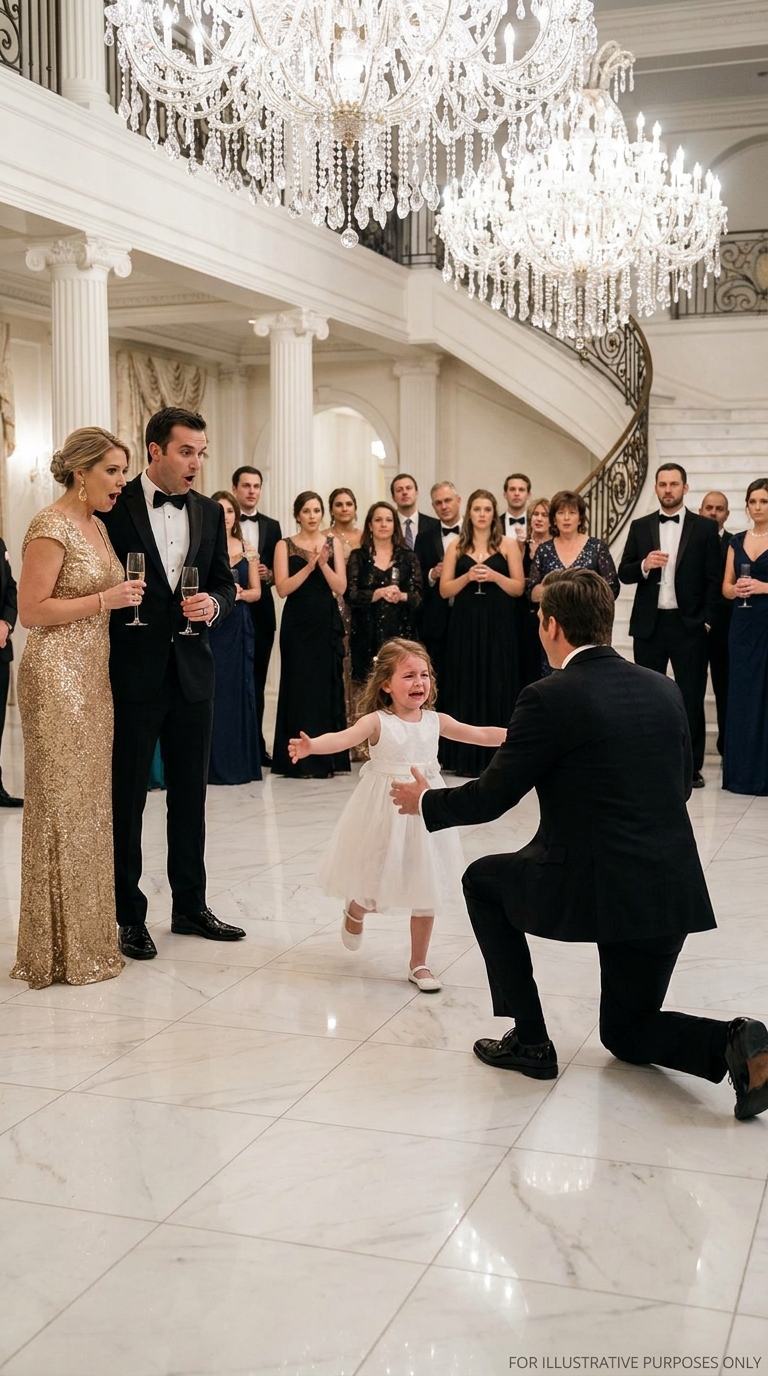
That was when Lily saw Ethan.
She did not understand timing, reputation, donors, board seats, inheritance, or the brutal art of public image. She knew only that the man from the park was standing across the room looking sad and scared and hers.
So she ran.
The pebble fell from her pocket.
It rolled across the marble.
And Lily shouted, “Daddy!”
Everything stopped.
Ethan moved before fear could catch him.
He walked through the center of the ballroom. People parted. He did not look at Margaret. He did not look at the cameras. He saw only Lily, standing under chandeliers too large for any child, smiling like she had brought light into a room that badly needed it.
He crouched.
Lily threw her arms around his neck.
He held her with both arms and closed his eyes.
For one second, he allowed himself to feel the full weight of what he had missed.
Then he stood with Lily in his arms and walked to the microphone.
Margaret’s face was white.
“Ethan,” she said quietly, but the microphone caught it.
He looked at his mother.
For the first time in his life, he did not wait for permission.
He turned to the ballroom.
“This is Lily Grace Carter,” he said. “She is five years old. She is my daughter.”
A wave moved through the guests. Gasps. Whispers. A dropped fork. Someone saying, “Oh my God,” too loudly.
Ethan continued.
“Her mother is Emma Carter, a woman I loved and failed six years ago because I was too afraid to stand up to my own family.”
Emma stood near the entrance, still as stone.
Lily leaned toward the microphone.
“And I like yellow.”
A stunned laugh broke through the room. Not cruel. Not mocking. Human.
Ethan smiled through tears.
“She likes yellow,” he said. “She collects pebbles. She thinks Monday gets lonely. And she is not a scandal. She is not a complication. She is not a mistake.”
He looked at Margaret.
“She is my child.”
Margaret gripped the podium.
“Not here,” she whispered.
Ethan heard her.
So did half the room.
“Yes,” he said. “Here. Because private rooms are where this family has buried too many people who deserved daylight.”
Claire stepped forward then.
Nobody expected it, least of all Margaret.
Claire crossed the ballroom and stopped beside Emma.
Emma turned, guarded.
Claire did not offer a performance. She did not ask to be admired for decency.
She simply said, “I’m sorry.”
Emma’s face changed slightly.
Claire swallowed.
“I was part of a life built on your silence. I didn’t know everything, but I knew enough to know something was wrong. I should have asked harder questions.”
Emma studied her.
“You were trapped too.”
“That doesn’t erase harm.”
“No,” Emma said. “It doesn’t.”
Claire looked at Lily in Ethan’s arms.
“She’s wonderful.”
Emma’s eyes softened.
“She is.”
On the stage, Margaret stared at Lily.
The child looked back without fear.
That, more than Ethan’s speech, unsettled Margaret. Adults feared Margaret. Executives feared her. Competitors feared her. Her own son had feared her so deeply he had abandoned the woman he loved.
But Lily only looked at her with curiosity.
Then Lily reached into her pocket and frowned.
“Mommy,” she said. “Monday fell.”
The entire ballroom seemed to hold its breath as Lily wiggled out of Ethan’s arms and searched the carpet. Ethan crouched with her. Daniel joined. Then, impossibly, Claire.
A senator’s wife pointed under a chair.
“There,” she said softly.
Lily picked up the blue-green pebble, dusted it carefully, and walked toward Margaret.
Emma took one step forward, ready to stop her.
But Lily turned back.
“It’s okay, Mommy.”
She walked all the way to the stage and stood in front of Margaret Whitmore.
Margaret looked down at her granddaughter.
Granddaughter.
The word entered her face before it entered her heart.
Lily held up the pebble.
“This is Monday,” she said. “He gets lonely. You look lonely too.”
No one moved.
Margaret Whitmore had negotiated billion-dollar deals. She had ended careers with a phone call. She had built a family empire so polished that people mistook its shine for virtue.
But she had no defense against a five-year-old offering her a pebble.
Her hand trembled as she took it.
Lily leaned closer.
“You can borrow him.”
Margaret’s mouth opened.
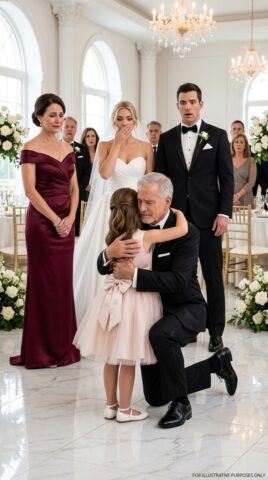
Nothing came out.
Then, for the first time Ethan could remember, his mother lowered herself to the floor in front of everyone.
Not gracefully. Not strategically.
Just down.
She sat on the edge of the stage in her silver gown, holding the pebble in her palm.
“What did you call him?” she asked, her voice breaking.
“Monday,” Lily said. “Because Monday is always by itself.”
Margaret closed her fingers around the stone.
And in front of three hundred people, the most powerful woman in Chicago began to cry.
Not beautifully.
Not quietly enough to preserve dignity.
She cried like a woman who had built a mansion around her own loneliness and only realized it when a child handed her a stone.
The gala did not recover.
How could it?
Dinner was served late. Half the donors left early. The other half stayed because they knew they were witnessing the kind of family collapse money usually prevented from becoming public.
By morning, society pages had the story.
By noon, business reporters had questions.
By the end of the week, Whitmore Holdings had lost two major partners, three board members had called for governance changes, and Margaret had stepped down as chairwoman “for personal reasons,” a phrase everyone understood meant the truth had finally become too large to manage.
Ethan resigned from Whitmore Holdings seventeen days after the gala.
His resignation letter was four sentences.
No accusations. No drama. No attempt to sound noble.
He had spent enough of his life sounding like things.
The divorce from Claire was finalized four months later. She kept the penthouse and moved to Boston to run an arts foundation under her own name. Before she left, she sent Emma a handwritten note.
I hope one day our lives are remembered for more than the roles we were given.
Emma kept it in a drawer.
Not because they were friends.
Because some apologies deserved not to be thrown away.
Ethan moved into a smaller apartment on West Monroe with morning light, noisy pipes, and a downstairs doorman named Al who treated Lily like visiting royalty. The first weekend she stayed over, she inspected every room and declared the apartment “less fancy but more alive.”
Ethan took that as the highest compliment he had ever received.
Learning to be a father was humiliating.
He burned pancakes.
He bought the wrong cereal.
He did not know which stuffed rabbit was bedtime rabbit and which one was backup rabbit, a distinction Lily explained with great disappointment.
He cried in the bathroom the first time she fell asleep on his couch because the sight of her small shoes by the door hurt him in places he had avoided for years.
Emma did not make it easy for him.
She made it fair.
There were schedules, boundaries, therapy sessions, school forms, pediatrician numbers, emergency contacts, and conversations that left Ethan feeling scraped open.
One evening, after he was ten minutes late because a meeting ran over, Emma opened her apartment door and did not invite him in.
“Never make her wait without warning,” she said.
“I’m sorry. It won’t happen again.”
Emma’s eyes were tired.
“Do you understand that for you, ten minutes is traffic, but for her, it can become proof?”
Ethan looked past her.
Lily was sitting on the stairs, pretending not to listen.
His chest tightened.
“Yes,” he said. “I understand.”
And after that, he was early.
Always.
Grace Carter visited his apartment in January.
She arrived unannounced, carrying a sweet potato pie and an expression sharp enough to cut rope.
Ethan opened the door.
Grace looked him up and down.
“So you’re the man who broke my daughter’s heart and misplaced five years of my grandbaby’s life.”
Ethan swallowed.
“Yes, ma’am.”
“Good. We’re starting with honesty.”
She stepped inside.
Lily ran from the kitchen.
“Grandma Grace!”
Grace hugged her, then looked back at Ethan.
“She likes blueberries in her pancakes. She hates itchy tags. She asks big questions right before bedtime because she knows adults are weaker when tired. If she says she’s not cold, she’s cold. If she says she’s fine, check again.”
Ethan nodded like he was receiving sacred law.
Grace narrowed her eyes.
“And don’t you ever let that family of yours make her feel like she is a secret that got out.”
“No, ma’am.”
Grace held his gaze.
“You hurt Emma again, I won’t raise my voice.”
Somehow that was more frightening.
“I understand.”
“Good,” Grace said, handing him the pie. “Now get plates.”
Margaret asked to meet Lily six months after the gala.
Not demanded. Asked.
That mattered.
Ethan told Emma on the front steps after dropping Lily home.
“My mother wants to meet her,” he said. “I told her it depends on you and Lily.”
Emma was quiet for a long moment.
“Has she apologized to you?”
“In her way.”
“That is not what I asked.”
Ethan looked down.
“She’s trying.”
Emma folded her arms.
“Trying is where people start when they’re not ready to be accountable.”
“I know.”
“I’ll ask Lily.”
The next morning, Emma sat beside Lily at the kitchen table.
“Your dad’s mom would like to meet you. Your grandmother.”
Lily looked up from arranging her pebbles.
“Is she the lonely lady?”
Emma paused.
“Yes. I think she might be.”
“Does she still have Monday?”
“Yes.”
Lily smiled.
“Then I should visit. Monday needs me to check on him.”
They went to Lake Forest on a Saturday in March.
The Whitmore estate was enormous, cold, and beautiful in the way museums are beautiful when no one lives in them. Lily stepped into the foyer, looked at the staircase, the portraits, the marble columns, and whispered, “This house needs socks.”
Ethan laughed before he could stop himself.
Margaret waited in the sitting room.
She had prepared tea, cookies, finger sandwiches, fresh flowers, and three different kinds of juice because she had not known what children drank and had refused to ask anyone who might notice she did not know.
When Lily entered, Margaret stood.
For the first time in a long time, she looked small.
Lily walked straight to her.
“Do you still have Monday?”
Margaret nodded.
She crossed to the windowsill and picked up the blue-green pebble. It had been sitting there for months in a small silver dish that once held cuff links.
“I kept him here,” Margaret said.
“Good,” Lily said. “He likes windows.”
Margaret looked at Ethan.
Ethan said nothing.
This was not his moment to manage.
Lily climbed onto the couch and patted the cushion beside her.
“You can sit.”
Margaret sat.
Not at the proper distance. Not in the correct chair. Beside her granddaughter, close enough that their shoulders almost touched.
Lily took the pebble and placed it between them.
“Monday says you can keep borrowing him if you’re careful.”
Margaret’s eyes filled.
“I will be very careful.”
Lily nodded.
“Daddy says careful is important.”
Margaret looked across the room at Ethan.
There were a hundred things she could have said. Defenses. Regrets. Explanations. Family history dressed up as excuse.
Instead she said, “I taught him fear and called it discipline.”
The room went silent.
Ethan could barely breathe.
Margaret looked at Emma, who had come only because Lily asked her to.
“I harmed you,” Margaret said. “And I harmed your daughter before I knew her name.”
Emma’s face did not soften, but it did not close either.
“Yes,” she said.
Margaret nodded.
There was no forgiveness in the room yet.
But there was truth.
That was more than the Whitmore house had held in years.
Spring came slowly to Chicago.
One Saturday in April, Ethan and Emma sat on a bench near the South Pond while Lily slept against Ethan’s side, worn out from feeding ducks and accusing one particularly aggressive mallard of “emotional stealing.”
For a while, neither adult spoke.
The fountain ran. Children shouted near the bridge. A dog barked at nothing. The city moved around them, ordinary and alive.
Ethan looked at Emma.
“I used to imagine apologizing would change the past.”
Emma kept her eyes on the water.
“That’s because apology is easier in your imagination.”
“I know that now.”
She glanced at him.
“What do you imagine now?”
He looked down at Lily’s curls against his jacket.
“Showing up tomorrow. Then the next day. Then the next.”
Emma was quiet.
“That’s better,” she said.
It was not romance.
It was not reunion.
It was not a clean ending tied with ribbon.
Some wounds do not become love stories again. Some become maps. Some become boundaries. Some become a child sleeping safely between two adults who choose truth over pride one difficult day at a time.
A year after the gala, Ethan opened a small development firm focused on affordable housing projects on the South Side. It did not make him the kind of money Whitmore Holdings had made. It did not put him on magazine covers. It made him feel useful in a way his old life never had.
On the wall above his desk, he taped a drawing Lily had made.
Two stick figures stood under a yellow sun.
One had curly hair and a dress.
The other had long arms and blue pants.
Under them, in uneven orange crayon, Lily had written:
Me and Daddy.
Ethan was not a perfect father.
He had missed first steps, first words, first fevers, first nightmares, first school pictures, first everything that should have taught him how to become necessary.
But it was Friday at 5:42 p.m., and Lily was waiting downstairs with her backpack, her stuffed rabbit, and a new pebble named Thursday, who apparently had “trust issues.”
Ethan picked up his jacket.
He checked his watch.
He was early.
He would keep being early.
Because love, he had learned, was not the speech you made when everyone was watching.
It was the door you opened when one small person expected you to be there.
And this time, Ethan Whitmore was there.