 “Then tomorrow can’t happen.”
Preston’s voice followed.
“If the old man dies tonight, suspicion falls naturally.”
Clara dropped to her knees.
August had recorded them.
Even in his final hours, the old man had seen the trap closing and left one last weapon behind.
Clara took the recorder, the yellow envelope, and the shattered remains of her courage back to her room. She knew then that she held enough truth to save Ethan Caldwell.
She also knew that if Victoria and Preston found out, they would kill her too.
The first time Clara saw Ethan after the arrest, he looked like a man already half buried.
The courthouse was packed wall to wall. Reporters filled the benches. Outside, crowds gathered around giant news screens. Atlanta had turned the trial into a spectacle, part tragedy, part entertainment, part public execution.
The prosecutor pointed at Ethan and thundered, “This man murdered his own father for inheritance.”
Women in pearls gasped. Men shook their heads. Cameras flashed.
Ethan stood. “That’s a lie.”
“Sit down,” Judge Whitcomb ordered.
“I didn’t kill him!” Ethan shouted, voice breaking. “Someone is framing me. Someone inside my own house.”
Two deputies grabbed his shoulders.
Clara sat in the very back row, hidden between coats and strangers. Her hands clutched her worn brown purse. Inside were not the recorder or the envelope. She had been too afraid to bring them. Not yet. Not with Victoria watching the room like a hawk.
But she was there.
And for one moment, Ethan’s desperate eyes searched the courtroom and found hers.
He did not know her. Not really.
Still, she did not look away.
That was the first kindness anyone had given him all day.
Victoria sat near the front in a black dress that made her look like a magazine photograph of grief. She pressed a lace handkerchief beneath dry eyes. Cameras adored her. America loved a beautiful woman betrayed by a handsome monster.
Beside her, Preston Vale whispered to the prosecutor, calm and immaculate.
Clara’s blood burned.
She wanted to stand right then. She wanted to scream. But fear closed both hands around her throat.
Who would believe a housekeeper?
Who would believe Clara Bennett, daughter of a truck stop waitress from Alabama, against Victoria Langley and Preston Vale?
Rich people did not need to tell louder lies. They only needed poor people to whisper the truth.
That night, Clara returned to the Caldwell mansion and found Victoria already behaving like its owner.
“Take down that portrait,” Victoria said, pointing at August’s image above the fireplace. She held a glass of red wine though it was barely noon. “I can’t stand him staring at me.”
Mrs. Mercer, the house manager, obeyed without a word.
Clara moved silently along the wall with a basket of folded linens.
“Clara.”
The sound of her name in Victoria’s mouth froze her.
“Yes, ma’am?”
Victoria turned slowly. Her beauty was the expensive kind, polished until nothing human remained. “You were working the night August died, weren’t you?”
“I work most nights, ma’am.”
Victoria smiled. “Did you hear anything?”
Clara lowered her eyes. “Only rain.”
“How poetic.” Victoria stepped closer. “You know, I keep thinking about a broken teacup.”
Clara’s mouth went dry.
“A cup shattered outside the study,” Victoria continued. “Strange thing. Nobody admitted to dropping it.”
“I wouldn’t know.”
“No?” Victoria tilted her head. “Because you look like someone who knows too much.”
Clara forced herself to breathe. “I only know where the dust gathers.”
For a moment, Victoria’s smile vanished.
Then she leaned close and whispered, “Women like you should be careful. Things that crack in this house often get swept away.”
Clara did not run until she reached the servants’ hallway.
In the kitchen, Mrs. June Mercer found her bent over the sink, shaking.
“What happened?”
“Victoria knows,” Clara whispered. “Or she suspects.”
Mrs. Mercer was nearly sixty, round-faced, sharp-tongued, and tougher than the cast-iron skillets she loved. She had worked for the Caldwells for thirty-one years and claimed she could smell evil through perfume.
“I told you that woman had a snake where her heart ought to be,” June said. Then her voice softened. “Child, what are you carrying that scares her so bad?”
Clara looked toward the door. “Truth.”
June closed her eyes. “Lord help us.”
Later that evening, Clara climbed to her attic room and knew something was wrong before she touched the doorknob.
The air smelled of unfamiliar cologne.
Her mattress had shifted. Her drawers were open. Her clothes lay folded too neatly. Someone had searched carefully, not like a thief, but like a hunter.
Clara lunged for the closet, pulled out the old cookie tin from beneath rags, and opened it with trembling hands.
The recorder was there.
The envelope was there.
She nearly sobbed with relief.
Then she saw the note on her pillow.
The letters had been cut from magazines and pasted crookedly onto plain white paper.
Mouths that talk too much stay closed forever.
Clara sank to the floor with the tin clutched against her chest.
For a few minutes, she was only afraid. Not brave. Not noble. Not strong. Just a terrified woman sitting in a room no bigger than a storage closet, facing enemies who could buy silence, obedience, even law.
She thought of her mother’s medications. She thought of the money she did not have. She thought of a bus ticket south. She could disappear before morning. She could become a waitress in Mobile or a motel clerk in Montgomery. Ethan Caldwell was rich. Maybe rich men found ways out. Maybe this was not her fight.
Then August’s voice rose in her memory.
You’re the only person in this house who hasn’t asked me for anything.
And Ethan’s face appeared behind it, pale and stunned, searching a courtroom for a single human being who did not hate him.
Clara wiped her tears with the heel of her hand.
“No,” she whispered. “I won’t let them win.”
Before sunrise, she carried the recorder and envelope to June in the kitchen.
“I need the biggest favor of my life.”
June stood beside the stove in a flowered apron, hair wrapped in a scarf. “That sounds like the kind of sentence that ruins breakfast.”
“If something happens to me, take these to the court.” Clara placed the bundle in June’s hands. “Hide them somewhere far from here.”
June stared at the package. “Is this what can save that boy?”
“Yes.”
“Is it what can get you killed?”
Clara swallowed. “Yes.”
June’s eyes filled. She pulled Clara into a hard embrace. “Then I’ll hide it where even the devil would need a warrant.”
For the next two days, Clara survived on coffee, fear, and the stubborn belief that truth had to matter somewhere.
Preston approached her in the grand salon while she mopped.
“Good morning, Clara.”
She stiffened. “Mr. Vale.”
He smiled. “You’re a smart young woman. Too smart to spend your life cleaning floors.”
She said nothing.
He placed a stack of cash on a side table. It was thick enough to make her chest hurt.
“That’s more than you make in five years,” he said softly. “Take it. Leave town. Visit family. Start over. Nobody needs to know why.”
Clara looked at the money.
Her mother’s prescription bottles flashed through her mind. Rent. Groceries. Bus fare. Safety. A life without being hunted.
Preston saw the hesitation and leaned in.
“This is not your war,” he said. “Ethan Caldwell would never risk his life for yours. August is dead. Victoria will move on. I will move on. But you? You could be happy.”
Clara pushed the money back.
“I’d rather stay poor than be bought by a murderer.”
The smile left Preston’s face so completely that she saw the thing underneath.
“You have no idea how small you are,” he whispered.
“I’ve been reminded every day.”
“Then remember it now. People disappear over less.”
Clara lifted her chin even though her knees shook. “Maybe. But some people leave proof behind.”
For the first time, Preston’s eyes flickered.
That afternoon, Clara went to the only journalist who had questioned Ethan’s guilt in print. His name was Daniel Price, and he worked for the Atlanta Journal, though his editor had buried his column behind weather and sports.
He was in his fifties, gray at the temples, tired-eyed, skeptical.
“I’m Clara Bennett,” she said in the newsroom lobby. “I work at the Caldwell house. Ethan didn’t kill his father.”
Daniel studied her. “Do you know how many people walk in here claiming they know the truth about famous cases?”
“I heard Victoria Langley and Preston Vale planning it.”
His expression changed slightly. “Do you have evidence?”
“Yes. A recording. Documents. A letter from August Caldwell.”
“Where?”
“Hidden.”
Daniel sighed. “Then I can’t publish anything.”
“They’ll kill me if I carry it around.”
“They’ll sue this paper into ash if I accuse them without seeing it.” He leaned closer, his voice less cold. “But listen to me. If what you’re saying is true, you need to get that evidence to court. Not to me. Not to television. Court. And do not go anywhere alone.”
She left the newsroom feeling both defeated and more certain. If nobody would save Ethan for her, she would have to do it herself.
On the way back, a black SUV pulled hard to the curb.
Two men got out.
“Clara Bennett?” one said.
She stepped back.
The other grabbed her arm.
“Get in.”
She screamed.
The street was narrow, nearly empty, the afternoon light fading behind buildings. Clara twisted, kicked, swung her purse into one man’s face, and ran. She ran through an alley, through a line of traffic, through a corner market where someone yelled after her. Her lungs burned. Her shoes slipped on wet pavement. Behind her came footsteps and curses.
At a crowded farmers market, she knocked over a crate of oranges. A vendor shouted, then saw the terror on her face and shoved a cart into the path behind her.
“Go!” the woman hissed.
Clara ducked under a tarp, squeezed between two stalls, climbed over a low brick wall, and landed hard on her knees in a service alley. Pain shot up her legs, but she kept moving.
An old man selling boiled peanuts opened a back door.
“In here, girl.”
Clara hesitated only a second, then stumbled inside.
He hid her behind sacks of peanuts and paper cups while the two men passed outside, swearing.
The old man handed her water with shaking hands. “I don’t know what trouble you’re in, but it’s wearing nice shoes.”
Clara almost laughed. Instead, she cried.
That night, she did not return to the mansion.
She went to June’s small house in Decatur, soaked from rain, hair wild, dress torn at the sleeve.
June opened the door and gasped. “Sweet Jesus, child.”
“They tried to take me.”
June pulled her inside and locked three locks behind them.
Only then did she bring out the package from a flour canister hidden behind the pantry wall.
Clara sat at the kitchen table and finally opened the yellow envelope.
Inside were bank records, wire transfers, copies of forged contracts, notes in August’s handwriting, and a signed statement accusing Preston Vale of stealing millions from Caldwell Properties. There were references to Victoria. Dates. Amounts. Account numbers.
At the bottom was a handwritten letter.
Clara read it through tears.
If you are reading this, Clara, then the wolves finally came. I am sorry for placing this burden on you, but I know no one else who still recognizes right from wrong. My son is flawed, proud, and too trusting, but he is not a killer. Tell him I loved him even when I did not know how to say it. Take this to justice. Let the truth outlive me.
August Caldwell
Clara pressed the letter to her heart.
June covered her mouth and cried quietly.
“Are you sure?” June asked. “Tomorrow they’ll tear you apart in front of the whole country.”
Clara looked at the recorder, the papers, the letter.
“Let them try.”
Part 3
The morning of the verdict arrived gray and breathless, with rain sliding down the courthouse steps like the city itself was sweating.
By seven, the street outside Fulton County Superior Court was packed. News vans lined the curb. People held signs calling Ethan Caldwell a murderer. Others simply came to watch. America loved nothing more than watching the powerful fall, especially when the fall came wrapped in blood, money, and betrayal.
Inside, Ethan sat between his exhausted defense attorney and a deputy with one hand near his cuffs.
He had not slept.
The prosecutor’s closing argument had carved him open in front of everyone. His defense had collapsed under planted witnesses, forged documents, and a public that had convicted him long before any jury instruction. His own attorney looked like a man waiting for a train wreck he could not stop.
Victoria sat two rows behind the prosecution table, dressed in black again. A small diamond cross rested at her throat. She looked pale, fragile, tragic.
Preston sat beside her, flipping through papers with the calm of a man who had already purchased tomorrow.
Judge Whitcomb entered.
“All rise.”
The courtroom stood.
Ethan rose slowly. His legs felt distant. He looked toward the back row without knowing why.
Clara was not there.
Something inside him sank.
He hated himself for hoping. She was a maid. A stranger. A woman who owed him nothing. Why had he imagined her face when the cell got too dark? Why had one steady pair of eyes mattered more than all the friends who abandoned him?
The judge sat. “You may be seated.”
The room settled into silence.
Judge Whitcomb adjusted his glasses. “Before this court issues its ruling, does the defense have any final evidence or motion to present?”
Ethan’s attorney stood slowly. “No, Your Honor. The defense has nothing further.”
Victoria lowered her head.
Preston’s mouth curved almost imperceptibly.
The prosecutor folded his hands.
Judge Whitcomb lifted the paper before him. “After reviewing the evidence presented, this court finds that the defendant, Ethan James Caldwell—”
The doors burst open.
“I have proof he’s innocent!”
The words cut through the courtroom like lightning through a church steeple.
Every head turned.
Two officers grabbed Clara at the entrance.
“You can’t come in here,” one snapped. “Court is in session.”
Clara tore one arm free. “Then stop the court before it murders an innocent man.”
Gasps rippled through the benches.
Judge Whitcomb’s gavel hovered in the air.
Ethan stood without realizing it.
Clara walked down the center aisle as if fear had burned away everything in her except purpose. Her face was pale. Her hair clung damply to her cheeks. One wrist was bruised. But her eyes were alive with a fire that made even the deputies hesitate.
Victoria shot to her feet.
“What is she doing here?” she cried. “Remove her! She’s staff. She has no right—”
“Sit down, Ms. Langley,” Judge Whitcomb said, though his eyes never left Clara.
Preston rose. “Your Honor, this is an outrageous disruption. This woman is unstable. She is a disgruntled employee looking for attention.”
Clara turned on him.
“No,” she said, voice shaking but clear. “I’m the woman you thought nobody would believe.”
The courtroom erupted.
Reporters stood. Cameras flashed. People whispered, “Who is she?” and “What does she have?” and “Did she say proof?”
Judge Whitcomb slammed the gavel down.
“Order!”
The sound cracked across the room.
Silence returned slowly, unwillingly.
The judge looked at Clara. “State your name.”
“Clara Bennett.”
“Your occupation?”
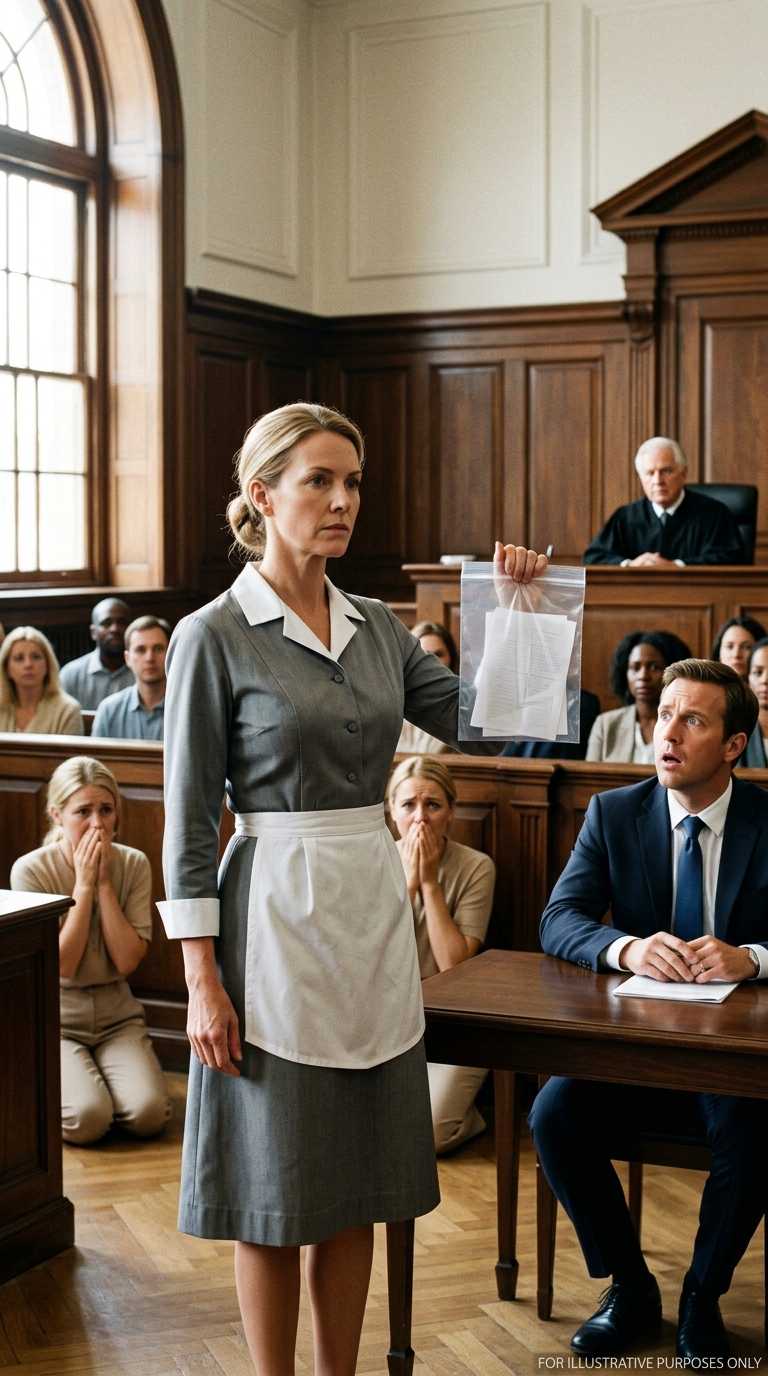
“I am a housekeeper at the Caldwell residence. I served Mr. August Caldwell his tea most nights.”
Ethan’s eyes filled.
Clara looked at him only once, and that was enough.
Judge Whitcomb leaned forward. “Ms. Bennett, you understand that interrupting a verdict and accusing people in open court carries serious consequences.”
“Yes, Your Honor.”
“Then you had better have more than emotion.”
Clara lifted the recorder in one hand and the envelope in the other.
“I have a recording made by August Caldwell on the night he died. I have financial documents proving Preston Vale stole from him for years. I have August Caldwell’s final letter saying he feared Preston and Victoria Langley were plotting against him. And I heard them with my own ears planning his murder.”
The courtroom went silent in a way that felt physical.
Preston’s face drained of color.
Victoria whispered, “No.”
It was one small word, but everyone heard it.
Judge Whitcomb’s gaze snapped to her.
Victoria covered her mouth too late.
Preston closed his eyes.
Clara stepped closer. “They were in the study the night Mr. Caldwell died. Mr. Vale said the revised will would ruin them. Ms. Langley said tomorrow could not happen. They planned to make Ethan look guilty because the world would believe a spoiled son killed for money.”
“That is a lie!” Victoria shrieked.
Judge Whitcomb pointed the gavel at her. “One more interruption and I will have you removed.”
Preston tried to recover. “Your Honor, any recording must be authenticated. We cannot allow—”
“We will begin by hearing what Ms. Bennett has brought,” the judge said. “Bailiff, take possession of the materials.”
Clara held tight for one second.
The bailiff approached gently. “Ma’am.”
She released the recorder and envelope as if handing over her own heartbeat.
A court clerk connected the recorder to the room’s audio system. The old device clicked. Static filled the speakers.
Then Preston Vale’s voice came out clear enough to make people gasp.
“He signed the revision this afternoon. Tomorrow he files it with the probate attorney. Once that happens, the foundation gets nearly everything. We get nothing.”
Victoria’s voice followed.
“Then tomorrow can’t happen.”
A woman in the audience cried out.
The recording continued.
“If the old man dies tonight, suspicion falls naturally.”
“On Ethan,” Victoria said, calm and cruel. “The public will believe anything if the story is ugly enough.”
Ethan gripped the table.
His attorney sat down hard.
The prosecutor went gray.
Then came the line that made the front row recoil.
“That little nobody?” Victoria laughed on the recording. “She’s invisible. Even if she saw God Himself, who would believe her over us?”
The courtroom exploded.
Judge Whitcomb pounded his gavel again and again. “Order! Order or I will clear this room!”
Clara stood motionless, tears sliding down her face. She was not crying from weakness. She was crying because for the first time, the truth had a voice louder than money.
The judge listened to the rest.
There was discussion of poison. The forged timeline. The cup. The plan to point investigators toward Ethan’s debts and arguments with his father. There was enough calculation in their voices to chill the blood of every person present.
When it ended, the silence was absolute.
Judge Whitcomb removed his glasses.
“Ms. Langley,” he said quietly, “would you like to explain why your voice appears on a recording planning the death of August Caldwell?”
Victoria stood trembling. “It’s fake.”
Preston gripped her arm. “Sit down.”
“It’s fake!” she screamed louder. “He couldn’t have recorded us. I checked the desk. There was nothing on the desk!”
The second the words left her mouth, she understood.
The room understood with her.
Judge Whitcomb’s face hardened. “You checked the desk?”
Victoria stared at him, lips parted.
Preston slowly released her arm.
Clara whispered, “The recorder was taped under the side table.”
Reporters began typing furiously.
The judge ordered the envelope opened.
The documents came next. Bank records. Transfers. Forged signatures. Shell companies tied to Preston Vale. A copy of August Caldwell’s revised will leaving a large portion of the estate to a charitable foundation for workers’ housing, a portion to Ethan, and a surprising smaller trust to Clara Bennett, “for loyalty and kindness shown without expectation of reward.”
Clara shook her head when the clerk read that part aloud.
“No,” she whispered. “I didn’t know. I never asked him for anything.”
Judge Whitcomb looked at her with something like sorrow. “That may be why he chose you.”
Then came the letter.
The clerk read it aloud.
If you are reading this, Clara, then the wolves finally came. My son is flawed, proud, and too trusting, but he is not a killer. Tell him I loved him even when I did not know how to say it. Take this to justice. Let the truth outlive me.
Ethan broke.
He covered his face with both hands, the handcuff chain clinking softly, and sobbed like a child who had waited too long to hear his father say the one thing he needed.
Clara looked away to give him the dignity the world had denied him.
Victoria, however, gave herself none.
“This is her fault,” she snapped, pointing at Clara. “That little maid ruined everything.”
Preston hissed, “Victoria, stop talking.”
But panic had shattered her elegance.
“I was supposed to have a life,” she cried. “Do you know what it feels like to stand beside all that wealth and know none of it is yours? August looked at me like trash. Ethan would have given me anything, but the old man kept poisoning him against me.”
The prosecutor stood slowly.
Judge Whitcomb’s voice was cold. “Ms. Langley, are you confessing to conspiracy in the death of August Caldwell?”
Victoria laughed wildly, tears finally real. “Conspiracy? Preston handled the poison. Preston forged the papers. Preston told me when to cry. I only did what I had to do.”
Preston lunged. “Shut up!”
Deputies moved instantly.
“Take them into custody,” Judge Whitcomb ordered.
The courtroom became chaos. Victoria screamed as deputies cuffed her. Preston shouted about lawyers and unlawful procedure while his own briefcase spilled papers across the floor. Cameras flashed so fast the room seemed filled with lightning.
Through it all, Clara stood beside the aisle, shaking.
Ethan turned toward her.
For the first time in weeks, there were no bars, no cameras, no lies between them. Just a man who had lost everything and a woman who had risked everything because a dead man trusted her and a living man needed truth.
Judge Whitcomb restored order with difficulty.
Then he faced Ethan.
“Mr. Caldwell, based on the evidence presented, this court vacates any movement toward verdict and orders your immediate release pending formal dismissal of all charges. The court also refers all new evidence to the district attorney for immediate criminal proceedings against Victoria Langley and Preston Vale.”
Ethan’s lips parted, but no sound came.
The judge’s voice softened. “On behalf of this court, I acknowledge the grave injustice nearly committed here today.”
The deputy unlocked Ethan’s cuffs.
The sound was small.
The meaning was enormous.
Ethan rubbed his wrists, stood slowly, and walked toward Clara. The courtroom watched. The reporters watched. The whole country, watching through cameras, watched.
He stopped in front of her.
“Why?” he asked, voice broken. “You barely knew me.”
Clara wiped her cheek. “Your father did.”
Ethan closed his eyes.
“He wanted you to know he loved you,” she said. “He wrote that because he knew you might not believe it if anybody else said it.”
Ethan nodded, but the tears came again.
Then he did something nobody expected.
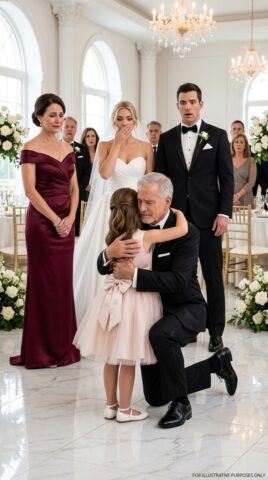
The millionaire everyone had called arrogant, spoiled, and heartless lowered himself to his knees in front of the maid everyone had ignored.
“Thank you,” he whispered.
Clara quickly reached for his shoulders. “Please don’t. Stand up.”
But he shook his head. “No. For once in my life, let me know where I belong.”
The courtroom fell silent again, but this silence was different. Softer. Human.
Six months later, the Caldwell mansion no longer looked like a museum of wealth and secrets.
The portrait of August Caldwell was back over the fireplace. The staff no longer had to enter through the back unless they wanted to. Mrs. June Mercer ran the household like a benevolent general and terrified every contractor who overcharged the foundation.
Preston Vale pleaded guilty after investigators uncovered years of fraud. Victoria Langley tried to blame everyone but herself until the recording, documents, and her own courtroom confession buried her defense. Both went to prison.
Ethan sold three luxury properties and used the money to launch the August Caldwell Foundation for Working Families, exactly as his father’s revised will intended. It funded legal aid, housing assistance, and emergency grants for domestic workers, hotel employees, and people who spent their lives being unseen by the powerful.
Clara did not become a society woman.
She did not move into the mansion as its queen. She did not start wearing diamonds or pretending wealth made her different.
She used part of the trust August left her to buy a small house for her mother near a good clinic. She helped June open a bakery she had dreamed about for twenty years. She went back to school at night to study law, because after what she had seen, she understood that justice needed more people who knew what it meant to be powerless.
One autumn afternoon, Ethan found her outside the foundation’s first housing project, watching workers paint the front doors of apartments that would soon belong to families who had never imagined safe walls and working heat could feel like a miracle.
“You know,” Ethan said, standing beside her, “my father would have loved this.”
Clara smiled. “He would have complained about the paint color.”
Ethan laughed, and for the first time, it did not sound like something broken trying to pretend.
After a moment, he said, “I spent years thinking money made people important.”
Clara looked at the building, at the workers, at the open windows catching sunlight.
“Most people with money think that.”
“I don’t anymore.”
“No?”
He shook his head. “The most important person in my life walked into court wearing a maid’s uniform.”
Clara turned to him. “I wasn’t trying to be important.”
“I know,” Ethan said. “That’s why you were.”
For a long time, they stood in quiet understanding.
The world had called Clara Bennett nobody.
A nobody who had listened.
A nobody who had remembered.
A nobody who had carried truth through fear, bruises, threats, and a courtroom full of people waiting for a rich man to fall.
But in the end, it was not wealth that saved Ethan Caldwell.
It was not power.
It was not influence, expensive lawyers, family names, or polished lies.
It was the courage of a woman the guilty had mistaken for invisible.
And by the time Clara Bennett finished speaking, no one in America would ever make that mistake again.