
Emily touched her coat pocket.
“It died.”
“Don’t charge it here.”
Emily looked at her mother.
“Why?”
Nora’s eyes moved toward the curtain, then back.
“Because last night, after they took my badge, a courthouse security supervisor asked if I had recorded anything. I said no.” Her voice trembled. “He told me that was good because recordings make honest people look confused.”
Emily reached into her pocket and pulled out the strip of black tape stuck to the folded pharmacy receipt.
Nora stared at it.
Her breathing changed.
“Where did you get that?”
“From your uniform pocket.”
Nora swallowed.
“I picked it up by the garage drain,” she whispered. “It fell off the device after he dropped it.”
“Victor Hail?” Emily asked.
Nora shut her eyes again.
That was answer enough.
Outside the curtain, shoes stopped.
Not nurses’ shoes. Not hurried shoes.
Men’s shoes.
Heavy. Polished. Still.
Emily slipped the tape into the folded receipt and pressed it flat under her palm.
The curtain opened two inches.
A man in a tan blazer stood there with a visitor sticker crooked on his lapel. His smile came first. Too clean. Too practiced.
“Mrs. Carter,” he said, “I’m from courthouse administration. We’re just checking on you after your incident.”
Nora did not answer.
The man’s eyes flicked to Emily.
Then to the pharmacy bag.
Then to the coat pocket where the dead phone made a square shape under the fabric.
“You must be Emily.”
He reached into his jacket and pulled out a white envelope.
“Your mother has had a hard day. Sometimes misunderstandings happen. This can help with medicine. Rent. Whatever you need.”
Emily looked at the envelope but did not take it.
“Why would you pay us if nothing happened?”
The man’s smile held, but only because he forced it.
“It’s not payment. It’s kindness.”
Emily looked at his visitor sticker. It had been printed at 11:04 a.m. The courthouse was at least twenty minutes away without traffic. The news banner on the television had said Dominic Moretti would leave court at 11:15.
The man followed her eyes.
Slowly, he peeled the sticker off his jacket and folded it once in his hand.
“Smart kids,” he said softly, “should know when adults are trying to help them.”
Nora pushed herself up, wincing.
“Get out.”
For the first time, the man stopped smiling.
“Mrs. Carter, I’d hate for your daughter to be dragged into something dangerous because you misunderstood a late-night maintenance check.”
Emily’s chest went cold.
Maintenance check.
That was what Nora had written on the back of an unpaid hospital invoice at 2:13 a.m., right beside three letters.
MKL.
The same letters Emily had seen on the garage badge in the dead phone’s broken video.
The man left without the envelope.
But when Emily looked down, she saw he had placed something on the tray beside her mother’s water cup.
A new visitor badge.
Already printed with Emily’s name.
And beneath it, in small black letters, the destination line read Courthouse Garage.
Part 2
Emily did not touch the badge at first.
It sat beside the plastic water cup like something alive, its white surface too clean against the scratched hospital tray.
Her name was printed in neat black letters.
Emily Carter.
No one at the hospital front desk had asked for it.
No one should have known she was there.
Nora stared at it with the same look she had when glass broke in the hallway outside their apartment. Not surprised exactly. Already tired of being afraid.
“Put it in your pocket,” Nora whispered. “Not the outside one.”
Emily slid the badge beneath the folded pharmacy receipt beside the strip of black tape. Then she tucked both into the inner lining of her coat where a seam had come loose. Her fingers found the dead phone there too, hard and warm from her hand, like a secret that had not finished speaking.
The nurse came in with a paper cup of ice chips and tried to make her voice bright.
“Sweetie, maybe you should sit in the family room for a while.”
But Emily saw the nurse glance at the doorway first.
Adults always looked at doors when they were afraid of whoever was outside them.
Emily looked at the clock above the sink.
11:09.
Six minutes before Dominic Moretti was expected to leave court.
“Mom,” Emily said quietly. “What did MKL mean?”
Nora’s eyes filled, but she did not cry.
“It was on the badge of the man in the garage. Three letters. I wrote them down because the camera over the freight elevator was blinking red like it was recording, but the one over the garage gate was dark.”
Emily remembered the dead phone’s broken video. The gray blur of concrete. Her mother’s breathing. A low male voice speaking like he owned the night.
“Was it Victor Hail?”
Nora’s mouth tightened.
“I saw his face when the van door opened. Silver hair. Navy coat. The kind of man who makes people apologize when he bumps into them.”
“And the other man?”
Nora shook her head.
“I didn’t see him. I only heard him. Younger. Angry. He said the family would tear itself apart before breakfast.”
Outside the room, the polished shoes moved again, then faded down the hall.
Emily waited until the sound was gone.
Then she stood.
“I have to go.”
Nora grabbed her wrist with surprising strength.
“No.”
Emily looked at the missing shoe under the bed. The unpaid bill clipped to the chart. The bruise on her mother’s cheek. The visitor badge printed before anyone had invited her anywhere.
“They already know my name,” Emily said. “Staying here doesn’t hide me.”
Nora’s hand trembled, then loosened.
She reached under the blanket and pulled out her employee ID. It was cracked across one corner. The blue lanyard still smelled faintly of bleach.
“If anyone stops you,” Nora whispered, “don’t say you’re my daughter first. Say you found this.”
Emily took it.
Her mother held on one second longer.
“Em.”
Emily looked back.
“If he believes you, don’t trust that either.”
Emily did not understand.
Nora’s eyes were tired but clear.
“Powerful men are not safe just because they are almost dead.”
Emily nodded even though her throat hurt.
Then she ran.
The hospital hallway seemed twice as long as before. Vending machines hummed. A janitor pushed a mop bucket past without looking up. On the television, the courthouse steps reappeared in live footage, bright under a hard white sky.
Dominic Moretti was already outside.
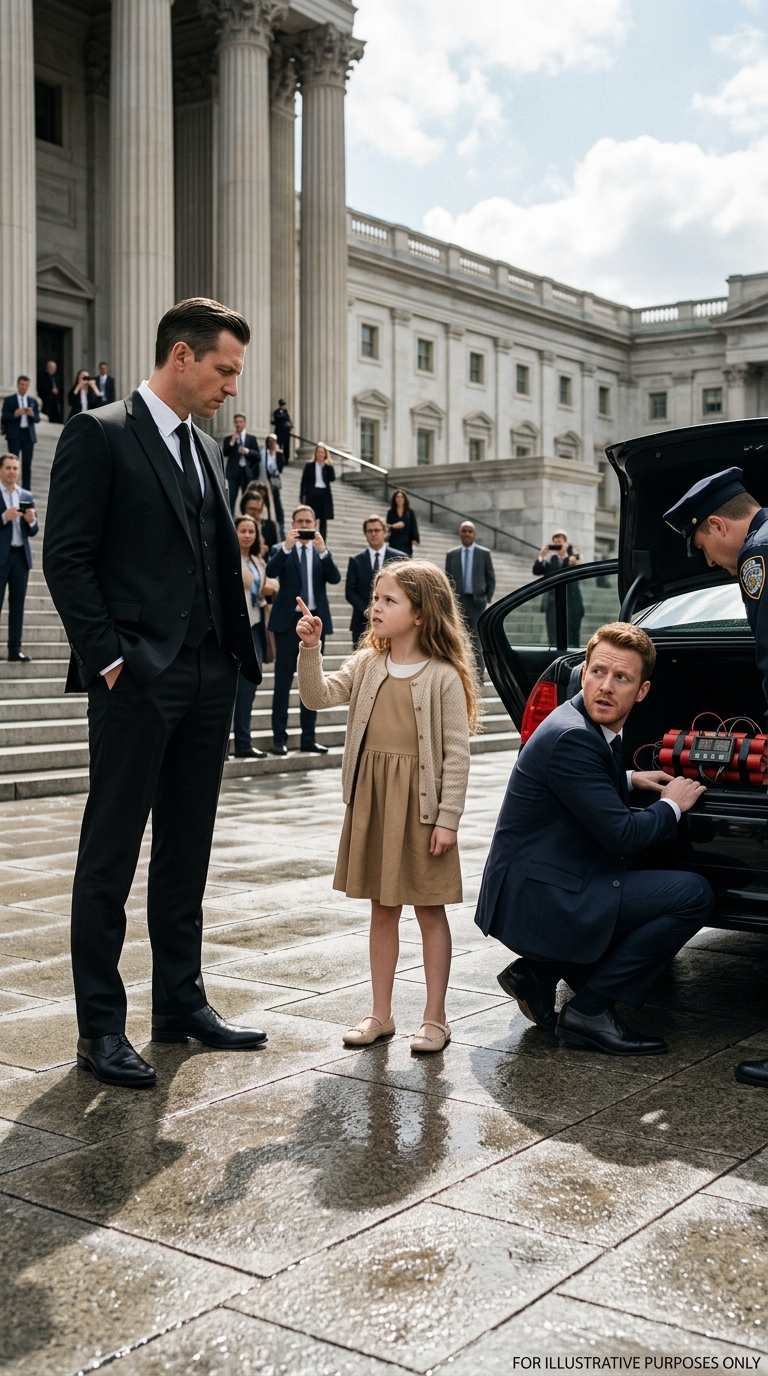
Emily saw the black SUVs at the curb. The barricades. The microphones. Victor Hail standing half a step behind Dominic with one hand near the inside of his coat.
The remote shape was gone from his pocket now.
But the black tape was not.
A tiny torn edge clung to his cuff, fluttering once when he lifted his hand to guide Dominic toward the open rear door.
Emily stopped breathing.
The strip hidden in her receipt was not just tape from a device.
It matched the piece still stuck to Victor Hail’s sleeve.
She ran harder.
By the time Emily reached the courthouse block, the sidewalks were packed behind metal barricades. Reporters stood on tiptoe. Camera crews pointed lenses at the black SUVs like they were waiting for a storm to choose a door.
Emily was too small to see over shoulders, so she ducked under one arm, squeezed between a man with a tripod and a woman holding a microphone, and slipped out near the first row of barriers.
A marshal in a dark suit stepped in front of her.
“Back behind the line, sweetheart.”
His voice was polite.
His hand was not rough, but it was final.
Emily held up her mother’s cracked ID.
“My mom works here. I need to tell someone about that car.”
The marshal glanced at the badge, then at Emily’s scuffed sneakers, her hospital bracelet, and the pharmacy bag clutched against her chest.
“Your mom can call the office,” he said. “This area is restricted.”
Behind him, Dominic Moretti had stopped near the SUV while Victor leaned close to say something into his ear.
Six bodyguards formed a black wall around them. Expensive coats. Clear earpieces. Hands folded at their waists like they could fold the whole city in half if ordered.
Emily saw the remote again.
Not in Victor’s pocket now, but in his right hand, mostly hidden beneath the leather folder.
The torn edge of tape on his cuff matched the piece in her receipt so perfectly her stomach turned.
“Please,” she said.
But the word disappeared under camera shutters.
A woman from courthouse administration appeared beside the marshal. She had the same calm smile as the man at the hospital.
“Is this the Carter child?” she asked softly, as if Emily were a misplaced item.
The marshal frowned.
“You know her?”
“Her mother had an incident last night.” The woman bent toward Emily, lowering her voice without making it kinder. “Honey, this is not the place. Important people are handling this.”
Emily looked past her.
Dominic had put one hand into his coat pocket. Victor was guiding him closer to the open rear door.
“Important people missed it,” Emily said.
The woman’s smile thinned.
“Missed what?”
Emily pulled out the folded pharmacy receipt and opened it just enough to show the black tape.
“This came off his button.”
For the first time, the woman’s eyes moved too fast.
Not to the tape.
To Victor.
It lasted less than a second.
Then she straightened.
“She needs to be removed from the press area.”
A bodyguard heard the change in tone and turned.
Dominic turned too, not all the way, just enough for Emily to see the side of his face.
The marshal reached for Emily’s shoulder.
Emily stepped backward, small and steady, and raised her voice so it cut between two camera flashes.
“Ask him why his car remote has courthouse tape on it.”
The words landed strangely.
Not loud enough to cause panic.
Sharp enough to make several adults stop pretending they had not heard.
Victor’s hand closed around the leather folder.
His smile remained in place.
“Children repeat whatever frightened adults tell them,” he said. “Mr. Moretti, we should go.”
Dominic did not answer at once.
His eyes had dropped to the torn strip in Emily’s hand. Then they moved to Victor’s cuff, where the matching black edge clung like a small guilty flag.
Victor must have felt the look because he calmly brushed his sleeve with two fingers and made the tape vanish into his palm.
For everyone else, the moment was over.
For Emily, it was the first time she had seen a powerful man make a mistake while trying to look innocent.
Victor Hail’s fingers closed around the scrap of tape.
For one second, he looked relieved.
Then Emily lifted her other hand.
Between her thumb and forefinger was the folded pharmacy receipt, already soft from sweat. Inside it was the first strip of tape, the one from Nora’s uniform.
Victor saw it before anyone else did.
His eyes did not widen. He was too practiced for that. But the skin beneath his left eye tightened.
Dominic noticed.
“What is that?” Dominic asked.
The courthouse steps went quieter in uneven layers. First the reporters closest to them. Then the marshals. Then the men in black coats who were used to being the reason other people went quiet.
Emily did not walk toward Dominic.
She held her ground behind the barricade and unfolded the receipt just enough for the black strip to show.
“This one came from the garage,” she said. “That one came from his sleeve.”
Victor gave a soft breath that almost sounded like sympathy.
“Mr. Moretti, this is exactly what I warned you about. A frightened child. A sick mother. Scraps of trash turned into a conspiracy. We cannot let street confusion dictate security decisions.”
Emily’s cheeks burned, but she did not lower the receipt.
“Trash doesn’t match unless it came from the same roll.”
One of Dominic’s bodyguards, a square-jawed man named Silas, stepped closer.
“Boss.”
Dominic did not look at him.
He was looking at the pharmacy receipt. At the number stapled to the top. $187.43. At the orange stain where a pill bottle had leaked. At the strip of black adhesive pressed flat like a dead insect.
Then his gaze moved to Victor’s closed palm.
“Open your hand.”
Victor’s smile stayed in place.
“Dominic.”
“Open it.”
The second command was quieter.
That made it worse.
Victor opened his hand slowly.
The matching scrap of tape lay across his lifeline, curled from the warmth of his skin.
Silas took both pieces with a handkerchief and held them side by side.
They were not just similar.
The torn edges met like two halves of the same wound.
Still, Victor did not break.
“That proves I brushed against some tape,” he said. “Nothing more.”
Dominic took the receipt from Silas and stared at the back.
There was writing there.
Faint pencil pressed hard into paper.
2:13 a.m. MKL. Black van. Navy coat. Door does the rest.
The words were uneven, as if written by someone whose hand had been shaking.
Dominic’s face changed, but only by a degree. Emily saw it because she was watching him the way children watch adults who might decide their whole life in one breath.
His eyes stopped on one phrase.
Door does the rest.
For the first time, Dominic looked at the SUV not as his car, not as his escape from court, but as an object waiting for him.
Victor reached for the receipt.
“That is private medical trash from an unstable employee. Give it to me before this becomes evidence of harassment.”
Emily pulled it back against her chest.
“My mother wrote it before they fired her.”
“Your mother was removed for entering a restricted area.”
“She was cleaning it at two in the morning. That was her shift.”
The simple answer made Victor pause half a beat too long.
Dominic heard the pause.
He had spent his life listening for pauses in men who lied for a living.
He turned to Silas.
“Check the undercarriage.”
Victor’s head snapped toward him.
“That is unnecessary.”
Dominic did not raise his voice.
“Then it will be quick.”
A marshal objected that the courthouse curb was not a private security zone. A reporter asked if there had been a threat. Someone behind the barricade whispered the word bomb, and fear moved through the crowd like cold wind under a door.
Silas crouched by the SUV with a compact inspection mirror and slid it beneath the rear passenger side where Dominic’s foot would have landed.
The mirror disappeared into the shadow below the running board.
For three seconds, nothing happened.
Then Silas stopped moving.
The back of his neck went rigid.
Dominic saw it before Silas spoke.
Victor saw it too.
Emily held the receipt so tightly the paper creased across her mother’s handwriting.
Silas looked up slowly.
“Mr. Moretti,” he said, his voice flat in the way trained men sounded when panic had to wait. “Step away from the vehicle.”
Dominic did not step right away.
He looked at Victor Hail, the man who had stood beside him through indictments, funerals, weddings, raids, and family wars.
Then Dominic’s hand drifted away from the SUV door as if the metal itself had become poisonous.
He stepped back.
And the courthouse erupted.
Part 3
Dominic Moretti stepped away from the SUV as if distance had become a kind of language.
He did not shout.
He did not reach for Victor.
He did not give the crowd the explosion of anger they expected from a man with his name.
He only lifted two fingers.
His men understood.
Silas moved the reporters back another twenty feet. Another guard pulled Emily behind the courthouse column, shielding her with his body before she realized anyone had chosen to protect her. A marshal began speaking into his radio so fast his words blurred.
Someone killed the SUV engine.
In the sudden quiet, the soft ticking beneath the vehicle seemed louder than sirens.
Victor Hail took one controlled step toward Dominic.
“This is exactly why we cannot let panic guide us,” he said. “Someone could have planted anything under there. You have enemies in every direction.”
Dominic looked at him for a long moment.
“I know.”
Victor’s shoulders eased almost invisibly.
He thought the sentence had saved him.
Dominic turned away before Victor could see his eyes.
“Take the child and her mother somewhere warm,” he said to Silas. “No phones except mine. No one touches what she gave us.”
Emily looked up quickly.
“I don’t want money.”
The words came out sharper than she meant them to.
Around her, adults looked down with the tired pity they used when poor people mentioned money first, even to refuse it.
Emily swallowed and held the wrinkled receipt against her chest.
“I want my mom not to be called crazy. And I want him away from that button.”
Dominic’s face did not soften.
But something in his silence shifted.
“Fair,” he said.
That was all.
They took Emily through a side courthouse hallway that smelled of floor polish, old paper, and rainwater dragged in from shoes. Outside, a storm had started without anyone noticing, tapping against the tall windows in thin gray lines.
Nora was brought from the hospital in a county transport chair, a blanket over her uniform, her hospital bracelet still loose on her wrist.
When she saw Emily, she tried to stand.
Emily ran to her.
For one second, Nora held her daughter so hard that all the men in the hallway looked away.
In a small witness room with beige walls and a coffee machine that hissed like it was tired, Emily sat beside her mother and listened to a plastic spoon touch the inside of a paper cup over and over while Silas stirred coffee he never drank.
For almost two minutes, nothing happened.
No one yelled.
No one explained.
Rain tapped the glass.
The dead phone lay on the table between the remote, the tape, the receipt, and Nora’s cracked employee ID.
Dominic stood near the door, reading the ID as if it were a contract.
Nora Carter. Night sanitation. Lakeshore Federal Courthouse Annex. Seven years.
He looked at her hospital bracelet.
Admitted 8:46 a.m.
Then he looked at the termination form Silas had pulled from courthouse administration.
Dismissed for erratic conduct at 8:10 a.m.
Dominic’s eyes stopped moving.
“She was fired before she was admitted.”
Victor, who had insisted on joining them as counsel, gave a soft, reasonable sigh.
“Administrative timestamps are often entered later. You know how offices are.”
Dominic did not answer.
He took out his phone and called a number that made Silas glance up.
“Mara,” Dominic said quietly. “I need every camera from the courthouse garage between two and three this morning. Not the edited package. The raw feed. And pull access logs for any key card marked MKL.”
Victor’s polite mask held.
But his thumb moved once across his screen, fast and low, as if sending a text from inside his pocket.
Emily saw it.
She did not speak right away.
She reached across the table and touched Dominic’s sleeve.
Not pulling this time.
Only stopping him before he turned.
“He just did it again,” she whispered.
Victor smiled at her sadly.
“Children see ghosts after frightening mornings.”
Emily looked at his pocket.
“Then why is your phone upside down?”
The room went still.
Dominic’s gaze dropped.
Victor’s phone was half hidden in his coat pocket. Screen facing outward. Upside down. A blue message bubble still glowing for one careless second before it locked.
Dominic did not grab it.
He only looked at Victor with the expression of a man adding a column of numbers that had been wrong for years.
The old phone on the table buzzed once as Silas connected it to a charger.
Its cracked screen lit up.
A saved voice memo appeared beneath Nora’s name.
The file was no longer titled Garage.
It had renamed itself from the first clear line of the recording.
Victor said the boss will never suspect me.
No one moved.
Even the rain against the courthouse glass seemed to soften, as if the building itself had leaned closer.
Dominic Moretti looked at the file name, then at Victor Hail.
He did not press play.
That restraint frightened Emily more than shouting would have.
Victor adjusted his cuff slowly, the way a man might straighten a picture frame in a burning house.
“A corrupted file can rename itself from anything,” he said. “Metadata is unreliable. Old phones are not evidence.”
Dominic nodded once.
“Then we won’t use the phone first.”
He turned to Silas.
“Bring in the garage access log. Leave the hallway camera on.”
Silas opened the door.
The little red light above the witness room camera blinked twice, then held steady.
Victor saw it.
Emily saw him see it.
A few minutes later, Silas placed a printed sheet facedown on the table, then a sealed manila envelope marked Raw Garage Feed.
Dominic did not touch either one.
Instead, he asked Victor a question so mild it made the room colder.
“What time did you leave the courthouse last night?”
Victor blinked once.
“Around midnight. Maybe a little after.”
“And after that?”
“Home. Alone.” Victor gave a thin smile. “Unless you are asking as a friend or a prosecutor, I don’t see the relevance.”
Dominic’s eyes did not change.
“I’m asking as the man who almost opened that door.”
The words landed.
For the first time, Victor looked away before answering.
“I went home.”
Emily watched his hands.
Adults lied with their mouths. Their hands always tried to finish the truth.
Victor’s right thumb rubbed the side of his index finger. The same motion he had made on the courthouse steps after hiding the tape.
Emily leaned toward Dominic.
Not dramatically.
Not like a witness on television.
Just a child trying not to be louder than the room.
“He said the wrong time.”
Victor sighed.
“Now she remembers more.”
Emily shook her head.
“No. My mom’s mop bucket squeaks. In the recording, it squeaked three times before he said two thirteen. She only takes that route after the freight elevator locks at two.”
Dominic’s gaze moved to Nora.
Nora nodded once, her hospital bracelet sliding down her wrist.
“Freight elevator shuts down for reset at two every night. Security knows.”
Dominic turned the printed sheet over.
Access log.
MKL temporary card. Entry 2:07 a.m. Garage B. Exit 2:31 a.m.
Under it, a second card number appeared.
Higher access.
No name attached.
Entry 2:05 a.m. Exit 2:34 a.m.
Victor glanced at the sheet and gave a careful laugh.
“Temporary contractor badges. That building is full of them.”
Dominic slid a pen across the table.
“Write your initials.”
Victor looked at him.
“Excuse me?”
“You sign my filings every week. Write your initials.”
It sounded harmless.
That was why it was not.
Victor picked up the pen with a controlled hand and wrote VH on the corner of the access log.
Emily stared at the letters.
Her brow folded.
“That’s not how you wrote it on the garage form.”
Victor’s pen stopped moving.
“What form?”
Dominic opened the manila envelope, but only halfway.
Inside was a photocopy of a late-night vehicle authorization. The signature at the bottom was Victor Hail’s name, but the H leaned backward like a hook.
Emily pointed before anyone asked her to.
“That H is the same one on the paper my mom copied MKL from. She said it looked like a chair falling over.”
For a moment, Victor forgot to smile.
The camera light blinked above the door.
The phone on the table vibrated again.
The voice memo waited to be played.
Dominic placed the real initials beside the copied authorization. Then he looked at Victor with a calm so deep it felt like a locked room.
Victor finally understood.
The child was no longer asking adults to believe her.
Dominic Moretti was using her memory to make him prove himself innocent.
The witness room door opened without a knock.
Mara Voss stepped in carrying a black laptop, a courthouse evidence drive, and the kind of stillness that made even Silas move out of her way.
She was not one of Dominic’s soldiers. She was the woman who had cleaned his books, buried his mistakes, and kept his empire legal enough to breathe. Her heels made no sound on the cheap tile.
She placed the laptop on the table.
“Raw garage feed,” she said. “No edits. No courthouse package.”
Victor’s mouth tightened.
“You obtained that without counsel present.”
Mara looked at him.
“I am counsel.”
Dominic turned the laptop so everyone could see.
The video opened in gray-green security light.
Garage B.
2:05 a.m.
A black van rolled into frame.
At 2:07, a man wearing an MKL contractor badge stepped out with a metal case.
At 2:09, Victor Hail appeared in his navy coat.
Not rushing.
Not hiding.
Holding the same leather folder he had carried on the courthouse steps.
Emily’s hand found her mother’s under the table.
Nora squeezed once.
The room watched in silence as the contractor knelt beside Dominic’s SUV.
The timestamp glowed in the corner.
2:13 a.m.
The mop bucket entered the edge of the frame, pushed by Nora Carter, small and tired in her gray uniform.
The video had no sound, but Emily could almost hear the squeak.
One.
Two.
Three.
Victor turned sharply.
Nora froze.
Then the second man stepped from behind the van.
Dominic’s face went completely still.
It was Anthony Bell.
His younger cousin.
His blood.
The man who had stood beside him at his sister’s funeral with a black tie and wet eyes.
In the video, Anthony handed Victor a document packet and tapped the bottom page twice.
Mara slid a paper copy across the table.
“Transfer of operating control,” she said. “Harbor logistics, three casinos, two restaurants, and every shell company you use for cash flow. All signed to Bell Holdings in the event of your death or incapacity.”
Dominic looked down at the signature.
It was his name.
But the slant was wrong.
The M was too narrow.
The final letter curled like Victor’s courtroom notes.
Emily leaned forward.
Barely above a whisper.
“That’s the chair-falling H.”
Mara turned one page.
At the witness line, Victor Hail had signed beside the same backward hook Emily had noticed.
The old phone on the table lit again as the recovered voice memo finished loading from backup.
Dominic pressed play himself.
Concrete hiss.
Mop wheels.
Victor’s voice, low and almost bored.
“Once Moretti steps outside court, the door does the rest.”
Then Anthony, clearer than anyone expected.
“When the car goes up, you file the transfer before the family starts shooting.”
Nobody moved.
Victor closed his eyes for half a second.
Not in guilt.
In calculation.
Dominic did not speak.
He looked at the laptop, then the contract, then Nora’s bruised face, then Emily’s small hand flattened over the receipt as if the paper might run away.
For the first time all day, the most feared man in the courthouse looked pale.
Not because he had almost died.
Because a woman with a mop and a child with a pharmacy receipt had guarded the truth better than the men paid to guard his life.
Outside the witness room, the hallway camera blinked red.
Dominic lifted the remote, the tape, the contract, and the old phone one by one, placing them in a straight line on the table.
Victor opened his mouth.
Dominic raised one finger.
The room went colder than silence.
“Call the federal marshal back in,” he said. “And tell Anthony Bell I want him on these courthouse steps.”
Victor Hail finally lost the careful rhythm of his breathing.
He looked toward the door, toward the laptop, toward the old phone, toward Emily, as if one of them might still offer him an exit.
None did.
Ten minutes later, Anthony Bell was brought through the side entrance in a charcoal suit and a rain-dark overcoat. His hair was still perfect. His face had already arranged itself into grief before he knew who was watching.
He stopped when he saw the evidence lined in a straight row across the table.
The remote.
The black tape.
The garage footage paused at 2:13 a.m.
The forged transfer.
Nora’s employee ID.
And the cracked phone that had refused to die.
Dominic did not accuse him.
He only turned the laptop around and pressed play.
Anthony watched himself step from behind the black van. Watched himself hand Victor the packet. Watched Nora’s mop bucket roll into frame.
His face emptied slowly.
Not from shame.
From the terrible realization that the people he had not counted as people had seen him clearly.
The federal marshal came in after that.
Then two investigators from courthouse security.
Then Mara Voss with copies already sealed in evidence envelopes.
Victor asked for counsel.
Anthony asked to speak to Dominic alone.
Dominic gave them both the same answer.
“No.”
Outside, on the same steps where Emily had been grabbed and called confused, Dominic stood before the cameras with Nora in a wheelchair beside him and Emily holding her mother’s cracked ID in both hands.
He did not make himself the hero.
He named every piece of evidence.
He named the forged report that called Nora unstable.
He named the termination form filed before she even reached the hospital.
Then he looked at the courthouse administrator who had tried to remove Emily and spoke into every microphone.
“You will correct her record today.”
The woman’s apology came stiff at first, all policy and regret, until Dominic turned and looked at her without blinking.
Then she faced Nora properly.
“Mrs. Carter,” she said, voice thinner now. “You were telling the truth. You should not have been fired. You should not have been dismissed. I am sorry.”
Nora did not smile.
She only nodded once.
Dignity did not require gratitude.
In the weeks that followed, Victor Hail lost his license pending investigation. Anthony Bell was removed from every family-controlled company, and the forged transfer became federal evidence instead of a weapon.
Nora’s back pay arrived with a corrected personnel file and a formal letter clearing her name.
Her hospital bill did not vanish by magic. Mara assigned an attorney who made the courthouse contractor’s insurer pay it line by line because Dominic insisted that help should leave a paper trail no one could later call charity.
Emily received a school placement outside the neighborhood, a witness protection contact, and a small card with Dominic’s private number written on it in blue ink.
She kept the old phone too, cracked screen and all, sealed in a clear evidence bag until the case no longer needed it.
The first time Dominic visited their new apartment, he brought no envelope of cash.
He brought groceries, legal documents, and a winter coat for Nora that still had the tags on because he had not known how to buy something ordinary without help.
Emily made grilled cheese at the tiny stove while rain tapped softly against the kitchen window.
Dominic sat at the table, too large for the room, watching the old phone rest beside a glass of milk like a relic from a war no one else would understand.
Emily slid the glass toward him.
“You can drink it,” she said. “I checked it first.”
For a moment, Dominic could not speak.
Then he laughed once, quietly, with more sadness than humor, and took the glass in both hands.
Across the table, Nora’s corrected ID lay under the warm kitchen light. Her name was unbent. Her job restored. Her truth written down where no powerful man could erase it.
Dominic looked at Emily.
“You were brave,” he said.
Emily shook her head.
“My mom was brave. I was just scared enough to run.”
Nora reached across the table and tucked a loose strand of hair behind her daughter’s ear.
Dominic looked away for a moment, toward the rain, toward the bright little kitchen, toward a life where people still made sandwiches and checked milk before trusting it.
He had spent years believing fear was something he owned.
That day, a child had taught him fear could also be a compass.
It could point to the truth.
It could make a little girl cross a city with a dead phone, a pharmacy receipt, and no one powerful on her side.
It could make a mother with a bruised face keep whispering the time.
It could stop a man from opening the wrong door.
And sometimes, if the world was forced to listen, it could make justice arrive before the explosion.