Earl stood with the help of one hand on his knee.
“That’s it.”
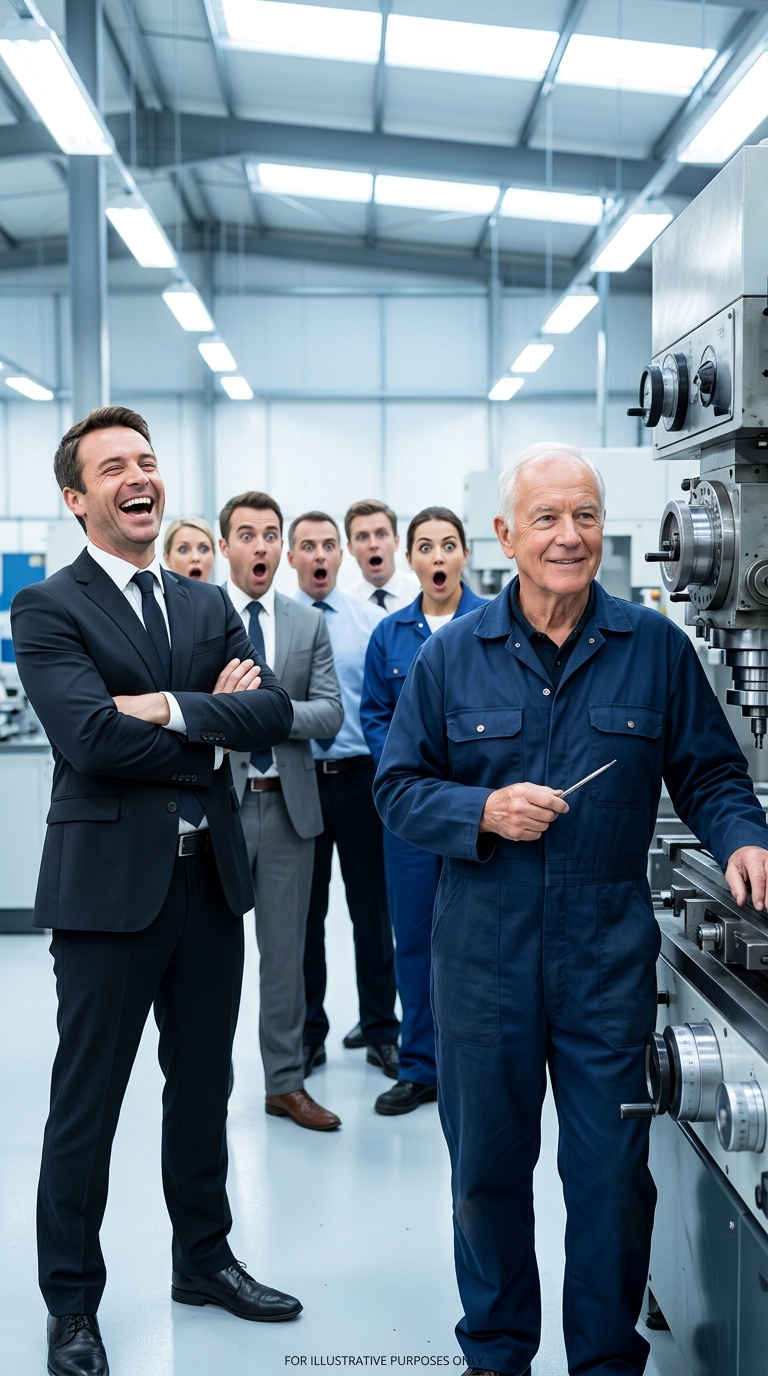
Grant stared at him.
“You were inside that panel for less than two minutes.”
“Closer to ninety seconds.”
Parker let out a humorless laugh. “There is no way.”
Earl turned to Daniel. “Start her from cold. Manual sequence first. Don’t jump to full load.”
Daniel hesitated.
Grant said, “Do it.”
The plant manager radioed the control room.
For a moment, nothing happened.
Then the first low hum moved through the factory.
It started so softly that some people thought they imagined it. A vibration underfoot. A pulse inside the walls. A green light flickered on at station one. Then another at station two. The control panels began waking up in sequence, red warning lights blinking off one by one.
Someone whispered, “No way.”
The conveyor belt moved six inches.
Stopped.
Moved again.
The robotic arm at station seven lowered, reset itself, and returned home.
Across the massive production hall, systems that had been dead for seventy-two hours began returning to life. Motors spun. Hydraulic lines pressurized. Screens cleared their fault codes. The overhead status board shifted from emergency shutdown to controlled restart.
A cheer rose from the workers.
Not polite applause. Not corporate approval. A real cheer.
Men and women who had spent three days afraid for their jobs clapped, shouted, hugged, and wiped their eyes. A forklift operator named Benny threw his hard hat in the air. Someone in the maintenance crew yelled, “That’s what I’m talking about!”
Daniel Price looked like he might collapse from relief.
Parker Ellis stared at the green lights as though they had personally betrayed him.
Grant Winslow stood in the center of it all, his face unreadable.
The line was running.
The factory was alive.
And the old man who had done it was already placing his screwdriver back into his bag.
Grant walked over to him.
“What was wrong?”
Earl zipped the bag. “Tiny misalignment in the auxiliary tension relay. It was feeding a false load signature into the standby loop whenever station seven hit a certain cycle position. System thought the line was about to tear itself apart, so it shut everything down to protect itself.”
Parker shook his head. “But the diagnostics never showed that.”
“They wouldn’t,” Earl said. “The relay wasn’t broken. It was scared.”
Grant frowned. “Scared?”
“That’s what I call it when a machine reacts to a ghost.”
Some workers chuckled.
Grant did not.
He was grateful, of course. Any rational man would be. But gratitude felt different when it arrived wearing humiliation. This old man had done in minutes what Grant’s entire expensive operation could not do in days.
“Send your invoice to accounting,” Grant said.
Earl nodded.
“I will.”
“And Mr. Callahan?”
Earl looked back.
Grant forced the words through his teeth. “Good work.”
Earl studied him for a moment, then nodded once.
“Your people did good work too,” he said. “They just didn’t know which ghost they were chasing.”
Then he walked toward the exit.
Nobody laughed this time.
Part 2
The invoice arrived at 4:37 that afternoon.
By then, the factory had been running for six straight hours. The production recovery team had built a revised schedule. Trucking companies had been contacted. Clients had received careful updates. The board chairman had left Grant a voicemail using the phrase excellent leadership, which Grant replayed twice and then deleted.
The crisis was not over, but the bleeding had stopped.
Grant was in his office overlooking the plant floor when his chief financial officer, Melissa Hart, walked in holding a single sheet of paper.
Melissa was not easily startled. She had survived audits, lawsuits, shareholder revolts, one attempted hostile acquisition, and Grant Winslow’s temper for eight years. But that afternoon, she entered his office wearing the expression of someone carrying either a bomb or a joke.
Grant looked up from his desk.
“What now?”
She placed the invoice in front of him.
“The technician’s bill.”
Grant glanced at it. “Pay it.”
“You should read it first.”
Grant leaned back. “Melissa, I’m not in the mood to argue over a few thousand dollars.”
“It’s not a few thousand dollars.”
He picked up the page.
At the top was a simple header.
Callahan Industrial Diagnostic Services
Abilene, Texas
Below that, in plain black type, were two line items.
Replacement adjustment component: $12
Professional diagnostic service: $699,988
Total: $700,000
Grant stared at it.
Then he laughed.
This time, he laughed fully. Loudly. The kind of laugh that bounced off the glass walls of his office and made his assistant glance in from the outer room.
“Is this real?”
Melissa said nothing.
Grant held up the paper. “Seven hundred thousand dollars?”
“Yes.”
“For turning a screw?”
“For restarting the plant.”
“For turning a screw,” Grant snapped.
Melissa folded her hands. “The plant was down for three days.”
“I’m aware.”
“We were losing nearly eighty thousand dollars an hour.”
“I said I’m aware.”
“If the line had stayed down through the weekend—”
Grant slapped the invoice on his desk.
“I am not paying an old man seven hundred thousand dollars for five minutes of work.”
Melissa’s expression did not change. “Then we need legal in the room.”
“Get them.”
Within twenty minutes, Grant’s conference room held Melissa, Daniel Price, general counsel Rachel Kim, Parker Ellis, two senior executives, and Earl Callahan, who had been called back from a roadside diner twelve miles away where he was halfway through a chicken-fried steak.
Earl arrived carrying the same canvas tool bag.
Grant noticed and hated that he noticed.
The old technician sat at the far end of the polished table beneath a wall screen displaying production recovery metrics. He did not look nervous. He did not look smug. He looked like a man waiting for coffee.
Grant remained standing.
“Mr. Callahan, I’ll get straight to it. This invoice is unacceptable.”
Earl nodded. “All right.”
“All right?”
“You said you’d get straight to it. You did.”
Daniel looked at the table.
Rachel Kim cleared her throat. “Mr. Callahan, we appreciate the service you provided. However, the amount billed appears disproportionate to the labor performed.”
Earl looked at her. “Does it?”
Grant slid the invoice across the table. “You charged twelve dollars for a part and six hundred ninety-nine thousand nine hundred eighty-eight dollars for professional service.”
“Yes, sir.”
“Explain that.”
Earl picked up the invoice, glanced at it, and set it down.
“The twelve dollars is for the adjustment component.”
“What component?” Parker asked.
“Spacer shim. Worn thin. I replaced it.”
Parker frowned. “I didn’t see you replace anything.”
“It was small.”
Grant pointed at the page. “And the rest?”
Earl leaned back.
“The rest is for knowing which twelve-dollar part mattered.”
The room went quiet.
Grant’s eyes narrowed.
“That’s a clever line,” he said. “But clever lines don’t justify seven hundred thousand dollars.”
Earl nodded slowly. “No. Results do.”
Parker leaned forward, unable to stop himself. “With respect, Mr. Callahan, our team had already narrowed the issue to the line synchronization network.”
Earl turned to him. “Had you?”
“Yes.”
“Then why wasn’t it running?”
Parker flushed.
Daniel looked away.
Earl’s voice remained gentle. That made it worse.
“You had good theories,” the old man said. “You had good tools. You had smart people. But the factory was still dead.”
Grant placed both hands on the table.
“You were here less than an hour.”
“I was.”
“You touched one panel.”
“Yes.”
“You turned one screw.”
“Two adjustments,” Earl corrected.
Rachel Kim spoke carefully. “Mr. Callahan, before this becomes adversarial, it may help if you provide an itemized explanation.”
Earl reached into the inside pocket of his jacket and removed a folded sheet of paper.
“I figured you might ask.”
He slid it across.
Grant opened it.
The page was handwritten in neat block letters.
Service breakdown:
Spacer shim: $12
Knowing the failure was mechanical, not software: $75,000
Knowing which diagnostic data to ignore: $100,000
Knowing station seven was the symptom, not the source: $125,000
Knowing the relay was misaligned, not defective: $150,000
Knowing how far to turn the adjustment without damaging the system: $100,000
Forty-seven years of experience making the above possible: $149,988
Total: $700,000
Nobody spoke.
For a moment, the only sound was the faint vibration of the factory below, running because of the man sitting at the end of the table.
Grant read the list twice.
Then he looked up.
“You expect me to believe experience costs that much?”
Earl met his eyes.
“No, Mr. Winslow. I expect you to understand that not having it already cost you more.”
Melissa shifted slightly.
Grant noticed.
He hated that too.
Earl continued. “By the time I walked in this morning, your company had lost close to five million dollars. That’s not counting late penalties, emergency shipping, reputational damage, or whatever promises you had to make to keep your clients calm. I didn’t create that number. Your factory did.”
Grant’s face hardened. “Careful.”
“I am being careful,” Earl said. “That’s why your line is running.”
The words landed hard.
Rachel Kim turned to Grant. “From a legal standpoint, we did request emergency specialized service. There was no pre-negotiated cap. He performed the service successfully.”
Grant stared at her. “Are you telling me to pay this?”
“I’m telling you that refusing may create more exposure than paying.”
Parker looked stunned. “There has to be a standard rate.”
Earl smiled faintly. “There is. For standard problems.”
Daniel finally spoke. “Grant, he saved us.”
Grant turned on him. “You think I don’t know that?”
“I think you’re angry because he made it look easy.”
The room went still again.
Daniel seemed surprised by his own courage.
Grant’s eyes locked on him. “Excuse me?”
Daniel took a breath. “We spent three days drowning. Earl walked in and saw the current. That doesn’t mean the work was small. It means the knowledge was big.”
Parker looked down.
Melissa looked at the invoice.
Rachel watched Grant carefully.
Grant stood at the head of the table, surrounded by people who depended on him, challenged by an old technician who needed nothing from him except payment.
For years, Grant had built his identity around being the smartest person in every room. He had mastered acquisitions, financing, supply chains, automation, labor negotiations, and investor psychology. He had saved his father’s failing machine shop and transformed it into an industrial empire.
But he had never rebuilt a relay with numb fingers in a freezing plant at 3 a.m.
He had never diagnosed a hydraulic press by the rhythm of its vibration.
He had never learned which alarm mattered by hearing the one sound that should not have been there.
And because he had never learned those things, he could not fully respect them.
Not yet.
He picked up the invoice.
“I’ll authorize partial payment.”
Earl stood.
“No.”
Grant blinked. “No?”
“No partial payment.”
“Mr. Callahan, you are in my building.”
“And you’re welcome to keep the invoice in it.”
Earl picked up his tool bag.
Rachel said, “Mr. Callahan, please sit down.”
The old man looked at Grant instead.
“I’m not here to fight you. I’m too old for that, and frankly, I’ve got better things to do. You called me because your factory was down and nobody could tell you why. I told you why. I fixed it. Now you know what that costs.”
Grant’s voice lowered. “And if I refuse?”
Earl shrugged. “Then you refuse.”
“That’s it?”
“That’s it.”
“You won’t sue?”
“I might. Or I might not. Depends how much patience I wake up with tomorrow.”
A nervous laugh escaped someone near the wall.
Earl turned toward the door.
At that exact moment, the conference room phone rang.
Grant looked at the screen.
Control Room.
Daniel grabbed the receiver. “Price.”
His face changed.
Every person in the room saw it.
“What do you mean fluctuating?”
Grant straightened.
Daniel listened, his knuckles whitening around the phone.
“Station seven?”
Parker stood.
Daniel looked toward Earl.
“Same warning pattern,” Daniel said.
The blood drained from Parker’s face.
Grant’s eyes flashed to the factory floor visible beyond the glass wall. The line was still moving, but on the far
overhead board, a yellow warning light had appeared.
Then another.
Grant turned to Earl.
The old man had not moved.
For the first time all day, Earl Callahan looked sad.
“I told your people to start cold and load slowly,” he said.
Daniel’s voice was tight. “We did.”
Earl looked at Parker.
Parker swallowed.
Grant followed the glance.
“What did you do?”
Parker opened his mouth, then closed it.
Daniel lowered the phone. “Parker?”
Parker’s face burned. “I ran a full diagnostic stress simulation during ramp-up.”
Earl closed his eyes.
Grant exploded. “Why?”
“Because I wanted to capture the fault signature before it disappeared again. If we had the data, we could prove exactly—”
“You stressed a system that had just come out of emergency shutdown?”
“It was within digital tolerance.”
Earl opened his eyes. “Digital tolerance isn’t the same as mechanical forgiveness.”
The yellow lights on the board turned red.
A siren chirped once.
Then the factory stopped.
Again.
Not completely this time. Not catastrophically. But enough.
The conveyor froze. The robotic arms locked. Workers looked up in disbelief as the silence returned like a curse.
Grant slowly turned back to Earl.
Nobody in the room breathed.
Earl set his bag on the table.
Then he looked at the CEO and said quietly, “Now we have a different problem.”
Part 3
It took Earl Callahan twenty-three minutes to find what Parker’s stress simulation had damaged.
Not because the second problem was harder than the first.
Because this time, he made everyone watch.
He did not let the executives remain in the conference room. He did not let Parker hide behind a laptop. He did not let Grant stand above the factory floor like a king looking down on a kingdom.
He brought them all to station seven.
Workers gathered at a distance, whispering. The air felt heavier than it had that morning. Hope had come, vanished, and left embarrassment behind.
Earl crouched beside the same panel and pointed to the relay assembly.
“You see this?” he asked Parker.
Parker knelt beside him, pale and sweating.
“Yes.”
“Tell me what it does.”
“It stabilizes auxiliary tension feedback during load transitions.”
“Textbook answer. Now tell me what it feels.”
Parker stared at him. “What it feels?”
Earl nodded. “Machine’s been down three days. Thermal cycling, pressure release, restart strain. Parts expand and contract. Mounts settle. Tiny things shift. You don’t bring her back by yelling at her.”
Grant stood behind them, silent.
Earl removed the cover again.
“This system didn’t need a stress test. It needed trust.”
Parker’s voice cracked. “I thought if I could capture the data—”
“You thought like an engineer,” Earl said. “That’s not an insult. But today you needed to think like a mechanic too.”
He reached inside and removed a small cracked bracket.
Daniel cursed under his breath.
Earl held it up.
“This was already fatigued. My adjustment brought the line back into balance, but the ramp-up needed to be gentle. Your simulation shook the weak point hard enough to crack it.”
Parker looked devastated. “Can we replace it?”
“Not with what you have on-site.”
Grant closed his eyes. “How long?”
“Factory stock order? Two days minimum if someone puts it on a plane.”
Daniel groaned.
Grant opened his eyes and looked at Earl. “Can you fix it?”
Earl did not answer immediately.
That pause did more to humble Grant Winslow than any argument could have.
Finally, Earl said, “I can make a temporary bracket that’ll hold until the proper part arrives. But nobody touches the ramp sequence afterward unless I say so.”
Grant nodded. “Agreed.”
“And I mean nobody.”
Grant looked at Parker.
Parker whispered, “Understood.”
Earl turned back to Grant.
“One more thing.”
“What?”
“My invoice is now different.”
Grant felt his stomach drop.
Earl’s expression remained calm. “Still seven hundred thousand for the original service. The emergency fabrication and restart supervision is separate.”
Melissa, who had followed them down, made a sound somewhere between a cough and a prayer.
Grant almost argued.
The words rose automatically. Too much. Outrageous. Impossible.
But the factory around him was silent again. His people were watching. The old man had been right once. Then he had been ignored. Now everyone was paying for it.
Grant looked at the cracked bracket in Earl’s hand.
“How much?”
“Fifty thousand.”
Parker flinched.
Earl added, “And an apology.”
Grant looked up.
“For what?”
The old man’s eyes did not waver. “Not to me. To them.”
He nodded toward the workers.
Grant turned.
Hundreds of employees stood under the white lights. Some had grease on their sleeves. Some had safety glasses pushed up on their heads. Some had been there all night. They were not investors. They were not board members. They did not care about headlines or stock movement.
They cared whether the plant ran.
They cared whether Friday’s paycheck cleared.
They cared whether leadership respected the work that kept the machines alive.
Grant felt something uncomfortable move in his chest.
Pride, cracking.
He walked to the center aisle.
No microphone had been set up, so he raised his voice.
“Everyone, listen up.”
The murmuring faded.
Grant looked over the crowd. He knew some of their names. Not enough.
“This shutdown has cost us time, money, and trust. This morning, Mr. Callahan restored the line. After that, we made decisions that put the system at risk again.”
Parker looked down.
Grant continued.
“I made the first mistake before he ever touched the machine. I judged him by how he looked, how old he was, and how simple the repair appeared. That was wrong.”
The factory was completely still.
“The second mistake was believing technology could replace judgment. Tools matter. Data matters. Training matters. But so does experience. So does listening to the people who know these machines not only from diagrams, but from years of keeping them alive.”
Daniel stared at him.
Grant swallowed.
“To every technician, operator, mechanic, electrician, and maintenance worker in this plant, I owe you better than that. I apologize.”
No one cheered.
Not at first.
An apology from a CEO was too rare a thing to trust quickly.
Then Benny the forklift operator clapped once.
Then again.
A maintenance woman named Carla joined him.
Soon, applause moved through the factory, not wild like the morning celebration, but steady and serious. It was not forgiveness yet. It was acknowledgment. Sometimes that was where forgiveness began.
Earl watched from beside station seven.
For the first time all day, he smiled.
Then he went to work.
He turned a maintenance bench into a field repair station. He asked Carla for a drill press, Benny for a clamp set, Daniel for the original part schematics, and Parker for a clean notepad.
Parker looked surprised.
“You want me to help?”
Earl glanced at him. “You want to learn or just feel bad?”
Parker grabbed the notepad.
For the next two hours, the factory became a classroom.
Earl fabricated a temporary reinforcement bracket from hardened stock. He explained why certain vibrations mattered more than others. He showed Parker how to place one hand against a housing and feel the difference between normal strain and angry strain. He made Grant hold the cracked bracket and trace the fatigue line with his thumb.
“See that?” Earl said.
Grant nodded.
“That crack started long before today. Your system reported numbers. Your machine reported pain. Nobody listened to the pain.”
Grant looked at the broken metal. “How do we teach people to hear it?”
Earl’s answer came without drama.
“You stop treating experience like an expense.”
By evening, the temporary bracket was installed.
This time, the restart was slow.
Painfully slow.
Earl stood in the control room beside Parker, one hand resting lightly on the console, his eyes not on the main screen but on a smaller analog vibration meter someone had almost thrown away during a modernization sweep.
“Station one,” Daniel said over the radio.
“Hold,” Earl replied.
They held.
“Station two.”
“Hold.”
They held.
Minutes passed. Grant stood in the back of the room with Melissa and Rachel. Nobody spoke unless Earl asked a question.
At station seven, the robotic arm woke carefully, almost gracefully. The new bracket held. The relay stabilized. The standby loop accepted the load signature without panic.
“Bring her up three percent,” Earl said.
Parker entered the command.
The system hummed.
“Another three.”
The hum deepened.
On the factory floor, workers watched the overhead board like families watching surgery through a hospital window.
Green light.
Green light.
Green light.
At 7:52 p.m., the entire line returned to full operation.
This time, nobody threw a hard hat.
Nobody screamed.
The applause rose slowly, like rain beginning on a roof.
Earl exhaled and stepped back from the console.
Parker turned to him. His eyes were wet.
“I’m sorry,” he said. “I was arrogant.”
Earl picked up his tool bag. “You were young.”
“That’s not an excuse.”
“No,” Earl said. “But it’s curable.”
Parker laughed shakily.
Grant approached the old man.
For once, he did not know how to begin.
Earl saved him the trouble.
“Accounting has my updated invoice.”
Grant nodded. “It will be paid tonight.”
“All of it?”
“All of it.”
“And the fifty?”
“That too.”
Earl studied him. “Good.”
Grant looked through the glass at the line below. “I want you to come back next month.”
“No.”
Grant turned. “No?”
“I don’t want a job.”
“Consulting, then.”
“No.”
Grant almost smiled. “You don’t know what I’m offering.”
“I know enough.”
“Name your price.”
Earl shook his head. “That’s the problem with men like you. You think every locked door is waiting for a bigger number.”
Grant felt the sting but did not argue. “Then what do you want?”
Earl looked out at the factory workers.
“You want to build what I have? You won’t do it with seminars and software alone. Pair your young engineers with your floor veterans. Not for a week. For years. Let operators teach managers what failure sounds like. Let mechanics sit in design reviews. Stop retiring knowledge without asking where it’s stored. And when an old hand says something feels wrong, don’t make him prove his worth before you listen.”
Grant was quiet.
Earl continued.
“You’ve got people in this building who know things your systems don’t. You just taught them to stay quiet.”
That sentence stayed with Grant long after the old man left.
The next morning, Winslow Advanced Systems paid Earl Callahan $750,000.
By noon, the story had already begun spreading inside the company.
Not the version Grant would have preferred. Not a polished corporate lesson about crisis response and operational excellence. The real version. The embarrassing version. The human version.
The CEO laughed at an old technician.
The old technician fixed what nobody else could.
The CEO refused the bill.
Then the machine failed again.
Then the old technician made him apologize to the whole factory.
By Monday, Grant did something nobody expected.
He cancelled a planned executive strategy retreat at a luxury resort outside Scottsdale and used the money to launch the Callahan Knowledge Program.
At first, people thought it was public relations.
Then the details came out.
Every engineer hired by Winslow Advanced Systems would spend six months shadowing maintenance crews before touching design authority. Every floor technician with more than fifteen years of experience would receive paid teaching hours, not unpaid mentoring squeezed between emergencies. Retiring workers would be interviewed, recorded, and compensated for documenting hard-earned knowledge that had never appeared in manuals. Operators would be invited into failure review meetings. Mechanics would review equipment purchases before contracts were signed.
And once a quarter, Grant himself would spend one full shift on the factory floor.
No cameras.
No press release.
No suit.
The first time he showed up in steel-toed boots and safety glasses, Carla from maintenance looked him over and said, “Those boots ever been dirty?”
Grant looked down. “Not yet.”
She handed him a grease rag. “We can fix that.”
By winter, the program had changed more than procedures.
It changed the way people spoke.
Young engineers stopped treating the maintenance bay like a place where ideas went backward. Technicians stopped hiding concerns because nobody wanted to hear bad news. Managers learned that the quietest person in the room often knew the most important thing.
Parker Ellis became one of the program’s strongest supporters. He spent every Thursday afternoon with Carla learning failure patterns in older drive systems. Months later, he caught a vibration anomaly that prevented another shutdown. When Grant congratulated him, Parker shook his head.
“Carla heard it first.”
So Grant congratulated Carla.
And meant it.
As for Earl Callahan, he returned to Abilene and tried to stay retired.
He failed.
Not because he needed money. The invoice had taken care of that. He failed because, for the first time in years, companies began calling not just to ask him to fix machines, but to teach people how to respect the ones who did.
He turned most of them down.
But once a year, he came back to Winslow.
He never stayed long. He walked the floor, listened to the machines, drank terrible break room coffee, and asked new engineers questions that made them rethink their education.
On his third visit, Grant found him standing beside station seven.
The same station. The same panel.
The factory was running smoothly around them.
Grant stood beside him. “Do you miss it?”
Earl did not ask what he meant.
“Some days.”
“The work?”
“The people,” Earl said. “Machines are honest. People take longer.”
Grant smiled faintly.
“I used to think leadership meant being the smartest person in the building.”
Earl looked at him. “And now?”
“Now I think it means knowing who to listen to before the building goes quiet.”
Earl nodded.
“That lesson cost you seven hundred thousand dollars.”
“Seven hundred fifty.”
“Worth it?”
Grant looked across the production floor.
He saw Parker kneeling beside Carla near a motor housing, both of them listening. He saw Daniel laughing with line workers near station three. He saw a young engineer taking notes while an older electrician explained why a cable path looked clean on paper but dangerous in real life. He saw a factory that no longer treated knowledge like it only counted when it came with a title.
“Yes,” Grant said. “Worth every dollar.”
Earl picked up his tool bag.
“Then you didn’t overpay.”
He started walking toward the exit.
Grant called after him. “Earl.”
The old man stopped.
“Thank you.”
Earl turned back, his weathered face softening just a little.
“Don’t thank me,” he said. “Thank the next person who knows something you don’t.”
Then he left the factory the same way he had entered it, quietly, with a faded cap, a worn tool bag, and forty-seven years of knowledge no machine could download.
Years later, when new employees joined Winslow Advanced Systems, they were told the story during orientation.
They were shown the twelve-dollar spacer shim, now mounted in a glass case near the main floor entrance. Beneath it was a small engraved plaque.
The part cost twelve dollars.
Knowing where it belonged saved the company.
No one had added the amount of the invoice.
They did not need to.
Everyone knew.
And whenever a young manager rushed past the maintenance bay without listening, someone would point to the glass case and say, “Careful. That little piece once cost a CEO seven hundred thousand dollars.”
It always got a laugh.
But never the cruel kind.
The laugh had changed.
So had the company.
And so had Grant Winslow.