“Tiberius.”
“The one who left Rome for Capri and let the empire rot.”
“Did it work?”
“What do you think?”
“I think,” Vittorio said, “a man who builds something and walks away was never building it for the right reasons.”
Her cloth stopped moving.
She looked at him.
“That’s an interesting thing for you to say.”
“Why?”
“Because you built an empire and live in this house alone.”
The sentence landed between them like a dropped blade.
Vittorio felt it enter his chest and settle against something he had spent decades protecting.
“You should be careful what you say to me,” he said quietly.
“You should be careful what you ask,” Sierra replied. “You keep starting conversations you’re not ready to finish.”
She turned back to the shelves.
Vittorio sat with his newspaper unread and his espresso growing cold.
She was right.
He was starting conversations he could not finish.
Part 2
In October, Vittorio hosted a dinner for eight captains and their wives.
The quarterly dinners were performances. Loyalty dressed up as family. Men who would sell one another for the right corner of Brooklyn toasted each other with expensive wine while their wives compared diamonds and pretended not to know where the money came from.
Sierra was on the serving rotation that night.
She moved through the dining room in a black staff uniform, balancing plates with steady hands. She refilled glasses before anyone asked. She stepped around chairs and elbows and egos with the clean precision of a surgeon.
Then Carmine Russo opened his mouth.
Carmine was fifty-eight and ran the Salvagio construction interests in the Bronx. He had been with Vittorio long enough to mistake survival for permission.
“Sweetheart,” he said as Sierra set down his plate. “You missed a spot.”
He pointed to a bead of sauce on the rim.
Sierra lifted the plate, wiped it with a cloth, and set it down again.
“Better,” Carmine said.
Then he leaned toward his wife and muttered something too low for most people to hear.
Vittorio heard it.
He had learned to read lips in prison thirty-five years ago and never stopped.
What Carmine said involved Sierra’s age, Vittorio’s empty bed, and a suggestion about what services the new maid might be offering after hours.
Sierra’s face showed nothing.
She turned and walked to the kitchen as if Carmine Russo were a chair that had learned to make noise.
After dinner, when the guests were gone and the house had exhaled, Vittorio stood on the back terrace smoking one of his three daily cigarettes.
The kitchen door opened.
Sierra stepped outside in her coat, bag over one shoulder.
“Mr. Salvagio. Kitchen is closed. Anything else before I leave?”
“What did Carmine say to you?”
She paused.
“He said I missed a spot.”
“And after that?”
“I don’t know what you mean.”
“You heard what he said to his wife and kept walking.”
“Does it matter?”
“It matters to me.”
“Why?”
Nobody asked Vittorio why. People asked where, when, how much, and who needed to disappear. They did not ask why.
He turned.
“Because anyone who disrespects you in my house disrespects me.”
Sierra looked at him for a long moment.
“With respect, Mr. Salvagio, I’ve been disrespected by men who make Carmine Russo look like a Hallmark card. I’m still standing.”
There was no drama in her voice. No invitation to pity. Just fact.
“How old are you, Sierra?”
“Twenty-five.”
“You talk like you’re older.”
“And you act like you’re younger,” she said, “leaving coffee cups on staircases to see if I’ll pick them up.”
The corner of his mouth moved.
Not a smile.
A crack.
“You knew.”
“Since the second time.”
She pulled her coat tighter.
“Good night, Mr. Salvagio.”
She left through the kitchen door.
Vittorio stayed on the terrace until his cigarette burned to the filter. No one had caught him at anything in decades. The feeling needed time to find a name.
The next morning, he summoned Carmine to the restaurant on Mulberry Street.
Same table.
Same folded napkin.
Carmine arrived sweating through his overcoat.
“You made a comment about my maid,” Vittorio said. “At my table. In my house. While eating food I paid for.”
“Vittorio, come on. I was talking to Tessa. It was nothing.”
“You’re going to write a letter of apology. You will bring it to my estate. You will stand in front of Sierra Callaway and read it aloud. Then you will leave, and you will never speak about her again. Not to your wife. Not to your men. Not to the walls of your bathroom.”
Carmine stared.
“She’s a maid.”
“Finish that sentence.”
Carmine did not finish.
Three days later, he stood in the foyer with a paper shaking in his hands while Sierra watched him with her arms at her sides.
He read every word.
When he finished, Sierra said, “Thank you, Mr. Russo.”
Carmine left with the face of a man who had escaped something he would never fully understand.
That evening, Sierra found Vittorio in the library.
He stood by the window, hands clasped behind his back, watching garden lights blink on one by one.
“You didn’t have to do that,” she said.
“Yes, I did.”
“He’s one of your captains. Thirty years with you. You humiliated him over a comment about a maid.”
“Over a comment about you. There’s a difference.”
She stepped into the room. Lamplight caught the scar on her neck.
“Can I ask you something?” Vittorio said.
“You’ve been asking me things for weeks. One more won’t ruin the pattern.”
“The way you don’t react. The way nothing lands on your face. Where did you learn that?”
Something shifted beneath her composure. Not a break. A tremor deep in the foundation.
“My father,” she said.
Vittorio waited.
Silence had always pulled more truth from people than questions did.
“He wasn’t rich,” Sierra continued. “He wasn’t powerful. He was a locksmith in the Bronx who came home every night and sat in his chair waiting for someone to give him a reason.”
Her fingers tightened around the strap of her bag.
“A dish in the sink was a reason. A light left on was a reason. Looking at him too long was a reason. Not looking at him long enough was a reason. You learn to control your face in a house like that. Flinching is an invitation. Crying is a target. The safest thing you can be is still. Perfectly still.”
Vittorio looked at the scar.
“Your neck?”
“Belt buckle. I was nine.”
“Where is he now?”
“I don’t know. My mother left when I was sixteen. She worked in a garment factory until it closed, then at a bodega. Then she got sick. She died when I was twenty-two.”
Vittorio looked at her across the room and saw, with a force that nearly unbalanced him, the same architecture inside her that lived in him.
Not the money.
Not the power.
The child who had learned not to flinch because flinching drew blood.
“I’m sorry,” he said.
“Don’t be. I’m not telling you for sympathy. I’m telling you because you asked. And because I think you already know what it costs to learn what I learned.”
She turned to leave.
“You carry it in a mansion,” she said. “I carry it in a studio apartment. The weight is the same.”
That night, Sierra sat on the floor of her apartment in Astoria with her back against the radiator and Scipio in her lap.
Scipio was a gray cat with one torn ear and the moral authority of a judge. He purred against her stomach as pipes clanked inside the walls.
Her apartment was four hundred square feet. One bed. One chair. A bookshelf filled with histories arranged by era. Ancient Rome to modern America. Used paperbacks, thrift-store hardcovers, library-sale finds with other people’s names written inside.
She had spent years building a life that needed no one.
A job that paid money for labor and asked for nothing emotional. A room where every object belonged to her. A routine no one could disrupt unless she allowed it.
And in six weeks, a sixty-year-old mafia boss with sad eyes and a coffee-cup game had walked through every wall she had built.
The terrifying part was that she had let him.
Worse, she wanted him to keep going.
“I’m in trouble,” she whispered to the cat.
Scipio purred louder.
“You’re no help.”
After that night, the pretending thinned.
She began calling him Vittorio.
He did not correct her.
He asked the kitchen to prepare a second espresso in the morning. She drank it standing by the library window while he sat in his chair. They talked about dead emperors, old neighborhoods, bad fathers, quiet rooms, and all the ways people survive things they should not have survived.
He told her about the first time he killed a man.
He had been twenty-two. His father handed him a gun and said one word.
“Learn.”
“Do you regret it?” Sierra asked.
Vittorio stared into his cup.
“I regret that I didn’t feel anything. I pulled the trigger and it felt like closing a door.”
“The fact that it scares you now means you’re not who you think you are.”
“Who do I think I am?”
“Your father’s son.”
The words stayed with him all day.
December brought cold into the estate and held it there. The hallways became quiet caves between warm rooms. One evening, Sierra stayed late to finish the West Gallery. Vittorio had been in his study with bourbon he had not touched and a letter from a federal prosecutor he had no intention of answering.
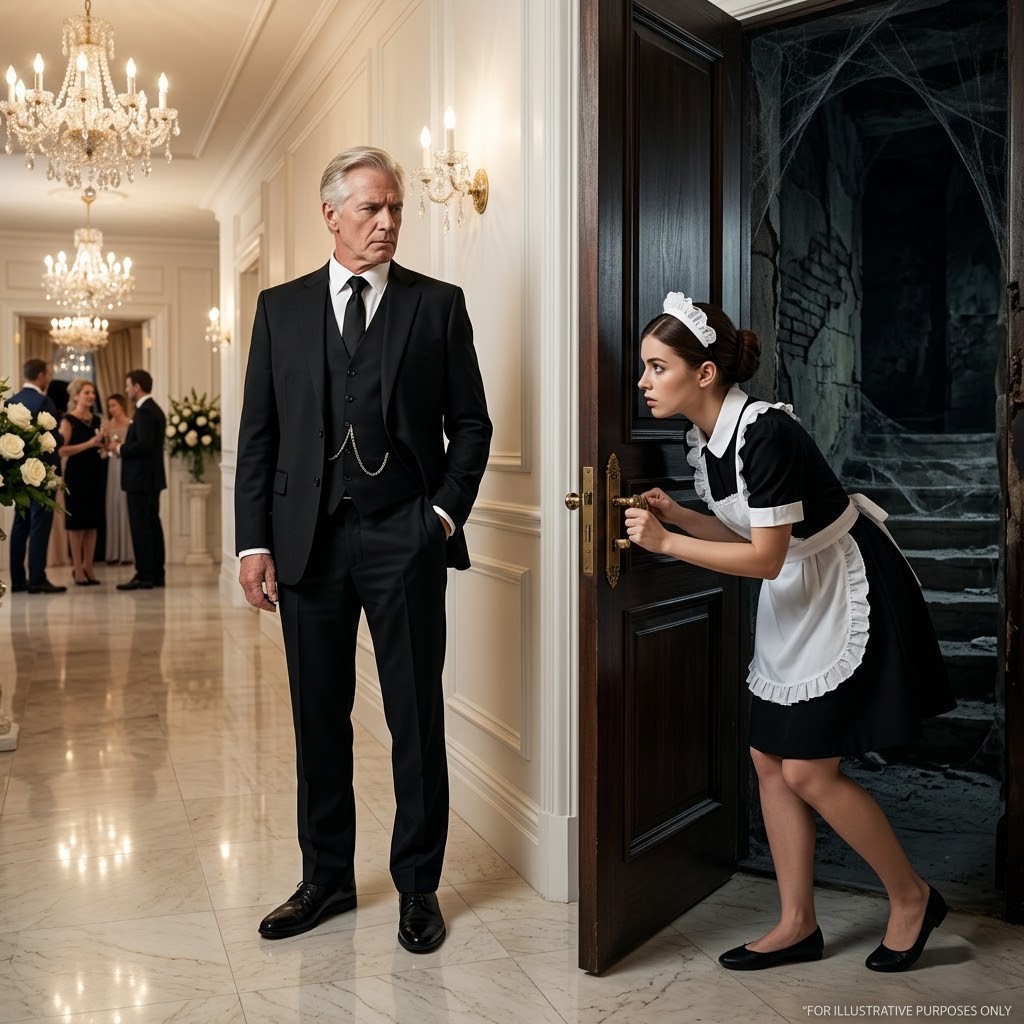
They met outside the locked door at the end of the hall.
The door was walnut, installed by Vittorio’s grandfather in 1932. No staff member had ever been told what was behind it. Most were told not to notice it.
Sierra stood three feet away from it, not touching, only looking.
“What are you doing?” Vittorio asked.
“I’ve cleaned every room in this house except this one.”
“There’s a reason.”
“There’s a reason for everything you do.”
He walked closer.
The hallway narrowed around them.
“If I tell you what’s behind that door, you won’t look at me the same way.”
“Try me.”
He should have left.
Every instinct he had built over sixty years told him to return to his study, drink the bourbon, and let the door remain locked.
Instead, he reached beneath his collar and pulled a chain from around his neck. A brass key hung from it, warm from his skin.
“Her name was Gianna,” he said. “She was nineteen when I married her. I was twenty. We had four months.”
He unlocked the door.
The room smelled like old wood, closed air, and perfume that had lost its sweetness.
A narrow bed stood made beneath a curtained window. A dresser held a silver-framed photograph, a wooden hairbrush with dark strands still caught in the bristles, a bottle of perfume with a peeling label, and a pair of pearl earrings laid on a square of cloth as if someone had taken them off and expected to return.
Sierra did not step inside.
She let the room speak.
“My father killed her,” Vittorio said.
Sierra’s face did not change.
“January 14, 1986. She was twenty. Four months married. My father said love was vulnerability. He was not a man who left vulnerabilities standing.”
“He killed her to teach you a lesson,” Sierra said.
“To teach me family comes first. That anyone I loved could be used against me.”
“No,” Sierra said softly. “He taught you that he was willing to murder a twenty-year-old girl to keep you obedient. That is not the same lesson.”
The words entered him like a key entering a lock.
Nobody had ever separated the lesson from the man who gave it.
Nobody had ever said the lesson was wrong because the teacher was evil.
Vittorio closed the door.
His hands were steady because he had practiced steadiness for forty years.
“You should go home,” he said.
Sierra did not argue. She picked up her coat and left.
Vittorio stood alone in the hallway until the radiators went quiet and his breathing was the only sound left.
The first time he kissed her, nothing about it was cinematic.
It was January. The staff had gone home. Sierra had stayed late to reorganize the pantry because, in her words, the existing system was an insult to the alphabet.
Vittorio came downstairs for water and found her on a step stool, arms full of canned tomatoes.
She turned too quickly.
The cans slipped.
He caught her instead.
She fell into his arms with the startled momentum of someone who had not expected anyone to be there. His hands closed around her waist. Her hands landed on his arms. They stood under buzzing fluorescent kitchen lights, surrounded by canned goods and polished counters.
Nothing was beautiful except the moment.
“Vittorio,” she said.
His name in her mouth sounded like a door opening.
“I’m going to kiss you,” he said. “And I need you to tell me if that’s what you want. I spent forty years not asking people what they wanted. I’m trying to learn.”
Her hand rose to his jaw.
Her thumb traced his cheekbone.
“I’ve been waiting for you to ask.”
He kissed her slowly.
She tasted like espresso and winter air. Her fingers tightened against his face. His hands held her waist as if she were real enough to vanish and precious enough to stay.
When they parted, she did not step away.
“You’re shaking,” she whispered.
“I haven’t done this in forty years.”
“Then we go slow.”
“I don’t know slow. I know how to not do something, and I know how to do it completely.”
Sierra’s thumb moved across his cheek again.
“Then we do it completely,” she said. “And we learn the speed together.”
Part 3
Enzo knew before Vittorio told him.
Twenty-six years at Vittorio’s right hand had made him a scholar of the man’s silence. He noticed the jaw unclenched in the morning. The cigarettes reduced from three to two. The way the chef looked frightened after Vittorio thanked him for dinner and almost smiled.
“It’s the girl,” Enzo said one morning.
“Her name is Sierra.”
Enzo sat across from him.
“Vittorio, she’s twenty-five. She’s staff. You are who you are. If this becomes known, people will see her as leverage.”
The word landed like a gunshot.
Leverage.
That was the word Vittorio’s father had used about Gianna.
“That’s what he called my wife,” Vittorio said. “Then he proved it.”
“I’m not your father.”
“No. You’re the man who has kept me alive for twenty-six years.”
“And I’d like to continue.”
“Then keep her alive too.”
Enzo looked at him for a long time. Then he nodded.
In March, the phone call came.
Vittorio was alone in his study when the private line rang. Only five people had that number. Three worked for him. One owed him his life. One was dead.
He answered.
“Vittorio.”
The voice was thin and old, but it wrapped around his throat like a wire.
His father.
Salvatore Salvagio was eighty-seven and supposed to be dead.
Not truly dead. Vittorio had not given himself that mercy. Twelve years earlier, he had driven his father to a private facility upstate after the old man’s body betrayed him with a stroke. He told the staff the patient would be comfortable, guarded, and for all public purposes nonexistent.
“How did you get a phone?” Vittorio asked.
“I always have my ways.”
“What do you want?”
“I hear there’s a girl. A maid. Young. Pretty. You’re behaving like a man who forgot the most important lesson of his life.”
Vittorio walked to the window.
In the garden, early spring shoots were pushing through the soil.
“If you touch her,” he said, “if you send anyone near her, if you say her name again—”
“You’ll what? Come finish what you should have finished twelve years ago?”
Vittorio said nothing.
“You were soft at twenty,” Salvatore whispered. “You are soft at sixty. This girl will prove it the way Gianna proved it.”
Vittorio hung up.
He called Enzo.
“My father is making calls. Find out who gave him a phone. Find out who is feeding him information about my house. Put additional security on Sierra now.”
He did not tell Sierra.
He told himself it was protection.
The truth was uglier.
He was afraid she would see through him and say what he was not ready to hear.
Two weeks later, Vittorio came home from Manhattan and found the estate locked down. Extra cars in the driveway. Armed men at the gate. Enzo on the front steps with a phone in one hand and the face he wore before funerals.
“Two men approached Sierra outside the subway this morning,” Enzo said. “They didn’t touch her. They handed her an envelope.”
“Where is she?”
“Library.”
Vittorio went inside.
He opened the library door and found Sierra sitting in his chair.
His chair.
She held an old photograph in both hands.
It was faded, printed in the 1980s. A young man in a dark suit and a young woman in a white dress stood in front of a church, both wearing the stunned, grateful expression of people who could not believe happiness had found them.
Vittorio and Gianna.
Their wedding day.
On the back, in handwriting Vittorio recognized with the sickness of recognizing his own pulse, were three words.
Remember the lesson.
Sierra set the photograph on the chair arm.
“Who sent this?”
“My father.”
“The man who killed your wife.”
“Yes.”
“The man you let me believe was dead.”
Vittorio felt the room split.
“I never said he was dead.”
“No. You just let me believe it.” Her voice sharpened. “You let me walk through this house, hear what he did, touch the room he created, fall in love with you, and all this time he was alive and watching.”
“I was trying to protect you.”
“No,” Sierra said. “You were trying to manage me.”
The word hit harder than he expected.
“Your father killed Gianna to prove love made you weak. Now you’re lying to the woman you love because you think the truth will put her in danger. Do you hear yourself?”
“It isn’t the same.”
“It is the same logic. Different scale, same cage.”
She stood.
Her composure was shaking now. For the first time since he had known her, Sierra Callaway looked close to breaking.
But she did not break backward.
She broke open.
“My father managed my mother by keeping her afraid. He managed me by keeping me small. I spent my whole life getting free of men who called control protection. I will not walk into another version of it. Not even yours. Not even for you.”
Vittorio could face prosecutors, killers, senators, traitors, and grieving sons.
He could not face her eyes.
His gaze dropped.
“I can’t say it,” he whispered.
“Say what?”
“That I don’t love you. I’ve tried to build the sentence for weeks. Every night, I construct it. Every morning, I look at you, and it disappears.”
He pressed his hand to his chest.
“But I can’t let what happened to Gianna happen to you. The thought stops my breathing.”
Sierra crossed the room and took his face in both hands.
Her palms were warm and rough from work.
“Then we stop him together. Not you making decisions while I stand in the dark. Together.”
His eyes lifted.
“Let me in,” she said. “All the way. The locked room. The phone calls. The father upstate. Everything. I didn’t fall in love with a polished version of you. I fell in love with the terrified man in the doorway who is trying to protect me from something I am not afraid of.”
His hand covered hers.
“Okay,” he said.
The confrontation happened in April.
Sierra insisted on being there.
Vittorio hated the idea. He hated it all the way through the planning, all the way into the car, all the way upstate through narrow roads lined with trees that pressed too close to the pavement.
But he had promised her all the way in.
So he kept the promise.
Enzo drove. Four men followed in a second car. Sierra sat beside Vittorio and held his hand for three hours, her thumb moving slowly over his knuckles.
The facility looked like a wealthy retirement home from the outside. Clean brick. White columns. Expensive landscaping.
Only the cameras beneath the eaves and reinforced windows told the truth.
Salvatore Salvagio sat in a wheelchair in a sunroom at the back of the house.
He was thin the way old predators become thin, flesh retreating while the bone structure remains cruel. His jaw was still sharp. His eyes still carried the intelligence that had built an empire before his son was born.
He looked at Vittorio.
Then at Sierra.
His mouth arranged itself into a smile.
“So this is the maid.”
“Her name is Sierra,” Vittorio said.
“I don’t care about her name. Names are for people who survive.”
Sierra released Vittorio’s hand.
She walked forward.
Past Enzo. Past the bodyguards. Past the nurse by the window.
She stopped three feet from the wheelchair and looked down at Salvatore Salvagio.
“You killed his wife because you were afraid,” she said.
The sunroom went silent.
Salvatore’s eyes narrowed.
“I killed his wife because she was making him soft. A soft man in our business is a dead man.”
“No. You killed her because she loved him and he loved her back. You saw your son choose someone freely, and you could not stand it. Not because it was dangerous. Because it was something you had never been brave enough to build.”
The old man’s jaw tightened.
“You know nothing about me, girl.”
“I know you’ve been in this room for twelve years. I know your son put you here because he couldn’t do what you would have done. Which means the part of him you spent his life trying to kill is still alive.”
She leaned in slightly.
“That isn’t weakness. That is the one thing you failed to destroy.”
Salvatore looked past her to Vittorio.
“She’ll get you killed.”
“No,” Vittorio said. “Gianna didn’t get me killed. You killed Gianna. That was your choice. This is mine.”
For the first time, something like uncertainty moved across Salvatore’s face.
Then he smiled again.
Not at Vittorio.
At Enzo.
“Tell him,” Salvatore said.
The room changed.
Every person felt it.
Vittorio turned slowly toward the man who had stood beside him for twenty-six years.
Enzo’s face had gone blank, but not with discipline. With exposure.
“Tell me what?” Vittorio asked.
Salvatore’s smile widened.
“Tell him who gave me the phone. Tell him who has been reporting on his household for twelve years. Tell him who told me about the girl.”
Outside, a bird sang in a tree by the window.
The sound was obscene in its innocence.
Vittorio stared at Enzo.
Enzo, who arrived every morning at nine with espresso and a leather folder.
Enzo, who knew every room, every route, every guard, every secret.
Enzo, who had warned him Sierra would become leverage.
“Is it true?” Vittorio asked.
Enzo’s throat worked.
“He’s your father.”
“Is it true?”
“He asked me to watch. To report. I never acted against you.”
“You told him about Sierra.”
“I told him you had a new staff member. I didn’t know he would—”
“You watched me open a door I kept locked for forty years.” Vittorio’s voice dropped below anger, into the cold place men feared most. “You watched me trust someone for the first time since I was twenty, and you reported it to the man who killed the last woman I trusted.”
Enzo said nothing.
The betrayal was too simple to deny.
Salvatore leaned back in his wheelchair, satisfied.
“You see? Trust is a fairy tale. The man beside you was mine the whole time. The only safe position is alone.”
The room waited for Vittorio to become the man everyone expected.
But Sierra moved first.
She walked back to him and took his hand.
Not gently.
Firmly.
“He wants you to do what you’ve always done,” she said, low enough that only he could hear. “Shut down. Push everyone out. Prove him right. Everyone in this room is waiting for you to become the man your father built.”
Vittorio looked at her hand around his.
“If you do,” she said, “he wins. Not because he outsmarted you. Because he outlasted you.”
Vittorio turned to Enzo.
“Go home.”
Enzo blinked.
“Your things will be sent to your apartment by tonight. If I see you again, we will have the conversation you helped me have with other people for twenty-six years.”
Enzo’s eyes filled.
“For what it’s worth,” he said, “the twenty-six years were real. Everything except this.”
“That’s what makes it unforgivable.”
Enzo left.
His footsteps faded down the hall, and with each step, twenty-six years of espresso, folders, mornings, and loyalty disappeared like chalk in rain.
Vittorio faced his father.
“You planted a man in my life for twenty-six years. You waited until I was vulnerable and used him. And it still does not matter.”
Salvatore’s smile vanished.
“Because the thing you spent your life trying to prove is wrong,” Vittorio said. “It has always been wrong. I am standing here with this woman, and I am not weaker. I am more dangerous than I have ever been, because for the first time in forty years, I have something worth protecting.”
Salvatore opened his mouth.
Nothing came out.
For the first time in anyone’s memory, Salvatore Salvagio had no words.
He looked suddenly small in the wheelchair. Old. Not legendary. Not immortal. Just a man in a sunroom with nothing left behind his cruelty.
Vittorio took Sierra’s hand.
Together, they walked out into the April afternoon.
In the car, Sierra fell asleep against his shoulder before they reached the highway. Her weight settled into him with the unconscious trust of someone who had chosen where she belonged.
Vittorio sat perfectly still so he would not wake her.
Then he kissed the top of her head.
The wedding was in June.
Fourteen people.
The garden behind the estate.
Roses in full bloom.
Sierra wore a white dress bought off a rack in Brooklyn. Vittorio wore charcoal. A judge officiated. No priest. Sierra had asked for that, and Vittorio had not argued.
His vows were written on a napkin at three in the morning, then abandoned the moment he saw her.
“I was a locked room for forty years,” he said, holding her hands. “You walked into my house and did not knock. You picked up the things I left behind to test you and put them back where they belonged. You did that every day until I understood the test was never about you. It was about whether I could stop testing and start trusting.”
Sierra’s eyes shone.
“I trust you with the room,” Vittorio said. “With the key. With every hidden thing I thought made me safe.”
Sierra’s vows were shorter.
“I came to clean your house,” she said. “I stayed because I saw the man buried under it.”
The fourteen guests pretended not to cry and failed.
That night, Vittorio unlocked the room at the end of the West Gallery for the last time.
He carried Gianna’s photograph into the garden and sat beside Sierra on a stone bench beneath the roses.
For a long time, he said nothing.
Then he looked at the faded face of the girl he had loved at twenty.
“Thank you,” he whispered.
Thank you for proving there had once been something alive inside him.
Thank you for being real.
Thank you for waiting in memory long enough for him to learn that love had never been the weakness.
Fear had.
He set the photograph on the bench.
Then he reached behind his neck and unclasped the chain he had worn for forty years. The brass key lay in his palm, warm from his body, heavier than any weapon he had ever carried.
He took Sierra’s hand and placed the key inside it.
“There is nothing left to lock,” he said.
Sierra looked at the key.
Then at the man who had carried it above his heart for four decades.
Her fingers closed around it.
She pulled him toward her by the front of his shirt and kissed him.
It was not gentle. It was not careful. It was the kiss of a woman who had spent her whole life learning to be still and had finally found the one person worth moving for.
The garden darkened around them.
The roses became black shapes against a deep blue sky.
Manhattan glowed far to the south, bright and restless, unaware that its most feared man had been defeated by a twenty-five-year-old maid with a three dollar brush, a scar on her neck, and the courage to do what no woman had ever dared.
She stayed.