“It wasn’t a date.”
Lily grinned. “You’re a terrible liar.”
Claire rolled her eyes and warmed the food in the microwave.
That night, lying in the dark room she shared with her sister, Claire replayed Daniel’s words again and again.
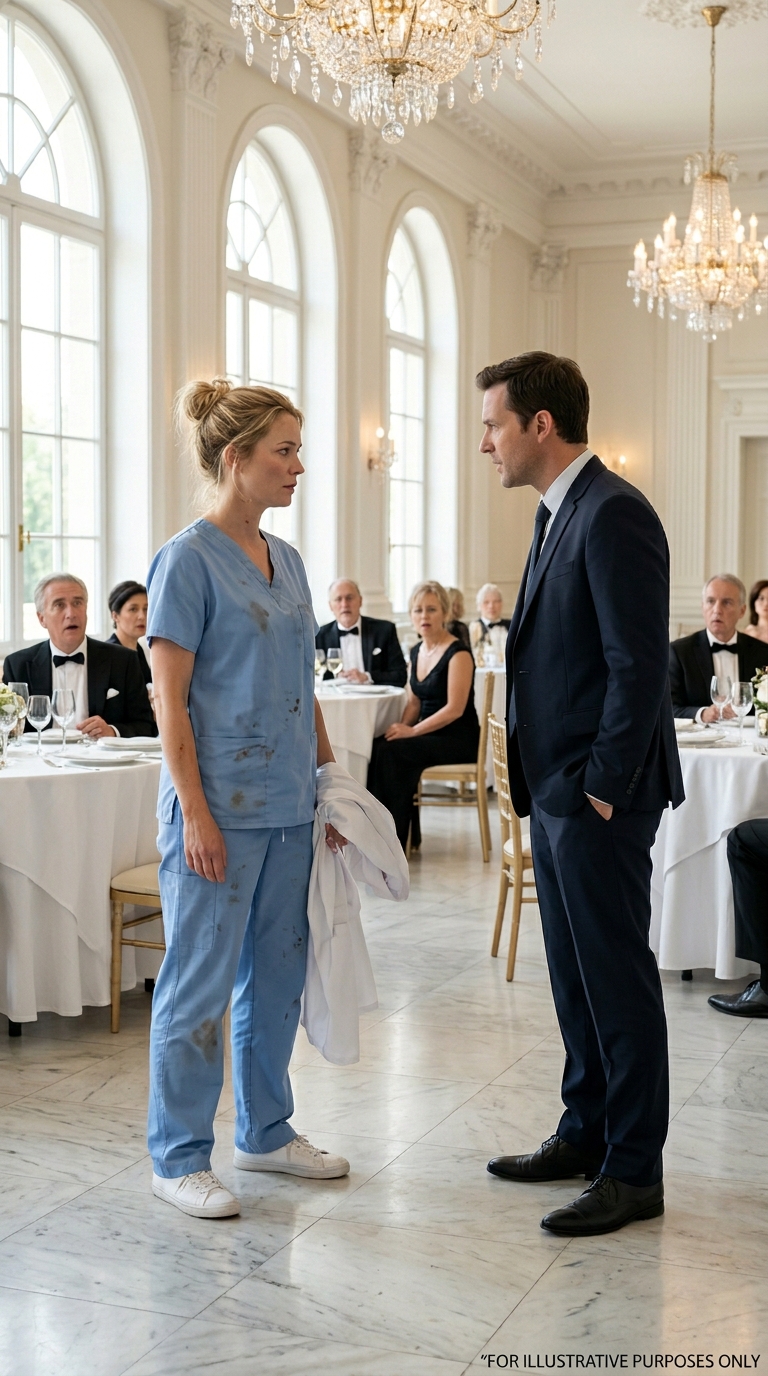
That uniform is the only honest thing that has walked into this room tonight.
She told herself she would not see him again.
She told herself men like Daniel Whitmore collected touching stories and forgot them by breakfast.
Three days later, Daniel appeared at St. Anne’s Medical Center.
Not with flowers. Not in a suit. Not with reporters or a donation check.
He came wearing jeans and a plain gray sweater and asked the charge nurse if he could sit with the woman in Room 412.
Mrs. Evelyn Parker.
No family. No visitors. Eighty-one years old. A retired school librarian who talked to the television because silence frightened her.
Claire found him by accident through the glass, sitting beside Evelyn’s bed, reading the newspaper out loud while the old woman corrected his pronunciation of local politicians’ names.
He looked up when he came out and saw Claire standing there.
“I kept my side,” he said. “Now you decide if I’m allowed to come back.”
Claire hated how hard her heart moved.
“Room 412 always needs company,” she said.
It was all she allowed herself.
But they both knew a door had opened.
Part 2
Daniel learned to meet Claire on her ground.
He stopped inviting her to restaurants where people measured the worth of a woman by the fabric on her body. Instead, he waited in the hospital cafeteria with two terrible coffees from the vending machine, one black for him and one with too much cream for her. The first time he handed it over, Claire laughed because it tasted like cardboard and kindness.
“You realize you’re drinking the worst coffee in Chicago,” she said.
“I’m adapting.”
“To what?”
“To you.”
She looked away because he said it too easily, and because the words landed somewhere dangerous.
Over the next two weeks, Daniel came twice to sit with Mrs. Parker. Sometimes he read the paper. Sometimes he listened to stories about students she had taught thirty years earlier. Once, when Claire stepped into the room to check vitals, she found him trying to help Evelyn finish a crossword puzzle and being thoroughly defeated by a five-letter word for “bird with a harsh cry.”
“Heron,” Claire said from the doorway.
Evelyn pointed a trembling finger at Daniel. “See? The nurse is smarter than the millionaire.”
Daniel looked wounded. “I never claimed otherwise.”
Claire smiled before she could stop herself.
But every soft thing growing between them had a shadow.
Vanessa Caldwell.
Claire learned the full story on a windy Thursday evening when she walked out of St. Anne’s and found a woman leaning against a black Mercedes at the curb.
She recognized her before the woman spoke.
Vanessa was the kind of beautiful that looked expensive to maintain. Blonde hair in a smooth twist. Camel coat. Leather gloves. Calm eyes that did not need to raise themselves above anyone because everyone had already been placed below her.
“Claire Bennett?”
Claire tightened her grip on her tote. “Yes.”
“I’m Vanessa Caldwell.”
“I know.”
A small smile touched Vanessa’s mouth. “Then we can skip the awkward introduction.”
Claire almost kept walking. But there was something in Vanessa’s expression that made her stop. Not cruelty exactly. Something colder than cruelty. Calculation polished into manners.
“I wanted to meet the woman who has Daniel distracted,” Vanessa said.
“There’s nothing to meet. I’m a nurse who cared for his grandfather.”
“And now he reads newspapers to lonely old women in your hospital.”
Claire’s jaw tightened. “That’s not a crime.”
“No. It’s sentimental.” Vanessa glanced toward the hospital doors. “Daniel has always been vulnerable to guilt. His grandfather knew that. His uncle knows that. Apparently, now you do too.”
Claire felt the words hit, but she refused to flinch.
“If you came here to insult me, you’re wasting both our time.”
“I came here to warn you.”
“About Daniel?”
“About reality.” Vanessa’s voice remained smooth. “The Whitmore vineyards are in debt. Serious debt. Daniel’s father made reckless investments before he died, and Arthur spent his final years patching holes with borrowed money and family favors. The only clean way to keep the vineyards from being broken apart is a merger with my family’s holdings in Napa.”
Claire stood still.
Vanessa looked at her carefully. “That merger comes with a marriage.”
The air seemed to change.
“It was arranged years ago,” Vanessa continued. “Before you. Before hospital cafeterias and warm soup and whatever story Daniel is telling himself now. It isn’t romantic. It’s architecture. Two families holding each other upright.”
Claire heard Daniel’s phone buzzing on the table at The Marlowe. She saw his hand turning it over.
“He didn’t tell you,” Vanessa said.
“He started to.”
“But not enough.” Vanessa’s expression softened for a second, and that was somehow worse. “Daniel can play at being a different man for a while. He can sit at bedsides and ride trains and pretend money is something he can set down when it gets heavy. But when the moment comes, he will choose the Whitmore name. Men like him always do.”
Claire swallowed.
“And what do you want from me?”
“Be smart,” Vanessa said. “Leave before you are publicly embarrassed. Before he hurts you while convincing himself he had no choice.”
Then she got into the Mercedes and drove away.
Claire stood on the sidewalk until her fingers went numb.
That night she did not sleep.
It was not only jealousy. Jealousy would have been easier. What hurt was understanding him. She knew what it meant to carry people on your back. She knew what it meant to wake up every morning and make decisions based on who would fall if you chose yourself.
Daniel was not hiding a girlfriend.
He was trapped inside a promise.
The next evening, he was waiting by the employee exit.
Claire knew from his face that he already knew Vanessa had come.
“Did she talk to you?”
“Yes.”
Daniel closed his eyes briefly.
“She told me enough,” Claire said.
“It’s not what you think.”
“It’s exactly what I think.” Her voice did not shake, and she was proud of that. “Your family is drowning. Her family is the life raft. And you’re the price.”
Daniel looked as if she had struck him.
Claire softened, but only slightly. “I’m not angry.”
“You should be.”
“I understand. That’s worse.”
He took a step toward her. “Claire—”
“No. Don’t make me the reason you break something that big. Don’t put that on me. If you have to marry her to save people’s jobs, then do it honestly. But don’t stand in hospital cafeterias making me feel seen while another woman is waiting for the rest of your life.”
Daniel’s face tightened. “I don’t love her.”
“That doesn’t mean you’re free.”
The words hung between them.
For several days, they did not speak.
Daniel returned to meetings. To banks. To his uncle Richard Whitmore, who had become the loudest voice in the family after Arthur’s death.
Richard believed in duty, leverage, and never letting emotion enter a room unless it could be used. He reminded Daniel of the vineyard workers whose families had lived on Whitmore land for generations. He reminded him of the debts. The lenders. The Caldwell family’s patience. The merger agreement.
And most of all, he reminded Daniel of Arthur.
“Your grandfather died believing you would hold this family together,” Richard said one evening in Arthur’s old study, pouring two glasses of Whitmore cabernet. “Don’t dishonor him because a nurse made you feel noble for five minutes.”
Daniel did not touch his wine.
“Granddad also told me I’d wake up old and alone counting money in an empty room.”
Richard’s expression hardened. “Arthur said many things when he was sick.”
“He was clear enough.”
“You are not your father,” Richard snapped. “Your father followed every feeling he ever had and left us with debt, shame, and a funeral bill.”
Daniel stood by the window, looking out at the dark rows of vines beyond the glass. “Maybe he didn’t ruin us by living his life. Maybe he ruined us because he never had the courage to face it.”
Richard’s voice went cold. “You have three weeks until the engagement dinner. By then, you will come to your senses.”
“And if I don’t?”
“Then you walk alone.”
Daniel left without answering.
That night he drove to Claire’s neighborhood and parked across from her apartment building. He did not get out. He had no right to knock with nothing solved, no plan, no certainty, only a heart that had finally woken up and a life collapsing around it.
Upstairs, Claire saw his car from the window.
For a long time, neither of them moved.
Then Claire turned off the light.
Not because she wanted him gone.
Because if she went downstairs, she knew she would run.
Daniel understood. A minute later, her phone lit up.
I have three weeks. Wait for me.
She did not respond.
But she did not delete the message.
The three weeks became stolen time.
Daniel did not speak of Vanessa or the engagement dinner. Claire did not ask for promises. Instead, he appeared in the quiet spaces of her life. He walked her to the train. He brought vending-machine coffee. He sat with Mrs. Parker, who began calling him “my handsome newspaper boy.” He met Lily one Sunday when Claire came home from a shift and found her sister interrogating him in the hallway.
“Are you the millionaire?” Lily asked.
Daniel blinked. “I suppose that depends who’s asking.”
“I am. And I don’t like rich men.”
“Fair.”
“Do you make my sister cry?”
“Not on purpose.”
Lily narrowed her eyes. “Wrong answer.”
Claire nearly died of embarrassment, but Daniel only nodded as if Lily had given him a serious business assessment.
“I’ll do better,” he said.
Against every instinct, Claire let him in.
He brought groceries the next Sunday and announced he would cook dinner. It became clear within twenty minutes that Daniel Whitmore could negotiate with banks but could not cook rice without burning it. Lily laughed so hard she had to sit on the floor. Claire opened windows while Daniel waved smoke away with a dish towel and apologized to the pan.
For one evening, the apartment felt full in a way it had not since their parents died.
After dinner, Daniel helped Lily with algebra. He listened when she said she wanted to become a doctor but knew medical school was expensive. He did not make a grand promise. He only said, “Then we’ll figure out scholarships like a military operation. Talent like yours doesn’t get wasted.”
Claire heard it from the sink and had to grip the counter.
Later, after Daniel left, Lily leaned against the doorway.
“He looks at you like you’re not tired,” she said.
Claire turned. “What does that mean?”
“It means when other people look at you, they see how much you carry. When he looks at you, he sees who you were before you had to carry it.”
Claire wanted to argue.
She could not.
A few days later, Daniel drove Claire to Napa for the first time.
Not by private jet. Not with a chauffeur. Just Daniel behind the wheel of a dusty SUV, sleeves rolled, talking about soil and rain and how vines had to struggle to make better fruit. The Whitmore vineyard stretched across golden hills, rows of green reaching toward the late afternoon sun. It smelled of earth, leaves, and something old enough to outlive everyone who fought over it.
Claire saw him change there.
In Chicago, Daniel looked like a man wearing armor. In Napa, with dirt on his shoes and sunlight on his face, he looked younger. Not easier. Truer.
He showed her how Arthur had taught him to test grapes, rolling one gently between his fingers.
“The best ones come from difficult soil,” he said. “Too much comfort and the vine gets lazy. Struggle gives the fruit depth.”
Claire looked at him. “That sounds like something rich people say to make struggle romantic.”
He laughed. “You’re right.”
“Good.”
“But maybe,” he said, quieter now, “some things that grow in hard places are still worth protecting.”
The wind moved through the vines.
Claire did not know who moved first.
Their first kiss was not dramatic. No thunder. No swelling music. Just Daniel’s hand, warm and careful at her cheek, and Claire finally lowering a guard she had forgotten how to live without.
When they pulled apart, his forehead rested against hers.
“I don’t have everything solved,” he whispered.
“I know.”
“I may lose a lot.”
“I know.”
“I don’t want you to choose me because you think I need saving.”
Claire looked up. “Good. Because I’m too tired to save men.”
He laughed softly, then grew serious.
“I love you,” he said.
Claire closed her eyes.
The words frightened her more than anything Vanessa or Richard had said.
Because she believed him.
Part 3
The real blow came two days before the engagement dinner.
Claire walked out of St. Anne’s after a brutal shift and found Richard Whitmore waiting by the curb.
He was not what she expected. No villain’s sneer. No raised voice. He was silver-haired, well dressed, and courteous in the way men became courteous when they were about to do something cruel and wanted to feel civilized.
“Ms. Bennett,” he said. “May I have five minutes?”
Claire should have kept walking.
Instead, she followed him to a coffee shop across the street.
Richard did not waste time. He placed a white envelope on the table and slid it toward her.
Claire looked at it.
“What is that?”
“A practical solution.”
She did not touch it.
Richard folded his hands. “Inside is enough money to change your sister’s life. Tuition. Housing. Medical school preparation. Enough for you to stop working double shifts for a while. Enough to breathe.”
Claire’s stomach tightened.
“For what?”
“For you to leave Daniel before Friday night.”
There it was.
No shouting. No threat. Just a price placed neatly on the table.
“Let him believe it was your choice,” Richard continued. “Clean break. No drama. No public scene. He will be hurt, but he’ll recover. The vineyard will survive. Your sister will have opportunities you and I both know you cannot currently provide.”
For one second, Claire thought of Lily.
Not herself. Never herself.
Lily, hunched over textbooks at midnight. Lily pretending not to notice when bills were late. Lily wanting a future that cost more than love could pay.
Claire’s fingers trembled.
Richard saw it.
His voice softened. “There is no shame in being practical.”
Claire placed her hand on the envelope and pushed it back.
“I have spent my whole life being practical,” she said. “I have counted quarters for laundry. I have chosen between groceries and prescriptions. I have worked with fevers because rent didn’t care if I was sick.” She looked him directly in the eye. “But I have never sold myself. And I’m not starting now because something good finally happened to me.”
Richard’s polite mask hardened.
“You will regret this.”
“Maybe,” Claire said. “But if Daniel leaves me, he’ll have to say it to my face. Not through an envelope.”
Richard stood, taking the envelope with him.
Claire remained at the table after he left, shaking so badly she spilled coffee on her sleeve.
That night, Daniel noticed the change in her before she said a word.
“What happened?”
“Nothing.”
“Claire.”
She closed her eyes, exhausted by how well he saw her.
So she told him.
Daniel became very still.
Not loud. Not explosive. Still.
The kind of stillness that frightened her.
“He offered you money?”
“Don’t do something stupid.”
“He tried to buy you out of my life.”
“And I said no.” Claire stepped in front of him. “Daniel, listen to me. If you break with your family, it cannot be because you’re angry at your uncle. It cannot be revenge. It has to be because you know who you are.”
He looked at her for a long time.
Then he asked the question that had been waiting under everything.
“If I lose it,” he said, “the easy money, the family backing, the certainty, if I walk out with debt and a damaged name and nothing impressive left to offer you, do you still love me?”
Claire did not hesitate.
“I never loved you because of what you had,” she said. “I loved you in spite of it.”
The room went silent.
It was the first time she had said the word.
Daniel’s face changed as if something inside him had unclenched after years.
The next day, he disappeared into meetings.
He met with lenders one by one. He offered his personal assets as collateral. He negotiated repayment schedules. He called in favors that had nothing to do with the Caldwells. He found one narrow path through the wreckage, risky and painful but possible.
The main creditor agreed.
A second one asked for time.
A third refused, then called back at sunset and said Arthur Whitmore had once saved his father’s farm, and he would give Daniel ninety days to prove himself.
By Thursday night, Daniel had a plan.
Not a comfortable one.
A plan that could ruin him if he failed.
But it was his.
The engagement dinner was held at the Whitmore vineyard house in Napa, the place Arthur had built with his own hands before anyone called the family rich. Richard had chosen the setting carefully. The old stone walls. The portraits. The barrels in the cellar below. The weight of legacy pressing down from every beam.
Daniel arrived in a black suit, calm enough that Richard mistook it for surrender.
Vanessa stood near the staircase in a silver dress, beautiful and pale. When their eyes met, Daniel saw something he had never allowed himself to see before.
She was miserable too.
They were not enemies.
They were prisoners in neighboring cells.
Dinner moved like theater. Toasts. Polite laughter. Wine poured from bottles older than Lily. The Caldwell family smiled as if they already owned half the table. Richard watched Daniel like a hawk.
At dessert, Richard stood.
He lifted his glass and spoke of family, duty, sacrifice, and the sacred responsibility of protecting what the dead had left behind. He mentioned Arthur’s name with such polished emotion that Daniel felt his stomach turn.
Then Richard smiled.
“Tonight,” he announced, “we celebrate not merely a business alliance, but the joining of two families. Daniel, Vanessa, please stand so we may honor the commitment that will secure our future.”
Applause began before Daniel moved.
Glasses rose.
Vanessa closed her eyes briefly.
Daniel stood.
The room quieted.
“Yes,” he said. “It is time to honor the future. And the only way I can do that is by telling the truth.”
Richard’s smile froze.
Daniel placed both hands on the back of his chair.
“There will be no engagement tonight,” he said. “Not to Vanessa. Not now. Not ever.”
The silence was immediate and violent.
Daniel continued before anyone could stop him.
“I am grateful to the Caldwell family for their patience and generosity. I regret the years we allowed this arrangement to continue when neither of us had the courage to name it for what it was. But I will not seal my grandfather’s legacy with a lie. Arthur Whitmore taught me many things. How to read soil. How to wait for harvest. How to work until your hands hurt. But he did not build this place so his grandson could become a contract wearing a wedding ring.”
Richard’s face turned red. “Daniel.”
“No.” Daniel’s voice remained calm. “You used his name to frighten me for years. I let you. That ends tonight.”
Gasps moved around the table.
Daniel looked at the workers’ manager seated near the far end, a man whose father and grandfather had both worked Whitmore land.
“I have renegotiated the primary debt,” Daniel said. “I have secured extensions from two other creditors. I have put my own assets behind the vineyard. It will be hard. It will be dangerous. It may fail. But if we fail, we will fail working. Not hiding behind a marriage neither of us wants.”
Vanessa’s father slammed his hand on the table. “You arrogant little fool.”
Richard stood so quickly his chair scraped the floor. “You are repeating your father’s mistakes.”
“My father did not ruin this family because he lived honestly,” Daniel said. “He ruined it because he ran from consequences. I am standing inside mine.”
Richard’s voice shook with fury. “If you walk out that door, you walk alone.”
Daniel nodded.
“For the first time in my life,” he said, “that sounds like freedom.”
Then Vanessa stood.
Everyone turned.
She placed her napkin on the table with trembling fingers.
“I don’t want this marriage either,” she said.
Her father stared at her. “Vanessa.”
“No.” Her voice grew stronger. “I let all of you decide for me because it was easier than admitting I was afraid. Daniel was brave enough to stop lying. I won’t punish him for doing what I should have done years ago.”
Her father began to speak, but she looked at him with tears in her eyes.
“I am not a payment plan,” she said. “And I am not marrying a man to make everyone else comfortable.”
The room erupted.
Accusations. Shouting. Old money losing its manners.
Daniel did not stay to watch.
At the doorway, he turned back once.
“I am not abandoning this family,” he said. “I am only refusing to buy its peace with a lie. Every job stays. Every debt will be answered for. And if any of you remember Arthur as more than a weapon, remember this too. He used to say fruit grown by force turns bitter.”
For one moment, Richard did not answer.
Beneath the rage, something old and tired crossed his face.
Daniel walked out.
Vanessa followed him to the front porch.
For the first time in all the years they had been tied together, they spoke like two human beings.
“I hated you a little,” she admitted, wrapping her arms around herself against the night air. “For accepting it. Because every time you agreed, it made it harder for me to say no.”
Daniel nodded. “I’m sorry.”
“I am too.”
They stood looking out over the dark vineyard.
“I hope you find her,” Vanessa said.
“I hope you find yourself.”
She laughed once, watery but real. “That sounds like something from a terrible movie.”
“Probably.”
Then she hugged him. Briefly. Honestly.
When Daniel left the vineyard house, he had never been more uncertain in his life.
He had lost the smooth road. The family shield. The polite future everyone had arranged for him.
All he had was a fragile debt plan, two shaking hands, and a heart that no longer belonged to fear.
He drove to Claire’s apartment with the windows down, letting the cold air strip the evening from his skin.
It was nearly midnight when Claire heard the knock.
Lily sat up on the couch, where she had fallen asleep pretending not to wait.
Claire opened the door.
Daniel stood there in the hallway, tie loosened, hair windblown, empty-handed.
No flowers.
No grand gesture.
No polished speech.
Just Daniel.
“It’s done,” he said.
Claire’s hand tightened on the door.
“The engagement?”
“There isn’t one.”
“Your family?”
“Angry.”
“The vineyard?”
“Still in danger.”
“Your money?”
He gave a tired half-smile. “Less impressive than yesterday.”
Claire looked at him for a long second.
Then she stepped into the hallway and wrapped her arms around him.
Daniel folded around her like a man who had been standing for years and had finally found somewhere to rest.
“I came with nothing,” he whispered.
Claire held him tighter.
“No,” she said. “You came honest.”
Behind them, Lily sniffed loudly and muttered, “Finally,” before disappearing into the kitchen to give them privacy and probably call Mrs. Parker with the news.
The months that followed were not a fairy tale.
The Caldwell family withdrew from the merger. Richard refused to speak to Daniel for six weeks. Newspapers ran stories about the broken engagement, and gossip pages speculated cruelly about the nurse in scrubs who had “stolen” a millionaire from his dynasty.
Claire hated that most.
Daniel hated it more.
But they did not hide.
When photographers caught them leaving St. Anne’s together, Claire wore her scrubs and Daniel carried two vending-machine coffees. Someone online mocked her shoes. Someone else wrote that no designer gown in Chicago had ever looked as honorable as those tired blue scrubs.
The comment went viral.
Donations began arriving at St. Anne’s for a volunteer bedside companion program Claire had once mentioned casually. Daniel funded the first year anonymously, though Claire made him remove his name from the paperwork twice.
Mrs. Parker became the program’s unofficial queen. She recovered enough to leave the hospital for assisted living, where she demanded weekly visits and criticized Daniel’s crossword skills until he improved.
Lily got into a summer medical program with a scholarship Daniel helped her find but did not pay for outright, because Claire insisted her sister deserved doors, not dependence.
The vineyard survived the first ninety days.
Barely.
Then it survived six months.
Daniel sold two luxury properties, cut executive salaries, and spent more time in the fields than in boardrooms. Some relatives called him reckless. Some workers called him Arthur’s grandson again.
Richard came around slowly.
Not with an apology at first. Just a phone call about a shipment problem. Then a meeting. Then one afternoon, he appeared at the vineyard while Claire was visiting and stood beside her under the shade of an old oak tree.
“I misjudged you,” he said stiffly.
Claire looked at him. “Yes, you did.”
Richard nodded, accepting the hit.
“You refused money most people would have taken.”
“I almost took it.”
That surprised him.
Claire turned toward the vines. “For my sister. For one second, I almost did.”
“But you didn’t.”
“No,” she said. “Because I needed Lily to know there are some things poverty doesn’t get to take from you.”
Richard was silent for a long time.
Then he said, “Arthur would have liked you.”
Claire gave him a small smile. “He did.”
A year after the night at The Marlowe, Daniel took Claire back there.
She almost refused.
“I still hate that place,” she said.
“I know.”
“Then why are we going?”
“Because I owe that room a correction.”
This time Claire did not come in scrubs. She wore a simple black dress Lily had helped her choose, and her hair was loose around her shoulders. But inside her purse, folded carefully, was her hospital badge. She did not know why she brought it. Maybe because it reminded her who she had been before anyone decided she was worth looking at.
The restaurant was still bright, still expensive, still filled with people pretending not to stare.
Daniel had reserved the same table.
Halfway through dinner, Claire recognized the woman in ivory silk from the year before. She walked past their table, saw Claire, and slowed.
Claire waited for the old shame to rise.
It did not.
Daniel reached across the table and took her hand.
The woman looked at their joined fingers, then at Claire’s face, and this time she said nothing.
After she left, Daniel smiled. “You scared her.”
“No,” Claire said. “I stopped being scared of her. There’s a difference.”
He laughed softly.
Later, outside beneath the same yellow awning where she had once refused his car, Daniel did not drop to one knee. He knew her too well for theater.
Instead, he took her hands.
“I don’t want to rescue you,” he said. “I don’t want to own your strength or decorate my life with it. I want to build something beside you. Something honest. Something we choose every day, even when it’s hard.”
Claire’s eyes filled.
“I’m still going to work double shifts sometimes,” she said.
“I know.”
“And Lily comes first.”
“She should.”
“And if you ever use money to win an argument, I’ll leave you standing wherever you are.”
Daniel smiled. “Understood.”
Only then did he open the small box.
The ring was not enormous. It was beautiful because it was simple.
Claire looked at it, then at him.
“Yes,” she said.
No gasp from a crowd. No applause. No viral moment.
Just rain beginning softly over Chicago, the city shining around them, and two people who had both spent years paying debts to the dead finally choosing a life among the living.
On their wedding day, Claire wore her mother’s pearl earrings and carried white roses from the hospital garden. Mrs. Parker sat in the front row with tissues in both hands. Lily cried openly and denied it. Vanessa came too, alone and smiling, having started her own design firm in San Francisco.
Richard stood near the back, rigid as ever, but when Daniel walked past him, he touched his nephew’s shoulder once.
It was not everything.
But it was a beginning.
At the reception, Daniel told the story of the first night at The Marlowe.
How Claire arrived in wrinkled scrubs, apologizing for the very thing that made her extraordinary.
How he looked at her uniform and saw the truth his world had forgotten.
Then Claire took the microphone from him.
“My husband likes to make that moment sound romantic,” she said, and everyone laughed. “But the truth is, I was tired, embarrassed, and one bad comment away from crying in the bathroom. What changed my life was not that a rich man noticed me. It was that someone finally saw me without asking me to become smaller first.”
She looked at Daniel.
“And then he had the courage to become honest too.”
Daniel’s eyes shone.
Claire smiled, steady and whole.
Because love had not saved them from difficulty.
It had simply taught them to stop mistaking fear for duty, money for worth, and loneliness for strength.
And years later, whenever a young nurse at St. Anne’s apologized for arriving somewhere in scrubs, Claire would smile and tell her the truth.
Never apologize for the uniform.
Sometimes it is the most honest thing in the room.