Miles’s knight stepped out and shut the threat down.
Walter’s eyebrows rose.
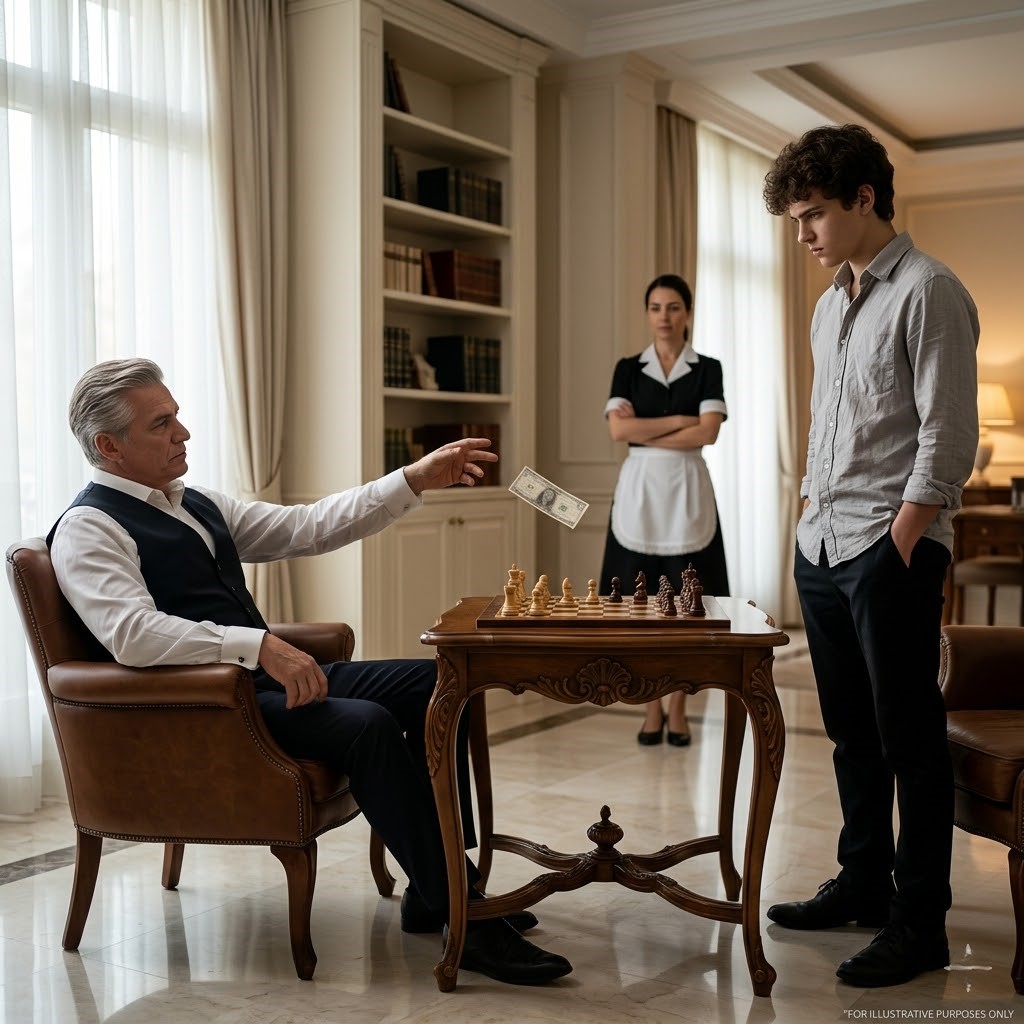
Edward noticed only that his attack had not landed. He tried to regain the rhythm with another bishop move, then another pawn grab, snatching material like a man looting a house he thought was already burning.
Miles allowed it.
That was what made Walter pay close attention.
Most players panic when a wealthy amateur starts gobbling pawns. They defend every inch and get squeezed until they collapse. Miles did not defend greedily. He gave Edward space.
A pawn here. A pawn there.
Always one square deeper.
Edward thought he was winning because the board looked fuller on his side. What he did not realize was that every piece he touched was drifting farther away from the safety of his king. The room saw the material count. Walter saw the geometry.
At the edge of the ballroom, Denise had stopped breathing normally. She stood with one hand on a column, watching her son with a look she had once reserved for the church steps after a hard sermon. Not fear. Recognition.
Because the stillness on Miles’s face belonged to somebody else first.
Her father’s.
Theodore Mason had been a legend in Harlem long before anyone in chess magazines knew his name. People called him Pops because he had that kind of warmth, the kind that made strangers feel like they had known him for years. He had taught Miles the game one square at a time in Marcus Garvey Park, at a stone table under a maple tree.
Miles remembered those Saturdays as clearly as if he were still there.
The sound of traffic beyond the park. The smell of damp leaves after rain. Pops setting up the pieces with old, careful fingers.
“You don’t beat a bully by rushing him,” Pops had told him once. “You let him take what he thinks he wants. Then you close the door.”
Miles had been eleven the day Pops died. Too young to understand how much of his grandfather’s teaching would stay with him. After the funeral, he began playing online in secret, using the name Stone Table 11. He studied classic games, grandmaster tournaments, and openings so deep they felt like family history. He built a private library of traps. He learned the kinds of mistakes arrogant men made when they saw a poor kid and decided the game already belonged to them.
Back in Greenwich, Edward Langford leaned over the board and tried to turn the pressure into a performance.
“Maybe he’s good for a school club,” he said to the room. “But this is grown-up chess.”
Then he laughed at his own joke.
Miles looked at him for the first time, really looked. “Your queen is overextended,” he said.
A few people in the room quieted.
Edward laughed again, though not as easily. “You should stick to what you know, boy.”
Miles moved his bishop.
The bishop landed with the kind of quiet finality that makes smart people start sweating. Walter’s head tilted slightly. He saw the idea. Not yet the full trap, but enough to know one was there.
The billionaire had begun to feel it too. His smile had faded at the corners. He shifted in his seat. The next move came slower than the ones before.
Miles kept his face blank.
He sacrificed a pawn.
Then another.
Edward’s eyes lit up. He took both without thinking, and each time he took one, his queen wandered deeper into a bad neighborhood. Walter almost smiled.
That was the bait.
Miles’s king castled smoothly to safety. His rook slid over like a locked door. The pieces no longer looked scattered. They looked arranged.
Denise felt something cold move down her spine. She knew that look in her son’s face. She had seen it in the hospital when a nurse tried to tell her he was “just a quiet boy” after he beat older kids at math. She had seen it when he fixed the broken radio in their apartment by ear. It was the look of somebody who already knew how the story ended.
Edward started to talk more, which was always a bad sign.
“You know what your problem is?” he said. “You think the room owes you respect because you sat down. It doesn’t.”
Miles’s answer came in less than three seconds.
“Then your king is going to have a bad night.”
A few people laughed nervously, not sure whether it was a joke.
Walter wasn’t laughing at all.
By move seven, Edward had realized that the position had changed. That much was obvious from the way he leaned back and began staring too hard at the board. He could feel the walls closing in, but he could not yet see them.
Miles could.
Every piece had a purpose. Every one of Edward’s greedy little captures had made the trap tighter. The queen had ventured too far. The bishop was blocked. The knight on the edge of the board was no longer helping. There was only one thing left that mattered.
The king had nowhere left to breathe.
Walter leaned toward the nearest guest and said, low enough that only the people around him could hear, “He’s not defending. He’s hunting.”
That spread through the crowd faster than the music.
The stream count, visible on one phone held too high above somebody’s shoulder, kept climbing.
Denise watched her son and remembered a rainy Saturday in Harlem, years ago, when Pops had folded a worn wooden king into Miles’s hand and said, “One day somebody will laugh before you touch a piece. Don’t argue. Let the board speak.”
Her mouth trembled.
At the table, Edward Langford reached for his glass and found it empty. For the first time that night, the room saw him thinking.
It was a shock all by itself.
He moved a piece too late. Miles answered immediately.
Then Walter Hayes said, “That’s check.”
The room went dead quiet.
Edward frowned. “No, it isn’t.”
Walter pointed without emotion. “Your king has one square. Your own pieces are covering the rest.”
Edward looked. Looked again.
His jaw tightened.
The silence in the ballroom was no longer polite. It was hungry.
Part 3
Edward Langford had spent most of his adult life in rooms where other people were the ones who got nervous. He was used to being the loudest voice, the richest man, the one everyone else watched to decide how to feel. But now the ballroom had turned on him. He could sense it. The air itself had changed.
He stared at the board with a face that was still trying to smile.
“Cute,” he said. “Very cute.”
Miles did not answer.
Edward’s king was pinned. His own pieces were boxing him in. The queen that had charged so proudly into enemy territory was useless now, trapped behind her own army. One of the rooks was blocking the only escape lane. The knight, which had seemed so active earlier, had become a piece of furniture.
The audience understood enough chess to know something had gone wrong. Walter understood enough to know it was already over if Edward could not find a miracle.
There was no miracle.
Edward made a move with shaking fingers. A retreat disguised as strategy. Miles answered in seconds.
The trap was now visible to everyone in the room.
One of the white squares near Edward’s king had become a coffin lid.
A woman near the back whispered, “Oh my God.”
Miles lifted a knight and placed it with surgical calm.
Check.
Edward’s face changed for the first time. Not dramatically. Just enough for the people watching closely to see fear flicker under the surface.
He tried to laugh it off. “This is insane.”
Walter’s voice cut through the room. “It’s checkmate in one if he sees it.”
Edward looked at him. “Whose side are you on?”
“The side of the board.”
That drew a few shocked laughs, but the laughter did not last.
Edward played the only legal move left. His hand trembled when he set the piece down.
Miles looked at the position for barely a second.
Then he moved.
The knight dropped into the final square like a blade finding the last opening in armor.
Checkmate.
Nobody spoke.
Not for a beat. Not for two.
The whole room seemed to lean backward at once, as if a door had slammed somewhere deep inside the house.
Then Walter Hayes began to clap.
Slowly. Deliberately. Once. Twice. The sound carried like a verdict.
After that, the room broke.
Applause rolled across the ballroom. Not for Edward. For the boy in the secondhand sneakers who had just buried a billionaire king under his own army in nine moves.
Miles did not smile. He reached into his pocket and took out the small wooden king Pops had given him years earlier. He placed it beside the board, facing Edward’s fallen position.
“This is for the man who taught me,” Miles said. “He played in a park for five dollars a game. He was better than everyone in this room. Nobody ever knew his name.”
Denise crossed the floor before anyone could stop her. She took her son’s face in both hands. Her eyes were wet now, but she was standing straighter than she had in six years.
Edward Langford tried to recover with the old, lazy grin.
“This is ridiculous,” he snapped, and there was too much panic under it. “Nobody’s paying a million dollars because a kid got lucky.”
Walter’s expression did not change. “You made a public wager, Edward. Witnessed by two hundred people and recorded on multiple phones. Luck had nothing to do with it.”
At that moment a man from the back of the room stepped forward. Charles Whitfield, one of Langford’s largest investors, his face pale and hard.
“Eighty million of my retirees’ money is sitting in your fund,” he said quietly. “I just watched you try to wriggle out of a bet in front of everybody you know. Monday morning, my money gets out.”
A ripple moved through the room.
Then another investor said, “Mine too.”
Edward’s smile began to crack for real. “Now hold on. This is just a misunderstanding.”
“No,” Walter said. “It’s a record.”
One by one, the guests started understanding the shape of the disaster. Not just the chess disaster. The bigger one. Edward Langford had built his brand on confidence, judgment, dominance. And now 200 people, plus tens of thousands online, had watched that judgment get outplayed by a fourteen-year-old.
Money can absorb a lot of things. Public embarrassment is not one of them.
Edward’s phone began to buzz. Then buzz again. One of his assistants rushed over with a look that said the night had gotten away from them.
Denise, still holding her son’s face, spoke for the first time with her head up.
“For six years,” she said, “you called me the help. You talked to me like I was nothing. But I know who my son is. And you know what, Mr. Langford?”
Edward looked at her, stunned by the sound of her voice.
“We were never beneath you. You just needed us to be.”
The room went quiet again, this time for a different reason.
Miles stepped back toward the board, picked up the twenty-dollar bill from where it had landed earlier, and folded it once. Then he held it out to Edward.
“You can keep it,” he said. “You’re going to need it more than I will.”
A few people gasped. Someone laughed, then covered their mouth.
Edward did not take the bill. He could not seem to move at all.
By the next morning, the clip was everywhere.
Nine moves.
The maid’s son.
The billionaire’s humiliation.
The live stream had been shared so many times that no one could track it anymore. It was on phones, group chats, news sites, sports shows, financial channels. By Sunday night, the video had millions of views. By Monday, Langford Capital was fielding redemption requests. By Wednesday, the first major investor pulled out. Then another. Then another.
It did not help that the story was too perfect. Rich man. Poor boy. Chessboard. One million dollars. Public arrogance. Public collapse.
People love a story that reminds them money is not the same thing as wisdom.
Langford tried to fight it. Tried to call it a misunderstanding. Tried to say the boy had been coached. Tried to say the bet had been a joke. But jokes do not survive video. Neither do lies that can be paused and replayed.
The money he owed Denise came in the form of a check that arrived at her apartment in Bridgeport on a Tuesday, the same day of the week Pops had died years earlier.
She held it for a long time at the kitchen table and cried quietly while Miles sat across from her.
Then she laughed once through the tears. “I am never cleaning another bathroom in that house.”
“No, ma’am,” Miles said.
They quit the next morning.
The mansion didn’t fall in a day, but it did fall. The fund bled. The cars went first. Then the art. Then the legal fees. The board that had once seemed like a monument to Edward Langford’s ego ended up at auction, where an anonymous bidder bought it and later donated it to a public school chess club in Harlem.
Nobody ever proved who bought it.
Walter Hayes only smiled when reporters asked.
A year later, Miles stood on a stage in a blazer that was still too big for him and held a state youth championship trophy over his head. He had not lost a rated game all season. Walter sat in the front row, clapping first and longest, looking like a man who had found one last brilliant game to care about.
The training after that was hard, quiet work. No magic. No shortcuts. Walter taught him how to stay calm under clocks, how to lose without panic, how to see the board not as pieces but as plans. Miles took to it the way he took to everything else. Fast. Deep. Without showing off.
Denise ran the Mason Foundation, named for Pops. It paid tournament entry fees for kids who had talent but not money. It bought boards, lessons, and bus passes. Saturday mornings in Harlem became full of children learning what Miles had learned: that the board does not ask where you come from. It only waits for your move.
One spring morning, a little girl with butterfly clips in her hair sat across from him at the stone tables. She frowned at the knight as if it had personally insulted her.
Miles smiled. “This one’s my favorite.”
“Why?”
He picked it up and turned it between his fingers. “Because it moves like an L and thinks like a knife.”
The girl grinned.
Across the park, Denise watched them and felt something she had not felt in years.
Peace.
As for Edward Langford, he kept his house, barely. He sold the cars, then the art, then the silence around him. People said he still had one thing from that night framed in his study.
The twenty-dollar bill.
Maybe he kept it as a wound. Maybe as a lesson.
Maybe both.
But the real lesson was never his to keep.
It belonged to the board, to Pops, to Denise, to every kid who has ever been laughed at by someone with more money and less imagination.
Some inheritances are worth more than a million dollars.