Daniel did not answer right away.
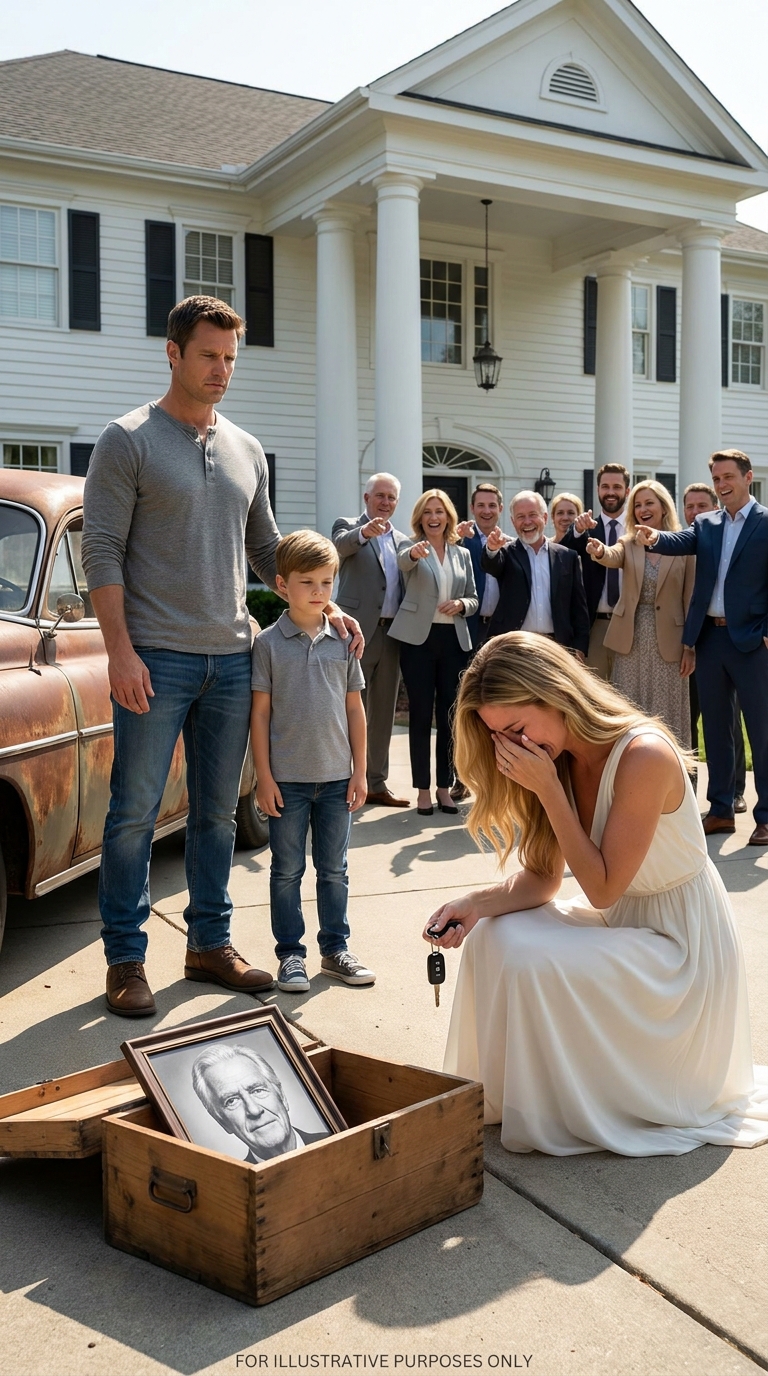
Because if he was wrong, it was just an old car.
But if he was right, Vanessa Callaway had made the most expensive joke of her life.
The car looked even worse under the fluorescent lights of Daniel’s garage.
At the Callaway estate, surrounded by marble floors and champagne laughter, it had seemed like a forgotten object from a rich man’s storage problem. In Daniel’s narrow workshop, where every tool had its place because there was no room for waste, the car became something else entirely. A question. A dare. A ghost from a time when men still shaped metal by hand and believed the future could be built in a garage.
Lily saw it after school the next day.
She stepped through the side door with her purple backpack bouncing against her shoulders, stopped beside a stack of tires, and stared.
“Dad,” she said, “why did you bring home a zombie car?”
Daniel smiled for the first time all day.
“That is an unfair description.”
“It has holes.”
“Lots of important things have holes.”
“Like what?”
“Swiss cheese.”
Lily gave him the patient look Sarah used to give him when his jokes failed.
Daniel crouched beside her. “I think this car may be special.”
Lily looked again, trying hard because she loved him. “Special like old special or special like we can sell it and get a dishwasher?”
“Maybe both.”
Her eyes widened. “A dishwasher special?”
“Don’t get excited.”
Too late. She was already circling the car with the solemn concentration of a child inspecting treasure.
Daniel began the work that night after Lily went to bed.
He did not restore the car immediately. That would have been reckless. Restoration could erase evidence if done carelessly, and Daniel had too much discipline for that. He photographed every inch. He logged measurements. He brushed away dirt gently rather than stripping it. He searched for stamped numbers, manufacturer plates, welding marks, casting symbols, anything that could tell him where the vehicle had come from.
The deeper he looked, the stranger it became.
The chassis number did not match any standard production record he could find. Several parts appeared handcrafted, not factory-made. The suspension geometry was years ahead of what should have existed for the apparent age of the frame. The engine block carried no commercial stamping, only a small series of etched numbers hidden near the firewall.
HRX1-02.
Daniel stared at it for a long time.
His heartbeat shifted.
HRX. Hawthorne Raven Experimental.
The kind of abbreviation he had seen only once before, in that old journal article with the grainy photograph and the dismissive footnote calling the project “unverified.”
For the next several nights, Daniel barely slept.
He pulled out old journals from boxes in his closet. He searched library archives online until his eyes burned. He compared the car’s fender curve to photographs. He enlarged images. He traced lines on transparent paper at the kitchen table while Lily slept down the hall.
At 1:12 in the morning on the fourth night, he found the photograph.
It showed three men standing beside a sleek dark prototype outside a small engineering facility in Detroit in 1964. The image was blurry. The caption uncertain. The prototype’s front end was partially shadowed, but the curve of the fender, the angle of the windshield, and the narrow grille were unmistakable.
Daniel looked toward the garage door.
Then back at the photograph.
His hands began to tremble.
“No,” he whispered.
But the evidence was becoming harder to deny.
The Hawthorne Raven X-1 had been a private experimental sports car commissioned by a short-lived American engineering firm that collapsed after a lawsuit, a fire, and the mysterious disappearance of its second prototype. Collectors had debated for decades whether the surviving photographs showed a real working car or just a styling mock-up. If Daniel’s vehicle was genuine, it was not merely valuable.
It was historic.
And somehow, Richard Callaway had hidden it in plain sight.
Daniel needed proof beyond his own belief.
He emailed photographs to four automotive historians. Three ignored him. One replied with a polite message explaining that every year, dozens of people claimed to have found famous lost prototypes, and almost all were mistaken.
Daniel almost stopped there.
Then he found the seat compartment.
It happened by accident on a rainy Thursday night. Daniel was removing the driver’s seat to inspect the frame beneath it when his fingers brushed a raised seam in the old leather. The stitching was too careful to be damage and too uneven to be original. He leaned closer, shining a flashlight over it.
Someone had opened the seat before.
Someone had hidden something inside.
He used a thin blade and worked slowly, each movement careful enough that he barely breathed. Beneath the leather was a narrow compartment built into the seat base. Inside, wrapped in oilcloth, lay a worn brown notebook, six photographs, and a bundle of letters tied with faded string.
Daniel sat back on the concrete floor.
For several minutes, he did not touch them.
He felt suddenly like a trespasser.
The car had become a puzzle to him, but the notebook was different. This was not metal, not mechanics, not history in the abstract. This was a dead man’s private life.
He thought of Sarah’s box in his bedroom closet. Her letters. Her recipes. Her scarves still holding the faintest trace of perfume if he pressed them to his face on nights when grief got too loud.
Some things, he believed, deserved reverence.
But Richard Callaway had hidden the notebook inside the car. Maybe because the car and the notebook explained each other.
Daniel opened it.
The first page was dated June 17, 1989.
The handwriting was bold, slanted, unmistakably Richard Callaway’s from the signatures Daniel had seen online beneath foundation letters and corporate documents.
I bought myself time today, the entry began. Not with money. Not exactly. With a car no one else believed mattered enough to save.
Daniel read until the rain stopped.
Richard’s notebook told a story no newspaper profile had ever printed.
Before he became a billionaire, before his name climbed onto buildings, Richard Callaway had been a poor mechanic’s son from South Bend, Indiana. He worked in garages, slept in borrowed rooms, and fixed anything people brought him. One of those people was Everett Hawthorne, a brilliant but broke engineer who had been involved in a failed experimental car project in Detroit.
Everett owed Richard money he could not pay.
So he gave him the car.
At first, Richard thought it was madness. He needed cash, not a broken prototype connected to a dead company and legal trouble. But Everett begged him not to scrap it.
“She is proof we were not crazy,” Everett had written in one of the letters. “One day the world will understand what we built.”
Richard kept the car.
Then he built his own fortune.
And as the years passed, the car became more than a rare machine. It became the one object that reminded Richard of who he had been before wealth taught everyone to bow when he entered a room.
Later entries changed tone.
They mentioned Vanessa.
She is twelve today, Richard wrote in one entry. I missed her recital because a board vote ran long. She smiled when I gave her the bracelet, but she looked past me when she said thank you. I am teaching her the wrong language. I give gifts when I owe time.
Another entry, years later, read, She speaks to waiters like they are interruptions. I wanted to correct her at dinner tonight and found I had no authority. Children become what we reward. I rewarded distance. I rewarded polish. I rewarded winning.
Daniel had to stop reading then.
He sat alone in the garage with the notebook open in his lap, thinking of Vanessa’s cold smile, of the way she had tossed him the keys, of the laughter that had filled the auction hall.
Then he thought of Richard, an old man hiding a rusty car and a notebook from the daughter he did not know how to reach.
The next morning, Daniel called Professor Diane Marsh.
She was the only historian who had not dismissed him entirely. A professor at the University of Michigan, she specialized in twentieth-century experimental automotive design. Her voice changed when Daniel mentioned the etched HRX1-02 number.
“Do not restore anything,” she said immediately.
“I haven’t.”
“Do not sell anything.”
“I wasn’t planning to.”
“And Mr. Hayes?”
“Yes?”
“If this is what you think it is, a lot of people are going to start pretending they believed you from the beginning.”
Two days later, Professor Marsh arrived with two colleagues and enough equipment to make Daniel’s little garage look like a crime lab.
For six hours, they examined the car.
They scanned metal composition. Compared weld patterns. Cross-referenced old engineering diagrams. Checked the hidden etching against copies of Hawthorne records that had been sitting in university archives for decades, uncataloged and half-forgotten.
Lily sat on a stool near the office door, eating crackers and watching adults whisper around the zombie car as if it were a sleeping dragon.
Near sunset, Professor Marsh stood back from the engine bay, took off her glasses, and pressed two fingers to the bridge of her nose.
“Well?” Daniel asked quietly.
She looked at him.
“This is real.”
The garage fell silent.
One of the other experts, an older man named Kenneth Rourke whose books Daniel owned, let out a breath that sounded almost like a laugh.
“Mr. Hayes,” he said, “this may be the most important American prototype discovery in forty years.”
Daniel leaned against the workbench because his legs suddenly felt unreliable.
“How much?” Miguel asked from the corner, because Miguel had arrived “just to bring coffee” and then refused to leave.
Rourke looked at Professor Marsh.
“Difficult to estimate,” she said. “With provenance, historical documentation, and the Callaway connection… several million at minimum.”
Miguel nearly dropped his cup.
Daniel thought of the overdue utility bill again.
Then he thought of Vanessa.
He knew it would reach her. News like this never stayed quiet.
It reached her faster than he expected.
Vanessa Callaway was in her father’s study when the article appeared on her phone. A friend sent it with a string of question marks.
Possible Hawthorne Raven X-1 prototype discovered in Illinois garage.
She almost deleted it. Then she saw the photo.
The rusted fender.
The faded grille.
The old wound of a dent near the left headlight.
Her body went cold.
For a moment, she was no longer Vanessa Callaway, heiress, board member, public figure, daughter of a dead billionaire. She was just a woman staring at the exact object she had thrown away in front of a laughing crowd.
She called Walter Briggs, her father’s longtime attorney.
“Tell me that car was worthless,” she said when he answered.
Walter was silent too long.
“Vanessa.”
Her stomach dropped.
“What did I give away?”
Walter sighed. “Your father received offers for that vehicle for years.”
“What kind of offers?”
“Serious ones.”
“How serious?”
“Some reached into the millions.”
Vanessa gripped the edge of the desk.
“Why didn’t you tell me?”
“Your father instructed me not to discuss the vehicle unless you asked about it directly.”
“That’s absurd.”
“He hoped you would ask.”
The sentence hit harder than any accusation could have.
Vanessa looked around the study. The leather chair. The shelves of business awards. The framed photos of her father shaking hands with presidents, governors, CEOs, hospital directors. Everywhere, Richard Callaway looked powerful. Important. Untouchable.
But not once in any of those photographs did he look like a man waiting for his daughter to ask about a rusty car.
Vanessa drove to Daniel’s garage the next afternoon.
She dressed differently than usual, though she hated herself for thinking about it. Jeans. A gray sweater. No driver. No assistant. No diamond earrings. It felt ridiculous, as if humility could be put on like a costume.
Daniel was under the hood when she arrived.
He looked up, wiped his hands on a rag, and said nothing.
The silence was unbearable.
“I came to buy it back,” Vanessa said.
Daniel nodded slowly, as though he had expected that.
“I’ll offer two million,” she said. “Today. No auction. No delay.”
Miguel, who was organizing parts in the back, made a strangled sound and pretended to cough.
Daniel stayed calm.
“No.”
Vanessa blinked. “Three.”
“No.”
“Five million.”
Daniel set the rag down.
“This is not a negotiation.”
“Everything is a negotiation.”
“That might be the saddest thing you believe.”
Her face flushed.
For a second, the old Vanessa rose in her, sharp and defensive. She wanted to remind him who she was. She wanted to say the car had belonged to her father, her estate, her family. She wanted to say he would still be invisible if not for her careless gift.
But Daniel’s eyes stopped her.
They were not angry. That was worse.
They were disappointed in a way she had not earned the right to resent.
“What do you want?” she asked.
“The truth.”
“The truth?”
“Your father kept this car for thirty years. He hid records inside it. He refused millions for it. And you gave it away because you thought humiliating a stranger would be funny.” Daniel paused. “I want to know why it mattered to him.”
Vanessa looked past him at the car.
For the first time, she did not see junk.
She saw a locked door her father had left behind.
“I don’t know why,” she said, and the honesty sounded unfamiliar in her own voice.
Daniel studied her for a moment.
Then he walked to the office, opened a drawer, and returned with the notebook wrapped carefully in cloth.
Vanessa stared at it.
“What is that?”
“Your father’s notebook.”
Her lips parted, but no words came.
“I found it hidden in the seat,” Daniel said. “There are letters too. Photographs. I read enough to understand the car, but the rest belongs to you.”
Vanessa reached for it, then stopped.
Her hand trembled.
“I’m not sure I want to know.”
Daniel’s voice softened. “I think he wanted you to.”
They sat in the garage office as evening settled outside and read the first pages together.
At first, Vanessa sat stiffly, arms crossed, jaw tight, prepared to be bored, prepared to be angry, prepared to find some excuse to hate Daniel for holding her father’s secrets.
Then Richard’s voice emerged from the pages.
Not the public voice from interviews.
Not the polished voice from shareholder letters.
A young man’s voice. Hungry. Proud. Afraid. A man counting dollars for rent. A man fixing engines in winter with cracked hands. A man accepting a strange prototype as payment because something in him could not bear to see another man’s dream crushed into scrap.
Vanessa read silently until she reached the entries about herself.
The first tear fell before she noticed it.
By the third entry, she was no longer trying to hide them.
I missed her birthday dinner again. She said it was fine. It was not fine. Children learn to lie politely when adults disappoint them often enough.
Vanessa pressed a hand over her mouth.
Daniel stood to leave, but she shook her head.
“Please,” she whispered. “Don’t.”
So he stayed.
The woman who had laughed at him in a mansion sat in a grease-smelling garage and wept over a father she had never truly known.
And for the first time since Daniel had met her, Vanessa Callaway looked less like an heiress than a daughter.
Part 3
The auction house wanted spectacle.
Daniel wanted dignity.
That became the first real argument between them.
By then, the Hawthorne Raven X-1 had been authenticated with enough certainty to send tremors through the collector world. Trade publications ran features. Historians debated details. Wealthy buyers began calling through representatives, each pretending not to be desperate while making offers that would have changed Daniel and Lily’s lives forever.
One collector offered four million privately.
Another offered six, then acted offended when Daniel did not accept within the hour.
Professor Marsh urged patience. Kenneth Rourke urged preservation. Miguel urged Daniel to remember that Lily deserved a dishwasher, central air, college savings, and maybe a vacation that did not involve driving past a water park and saying “someday.”
Daniel listened to everyone.
Then he called Vanessa.
“I’m selling it publicly,” he told her. “But not like a circus.”
Vanessa had expected that decision. She had also feared it.
Over the weeks since reading Richard’s notebook, she had returned to Daniel’s garage several times. At first, it was for the car. Then for the letters. Then, unexpectedly, for the quiet. Daniel’s world was nothing like hers. No one performed. No one flattered. No one cared what her last name could buy.
Lily cared only that Vanessa once arrived with store-bought cookies and did not know they were “the sad kind.”
“They taste like cardboard pretending to be a birthday,” Lily said.
Vanessa had stared at her in shock.
Daniel had coughed into his coffee to hide a laugh.
The next time, Vanessa brought cookies from a bakery and asked Lily’s opinion before removing her coat.
“Better,” Lily said. “Still not Dad’s.”
Vanessa had smiled, and Daniel noticed because it was the first smile of hers that did not seem practiced.
Now, sitting across from Daniel in a small diner near his garage, Vanessa folded her hands around a mug of coffee she had not touched.
“The auction house will use my father’s name,” she said. “They’ll make it about scandal if we don’t control the story.”
“Then we control it.”
“You make that sound easy.”
“No,” Daniel said. “I make it sound necessary.”
Vanessa looked out the window at the gray afternoon. “People will laugh at me.”
Daniel waited.
“For giving it away,” she continued. “For not knowing. For being exactly what they already think I am.”
“And what do they think you are?”
Her mouth tightened. “Cold. Spoiled. Cruel.”
Daniel did not rush to comfort her.
That was one of the things that made him different from the people Vanessa knew. He did not rescue her from the truth just because she was uncomfortable.
Finally, he said, “Were they wrong?”
She looked down.
“No.”
The answer was small, but it was real.
The auction was scheduled in Chicago six weeks later.
By then, the car had not been fully restored. Daniel refused to erase its history. He stabilized it, cleaned it carefully, preserved original materials, and restored only what was necessary to make the vehicle presentable without making it false.
“The rust is part of the story,” he told the auction team when they complained.
The auction specialist, a silver-haired man with a pocket square and the emotional range of a calculator, said, “Buyers prefer beauty.”
Daniel looked at the car. “Then they can buy a poster.”
Vanessa laughed before she could stop herself.
The man did not appreciate it.
On the night of the auction, the room was packed.
Collectors flew in from Europe, California, Texas, New York. Journalists lined the back wall. Cameras waited. Experts whispered. Men who had once ignored Daniel at the Callaway estate now tried to catch his eye as if they had always known he was worth noticing.
Daniel wore a dark suit Vanessa had insisted he borrow from a tailor.
“I can wear my own jacket,” he had said.
“You can,” she replied. “But your own jacket looks like it survived a bar fight with a lawn mower.”
“It has character.”
“It has surrender.”
Lily loved the suit. She told him he looked like “a dad from a movie where something important happens.”
Vanessa arrived in a simple black dress with no diamonds except a small ring that had belonged to her mother. She sat beside Daniel near the front, not in the VIP row where the Callaway name had been placed, but next to him, where the story had actually begun.
Before bidding started, the auction house played a short video about the Raven X-1. It included photographs of Everett Hawthorne, the failed Detroit project, Richard Callaway as a young mechanic, and the car’s decades in hiding. At Daniel’s insistence, it also included a line from Richard’s notebook.
A machine is never only metal. Sometimes it is the last honest witness to who we were before the world taught us to pretend.
Vanessa heard her father’s words read aloud and closed her eyes.
Daniel noticed but said nothing.
The bidding opened at one million dollars.
The number was so large that Daniel’s body almost rejected it. He had spent the previous week deciding whether to replace two tires on Lily’s school carpool van or wait until next month. Now strangers raised paddles as casually as if they were ordering lunch.
Two million came within minutes.
Then three.
At four million, Miguel, seated behind Daniel with Lily, whispered, “I am going to pass out in a rich person chair.”
Lily whispered back, “Don’t. They’ll charge us for it.”
At five million, the room changed.
The casual bidders dropped away. The journalists leaned forward. The auctioneer’s voice grew smoother, sharper. Two serious buyers remained, then a third reentered by phone.
Six million.
Six point five.
Seven.
Daniel felt strangely detached. The money mattered. Of course it mattered. It meant security for Lily. It meant saving the garage. It meant never again pretending he was not worried when a bill arrived.
But it also felt like the least important part of the room.
Beside him, Vanessa was crying silently.
Not dramatically. Not for attention. Just tears slipping down her face while she stared at the car her father had loved, hidden, protected, and failed to explain.
Daniel leaned slightly toward her.
“You okay?”
“No,” she whispered. “But I think I needed not to be.”
The bidding reached eight million.
A hush fell.
Then a European industrialist on the left side of the room lifted his paddle.
“Nine million dollars,” the auctioneer announced.
The gasp moved through the hall like wind.
Daniel stared at the stage.
Nine million.
The auctioneer called once.
Twice.
A final pause.
Then the gavel came down.
Sold.
The room erupted.
Applause rose, cameras flashed, people stood. Miguel grabbed Daniel from behind in a hug that nearly knocked him into the row ahead. Lily was crying and laughing at the same time. Professor Marsh shook both of Daniel’s hands. Kenneth Rourke looked like a man watching history apologize for being late.
Vanessa remained seated.
Daniel turned to her.
She was looking at the car, but Daniel knew she was seeing her father.
“I used to think he left me buildings,” she said. “Companies. Accounts. A name people recognized.”
Her voice broke.
“He left me a rusty car and hoped I’d become curious enough to ask why.”
After the auction, the legal process took time, but the outcome was clean. Vanessa had given Daniel the car publicly, clearly, and voluntarily. There were witnesses. There was no contract to undo her cruelty.
Daniel became wealthy, but not loud.
The first thing he did was pay every debt he had.
The second was buy the small rented house in Elgin, because Lily cried at the idea of leaving the bedroom where she still talked to her mother at night.
The third was install a dishwasher.
Lily held a ribbon-cutting ceremony with dental floss and safety scissors.
Then Daniel did something that confused nearly everyone except the people who truly knew him.
He used a major portion of the proceeds to buy the entire industrial building around his garage. He expanded it into the Hayes Restoration Academy, a training program for teenagers aging out of foster care, single parents looking for skilled work, veterans rebuilding their lives, and anyone who needed a second chance but had never been handed a first one properly.
Miguel became operations manager, mostly because he declared himself too emotionally invested to be ignored.
Professor Marsh helped design a preservation curriculum.
Lily painted a sign for the front office that read, Old things can still matter.
Daniel framed it.
Vanessa changed more slowly, but more deeply.
At first, people assumed it was public relations. A humbled heiress trying to repair her image after a viral embarrassment. She ignored them. For once, she did not defend herself through interviews or glossy magazine profiles.
She started inside Callaway Enterprises.
She learned the names of the security guards.
She changed contractor policies that had quietly underpaid cleaning crews for years.
She redirected foundation money toward trade schools, medical debt relief, and childcare grants for working parents. She sold two vacation properties she barely used and funded scholarships in her father’s name, not for the children of executives, but for the children of hourly employees.
At the first board meeting where she challenged a cost-cutting proposal that would have damaged warehouse workers’ health benefits, one director laughed.
“Since when did you become sentimental?”
Vanessa looked at him calmly.
“Since I realized cruelty is usually laziness wearing expensive shoes.”
No one laughed after that.
Her old friends drifted away. They found her less entertaining. Less sharp. Less useful at parties where the main sport was quietly humiliating people without consequence.
Vanessa let them go.
One year after the auction, she returned to the Hayes Restoration Academy on a bright Saturday morning.
The building smelled like sawdust, coffee, engine oil, and possibility. Young people worked in open bays beside mentors. An old pickup sat on a lift. A teenage girl in safety glasses argued confidently with Miguel about carburetor settings. Lily, now nine and a half and very serious about decimals, sat at the front desk doing homework under a sign that said no rich people cookies unless approved by management.
Vanessa laughed when she saw it.
Daniel was near the back, kneeling beside an engine with a seventeen-year-old boy named Marcus, who had arrived three months earlier angry at everyone and was now learning to rebuild transmissions with the concentration of a surgeon.
Daniel looked up when Vanessa approached.
“You’re early,” he said.
“I’m trying a new thing where I don’t make everyone wait just because I can.”
“Dangerous habit.”
“I know. People may start expecting character.”
He smiled.
She looked around the academy. “You built something good.”
“We built something useful.”
“That’s better?”
“Usually.”
They walked toward the small hallway where photographs hung along the wall. There were pictures of finished restorations, students on graduation day, Lily with grease on her cheek, Miguel pretending not to cry at the academy opening, and one framed black-and-white photograph Vanessa had donated.
It showed Richard Callaway at twenty-three, long before the suits, standing beside an engine with grease-stained hands and a grin Vanessa had never seen in his formal portraits.
She stopped in front of it.
“I hated him for being absent,” she said quietly. “Then I hated myself for not understanding him. Now I think both things can be true.”
Daniel stood beside her.
“They can.”
“He hurt me.”
“I know.”
“And he loved me.”
“I know that too.”
Vanessa swallowed. “Do you think people can really change, Daniel? Or do they just behave better once shame catches them?”
He considered that.
Outside, someone started an engine. It coughed, sputtered, then roared awake. Cheers erupted from one of the bays.
“I think shame can open the door,” Daniel said. “But you still have to decide whether to walk through it after everyone stops watching.”
Vanessa looked at him.
“And have I?”
Daniel smiled gently. “You’re here on a Saturday morning asking a mechanic philosophical questions while wearing normal shoes. That’s progress.”
She laughed, and this time the sound held no blade.
They stood quietly before Richard’s photograph.
After a while, Vanessa said, “I keep thinking about that night. What if I hadn’t thrown you those keys? What if I’d just had the car hauled away? What if it had ended up in scrap?”
Daniel looked through the open bay doors at the young people working inside the academy. At Lily helping Marcus label tools. At Miguel pretending to be stern while smiling like a proud uncle. At a place that existed because one cruel joke had been met with patience instead of rage.
“Then you might never have known who your father really was,” he said.
Vanessa’s eyes filled again, but she did not look away.
“And you?”
Daniel looked at Lily.
“I might have spent the rest of my life thinking the quiet years were all I had left.”
Vanessa followed his gaze.
Lily caught them looking and waved with a wrench in one hand.
Daniel waved back.
The greatest inheritance Richard Callaway left behind was not the car. It was not the nine million dollars. It was not the company, the estate, or the famous name carved into buildings across Chicago.
It was a lesson hidden under dust.
A lesson Vanessa had been too proud to see, Daniel had been humble enough to recognize, and Lily would grow up understanding better than either of them had at first.
That worth is not always polished.
That kindness is not weakness.
That some treasures only reveal themselves to people willing to look past rust, silence, grief, and shame.
And that sometimes, the thing a cruel person throws away as a joke becomes the very thing that saves them.