“Ryan Carter.”
“Thank you, Mr. Carter.”
That was all.

No warmth. No accusations. No questions about whether I had stolen anything or touched her daughter or planned to use this moment for money. Just two controlled words and my name filed somewhere behind her eyes.
I nodded and walked back to my car.
I thought that was the end of it.
I drove home, changed clothes in the apartment parking lot because my father was asleep on the couch and I didn’t want to wake him, ate a protein bar that tasted like chalk, and made it to work four minutes late.
Nobody noticed.
The morning swallowed me whole. Delayed routes. A supplier screaming about missing pallets. A driver stuck outside Riverside with a dead battery. A spreadsheet that refused to balance because someone in procurement had entered three hundred units as thirty thousand.
By lunch, the girl outside the bar felt like something I had dreamed during a fever.
Then at 2:15, every mid-level manager was called into the largest conference room.
Rumors moved faster than freight.
The company had been sold. New ownership. New leadership. Possible restructuring. Everyone sat straighter than usual, pretending not to be afraid.
I sat in the back row because I was exhausted and because people who sit in the front get asked questions.
The room went quiet when the door opened.
The woman from the mansion walked in.
Same black hair. Same calm face. Same eyes that could read damage without asking to see the wound.
She set a folder at the head of the table and looked around.
“My name is Evelyn Brooks,” she said. “As of this morning, I am the chairwoman and chief executive officer of Brooks Consolidated Logistics.”
My body went cold.
Chloe was her daughter.
The woman whose front steps I had stood on at sunrise now controlled the company where I worked, the paycheck keeping my father alive, and the future I was barely holding together with caffeine and fear.
Her eyes moved across the room.
For one second, they stopped on me.
No change in expression.
No recognition.
Somehow, that scared me more.
Part 2
For the next week, I tried to become invisible.
I didn’t mention Chloe. I didn’t mention the mansion. I didn’t mention the fact that I had seen our new CEO before anyone else in the company knew her name. I kept my head down, did my work, and avoided eye contact whenever Evelyn Brooks entered the operations floor.
That would have been easier if she hadn’t started appearing there constantly.
Evelyn didn’t lead like the executives we were used to. She didn’t sweep through with an entourage, demand applause, or give speeches about family while preparing layoffs. She listened. She stood in corners. She asked questions so precise they felt surgical.
“Why does this route pass through two congestion points when the delivery window is flexible?”
“Who approved this staffing model?”
“Why is the warehouse team using a spreadsheet that contradicts the live inventory system?”
People hated her within days because she noticed things they had spent years hiding under jargon.
One Wednesday afternoon, she sat silently near the window while I walked my team through the northern delivery routes. I had changed them unofficially six weeks earlier after realizing the old plan forced three drivers through the same bottleneck every morning.
“Average trip time dropped by thirteen minutes,” I told the room. “Fuel costs are down four percent on that section, and customer complaints from those zones have decreased.”
When the meeting ended, Evelyn spoke for the first time.
“Was this change approved through the formal process?”
Every head turned toward me.
I kept my voice steady. “The proposal was submitted twice.”
“To whom?”
“Marcus Hail and Trevor Sands.”
Across the room, Marcus smiled like a man watching someone else step into a trap.
“And the response?”
“The first submission received no reply. The second was marked for next-quarter review.”
Evelyn wrote something in a small notebook.
“Yet you implemented it.”
“With limited scope and driver feedback,” I said. “The old route was wasting time and money.”
She looked at me for a long second. “Send me the original proposal.”
“Yes, ma’am.”
She left without another word.
That was when Marcus Hail started paying attention to me.
Marcus was senior director of operations, which meant he knew just enough about the work to take credit for it and just enough about politics to avoid blame. Trevor Sands was vice president of regional strategy, a man with perfect teeth and the emotional warmth of a locked filing cabinet.
They had both expected Evelyn to rely on them.
Instead, she kept asking people like me questions.
A week later, Chloe texted me.
I was at my desk, staring at a route delay map, when an unknown number appeared.
Hi Ryan. This is Chloe. I got your number from the ride history before it disappeared. I wanted to say thank you. Properly.
I stared at the message until the screen dimmed.
There was no version of this that was safe. Ignoring the CEO’s daughter seemed rude. Answering her seemed dangerous. Meeting her seemed insane.
So naturally, I chose the worst middle option.
You don’t need to thank me. I’m glad you got home safe.
She replied immediately.
Coffee? Public place. Ten minutes. I promise I’m sober.
I rubbed my face with both hands.
At lunch, I met her at a café two blocks from the office.
Sober Chloe looked nothing like the girl from the planter box. Jeans, white T-shirt, hair tied back, no makeup except lip balm. She looked younger, softer, and deeply embarrassed.
“I owe you an apology,” she said before I sat down.
“You don’t.”
“I do. I was a mess.”
“You were having a bad night.”
She looked at me carefully. “That’s generous.”
“It’s accurate enough.”
She wrapped both hands around her coffee cup. “My boyfriend cheated on me with one of my best friends. I found out at the party. Everyone knew except me. I handled it with all the grace of a reality TV finale.”
I didn’t laugh, though she clearly wanted me to.
“I’m sorry,” I said.
“I didn’t tell you that so you’d feel bad for me. I just wanted you to know I don’t usually wake up with no memory of where I live.”
“I figured.”
“You didn’t judge me.”
“You were already judging yourself pretty hard.”
Her eyes dropped.
We talked for fifteen minutes. Traffic. Weather. Her mother’s terrifying ability to make grown men sit straighter. She asked about my work, and I gave vague answers. When I stood to leave, she stopped me.
“My mom asked about you.”
My stomach tightened.
“What did she ask?”
“Whether you seemed like someone who wanted something.”
“And what did you say?”
Chloe looked at me then, serious for the first time.
“I said you looked like someone who was too tired to want anything except sleep.”
That hit closer than I wanted it to.
That evening, Evelyn appeared near my desk after most people had gone home.
“Mr. Carter.”
I stood too quickly, nearly knocking over my coffee.
“Yes?”
“My daughter told me she met you today.”
There it was. The thing I had been trying to avoid.
“I’m sorry if that was inappropriate. She asked to thank me. I kept it brief.”
“I’m not here to reprimand you.”
That didn’t make me relax.
Evelyn glanced at the stack of route reports on my desk. “How many hours do you work outside this office?”
I felt my face close. “Enough.”
“That wasn’t an answer.”
“It’s the only one I have.”
Something unreadable passed through her expression.
“Why did you decline two promotion offers?”
I looked toward the glass walls of the operations floor. No one was close enough to hear, but still.
“Personal availability.”
“That is what your file says.”
“Then my file is accurate.”
“It’s incomplete.”
“With respect, my personal life isn’t a company document.”
For a second, I thought I had gone too far.
Then Evelyn nodded once.
“No. It isn’t.”
She walked away, and I thought maybe I had offended her.
Instead, three days later, I was offered the chance to lead a six-month regional expansion project.
It was the kind of opportunity that changes a career. Multi-state coordination. Direct reporting to the chair’s office. A real budget. Real authority. The old Ryan, the one before hospital bills and rideshare shifts and exhaustion that lived in his bones, would have said yes before the sentence was finished.
But the project required evenings. Weekends. Travel.
I couldn’t.
If I stopped driving, I couldn’t cover my father’s payments. If I kept driving and took the project, I would collapse. Maybe not dramatically. Maybe just one morning at a red light, with my hands on the wheel and no strength left to press the brake.
So I declined.
Limited personal availability.
The phrase felt like a chain around my throat.
That was when the rumors started.
At first, they were whispers.
Ryan had the CEO’s attention.
Ryan had been seen with Chloe.
Ryan knew the Brooks family before the takeover.
Ryan’s little route proposal was suddenly important because of who he drove home.
Marcus and Trevor didn’t say anything directly. Men like that rarely do. They let other people carry poison for them.
A process improvement I had written eight months earlier appeared in Marcus’s leadership presentation with my name removed. A staffing analysis I had sent Trevor became “regional strategy research.” My team got blamed for delays caused by recommendations I had made and they had ignored.
In meetings, Trevor started using phrases like “independently verified achievement” while looking at no one and somehow still looking at me.
I saved every email. Every timestamp. Every version history.
But I didn’t complain.
Complaining would mean asking Evelyn Brooks for protection, and that would prove the rumors in everyone’s mind. Staying silent meant watching my work get stolen and my reputation bleed out slowly.
By Thursday night, I had made my decision.
I opened a blank document and typed my resignation.
It took me four days to send it.
On Monday morning, I arrived before sunrise. The office was dark except for the blue glow of emergency lights. I sat at my desk, read the letter one last time, and pressed send.
Then I went to the break room, made coffee, and started working like I hadn’t just cut the only rope holding my life together.
At 10:12, Marcus presented my coordination method in the quarterly review meeting.
He stood at the front of the room, smiling, clicking through slides I knew better than my own reflection.
“This new cross-regional approach,” he said, “has the potential to reduce delivery errors by eleven percent.”
I stared at the screen.
My charts.
My structure.
My language, polished just enough to hide the theft from anyone who hadn’t written the first version at 1:30 in the morning after a delivery shift.
Then Trevor stood.
“Of course,” he said smoothly, “as we restructure, we must ensure advancement is based on proven leadership rather than personal proximity to new ownership.”
The room shifted.
A few people glanced at me.
I wrote one sentence in my notebook so my hands wouldn’t shake.
Do not give them the satisfaction.
When it was my turn, I gave my report. Driver shortages. Inventory risk. Staffing gaps at the Western Distribution Center. I didn’t defend myself. I didn’t accuse anyone. I had already resigned. All I had left was the discipline to leave cleanly.
After I sat down, Evelyn placed her pen on the table.
The sound was small.
The room went silent anyway.
“There are several matters that need clarification before we continue,” she said.
Marcus’s smile weakened.
Evelyn opened a folder.
“Mr. Hail, the coordination method you presented was created by Ryan Carter eight months ago and submitted through the proper channels on March 14 at 11:42 p.m.”
No one moved.
She slid printed documents across the table.
“Here is the original proposal. Here is the email submission. Here is the file history. Here are the comments made by Mr. Carter during the six-week pilot phase. Your presentation uses the same structure, data set, and projected outcomes with his name removed.”
Marcus cleared his throat. “The proposal was part of a broader team discussion.”
“I’m not finished,” Evelyn said.
Three words. Quiet as falling snow. Deadlier than a shout.
She turned the page.
“Mr. Sands, this staffing analysis was submitted by Mr. Carter six weeks before your department presented it under regional strategy. The recommendations were not implemented. Later, the resulting staffing failures were used to criticize Mr. Carter’s team.”
Trevor’s face went pale beneath his tan.
“This is not collaboration,” Evelyn continued. “This is not administrative confusion. This is a pattern of transferring one employee’s work to senior leadership while undermining his reputation.”
HR sat frozen.
The drivers’ manager across from me looked like he wanted to cheer but valued his mortgage too much.
Evelyn looked around the table.
“When a company cannot identify who is actually creating value, it does not merely lose talent. It loses the ability to understand itself.”
My throat tightened.
I had spent weeks thinking no one would believe me unless I begged.
She hadn’t needed me to beg.
She had gone looking for the truth.
Marcus and Trevor were placed under formal investigation before lunch. Both were removed from decisions involving operations. By 2:30, my resignation had been acknowledged but not processed.
At 3:00, I was sitting in Evelyn Brooks’s office.
Her office overlooked the bay. It had no unnecessary decorations. Just books, files, and a photograph of Chloe at about eight years old, missing two front teeth and grinning at the camera.
Evelyn sat across from me, not behind her desk.
“I understand why you resigned,” she said. “I will not pressure you to withdraw the letter.”
I looked down at my hands. “That makes one of us.”
Her face softened slightly.
“My attention to your work created problems for you.”
“You didn’t start the rumors.”
“No. But I underestimated how quickly weak people turn observation into accusation.”
I almost smiled.
She leaned forward.
“Why didn’t you report Marcus and Trevor?”
“You know why.”
“I want to hear you say it.”
“Because if I asked you for help, everyone would say I had special access. If I didn’t, they would keep stealing my work. Leaving seemed like the only option that belonged to me.”
Evelyn was quiet for a long moment.
“You carry consequences that are not yours.”
I looked up.
The words landed somewhere deeper than I expected.
She slid a folder toward me.
“I am restructuring the regional expansion role. Reasonable hours. Independent oversight. Compensation aligned with the responsibility. You would report to the vice president of operations, not to me.”
I didn’t open the folder.
“Why?”
“Because you are the right person for the job.”
“Chloe told you about my father.”
“She did.”
I stood halfway from my chair. “Then I can’t accept it.”
“Sit down, Mr. Carter.”
The command in her voice worked before my pride could argue.
“I am not offering you charity,” she said. “I am correcting a business failure. If one of my strongest managers must work two additional jobs to survive while senior leaders steal his work, the problem is not his pride. It is the company’s structure.”
I swallowed.
“I don’t want pity.”
“You’re not getting pity. You’re getting terms you should have been offered before.”
For the first time in two years, I didn’t know what to say.
Evelyn’s voice changed then. It became quieter, almost human.
“My daughter said you got her home safely without asking for anything. Today I watched you sit through men taking credit for your work without lowering yourself to their level. Integrity is easy to perform when people are watching, Ryan. It is much harder to live when no one is.”
No one at that company had ever said my first name like it mattered.
I took the folder.
“I’ll think about it.”
“That is all I ask.”
At the door, I turned back.
“What you did today mattered.”
Evelyn looked at me, expression unreadable.
“You did the work,” she said. “I only made sure people read the right name.”
Part 3
I withdrew my resignation three days later.
Not because I owed Evelyn Brooks anything. Not because Chloe had thanked me. Not because I suddenly trusted the company that had nearly let me disappear under other men’s names.
I stayed because the new role was real.
The hours were clear. The pay was fair. The reporting structure protected both me and everyone else from the appearance of favoritism. Every review would go through an independent committee. Evelyn would not be involved in my compensation, promotions, or performance ratings.
For the first time in years, I signed an offer without feeling like I was trading my health for survival.
The new salary let me quit overnight deliveries first.
Two weeks later, I cut my rideshare hours in half.
A month after that, I drove my final passenger to the airport, parked at a café near Mission Bay, and sat with the app open on my phone. My thumb hovered over the screen.
Go offline.
Two small words.
I pressed them and waited for relief to hit me like a wave.
It didn’t.
Instead, there was quiet.
A strange, almost frightening quiet.
For two years, my life had been measured in dollars per mile, hours of sleep, medication costs, and how many shifts I could stack before my body rebelled. Suddenly there was space where panic used to be.
My father noticed first.
“You’re home before dark,” he said one evening from his recliner.
“Don’t sound so suspicious.”
“I’m trying to decide whether to call the police. Maybe someone stole my son and replaced him with a man who eats dinner sitting down.”
I laughed harder than the joke deserved.
At work, the regional project moved fast. We reorganized routes across Southern California, Nevada, and Arizona. We built driver feedback into planning instead of treating the drivers like moving parts. We fixed the warehouse staffing model Marcus and Trevor had ignored.
Marcus resigned before the investigation ended. Trevor was terminated after HR found he had altered document records on more than one project.
People still talked about me.
They said Evelyn had protected me because of Chloe. They said the investigation was personal. They said I was lucky.
Maybe I was.
But luck had timestamps, emails, file histories, and six years of work behind it.
Evelyn and I remained careful. In meetings, she challenged my proposals harder than anyone else’s. If my numbers were weak, she said so. If my timeline was unrealistic, she dismantled it line by line. She never humiliated me, but she never softened the truth either.
I respected her for that.
Respect became something else slowly.
It started with small moments.
Once, after a fourteen-hour planning session, I found her alone in her office, staring at a cold cup of coffee like she had forgotten what it was for.
“Have you eaten?” I asked from the doorway.
She looked up, surprised. “That is not a standard project question.”
“It becomes one when the CEO looks like she’s about to intimidate herself into starvation.”
The corner of her mouth moved. Almost a smile.
“There’s a diner two blocks away,” I said. “We can discuss the Phoenix timeline there.”
She studied me the way she studied financial reports.
“Professional dinner?”
“Professional food,” I said. “Possibly professional pie.”
That almost-smile became real.
We went to the diner.
At first, we talked about the project. Then the conversation shifted. She told me about taking over the company her father had built but never believed she could lead. She told me about a marriage that had ended quietly after years of being less important than the next acquisition. She told me about Chloe as a child, waiting in ballet shoes by the front door while Evelyn missed another recital because a board vote ran late.
“I kept telling myself I would fix it when things calmed down,” Evelyn said, looking out the window. “But work never calms down. It only teaches you to abandon people efficiently.”
I told her about my father. About the surgery. About the first time I saw him unable to button his own shirt and went into the bathroom to cry where he couldn’t hear me. About being angry at bills, at hospitals, at myself, at a world where love could be measured by how much debt you were willing to survive.
Evelyn listened without interrupting.
That night, when we walked back to the parking lot, she said, “Thank you.”
“For dinner?”
“For not treating me like a title.”
I looked at her. “Tomorrow you can go back to terrifying everyone.”
“Do I terrify everyone?”
“Yes.”
She laughed.
Not politely. Not strategically. A real laugh, surprised out of her.
After that, we had dinner sometimes. Coffee. Walks by the water. Always after hours. Always carefully. We didn’t hide, but we didn’t announce anything either.
Chloe noticed before we admitted it to ourselves.
I was at Evelyn’s house one Saturday helping install a loose shelf in her home office after a project meeting that had somehow turned into furniture repair. Chloe appeared in the doorway wearing sweatpants and the expression of someone discovering a crime scene.
“Are you two dating?”
I dropped a screw.
Evelyn didn’t blink. “We are discussing operational timelines.”
Chloe looked at the shelf, the drill in my hand, and the pencil behind my ear.
“Does logistics usually involve wall anchors?”
I crouched to retrieve the screw, wishing the floor would open.
Chloe smiled at me, but her voice softened.
“I don’t object, Ryan. Just don’t hurt my mother.”
Evelyn turned sharply. “Chloe.”
“What? She’s scary at work, but she’s soft where it counts. Someone should say it.”
Then she walked away, leaving silence behind her.
That night, Evelyn and I stood by the windows overlooking the ocean.
“She shouldn’t have put you in that position,” Evelyn said.
“She cares about you.”
“She worries I’ll make a foolish decision.”
“You don’t make decisions quickly enough to be foolish.”
She looked at me, and there was sadness in her smile.
“I’m almost twenty years older than you.”
“I know.”
“I am the chairwoman of the company where you work.”
“I know that too.”
“People already accused you once.”
“That’s why we handle this correctly.”
I had thought about it more than I wanted to admit. If we were going to try, we would report it to HR and the board. My supervision would remain fully independent. Evelyn would have no involvement in my reviews, raises, promotions, or disciplinary matters. Everything would be documented.
She listened without speaking.
When I finished, she asked, “How long have you been planning this?”
“Longer than I should probably admit.”
“And you want to try?”
I looked at the woman who had opened her door to me at sunrise as a stranger, then walked into my company and changed the course of my life without ever asking me to kneel for it.
“Yes,” I said.
For once, Evelyn Brooks did not answer with policy, structure, or strategy.
She stepped closer, touched my face with a gentleness that felt almost uncertain, and kissed me.
The kiss was careful. Brief. Honest.
It felt less like the beginning of something sudden and more like the truth finally stepping into the room.
We reported the relationship before it became public.
People talked anyway.
Of course they did.
Some said the rumors had been true from the beginning. Some said I had planned everything from the night I drove Chloe home. Some said Evelyn had lost her judgment. A few said worse.
This time, I didn’t resign.
I didn’t shrink.
My work was documented. My position was independently supervised. The people who mattered knew the facts. The people who preferred gossip had never needed facts in the first place.
But our relationship was not simple.
Evelyn was used to solving problems with power. I was used to surviving by refusing help. Those two instincts collided hardest when I found out she had called the hospital billing department and offered to pay the remaining balance on my father’s medical debt.
I drove to her house that night furious.
“You had no right,” I said.
She stood in the kitchen, calm at first. “I was trying to help.”
“You were trying to fix me.”
“That is not fair.”
“No. What isn’t fair is making decisions about my life because you have enough money to skip the part where I get a say.”
Her expression tightened. “You are exhausted, Ryan. You have been exhausted for years.”
“And I still get to choose how I stand.”
The argument lasted almost an hour. Not loud. Worse than loud. Precise. Painful. Two people using truth like a knife because both were scared.
Finally, Evelyn looked away.
“I don’t know how to love people without removing obstacles,” she admitted. “That is what I know how to do.”
I sat down, the anger draining into something sadder.
“I don’t need you to carry my life for me,” I said. “I need you beside me while I carry it better.”
The next day, she apologized.
Not with flowers. Not with a grand gesture. She sat across from me at a café and said, “I was wrong.”
Then she connected me with a financial adviser, only after I agreed. The debt was restructured. Interest reduced. Payments organized into something human. I paid every cent myself, but now I could see the end.
My father met Evelyn two weeks later.
He was suspicious from the moment she stepped into our apartment wearing a simple blue dress and carrying soup she definitely had not made herself.
He pulled me aside in the hallway.
“Are you sure she likes you?”
“Yes.”
“She looks like she could buy the building if the elevator annoyed her.”
“She probably could.”
“Ryan.”
“She likes me, Dad.”
He studied me, then nodded. “Just making sure she’s not planning to acquire you.”
At dinner, Evelyn did something I’ll never forget.
My father struggled to stand from his chair. Most people rushed to help him too quickly, turning kindness into embarrassment. Evelyn didn’t. She simply moved his cane within reach, steadying the table without making a show of it.
My father noticed.
By dessert, he had stopped interrogating her and started telling stories about me as a kid, including one involving a stolen church microphone and a talent show performance I still deny.
Before Evelyn left, my father took her hand.
“My son thinks love means never needing anyone,” he said. “If you’re staying, don’t let him get away with that.”
Evelyn glanced at me.
“I’m trying,” she said.
Chloe was healing too.
She started therapy after that night outside the bar. Eventually, she enrolled in a counseling psychology program. She said she wanted to work with young adults before one bad night became a life they couldn’t return from.
One afternoon, she came by the office with lunch for her mother and found me in the lobby.
“I never thanked you enough,” she said.
“You thanked me plenty.”
“No.” She looked toward the glass doors. “I mean for not making that morning the worst story of my life. You could have judged me. You could have left me. You could have taken advantage of the situation.”
“I did what anyone decent would do.”
She smiled sadly.
“That’s the thing, Ryan. Not everyone does.”
Two years after Evelyn took over Brooks Consolidated Logistics, the regional expansion project finished ahead of schedule. Driver schedules improved. Operating costs dropped. Complaints decreased. The company began promoting from inside departments instead of letting senior managers harvest other people’s ideas.
I was offered regional director of operations.
The recommendation came from the independent committee. Evelyn had no vote.
I accepted.
The same month, I made the final payment on my father’s medical debt.
When the confirmation email arrived, I didn’t shout. I didn’t cry. I just sat at my desk for a long time and read the words over and over until they became real.
Paid in full.
That night, Evelyn brought me to the beach house.
Chloe was there. My father was there. There was a cake from a grocery store bakery with the wrong frosting because Chloe had forgotten I hated coconut. We ate it anyway.
After dinner, Evelyn and I walked down toward the water. The sky was dark, the house glowing behind us, the waves folding softly onto the shore.
I had a small box in my jacket pocket.
Of course she noticed.
Evelyn noticed everything.
“Ryan,” she said carefully.
“I know. You’re older than me.”
Her mouth opened, then closed.
“I know you’re the chairwoman. I know people talk. I know we argue over things other couples probably don’t put into spreadsheets.”
“That spreadsheet was useful.”
“It was horrifying.”
“It had tabs.”
“It had too many tabs.”
She laughed, and I took the box out.
“The morning I picked up Chloe,” I said, “I thought it was one more ride. One more fare. One more forty dollars toward a bill that felt like it would never end. I didn’t know it was bringing me to your door.”
Her eyes shone, but she stayed still.
“You protected my work when I had already given up on it,” I continued. “You challenged me when I needed it. You overstepped when you were scared. You apologized when you were wrong. And somewhere in the middle of all that, you became the person I wanted beside me when life got difficult.”
I got down on one knee.
“Evelyn Brooks, you are stubborn, terrifying, brilliant, impossible, and the most honest person I have ever loved. Will you marry me and keep arguing with me about every important decision for the rest of our lives?”
Tears slipped down her face, but she smiled.
“You still have time to change your mind.”
“I don’t decide important things quickly.”
“No,” she whispered. “You don’t.”
“So believe me when I say I’ve thought about this long enough.”
She nodded.
“Yes.”
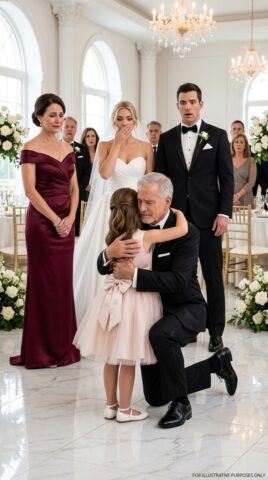
We married the following spring on the lawn facing the ocean.
No giant society wedding. No press. No performance. Just family, close friends, a few colleagues, and several drivers who cried harder than anyone expected and blamed allergies.
My father sat in the front row. Chloe stood beside her mother, holding her bouquet and trying not to ruin her makeup.
In her vows, Evelyn said I had seen her daughter at her worst without judgment, seen her company at its ugliest without bitterness, and seen her power without ever trying to use it.
In mine, I said Evelyn had taught me that accepting help did not make a man weak. Sometimes self-respect was not carrying everything alone. Sometimes it was knowing who had earned the right to stand beside you.
After the wedding, life did not turn perfect.
Evelyn still worked too much. I still hid stress until it leaked out sideways. Chloe and her mother still fought sometimes, then apologized awkwardly because neither of them had much practice. My father still had checkups, still complained about hospital food, and still flirted shamelessly with nurses who were nice enough to pretend he was charming.
But none of us walked away when things got uncomfortable.
One Saturday morning, I drove Evelyn and Chloe through downtown. We passed the old planter box outside the closed bar where I had found Chloe barefoot before sunrise.
Chloe pointed through the windshield.
“There,” she said softly.
Evelyn looked at the sidewalk, then at me.
“You could have canceled the ride.”
“I almost did.”
“Why didn’t you?”
I kept my eyes on the road.
“Because she needed someone to stop.”
The car went quiet.
Then Evelyn reached over and placed her hand over mine.
I had once thought that morning was just one more fare before work. A tired man doing a small decent thing, then rushing to a job where no one noticed how close he was to breaking.
But life does not always change because of grand decisions.
Sometimes it changes because one person stops for a stranger.
Sometimes it changes because a woman with a locked heart opens her front door.
Sometimes it changes because the truth waits quietly in timestamps and old emails until someone brave enough decides to read the right name.
I drove a drunk girl home that morning.
I didn’t know I was driving toward my future.