His voice was not loud. That made the room colder.
“Laundry basket, sir,” Ellie said.
“Which basket?” Vivien asked.
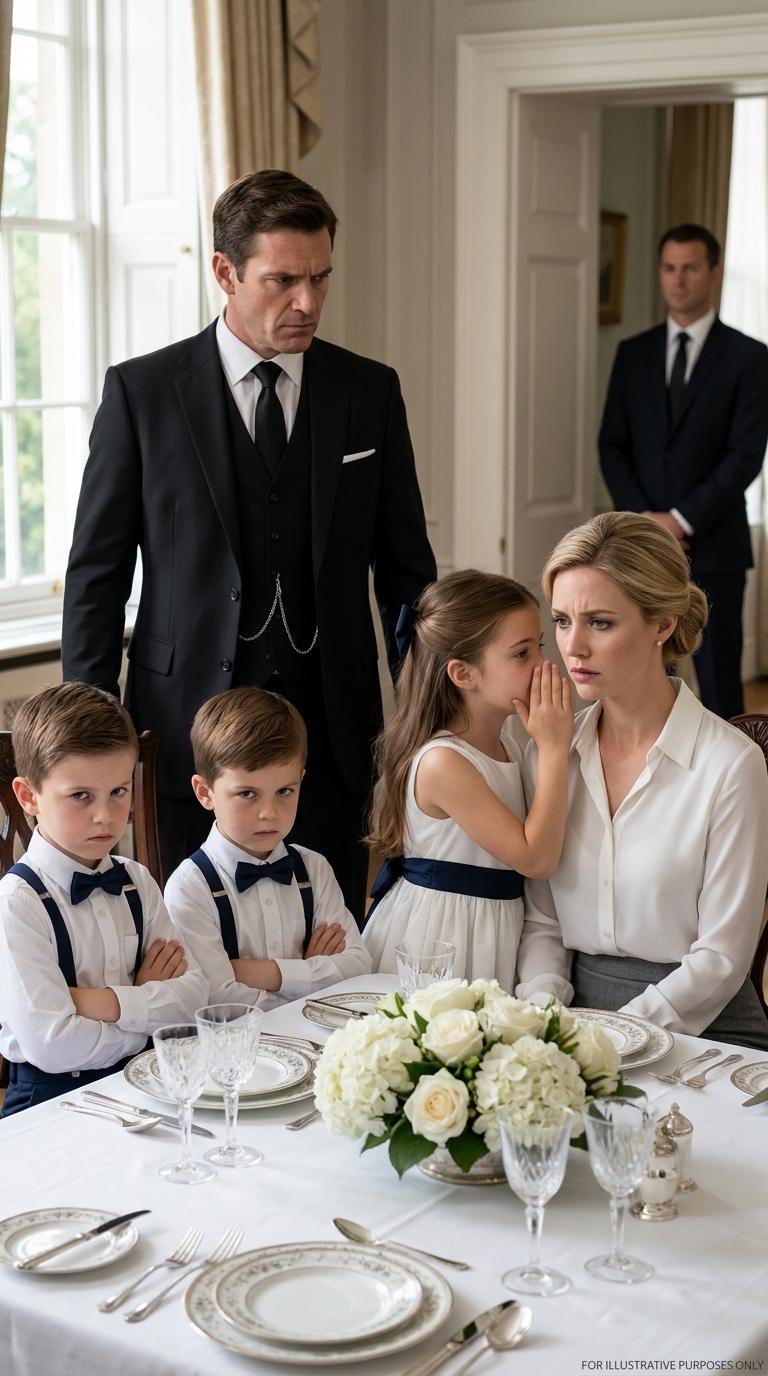
Too fast.
Ellie noticed. Dominic noticed Ellie noticing.
“The one under the dinner linens,” Ellie said. “It was hidden.”
Dr. Harlon cleared his throat and slipped the brown bottle deeper into his suit pocket.
Dominic did not look directly at it. He looked at the square shape pressing against the fabric.
Then his gaze shifted to Lucia’s glass.
Ellie swallowed hard. “The napkin smells like the juice.”
Vivien laughed softly. “Children invent patterns.”
Sarah Harper appeared in the kitchen doorway, face pale, one hand still wet from the sink.
Ellie saw her mother shake her head once.
Don’t.
But Ellie had already seen too much.
Dominic reached for Lucia’s glass. Vivien placed a hand on his wrist.
“Dominic, please,” she said. “You know what Dr. Harlon said. Any disruption can trigger them.”
Dominic looked down at her hand.
Vivien removed it.
Slowly, Dominic lifted the glass and held it beneath his nose. He did not flinch, but his jaw tightened.
Ellie glanced toward the sideboard and saw a white pharmacy receipt tucked beneath Dr. Harlon’s medical folder.
At the top was tomorrow’s date.
Beneath it were three names.
Matteo Moretti.
Enzo Moretti.
Lucia Moretti.
Then the words compounded citrus suspension.
Ellie did not know what compounded meant. She knew tomorrow had not happened yet. She also knew adults only printed things early when they had already decided what was going to happen.
Dominic set the glass down.
“Doctor,” he said, “why is their medication prepared for tomorrow?”
Dr. Harlon’s smile did not break.
“Routine refill. The pharmacy schedules ahead.”
“That was not my question.”
Vivien shifted slightly, her black sleeve brushing the sideboard and covering part of the receipt.
Lucia pushed her chair back so hard the legs screamed against the floor.
Matteo grabbed the table.
Enzo shut his eyes.
Ellie looked at them, then at the empty chair.
“It happens when someone touches her place,” Ellie said.
Vivien turned slowly. “Her place?”
Ellie pointed at the chair.
“That place.”
No one moved.
Even Miss Caroline stopped wiping sauce from her blouse.
Ellie walked around the table, careful not to step on broken glass. When she reached the empty chair, she did not pull it out. She bent down and looked at the high back where candlelight barely reached.
Someone had painted over the wood.
Almost perfectly.
Almost.
“There,” Ellie whispered.
Dominic came around the table. He did not hurry. Men like Dominic Moretti did not hurry in front of people. But his hand was empty now, and that made him look more dangerous than the knife ever had.
Ellie touched the back of the chair.
“Three stars,” she said.
Beneath a fresh layer of dark polish, three thin scratches marked the wood in a crooked little row.
Three stars like the ones stitched into the napkin.
Dominic crouched beside the chair. His expensive suit brushed the rug where pasta sauce had spilled. He ran his thumb over the marks.
Dark polish came away on his skin.
Fresh.
Vivien spoke behind him.
“Rosalie was sentimental. She marked things. It embarrassed everyone.”
At the sound of the name, Lucia made a broken little noise.
Ellie turned to her.
“Your mommy did that?”
Lucia nodded once.
Enzo whispered, “For us.”
Matteo looked at Dominic, but he did not reach for him.
That hurt more than if he had.
Ellie looked at the receipt, then at the chair, then at Vivien’s hand resting too still on the sideboard.
“Someone tried to cover the stars after the medicine was ordered,” Ellie said.
Vivien smiled.
For the first time that night, her eyes did not.
Part 2
“Dominic,” Vivien said, folding her hands in front of her black dress, “this has gone far enough.”
Her voice was smooth, but the room no longer belonged to her.
A frightened nanny stood by the curtains. A doctor’s fingers twitched near his pocket. Three children watched their father with a kind of desperate hunger that made Ellie’s chest ache.
Dominic rose from beside the chair.
Vivien continued, softer now. “A service child found a stained napkin, repeated a forbidden name, and now grief is rearranging facts in front of your sons and daughter.”
Frank Ballardi, Dominic’s consigliere, stepped closer.
He was an older man with a scar across one eyebrow and a sad patience in his eyes. He had the look of someone who had spent years cleaning up other people’s disasters before they reached the newspapers.
“Boss,” Frank said carefully, “with respect, the girl should be removed until we know who put her up to this. A laundry child does not walk into a Moretti dinner and direct the room.”
The words did not sound cruel.
That made them worse.
Ellie felt every adult eye lower her into something smaller than a person. A problem. A mistake. A child standing on an expensive rug with dirty sneakers and an old napkin she had no right to touch.
Dr. Harlon lifted his medical folder and slid the pharmacy receipt deeper beneath it.
“These children need structure,” he said. “Not superstition. Not servant stories. Certainly not a little girl teaching them to cling to delusions.”
Sarah Harper made a small sound from the doorway.
Two guards stepped between her and the dining room.
Ellie did not look at her mother. If she did, she might run.
Vivien stepped closer.
“Ellie,” she said gently, “give me the napkin and apologize to Mr. Moretti. Then your mother can keep her position. We do not need to make this larger than it is.”
There it was.
Not a threat.
Not out loud.
Just the kind of velvet-covered knife rich houses used when they wanted poor people to understand the floor beneath them could vanish.
Ellie’s fingers tightened around the napkin.
“I can’t apologize for the chair,” she said.
The dining room stilled.
Vivien’s smile thinned. “For the chair?”
“You said Mrs. Rosalie marked things years ago.” Ellie looked at Dominic, not Vivien. “But the paint came off on his thumb. Fresh paint smells sharp. Old paint doesn’t.”
Frank glanced at Dominic’s hand.
A dark smear marked the pad of his thumb.
Dominic looked at it, too. He did not wipe it away.
Dr. Harlon sighed.
“Children notice smells and invent conclusions. It is common at her age.”
“Then test it,” Ellie said.
Those three words did what crying could not have done.
They made the adults stop.
Dominic’s gaze settled on her.
“What test?”
Ellie looked at the glasses of orange juice. One sat in front of Lucia. One sat near the empty chair.
“Switch them without telling the triplets,” she said. “Then put the napkin by the chair, not by them. If they’re only being bad, nothing changes.”
Vivien took one step forward.
“Absolutely not.”
Too fast.
Dominic heard it.
Everyone heard it.
He lifted one hand, and the room obeyed.
Frank stepped back. The guards stopped. Even Dr. Harlon closed his mouth.
Dominic switched the glasses himself.
Crystal on wood.
One inch left.
One inch right.
Ellie placed the napkin on the edge of Rosalie’s empty chair.
Matteo stared at the glass now in front of Lucia. He breathed in once and pushed it away so hard orange juice climbed the rim.
Enzo reached for the napkin.
Lucia whispered, “Not Mommy’s cup.”
Vivien’s face became calm again, but it was a borrowed calm laid over panic.
“You see?” she said. “The name confuses them.”
For half a second, she almost recovered the room.
Then Dominic turned the glass near the empty chair and saw the tiny white label stuck beneath its base.
It was damp at one edge, no bigger than a postage stamp.
But the black print was clear.
MH refill 417.
Tomorrow.
Dr. Harlon’s initials.
Tomorrow’s refill number.
No one spoke.
The candle wicks crackled softly. Rain began tapping against the tall windows. Somewhere in the house, a service elevator hummed and stopped.
“It’s inventory,” Dr. Harlon said. “The staff labels everything.”
Dominic lifted his eyes.
“No,” he said. “The staff hides things when they are afraid. You label things when you think no one will look.”
Vivien breathed through her nose, almost laughing.
“Dominic, medicine schedules are not crimes.”
“No,” Dominic said. “But lying about them is a habit.”
Ellie felt her mother behind the guards before she saw her. That was how children knew their mothers, even through doors and fear.
Then Sarah’s voice came from the kitchen doorway, thin but steady.
“Ellie.”
Dominic looked toward the guards and nodded once.
They stepped aside.
Sarah entered the dining room in her gray laundry apron, shoulders rounded, hair pinned messily at the back of her head. She smelled faintly of soap, steam, and worry.
In one hand, she held a folded white towel.
In the other, Ellie’s old canvas lunchbox, the one with the broken zipper and faded yellow ducks.
Vivien’s mouth tightened.
“Sarah, this is not appropriate.”
Sarah stopped at the edge of the rug.
“No, ma’am,” she said softly. “It never was.”
Ellie walked to her mother before anyone could stop her.
Sarah lowered the lunchbox into Ellie’s hands. She was not giving it to Dominic. That mattered. She was giving it to the daughter who had been brave enough to carry what adults had buried.
Ellie opened the zipper.
Inside, wrapped in a paper napkin, lay a cracked hospital bracelet yellowed with age. The clasp was broken, but the printed name remained.
Moretti, female.
Emergency intake.
12:51 a.m.
Three years earlier.
The night everyone said Rosalie Moretti had packed a suitcase and left after dinner.
Dominic took the bracelet only when Ellie held it out.
His fingers closed around it as if it might bruise.
For a long moment, his face emptied. Not of feeling. Of every mask he had ever learned to wear.
Sarah spoke into the silence.
“It was in the laundry chute the next morning,” she said. “Tangled in a sheet. There was wheel grease on the edge. I should have brought it sooner.”
“Why didn’t you?” Frank asked, not unkindly.
Sarah looked at Vivien.
“Because Mrs. Lock said if I repeated ugly stories about a grieving woman, I’d lose my job, my apartment, and my daughter would learn what happens to thieves.”
The word thieves landed hard.
Vivien’s expression softened at once, wounded and graceful.
“I protected this family from gossip. That is all.”
Dominic turned the bracelet over.
On the inside, nearly rubbed away, was a tiny blue star.
A memory moved across his face.
Rosalie had drawn stars on hospital forms when the triplets were born. One for each baby. She said numbers made babies sound like inventory.
Dominic closed his hand around the bracelet.
When he looked up, he did not look at Dr. Harlon first.
He looked at Vivien.
“How did you know Sarah had been called a thief before anyone in this room said what was missing?”
Vivien did not answer at once.
That was the first honest thing she had done all night.
Her eyes moved from Dominic to the bracelet, then to Ellie and Sarah, as if searching for the smallest person in the room to blame.
“Because Sarah has been accused before,” Vivien said finally. “People who work too close to valuable things sometimes forget where they end and where the family begins.”
Sarah lowered her eyes.
Ellie did not.
Dominic set the bracelet beside the pharmacy-labeled glass.
Then he said, “Dinner is over.”
Vivien looked relieved too soon.
Dr. Harlon exhaled too softly.
Frank saw both.
Dominic turned to the nanny, who still stood near the sideboard, shaking.
“Take the evening off,” he said. “You will be paid for the full week.”
Miss Caroline fled with a sob.
Then Dominic looked at his children.
“No medicine tonight unless I see the bottle, the order, and the dosage myself.”
Dr. Harlon’s smile twitched.
“Dominic, interrupting a regimen can be harmful.”
“So can trusting the wrong doctor.”
The words were quiet enough for the children not to flinch and sharp enough for every adult to understand.
Rain fell harder.
In that brief ordinary sound, Ellie realized how tired she was. Her stomach hurt because she had missed dinner downstairs. Her hands smelled like old linen and orange peel.
Sarah touched the back of her sweater.
A mother’s touch.
Not permission to stop. A reminder that she was still a child.
Dominic saw it.
He reached into his jacket and took out a folded check.
Ellie stepped back before he even opened it.
“I don’t want money,” she said.
Dominic paused.
“What do you want?”
Ellie looked at the triplets.
Matteo’s chin was lifted in fear. Enzo had tears drying on his cheeks. Lucia clutched the edge of the table like it was the only thing keeping her in the room.
“I want nobody to call them bad when they’re scared,” Ellie said. “And I want my mom not to lose her job for keeping something somebody tried to burn.”
Dominic folded the check again.
“Frank.”
The older man was already moving.
Ten minutes later, the mansion changed without appearing to change.
The guards remained at the doors, but their earpieces went silent. Staff were told to continue normal duties. Vivien was escorted to the sitting room with tea she did not drink. Dr. Harlon was asked politely to wait in the library.
Dominic went downstairs.
Not to his office with oil paintings and a locked bar.
To the laundry level.
The walls sweated warmth. Machines thumped through their cycles. A muted weather report glowed on a tiny television in the corner. A spoon sat in a chipped mug of coffee. Steam ghosted the small high window.
Dominic looked too large for that room.
Too expensive.
Too late.
“Show me where,” he said.
Sarah led him to the laundry chute.
Ellie pointed to the dented metal rim.
“Mom said the sheet got stuck here.”
Frank arrived with a tablet and Paul Rizzo, the head of security, a gray-haired man who looked at the floor before he looked at Dominic.
“Service hall footage from that night exists,” Paul said. “But there is a gap.”
Dominic did not blink.
“How long?”
Paul swallowed.
“Seven minutes. From 12:43 to 12:50 a.m.”
Sarah’s hand went to her mouth.
The bracelet said emergency intake at 12:51.
Frank slid another record onto the screen.
South service elevator opened during the gap.
Key card registered to Vivian Lock.
Rain tapped harder against the small window above them.
Somewhere upstairs, one of the triplets laughed once, then went quiet as if remembering laughter was not safe in that house.
Dominic stared at the key card log.
Then at the laundry chute.
Then at Ellie’s hands folded around the old napkin.
In the silence, he finally understood.
He had not been protecting his children from their mother’s memory.
He had been protecting the lie that stole it from them.
Part 3
“Put it away,” Dominic said.
Frank frowned. “Boss, if we show her now, she explains it now.”
Dominic’s face was calm in a way that frightened Ellie more than shouting ever could.
“I want to hear what she chooses to say before she knows what we have.”
They went back upstairs.
Vivien waited in the sitting room beneath a portrait of Dominic’s father. Her tea sat untouched beside her. Dr. Harlon stood near the fireplace with his medical bag in one hand, pretending not to watch the door.
When Dominic entered, he looked almost the same as before.
Same black suit.
Same measured steps.
Same wedding ring he still wore on his right hand because Rosalie had once told him it looked better there.
Only Ellie saw what had changed.
He no longer stood where people expected the most powerful man in the room to stand.
He stood where he could see everyone’s hands.
“I owe you an apology,” Dominic said.
Vivien’s shoulders softened at once.
But not fully.
“You are grieving all over again,” she replied. “That girl stirred up something cruel.”
Ellie stood half behind Sarah near the doorway, the napkin pressed flat against her chest. Her knees hurt. Her mouth was dry. But when Vivien said that girl, Ellie lifted her chin.
Dominic nodded once, almost as if agreeing.
“Cruel things should be settled,” he said. “So we’ll sign the transfer papers tonight.”
Dr. Harlon’s fingers tightened around his medical bag.
Vivien’s eyes flicked toward the briefcase Frank carried in.
Small movement.
Hungry movement.
Frank placed a sealed envelope and a contract face down on the coffee table.
Beside it, Dominic set three things with quiet care.
A clean glass of orange juice.
The burned napkin.
The cracked hospital bracelet wrapped in Sarah’s towel.
Vivien looked at the bracelet too long.
“For the children,” Dominic said. “I want one final statement from everyone who made decisions that night.”
He turned to Dr. Harlon.
“Rosalie left after dinner?”
“Yes,” the doctor said. “Emotionally distressed. Volatile.”
“And no ambulance came?”
“Not officially.”
“That is not an answer.”
Dr. Harlon swallowed.
From Frank’s pocket came the soft buzz of a phone receiving a file.
No one reached for it.
Dominic turned to Vivien.
“Your key card opened the service elevator often.”
“Yes,” she said. Her hand stopped halfway to her teacup. “I managed the house. Of course it did.”
“Including after midnight?”
“If staff needed me.”
“On the night Rosalie left?”
Vivien smiled sadly.
“Dominic, I cannot be expected to remember every hour of the worst night of our lives.”
Ellie looked at the mantel clock above the fireplace.
The hands pointed to 8:17.
Suddenly, she remembered something her mother had said years ago. Not the big part. Not the fear. The small part adults had ignored because adults always thought truth looked dramatic.
Sometimes truth looked like a broken kitchen clock.
“The kitchen clock was broken that night,” Ellie said.
Every face turned.
Her voice came out small, but clear.
“Mom said it kept chiming one o’clock every fifteen minutes. She heard it when the wheels hit the laundry chute. If Mrs. Lock was upstairs helping staff, she would have heard it too.”
Vivien’s lips parted.
Then closed.
Dominic’s gaze did not leave her.
“Did you hear the kitchen clock, Vivien?”
“No,” she said too quickly.
Ellie looked at the floor.
“Then you weren’t upstairs.”
Frank’s phone buzzed again.
This time he took it out, glanced down, and placed it face up on the table.
A paused security clip filled the screen.
The south service hallway.
Timestamped 12:43 a.m.
Vivien stood with one hand on the elevator door.
Behind her, a white sheet was visible at the edge of the frame.
Not laundry.
Not a tablecloth.
A covered body on a rolling stretcher.
Dr. Harlon reached for his bag.
Dominic’s voice stopped him.
“Leave it.”
The doctor’s hand froze.
Vivien stared at the image as if stillness could turn it back into nothing.
Dominic did not play the clip.
“Not here,” he said.
He turned and walked toward the dining room.
For a few seconds, no one moved because no one knew whether they had been invited or summoned.
Then they followed.
The ruined plates had been cleared from the dining room, but an orange stain still darkened the white tablecloth near Lucia’s seat. The empty chair remained beside Dominic’s place, turned slightly outward.
Dominic stood at the head of the table.
Then he looked at the empty chair.
“Put everything there.”
Frank laid down the phone with the paused footage.
Sarah placed the hospital bracelet beside it.
Ellie unfolded the burned napkin and smoothed it carefully with both hands.
Vivien watched the cloth open.
This time, her mask slipped before she could catch it.
“Do not let that child touch Rosalie’s things,” she snapped.
The room went colder because she had said Rosalie’s name like ownership.
Ellie looked down.
The fold that had hidden the lower stitch line loosened beneath her thumb. She had seen the three stars. She had seen the name. But now, under candlelight, another line appeared in thread so faded it looked gray instead of silver.
“There’s more,” Ellie whispered.
Dominic did not move.
“Read it.”
Ellie’s voice trembled once, then steadied.
“For my three stars. If I am gone, tell them I did not leave.”
No one breathed.
Even the rain seemed to soften against the windows.
Dominic stared at the words as if they had crossed three years and touched his throat.
The man who could silence a room by entering it could not speak in front of a napkin his wife had stitched by hand.
Frank placed a second device on the table.
An old laundry room recorder.
Sarah had hidden it in the lunchbox beneath Ellie’s winter gloves.
“Sarah kept this too,” Frank said. “She was afraid to play it.”
Ellie nodded because her mother could not.
Frank pressed play.
Static breathed through the room.
Then Rosalie Moretti’s voice, weak but clear, filled the dining room where her name had been forbidden.
“Vivien, please don’t give them the orange cups. They’re just babies.”
A pause.
A man’s voice.
Dr. Harlon.
Low and impatient.
“She’s fighting the sedative.”
Then Vivien.
No longer elegant.
No longer grieving.
Only cold.
“After tonight, Dominic will believe whatever the papers say. She wanted to take them from the family. Now the family takes them back.”
Dominic went pale so completely Ellie thought he might fall.
He did not.
He put one hand on the table beside the napkin, not touching it, as if he no longer believed he deserved to.
Vivien whispered, “Dominic, you don’t understand what she was going to do.”
Dominic looked at the orange stain, the hospital bracelet, the video, the recorder, and finally at Ellie, the child everyone had tried to shrink into silence.
Then he removed the Moretti signet ring from his finger.
He set it beside Rosalie’s napkin.
“Frank,” he said quietly, “call my attorney.”
Frank nodded.
Dominic looked at him.
“Not the family attorney.”
Frank did not ask which attorney Dominic meant.
He already knew.
The family attorney had protected the Moretti name for twenty-two years.
Tonight, Dominic needed someone to protect the truth from it.
Vivien stood beside the empty chair with one hand at her throat, staring at the signet ring as if it were a door closing.
Dr. Harlon tried once more to speak.
But the recorder was still there.
Rosalie’s voice was still trapped inside it.
No polished sentence could step over that sound.
Within an hour, the Moretti dining room filled with people who had never before been allowed to see the cracks in that house.
An outside attorney from Manhattan.
A child welfare advocate.
An investigator from the medical licensing board.
Two federal agents who entered quietly through the front door instead of the service hall.
Dominic did not hide the evidence.
He placed each piece on the table himself.
The orange-stained cloth.
The pharmacy label.
The hospital bracelet.
The key card log.
The seven-minute camera gap.
The recorder Sarah Harper had been too afraid to play for three years.
Vivien’s name came off the trust documents before midnight.
Dr. Harlon’s medical bag was sealed and taken away with his phone, prescription pads, and the brown bottle he had tried to slip into his coat.
No one dragged Vivien from the room.
No one needed to.
The power left her first.
It left when Lucia looked at her and did not reach for her.
It left when Matteo pushed the orange juice away and Dominic let him.
It left when Enzo whispered, “She lied about Mommy.”
And no adult corrected him.
Sarah Harper stood near the wall, still in her laundry apron.
As the outside attorney read a formal statement into the record, Sarah learned she had not stolen from the Moretti estate.
She had preserved evidence.
Her termination threat was void.
Her missing wages, unpaid overtime, housing pressure, and three years of silence would be addressed through legal protection so no one in the house could punish her for telling the truth.
Dominic turned toward her in front of staff, guards, lawyers, and men who had once looked through her like she was furniture.
“Mrs. Harper,” he said, his voice low, “you protected what I failed to protect.”
Sarah covered her mouth.
“I was scared,” she said.
“So was I,” Dominic answered. “That is not an excuse. It is the beginning of the truth.”
Ellie stood beside her mother, one hand tucked into Sarah’s apron pocket, the other holding the corner of Rosalie’s napkin.
Dominic did not offer Ellie a reward in front of everyone.
He offered something harder for a man like him.
He listened.
When Ellie said her mother needed a safe apartment away from staff housing, Dominic ordered it through the attorney, not as charity, but as witness protection written into a legal agreement.
When Sarah said Ellie had missed school because laundry shifts ran late, Dominic arranged a scholarship through an outside foundation with no Moretti name on the plaque.
When Ellie asked what would happen to the triplets, the room went still again.
Dominic looked at his children.
Matteo, still trying not to cry.
Enzo, still gripping his own wrist.
Lucia, still staring at the empty chair.
Then he looked at Rosalie’s place setting.
“They stay home,” Dominic said. “With doctors I do not own. With records no one in this family can edit. And with their mother’s name spoken whenever they need to speak it.”
Days later, the dining room looked different, though almost nothing expensive had changed.
The same chandelier shone above the same mahogany table. The same silver had been polished. The same tall windows looked out over the same wet winter lawn.
But the empty chair was no longer turned away.
Behind it, in a simple frame, hung the napkin Rosalie had stitched for her three stars.
The faded words were visible beneath museum glass.
For my three stars. If I am gone, tell them I did not leave.
There was milk on the table instead of orange juice.
There was warm bread beneath a cloth.
No guards stood behind the children’s chairs.
Ellie sat beside Lucia, teaching her how to fold a napkin into a swan. Matteo tried and failed to make his stand up.
Enzo laughed first, then stopped, waiting to see if laughter was allowed.
Dominic heard it.
He did not look away.
He set down his fork and let the sound stay.
At the end of dinner, Ellie slid a little paper place card toward the empty chair.
In careful pencil, she had written one name.
Rosalie.
Dominic stared at it for a long moment.
The silence no longer frightened the room.
Then Ellie said, “Now everybody knows where she sits.”
For the first time in that house, the smallest voice at the table was the one no one dared ignore.