Rosa gave a humorless little laugh.
“You want the short version or the version people pretend they want until it makes them uncomfortable?”
“The real one.”
She studied him for a long moment, deciding.
Maybe it was the hour. Maybe it was the coffee. Maybe it was the fact that he had sat on the stairs instead of standing over her. Whatever the reason, she began.
Rosa Martinez had grown up in Pilsen, on the South Side of Chicago, in a two-bedroom apartment above a bakery. Her mother, Elena, had cleaned hotel rooms for twenty-five years. Her father had left when Rosa was seven and reappeared only when he needed something.
Rosa had been the smart one. The one teachers pulled aside after class to say, “You can get out.” She had earned a partial scholarship to a nursing program and worked evenings at a grocery store to cover what the scholarship did not. She was one year away from finishing when she became pregnant.
Lily’s father, a charming man with warm hands and weak character, had promised everything until responsibility became real. Then he disappeared to Arizona with a woman he called his “fresh start.”
Around the same time, Rosa’s mother’s kidneys began failing.
Dialysis three times a week. Medical bills. Missed classes. Missed exams. Missed sleep.
“I told myself I’d take one semester off,” Rosa said, staring at her coffee. “Then two. Then Lily needed formula. Then Mom got worse. Then rent went up. Then every month became just another month I had to survive before I could become a person again.”
“You are a person now,” Nathan said.
Rosa looked at him, startled.
He had not meant it to sound so intense, but he did not take it back.
She looked away first.
“The cleaning company pays more for overnight,” she continued. “No customers. No retail smile. Just bathrooms and floors and trash. I can take care of Lily during the day if Mom is well enough to sleep nearby. On nights when Mom can’t watch her, I bring her here.”
“And no one knows?”
“Some of the other cleaners know. They help when they can. But everyone is scared. The company writes people up for breathing wrong.” She rubbed one hand over her face. “I’ve been saving to go back to school. Online classes. Two semesters left. I just need enrollment fees, books, childcare during clinical hours, and a miracle.”
The last word came out flat, as if she no longer believed in it.
Nathan thought of the paintings in his penthouse. The leather chairs. The wine collection he barely drank. The watch on his wrist that cost more than Rosa’s semester.
He felt ashamed, but not the useful kind. Not yet.
The stairwell door opened above them, and a resident in running clothes looked down, saw them, and hesitated. His gaze slid over Rosa’s uniform, Lily’s sleeping form, Nathan’s expensive coat, the coffee mugs, the foam pad. Confusion crossed his face.
Nathan met his eyes calmly.
“Morning,” Nathan said.
The man nodded and retreated quickly, as if the sight had embarrassed him.
Rosa stiffened.
“This is why I can’t have people seeing her.”
Nathan looked at the closed door.
“Because they might complain?”
“Because people complain when the poor become visible.”
The sentence landed hard.
Nathan had grown up in a two-bedroom apartment in Milwaukee with a mother who worked double shifts at a diner. He remembered food stamps tucked in a drawer. He remembered pretending not to notice when his mother watered down soup near the end of the month. He remembered how rich people in suits looked through her when she cleaned tables after them.
He had told himself success would mean never feeling that invisible again.
But somehow, in becoming visible, he had built a life where people like Rosa had disappeared from view.
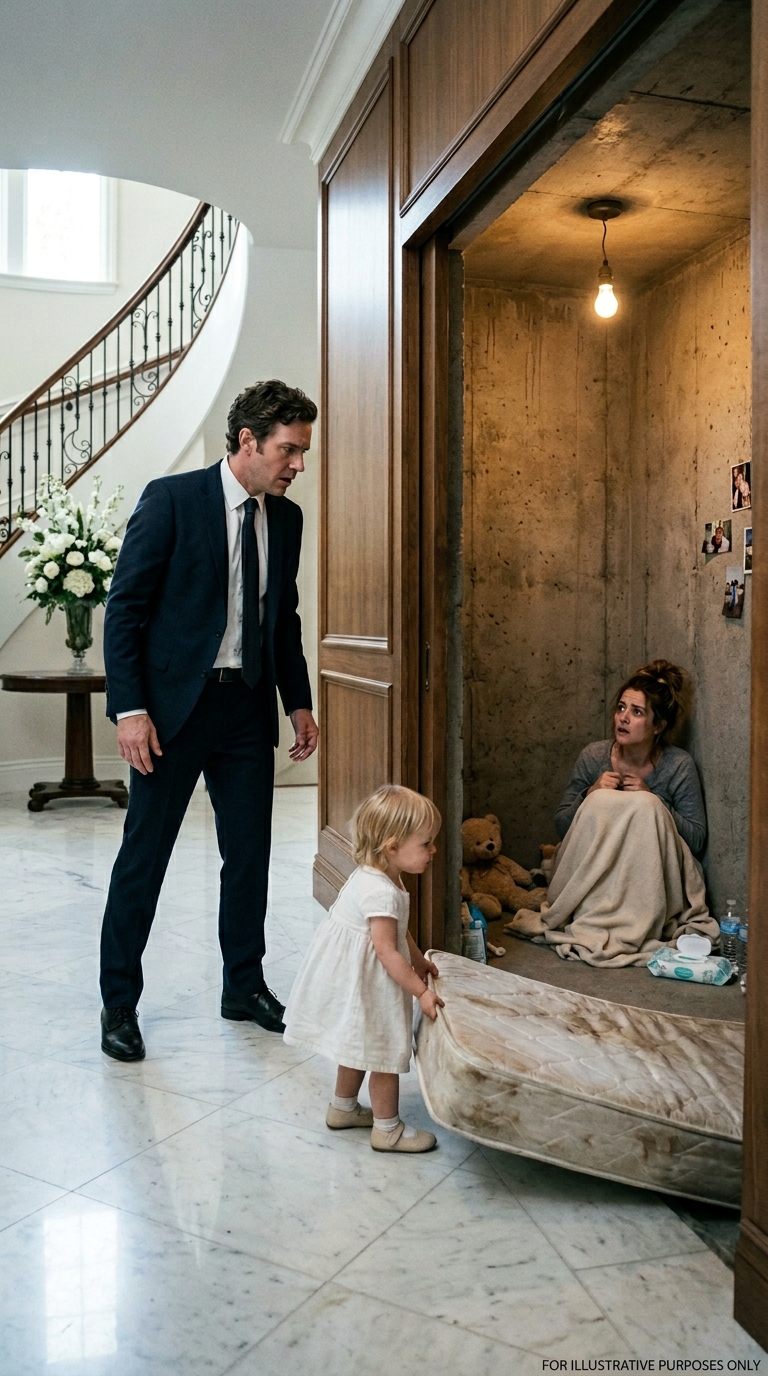
At seven sharp, Rosa packed the foam pad with practiced speed. Lily woke when her mother touched her shoulder and immediately reached for Humphrey.
“Time to go, baby.”
Lily blinked at Nathan.
“Bye, Nay,” she said.
Nathan almost smiled.
“Nay?”
“She can’t say Nathan,” Rosa said. “Don’t encourage it.”
“Bye, Lily.”
The child waved Humphrey’s floppy arm at him.
When Rosa stood, she hesitated.
“You won’t tell?”
Nathan looked at her.
“No.”
Her shoulders lowered by half an inch.
“But this can’t keep happening,” he said gently.
Her face closed again.
“I know that better than you do.”
“I didn’t mean it like that.”
“No,” she said. “You meant it like someone who gets to notice the problem for one morning and go back upstairs.”
Then she picked up the foam pad with one arm, lifted Lily with the other, and walked down the stairs before he could answer.
Nathan stood there long after the stairwell door closed.
He had been insulted by powerful people in boardrooms, mocked by investors, threatened by competitors.
Nothing had ever hit him quite like that.
Because she was right.
Part 2
Nathan did go back upstairs.
That was the part that bothered him most.
He returned to his penthouse with its floor-to-ceiling windows and silent kitchen and coffee machine that cost more than Rosa’s monthly rent. He showered. He changed. He checked his phone. He answered emails from people who used words like leverage and disruption and market capture as if they were discussing oxygen.
But the whole time, he saw Lily dragging that mattress.
He saw her little shoulders bent forward, determined not because she was strong, but because she had never been given another choice.
By noon, Nathan had canceled two meetings.
By one, he had called his assistant, Erin.
“I need information,” he said.
“That sounds ominous,” Erin replied. She had worked for him six years and had earned the right to sound unimpressed.
“I need to know what benefits Pinnacle Property Services provides to overnight cleaning staff assigned to Meridian Tower.”
There was a pause.
“That is oddly specific.”
“Can you find out?”
“Of course.”
“And not through building management. Quietly.”
Another pause. This one was longer.
“Is someone in trouble?”
Nathan looked toward his refrigerator, where Lily’s half-eaten toast plate sat in the sink because he had not been able to throw the leftovers away.
“Someone has been in trouble for a long time,” he said. “I just noticed.”
By the next afternoon, Erin had answers.
They were worse than Nathan expected.
Pinnacle’s overnight staff had no childcare support, no meaningful emergency leave, no reliable translation support for benefit paperwork, and an attendance policy that punished people for circumstances the company never bothered to understand. Rosa had two write-ups. One for missing a shift when Lily had an ear infection. One for leaving early when her mother had been taken to the hospital after a dialysis complication.
“Technically,” Erin said over the phone, “they can fire her after a third violation.”
“Technically is doing a lot of ugly work in that sentence.”
“I agree.”
Nathan spent the next week quietly digging.
He called the director of a foundation he supported, one that provided education grants to working parents. He called an old friend who sat on the board of a nursing school in Evanston. He spoke with a city official about childcare subsidies and discovered, with growing anger, that Rosa likely qualified for at least two programs nobody had told her how to access.
The information existed.
That was the cruel joke.
It sat buried on government websites, hidden behind forms written for people who had printers, time, reliable internet, and the emotional energy to decode bureaucracy after working all night.
Nathan had built software that could detect a cyberattack in milliseconds.
Yet a mother sleeping her child in a stairwell could not find a childcare form written in plain English.
The absurdity made him furious.
Still, he did not approach Rosa with a stack of solutions. Something about their conversation held him back. She was not a project. She was not a problem for him to solve so he could feel like a better man. He understood that the difference mattered.
So he started small.
One morning, he happened to be leaving for a run when he saw Rosa and Lily near the service elevator. Lily had a paper bag in her lap and a broken red crayon in her hand.
“Nay!” Lily shouted.
Rosa winced.
“He lives here, baby. We don’t yell at residents.”
“I yell quiet,” Lily said, then whispered loudly, “Nay!”
Nathan crouched slightly. “Good morning.”
Lily held up the paper bag.
It showed something round with four lines sticking out of it.
“That’s Humphrey,” she announced.
Nathan examined it seriously.
“Strong ears.”
“Those are legs.”
“My mistake.”
Rosa tried not to smile and failed.
That smile changed her face. It made her look her age. Younger, even. For one quick second, Nathan saw the woman she might have been without all the weight pressed on top of her life.
“Don’t flatter her too much,” Rosa said. “She’ll start charging for art.”
“I have wall space.”
“Must be nice.”
It was not bitter this time. Not exactly.
Nathan accepted the drawing when Lily insisted, and he put it on his refrigerator with a magnet shaped like Lake Michigan.
A few days later, Lily gave him another drawing, this one of what might have been a dog, a cloud, or a potato with ambition. Nathan put that one beside Humphrey.
When Victoria Ashworth came over that Friday night, she noticed the drawings immediately.
“What are those?” she asked.
“Art.”
Victoria smiled in the polite way she smiled at things she did not understand but did not consider important.
“They’re very… abstract.”
“They’re Lily’s.”
“The cleaner’s child?”
Nathan looked at her.
“Rosa’s daughter.”
“Yes,” Victoria said. “Rosa’s daughter.”
Victoria was beautiful in a way that always seemed expensive. Her blond hair fell in perfect waves. Her cream-colored sweater looked soft enough to be illegal. She came from a family whose name was carved into museum walls, hospital wings, and university buildings across Illinois. She knew which fork to use at any table and which trustee hated which donor and which social slight could take ten years to repair.
Nathan had once admired that. Her certainty. Her polish. Her ability to navigate rooms that had made him feel like an intruder even after he became richer than most of the people in them.
But lately, her elegance had started to feel like glass. Clear, flawless, and cold to the touch.
They were engaged, though no date had been set. Victoria wanted a spring wedding at the Art Institute or possibly a private estate outside Lake Forest. Nathan kept saying they had time. Victoria kept pretending not to hear the hesitation.
At dinner, he told her about Rosa.
Not everything. Just enough.
He told her about the stairwell. About Lily sleeping there during overnight shifts. About the lack of childcare. About Rosa trying to finish nursing school.
Victoria set down her fork.
“Nathan.”
He knew from her tone that he would not like what came next.
“What?”
“Please tell me you reported this.”
He stared at her.
“Reported what?”
“A child sleeping in a service stairwell. That’s a liability nightmare.”
“She’s three.”
“That is exactly my point.”
“No, your point is the building might get sued.”
Victoria inhaled slowly, as if calming a difficult client.
“My point is that rules exist for a reason. What if the child wanders off? What if she gets hurt? What if someone dangerous finds her? This is not safe.”
“She knows it isn’t safe,” Nathan said. “That’s why she’s terrified of losing her job.”
“I’m sure she is. But fear doesn’t exempt people from consequences.”
The room seemed suddenly too quiet.
Nathan looked across the table at the woman he had planned to marry.
“Consequences,” he repeated.
Victoria’s expression softened, but only in the way one softens when trying to guide someone unreasonable back to sense.
“You have a generous heart. I love that about you. But people can take advantage of that. Especially people in desperate situations.”
“People like Rosa.”
Victoria hesitated half a second too long.
“I didn’t mean it cruelly.”
“That doesn’t mean it wasn’t cruel.”
Her eyes flashed.
“That’s unfair.”
“Is it?”
“Nathan, you cannot save everyone who has a sad story. My family has funded shelters, clinics, scholarship programs. I understand hardship.”
“No,” Nathan said quietly. “You understand charity.”
Victoria went still.
“That was beneath you.”
Maybe it was. But it was also true.
Dinner ended with most of the food untouched.
Victoria left after kissing his cheek, a gesture so practiced and controlled that it felt like signing paperwork.
Nathan watched the elevator doors close behind her and knew something between them had shifted.
He just did not know yet how badly.
The answer came three weeks later.
It was a Thursday afternoon, raining hard enough that the city outside Meridian Tower looked blurred and silver. Nathan returned early from a lunch meeting after pretending to care about a venture fund’s new acquisition strategy for ninety minutes.
When he stepped out of the elevator, he saw a small crowd gathered near the service corridor.
Two building managers.
A woman in a navy corporate blazer.
A security guard.
Rosa.
Lily stood pressed against Rosa’s leg, clutching Humphrey with both arms. The foam pad was rolled tightly beside them. Rosa’s face was pale but composed, the kind of composed people become when they cannot afford to break.
Nathan stopped.
The woman in the blazer was saying, “These policies are explained during onboarding.”
“I understand,” Rosa said.
“Unauthorized presence of a minor child on restricted property is a serious violation.”
“I understand.”
“You were warned previously about access boundaries.”
“That was for using the staff break room before shift.”
“It was still a boundary issue.”
Lily looked up at her mother.
“Mommy, are we in trouble?”
Rosa’s mouth trembled once.
“No, baby. We’re okay.”
But they were not okay. Nathan could see that from twenty feet away.
One of the building managers noticed him and straightened immediately.
“Mr. Cole.”
The others turned.
Rosa’s eyes met Nathan’s. He saw shame there, and anger, and something that looked dangerously close to defeat.
“What’s happening?” Nathan asked.
The woman in the blazer adjusted her folder.
“Mr. Cole, this is an internal staffing matter.”
“I asked what’s happening.”
The building manager cleared his throat.
“Pinnacle has decided to remove Ms. Martinez from the Meridian assignment.”
“Remove,” Nathan said.
The word tasted sanitized.
Rosa answered before anyone else could.
“I’m being fired.”
Lily’s grip tightened around the elephant.
Nathan looked at the manager.
“For what?”
“Repeated access violations. Unauthorized use of common areas. Resident safety concerns.”
“Which resident?”
The question landed like a dropped glass.
The manager blinked.
“I’m not sure I can disclose—”
“Which resident complained?”
The man’s eyes flicked toward the other manager.
That was when Nathan understood.
Not all of it.
Enough.
He turned to Rosa.
“Did something happen?”
She lifted her chin.
“Lily got out of the stairwell two nights ago. I was on thirty-nine. She went looking for the bathroom and a resident saw her near the elevators. She didn’t touch anything. She didn’t bother anyone. I had her back downstairs in less than a minute.”
The building manager stepped in.
“A premium resident filed a formal complaint with the advisory board.”
Nathan’s voice went very calm.
“What advisory board?”
The manager swallowed.
“The Meridian resident advisory board.”
Nathan already knew the answer, but he asked anyway.
“And who chairs that board?”
Silence.
Rain tapped against the windows at the far end of the hall.
Finally, the other manager said, “Ms. Ashworth.”
Victoria.
Nathan felt the hallway narrow around him.
He remembered her at his dinner table, poised and certain.
Please tell me you reported this.
Rules exist for a reason.
People can take advantage.
He looked at Lily, who did not understand policy or liability or advisory boards. She only understood that adults were using serious voices and her mother was holding her hand too tightly.
Nathan stepped closer to the managers.
“I need a word.”
“Mr. Cole,” the woman from Pinnacle began, “again, this is an internal—”
“No,” Nathan said. “It is happening in the hallway outside my home, in a building where I am a primary leaseholder, involving a worker assigned to this property and a complaint processed through a resident board chaired by my fiancée. So now it is also my concern.”
Nobody spoke.
Nathan did not raise his voice. He never had to. His power had never come from volume. It came from precision.
“Ms. Martinez will not be terminated in this hallway in front of her child.”
The woman in the blazer stiffened.
“The termination has already been processed.”
“Unprocess it.”
“That is not how employment decisions—”
“Then call someone who knows how they do work.”
The building manager moved uneasily.
“Mr. Cole, perhaps we should discuss this upstairs.”
“We’ll discuss it here.”
Rosa whispered, “Nathan, don’t.”
He glanced at her. “I’m not doing this because you asked.”
“I didn’t ask.”
“I know.”
Something unreadable passed across her face.
Nathan turned back.
“I want a formal review of the policy being applied here. I want documentation of every similar violation by staff over the past two years and the disciplinary response in each case. I want the complaint reviewed for potential conflict of interest. And I want Pinnacle corporate on the phone within the hour.”
The woman in the blazer gave him a tight smile.
“With respect, Mr. Cole, you don’t have authority over our staffing.”
“No,” Nathan said. “But I own twelve percent of the company that owns this building.”
The smile disappeared.
That was not something residents generally knew. It was not something Nathan mentioned at parties. He had invested in the holding company years ago through a real estate fund and rarely thought about it.
He was thinking about it now.
The manager’s face changed.
“I’ll make a call.”
“Good.”
The next hour did not feel dramatic. No one shouted. No one cried. There were phone calls, lowered voices, legal phrases, corporate apologies, and promises to pause the termination pending review.
Rosa stood through all of it like a woman trying to survive a storm without letting her child see the rain.
When it was over, Lily had fallen asleep sitting upright against her mother’s leg, Humphrey tucked under her chin.
Rosa looked at Nathan.
“You shouldn’t have done that.”
“I disagree.”
“You don’t know what it costs when people like you help people like me.”
Nathan absorbed that.
“Tell me.”
She laughed once, quietly and without humor.
“It costs pride. It costs privacy. It costs becoming a story rich people tell themselves when they want to feel kind.”
The words hurt because they were honest.
“I don’t want you to be my story,” Nathan said.
“Then what do you want?”
He looked down the hallway, toward the polished doors and hidden cameras and soft carpets that had somehow concealed a child’s suffering for eight months.
“I want to know why a little girl needed a mattress in a stairwell before anyone noticed she existed.”
Rosa’s anger faltered.
Nathan continued, “And I want to know why the answer to that was firing her mother.”
Rosa looked away.
For a moment, neither of them spoke.
Then Lily stirred and mumbled, “Humphrey wants pancakes.”
Rosa closed her eyes. Her face crumpled for half a second, not into tears exactly, but into exhaustion so complete Nathan had to look away to give her dignity.
When she opened her eyes again, she said, “I don’t want pity.”
“I don’t feel pity.”
“Then what?”
Nathan thought about his mother coming home from the diner with swollen feet. About the men who called her sweetheart and left quarters on the table like mercy. About the shame of needing help. About the greater shame of being refused it.
“I feel angry,” he said. “That’s different.”
Rosa studied him.
Then, very slowly, she nodded.
Part 3
Victoria arrived at Nathan’s penthouse that evening wearing a black raincoat and the expression of a woman prepared for a difficult conversation she intended to win.
Nathan had not invited her.
That told him enough.
She stepped inside without waiting for the usual kiss.
“I got a call from Bruce Halpern,” she said.
The chairman of the resident advisory board.
Nathan closed the door.
“I’m sure you did.”
“Nathan, what were you thinking?”
“I was thinking a woman was being fired in front of her three-year-old because someone with power chose punishment over help.”
Victoria’s mouth tightened.
“That is a very emotional framing.”
“It was an emotional situation.”
“It was a safety violation.”
“It was a child sleeping on concrete.”
“Exactly. Which is unsafe. Which is why it had to be reported.”
Nathan stood still.
“So it was you.”
Victoria removed her gloves finger by finger.
“I filed a concern through the proper channel.”
“A concern.”
“Yes.”
“You knew her name?”
She hesitated.
“No.”
“You knew the child’s name?”
“Nathan.”
“Her name is Lily.”
Victoria’s face showed the first crack of irritation.
“I understand you’re upset.”
“No,” he said. “I don’t think you do.”
She walked to the window, looking out over Lake Michigan as if the view might organize the conversation into something acceptable.
“You told me a troubling situation,” she said. “I acted responsibly. If that child had been injured, everyone would ask why no one said anything.”
“You didn’t ask how to help them.”
“That is not the advisory board’s role.”
“Then maybe the board is useless.”
She turned.
“That’s easy for you to say. You get to be the hero. You get to sweep in and make grand gestures because you’re Nathan Cole and everyone moves when you speak. The rest of us have to preserve systems.”
“Systems that protect who?”
“Everyone.”
“No,” Nathan said. “They protect people like us from having to see people like Rosa.”
Victoria flinched.
He had never spoken to her that way.
Part of him regretted the harshness. A larger part knew softness had allowed too many truths to stay hidden.
“She broke the rules,” Victoria said.
“She broke them because the rules gave her no livable option.”
“There are programs. Charities. Shelters. Churches. City resources.”
“She didn’t know how to access them.”
“Then she should have asked.”
Nathan stared at her.
Asked whom?
The question did not need to be spoken. It filled the room anyway.
Victoria looked away first.
There it was, the invisible wall between their worlds.
For Victoria, help was a door that existed everywhere. You simply knocked, made the right call, spoke to the right person, filled out the right form. For Rosa, help was a maze designed by people who had never been desperate.
Nathan’s voice softened, which somehow made the moment worse.
“Do you see her?”
Victoria frowned.
“Of course I see her.”
“No. Do you see her as a person? Not a risk. Not a violation. Not a staff issue. A person.”
Victoria’s eyes shone, though whether from anger or hurt, he could not tell.
“That’s unfair.”
“Maybe.”
“You think I’m cruel.”
“I think you’re blind.”
The word landed hard.
Victoria drew in a breath.
Nathan hated himself a little for saying it, but not enough to take it back.
“I was raised to care,” she said. “My family has given millions away.”
“I know.”
“My mother runs a foundation.”
“I know.”
“I have spent my life around service and philanthropy.”
“I know.”
“Then how can you say that?”
“Because giving to people from a distance is not the same as looking them in the eye when their child is sleeping in a stairwell.”
Victoria’s composure broke then, not dramatically, but quietly. Her lips parted. She seemed suddenly younger, less polished, almost lost.
“I didn’t know what else to do,” she said.
The admission surprised both of them.
Nathan said nothing.
Victoria lowered herself onto the edge of the sofa.
“I heard what you said at dinner,” she continued. “And I hated how it made me feel. I hated that you looked at me like I had failed some test I didn’t know I was taking. So when I saw the notice about the child on the advisory email, I thought… I thought if I handled it properly, you’d understand that I was being practical.”
Nathan sat across from her.
“You were proving something.”
“Yes,” she whispered. “Maybe.”
“What?”
“That I wasn’t heartless.”
He felt his anger shift, not disappear, but deepen into sorrow.
Victoria Ashworth had been trained to manage impressions before she had learned to understand feelings. She knew how to behave at galas, funerals, charity luncheons, boardrooms. But nobody had taught her what to do with the sight of a mother without options except turn it into a procedure.
“Nathan,” she said, “I don’t know how to be poor. I don’t know how to think like someone who has no backup plan. That doesn’t make me evil.”
“No,” he said. “It doesn’t.”
“But it makes me wrong.”
He was quiet.
Her eyes filled.
“That’s what you think.”
“I think you had a chance to be kind,” Nathan said. “And you chose to be correct.”
Victoria wiped one tear quickly, almost angrily, as if ashamed of it.
“Is this the part where you call off the engagement?”
He looked at the ring on her finger. Elegant. Historic. A family diamond reset in platinum. When he had proposed, people had called them perfect. Young tech billionaire and old-money heiress. New power and old power. A merger disguised as romance.
He had believed there was love in it.
Maybe there had been.
But love, he was learning, was not only attraction or admiration or shared ambition. Love was the direction two people looked when someone vulnerable entered the room.
Nathan looked toward the refrigerator, where Lily’s drawings were crooked under magnets.
“I think we need time.”
Victoria laughed softly, brokenly.
“Time means no.”
“Not always.”
“With people like us, it does.”
People like us.
There it was again.
The phrase did not anger him this time. It only made him tired.
“I don’t want to punish you,” Nathan said. “I don’t want to make myself the good guy and you the villain. That would be too easy. But I can’t marry someone while wondering whether our children would learn compassion from one parent and hierarchy from the other.”
Victoria closed her eyes.
That was the sentence that ended it, though neither of them said so then.
She left an hour later.
At the elevator, she paused and turned back.
“What’s her full name?” she asked.
Nathan did not pretend not to understand.
“Rosa Martinez. Her daughter is Lily.”
Victoria nodded.
“Good night, Nathan.”
“Good night, Vic.”
The elevator doors closed with a soft silver whisper.
Nathan stood alone in his perfect penthouse and felt the strange grief of losing a future he had not realized he was already leaving behind.
Over the next two months, Nathan learned that helping was more complicated than writing checks.
Writing checks was easy. He had done it for years. He had put his name on plaques, funded scholarships, matched donations, sponsored dinners. Money could open doors, but it could also humiliate. It could turn a person into a recipient before anyone asked what they wanted to become.
So he moved carefully.
He did not offer Rosa cash.
Instead, he asked the foundation he already funded to expand its working-parent grant program to include emergency childcare and continuing education for hourly workers. The first recipient was selected through a regular application process Erin helped simplify. Rosa qualified without Nathan’s name appearing anywhere on the paperwork.
He had plain-language flyers printed in English and Spanish listing childcare subsidies, emergency leave resources, food assistance, legal clinics, and nursing program grants. He made Meridian Tower distribute them to every overnight worker, every maintenance employee, every parking attendant, every security guard.
The building manager looked deeply uncomfortable.
Nathan considered that progress.
Pinnacle Property Services, after a very expensive review and several tense phone calls, agreed to revise its policy on overnight staff emergencies and create a childcare assistance pilot program. Nathan suspected they did this mostly because they feared bad press. He did not care. A good thing done for selfish reasons could still keep a child off a concrete floor.
Rosa returned to work after a week of paid administrative leave that Pinnacle called a courtesy and Rosa called “the least they could do.”
She did not thank Nathan right away.
He respected that.
The first real conversation they had afterward happened in the staff break room at five-thirty in the morning. Nathan found her studying anatomy flashcards beside a vending machine that hummed loudly enough to be rude.
“You’re really going back,” he said.
Rosa looked up.
“I never left in my head.”
He smiled.
“That sounds like something a nurse would say.”
She tapped the flashcards against the table.
“I got the grant.”
“I heard.”
“You had nothing to do with it?”
He paused.
“I had something to do with making sure the grant existed.”
Her eyes narrowed.
“But you didn’t pick me.”
“No.”
“And you didn’t pay my tuition.”
“No.”
“Good.”
He nodded solemnly. “I assumed that would be important.”
“It is.”
“I’m learning.”
Rosa studied him for a long moment.
Then she said, “Thank you.”
He knew what it cost her to say it.
“You’re welcome.”
She looked back down at her flashcards.
“I’m still mad at you a little.”
“That seems fair.”
“You came into my life with billionaire energy.”
“I’m afraid to ask what that means.”
“It means you saw a problem and immediately started making calls.”
“I did do that.”
“You also sat on a stairwell and brought my kid peanut butter toast.”
“I did that too.”
Rosa’s mouth twitched.
“That was less annoying.”
He laughed, and this time she laughed with him.
It was not romance. Not then. It was something more fragile and more important at that moment: trust beginning where humiliation had almost taken root.
Lily started daycare three mornings a week.
The first day, Rosa sent Nathan a text.
First lecture in four years. Lily yelled, Go, Mama, so loud outside the daycare that three parents clapped. I am not crying. I am a professional.
Nathan read it in the middle of a board meeting and had to pretend his eyes were watering because of allergies.
He printed Lily’s new drawing, sent as a photo, and put it on his refrigerator. This one showed three stick figures, a lopsided elephant, and what Lily explained in a voice message was “the big house with no stairs for sleeping.”
That phrase stayed with him.
No stairs for sleeping.
A child’s definition of safety.
Months passed.
Chicago shifted from wet autumn to sharp winter. Lake Michigan turned steel gray. Christmas lights appeared along Michigan Avenue. Rosa worked, studied, cared for her mother, loved her daughter, and slept in fragments. Nathan ran his company, pushed the foundation harder, attended fewer galas, and learned to notice names on uniforms.
He learned the security guard in his lobby was Jerome and that Jerome’s son had just joined the Navy. He learned the woman who watered the orchids was named Patrice and took two buses from Oak Park. He learned the parking attendant Victoria had once spoken through was named Malcolm and wrote poetry during slow hours.
The building had always been full of people.
Nathan had simply mistaken silence for emptiness.
One evening in late November, the city’s first snow began falling in soft, hesitant flakes. Nathan came home from a run, his breath visible in the air, and found Lily standing near the lobby Christmas tree in a bright red coat with yellow buttons.
Humphrey was tucked under one arm.
Rosa stood nearby speaking with Jerome, her backpack full of nursing textbooks slung over one shoulder.
“Nay!” Lily shouted.
Several residents turned.
Rosa sighed. “Indoor voice.”
Lily lowered her volume by perhaps three percent.
“Nay, Humphrey has news.”
Nathan crouched. “Important news?”
“Very.”
“What is it?”
Lily held up the elephant and made him nod.
“We don’t sleep on stairs anymore.”
The lobby went strangely quiet around them.
Rosa looked down.
Nathan felt the words enter him and settle somewhere permanent.
“No,” he said gently. “You don’t.”
“Mommy says stairs are for walking.”
“She’s right.”
“And pancakes are for Saturday.”
“Also true.”
Lily seemed satisfied with the legal clarity of this conversation. She hugged Humphrey, then leaned forward and whispered, “Mommy passed her test.”
Nathan looked up at Rosa.
Rosa rolled her eyes, but she was smiling.
“One test,” she said. “Not the whole program.”
“One test matters,” Nathan said.
Rosa’s smile softened.
“Yes,” she said. “It does.”
That night, after Lily and Rosa left, Nathan rode the elevator to the forty-second floor and walked into his penthouse. The view was still spectacular. The lake still stretched black and endless beyond the glass. The furniture was still expensive, the art still carefully chosen, the silence still deep.
But the apartment no longer felt like a monument to everything he had achieved.
It felt like a place where he was responsible for what he noticed.
He stood in front of the refrigerator, looking at Lily’s drawings.
Humphrey with strong legs.
The dog-cloud-potato.
The big house with no stairs for sleeping.
A week later, an envelope arrived at his office.
No return address.
Inside was a handwritten note from Victoria.
Nathan,
I met Rosa today.
I did not tell her who I was at first, which was cowardly. Then I did. She knew anyway. She let me apologize. She did not make it easy. I deserved that.
I am writing because you once asked if I saw her.
I don’t know if one conversation counts as seeing. I don’t know if guilt can become anything useful. But I am beginning to understand that kindness is not a mood or a donation. It is a discipline.
I resigned from the advisory board.
My mother’s foundation is reviewing how many of our programs are impossible to access by the people we claim to serve. That sentence embarrasses me, but it should.
I hope you are well.
Victoria
Nathan read the note twice.
Then he folded it carefully and placed it in his desk drawer.
He did not call her.
He did not need to.
Some endings did not require reunion to become meaningful. Some apologies did not erase harm, but they could still open a door in the person who offered them. Nathan hoped Victoria walked through hers. He genuinely did.
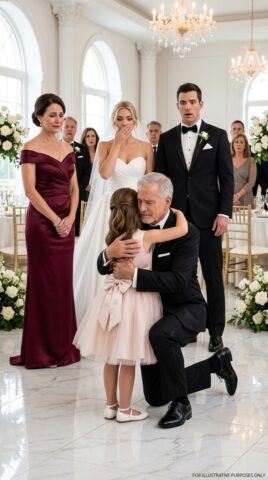
In May, Rosa graduated from her nursing program.
The ceremony was held in a university auditorium that smelled faintly of floor polish and flowers. Lily wore a yellow dress and spent the first twenty minutes asking whether clapping was allowed yet. Elena, Rosa’s mother, sat in the front row with a cane across her lap and tears already shining on her cheeks.
Nathan stood near the back.
He had told Rosa he would come only if she wanted him there.
She had texted back one sentence.
Lily says Humphrey needs a ride.
So he came.
When Rosa’s name was called, the applause was loud from her small section. Elena cried openly. Lily stood on her chair and screamed, “That’s my mommy!” before Rosa’s cousin pulled her back down, laughing.
Rosa walked across the stage in her cap and gown, head high, eyes bright. For a moment, Nathan saw all the versions of her at once: the exhausted mother in the stairwell, the guarded woman with cracked hands, the student memorizing anatomy beside a vending machine, the daughter, the mother, the nurse.
Not saved.
Never saved.
She had carried herself the whole way.
But now, at least, she was not carrying everything alone.
After the ceremony, Lily ran to Nathan and thrust Humphrey into his hands.
“He wants a picture.”
“With me?”
“With everybody.”
Rosa approached, diploma tucked under her arm.
“You came,” she said.
“You invited Humphrey. I’m his driver.”
She laughed.
Her laugh was easier now. Still tired sometimes, still edged with everything life had asked of her, but no longer buried.
Elena reached for Nathan’s hand.
“Mr. Cole,” she said, her accent warm and strong. “My daughter says you are stubborn.”
Nathan smiled. “Your daughter is accurate.”
“She also says you listened.”
That was harder to answer.
“I tried.”
Elena squeezed his hand.
“Trying matters when it changes what you do.”
They took the picture outside beneath a tree bursting with spring leaves. Rosa held her diploma. Lily held Humphrey. Elena stood proudly beside her daughter. Nathan stood at the edge of the frame until Lily grabbed his sleeve and pulled him closer.
“No, Nay. You’re in it.”
So he stepped in.
Years later, Nathan would not remember what his company was valued at that week. He would not remember which magazine had called him visionary or which investor had predicted his next billion. He would not remember the exact wording of the revised Pinnacle policy, though it helped dozens of workers after Rosa.
He would remember a little girl’s hand tugging his sleeve.
He would remember Rosa’s face when the camera flashed.
He would remember that the most important moment of his life had not happened in a boardroom or on a stage or under the glittering lights of a billionaire’s world.
It had happened in a service stairwell, beside a foam mattress, when a child showed him where she slept.
And he finally understood that seeing someone was not the same as saving them.
Seeing someone meant refusing to look away.
Six months after graduation, Rosa began working at Northwestern Memorial Hospital in the pediatric unit. On her first week, she sent Nathan a photo of her badge.
Rosa Martinez, RN.
Below it was another message.
Lily says nurses are superheroes but with snacks.
Nathan replied.
Lily is correct.
Rosa sent back a laughing emoji, then another message.
Thank you for noticing us.
Nathan stared at those words for a long time.
Then he typed carefully.
Thank you for making sure I understood what noticing means.
He put the phone down and looked out over Chicago.
Somewhere below, thousands of lights glowed in thousands of windows. Behind each one was a life he would never fully know. Mothers finishing shifts. Children falling asleep. Men and women carrying burdens no one had asked about. People becoming invisible in plain sight.
Nathan could not fix the whole city.
He knew that now.
But he could refuse the comfort of not seeing it.
He could build better doors where he had influence. He could ask harder questions. He could make sure help did not require humiliation. He could remember that every policy had a human face somewhere beneath it.
And sometimes, if he was lucky, he could answer the elevator doors at six in the morning and find that the world was giving him one more chance to become the kind of man his mother had raised him to be.
On the refrigerator in his penthouse, Lily’s drawings remained.
Guests sometimes asked about them.
Nathan always gave the same answer.
“That,” he would say, pointing to the one-eyed elephant with too many legs, “is Humphrey. And that one is the house with no stairs for sleeping.”
Most people smiled politely, unsure what to do with that.
But every so often, someone understood.
Every so often, someone looked at the drawings, then back at Nathan, and something in their face changed.
That was enough.
Because the world did not become kinder all at once.
It changed in hallways.
It changed in stairwells.
It changed when powerful people stopped calling suffering a liability and started calling it what it was.
A child.
A mother.
A life.
A chance to do better.