Franklin slowly lowered the phone. “Does she?”
Valerie stood, embarrassed. “It was not a comment about you.”
“It sounded accurate anyway,” he said.
That night, he came home before seven for the first time in months. The next night, before six. By Friday, he sat stiffly on the living room rug while the twins drew a family portrait in crayon. They gave him long legs, serious eyebrows, and a red heart drawn slightly crooked over his chest.
“Who is this?” he asked, touching the blue figure beside the girls.
“That’s Mommy Valerie,” Lily said matter-of-factly. “And the yellow star is Mommy Jessica because Eleanor said stars don’t leave. They just get hard to see during the day.”
The room went silent.
Eleanor’s face paled. She had broken the old rule without permission. Valerie prepared for Franklin’s anger, but he only stared at the yellow star. His fingers trembled around the crayon.
“What did your mother like?” Emma asked.
Franklin’s throat worked. “She liked terrible coffee, old bookstores, and singing along to the radio even when she didn’t know the words.”
The girls listened as if he were handing them treasure.
From the kitchen doorway, Valerie watched something loosen in him. Not heal. Not yet. But loosen enough for breath to pass through.
The peace did not last because Amanda Vale was not a woman who tolerated being replaced by warmth.
Amanda was Franklin’s fiancée, though Valerie learned quickly that the word meant different things to each of them. To Franklin, it meant a sensible arrangement made after years of loneliness and pressure from board members, society friends, and his own fear that his daughters needed a mother figure with the right education, wardrobe, and last name. To Amanda, it meant access: to the Buchanan name, the Buchanan estate, the Buchanan foundation, and eventually, if she played carefully enough, influence over the twins’ inheritance.
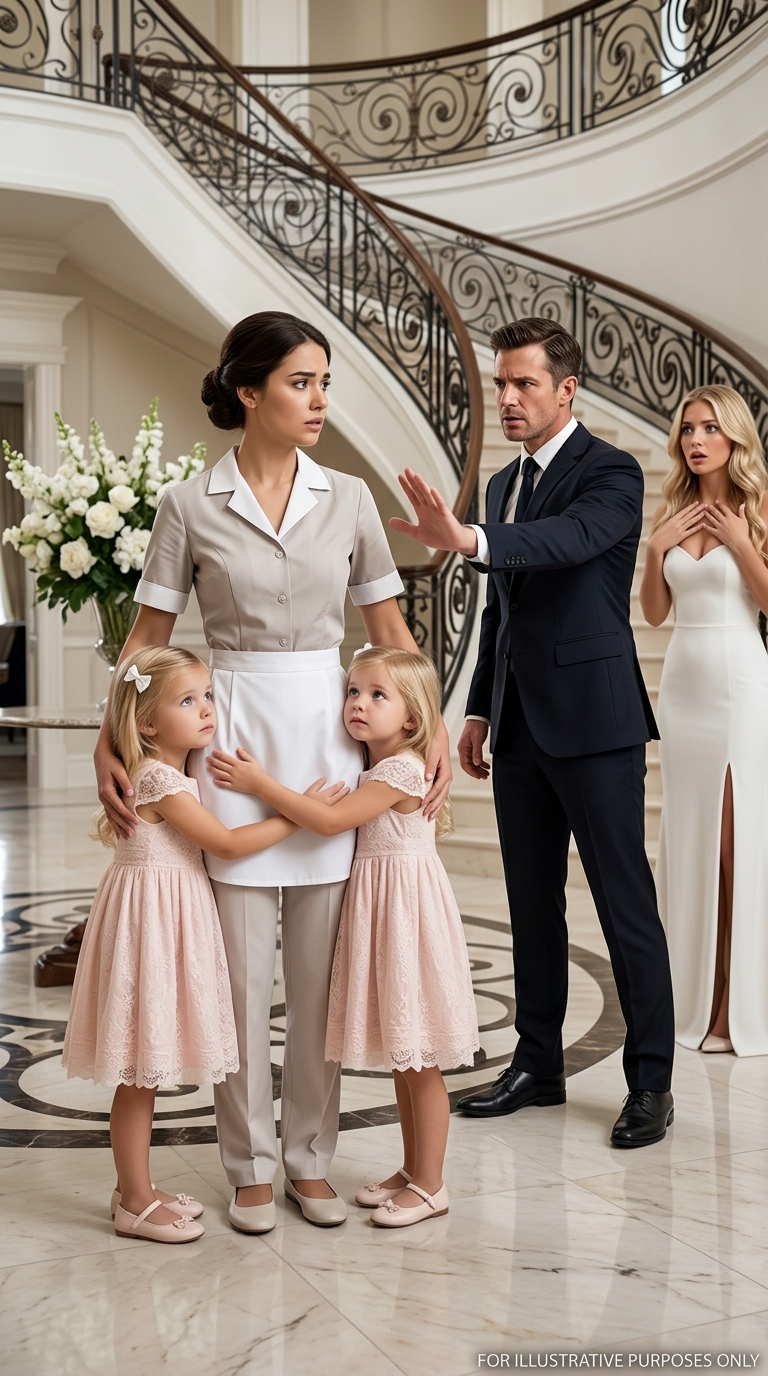
She arrived one morning without warning, clicking across the marble foyer in beige stilettos and a dress too tight for kneeling, bending, or comforting a child. Valerie and the girls were in the kitchen making heart-shaped cookies. Flour dusted the counter, the floor, Emma’s nose, Lily’s hair, and Valerie’s apron. It was messy and happy, which in the Buchanan house meant it was still new enough to feel dangerous.
Amanda stopped in the doorway as if she had discovered animals on the furniture. “What is this?”
“Cookies,” Lily said.
“Filth,” Amanda corrected. “Children of your position do not roll around like street kids.”
Valerie wiped her hands slowly. “They’re baking. They’ll wash up before lunch.”
Amanda’s gaze moved over Valerie’s uniform, her simple sneakers, and the small silver cross at her throat. “And you must be the new help Franklin mentioned. How charming. Does he collect sad little projects now?”
Emma’s smile vanished.
Valerie kept her voice even. “The girls are enjoying themselves. You’re welcome to have a cookie when they’re done.”
“I don’t eat food touched by servants who forget their place.”
Franklin appeared behind Amanda. “What’s going on?”
Amanda’s expression changed so quickly Valerie almost admired the skill. Her mouth softened, her shoulders drooped, and her voice became fragile. “Darling, your employee is encouraging defiance. The girls are covered in flour. This house has become unbearable.”
Before Franklin could answer, Lily stepped forward. Her little hand shook as she pushed up her sleeve and showed a fading yellow bruise on her upper arm. “She did that.”
Amanda went perfectly still.
Franklin’s eyes fixed on the bruise. “Who did?”
Lily pointed at Amanda. “She grabbed me last week when you were at dinner. She said if I told, you’d send me away because you wanted a new wife who didn’t have bad girls.”
The room changed temperature.
Amanda laughed once, too high and too sharp. “Franklin, surely you are not going to believe a dramatic child over me.”
Emma moved beside her sister. “She told us Mommy Jessica was dead because we came too early.”
Eleanor made a sound of horror.
Franklin’s face hardened into something Valerie had not seen before. In the business papers, they called him ruthless. Until that moment, Valerie had thought the word exaggerated. Now she understood that ruthlessness, when pointed in the right direction, could look like a locked door.
“Valerie,” he said quietly, “please finish the cookies with my daughters.”
Amanda stepped toward him. “Franklin—”
“My office. Now.”
The door closed behind them with a heavy sound. The argument lasted nearly an hour. Amanda denied, cried, blamed the staff, blamed grief, blamed “unhealthy attachment” to Valerie, and finally blamed the twins for being manipulative. Franklin did not end the engagement that day, but something worse for Amanda happened. He began watching.
He canceled dinners. He came home early. He asked Eleanor questions. He reviewed staff schedules. He sat beside the girls at breakfast and listened when they spoke. Every answer showed him the same painful truth: for five years, he had mistaken providing for protecting. He had filled the house with expensive people and never noticed which ones were kind.
Amanda noticed him noticing.
Her next move came at Bergdorf Goodman on a bright Saturday afternoon. Franklin had given Valerie his credit card and asked her to take the girls shopping for school shoes. Valerie tried to refuse the black card, but he pressed it into her palm.
“They trust you,” he said. “So do I.”
The words followed her through the shining department store like a warmth she did not know where to put. The twins skipped ahead, arguing over sparkly sneakers versus sensible Mary Janes, when Amanda appeared with three polished friends and a smile sharp enough to cut glass.
“Well,” Amanda said loudly, “what a tragic picture. Franklin’s children shopping with the maid.”
Valerie placed one hand on each girl’s shoulder. “Excuse us. We have an appointment in the children’s shoe department.”
Amanda blocked her path. “Girls, come kiss your future stepmother.”
Neither twin moved.
Amanda’s smile tightened. “I said come here.”
She reached for Emma’s wrist. Valerie caught Amanda’s hand before it landed.
“Do not touch her.”
Amanda stared at Valerie’s fingers around her wrist. So did her friends. So did half the nearby shoppers.
Valerie released her first because she refused to become what Amanda wanted her to look like. “You can insult me if that makes you feel important. You cannot put your hands on them.”
Amanda leaned close enough for Valerie to smell her perfume. “Franklin told me last night he regrets hiring you. He said you’re a charity case from a dirty neighborhood who forgot she was temporary.”
Before Valerie could absorb the cruelty, Lily stepped around her. “Liar.”
Amanda blinked.
“Daddy told Uncle Richard on the phone that Mommy Valerie is the best thing that ever happened to us,” Lily said, her small voice carrying beautifully in the open space. “He said you make the house feel like a hotel where everybody is scared.”
Amanda’s friends began looking anywhere else.
Emma added, with devastating innocence, “And you were hiding outside the kitchen door when he said it. Like a sneaky rat.”
By the time Valerie got the girls back to the town car, Amanda’s humiliation had hardened into something more dangerous than embarrassment.
That evening, Valerie returned to find three designer suitcases arranged in the living room like evidence. Amanda sat on the sofa. Franklin stood by the window. Eleanor silently guided the twins into the kitchen, promising lemonade.
Amanda did not wait. “Fire her, Franklin. In front of me. Now. Or I walk out and make sure every society columnist in New York knows you chose an uneducated maid over your fiancée.”
Franklin turned from the window. “Valerie is staying.”
Amanda laughed. “You cannot be serious.”
“My daughters sleep through the night now. They laugh at breakfast. They talk about their mother without trembling. You bruised my child and threatened her into silence.”
“I did no such thing.”
“I reviewed the hallway camera.”
Amanda’s mouth opened, then closed.
Franklin’s voice dropped. “You had it disabled for eleven minutes. Oliver restored the backup drive.”
For the first time, fear flashed across Amanda’s face.
Franklin stepped toward her. “Leave my house.”
Amanda rose slowly, hatred twisting her features. “You think she loves you? She loves your money. People like her spend their lives looking through windows at people like us.”
Valerie flinched despite herself.
Franklin saw it. His eyes sharpened. “People like Valerie clean the windows people like you admire yourselves in. That does not make her small. It makes your reflection clearer than you can stand.”
Amanda grabbed her handbag. At the door, she turned to Valerie. “He will throw you away too. Men like Franklin don’t marry women like you. They just use you until the house feels warmer.”
The door slammed.
For a few weeks, everyone pretended that was the end of it.
It was not.
Love entered the Buchanan house the way spring enters a city after a brutal winter: first in small signs, then everywhere at once. Valerie’s mother, Alice, came on Sundays and cooked stew so rich that even Franklin’s polished board-member brother, Richard, asked for seconds. Eleanor stopped whispering and began singing old Motown songs while folding laundry. Oliver taught the twins how to check the oil in the town car, which horrified Franklin until Emma told him, “Girls should know how cars work because princesses might need to escape dragons.”
Valerie found a shivering stray dog near a subway station after taking Alice home one rainy night. She brought him to the mansion wrapped in her coat, intending only to feed him and find a shelter. The twins named him Peanut within four minutes. Franklin objected for an hour, lost the argument before dinner, and by the end of the week had purchased a ridiculous leather collar with PEANUT BUCHANAN embossed in gold.
One evening in early May, Franklin found Valerie in the backyard hanging the girls’ school uniforms on a temporary clothesline because she claimed sunlight did what dryers could not.
“I own six dryers,” he said.
“And yet none of them smell like May.”
He rolled up his sleeves and tried to help, clipping one shirt upside down. Valerie laughed, and the sound hit him with such force that he forgot the joke he meant to make. She was standing under a blooming tree, petals caught in her hair, sunlight on her face, his daughters’ little socks in her hands. For five years, Franklin had believed love was a room he had locked after Jessica died. Valerie had not picked the lock. She had simply filled the rest of the house with so much life that the door could no longer stay shut.
“There’s something I need to tell you,” he said.
Valerie’s smile faded at his seriousness.
They sat on a stone bench while Peanut dug illegally in the flower bed and pretended not to hear Franklin ordering him to stop.
“Jessica and I met when we were twenty-five,” Franklin began. “She was a pediatric dentist. Brilliant. Stubborn. She gave free care to kids whose parents couldn’t pay, and she argued with me constantly about what money was for. I thought wealth meant control. She thought it meant responsibility.”
Valerie listened without interrupting.
“When she died giving birth to Emma and Lily, I blamed myself. Then, because I could not survive blaming myself every minute, I blamed the girls without admitting it. Not in words. Never in action, I thought. But I kept myself away from them because looking at them hurt. I hired people. I paid for the best. I told myself love could be managed.”
His voice broke. “Then they disappeared, and I realized I had been the one missing all along.”
Valerie looked down at her hands. “Franklin…”
“You brought them back to me. Not just from the sidewalk. From everything I turned this house into.” He reached for her hand, then stopped, giving her the choice.
She placed her hand in his.
“I don’t want you here as an employee anymore,” he said. “I know there are complications. I know people will talk. I know my world can be cruel, and I know Amanda was right about one thing: men like me have too often used women like you and called it generosity. I won’t do that. If you don’t feel the same, your position is safe, your mother’s care is safe, and my respect for you is safe. But if you do feel even part of what I feel, I would like to court you properly. Slowly. Honestly. In the daylight.”
Valerie’s eyes filled. “I don’t know how to be in your world.”
Franklin smiled sadly. “I don’t know how to be in yours either. Maybe we build one where the girls can be happy.”
She laughed through tears. “That sounds very expensive.”
“I’m told sunlight is free.”
Behind the rosebushes, the twins shrieked with delight because they had been spying with all the subtlety of two squirrels in church.
Franklin did not kiss Valerie that day. He squeezed her hand and walked her back inside for dinner. That restraint mattered. It told Valerie he meant what he said about daylight.
Over the next months, he courted her like a man learning a language he should have learned years earlier. He took her to diners instead of gala restaurants because she said she trusted a place by how the waitresses talked to regulars. He visited Alice in East New York and fixed her wobbly kitchen chair himself after watching three online videos and using the wrong screwdriver twice. He brought flowers to Jessica’s grave and told Valerie afterward, with tears in his eyes, that grief did not feel like betrayal when it made room for gratitude.
The twins began calling Valerie “Mama Val” with the casual certainty of children who had already made their decision. Valerie corrected them at first, then less often, then not at all when Emma told her, “You don’t replace Mommy Jessica. You sit next to her in our hearts.”
That sentence became the shape of their family.
Then Amanda returned.
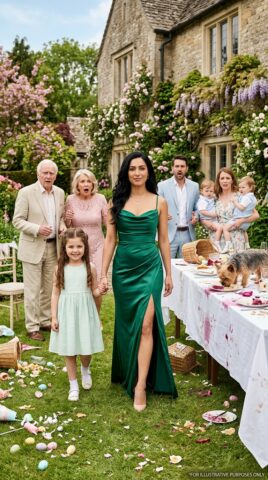
It happened on the twins’ sixth birthday, when the Buchanan garden was strung with paper streamers instead of crystal chandeliers, and the guest list included staff, neighbors, school friends, Alice, Eleanor, Oliver, Richard, and three children from the dental charity Jessica had founded. Franklin had refused every event planner in Manhattan. Valerie and the girls had made cupcakes themselves. Peanut stole one before lunch and ran across the lawn with blue frosting on his snout while guests cheered.
Franklin had planned to propose quietly after the party. In his jacket pocket was his grandmother’s ring, a simple gold band with a small blue sapphire that had belonged to a woman who married a milk delivery boy before he became anyone important. Franklin had chosen it because Valerie would have hated a diamond large enough to require its own security guard.
He never reached the speech he had practiced.
At three fifteen, the front gate opened. Amanda walked in with two reporters, a private security consultant, and a woman from a family law office Franklin recognized immediately. Her smile was bright, false, and hungry.
Franklin moved toward the children by instinct. Valerie did the same.
Amanda lifted a folder. “I am sorry to interrupt this charming little performance, but someone has to protect Jessica Buchanan’s daughters.”
The garden went silent.
Franklin’s voice was deadly calm. “You were told never to come here again.”
“And you were told grief makes men vulnerable.” Amanda looked at the reporters. “Mr. Buchanan allowed a cleaning woman with a financial motive to attach herself to his traumatized children after a suspicious incident in which those children were found blocks from his office. Since then, he has moved this woman into his home, paid her mother’s medical bills, and begun a romantic relationship with her. I have reason to believe the original encounter was staged.”
Valerie felt the blood leave her face.
The reporters started recording.
Franklin stepped forward, but Valerie touched his arm. If he exploded, Amanda would get exactly the image she wanted: unstable widower, manipulative nanny, frightened children. Valerie had spent her life around people who could not afford the luxury of losing their temper. She knew the price of appearances.
Amanda opened the folder. “Valerie Cole’s mother received money from a Buchanan-linked medical fund years ago. Valerie knew exactly who Franklin was.”
“That’s not true,” Valerie said, but her voice sounded small in the huge garden.
Amanda smiled. “You expect us to believe a cleaning woman just happened to find his daughters outside his building, then just happened to become indispensable?”
Franklin looked at Valerie, not with suspicion, but with concern. Still, the accusation entered the air like smoke. Guests shifted. Alice stood slowly from her chair, trembling.
“I never knew,” Valerie said to Franklin. “I swear I never knew.”
Alice’s face crumpled. “Val, baby, I didn’t know either. The clinic helped me after my first bad episode. They said it was a charity grant.”
Amanda pounced. “How convenient.”
Then Oliver stepped forward.
For seventeen years, Oliver Reed had been nearly invisible in the Buchanan household, appearing with umbrellas, opening doors, carrying luggage, and quietly remembering what everyone else tried to forget. But now he walked into the center of the lawn with his shoulders straight and his old chauffeur’s cap in his hands.
“That is enough,” Oliver said.
Franklin turned. “Oliver?”
Oliver looked at Amanda first. “I drove Mrs. Jessica Buchanan to that clinic every Thursday before the twins were born. She approved many emergency grants herself, including one for Alice Cole after Mrs. Cole collapsed while working two jobs. Miss Valerie was nineteen then. She wrote a thank-you note to the foundation, but Mrs. Buchanan never met her in person. Miss Valerie did not know the Buchanan name because Mrs. Buchanan often gave through a separate community fund to avoid publicity.”
Amanda’s smile faltered. “That proves nothing.”
“No,” Oliver said. “This does.”
He removed an envelope from inside his jacket. The paper was old, cream-colored, and sealed in a plastic sleeve. Franklin stared at it as if seeing a ghost.
“Jessica gave this to me three weeks before the twins were born,” Oliver said softly. “She made me promise not to give it to you while you were drowning in grief because she said you would turn it into another punishment. She told me I would know when the house was ready.”
Franklin’s face had gone pale. “You had a letter from my wife for six years?”
“I had a responsibility from your wife for six years,” Oliver replied, and his voice shook. “There is a difference.”
He handed Franklin the envelope.
Franklin opened it with trembling hands. Valerie wanted to look away, but he reached for her as if he needed her beside him to survive whatever came next. He read silently at first. Then his breath broke, and he read aloud.
“My stubborn Franklin, if you are reading this, it means someone finally taught this house to laugh again, and Oliver has decided you are brave enough to hear me without using my memory as a wall. Do not choose a woman because she knows which fork to use at a charity dinner. Choose the woman who kneels on dirty pavement when a child cries. Choose the woman who will tell you the truth when your money has taught everyone else to flatter you. If our daughters ever call someone Mommy, do not punish them for needing love. Ask whether heaven was kind enough to send them more.”
No one moved.
Franklin pressed the letter to his mouth, shaking.
Amanda’s face twisted. “That is sentimental nonsense. It does not address the staged disappearance.”
“No,” Richard Buchanan said from near the oak tree. Franklin’s younger brother had been quiet until then, but now he held up his phone. “The security footage does.”
Amanda turned toward him.
Richard’s expression was grim. “When you threatened Franklin last month, I hired an independent investigator. Not because I doubted Valerie. Because I doubted you.”
Franklin looked sharply at his brother.
Richard tapped the phone and sent the footage to the outdoor projector the twins had been using for cartoons against a white garden wall. The image flickered, then sharpened: the lobby of Buchanan Capital on the day Emma and Lily disappeared. The temporary nanny stood near the elevators. Amanda entered wearing sunglasses and a white coat. She spoke to the nanny, handed her something, and gestured toward the side exit. The nanny left. Amanda crouched before the twins, pointed toward the revolving doors, and then walked away while the girls looked confused.
The next clip showed the twins stepping outside alone.
The garden erupted in shocked whispers.
Amanda lunged for the phone. Richard stepped back. “There’s audio from the nanny’s statement too. She says you paid her to leave the girls unattended for ten minutes so you could ‘prove Franklin needed a real wife in control of the household.’ You didn’t expect Valerie. You expected fear. You expected Franklin to panic, marry you quickly, and let you send the girls to that behavioral boarding program your friend’s family invests in.”
Franklin turned toward Amanda with a look so cold even the reporters lowered their cameras.
Valerie’s knees nearly gave out. The day she had thought was chance had been cruelty interrupted.
Amanda’s composure shattered. “I was trying to save him from becoming pathetic. Look at him. Look at this circus. A maid, a sick mother, a stray dog, servants eating with family—Jessica would have been humiliated.”
Franklin folded the letter carefully and placed it inside his jacket, near his heart. “Jessica would have opened the gate wider.”
The family law attorney who had come with Amanda quietly stepped away from her. One reporter stopped recording and said, “Ms. Vale, did you just admit to paying someone to abandon two children in Manhattan?”
Amanda’s mouth opened, but no words came.
Franklin did not shout. That was what made it final. “Oliver, please call the police and give them everything. Richard, make sure Miss Vale’s guests are comfortable while they wait to provide statements. Valerie, would you take the girls inside?”
Emma and Lily ran to Valerie, but Valerie did not move immediately. She looked at Amanda and saw, beneath the expensive dress and fury, a person who had mistaken control for love so completely that she had become dangerous.
“I hope one day you understand what you almost did to them,” Valerie said.
Amanda laughed bitterly, but tears glittered in her eyes. “Don’t pretend you pity me.”
“I don’t pity you,” Valerie replied. “I pity the child you must have been before you thought being loved meant winning.”
For one second, Amanda looked less like a villain and more like a woman standing in the wreckage of every wrong lesson she had ever learned. Then the moment vanished. She turned away as sirens sounded faintly beyond the gate.
The party did not continue in the same way after that. How could it? Children had cried. Adults had whispered. Old grief had opened in public. Yet something steadier replaced the ruined celebration. People stayed, not because they were entertained, but because families do not leave when the weather changes.
Alice made tea. Eleanor sliced the least damaged cupcakes. Oliver sat alone near Jessica’s memorial rosebush until Franklin joined him and embraced him for the first time in seventeen years. Richard took the twins and Peanut to chase bubbles on the far lawn. Valerie stood under the oak tree, holding Jessica’s letter with Franklin beside her.
“I should have known Amanda was capable of it,” Franklin said.
“You know now.”
“I should have protected them sooner.”
“You protected them today.”
He shook his head. “You did.”
Valerie turned to him. “No, Franklin. We all did. That’s what changed.”
He looked at her for a long moment, then laughed softly through tears. “I had a speech.”
“I’m sure it was very serious.”
“Terribly serious. Possibly too long.”
“Then don’t waste it.”
He reached into his jacket and took out the antique velvet box. His hands trembled, but this time he did not hide it. The remaining guests noticed and quieted. Emma and Lily ran over, eyes wide, Peanut barking as if he had personally arranged the moment.
Franklin lowered himself to one knee in the grass, ruining another expensive pair of trousers and caring less than ever.
“Valerie Cole,” he said, his voice thick but clear, “the day I met you, I thought I had lost everything. You found my daughters, then somehow found the parts of me I had buried with my grief. You did not enter this house quietly. You brought pancakes, truth, muddy shoes, bedtime stories, a criminal dog, your mother’s stew, and a kind of courage money cannot buy. Emma and Lily already know who you are to them. I am asking if you will let me spend my life proving I know it too. Will you marry me—not as a rescue, not as a secret, not as a man trying to replace the woman he lost, but as a man who has learned that love can grow again without betraying what came before?”
Valerie covered her mouth. Tears spilled over her fingers.
Emma whispered loudly, “Say yes, Mama Val, or Daddy might faint.”
Lily added, “And he’s too heavy for us to catch.”
Laughter rippled through the garden, gentle and relieved.
Valerie looked at Franklin, then at the twins, then at Alice, who was crying into Eleanor’s napkin and nodding as if her neck might break from enthusiasm. Finally, Valerie looked toward Jessica’s rosebush, where pink blooms moved softly in the wind.
“Yes,” she said. “But Peanut is in the wedding.”
Franklin slipped the blue sapphire ring onto her finger. “Peanut can be best man.”
The twins screamed with joy and tackled them both so hard Franklin nearly fell backward. Peanut, thrilled by the chaos, stole another cupcake.
Months later, people in certain Manhattan circles still whispered. Some said Franklin Buchanan had lost his mind. Some said Valerie Cole had climbed higher than any maid had a right to climb. Some said the Buchanan twins were being raised too freely now, allowed to paint, cook, adopt worms from the garden, and speak their feelings at dinner as if children were actual people.
Franklin learned to ignore them.
Valerie learned something harder: she did not have to shrink to make others comfortable with her happiness. She still visited East New York. She still knew the price of insulin, bus fare, and eggs. She still thanked janitors, tipped delivery workers too much, and corrected anyone who spoke to staff as if kindness were optional. Becoming Mrs. Buchanan did not erase the woman who had scrubbed floors until her hands cracked. It honored her.
The wedding took place the following spring in the Buchanan garden. It was not a society event. There were no swans, no imported orchids, no orchestra flown in from Europe. There were folding chairs, roses from Jessica’s memorial bush, Alice’s cooking, Eleanor’s tears, Richard’s terrible dancing, Oliver’s proud silence, and two little girls in white dresses carrying a sign that read, “Our family found its way home.”
Before Valerie walked down the aisle, Oliver handed her something small: a folded copy of Jessica’s letter.
“She would have liked you,” he said.
Valerie touched the blue sapphire on her finger. “I wish I could thank her.”
Oliver looked toward the garden, where Franklin stood waiting with Emma and Lily on either side of him. “I think you already have.”
When Valerie reached the altar, the twins did not stand apart from her and Franklin. They stood between them, exactly where they belonged. Franklin made vows not only to Valerie, but to his daughters: to listen before fear became anger, to come home before the house forgot his voice, and to speak of their mother Jessica not as a ghost, but as the first chapter of a story still being written.
Valerie promised to love them without pretending love was always tidy. She promised scraped knees, honest apologies, warm dinners, firm boundaries, silly songs, and a home where no child had to earn tenderness by behaving perfectly.
At the reception, Peanut wore a crooked bow tie and behaved badly. Alice danced with Franklin. Eleanor danced with Oliver. Emma and Lily fell asleep after cake, one against Valerie’s lap and the other against Franklin’s side, just as they had fallen asleep in the town car the night everything began.
Near sunset, Franklin found Valerie standing by the old stone bench beneath the blooming tree.
“Do you ever think about that day?” he asked.
“The day you accused me of kidnapping your children?”
He winced. “I was hoping you remembered a gentler version.”
Valerie smiled. “I remember two little girls who were scared. I remember a man who was scared too. And I remember thinking I was too tired to help anyone.”
“But you did.”
She looked across the lawn at the glowing windows of a house that no longer felt like a museum. “That’s the strange thing about love. Sometimes you think you’re empty, and then someone needs you, and you discover there was more in you than you knew.”
Franklin took her hand. “Jessica wrote that heaven might send the girls more love.”
Valerie leaned her head against his shoulder. “It sent all of us more.”
Inside, the twins stirred awake and began calling for them. Not in panic this time. Not as abandoned children on a sidewalk. Just as daughters calling their parents home for cake, stories, and one more ordinary, miraculous night.
Franklin and Valerie walked back together, hand in hand, toward the noise, the mess, the dog hair, the laughter, the family they had not planned but had chosen completely.
And in the warm light of that once-silent mansion, the richest thing Franklin Buchanan owned was no longer his company, his estate, or his name.
It was the sound of his daughters laughing while the woman they called Mommy opened the door.