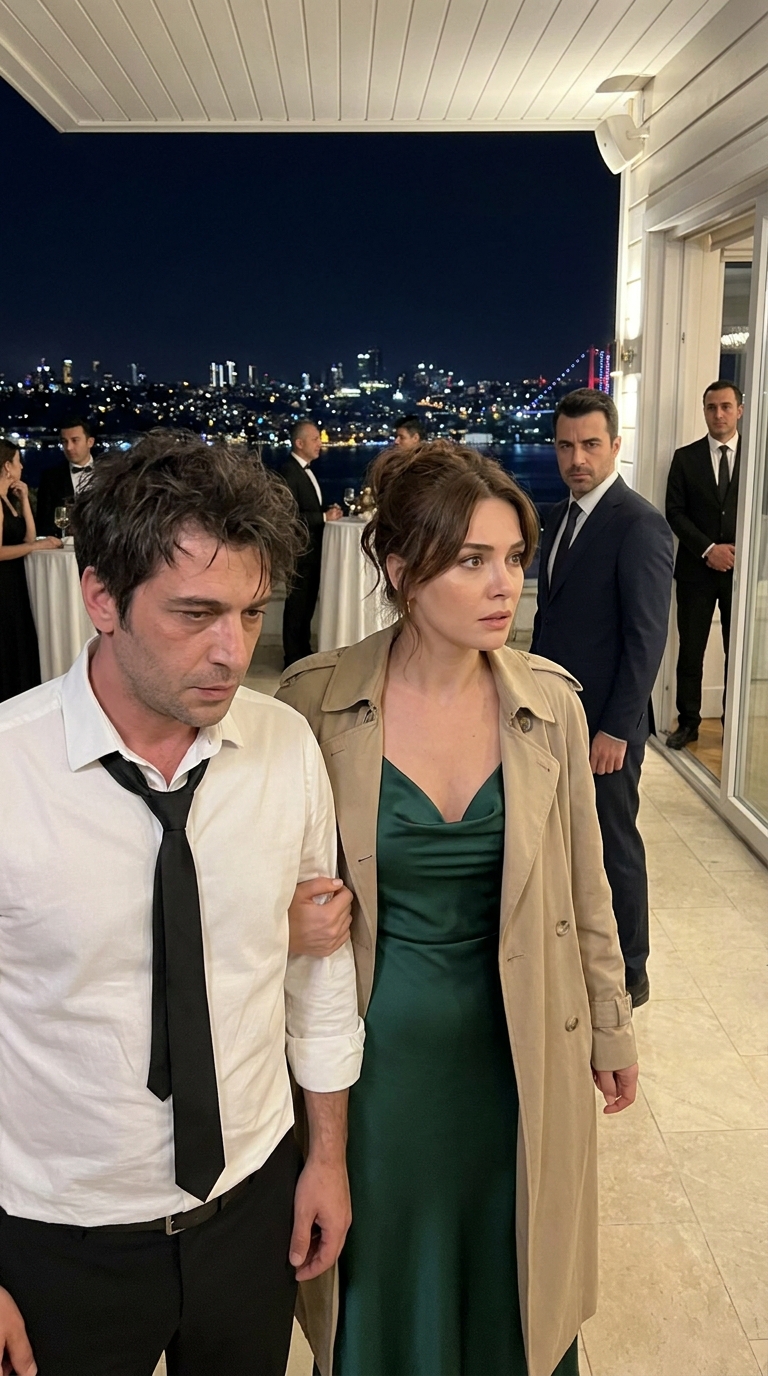
I stared at her, trying to force the missing hours back into place. “You kissed me?”
Her face tightened with pain, but she did not look away. “Yes. Before anything happened to you. Before the champagne. We were on the balcony, and I said I needed to ask you something selfish. I asked if I could kiss you. You said yes.”
My throat went dry.
“I would never have touched you if you hadn’t,” she said. “But the video doesn’t show that part. It only shows later, when I was helping you stand near the service door. Someone cut it to make it look like you were barely conscious and I kissed you anyway.”
“Did you?”
“No.” Her voice broke. “The kiss happened earlier. You were sober. We were both sober. It was still complicated, and I take responsibility for that. I’m your CEO. I crossed a line the moment I let my feelings matter more than the power difference between us. But I did not do what that video implies.”
I believed her before my mind had time to build a defense. Not because I wanted to, though I did. I believed her because shame and fear can be performed, but the disgust in her eyes when she described the edited video was too raw to be strategy.
“Who has it?” I asked.
“The board. HR. Legal. Colin Mercer called an emergency ethics meeting for ten.”
“Colin?”
She nodded. “He says an anonymous employee submitted it.”
I looked through the glass wall at the office beyond. Blake walked past at that exact moment, laughing with two managers. He glanced in, saw Evelyn, and looked away too quickly.
I remembered his fingers tightening around the champagne glass.
“The drink,” I said. “Blake brought drinks.”
Evelyn went still.
“He brought two glasses. I took yours.”
Her face drained of color.
“That’s why you’re scared,” I said slowly. “Whatever was in that glass was meant for you.”
Before she could answer, someone knocked once and opened the door without waiting.
Colin Mercer stepped in wearing a navy suit and an expression of professional sorrow. Blake stood behind him, suddenly solemn.
“Evelyn,” Colin said. “Nathan. I’m sorry to interrupt, but legal is ready.”
His eyes moved between us, measuring distance, posture, guilt. He looked like a man who had rehearsed sympathy in a mirror.
“This is a sensitive matter,” he continued. “For everyone’s protection, I think it’s best if Nathan comes with us separately.”
Evelyn’s voice turned cold. “He’s not a suspect.”
“No one said he was.”
“You implied it by bringing an audience.”
Blake lifted both palms. “I’m only here because I was asked to confirm the timeline.”
I looked at him. “Then confirm the drinks.”
His smile faltered. “Excuse me?”
“The champagne you brought us. Which glass was meant for Evelyn?”
Colin’s face did not change, but the air did.
Blake gave a small laugh. “Nate, you were pretty emotional last night. I’m not sure your memory is the best source right now.”
“That’s convenient,” I said.
Colin stepped forward. “Careful, son.”
For most of my life, that tone would have worked on me. I would have swallowed my anger because rent was due, because medical bills did not care about pride, because men like Colin Mercer often won by making ordinary people afraid of consequences they could not afford.
But Evelyn had asked me if I remembered, and behind her fear I had seen something else: a desperate hope that I might not let them turn my silence into their weapon.
So I stood.
“I’ll go to legal,” I said. “But I want my own statement recorded, and I want medical testing. If I was drugged, there may still be evidence.”
Blake’s jaw tightened.
Colin smiled thinly. “Of course. Transparency helps everyone.”
That was the first lie of the day.
The ethics meeting took place in a boardroom with a view of the river and no warmth at all. Three board members joined by video. Hartwell’s general counsel, Denise Walker, sat at the head of the table with a laptop open. HR director Marla Chen—born in Ohio, raised in Evanston, and more terrifying than anyone in finance—watched everyone like she was counting heartbeats.
The video played once.
It showed Evelyn and me in a dim service corridor. I looked unsteady. She had one hand on my arm, her body angled toward mine. The clip jumped, and suddenly her face was close to mine. Then the video froze.
It was obscene in its carefulness. Not because of what it showed, but because of what it removed.
Denise closed the laptop. “Nathan, do you remember this moment?”
“No.”
Colin sighed softly, as if disappointed by my honesty.
“But I remember the balcony before it,” I added. “I remember Blake Stafford bringing champagne. I remember taking the glass he offered Ms. Hart.”
“Evelyn,” Evelyn said quietly.
I looked at her.
“If we’re telling the truth,” she said, “use my name.”
That single sentence changed the room. It admitted more than a legal defense would have allowed, and because it admitted something real, Colin looked almost pleased.
Denise asked, “Are you confirming a personal relationship with an employee under your chain of command?”
Evelyn held her shoulders straight. “I’m confirming that I kissed Nathan Reed after asking his permission, before either of us consumed those drinks. I am also confirming that I should have recognized the power imbalance and stepped back. I will comply with any review. But the edited clip is not the whole event, and Nathan’s memory loss suggests something criminal happened afterward.”
Colin leaned back. “Or he drank too much and regrets it.”
“I rarely drink,” I said.
Blake murmured, “You had at least three.”
“I had one beer before you brought champagne.”
“You sure?”
“No,” I said. “Which is why I want bloodwork.”
Marla Chen finally spoke. “That request is reasonable.”
Colin’s eyes flashed toward her. She ignored him.
The meeting ended with Evelyn temporarily recusing herself from decisions involving my department. I was placed on paid administrative leave pending review, which sounded gentle until I walked back to my desk under the eyes of coworkers who had already heard enough rumor to decide there was smoke.
By noon, my access badge stopped working.
By two, I was at an urgent care clinic giving blood and urine samples while my sister Mia sat beside me in the waiting room, furious enough to bite through steel.
“You’re telling me your CEO kissed you, somebody drugged you, and now the company wants to make you the problem?” she said.
“Keep your voice down.”
“No. I postponed college for three years. I have earned the right to be loud in medical facilities.”
Despite everything, I almost smiled.
Mia had our father’s eyes and our mother’s stubbornness. She was twenty-two, sharp, practical, and allergic to rich people’s excuses. When I told her Evelyn’s version, Mia listened with her arms crossed.
“Do you believe her?” she asked.
“Yes.”
“Because she’s beautiful or because she’s telling the truth?”
“That’s not fair.”
“Life isn’t fair. That’s why I’m asking.”
I looked at the beige wall across from us, where a poster advised patients to manage stress as if stress were a houseplant that needed better sunlight.
“I believe her because she came to me before legal did,” I said. “If she wanted to protect herself, she could have let them define the story first.”
Mia studied me, then nodded reluctantly. “Fine. But believing her doesn’t mean protecting her at your own expense.”
That sentence followed me home.
For two days, the company stayed silent while rumors multiplied. Someone leaked enough of the video that my phone started buzzing with messages from coworkers pretending to check on me. A few were kind. Most were hungry. Blake sent one text: Hope you’re okay, man. Rough situation.
I deleted it before I could answer something that would become evidence.
On the third day, the toxicology report came back. Traces of a sedative were present. Low dose, fast-acting, consistent with memory impairment. The clinic physician said the timing matched the party.
I should have felt vindicated. Instead, I felt cold.
Because proof that I had been drugged meant proof that someone had intended harm. And if the glass had been meant for Evelyn, then the edited kiss was only one piece of a larger plan.
That evening, I went to Hartwell to pick up a few personal items from my desk. My badge had been reactivated for one hour under security escort. The building felt different after dark, less like a workplace than a stage after the audience leaves. My escort was called away to the lobby for a delivery issue, and while I waited near the service elevators, a familiar voice came from the maintenance hallway.
“Mr. Reed.”
Luis Alvarez stood under the fluorescent light holding a mop handle like a cane. He looked smaller than I remembered, but his eyes were bright.
“Mr. Alvarez,” I said. “I didn’t know you were working tonight.”
“I work when people forget buildings have ears.”
Something about his tone made me lower my voice. “Do you know something?”
He glanced toward the cameras. “Not here.”
He led me into a storage room that smelled of cardboard, floor wax, and old dust. Then he closed the door and reached behind a stack of supply boxes. From there he pulled a small padded envelope.
“I was going to give this to Ms. Hart,” he said. “But she is watched right now. You are watched too, but people underestimate a man they think has already lost.”
I stared at the envelope. “What is it?”
“Truth with poor lighting.”
Inside was a flash drive and a folded piece of paper. The paper showed camera angles, timestamps, and handwritten notes.
“You recorded the hallway?”
Luis gave me a look. “Maintenance records building systems. Cameras fail when powerful men need privacy. Backup sensors do not fail so easily.”
I remembered Evelyn’s note: Character is what you do when nobody important is watching.
“Why help me?” I asked.
Luis’s expression softened. “Because you helped me when you thought I was nobody important.”
Then came the first twist.
Luis Alvarez was not just a maintenance worker. He had once been a forensic accountant for federal procurement cases. Evelyn had hired him quietly six months earlier after she suspected Colin Mercer was using vendor contracts to prepare Hartwell for a forced sale to Meridian Capital, a private equity group known for buying companies, stripping assets, and burying liabilities under new names.
“Ms. Hart needed someone invisible,” Luis said. “In this building, an old man pushing a cart can stand beside any door.”
The promotion I lost had not been ordinary office politics. Colin had pushed Blake into the role because the manager would gain access to procurement files Evelyn’s team had been auditing. My project reports had flagged irregularities without my understanding their full meaning. I had noticed duplicated vendor codes, inflated consulting fees, and emergency software expenses tied to hospitals that never received the upgrades.
“I thought they were accounting errors,” I said.
“They were doors,” Luis replied. “You kept finding doors.”
He pointed to the flash drive. “Last night, Mr. Stafford brought two glasses. One was marked with a small black stirrer. That one was intended for Ms. Hart. You took it. After you became disoriented, they moved you toward the service hallway. Mr. Mercer’s private security consultant was waiting there. Ms. Hart followed because she saw you stumble. That ruined the rest of their plan, so they used the kiss instead.”
My mouth went dry. “What was the rest of their plan?”
Luis looked older suddenly.
“They needed Ms. Hart incapacitated long enough to photograph her signing a digital authorization for the Meridian sale. Her biometric token was in her clutch. They had a board vote scheduled for emergency approval this week. If she objected later, they would say she was unstable, intoxicated, compromised by a subordinate. The video was insurance.”
I sat down on a crate because my legs stopped trusting me.
“What does this have to do with my father?” I asked.
Luis went still.
I had not meant to ask it. The words had risen from that broken memory: Don’t sign Meridian. It killed my father.
Luis opened the envelope again and removed a second folded sheet. “I hoped you would not need this part yet.”
The document was an old billing summary from St. Anne’s Medical Center, the hospital where my father had died. Attached to it was a vendor name I knew from Hartwell’s suspicious files: Aster Ridge Services.
“My father’s bills,” I said slowly.
“Aster Ridge handled patient financing software and debt reconciliation for several hospitals. They inflated balances, duplicated charges, and sold the debt through shell agencies. Many families paid bills they did not owe.”
I felt something inside me go quiet in the most dangerous way.
“My mother worked double shifts for those bills.”
“I know.”
“My sister delayed college.”
Luis nodded.
“And Colin?”
“Colin Mercer was an investor in Aster Ridge before it disappeared into Meridian’s portfolio.”
The room blurred. For years, I had treated my father’s debt like weather—terrible, crushing, but impersonal. Now I was holding proof that part of our suffering had not been fate. It had been designed by men who turned grief into revenue and called it financial services.
Luis touched my shoulder gently. “Your father filed complaints before he died. He believed the billing was wrong. He sent documents to a state investigator, but the case stalled. His name appears in the archive. That is why, when you said those words last night, Ms. Hart understood the connection.”
“She knew?”
“Not before last night. She suspected Meridian. She did not know about your father until you said it while drugged.”
I pressed my hands over my face. The anger was so large it had no shape. It wanted to become shouting, violence, destruction. But beneath it was a deeper ache: my mother at the kitchen table, circling numbers with a pen; Mia pretending community college was her first choice; my father apologizing from a hospital bed because dying had become expensive.
Luis waited until I could breathe again.
“What do I do?” I asked.
“You decide whether truth is only revenge or something bigger.”
The next morning, Evelyn called from a number I did not recognize.
“Are you safe?” she asked.
It was the first thing she said. Not “Do you have the evidence?” Not “Can you help me?” Just: Are you safe?
I closed my eyes. “I met Luis.”
Silence.
Then she exhaled. “I was afraid he’d have to involve you.”
“You should have told me.”
“I wanted to protect you.”
“That’s what everyone says right before they decide for someone else.”
She absorbed the hit without defending herself. “You’re right.”
That made it harder to stay angry.
We met at a small diner in Oak Park because Evelyn said her office, home, and usual car were likely monitored. She arrived in jeans, a gray sweater, and a baseball cap pulled low, looking so unlike the CEO on magazine covers that the waitress called her “hon” and asked if she wanted more coffee.
I placed Luis’s flash drive on the table between us.
Evelyn looked at it but did not touch it. “Once we use that, this becomes bigger than an ethics review.”
“It already is.”
“Yes,” she said softly. “It is.”
For a while, neither of us spoke. Rain moved down the window beside us. Across the diner, a father cut pancakes for a little girl wearing glitter sneakers, and the ordinariness of it hurt.
“I need to say something before this goes any further,” Evelyn said. “What happened between us on that balcony was real for me. That’s exactly why it was wrong to let it happen while I had power over your job.”
I looked at her. “I said yes, didn’t I?”
“You did. But consent is not only a word. It’s also circumstance. You needed that promotion. You were hurting. I was your CEO. I should have known better.”
Her honesty landed heavily between us.
“Do you regret it?” I asked.
Her eyes lifted to mine. “No. I regret the timing, the position I put you in, the harm it could cause you. But I don’t regret wanting to kiss you. That would be another lie.”
My heart turned painfully in my chest.
“I don’t regret it either,” I said. “At least the part I can remember wanting.”
A sad smile touched her mouth. “That may be the most legally terrible romantic sentence ever spoken.”
I laughed despite everything, and the laugh loosened something we both needed loosened.
Then she became serious again. “We give the evidence to Denise and Marla first. Not the board. Denise has legal duties beyond Colin’s influence, and Marla hates bullies more than she likes company politics. We also send copies to outside counsel and the state attorney general’s office. If we only fight internally, Colin controls the walls.”
“What about the video?”
“I’ll take responsibility for the kiss. Publicly if I have to. But I won’t let them turn an edited clip into a weapon against you.”
“What if the company falls apart?”
Evelyn looked out the window. “Then maybe it was already falling apart in places I didn’t want to see.”
That was the moment I understood why people followed her. It was not because she was fearless. It was because she was afraid and still chose the harder door.
The board meeting happened on Friday.
By then, Colin had grown confident. The leaked clip had circulated quietly among senior leadership. Evelyn’s temporary recusal had become gossip. Blake had started behaving like a man measuring curtains for an office not yet vacant. Meridian’s representatives were already in the building, waiting for the board’s “emergency continuity discussion,” which was corporate language for taking power before employees could ask why.
I arrived with Denise Walker, Marla Chen, and an outside attorney named Grant Pell, who looked like he had been carved from courthouse marble. Evelyn was already seated at the table. Colin sat opposite her, smiling gently. Blake stood near the wall with a tablet, avoiding my eyes.
The board chair, Arthur Voss, joined by video from New York. He was seventy, elegant, and predatory in the way some men become after decades of being rewarded for mistaking cruelty for intelligence.
“Ms. Hart,” Voss said, “given recent concerns about judgment, we must discuss leadership stability.”
Evelyn folded her hands. “I agree.”
Colin blinked.
She continued, “Leadership stability requires removing the people who attempted to drug me, frame an employee, falsify procurement data, and force an unlawful sale to Meridian Capital.”
The room went silent.
Voss’s expression hardened. “That is a serious allegation.”
“Yes,” Evelyn said. “We brought serious evidence.”
Denise connected her laptop. The first video appeared.
This one was not edited.
It showed Blake approaching with the champagne. It showed the black stirrer in one glass. It showed me taking that glass from Evelyn’s hand. It showed Blake turning sharply toward Colin across the rooftop, panic flashing before he controlled it.
The next clip came from a service corridor sensor and a maintenance camera hidden above a supply cage. It showed Blake and a man I did not recognize trying to steer me toward a restricted elevator while I could barely stand. It showed Evelyn following, pushing between them, and taking my arm. It showed the man saying, clear enough for the room microphone to catch: “He wasn’t supposed to drink it.”
Blake’s face turned gray.
Colin stood. “This is fabricated.”
Grant Pell slid a folder across the table. “The toxicology report is not. Neither are the vendor records, shell company filings, altered promotion scoring documents, or the Aster Ridge debt portfolios tied to Meridian.”
At the mention of Aster Ridge, Arthur Voss leaned closer to his camera.
That small movement told me everything.
Evelyn looked at him. “You knew.”
Voss smiled without warmth. “Young lady, be careful.”
It was the wrong thing to say to a woman who had spent eleven years being careful while men like him mistook restraint for weakness.
“No,” Evelyn said. “I was careful when I kept this company alive after my father died. I was careful when I let Colin think I didn’t notice the vendor duplication. I was careful when I hired Luis Alvarez to audit the building from the basement up. I was careful when I watched you push for Meridian while pretending it was a rescue. Today I’m done being careful.”
Voss’s mouth tightened. “You do not have the votes.”
Marla Chen cleared her throat. “Actually, two board members have already requested emergency review after receiving the evidence package this morning.”
Denise added, “And as general counsel, I must inform everyone present that failure to preserve documents after this point may constitute obstruction.”
Blake suddenly looked like he might be sick.
Colin turned on him. “Sit down.”
But Blake did not sit. Fear made him stupid, or maybe guilt finally found a crack.
“You said nobody would get hurt,” he snapped. “You said she’d just be embarrassed and resign.”
Colin’s face went white with rage.
The room froze around Blake’s confession.
Evelyn did not look triumphant. She looked exhausted.
“Blake,” she said quietly, “who prepared the drink?”
His eyes moved from Colin to Voss on the screen.
“I don’t know what was in it,” he whispered. “I swear. Colin gave it to me. He said Evelyn needed to be slowed down, not hurt. He said the board had already decided.”
Colin lunged verbally, not physically. “You pathetic little—”
“Enough,” Denise said.
Security entered two minutes later. The police arrived in twelve.
I watched Colin Mercer leave the boardroom in handcuffs, his perfect silver hair still in place, his face arranged into offended dignity. Blake went with him, crying before the elevator doors closed. Arthur Voss disconnected from the call before officers could ask him anything, but Grant Pell was already on the phone with authorities in New York.
It should have felt like victory.
Instead, when the room emptied, Evelyn sat down as if her bones had finally remembered gravity.
I remained near the window, looking at the river below. For years, I had imagined justice as a clean moment, a door slamming, a villain exposed, a debt erased. But real justice felt messier. It opened graves. It made you count the cost of what could never be returned.
“My father knew,” I said.
Evelyn looked up.
“He knew the bills were wrong. We thought grief made him paranoid near the end.”
Her face softened. “Nate…”
“He kept saying the numbers didn’t add up. I told him to rest.” My throat closed. “I told him we’d handle it.”
Evelyn came closer but stopped before touching me. That restraint meant more than comfort would have.
“You were his son,” she said. “Not his lawyer. Not his investigator. His son.”
The kindness almost broke me.
Two months later, the story became public in pieces.
Colin Mercer was charged with fraud, conspiracy, and evidence tampering. Blake cooperated in exchange for a lesser sentence, though nobody at Hartwell ever said his name without lowering their voice. Arthur Voss fought extradition with expensive lawyers and television statements about misunderstanding, but the documents Luis preserved had long memories.
Meridian’s proposed acquisition collapsed. Aster Ridge’s old debt portfolios triggered a state investigation into fraudulent medical billing, and for the first time in years, my mother received a letter that did not demand payment. It said our family’s account was under review for restitution.
She cried at the kitchen table when she read it.
Not pretty crying. Not movie crying. The kind of crying that comes from realizing the monster under your bed had a mailing address all along.
Mia started college that spring.
Hartwell survived, though not unchanged. Evelyn remained CEO after an independent review cleared her of misconduct related to the edited video but criticized her boundary violation with me. She accepted the finding publicly. No excuses. No polished deflection.
“As leaders,” she told the company during an all-hands meeting, “we are responsible not only for our intentions but for the pressure our positions create. I failed to respect that fully. I am sorry.”
People expected me to disappear after that. Some assumed I would sue everyone and move to Florida. Others assumed Evelyn would quietly pay me off. Neither happened.
I transferred to a new division under a different executive, then later accepted the management role after the promotion process was rebuilt from scratch and reviewed externally. I did not take it because Evelyn offered it. I took it because the corrected scoring showed I had earned it the first time.
On my first day in the new office, I opened my desk drawer and found a note.
Not from Evelyn.
From Luis.
Character is still what you do when powerful people are watching.
I laughed for the first time in weeks.
As for Evelyn and me, we did the slow thing. The careful thing. The unglamorous thing no one writes songs about because it involves HR forms, reporting changes, legal boundaries, and months of not touching even when silence between two people feels like a lit match.
We met for coffee after my transfer became official. Then dinner. Then Sunday walks along the lake. We talked about my father, her father, fear, ambition, money, grief, and how easy it is to mistake being needed for being loved.
One evening in late summer, nearly eight months after the rooftop party, Evelyn came with me to my mother’s house in Joliet. She brought peach pie from a bakery and looked more nervous than she had before facing the board.
My mother opened the door, looked her up and down, and said, “So you’re the woman who caused all that trouble.”
Evelyn went pale.
Then my mother smiled. “Good. We needed the truth to make some noise.”
Over dinner, Mia interrogated Evelyn about corporate ethics, income inequality, and whether billionaires should exist. Evelyn answered every question seriously. My mother watched them with quiet amusement, and for the first time in years, our kitchen felt lighter than the bills stacked on the counter.
Later, Evelyn and I stood on the back porch while the cicadas sang in the dark.
“I was terrified that morning,” she said.
“I know.”
“I thought if you didn’t remember, you’d look at me and see someone who had taken advantage of you.”
I leaned against the railing. “For a minute, I was afraid I’d wake up and find out I had ruined the life I was barely holding together.”
“And now?”
I looked through the kitchen window at my mother laughing with Mia. I thought about my father, about the truth arriving too late to save him but not too late to honor him. I thought about Luis pushing his cart through hallways where powerful men forgot to look down. I thought about a kiss on a rooftop that had become a weapon, then a confession, then a boundary, then eventually something we could choose freely.
“Now,” I said, “I think remembering isn’t always about getting every detail back. Sometimes it’s about learning what really happened and deciding what kind of person you’ll be after you know.”
Evelyn’s eyes softened. “That sounds like something your father would have said.”
“Maybe.”
She reached for my hand, slowly enough that I could step away if I wanted.
I didn’t.
Months later, Hartwell created the Reed-Alvarez Fund, an employee assistance program for medical debt, emergency family care, and tuition support. Evelyn insisted Luis’s name be on it because, as she said during the launch, “Some of the most important people in any building are the ones arrogant people overlook.”
Luis pretended to hate the attention. Then he cried in the supply room where nobody could see him, except of course I did, because by then I had learned that buildings have ears and kindness has witnesses.
The fraudulent charges against my father’s estate were cleared the following year. Restitution did not bring him back. Nothing could. But when my mother received the final letter stating our balance was zero, she placed it beside his photograph and whispered, “You were right, Tom.”
That was enough to make the house quiet in a new way.
Not empty.
Peaceful.
Evelyn and I never told people our love story began with a kiss at a party. That sounded too simple, too pretty, too false. The truth was harder and better. It began with an old maintenance worker in a rain-slick parking garage. It began with a note in a wallet. It began with a woman powerful enough to admit when she was wrong and a man ordinary enough to be underestimated.
And yes, it began with a question.
Do you remember last night?
For a long time, I hated that I could not answer yes.
Now I understand that the question was never really about one night. It was about whether truth could survive shame, whether love could grow without hiding from accountability, whether ordinary kindness could outlast extraordinary corruption, and whether two people who met inside a trap could walk out of it without becoming cruel.
The answer, after everything, was yes.
THE END