The CEO looked at my $199 invoice like I had asked her to fund my whole life. When she accused me of cheating her in front of my employees, every wrench in the garage seemed to go quiet, and I felt my daughter’s grocery money disappear with her taillights. But I still had the damaged cooling hose, the signed work order, and one unpaid invoice stamped 5:47 p.m. By sunrise, a black sedan was parked outside my garage, and I realized her insult had reached someone she never meant to hear it.
The old pickup truck rolled into Callaway Auto & Tire five minutes before closing, rattling so hard the hood looked like it might shake loose.
Ryder Callaway looked up from the workbench, wiped his hands on a red shop rag, and listened.
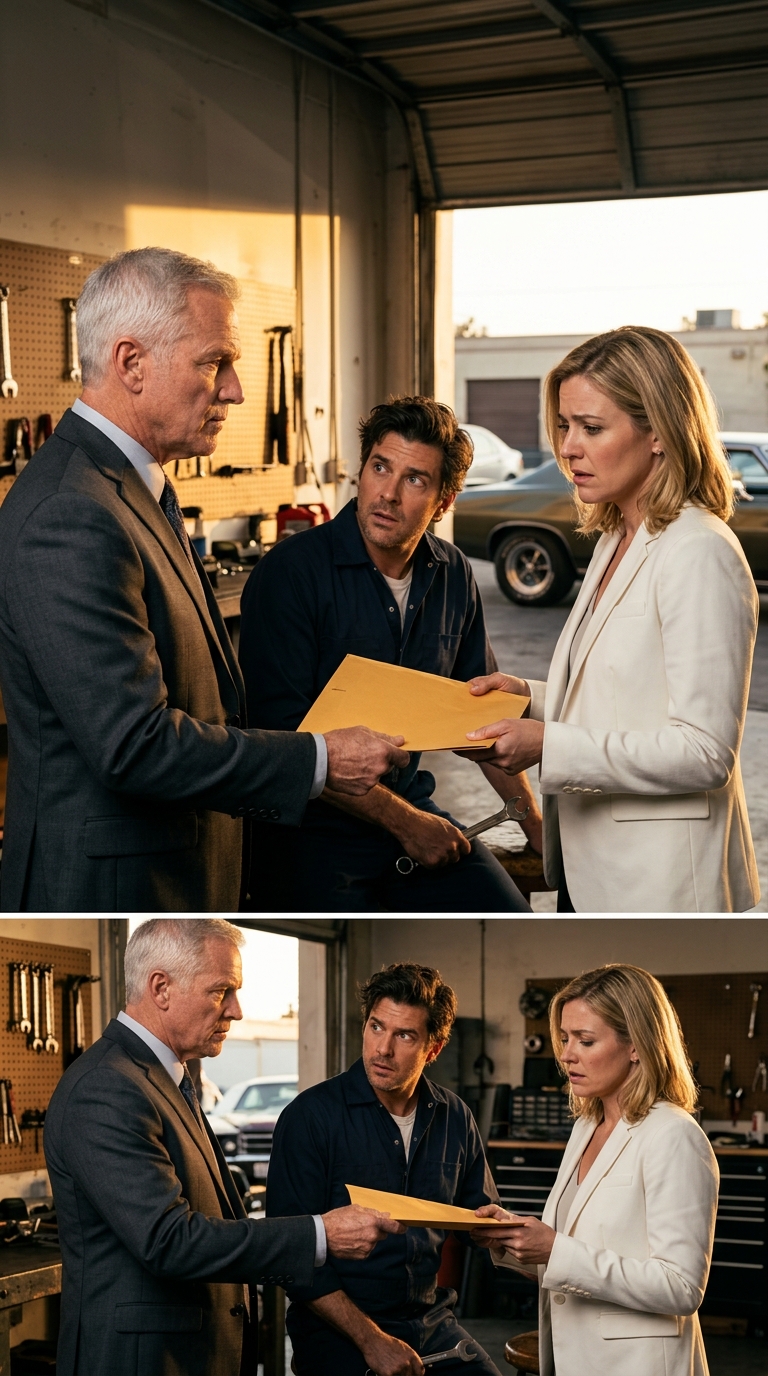
A mechanic could tell a lot by listening.
A loose belt had a whine. A bad bearing had a growl. A tired engine had a cough like an old man trying to clear his throat on a cold morning.
This truck sounded frightened.
Ryder stepped out from beneath the faded blue awning of his garage and watched the pickup limp across the gravel lot. The sun was already dropping behind the water tower at the edge of Ashford, turning the shop windows gold. His one remaining employee, Milo, had started pulling the bay doors down. Inside the office, the coffee pot had burned itself into bitterness, and a stack of envelopes sat unopened beside the cash register because Ryder already knew what most of them said.
Past due.
Final notice.
Payment required.
He was thirty-eight years old, a widower, a father, and a mechanic who had become very good at pretending he was not tired.
The truck stopped in front of Bay Two with one last shudder.
The driver’s door opened.
A woman stepped down in heels that did not belong anywhere near a gravel parking lot.
She was polished in the way expensive people often were. Navy suit, cream blouse, dark sunglasses, leather bag tucked against her ribs like a shield. Her hair was smooth enough to look professionally managed. Even before she spoke, Ryder knew she was used to being obeyed quickly.
She looked at the building first, then at the cracked pavement, then at Ryder.
“Are you still open?”
Ryder glanced at the clock through the office window.
“Depends how bad it is.”
Her mouth tightened, as if that answer had not been efficient enough.
“My SUV overheated on Route 16. My assistant called every dealership within forty miles and nobody could take it today. A state trooper said this was the nearest garage.”
Ryder looked past her.
Behind the pickup, sitting on the shoulder of the road, was a silver luxury SUV with its hazard lights blinking. Steam drifted lightly from beneath the hood.
“You drove that in hot?”
“I drove it as far as it would go.”
He tried not to wince.
“All right,” he said. “Let’s get it inside before it gets worse.”
She handed him the key without asking his name.
That was the first thing Ryder noticed.
People who grew up around working folks usually asked your name.
People who were used to service just handed you problems.
He drove the SUV carefully into Bay One while Milo guided him in. The smell hit immediately. Hot coolant. Overheated rubber. A stressed engine that had been asked to do too much for too long.
Ryder raised the hood and leaned in with a flashlight.
The woman stood just outside the bay, checking her phone.
“I have a dinner in Blackwood at seven,” she said. “Can you make that happen?”
Ryder did not answer right away.
He believed in answering the machine before answering the person.
A split cooling hose. Thermostat sticking. Reservoir nearly empty. Nothing catastrophic yet, but close enough that another ten miles might have turned a $200 repair into a $4,000 apology.
“You were lucky,” he said.
She looked up.
“I prefer prepared.”
Ryder gave a small nod, because some people had never learned the difference.
“I can replace the hose and thermostat. Flush what needs flushing. If nothing else shows up, you’ll be back on the road in a couple hours.”
“How much?”
“About one ninety-nine, give or take a few dollars depending on coolant.”
She stared at him over the top of her sunglasses.
“For a hose?”
“For the hose, thermostat, coolant, labor, and staying open.”
Her face gave nothing away.
“Fine. Just get it done.”
Ryder did not like the way she said fine. It had a crack in it. A warning.
But the SUV needed the work, and he needed the money.
So he stayed.
Milo stayed too, though Ryder told him to go home twice. Outside, the evening traffic thinned. Pickups rolled past on the county road. The feed store closed across the street. A few customers came by to grab vehicles Ryder had finished earlier, and one old man named Mr. Bell left an envelope with sixty dollars toward a bill he had owed for three months.
“No hurry on the rest,” Ryder told him.
Mr. Bell looked embarrassed.
“There ought to be a hurry. You got your own child to feed.”
Ryder smiled and tucked the envelope in the drawer.
“My child eats better than I do.”
It was almost true.
Tessa Callaway was nine years old and loved scrambled eggs, soccer, library books, and putting stickers on every surface her father forgot to defend. She had her mother’s dark eyes and Ryder’s habit of watching people quietly before deciding whether to trust them.
Three years earlier, Ryder’s wife, Elise, had gone from tired to feverish to gone in a blur that still made certain rooms in his house feel impossible.
Since then, Ryder had lived two lives every day.
In one life, he was the owner of Callaway Auto & Tire, a small-town repair shop with peeling paint, three bays, and a waiting room where the chairs sank too low because nobody had bought new ones since 2008.
In the other life, he was Tessa’s entire world.
He packed her lunches before sunrise. He learned to braid hair from a YouTube video and still got it wrong half the time. He sat at school concerts with grease under his nails and clapped like she had just performed at Carnegie Hall. He checked her math homework at the kitchen table while utility notices waited unopened near the microwave.
He was proud of that life.
He was also terrified of losing it.
Business had been getting harder. A bright, corporate service center had opened off the interstate, thirty miles away, with free coffee, digital coupons, and a waiting lounge that looked like an airport. Ryder could not compete with that. He could not offer a loyalty app or same-day loaner cars.
All he could offer was honest work.
Honest work, he had learned, did not always pay fast enough.
At 6:47 that evening, Ryder tightened the last clamp, refilled the coolant, and started the SUV. The engine settled into a clean hum.
Milo grinned from the other side of the bay.
“That’s a happy car.”
“It’s a relieved car,” Ryder said.
He took it for a slow test drive around the block, watched the temperature gauge hold steady, then pulled back into the lot.
The woman was waiting near the office door, irritated in that quiet way rich people sometimes are when reality has failed to hurry for them.
Ryder printed the invoice.
Parts. Labor. Coolant.
Total: $199.14.
He rounded it down to $199.
“Here you go,” he said.
She took the paper between two fingers, as if it might leave a stain.
For a moment, nothing happened.
Then she laughed once.
Not because anything was funny.
Because she wanted everyone nearby to understand that the invoice was beneath her.
“This is ridiculous.”
Ryder kept his voice even.
“Ma’am?”
“One hundred ninety-nine dollars for a hose and some fluid?”
“And a thermostat.”
“I know what a thermostat costs.”
“Then you know the part is listed right there.”
She looked around the garage. Milo had gone still. Mrs. Alvarez, who had come to pick up her minivan, stood near the coffee machine with her purse hanging from one shoulder. Two teenage boys waiting for their father’s truck stopped scrolling their phones.
The woman noticed the audience.
Her chin lifted.
“I don’t appreciate being taken advantage of just because I’m from out of town.”
Ryder felt heat move up the back of his neck.
That accusation hit him harder than the money.
“I’m not taking advantage of you.”
“You expect me to believe this place charges dealership prices?”
“No, ma’am. A dealership would’ve charged you more and kept it overnight.”
Her eyes sharpened.
“What did you say?”
Ryder regretted the edge in his voice, but not the truth.
“I said the repair is done correctly. The old parts are in the box if you’d like to see them. I stayed late. My employee stayed late. Your vehicle is safe to drive.”
She dropped the invoice on the counter.
“I’m not paying this.”
The room changed.
Small towns have a way of going quiet that cities never learn. In a city, arguments blend into traffic. In Ashford, every silence had witnesses.
Ryder looked at the invoice on the counter, then back at her.
“Ma’am, you approved the estimate.”
“I approved a reasonable repair.”
“This is a reasonable repair.”
“Not in this building.”
Milo took one step forward, but Ryder lifted his hand slightly.
He had dealt with angry customers before. People got scared when cars broke. They felt trapped. Money made folks ashamed, and shame often dressed itself up as anger.
But this was not shame.
This was contempt.
“What’s your name?” she asked.
“Ryder Callaway.”
“I’m Victoria Sterling.”
The name landed.
Even Mrs. Alvarez reacted.
Everyone in that part of the state knew the Sterling name. Sterling Systems had its glass headquarters outside Blackwood, all reflective windows and manicured lawns. Victoria Sterling was on business magazine covers, quoted in articles about leadership, invited to charity galas where people paid five thousand dollars a plate to talk about helping communities they had never actually visited.
Ryder had seen her face before.
He had not expected to meet it over a $199 invoice.
Victoria waited for recognition to do its work.
Ryder gave her none.
“All right, Ms. Sterling. Your total is still one ninety-nine.”
Her smile turned cold.
“You really don’t understand who you’re speaking to.”
“I understand your vehicle came in overheated and left repaired.”
She leaned closer.
“You can send whatever bill you think you’re owed. My office will decide whether it deserves payment.”
“That’s not how this works.”
“It is today.”
She picked up her key from the counter.
Ryder stepped aside because he would not grab a customer, would not block a door, would not turn his garage into a spectacle his daughter might someday hear about in town.
Victoria paused at the threshold.
“You should be careful,” she said, soft enough to sound almost polite. “Businesses like this survive on reputation.”
Ryder looked at her.
“So do people.”
For the first time, something flickered in her expression.
Then it was gone.
She walked to her SUV, got in, and drove away.
The gravel snapped under her tires.
The red taillights disappeared toward Blackwood.
Nobody spoke.
Then Mrs. Alvarez set her purse on the counter and pulled out a twenty-dollar bill.
Ryder shook his head immediately.
“No.”
“Ryder.”
“No, ma’am.”
“You fixed my van twice when I couldn’t pay.”
“And you paid when you could.”
She looked toward the road.
“She had no right.”
“No,” Ryder said quietly. “She didn’t.”
But his voice did not sound as steady as he wanted.
That night, after closing, he drove to the elementary school soccer field to pick up Tessa. She was sitting on the bottom row of the bleachers with her backpack between her feet and one shin guard still on.
The moment she saw him, she stood.
“Dad?”
He forced a smile.
“Hey, bug.”
“You’re late.”
“Ten minutes.”
“Twelve.”
“Then I owe you twelve minutes of ice cream.”
She narrowed her eyes, considering whether to negotiate.
“With sprinkles.”
“With sprinkles.”
On the drive home, she told him about a girl named Maddie who cheated during spelling baseball and about how the cafeteria chicken nuggets had “a weird bounce.” Ryder listened, nodded, laughed in the right places.
At home, he made scrambled eggs because he was too tired for anything else. Tessa did her homework at the kitchen table while he sorted mail.
Electric.
Mortgage.
Parts supplier.
A notice from the bank that made his stomach tighten before he even opened it.
Tessa watched him over the top of her pencil.
“Bad mail?”
“Grown-up mail.”
“That means bad.”
“Not always.”
“You use your forehead wrinkle when it’s bad.”
He touched his forehead.
“I have a forehead wrinkle?”
“You have three.”
He laughed then, because if he did not laugh, he might have put his head down on the table and stayed there.
After dinner, Tessa disappeared into her room. When she came back, she placed a folded piece of notebook paper beside his plate.
“What’s this?”
“Don’t open it till I brush my teeth.”
“That sounds serious.”
“It is.”
She went down the hall in her socks.
Ryder opened the note.
In purple marker, with several letters leaning the wrong way, she had written:
You’re the best dad in the world.
Things always get better.
Under the words, she had drawn the two of them standing beside the garage. He was twice her size, with enormous square hands. She had added a yellow sun above the roof.
Ryder sat there for a long moment.
Then he folded the note carefully and put it in his wallet behind Elise’s old driver’s license.
Later, after Tessa was asleep, Ryder returned to the garage.
He told himself he only needed to shut off the compressor. But once he was there, he sat in the office chair beneath the buzzing fluorescent light and opened the bank notice.
The numbers were exactly as bad as he had feared.
He was behind.
Not ruined yet.
But close enough to see ruined from where he sat.
He leaned back and stared at the ceiling tiles.
One hundred ninety-nine dollars should not have mattered that much. It should not have had the power to make a grown man feel small.
But it did.
It was groceries. It was gas. It was Tessa’s field trip money. It was the difference between paying half a bill and making another humiliating call.
Mostly, it was work he had done with his hands that someone wealthy had decided had no value.
Across the county, in a dining room longer than Ryder’s entire house, Victoria Sterling told the story differently.
She sat at the end of her father’s table beneath a chandelier that had been shipped from Italy, swirling a glass of red wine while a private chef cleared the first course.
Theodore Sterling sat across from her.
At seventy-two, Theodore was not loud, not flashy, and not easily impressed. He wore old cardigans over expensive shirts and kept a battered lunch pail from his first factory job on a shelf in his private study. People often mistook his quietness for softness.
They usually only did it once.
Victoria mentioned the garage because she expected him to be amused.
“You wouldn’t believe the place,” she said. “It looked like it was being held together by rust and coffee. And the man tried to charge me two hundred dollars for a hose.”
Theodore looked up from his plate.
“Did he repair the car?”
“Yes.”
“Correctly?”
“As far as I can tell.”
“Did he give you the price before the work?”
Victoria shifted slightly.
“He gave me an estimate.”
“How much?”
“One ninety-nine.”
Theodore set his fork down.
The sound was gentle.
Victoria stopped smiling.
“And what did you pay him?”
She took a sip of wine.
“I told him to send it through the office.”
“That was not my question.”
The room seemed to cool.
Victoria glanced toward the kitchen doors, but the staff had already vanished with the instinct of people who knew when not to be present.
“I didn’t pay him,” she said. “Not there.”
Theodore leaned back.
“Why?”
“Because it was absurd.”
“You just told me he quoted the price, did the work, and the car runs.”
“That doesn’t mean—”
“Why?” Theodore asked again.
Victoria’s lips pressed together.
“Because men like that see someone like me and assume they can add whatever they want.”
Theodore studied his daughter for a long, painful moment.
When he finally spoke, his voice was not angry.
That made it worse.
“Men like that?”
Victoria looked away.
Theodore stood slowly.
“Excuse me.”
“Dad.”
But he had already left the room.
In his study, Theodore closed the door and made three phone calls.
The first was to his driver, who confirmed the SUV had been running hot before Victoria reached Ashford and that the garage owner had stayed late.
The second was to a retired county judge who knew everyone worth knowing between Ashford and Blackwood.
The third was to a woman named Nadine Bell, whose late husband had once run the Ashford VFW.
By midnight, Theodore Sterling had a legal pad full of notes.
Ryder Callaway had fixed the church bus for free the winter the youth group could not afford repairs.
He had kept Mrs. Alvarez’s van running during her chemotherapy appointments and refused payment until she was back at work.
He had replaced Mr. Bell’s battery during a snowstorm and told him to bring money “whenever the government decided veterans deserved faster checks.”
He had sponsored two sets of soccer cleats anonymously through the elementary school office.
He had repaired a teacher’s car before Christmas and written “paid” on the invoice after she cried in the waiting room.
He had once driven forty minutes at midnight to help a young mother stranded outside a closed pharmacy with a feverish toddler in the back seat.
No social media posts.
No plaques.
No public speeches.
Just work.
Just decency.
Theodore sat alone in his study long after the house went quiet.
On the shelf, the old lunch pail caught the lamplight.
He thought of his own father coming home with cracked hands and silence in his shoulders. He thought of the first foreman who had called him boy in front of a line of workers. He thought of every man and woman who had been treated like a tool because someone richer was holding the handle.
At 6:15 the next morning, Theodore was dressed.
At 7:40, his black sedan left the Sterling estate.
At 8:03, it pulled into the gravel lot of Callaway Auto & Tire.
Ryder was inside Bay Two, trying to coax life out of the coffee machine, when Milo whistled low.
“Boss.”
Ryder turned.
The sedan looked out of place in the lot, like a grand piano abandoned in a feed store.
An older man stepped out.
Ryder knew him immediately.
Theodore Sterling had the kind of face that appeared in newspaper photos beside words like manufacturing, foundation, civic gift, and expansion project. He was taller than Ryder expected and moved carefully, not weakly, like a man who had learned not to waste motion.
Ryder wiped his hands and walked outside.
“Mr. Sterling?”
Theodore held out his hand.
“Mr. Callaway.”