
PART 2
Six weeks earlier, rain had been blowing sideways across Pacific Crest Executive Airport outside San Diego when Ethan Walker first drove through the security gate.
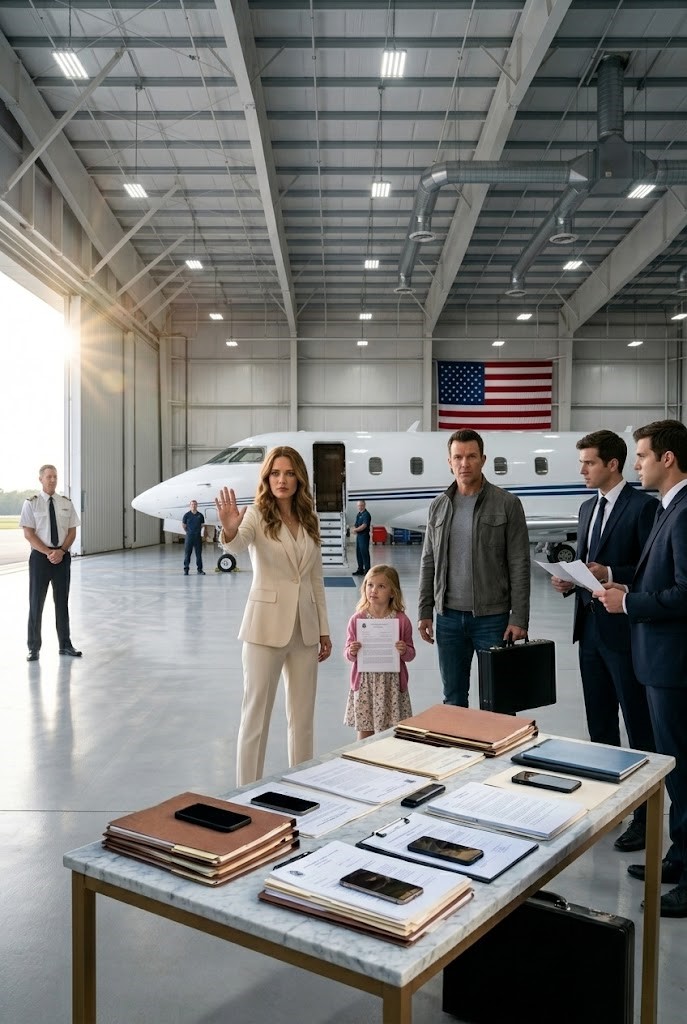
His pickup truck coughed once near the guard booth, then settled into a tired rumble. The truck had two hundred thousand miles on it, a cracked dashboard, and a booster seat in the back from the years when his daughter, Lily, had still needed one. She was fifteen now, tall, sarcastic, and pretending not to know their life was hanging by a thread.
Ethan knew.
The bank knew.
His landlord knew.
The only people who did not know were the ones who saw him walk into a hangar with a toolbox and assumed quiet meant weak.
Preston Vale had called three hours earlier.
“Private Gulfstream,” he said. “Grounded. Needs to be ready in six weeks. Big contract if you can handle it.”
“What happened to it?” Ethan asked.
“Electrical and hydraulic complications.”
“When was the last complete inspection?”
A pause.
“I’ll have records pulled.”
“What condition are the hydraulic lines in?”
Another pause.
“That’s what we need you to determine.”
Ethan almost said no right then.
Instead, he drove through the rain to Hangar 9.
The Gulfstream G550 belonged to the late Warren Whitaker, founder of Whitaker Meridian Group, a defense logistics and private infrastructure giant with offices in Chicago, Washington, D.C., and San Diego. Warren had died eighteen months earlier after a medical emergency overseas. Since then, his daughter Grace had taken control of a company full of men who called her “brilliant” in public and “temporary” in private.
The aircraft had not flown since shortly before Warren’s death.
When Ethan opened the hangar door and aimed his flashlight into the forward avionics bay, his first thought was simple.
Someone had touched everything.
His second thought was worse.
Someone had touched everything badly.
Wire bundles had been disconnected and reconnected without proper tagging. A hydraulic accumulator carried no traceable part number. Access panels showed tool marks from rushed hands. The maintenance logs were not just incomplete; they were selective. Whole months were missing. Certain service orders had been summarized instead of documented. A directional flight control component had been replaced, but the serial number did not match any manufacturer record Ethan had ever seen.
He stood there for nearly a minute, rain dripping from the hem of his jacket onto the hangar floor.
Preston arrived in a navy suit, holding an umbrella someone else had clearly given him.
“Can you fix it?”
Ethan looked back at the jet.
“I can inspect it.”
“That wasn’t my question.”
“That was my answer.”
Preston’s smile thinned.
“We need this aircraft operational before the merger closes. Washington meetings. Board pressure. Media watching. I don’t need poetry, Mr. Walker. I need wheels up.”
Ethan clicked off his flashlight.
“Then call someone who sells wheels up. I sell safe.”
Preston studied him, weighing whether the line was courage or stupidity.
By morning, Ethan had a contract covering labor, certified parts, reimbursement, and a completion bonus if the aircraft was ready within the six-week target. Target. Not deadline. He read the word three times before signing.
His shop, Walker Air Works, was small but respected. His best avionics technician, Harper Sloan, arrived the next day with diagnostic equipment, black coffee, and the expression she wore when a job was already worse than promised.
“This thing looks haunted,” she said, ducking under the wing.
“It’s not haunted,” Ethan replied. “It’s hiding something.”
They brought in two other certified technicians and divided the aircraft into zones. Every anomaly was photographed. Every missing entry was marked. Every questionable part was logged.
By day four, Harper had traced the unregistered flight control component to a vendor called Vanguard Aero Supply.
By day six, she found Vanguard had billed Whitaker Meridian more than four million dollars in parts over three years.
By day eight, she found every approval flowed through Preston Vale.
Ethan sent formal inspection reports to Whitaker Meridian’s aviation department. The reports described unsafe components, incomplete documentation, and possible falsification.
Grace Whitaker received summaries.
Not the reports.
Preston made sure of that.
The summaries said Ethan was behind schedule, over budget, and expanding the job unnecessarily.
On day nine, Grace came to the hangar.
She arrived without warmth, without apology, and without raincoat despite the mist curling in from the coast. She found Ethan lying beneath a wiring conduit, one arm deep inside an access panel.
“I’m hearing concerns,” she said.
Ethan pulled out a connector and sat up. His hair was damp with sweat. There was a streak of grease across his jaw.
“About what?”
“The pace.”
He held up the connector.
“This internal contact is bent. Visual inspection would pass. In flight, it could cause intermittent autopilot failure.”
Grace looked at it.
Her face did not change, but her eyes sharpened.
“Why wasn’t I told that?”
“I sent it.”
“To whom?”
“Your aviation office.”
The silence that followed was the first honest thing between them.
Grace left twenty minutes later with copies of three unedited reports. Ethan watched her go and felt something uneasy move through him. She was not like Preston. She listened when the evidence got specific.
That could save lives.
Or make her more dangerous.
PART 3
Ethan’s daughter called every night at 8:30.
Lily pretended it was because she needed help with algebra, but Ethan knew she was checking whether he had eaten. He would sit on an overturned crate outside Hangar 9, holding his phone between his shoulder and ear, while the Gulfstream loomed behind him like a sleeping animal.
“You sound tired,” Lily said one night.
“I’m not.”
“Dad.”
“I’m old tired. Different category.”
She laughed softly, then stopped.
“Did the bank call again?”
Ethan looked across the hangar at the open belly panels, the tagged wires, the expensive parts his shop had already paid for because Preston kept delaying approvals.
“No.”
That was technically true.
They had emailed.
Lily was quiet long enough for him to know she did not believe him.
“We can move,” she said. “It’s fine.”
“It is not fine.”
“I don’t need a house.”
“You need a home.”
“I need you not to kill yourself fixing rich people’s toys.”
Ethan looked at the Gulfstream.
“It’s not a toy when people climb inside it.”
That was the part most people outside aviation never understood. A private jet could look like money, vanity, leather seats, chilled champagne, and executives who never carried their own bags. But once the door closed and the wheels left the runway, it became physics. It became metal, air, pressure, fuel, control surfaces, and the honesty of everyone who had touched it.
A lie on the ground became a scream in the sky.
On day twelve, Harper entered the hangar carrying a folder.
She did not rush. Harper never rushed when the news mattered.
“Vanguard isn’t a supplier,” she said.
Ethan wiped his hands and took the folder.
The company had no real manufacturing history, no legitimate aviation distribution chain, and no meaningful warehouse footprint. Its listed office address led to a suite in Nevada occupied by three dozen shell companies. Yet Whitaker Meridian had paid Vanguard for flight-critical components at enormous markups.
“Who approved the purchases?”
Harper tapped the page.
Preston Vale.
Ethan closed his eyes.
There were two kinds of corruption. The sloppy kind made men rich. The precise kind got people killed.
This looked precise.
That afternoon, Ethan removed a bolt from the directional control linkage and compared it to the Vanguard invoice. The dimensions were close enough to fool someone reading quickly and wrong enough to matter under load. He photographed it, bagged it, labeled it, and added it to his private log.
Then he requested a full replacement of the flight control assembly.
Preston rejected it before lunch.
“Schedule does not permit,” the email said. “Existing part cleared by certified engineer.”
Ethan looked up the engineer.
The man had left Whitaker Meridian fourteen months before the date printed on the sign-off.
Someone had used his name after he was gone.
Three days later, Ethan discovered the contract alteration.
The word target had become binding deadline. A penalty clause had appeared, allowing Whitaker Meridian to withhold payment if delivery missed the date.
Ethan had never initialed it.
He printed the original email chain and placed it in a separate folder.
That evening, Grace came back to the hangar at nine o’clock. She looked exhausted, but not careless. There were shadows beneath her eyes and a storm in her posture.
“Preston says you’re using safety concerns to pressure us for more money.”
Ethan did not answer.
“He says you’re threatening to withhold delivery.”
Still nothing.
“He says we should involve legal.”
Ethan reached into his work bag, pulled out the bagged bolt, and placed it on the tool chest between them.
“Compare that to the invoice for the directional control assembly.”
Grace opened her tablet.
The hangar seemed to go silent around her.
She read.
Then she read again.
“The specifications don’t match.”
“No.”
“Could it still function?”
“For a while.”
Her eyes lifted.
“For a while?”
“That’s how bad parts kill people. Not usually on the first day. They wait until everyone trusts them.”
Preston arrived fifteen minutes later.
Ethan noticed that immediately. Someone had called him. Maybe Grace. Maybe one of her assistants. Maybe someone in the walls.
Preston walked in smiling.
“Minor component substitution,” he said after Grace showed him the mismatch. “Common practice when dealing with older assemblies. Functionally equivalent.”
Ethan said nothing.
Preston turned slightly, lowering his voice just enough that Grace might miss the edges of it.
“You have a foreclosure notice on your shop, Mr. Walker. I would think carefully before accusing a company with forty attorneys of fraud.”
Ethan looked at him.
Then he nodded once and went back to work.
That night, he copied every report, photograph, invoice, access record, and diagnostic result onto three encrypted drives.
One went home with Harper.
One went into a safe deposit box in downtown San Diego.
One stayed with Ethan, behind Lily’s childhood photo in the lining of his work bag.
By morning, every Vanguard file had been deleted from Whitaker Meridian’s maintenance server.
Harper, who trusted executives about as much as she trusted unmarked wires, had already cloned the directory.
When she told Ethan, he did not smile.
“Good,” he said.
Outside, the Gulfstream sat under the lights, polished and patient.
Inside it, the truth was beginning to breathe.
PART 4
The final two weeks did not look dramatic.
No shouting. No sirens. No cinematic explosion of truth.
Just work.
Bench calibration. Pressure tests. Ground power checks. Wiring continuity. Hydraulic validation. Flight surface response. Redundant channel verification. Long hours under fluorescent lights while the rest of San Diego slept and the ocean fog pressed against the hangar doors.
Ethan’s team worked with the grim concentration of people who knew the enemy was not the machine.
The machine wanted to obey.
The records did not.
Ethan found a legitimate replacement assembly from a decommissioned Gulfstream in Tennessee, verified its full certification lineage, and wired a deposit from his own account because Preston had placed a forty-eight-hour review hold on any purchase over one thousand dollars.
His bank account dropped below a number he did not want Lily to see.
Harper noticed anyway.
“You paid for Tennessee yourself.”
“Temporarily.”
“That’s what people say before bankruptcy.”
“That’s what people say before finishing a job.”
She stared at him.
“You know they might not pay.”
Ethan slid beneath the panel again.
“They still might fly.”
That ended the argument.
On the morning the engines turned over for the first time, the sound moved through the hangar floor like thunder finding its way home. One of the younger technicians stopped working. Harper exhaled once, softly, then immediately picked up her clipboard as if satisfaction were a luxury they could not yet afford.
Grace arrived while the auxiliary power unit was still humming.
She stood near the hangar entrance for almost a minute before approaching. Ethan saw her place one hand against the lower fuselage. Not like a CEO touching an asset. Like a daughter touching a memory.
“My father loved this aircraft,” she said.
Ethan kept his voice low.
“I know.”
“How?”
He nodded toward the cockpit.
“There’s a photo tucked beside the pilot’s seat. You and him. Tarmac somewhere sunny. You were maybe sixteen.”
Grace turned away slightly.
“Phoenix,” she said. “He let me sit in the cockpit. I thought he owned the sky.”
Ethan looked at the aircraft.
“No one owns the sky.”
She almost smiled.
“No. I suppose not.”
For a moment, they were just two tired people standing beside a machine that carried ghosts.
Then Preston entered with a delivery schedule.
The spell broke.
“We release to flight operations tomorrow,” he said.
Ethan did not look up from his clipboard.
“No.”
Grace stiffened.
Preston’s smile vanished.
“The merger timeline is fixed.”
“So is the inspection timeline.”
“Mr. Walker, this aircraft is clearly operational.”
“Operational and certified are not the same thing.”
Preston stepped closer.
“You were hired to get it flying.”
Ethan finally looked at him.
“I was hired to make sure it comes back.”
That evening, Preston made his move.
A junior technician from Whitaker Meridian’s aviation department entered Hangar 9 after midnight using company access credentials. He carried two boxes of old Vanguard components into the storage room and placed them behind a stack of cleaning supplies. The plan was simple. If investigators asked questions, Preston could claim Ethan had sourced unauthorized parts and tried to hide them inside the hangar.
The young technician did not know the storage room had an access camera.
He did not know Ethan had requested logs weeks earlier.
He did not know Harper had begun checking every midnight movement like a woman expecting betrayal to keep office hours.
The next morning, Ethan submitted the invoice.
Two hundred forty thousand dollars.
Labor. Certified parts. Personal advances. Completion bonus under the original contract.
Before lunch, Preston assembled legal.
By two o’clock, Ethan received the formal notice: payment withheld pending investigation into unauthorized parts, missed deadline, and contract violations.
Preston delivered the news personally.
He stood in the hangar doorway, framed by sunlight, with the expression of a man who had already practiced being reasonable.
“The company will not be paying,” he said.
Ethan’s crew went still.
Harper looked ready to put a wrench through the glass wall.
Ethan only removed his gloves.
Preston continued.
“However, as I said before, I can authorize a smaller personal payment if you sign the final certificate today.”
Ethan picked up the hangar key.
For one second, Grace’s earlier touch on the fuselage crossed his mind. Her father’s photograph. The old mechanical clock with the cracked crystal. The possibility that she was being lied to by men who had learned to smile in boardrooms.
Then he thought of Lily.
He thought of every passenger who might sit in that cabin.
He thought of the wear pattern forming inside a wrong part at thirty thousand feet.
He placed the key on the workbench.
“I’m done being pressured.”
Preston’s voice chilled.
“You are walking away from the biggest client you will ever have.”
Ethan pulled out his certification card, looked at it, and put it back in his pocket.
“No,” he said. “I’m walking away from the smallest offer.”
He left the hangar without raising his voice.
That was why nobody understood he had just shut down the aircraft.
PART 5
Grace Whitaker found her father’s letter because Captain Reed refused to move.
By 9:15 that morning, the tarmac had become a stage for corporate panic. Assistants whispered into phones. Preston paced near the terminal windows. Board members called every few minutes from Chicago and Washington. A financial newsletter had already posted a question about whether Whitaker Meridian’s leadership transition was “experiencing operational instability.”
Grace hated that phrase.
Operational instability.
It sounded clean. It sounded harmless.
It did not sound like a private jet sitting on a runway because no pilot would risk dying in it.
“Daniel,” Grace said, using Captain Reed’s first name because he had known her since she was a teenager. “Tell me exactly why you won’t fly.”
The pilot looked toward the Gulfstream.
“Because Ethan Walker wrote an open discrepancy that has not been resolved.”
“Is his word that important?”
Captain Reed turned back to her.
“Your father thought so.”
Grace went quiet.
Reed told her about a morning years earlier when Warren Whitaker had stormed into a hangar furious because a young mechanic refused to release his aircraft over a fuel feed irregularity. Warren had threatened jobs. Ethan had refused anyway. Two weeks later, the manufacturer confirmed the defect could have caused engine failure in cruise.
“Your father never forgot,” Reed said. “After that, he trusted Walker’s signature more than anyone’s title.”
Grace felt the first crack run through the story Preston had built for her.
She walked back into the aircraft alone.
The cabin smelled faintly of leather, metal, and memory. She moved past the cream seats, past the folded blanket her father had once kept onboard, past the polished wood table where he had taught her how to read balance sheets on flights between Chicago and D.C.
Behind the copilot’s seat was a private cabinet Warren had always kept locked.
Grace had the key on her personal ring.
Inside, beneath a folded navigation chart, lay a sealed envelope.
Her name was not on it.
Ethan Walker’s was.
Grace stared at the handwriting.
Her father’s.
For several seconds, she could not move.
The letter was dated three years before Warren’s death. It was only four paragraphs, but Grace read them as if every word had been waiting for her.
Warren wrote that aviation safety depended on people willing to be inconvenient. He wrote that a professional signature was not a courtesy, not paperwork, not decoration for a transaction. It was a promise that the truth had survived pressure. He wrote that Ethan Walker had once cost him time, money, and pride—and had probably saved his life.
At the bottom, Warren had written one final sentence.
If anyone ever tells you Ethan Walker is the problem, ask what they are trying to fly without him.
Grace pressed the letter to her chest before she realized she had done it.
Then she saw the second item in the cabinet.
A small voice recorder.
Her father’s voice filled the cabin when she pressed play.
It was too close. Too alive. Too cruel in its timing.
Warren was speaking to Preston Vale.
He was asking why aviation maintenance costs had risen thirty-one percent without any increase in flight hours. Preston’s answer was smooth, detailed, and plausible. Grace could hear him building fog sentence by sentence.
Then Warren said he would order a full audit of third-party aviation vendors after returning from his international trip.
The recording ended.
Warren had not returned from that trip.
Grace sat alone in her father’s jet until her breathing steadied.
Then she stood, walked out past Preston without answering his questions, and got into her car.
She drove to Walker Air Works herself.
The shop sat near the edge of the airport in a low industrial building with peeling paint and a crooked sign. A bank closure notice was taped to the front door.
Inside, Ethan was packing tools into crates.
He looked up when Grace entered but did not seem surprised.
“I found a letter,” she said.
He set down a wrench.
“From your father?”
Her throat tightened.
“You knew?”
“No. But he was the kind of man who wrote things down when he was afraid his voice wouldn’t be enough.”
Grace handed him the envelope.
Ethan read it slowly. His face changed only once, near the final line.
She told him about the recording.
Then she said the words she should have said weeks earlier.
“I’m sorry.”
Ethan folded the letter carefully.
“For what part?”
Grace absorbed the blow because it was deserved.
“For believing the edited version.”
He nodded once.
She continued.
“I can release the payment immediately. I need you to come back and certify the aircraft.”
“No.”
Grace blinked.
“No?”
“My signature covers the whole aircraft. Payment doesn’t make an untraceable part traceable. An apology doesn’t erase a falsified record.”
“What do you need?”
“Independent inspection authority. Full traceability review on every flight-critical component. Full payment to my team regardless of outcome. And Preston removed from the chain before he destroys what’s left.”
Grace looked around the shop—the crates, the tired equipment, the foreclosure notice visible through the glass.
“You’re asking for more delay.”
“I’m asking for the truth.”
She nodded slowly.
Then she took out her phone and called the chairman of the board.
PART 6
Grace did not confront Preston immediately.
That was the first smart thing she did.
She had watched him operate long enough to understand that men like Preston did not panic loudly. They deleted, shifted, renamed, transferred, and smiled. So she told the board she was initiating an emergency internal audit and needed forty-eight hours. She told outside counsel to preserve every aviation procurement record. She gave independent auditors access to Ethan’s documentation, Harper’s cloned server files, and the aircraft’s hangar access logs.
Preston heard something anyway.
By midnight, he was moving.
A truck arrived at the hangar to remove the boxes of Vanguard components from storage. The shipping manifest listed them as obsolete cleaning equipment headed for disposal at a warehouse east of San Diego.
Harper flagged it before breakfast.
The auditors intercepted the shipment at a facility registered to an LLC controlled by Preston’s brother-in-law.
Inside, they found three hundred twelve aircraft components across seventeen categories. None had valid airworthiness certification. Many carried counterfeit markings. All connected back to Vanguard Aero Supply billing records approved through Preston Vale’s office.
The average markup was two hundred sixty percent.
Grace convened the board in Chicago the next morning.
Preston arrived calm.
That calm lasted nine minutes.
He began with the explanation he had prepared: alternative supply channels, emergency availability, industry flexibility, misunderstood paperwork, Ethan Walker’s financial distress, a mechanic trying to manufacture leverage.
Then Grace played the recording from her father’s jet.
Warren Whitaker’s voice entered the boardroom like a ghost with evidence.
No one interrupted it.
When the recording ended, Preston adjusted his tie.
“Warren misunderstood the procurement structure,” he said.
Grace placed Ethan’s access logs on the table.
“Then explain why your technician placed Vanguard components in Hangar 9 after Ethan submitted his invoice.”
Preston’s jaw tightened.
Ethan stood near the wall, not at the table. He had refused a seat among executives who had laughed at his invoice.
Preston pointed toward him.
“This man was terminated by his previous employer for insubordination. His shop is under financial pressure. He has every incentive to create a crisis.”
Ethan answered quietly.
“That termination is documented. I refused to certify parts from an unapproved vendor. The company fired me. Eleven months later, those parts were recalled after a federal investigation. The report is on page twelve.”
A board member turned pages.
Preston did not.
Because he already knew what page twelve said.
Grace suspended him pending investigation.
Then the auditors delivered the sentence that changed everything.
“The same class of suspect component appears to have been installed on two additional Whitaker Meridian aircraft.”
The room froze.
Grace grounded the entire private fleet within sixty seconds.
Three board members objected at once.
She let them finish.
Then she said, “If anyone at this table believes a schedule outranks flight control integrity, say so clearly and I’ll have it entered into the minutes.”
No one spoke.
The merger collapsed within a week. The other company’s due diligence team discovered the grounding and paused negotiations. Reporters circled. Investors questioned Grace’s leadership. Men who had spent months waiting for her to fail suddenly found the vocabulary of caution.
But Grace did not reverse course.
Preston offered his resignation in a polished voicemail about “protecting the company from distraction.”
Grace forwarded it to outside counsel and federal aviation authorities.
Ethan and Harper inspected the other two aircraft. They found the same pattern: Vanguard components, incomplete logs, falsified sign-offs, and maintenance windows that looked clean only until someone read them with suspicion.
Neither aircraft had failed.
Yet.
That word lived in the hangar like a warning.
During the final review of the Gulfstream’s directional control assembly, Ethan found a wear groove inside the linkage housing. It was deep, narrow, and consistent with an improperly rated component under repeated load.
Captain Reed stood beside him when the measurement was taken.
“If we had flown that morning?” Reed asked.
Ethan did not dramatize it.
“Symptoms likely over Arizona or New Mexico. At altitude. Maybe intermittent at first. Then worse.”
“No runway close enough?”
“Not one I’d bet your life on.”
Reed looked at the groove for a long time.
Then he said, “I was right to put down the logbook.”
Ethan glanced at him.
“That didn’t take courage. It took reading.”
Reed gave a dry laugh.
“I know a lot of men who can’t manage both.”
Grace apologized to Ethan’s crew in person.
Not through counsel.
Not through a memo.
She stood in the hangar and faced Harper, the two technicians, and Ethan.
“I accepted a version of events designed to protect someone else,” she said. “I acted on it without asking the right questions. That was my failure.”
Harper crossed her arms.
“You almost let them bury him.”
Grace did not flinch.
“Yes.”
“And us.”
“Yes.”
“And anyone on that plane.”
Grace’s voice lowered.
“Yes.”
Harper studied her, then nodded once. It was not forgiveness. It was acknowledgment. Sometimes that was the only honest place to start.
Grace asked Ethan how to fix the system.
He said, “Not with a policy.”
“Then how?”
“Behavior. Repeated. Visible. From the top. People need to see that telling the truth won’t end their careers.”
She offered him a senior safety position inside Whitaker Meridian.
He refused.
“The value of my work is independence. Put me inside your hierarchy and you’ll turn the lesson into decoration.”
So Grace created an independent inspection agreement with Walker Air Works, reporting directly to the board, bypassing operations entirely.
The bank received payment.
The lien on Ethan’s shop was released.
His crew was paid in full with interest.
And when Lily saw the zero balance on the foreclosure notice, she hugged her father so hard he had to close his eyes.
PART 7
The replacement components arrived certified, traceable, and documented from manufacturer to installation.
Ethan reviewed every page personally.
He did not rush because the company had apologized. He did not soften because Grace now listened. He did not sign because the wire transfer had cleared, or because the board wanted closure, or because reporters had stopped calling the grounding a crisis and started calling it reform.
He signed only after the aircraft earned it.
On a bright spring morning, the Gulfstream sat at the runway threshold at Pacific Crest Executive Airport, its engines rising in a clean, controlled roar. The sky over San Diego was pale blue, washed with high white cloud. Captain Reed sat in the left seat. The first officer who had refused the earlier departure sat beside him.
Two contract pilots who had walked away weeks before came to watch.
They did not need invitations.
Ethan stood at the edge of the tarmac with Harper on one side and Lily on the other. Grace stood several feet away, hands clasped, face unreadable except for her eyes. She was not looking at the aircraft like an owner anymore.
She was looking at it like someone who understood the cost of trust.
The Gulfstream accelerated.
For a few seconds, all anyone heard was power.
Then the nose lifted.
The wheels left the runway.
The jet climbed cleanly into the morning, banking gently over the California coast, doing exactly what it had been built to do and nothing more dramatic than that.
Ethan watched until it became a bright shape against the clouds.
Lily slipped her hand into his.
“You okay?”
He nodded.
“Yeah.”
“You sure?”
“No.”
She smiled.
“That sounds more accurate.”
For two hours, Captain Reed ran the aircraft through a full systems evaluation. Every surface responded. Every redundant channel held. Every automated correction performed within limits. When the jet returned and touched down, the landing was so smooth no one inside mentioned it.
That was the victory.
No drama.
No surprise.
No headline.
Just a safe aircraft returning to earth.
Captain Reed came down the stairs and shook Ethan’s hand.
“She’ll take Grace anywhere she needs to go,” he said.
The word anywhere carried the weight of every lie that had almost made it impossible.
Grace approached Ethan with a physical check in her hand.
He looked at it.
“The wire cleared two days ago.”
“I know,” she said.
“Then what’s that?”
“This is going in the boardroom.”
He frowned.
Grace turned the check so he could see the memo line.
For the signature they tried to buy and could not.
Beneath it, she planned to install a brass plate.
No schedule, contract, or executive authority stands above the safety of this aircraft.
Ethan looked toward Harper, who rolled her eyes hard enough to make Lily laugh.
“It’s a little dramatic,” Ethan said.
Grace almost smiled.
“So was nearly flying a counterfeit part to Washington.”
“Fair.”
In the months that followed, Walker Air Works expanded quietly. One new technician became two. A larger diagnostic suite arrived. A regional carrier signed an independent inspection agreement after hearing about the Whitaker case through the aviation industry’s informal network, which moved faster than any press release.
Grace kept her position as CEO not by controlling the story but by refusing to hide it. She held open safety reviews. She removed executives who had learned too much from Preston’s culture. She visited maintenance facilities without entourage or prepared speeches. She asked mechanics what they needed and waited long enough to hear the uncomfortable parts.
Federal investigators built their case against Preston and the network behind Vanguard Aero Supply. More companies appeared in the records. More shell addresses. More counterfeit parts. Ethan testified once, clearly, without embellishment. Harper testified with the terrifying precision of a woman who remembered every serial number that had ever offended her.
Preston’s downfall was not cinematic.
No screaming confession.
No courtroom collapse.
Just documents, signatures, timestamps, invoices, and the slow closing of every door he thought he had left open.
One Thursday afternoon, Grace came to Walker Air Works carrying two coffees and no appointment.
Ethan was in the small office off the main bay, reviewing maintenance records for a Beechcraft owner who insisted the problem was “probably minor,” which usually meant expensive.
Grace placed one cup on his desk.
“Your assistant said I could come back.”
“I don’t have an assistant.”
“The young technician with the eyebrow ring.”
“That’s Mason. He tells everyone yes because he fears conflict.”
“I’ll thank him later.”
Ethan picked up the coffee.
“Boardroom check framed?”
“With the brass plate.”
“Subtle.”
“My board hates it.”
“Then it’s working.”
They sat in comfortable silence for a while, looking through the office window at the hangar floor. A new aircraft sat open under the lights, panels removed, records stacked beside it like testimony waiting to be heard.
Lily called during the visit.
Ethan stepped outside, came back five minutes later, and looked faintly annoyed.
Grace noticed.
“Everything okay?”
“My daughter asked whether a CEO who personally delivers coffee to a maintenance shop and stays for two hours might have interests beyond professional oversight.”
Grace lifted her cup.
“What did you tell her?”
“I said nothing.”
Grace looked through the glass at the aircraft.
“I haven’t said anything either.”
For the first time in months, Ethan laughed.
Not loudly.
Not freely.
But enough.
A man entered the office carrying a folded logbook and the nervous expression of someone hoping reality would be cheaper than fear.
“You Ethan Walker?” he asked.
“I am.”
“My plane’s been grounded in Phoenix. They said you’re the guy who can get it flying again.”
Ethan took the logbook, opened it, and turned three pages.
Then he said what he always said.
“I’m not paid to get it flying.”
The man blinked.
Ethan looked up.
“I’m paid to make sure it comes back.”
Outside, another aircraft waited beneath the hangar lights, full of secrets or maybe just wear, full of questions that would not answer themselves. Ethan reached for a pen, Harper called from the bay asking whether anyone had seen her torque wrench, Lily texted him a photo of a college brochure, and Grace sat quietly with her coffee, watching a man who had lost almost everything because he refused to sell the one thing that mattered.
His signature had grounded a billionaire’s jet.
His silence had exposed a company’s corruption.
And his integrity had made the sky honest again.