Part 2
By the time Preston noticed I was gone, the christening cake had been cut, Sloane had posed for pictures with every important guest in the room, and Margaret Whitmore had begun introducing Beau as “our little blessing.”
He did not look for me because he missed me. He looked for me because the valet had only one set of keys, his phone was dying, and a board member had asked why his wife looked so pale before leaving without saying goodbye.
Preston called my number.
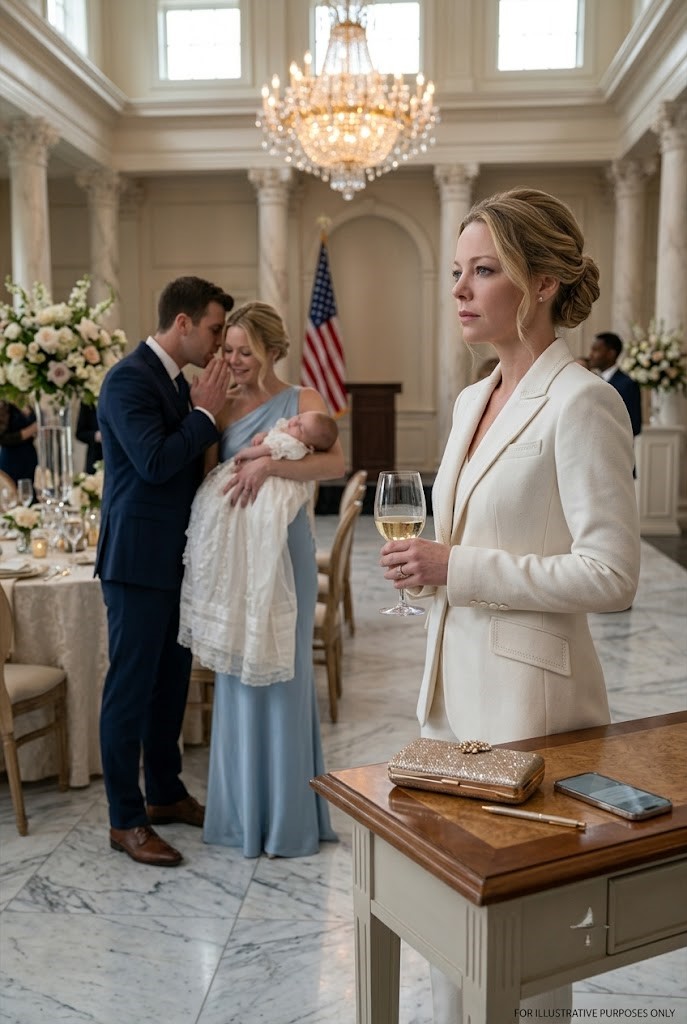
It went straight to a dead tone.
He texted.
No response.
He found my assistant, Lauren, near the bar and asked if she had seen me. Lauren was loyal enough to me not to smile.
“I believe Mrs. Whitmore left,” she said.
“Left where?”
“Just left.”
His irritation turned to unease when one of his college friends slapped him on the shoulder and laughed. “Man, I didn’t know Evelyn spoke German. She saved me from making a fool of myself with those Berlin investors earlier. Her accent is better than yours.”
Preston froze.
“What did you say?”
“Your wife. German. Fluent. Where have you been?”
The blood drained from Preston’s face so completely that even Sloane noticed from across the room.
He pushed through guests, ignoring Sloane calling his name. He ran from the ballroom so fast the priest stopped mid-conversation. Margaret’s face tightened with embarrassment, but she did not understand yet.
Preston understood.
He understood every word he had said near the balcony. Every promise. Every insult. Every plan.
By the time he reached our house in Oak Brook, the sky had gone dark. The mansion stood silent at the end of the curved driveway, all stone columns and cold windows. No lamps glowed in the kitchen. No fire burned in the living room. No music drifted from my study.
He used his key and shoved the door open.
“Evelyn?”
His voice echoed through the foyer.
Nothing.
He ran upstairs. My clothes still hung in the closet. My jewelry box sat untouched. My perfume bottles lined the vanity. My wedding dress, sealed in preservation glass, remained in the corner like a ghost from another woman’s life.
That was what frightened him most.
I had not packed.
I had not fled with suitcases, tears, and drama.
I had walked away as if nothing in that house was worth taking.
Then he entered his study.
On the oak desk lay three things: a divorce petition, a sealed envelope, and an old yellowed receipt pinned beneath a crystal paperweight.
His hands trembled as he lifted the receipt.
Advanced German Language Program. Student: Evelyn Hart. Date: Three years earlier.
I had left it there because some lessons deserved to be understood slowly.
The envelope contained a note in my handwriting.
Preston,
I heard everything.
You once told me language was power. You were right.
Evelyn
According to Lauren, who heard the story later from one of the housekeepers, Preston sat on the floor for nearly twenty minutes, clutching that receipt like it might change the past. But regret, for men like Preston, usually arrives dressed as fear. He was not grieving the wife he had broken. He was calculating what the wife he had underestimated could destroy.
His phone rang.
Margaret.
“Where is Evelyn?” she demanded the second he answered. “Guests were asking questions. Do you know how humiliating that was? She has always been too proud for her own good. I told you a woman from a middle-class Denver family would never understand our standards.”
“Mom,” Preston said, voice hoarse. “Something happened.”
“What happened is your wife embarrassed us at Beau’s christening. Sloane was graceful enough not to comment, but I saw the hurt in her eyes. That poor girl gave this family what Evelyn never could.”
Preston closed his eyes.
“She knows German.”
The line went quiet.
“What?”
“She heard us.”
Margaret inhaled sharply. “Then control her.”
“I don’t think you understand.”
“No, Preston, you don’t understand. A wife does not walk out and threaten a family like ours. Bring her here tomorrow. I will speak to her.”
“You can’t fix this with tea and insults.”
“Watch your tone.”
But before the argument could continue, the doorbell rang downstairs. Preston looked at the clock. Nearly midnight.
The housekeeper opened the door to a man in a charcoal suit carrying a leather briefcase. His name was Malcolm Price, one of the most feared divorce attorneys in Illinois. He specialized in complicated assets, reputational damage, and men who believed money made them untouchable.
He did not remove his coat.
“Mr. Whitmore,” he said. “I represent Evelyn Hart Whitmore.”
Preston gripped the banister. “She sent a lawyer to my house at midnight?”
“No,” Malcolm said. “She sent consequences.”
Margaret arrived twenty minutes later, wrapped in a cashmere coat, furious enough to forget her pearls. She entered like a queen arriving to punish servants.
“Where is my daughter-in-law?” she snapped.
Malcolm placed documents on the coffee table.
“Mrs. Whitmore has filed for dissolution of marriage. She has also requested temporary emergency measures to prevent asset dissipation.”
Margaret frowned. “Speak English.”
“The accounts are frozen.”
For the first time in her life, Margaret Whitmore looked small.
“What accounts?”
“All jointly controlled accounts connected to marital property, certain company reserves under dual authorization, several real estate holdings, and all transfers flagged as suspicious.”
Preston lunged for the papers. “You can’t do that.”
“The court can,” Malcolm said calmly. “And did.”
“My company has a payment due Monday morning. A European shipment. If that money doesn’t clear, the port hold will trigger penalties.”
“I imagine Mrs. Whitmore knows that.”
“She’s trying to ruin me.”
“No,” Malcolm said. “She’s refusing to keep saving you.”
Margaret grabbed the edge of the sofa. “That woman came into our family with nothing.”
“With respect,” Malcolm said, “your family company was ninety days from insolvency when she married your son. Her restructuring plan kept your name on the building.”
Preston’s jaw clenched.
Malcolm opened another folder. The top page was a spreadsheet.
“Mrs. Whitmore also asked that you review these transfers before deciding whether to contest the divorce. A Mercedes registered to Sloane Mercer. A condominium in River North. Jewelry purchases. Private medical bills. A trust account created for the benefit of Beau Mercer. Total suspected diversion over four years: $4.8 million.”
Margaret made a sound like she had been stabbed.
“Sloane said she was struggling,” Margaret whispered. “You told me you were helping with baby expenses.”
Preston said nothing.
Malcolm slid one final sealed page across the table.
“Mrs. Whitmore has not yet filed this with federal authorities. She called it a courtesy.”
Preston opened it.
His face changed.
Import contract irregularities. False vendor invoices. Tax exposure. Potential criminal liability.
Margaret leaned toward him. “What is it?”
Preston’s voice cracked.
“If she turns this in, I could go to prison.”
Malcolm stood.
“My client will accept a clean divorce, full return of diverted marital assets, and your resignation from any financial authority connected to her holdings. You have until noon tomorrow.”
He closed his briefcase.
“One more thing,” he said at the door. “Mrs. Whitmore wanted me to tell you that she was never cold. She was simply doing math while everyone else was lying.”
Part 3
The next morning, Whitmore Global’s headquarters looked less like a corporation and more like a courthouse after a verdict.
By seven-thirty, suppliers crowded the lobby. By eight, two minority shareholders had threatened lawsuits. By eight-fifteen, financial bloggers had started posting rumors about frozen accounts, a secret child, and a CFO wife walking out of a christening.
I arrived at eight-thirty.
Not through the private garage. Through the front doors.
I wanted everyone to see me.
I wore a white tailored pantsuit, not the soft navy dresses Margaret preferred because they made me look “less severe.” My hair was pulled back. My makeup was simple. My diamond wedding ring was gone.
The lobby fell quiet in waves.
“Mrs. Whitmore,” the receptionist whispered.
“Ms. Hart,” I corrected gently.
Then I walked to the elevator.
When the doors opened on the executive floor, Preston was standing outside the boardroom surrounded by men twice his age and twice as angry. His face was gray beneath his tan. His tie was crooked. He looked as if he had not slept.
The moment he saw me, hope flashed in his eyes.
That almost made me laugh.
He still thought I had come to rescue him.
“Evelyn,” he said, hurrying toward me. “Thank God. We need to talk privately.”
“No.”
His smile twitched. “This is a business crisis.”
“I know. That’s why I’m here.”
He lowered his voice. “Don’t do this in front of everyone.”
I looked at him the way I looked at a bad investment.
“You did it in front of God and a baby.”
The boardroom doors opened. Inside, directors, legal counsel, senior managers, and shareholders sat around the long glass table. They looked at me with the expression people wear when the person they ignored turns out to be the only one holding the building up.
I walked to the head of the table.
Preston followed. “That’s my seat.”
“It was,” I said.
Lauren entered behind me carrying bound reports. She placed one in front of every person.
The cover read:
Executive Ethics, Liquidity Exposure, and Governance Failure: Emergency Risk Report.
Preston snatched a copy. “What is this?”
“My farewell gift.”
The room went silent.
I stood with both hands resting on the back of the chair.
“For four years, I served as CFO of Whitmore Global Logistics. During that time, I reduced debt exposure by thirty-two percent, renegotiated five major supplier contracts, prevented two covenant breaches, and secured financing that allowed this company to survive its expansion.”
One of the older board members, Henry Calloway, nodded reluctantly.
“However,” I continued, “over the last eighteen months, executive misconduct has created substantial financial and reputational risk. Funds were diverted through false expense categories and shell consulting payments. These diversions contributed directly to the liquidity crisis you are facing this morning.”
Preston slammed his hand on the table. “This is personal revenge.”
“No,” I said. “Revenge uses emotion. This uses evidence.”
I turned to page seven on the screen.
A chart appeared. Transfers. Dates. Recipients. Amounts.
Sloane Mercer’s name showed again and again.
A low murmur moved through the room.
I pointed to the largest line item. “This one-point-six-million-dollar transfer was coded as a strategic warehouse deposit. The deed shows a luxury condominium purchased for Ms. Mercer.”
Henry Calloway removed his glasses. “Preston?”
Preston’s mouth opened, but no words came.
I clicked to the next slide.
“This trust account was created for Ms. Mercer’s infant son. The funds came from accounts partially secured by marital assets and company-backed credit facilities. I have reason to believe further attempted diversion was planned.”
A director whispered, “My God.”
I looked around the room. “Numbers don’t blush. They don’t lie to protect family names. They don’t care how old your last name is. They simply show what happened.”
Preston’s face reddened. “You vindictive—”
“Careful,” I said softly.
The room heard it.
So did he.
Because he knew what I still had.
I placed a single envelope on the table. “This contains information related to tax irregularities and vendor fraud. I have not submitted it to authorities yet. That decision will depend on whether this board chooses transparency or continued denial.”
Henry stood. “Ms. Hart, are you resigning?”
“Yes. Effective immediately.”
The room erupted.
Preston stepped toward me. “You can’t leave. You built these systems. You know the bank covenants. You know the German contracts. Without you, this company—”
“Will become exactly what it is without me,” I said. “Yours.”
That silenced him.
For years, he had wanted credit for my work. Now I was giving it all to him.
A younger shareholder at the far end of the table rose. His name was Reid Wallace, founder of a private investment firm and one of the few people in that room who had never underestimated me.
“I’d like the minutes to reflect something,” Reid said. “My firm remained invested in Whitmore Global because of Ms. Hart’s financial discipline, not because of Mr. Whitmore’s leadership. If she is leaving, we will reassess our position immediately.”
Preston stared at him. “You can’t be serious.”
Reid looked at him. “I have never been more serious.”
The boardroom exploded again, voices overlapping, accusations flying. Preston shouted for order, but nobody obeyed. Power left him in real time. It moved through the room like smoke and settled nowhere near him.
I picked up my briefcase.
At the door, Preston called my name.
“Evelyn, please.”
That word almost stopped me.
Not because I felt sorry for him, but because once, years ago, I had wanted so badly to hear him say please and mean it.
I turned.
He looked destroyed.
I said, “When I loved you, I protected you from the world. When you betrayed me, you introduced yourself to it.”
Then I walked out.
My phone buzzed as I entered the elevator.
News alerts.
Whitmore Global Board Calls Emergency Session Amid Financial Misconduct Rumors.
CFO Evelyn Hart Resigns After Alleged Asset Diversion Scandal.
Secret Heir Scandal Rocks Chicago Logistics Dynasty.
I watched the headlines roll in without smiling.
Freedom did not feel like joy yet.
It felt like breathing after years underwater.
Part 4
For three days, Preston tried to prove he could survive without me.
He locked himself inside his office, living on coffee, cigarettes, and rage. Staff whispered that he shouted at analysts, threw a laptop against a wall, and fired a junior accountant for asking whether a wire transfer had legal approval. He called banks that no longer trusted him. He called suppliers who no longer answered. He called board members who let him go to voicemail.
Then he remembered the Harrington Defense contract.
For a year, Whitmore Global had been bidding to supply logistics technology and specialized transport services for Harrington Defense Systems, a Washington, D.C.-based giant with federal connections and billions in contracts. Winning the bid would bring an advance large enough to quiet creditors, calm shareholders, and buy Preston time.
In his mind, it became salvation.
In mine, it was already over.
On Friday morning, Preston flew to Washington, D.C., in a suit that looked expensive enough to hide desperation from a distance. Harrington’s headquarters stood near the Potomac, all black glass, steel, and security badges. Their boardroom overlooked the city with the cold confidence of people who made decisions that moved nations.
Preston arrived early. He practiced his pitch in the elevator reflection. He smiled at competitors. He shook hands like a man who believed charm could disinfect rot.
At exactly ten o’clock, Graham Harrington entered.
Graham was sixty-five, silver-haired, and famous for ending meetings with one sentence. He did not waste time or forgive weakness disguised as ambition.
“Ladies and gentlemen,” he said, standing at the head of the table, “before presentations begin, I want to introduce our independent senior risk consultant for this selection.”
The door opened.
I walked in.
Preston’s smile died so completely that even his competitors noticed.
I wore a charcoal dress beneath a cream coat, professional and calm. My folder was thin. I did not need a thick one. When risk is obvious, it does not require decoration.
Graham held out a chair to his right.
“This is Evelyn Hart,” he said. “Last year, Ms. Hart warned my team about exposure in a European supplier chain. Her analysis saved this company millions. I trust her judgment.”
Preston forced a laugh. “What a surprise. My wife and I are going through a private matter, but I’m sure Ms. Hart can remain objective.”
I looked directly at him.
“There is no wife at this table, Mr. Whitmore.”
His mouth tightened.
“Fine,” he said. “Then let business speak.”
“It will.”
The presentations began. Two competitors went first. Then Preston stood. He clicked through slides full of glossy promises: speed, reliability, proprietary software, national reach. He sounded almost like the man I had once believed in.
Almost.
When he finished, Graham looked at me.
“Ms. Hart?”
I opened my folder and placed a single-page assessment on the table.
“Whitmore Global currently carries unacceptable leadership, liquidity, legal, and reputational risk. Its operating cash flow is impaired. Several assets are frozen by court order. The CEO is personally implicated in alleged diversion of funds, executive misconduct, and potential tax irregularities. Awarding this contract to Whitmore Global would expose Harrington Defense to delivery failure, headline risk, and possible federal review complications.”
Preston stood so fast his chair rolled backward.
“This is revenge.”
“No,” Graham said before I could answer. “This is due diligence.”
“Mr. Harrington, my company has performed well for decades.”
“Your father’s company did,” Graham said. “I’m discussing yours.”
Preston swallowed. “Personal matters shouldn’t affect a contract.”
Graham leaned forward. “A man who lies to his wife while moving money through false categories will lie to a partner when the pressure is high. Character is not separate from business. It is the foundation beneath it.”
Preston looked around the room, searching for rescue.
There was none.
Graham closed Preston’s proposal without reading further.
“Whitmore Global is removed from consideration.”
The sentence fell softly.
It destroyed him loudly.
Security escorted Preston out while his competitors pretended not to watch. I did not follow immediately. I remained in the room for another hour, advising Harrington’s team on the remaining bids. When the meeting ended, Graham shook my hand.
“You did the right thing,” he said.
“I did the necessary thing.”
“Sometimes those are the same.”
Outside, Washington sunlight flashed against the Potomac. My phone chimed with a deposit confirmation: consulting fee, plus performance bonus.
Clean money.
Mine.
Not salary filtered through Preston’s ego. Not an allowance hidden behind his family name. Not wealth I earned while someone else took credit.
Mine.
I sat in a quiet café near Dupont Circle and opened the file from the private investigator I had hired the night of the christening.
His name was Marcus Vale, a former federal investigator with a voice like gravel and a talent for finding dirt people had buried under marble.
He called as I stirred iced tea I had not tasted.
“Ms. Hart,” he said. “You were right to be suspicious.”
“About Sloane?”
“About all of it.”
I looked out the window. “Tell me.”
“Sloane Mercer is not who she says she is. No old Virginia family. No German boarding school. No real estate license. Her diploma is fake. Her accent is memorized. She worked as a hostess in Las Vegas under a different name before someone cleaned her up and introduced her to wealthy circles.”
My hand stilled.
“And the baby?”
“We got the DNA sample from the pacifier your assistant retrieved at the christening and compared it with material from Mr. Whitmore’s office, as authorized for your legal case.”
I already knew. Some part of me had known the moment I saw Preston’s impossible pride.
Marcus exhaled.
“No paternity match.”
I closed my eyes.
Preston had destroyed his marriage, his company, and his mother’s sanity for a child who was not even his.
“There’s more,” Marcus said. “Sloane has a boyfriend. Kevin Rusk. Personal trainer. Criminal record. He’s likely the biological father. Bank statements show money Mr. Whitmore gave Sloane was being moved to Kevin within hours.”
A laugh escaped me, sharp and humorless.
“What a brilliant businessman,” I said.
“Do you want the full packet sent to your attorney?”
“Yes,” I said. “And send copies to me.”
When I hung up, I sat very still.
I thought I would feel victory.
Instead, I felt the strange emptiness that follows a house fire when you realize the flames did not just burn your enemy.
They burned everything.
Part 5
Margaret Whitmore learned the truth in pieces, and each piece cut away a different part of her pride.
First came the society whispers.
Chicago women like Margaret did not need newspapers. They had charity boards, private lunches, golf club terraces, and group chats more dangerous than court subpoenas. Within forty-eight hours of the boardroom scandal, photographs of Sloane from her Las Vegas past began circulating.
In one, she posed under pink neon in a dress that barely deserved the name. In another, she sat on Kevin Rusk’s lap, her arms around his neck, laughing into his mouth. In a third, she stood beside Preston at a hospital, wearing the sweet new-mother smile that had fooled Margaret completely.
Margaret attended a charity tea at the Drake Hotel wearing emeralds and denial.
She expected sympathy.
She received silence.
Women who once competed for her attention now looked away. One of them, Patricia Wallace, Reid’s mother and Margaret’s lifelong rival, approached with a smile sharp enough to draw blood.
“Margaret,” Patricia said, “congratulations on the grandson. Or should I say condolences?”
Margaret stiffened. “I don’t know what you mean.”
Patricia held up her phone.
Sloane’s photograph glowed on the screen.
The women nearby pretended not to stare while staring openly.
Margaret’s face hardened. “That is fake.”
“Oh, darling,” Patricia said. “The only fake thing is Sloane Mercer.”
The laughter that followed was soft, polite, and lethal.
Margaret left without finishing her tea.
But she did not go to Preston. She came to me.
By then, I had leased a modest office in Chicago’s West Loop and registered Hart Risk Advisory. No family crest. No inherited mahogany. Just glass walls, clean desks, good coffee, and people who respected competence.
Margaret stormed in at three-fifteen, past the receptionist, past two analysts, past Lauren, who looked at me through the glass wall as if asking permission to call security.
I shook my head.
Some confrontations are overdue.
Margaret burst into my office with her hair slightly loose and lipstick bleeding at the edges.
“You,” she hissed. “You did this.”
I closed the file I was reviewing.
“Good afternoon, Margaret.”
“Don’t you dare use that tone with me. You spread those pictures. You froze the accounts. You ruined Preston’s contract. You destroyed this family because you were jealous.”
“Of Sloane?”
“Of her son,” Margaret snapped. “She gave Preston what you couldn’t. A boy. An heir. You couldn’t stand being replaced by a real woman.”
The office beyond my glass wall went still.
I rose slowly.
For four years, I had swallowed that wordless accusation. I had accepted Margaret’s fertility teas, her prayer circles, her cruel little comments about “women who focus too much on careers.” I had let her pity Preston and blame me because I thought protecting his dignity was part of love.
But love had left the room days ago.
Only truth remained.
“Say that again,” I said.
Margaret lifted her chin. “Barren women are always bitter.”
I opened my desk drawer and removed a medical folder.
Then I threw it onto the desk between us.
The sound cracked like a gunshot.
Margaret flinched.
“Read it.”
She stared at the folder. “What is this?”
“Your son’s fertility report.”
Her face changed before she even touched it.
“No.”
“Yes.”
She opened the folder with trembling hands. Her eyes moved across the doctor’s conclusion. She did not understand every term, but she understood enough.
Severe male factor infertility. Extremely low probability of natural conception.
Her mouth opened.
No sound came out.
I stepped closer.
“Preston asked me to keep it private. He cried. He said you would never respect him again if you knew. So I protected him. I let you call me barren. I let your friends pity me. I drank your disgusting teas. I sat through your church lectures. I let you blame me for something your son begged me to hide.”
Margaret swayed.
“Beau cannot be Preston’s biological son,” I said. “Not naturally. And the DNA results confirm he isn’t.”
Her eyes filled with horror, then denial, then something worse: shame.
“You’re lying,” she whispered.
“No. You built a temple to bloodline and bowed before another man’s child.”
She slapped me.
Or tried to.
I caught her wrist before her hand reached my face.
Every person in the office saw it.
Her diamonds shook. Her eyes were wild. Mine were not.
“Don’t,” I said quietly. “You are no longer in your son’s house, and I am no longer your daughter-in-law.”
I released her wrist.
She stumbled back.
“You ungrateful little—”
“Security,” I called.
Two guards entered.
Margaret looked around, realizing she had lost the room. For decades, she had controlled people with money, age, and family name. None of those things worked here.
“This is a business office,” I said. “Not a stage for your grief.”
As the guards escorted her out, she screamed that I had cursed her family, that I would regret humiliating her, that Preston would recover and I would come crawling back.
I watched through the glass as the elevator doors closed on her fury.
Then I returned to my desk and sat down.
My hands were shaking.
Lauren stepped in softly. “Are you okay?”
I looked at the folder still open on the desk.
“No,” I said honestly. “But I’m free.”
That evening, I sent three envelopes.
One to Malcolm Price.
One to Preston.
One to Margaret.
Inside each was the investigator’s full report: Sloane’s real identity, Kevin Rusk’s photographs, bank transfers, DNA conclusion.
I sealed them myself.
Some truths are not letters.
They are detonations.
Part 6
Preston came to my office the next morning looking like a man who had aged ten years overnight.
His beard shadowed his jaw. His eyes were bloodshot. His expensive coat hung open as if he had forgotten how buttons worked. The receptionist tried to stop him, but he walked past her and dropped to his knees in front of my desk.
That was when I knew he had not opened the right page yet.
“Evelyn,” he said, voice breaking. “Please. I know I hurt you. I know I made mistakes. But Beau is innocent.”
I leaned back in my chair.
“Beau.”
“He’s just a baby. Whatever you think of Sloane, don’t cut off support for my son. Don’t punish a child because you hate me.”
I studied him.
Even ruined, Preston still reached for performance. Noble father. Tragic man. Victim of a cold wife. He had worn masks so long he mistook them for skin.
“You didn’t read the whole file,” I said.
His face tightened. “I read enough.”
“No. You read until you found a place to feel sorry for yourself.”
I opened my drawer and pulled out a second copy.
“Page thirty-two.”
He stared at it.
“Read it.”
“I don’t need more poison from you.”
“Then keep kneeling for another man’s baby.”
His head snapped up.
The silence was absolute.
“What did you say?”
“Read.”
His hands shook as he opened the file. Pages slipped against each other. Photographs. Bank records. Background checks. Then the DNA report.
No paternity match.
His lips moved soundlessly.
He flipped back. Forward. Back again.
“No.”
I said nothing.
“This is fake.”
“No.”
“You paid someone.”
“No.”
“You hate me.”
“Yes,” I said. “But I didn’t need to invent anything. You did enough damage with the truth.”
He turned the page and found the photographs of Sloane and Kevin Rusk. One showed Kevin holding Beau in a kitchen, kissing the baby’s forehead. Another showed Sloane and Kevin outside a gym, laughing beside a motorcycle. The final image was a bank transfer screenshot with Sloane’s note attached.
For our little family.
Preston made a sound I had never heard from him before.
It was not anger. Not sadness.
It was collapse.
He pressed the papers to his chest, then tore them away as if they burned.
“She said he was mine.”
“I’m sure she did.”
“She cried when she told me.”
“She probably cried very well.”
“I was going to give him everything.”
“I know,” I said. “I heard you.”
That broke something in him.
He stood, knocking over the chair. “I’ll kill her.”
“No, Preston. You’ll call your lawyer.”
But he was already moving.
“Preston.”
He turned at the door.
“If you do something stupid, don’t expect me to save you again.”
For one second, the old habit flickered between us: crisis, warning, my voice pulling him back from a cliff.
Then rage swallowed him.
He left.
Later, the police report, witness statements, and news coverage filled in the rest.
Preston drove to Sloane’s River North condo, the one he had bought with money coded as business development. He found her packing designer bags. Kevin was not there. The baby was asleep in a carrier near the sofa.
According to neighbors, they heard him screaming before he broke a vase.
“You made me a fool.”
Sloane tried to play innocent at first. She cried. She reached for his arm. She called him “baby.” Then he threw the DNA report at her feet.
Something in her mask dropped.
Fine, she told him. Yes. Beau was Kevin’s. Yes, she had used him. Yes, she had laughed every time he spoke about legacy. Yes, she was planning to leave Chicago before the accounts were frozen.
“You wanted an heir so badly,” she said, according to the police report. “I gave you one to pay for.”
Preston grabbed her suitcase and threw it against the wall. She slapped him. He shoved her. She fell into a glass table, cutting her arm. The baby woke screaming.
Then Margaret arrived.
She had received my envelope and driven there in a state of panic, still clinging to the hope that paperwork could be wrong. She stepped into a room full of broken glass, blood, screaming, and truth.
Sloane saw her and laughed.
“There’s Grandma,” she said. “Come see the heir.”
Margaret walked toward the baby carrier like a sleepwalker.
“Is it true?” she whispered. “Is he not Preston’s?”
Sloane wiped blood from her mouth. “Your son couldn’t father a goldfish.”
Preston lunged again. Margaret screamed. A neighbor had already called 911.
By the time police entered, Preston was standing over a shattered coffee table, Sloane was crying dramatically with blood on her sleeve, and Margaret sat on the floor rocking Beau’s empty christening blanket in her arms.
“My grandson,” she whispered. “My beautiful grandson.”
The baby was still in the carrier, untouched but wailing.
Margaret did not seem to hear him.
She stared at the blanket, smiling.
“My heir,” she hummed. “Grandma’s here.”
The officers removed Preston in handcuffs. Sloane accused him of assault. He accused her of fraud. Margaret was taken out by paramedics after she began singing lullabies to the blanket and calling it Beau.
When Malcolm called to tell me, I was standing in my apartment kitchen, making tea.
“Are you sitting down?” he asked.
“No.”
“You should.”
I listened without interrupting.
When he finished, he said, “I’m sorry.”
I looked out at the city lights.
“For whom?”
He had no answer.
The case became public within hours.
Wealthy Chicago CEO Arrested After Secret Heir DNA Scandal.
Mistress Accused in High-End Paternity Fraud Scheme.
Whitmore Matriarch Hospitalized After Condo Incident.
There are humiliations money cannot bury fast enough. This was one of them.
Preston’s board suspended him the next day. Creditors moved in. Federal investigators requested documents. Malcolm submitted the tax file after Preston refused the settlement and accused me publicly of extortion.
Men like Preston always mistake mercy for weakness until it disappears.
Part 7
The divorce finalized faster than anyone expected because Preston ran out of leverage.
He lost his position first. Then his voting control. Then the lake house. Then the illusion that his last name could protect him from federal charges. The company survived only because the board removed him and sold a controlling stake to Reid Wallace’s firm. They offered me the CFO position again under new leadership.
I declined.
I did not escape one cage to polish another.
Instead, Hart Risk Advisory grew.
At first, clients came because of the scandal. They wanted the woman who froze a dynasty overnight. They wanted the betrayed wife who had turned spreadsheets into weapons. They wanted the headline.
Then they stayed because I was good.
I helped a San Diego medical device company uncover procurement fraud. I advised a Washington, D.C. contractor before a merger. I built a reputation not as Preston Whitmore’s ex-wife, but as Evelyn Hart, the woman who could look at a beautiful lie and find the ugly numbers underneath.
Sloane’s trial came six months later.
By then, the investigation had revealed more victims. She and Kevin were part of a small network that targeted wealthy, heir-obsessed men. They used fake backgrounds, staged pregnancies, emotional manipulation, and carefully timed financial requests. Preston was not their first mark.
He was simply the proudest.
Sloane pleaded guilty to fraud-related charges after Kevin turned on her for a reduced sentence. The last photograph the tabloids published showed her leaving court without makeup, her blond hair tied back, her face hard and empty. She looked nothing like the glowing mother from the christening.
Kevin took custody of Beau through his own family after proving biological paternity. Not because he was noble. Because Beau was useful in a different way now, a bargaining chip in a life built on bargains.
I thought the baby deserved better than all of us.
Margaret never fully recovered. She lived in a private psychiatric facility outside Lake Forest, where she wore pearls with sweaters and told nurses her grandson would be visiting after his nap. Some days she remembered Preston. Some days she did not. She never asked for me.
Preston wrote letters from prison after his conviction.
The first blamed me.
The second blamed Sloane.
The third blamed his mother.
By the fourth, he began blaming himself, but only because there was nobody left.
I did not answer any of them.
A year after the christening, I was invited to speak at a national women’s leadership conference in New York. The event was held in a ballroom overlooking the Hudson River, which felt like life making a joke so elegant I could not refuse it.
I stood beneath crystal chandeliers, facing hundreds of women in business suits, evening dresses, uniforms, and simple black blazers. Behind them, the river moved dark and steady.
Someone introduced me as a survivor.
I stepped to the microphone.
“I used to think sacrifice was proof of love,” I said. “I believed that if I carried enough silence, protected enough pride, and fixed enough damage, my marriage would become safe. But silence does not build safety. It builds hiding places for people who hurt you.”
The room went still.
“I was called cold because I could read numbers. I was called barren because I protected someone else’s shame. I was called cruel because I stopped letting my labor fund my own betrayal.”
I looked across the ballroom, not searching for anyone, not needing anyone.
“Here is what I learned: never let someone convince you that your strength is only valuable when it serves them. Never become the shadow behind another person’s name. Because when they step out of the light, they will expect you to disappear.”
Applause rose slowly, then thundered.
After the speech, Reid Wallace found me near the windows. He had become a client, then a friend, and nothing more because I was still learning the shape of my own life.
“You were brilliant,” he said.
“I was honest.”
“That too.”
He offered me a glass of sparkling water. “What’s next for Evelyn Hart?”
I smiled at the river.
“Iceland.”
He blinked. “Iceland?”
“I’ve wanted to see the northern lights since I was twenty-one. Preston said it was a silly trip. Too cold. Too inconvenient. Too pointless.”
“And now?”
“Now I like cold, inconvenient, pointless things.”
Reid laughed.
Two months later, I boarded a flight from JFK with one suitcase, one passport, and no wedding ring. Business class was quiet. Snow dusted the runway. I looked out the window as the plane lifted through gray clouds into sudden sunlight.
For years, I thought being alone meant being abandoned.
But above the clouds, alone felt like ownership.
In Iceland, I stood beneath a winter sky while green and violet auroras moved like silk across the dark. No one asked me to be smaller. No one called me useful. No one needed me to hide their shame.
I cried then.
Not for Preston. Not for the marriage. Not even for the woman I had been.
I cried because the world was still beautiful, and I had almost let a faithless man convince me that my life ended with his betrayal.
It had not ended.
It had begun.
When I returned to Chicago, I bought a small house with wide windows and no family portraits. I planted white roses in the yard, not because they reminded me of the christening, but because I wanted to prove that even flowers from a terrible day could grow somewhere clean.
Sometimes people asked if I regretted destroying Preston.
I always corrected them.
“I didn’t destroy him,” I said. “I stopped protecting him from himself.”
And that was the truth.
The last time I saw him, he was on a courtroom video screen during a restitution hearing, thinner, paler, stripped of custom suits and inherited arrogance. He looked at me like I was both the wound and the weapon.
“Evelyn,” he said, “did you ever love me?”
The room waited.
I answered honestly.
“Yes.”
His face crumpled.
“Then how could you do this?”
I leaned toward the microphone.
“Because I finally loved myself more.”
The judge called the room to order. The hearing continued. Numbers were discussed. Assets were divided. Restitution was assigned. Life moved forward with the indifferent precision of math.
Outside the courthouse, snow began to fall over Chicago.
I stood on the steps, lifted my face, and let the cold touch my skin.
For the first time in years, I did not feel like someone’s wife, someone’s disappointment, someone’s shield, someone’s shadow, or someone’s mistake.
I felt like Evelyn Hart.
Whole.
Unowned.
Alive.