PART 2
Olivia woke to white ceilings, sharp antiseptic, and the steady beep of a heart monitor.
For a moment, she did not know where she was. Then she tried to move.
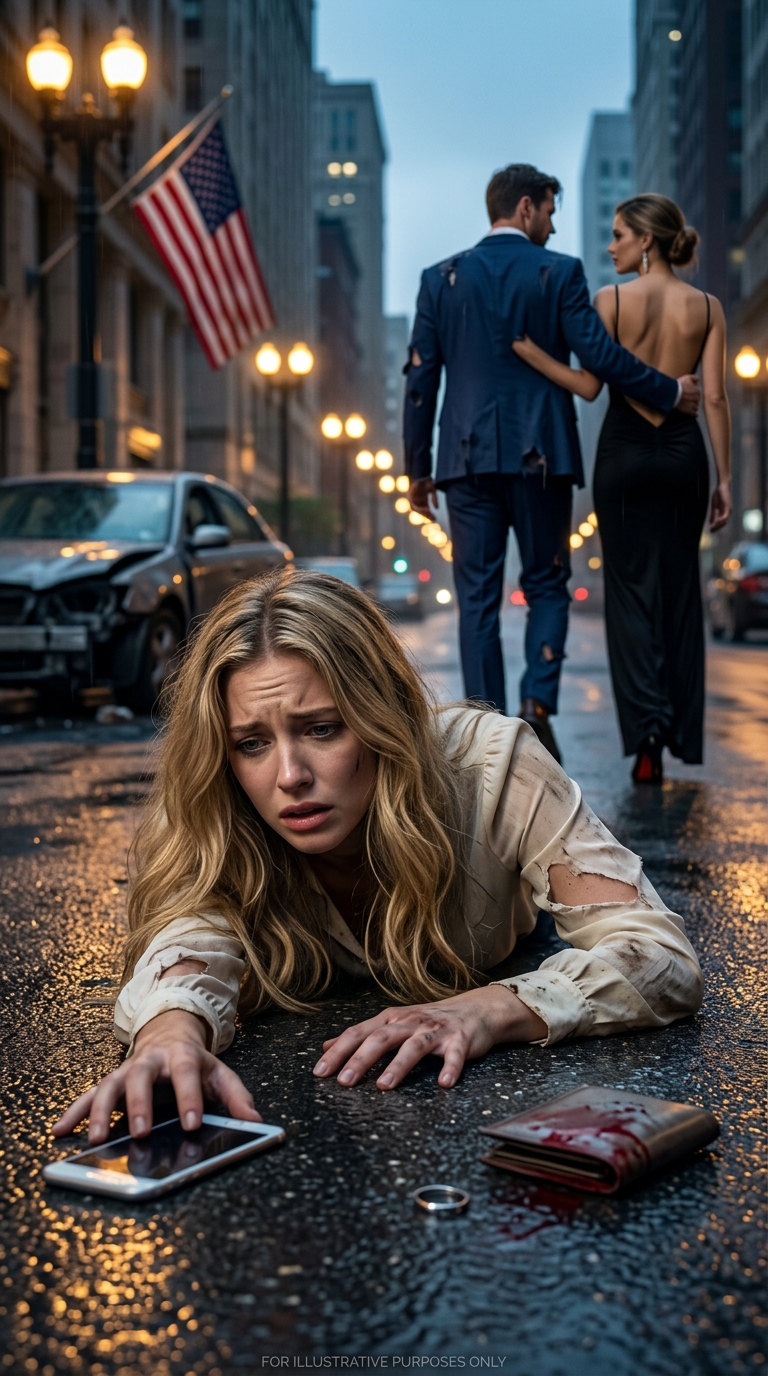
Pain exploded through her hips so violently that her vision flashed white. A strangled cry escaped her throat.
A nurse rushed to her side. “Mrs. Caldwell, don’t move. You’re at Mercy General.”
A doctor arrived minutes later, a gray-haired trauma surgeon named Dr. Halvorsen. His face was kind, but his tone carried the weight of bad news.
“You survived something most people would not,” he said. “But your injuries are severe. You have multiple pelvic fractures. You’ll need surgery, and rehabilitation will take months. Walking normally again is possible, but it will not be immediate.”
Months.
Olivia stared at the ceiling.
A different woman might have broken down. Olivia felt the tears somewhere inside her, but they did not rise. The place where grief should have lived had frozen solid the moment Grant walked away.
“Was my husband contacted?” the nurse asked gently.
Olivia turned her head toward the window. Morning light spilled across the room.
“I’m sure he’s busy.”
The nurse’s expression changed. She had seen enough human cruelty to understand what those words meant.
Grant did not arrive until late afternoon.
He entered while talking on his phone.
“Book the Italian place in Little Italy,” he said warmly. “No, don’t worry about her. I’ll handle it. Love you too, Madison.”
He ended the call only after stepping inside Olivia’s room.
His suit was fresh. His shoes were polished. The expensive watch Olivia had bought him five years earlier shone on his wrist.
He wrinkled his nose. “Hospitals always smell terrible.”
Olivia said nothing.
Grant stood near the foot of the bed, not close enough to touch her. “The doctor says you’ll live.”
“How comforting.”
“You won’t be able to walk for a while, apparently.” He looked at her immobilized body with open disgust. “This is exactly what I don’t need right now.”
Olivia turned her eyes toward him slowly.
He reached into his jacket and pulled out a folder.
Divorce papers.
He tossed them onto her blanket.
“Sign them.”
The papers slid against her hospital gown, stopping near her bandaged hand.
Grant’s voice grew almost cheerful. “This accident clarified things. I’ve been unhappy for years, Olivia. Madison understands me. She makes me feel alive. You make everything heavy.”
“She was in our car,” Olivia said. “On our anniversary.”
“You always focus on the wrong thing.” His jaw tightened. “The company is about to close the biggest deal of my career. I’m getting a twenty-five-million-dollar federal contract and a four-million-dollar credit line from First Atlantic Bank. I need a woman beside me who fits that future.”
A woman.
Not a partner. Not the wife who had spent eighteen years saving his company from collapse.
“A woman like Madison,” Olivia said.
His eyes hardened. “Exactly.”
She almost smiled.
The four-million-dollar credit line existed because First Atlantic trusted Olivia’s risk projections and because she had personally guaranteed the loan with her inherited property. The federal contract existed because Olivia had spent years building quiet credibility with Washington contacts, especially Henry Whitmore, chairman of Whitmore National Development, the prime contractor attached to the deal.
Grant knew none of that.
Or perhaps he knew and had convinced himself it did not matter.
“I’ll give you a settlement,” he said. “Enough to rent somewhere after rehab. Don’t make this ugly.”
“You left me in the street.”
He looked away, annoyed. “Madison was traumatized.”
Olivia studied the man before her. Once, Grant had held her hand during a fever and whispered, “I don’t know what I’d do without you.” Once, he had eaten cold pizza beside her on the office floor at midnight while they built their first proposal. Once, she believed success would make them happy.
Success had only revealed him.
“Are you sure?” she asked.
Grant frowned. “About what?”
“Divorcing me.”
He laughed. “It may be the smartest decision I’ve ever made.”
Olivia reached for the pen on the bedside tray. Her fingers trembled, partly from pain, partly from the cold satisfaction settling in her chest.
She signed.
Grant snatched the papers up so quickly he nearly tore them.
“Finally,” he said. “I’m free.”
When he left, the room became peaceful again.
Olivia picked up her phone.
Her hidden email account already contained the draft Daniel had prepared. The recipient list included every major client she had managed in the shadows, First Atlantic’s senior loan officer, Whitmore National Development’s executive board, key vendors, and the legal team that had quietly represented her personal interests for years.
The message was one sentence.
Effective immediately, I am withdrawing from all Caldwell Infrastructure projects and will no longer provide advisory, financial, or operational support.
No explanation.
No apology.
Olivia pressed send.
Somewhere in San Diego, Grant was probably lifting a glass with Madison, celebrating the removal of his inconvenient wife. He believed he had cut loose dead weight.
He did not yet know that he had cut the rope holding him above the cliff.
The next morning, Daniel called at exactly ten.
“Olivia,” he said, his voice tight. “The office is chaos.”
“Good morning to you too.”
“I’m serious. First Atlantic called three times. Whitmore’s people requested immediate clarification. Pacific Grid wants to know why you’re gone. Grant told reception to say you had a minor accident and would be back soon.”
“A minor accident.”
Daniel exhaled sharply. “I’m sorry.”
“Don’t be. What is Grant doing?”
“He’s locked in his office with Madison. He told us to handle the annoying calls.”
Olivia closed her eyes. “Of course he did.”
By noon, Grant called.
“What the hell did you do?” he shouted.
Olivia held the phone away from her ear. “You’ll need to be specific.”
“Clients are calling like the building is on fire. First Atlantic wants documents. Whitmore’s office is asking whether you’re still attached to the federal bid.”
“I’m not.”
“You don’t get to decide that.”
“I just did.”
Grant lowered his voice, trying to sound threatening. “Call them. Tell them you’re recovering and still involved.”
“No.”
“You’re still my wife.”
“You asked me to sign divorce papers yesterday.”
Silence.
Then he snapped, “Don’t be dramatic. This is business.”
Olivia looked down at the bandages covering her body. “Yes, Grant. It is.”
She ended the call.
That evening Daniel sent a message: Grant yelled at Pacific Grid’s director. Then he put Madison on the phone. She called him “sweetheart” by mistake.
Olivia laughed for the first time since the accident.
The first domino had fallen.
PART 3
The formal cancellation came the next morning.
Daniel called before Olivia’s breakfast tray arrived.
“Whitmore National Development sent notice,” he said. “They’re terminating negotiations. Official reason: loss of confidence in Caldwell’s executive continuity.”
Olivia looked toward the rain streaking her hospital window. “Henry moves fast.”
“He asked me to tell you he hopes you’re healing.”
That almost broke her.
Not because of Henry Whitmore, but because a client had shown more concern than her husband.
At one in the afternoon, Grant burst into the hospital room.
Madison followed behind him, hiding half her face as if the room itself offended her. She wore oversized sunglasses indoors and a beige coat that looked expensive enough to pay a nurse’s salary for a month.
Grant’s face was red.
“What did you tell Whitmore?”
Olivia set down her water cup. “Hello to you too.”
“The contract is gone.”
“I heard.”
His finger jabbed toward her. “You sabotaged me.”
“I withdrew my support.”
“That company was mine.”
“It still is.”
He looked momentarily confused.
Then Olivia added, “That’s the problem.”
Madison stepped forward, her mouth tightening. “Mrs. Caldwell, this is really sad. You’re angry because Grant moved on, but destroying his company won’t make you younger.”
Olivia looked at her calmly. “Madison, do you know what EBITDA means?”
Madison blinked.
Grant snapped, “Don’t talk down to her.”
“I asked a business question.”
“She’s learning.”
“Fast, I hope.”
Grant pulled the signed divorce papers from his briefcase and waved them. “I should have done this years ago. You’ve always resented my success.”
Olivia felt that land somewhere deep, but it no longer wounded her. There was almost relief in hearing his delusion spoken plainly.
“Your success,” she repeated.
“Yes. Mine.” He leaned closer. “You were a housewife who liked playing executive.”
Madison smiled.
Olivia reached for the pen beside her bed. “Then you won’t miss me.”
Grant’s mouth twisted. “Exactly.”
He left with Madison on his arm, victorious again.
But within twenty-four hours, victory turned expensive.
First Atlantic Bank called Caldwell Infrastructure’s office and requested immediate review of all outstanding loans. Since Olivia had formally withdrawn her personal guarantee, the pending four-million-dollar credit line evaporated. Worse, the bank froze Caldwell’s revolving account and demanded accelerated repayment of existing debt.
Grant called Olivia six times.
She did not answer.
By late afternoon, an unfamiliar attorney entered her hospital room with a hospital administrator trailing behind him.
The administrator looked uncomfortable. “Mrs. Caldwell, I’m very sorry. Your husband removed you from the private insurance policy this morning. The billing department needs to discuss transferring you out of this private suite unless alternate payment is arranged.”
Olivia nodded. “Thank you. My attorney will handle it.”
The man in the suit stepped forward.
“I represent Mr. Caldwell,” he said. “Name’s Preston Hale.”
He did not offer a card.
He dropped a thick packet of papers onto her bedside table.
“You have caused severe financial harm to Caldwell Infrastructure. My client is prepared to file suit for damages unless you sign this admission of liability.”
Olivia glanced at the first page. One million dollars.
Preston continued, “You will acknowledge intentional sabotage, waive spousal support, waive any ownership claim, and agree to cooperate in restoring client confidence.”
“Does Grant know you’re here?”
“He sent me.”
“Of course.”
Preston’s smile was thin. “You’re in no position to fight. Your accounts are joint. Your cards are closed. Your insurance is gone. Litigation will bury you before you learn to walk again.”
Olivia studied him.
He had expected fear. Tears. Panic.
Instead, she asked, “Did Grant show you the bank documents?”
Preston hesitated.
“I’ll take that as no.”
Olivia lifted her phone and opened a secure folder. She turned the screen toward him.
“This is the credit agreement from First Atlantic. Note the condition requiring my personal guarantee and my Santa Barbara land as collateral. Without me, the loan is void.”
Preston’s smile faded.
She swiped to the next file.
“These are internal expense records. Jewelry for Madison charged as client development. Hotel suites charged as strategic lodging. A leased apartment downtown listed as temporary project housing. A luxury car titled under the company but used exclusively by Madison.”
Preston’s face lost color.
“These,” Olivia said, “are emails showing I handled client negotiations while Grant represented my work as his own. And here are recordings of Grant instructing accounting to classify personal expenses as operational costs.”
The attorney’s jaw tightened. “You can’t prove—”
His phone rang.
He looked at the screen.
Grant.
Preston answered. “Grant, I’m with her now—”
Grant’s voice blasted through the line loud enough for Olivia to hear.
“The bank killed the credit line! They want repayment! Whitmore canceled! Pacific Grid wants three hundred eighty thousand by Friday! Get her to sign whatever you have to!”
Preston stood frozen.
Olivia leaned back against her pillow.
Grant’s voice cracked. “If she doesn’t fix this, the company collapses. Do you understand me? Collapses.”
The call ended.
Preston slowly lowered the phone.
Olivia gave him a tired smile. “Now, Mr. Hale, would you like to revise your assessment of my position?”
He gathered his documents without another word.
That night Daniel reported that employees had begun packing personal items. Vendors were demanding payment. Madison had been overheard asking whether the Hawaii trip Grant promised was still happening.
Olivia stared at the ceiling and felt the first real warmth of revenge.
The next day, Grant finally called from a place lower than anger.
“Olivia,” he said hoarsely. “Come back.”
“I’m in traction.”
“I mean professionally. Just call the bank. Call Henry. Tell them this was a misunderstanding.”
“It wasn’t.”
“Don’t be cold. We’re still married. I stopped the filing.”
Olivia almost laughed. “Because you discovered divorce was expensive?”
“Because I realized I made a mistake.”
“No, Grant. You realized I was useful.”
He breathed hard into the phone.
She closed her eyes and gave him his own words back.
“You can solve your company’s problems yourself. You have a phone.”
There was a sharp silence.
Then she added, “And one more thing. The lease on your office tower floor is in my name. Caldwell didn’t qualify without my guarantee. I terminated it this morning. You need to vacate by the end of next month.”
Grant made a sound like the air had been punched from his lungs.
“Olivia, please—”
She ended the call.
For eighteen years, she had softened every consequence before it reached him.
Now she let gravity do its work.
PART 4
Payroll failed on Friday.
At nine fifteen, Daniel called Olivia from the hallway outside the executive suite. The phone captured a storm of voices behind him.
“Everyone is outside Grant’s office,” he said. “No one got paid.”
Olivia tightened her grip on the phone. “What is he telling them?”
“That it’s a banking error.”
A shout erupted in the background.
Grant’s voice, high with panic, cut through the noise. “You’ll get your damn money tomorrow. If you don’t trust me, leave.”
A pause followed.
Then Daniel’s voice rang out, calm and clear.
“I resign.”
More voices followed.
“So do I.”
“Me too.”
“I’m not staying for fraud charges.”
Chairs scraped. Doors slammed. People walked out.
Daniel came back on the line. “The key staff are gone.”
“Thank you,” Olivia whispered.
“They weren’t hard to convince. Most of them knew you were the reason the company worked.”
By noon, Caldwell Infrastructure had no operating cash, no federal contract, no senior staff, no bank support, and a collapsing office lease.
Grant had Madison.
For a few hours, that was apparently enough.
Then Madison came to Olivia’s hospital room.
She arrived alone, no sunglasses this time. Her face looked smaller without triumph on it.
“Is it true?” she asked.
Olivia was reviewing physical therapy instructions. She looked up. “You’ll need to be specific.”
“Is the company really going bankrupt?”
“That appears likely.”
Madison swallowed. “Grant says he has a plan.”
“That’s unfortunate.”
“He says a private investor is coming in.”
Olivia studied her. “Madison, Grant’s private investors are usually lenders with interest rates that should be illegal.”
Madison’s eyes widened.
“He might ask you to sign something,” Olivia continued. “To prove your loyalty.”
Madison took a step back. “Me?”
“You said you were young and talented enough to support him.”
“I didn’t mean with debt.”
“No one ever does.”
Madison’s lips parted, but no answer came. Whatever fantasy she had built around Grant Caldwell was cracking fast.
By evening, Daniel identified the lender.
Victor Sloan.
A predatory private financier known for turning desperate executives into ruined men. Grant met him the next day in a dim café near the waterfront. Daniel watched from across the street and sent updates.
Grant offered Olivia’s Santa Barbara land as collateral using an old power of attorney she had signed years ago for estate planning.
Victor checked the records.
The power of attorney had been revoked.
Olivia’s attorney had filed protections over the property, placing it under managed legal custody until the divorce and financial disputes were resolved. Nothing could be pledged, sold, transferred, or mortgaged without court-reviewed approval.
At three o’clock, Grant came to the hospital.
For the first time, he looked ruined.
His custom suit was wrinkled. His eyes were bloodshot. His hair stuck up at odd angles. He carried a leather folder like a life raft.
“Olivia,” he said softly. “How are you feeling?”
She looked at him for a long moment.
It was the first time he had asked since the accident.
“What do you want?”
He flinched. “I deserve that.”
“Yes.”
He stepped closer. “I made mistakes. Terrible mistakes. But we built something together.”
“No. I built something while you took bows.”
His face tightened, but fear kept his anger in check. He opened the folder and pulled out papers. “I found an investor. It’s temporary. Bridge funding. Just paperwork.”
“Victor Sloan?”
Grant froze.
Olivia’s voice remained even. “You tried to use my land.”
His mask fell. “You don’t understand. I had no choice.”
“You always have a choice. You just prefer choices that cost other people.”
He gripped the folder until the edges bent. “If you sign, I can save the company.”
“If I sign, you can bury me under your debt.”
“Olivia, please.”
“You left me in the road.”
His eyes filled suddenly, dramatically. “I panicked.”
“No. You prioritized Madison.”
He dropped to his knees beside the bed. “I’ll leave her. I swear. I’ll take care of you. I’ll be the husband I should have been.”
Olivia watched him kneel, and felt nothing.
Not hatred. Not love.
Nothing.
That emptiness frightened her more than rage.
His phone rang.
Madison.
Grant answered instantly, desperation in his voice. “Madison, I need you. Come to the hospital. We can still—”
Olivia heard Madison’s voice through the speaker.
“I moved out of the apartment.”
Grant’s face slackened. “What?”
“The car and watch you gave me are being sold. I need money, Grant.”
“You can’t leave me now.”
“A broke CEO is just an older man in a bad suit.”
The call ended.
Grant stared at the phone as if it had betrayed him personally.
Olivia almost pitied him.
Almost.
The next morning, Henry Whitmore arrived in San Diego.
He came not to Grant’s office, but to Olivia’s hospital room first. A tall man in his sixties with silver hair and a Washington calm that made loud men nervous, Henry bowed his head when he entered.
“Olivia,” he said. “I’m sorry it took a catastrophe for you to stop carrying him.”
She smiled faintly. “So am I.”
Henry placed a folder on the table. “I visited Grant before coming here.”
Olivia had already received Daniel’s summary. Grant had been found sitting on the floor of his empty office, surrounded by demand letters. He begged Henry to reinstate the federal contract.
Henry refused.
Then he showed Grant the clause from their original agreement: all major projects were contingent on Olivia Caldwell’s executive advisory oversight. If Olivia withdrew, Whitmore National Development retained the right to terminate immediately.
Grant had never read the clause.
He had signed it.
He had signed hundreds of pages Olivia prepared and never understood.
Henry also delivered a penalty notice: two million dollars for misrepresentation, financial irregularities, and failure to disclose the loss of key oversight.
Grant collapsed.
Henry looked at Olivia now. “He’ll come here. I told him there is one path to mercy.”
Olivia’s eyes narrowed. “What path?”
“Confession.”
A quiet, dangerous smile touched her mouth.
Grant arrived the next morning.
He had practiced humility and wore it badly.
He entered with swollen eyes, fell to his knees, and pressed his palms together. “Olivia, forgive me. I was blind. I was stupid. I need you.”
She closed the book she had been reading.
“And?”
He blinked. “And I love you.”
“No, Grant. Try again.”
He swallowed. “I need you to speak to the bank.”
“There it is.”
His tears stopped.
Olivia pointed to the table. “I’ll help under one condition. Sign that.”
Grant snatched up the document.
His face changed as he read.
Immediate resignation as CEO. Transfer of all controlling shares to Olivia Caldwell. Personal liability for misappropriated funds. Full cooperation with civil and criminal investigations. No claim against her assets.
His hand shook.
“This is theft,” he whispered.
Olivia looked at him coldly. “No. This is accounting.”
PART 5
Grant threw the document onto the floor.
“You think you can steal my company from a hospital bed?”
Olivia did not flinch. “I think your company no longer exists.”
“I founded it.”
“You decorated it.”
His face went crimson. “You bitter, ungrateful—”
The door opened.
Henry Whitmore stepped in, followed by Daniel Pierce.
Grant stumbled backward as if struck. “Henry?”
Henry ignored him and approached Olivia’s bed. “How are you feeling?”
“Better,” she said.
Daniel nodded to her, his expression steady. “The transition paperwork is ready.”
Grant looked from one to the other. “Transition?”
Henry finally turned to him. “Yes. Olivia will be forming a new firm. Whitmore National Development will move its future projects there, provided her recovery allows advisory work at a sustainable pace.”
Grant’s mouth opened.
No sound came out.
Daniel added, “Most of the former staff have accepted offers.”
“My staff?” Grant choked.
“They were never yours,” Daniel said quietly. “They followed the person who actually knew how to run the business.”
Grant’s knees seemed to weaken.
Henry’s voice was mercilessly calm. “Caldwell Infrastructure is finished. What remains is debt.”
Grant grabbed the bed rail. “Olivia, tell them no. Tell them this is a misunderstanding. We’re married.”
Olivia looked at the hand clutching her bed.
“Were we married when you left me on the asphalt?”
His grip loosened.
“When you told me to call my own ambulance?”
His lips trembled.
“When you canceled my insurance while I couldn’t stand?”
Henry’s jaw tightened. Daniel looked away, furious.
Grant whispered, “I was scared.”
“You were cruel.”
The room fell silent.
Olivia reached for the transfer document and signed her name where indicated. Daniel signed as acting operations director. Henry signed the first strategic partnership commitment for Bennett Advisory Group.
Olivia did not keep the Caldwell name.
She returned to her maiden name.
Olivia Bennett.
The next week unfolded with the speed of a controlled demolition.
Her attorney filed the divorce agreement. Grant’s attempt to delay it failed because his own signed papers and subsequent misconduct were entered into record. Olivia’s medical bills were paid through her separate assets and emergency legal orders. Her private room remained hers.
Caldwell Infrastructure’s office was visited by bank representatives, vendor counsel, and eventually court officers. Computers were tagged. Furniture was inventoried. The framed magazine cover declaring Grant Caldwell “The Visionary Builder of the West Coast” was removed from the wall and stacked beside a printer.
Grant’s luxury company car was repossessed from the underground garage.
The downtown apartment he had leased for Madison was locked after rent defaults and legal review of company misuse.
His personal accounts were seized under multiple claims.
He tried calling Madison dozens of times. She blocked him.
He tried calling former employees. No one answered.
He tried calling Olivia.
She changed her number.
Three weeks after the accident, Olivia underwent the most difficult surgery of her life. Plates, pins, and careful reconstruction turned her shattered pelvis into something that could heal. The pain afterward was brutal, but different from betrayal. Physical pain had a purpose. It announced repair.
Rehabilitation began slowly.
The first time she sat upright without fainting, the nurse clapped.
The first time she stood with parallel bars, Olivia cried in silence.
Not because she was weak.
Because she was still there.
Daniel often worked from the chair beside her bed, turning the room into a miniature office. Former Caldwell employees rotated in with laptops, flowers, and updates. Henry sent policy documents from Washington. Clients sent contracts addressed to Bennett Advisory Group.
Olivia insisted on one rule.
“No one works like I used to,” she told them. “No silent sacrifice. No unpaid nights disguised as loyalty. No one gives their life to make another person look brilliant.”
Daniel smiled. “That may be the best company policy I’ve ever heard.”
By late summer, Bennett Advisory Group had signed three major contracts. Olivia reviewed strategy from her hospital bed, then from a wheelchair, then from a bright rehabilitation apartment overlooking San Diego Bay.
Grant, meanwhile, sank.
Unable to file clean bankruptcy because of fraud-related claims, he took temporary jobs under the table. A man who once demanded imported wine at client dinners now hauled equipment at construction sites outside Chula Vista. He slept in cheap motels when he had cash and in his car when he did not.
One evening in early fall, Bennett Advisory Group hosted its official launch reception at the Hotel del Coronado.
Olivia arrived with a cane.
She wore a tailored white suit, pearl earrings, and no wedding ring. Her hair was swept back. Her steps were slow but steady, each one earned.
The ballroom glowed with chandeliers and ocean light. Former clients shook her hand. Employees applauded when Henry introduced her.
“Some leaders build empires on noise,” Henry said. “Olivia Bennett built trust. Trust lasts longer.”
The applause almost overwhelmed her.
She lifted her glass. “To rebuilding the right way.”
Outside, beyond the glass doors, a man in muddy work clothes stood near the entrance trying to escape the wind.
Grant.
His face was thinner, beard uneven, eyes hollow. He stared through the glass at Olivia standing in warm light, surrounded by the people who now openly respected her.
For a moment, their eyes met.
His lips moved.
Olivia.
The doorman blocked him gently but firmly. “Sir, this is a private event.”
“I’m her husband,” Grant said desperately. “I built that company with her.”
The doorman looked at his clothes, then at the elegant room behind him. “Sir, please step away.”
Grant pressed one hand to the glass.
Olivia looked at him without anger.
That surprised her.
The rage had burned away. Even the satisfaction had cooled. He seemed less like a villain now and more like a warning: a man who mistook another person’s devotion for something he owned.
She gave him the smallest nod.
Not forgiveness.
Recognition.
Then she turned back to the people who had stayed.
Grant slid down against the outer wall as the wind off the Pacific cut through his jacket.
Inside, Olivia laughed for the first time without pain in her chest.
PART 6
Winter arrived slowly in Southern California, not with snow but with sharper mornings and pale gold light. Olivia’s cane leaned unused in the corner more often. Her physical therapist, a cheerful woman named Rachel, called her stubborn enough to scare bone into healing.
By December, Olivia could walk across her office without assistance.
The new headquarters of Bennett Advisory Group occupied two floors of a renovated building near the San Diego waterfront. The walls were glass, the conference rooms filled with plants, and no one had a reserved throne-like office at the top. Olivia’s office door stayed open unless she was on a legal call or resting.
The company grew faster than expected.
Whitmore National Development expanded the partnership. Pacific Grid returned. First Atlantic Bank, after reviewing Olivia’s independent governance structure, offered a new credit facility under terms she accepted only after making Daniel read every clause aloud with her.
“We read everything here,” she said.
Daniel grinned. “Especially the clauses arrogant men ignore.”
Olivia built a leadership team that did not require worship. Former employees who had once whispered around Grant now spoke freely. Madison’s name disappeared from the industry after she tried attaching herself to another executive in Los Angeles and was exposed selling company gifts online.
As for Grant, reports reached Olivia without her asking.
He worked short-term labor jobs. Debt collectors followed him. He lived under aliases sometimes, not to escape the law successfully, but to delay humiliation. He wrote long emails to Olivia’s old accounts, apologizing, begging, blaming, confessing, then blaming again. Her attorney archived them.
One letter was different.
It arrived handwritten.
Olivia almost did not open it.
Daniel saw the envelope on her desk. “Want me to throw it away?”
She considered that.
“No,” she said. “I’ll read it once.”
Grant’s handwriting, once bold and careless, had become uneven.
Olivia,
I used to think the worst night of my life was the night I lost the company. It wasn’t. It was the night I left you on that road. I replay it every day. I see you looking at me. I hear myself telling you to call your own ambulance. I don’t know what kind of man says that to his wife.
You were right. I didn’t love Madison. I loved how she made me feel. Important. Young. Admired. I hated that you knew the truth about me. You saw the weak parts. She only saw the performance.
I’m not asking you to save me. I know I don’t deserve it. I just wanted to say I know now. You were never the weight. You were the ground.
Grant.
Olivia read it twice.
Then she folded it carefully and placed it in a drawer.
Not because she wanted him back.
Because there was freedom in receiving an apology and not needing it.
In spring, Bennett Advisory Group won an award in Washington, D.C., for ethical infrastructure consulting. Olivia flew there with Daniel and Rachel, who had become both therapist and friend. At the gala, beneath flags and bright chandeliers, Olivia accepted the award with steady hands.
She did not mention Grant.
She did not tell the audience about the accident, the mistress, the hospital room, the papers thrown at her face. She spoke instead about invisible labor.
“Many successful systems are held together by people no one applauds,” she said. “Sometimes by wives. Sometimes by assistants. Sometimes by junior employees afraid to speak. A strong company is one where the person doing the work is seen, credited, and protected.”
The room stood for her.
Later that night, on a balcony overlooking the lights of Washington, Daniel raised a glass of sparkling water.
“To being seen.”
Olivia touched her glass to his. “To never disappearing again.”
Her life did not become perfect. Healing rarely works that way. Some mornings her hips ached when rain came in from the ocean. Some nights she woke from dreams of headlights and broken glass. Sometimes betrayal returned without warning—a scent of perfume in an elevator, a man laughing too loudly into a phone, the sound of tires skidding on wet pavement.
But pain no longer owned the room.
She went to therapy. She learned to rest. She learned that strength was not the same as endurance. Endurance had kept her inside a marriage that used her. Strength helped her leave the ruins without crawling back to rebuild them for someone else.
By the first anniversary of the crash, Olivia drove again.
Rachel insisted on going with her for the first highway trip. Daniel sent three encouraging texts and one dramatic warning not to exceed the speed limit because the entire company would “collapse from emotional distress.”
Olivia laughed.
She drove north along the coast, windows down, ocean air filling the car. At a scenic turnout, she parked and stepped out slowly. The Pacific stretched endlessly before her, blue and indifferent and beautiful.
She reached into her purse.
Inside was the old wedding ring.
Daniel had forgotten to throw it away months earlier. Or maybe he had known she would want to decide for herself.
Olivia held it in her palm.
Once, it had symbolized promise. Then prison. Then proof.
Now it was only metal.
She walked to a donation box outside a small coastal chapel and dropped it inside.
No ceremony.
No tears.
Just release.
That evening, she returned home to her quiet La Jolla house—the one now solely hers. She made tea, opened her laptop, and reviewed a proposal for a new bridge project in Northern California. The work was good. The numbers were clean. The team notes included challenges, disagreements, and credit where it belonged.
She smiled.
This, she thought, was what building looked like when no one had to bleed invisibly.
PART 7
Two years later, Olivia Bennett stood on a stage in Chicago.
The conference hall overlooked the Chicago River, where sunlight flashed across the water and steel towers rose like declarations. She had been invited to deliver the keynote at the National Women in Infrastructure Summit. Hundreds of executives, engineers, founders, policymakers, and students filled the room.
Behind her, the screen displayed one sentence:
THE COST OF INVISIBLE LEADERSHIP
Olivia paused before speaking.
She had told parts of her story before, carefully, professionally. Today she chose honesty.
“I used to believe loyalty meant absorbing damage quietly,” she began. “I believed if I loved someone enough, supported him enough, saved him enough times, he would eventually see me.”
The room went still.
“He did see me. He saw exactly how useful I was. That was not love.”
She did not name Grant. She did not need to.
She spoke about companies where credit flowed upward and blame downward. About spouses whose labor disappeared under family language. About the danger of making one person the secret pillar beneath an entire institution. About how any structure that depends on someone’s silence is already unsafe.
Then she told them about the night of the accident.
Not the worst details. Not Madison’s smile. Not the taste of blood. But enough.
“I lost the ability to walk for a while,” she said. “But long before my pelvis broke, my life had already trained me not to stand up for myself. Recovery taught me both skills at once.”
A young woman in the front row wiped her eyes.
Olivia continued.
“The person who abandons you at your lowest point may think they are leaving you powerless. Sometimes they are simply removing the last illusion that kept you loyal.”
When she finished, the room rose.
Afterward, a line formed. Women shook her hand. Men too. Some thanked her for business insight. Others lowered their voices and said, “I think I needed to hear that.”
Late in the afternoon, as Olivia left the conference center, she saw a man across the street near the riverwalk.
For a second, she did not recognize him.
Grant had aged more than two years should age a person. His shoulders curved inward. His hair, once styled with expensive precision, was longer and streaked with gray. His coat was clean but worn. He held a paper coffee cup in both hands as if warming himself.
Daniel, standing beside Olivia, noticed him too. “Want me to call security?”
“No.”
Grant did not cross the street. Perhaps he knew he no longer had the right. He only looked at her.
Olivia could have walked away.
Instead, she handed Daniel her briefcase and crossed at the light.
Grant straightened when she approached. Fear and hope battled across his face.
“Olivia,” he said.
“Grant.”
He looked behind her at the conference banners. “I heard you speak.”
“I assumed.”
“You were good.”
“I know.”
A faint, painful smile moved across his mouth. “You always were.”
They stood in the cold Chicago wind.
“I’m not here to ask for money,” he said quickly. “Or help. I swear.”
“Then why are you here?”
He looked down at the river. “I wanted to see if you were real.”
Olivia said nothing.
“For a long time, I told myself you ruined me,” he continued. “Then I told myself Madison ruined me. Then the bank. Then Henry. Then Daniel. Anyone but me.” His fingers tightened around the coffee cup. “But I ruined me. I did it one choice at a time. And the worst choice was leaving you there.”
The traffic hummed behind them.
“I don’t forgive you,” Olivia said.
He nodded slowly, eyes wet. “I know.”
“But I also don’t carry you anymore.”
That hurt him. She saw it. But it was the kindest truth she had left.
Grant swallowed. “Are you happy?”
Olivia looked back at the glass doors, where Daniel waited with her coat and Rachel waved from the lobby. She thought of her company, her home, her healed body, her mornings by the ocean, her work that no longer required disappearing.
“Yes,” she said. “I am.”
Grant closed his eyes.
“Good,” he whispered. “At least one of us became what we were supposed to be.”
For the first time, Olivia felt something close to peace between them—not reconciliation, not tenderness, but the quiet finality of a door that no longer needed to be slammed.
“Take care of yourself, Grant.”
He gave a broken laugh. “I’m trying to learn how.”
She turned and walked back across the street.
Her stride was steady.
Years earlier, on a cold road in San Diego, Grant had looked down at her broken body and decided she was disposable. He had walked away with another woman, believing Olivia would remain what she had always been: useful, forgiving, available.
He had not understood that some betrayals do not destroy a woman.
They introduce her to herself.
That night, Olivia flew back to California. From the airplane window, city lights shrank beneath the clouds. She opened her laptop, reviewed the next week’s agenda, then closed it and let herself rest.
Below her, somewhere in the vast dark country, men like Grant were still mistaking devotion for weakness. Women like her were still swallowing their names to make someone else’s sound louder.
But not all of them would stay silent forever.
Olivia Bennett had built a company, rebuilt a body, and reclaimed a life. She had learned that revenge could open the door, but freedom was walking through it without looking back.
Outside the window, dawn began to touch the horizon.
A thin line of gold spread over the clouds.
Olivia smiled.
Her new life was no longer beginning.
It was already hers.