PART 2
The drive back to their condo in downtown San Diego felt longer than the entire marriage.
Ethan gripped the steering wheel so tightly his knuckles turned white. Ava watched the city lights slide across the windshield, silent and cold. Neither of them mentioned the salad. Neither mentioned Madison’s pale face or Eleanor’s stare.
Finally, Ethan said, “Maybe it was an allergic reaction.”
Ava turned slowly toward him. “You don’t believe that.”
“I don’t know what I believe.”
“That’s the problem.”
He flinched as if she had slapped him.
Ava looked away. She loved him. That was the cruelest part. She loved the boyish softness still hidden under his expensive suit, the man who remembered her coffee order, who cried during old movies, who wanted desperately to believe his family was complicated instead of dangerous.
But love did not excuse cowardice.
Not anymore.
At home, Ethan took a shower he did not need. Ava sat alone in the living room with every lamp off. The Pacific shimmered beyond the balcony, black and restless. Her phone lay on the table until it buzzed at 1:12 a.m.
Unknown Number:
Can we talk? I’m scared.
Ava stared at the message.
She knew who it was.
Madison.
They met the next afternoon in a small café near Balboa Park, far from Blackwell territory. Madison arrived in sunglasses, no makeup, and a gray hoodie that made her look younger than Ava had ever seen her.
She sat without ordering.
“I thought I was going to die,” Madison said.
Ava did not soften the truth. “You ate my plate.”
Madison swallowed. “You switched them.”
“Yes.”
“Because you knew?”
“Because I smelled something wrong.”
Madison removed her sunglasses. Her eyes were red, angry, frightened. “My mother wouldn’t—”
Ava leaned forward. “She watched you get sick and did nothing.”
That silenced her.
Madison’s mouth trembled, not with sadness but with the violence of a worldview cracking open.
“She didn’t come to my room last night,” Madison whispered. “She didn’t call. She texted Clara to bring me ginger tea.”
Ava nodded. “Because you weren’t the victim she planned.”
Madison looked out the window. “Why would she hate you that much?”
Ava almost smiled. “Because I’m the one person in that house she never owned.”
The words hung between them.
Madison had spent years helping Eleanor humiliate Ava. She had laughed at the little punishments. The wrong seat at dinner. The excluded vacation. The birthday gift two sizes too small. She had believed cruelty was elegance because Eleanor had taught her so.
Now the lesson had turned on her.
“What do you want from me?” Madison asked.
“Nothing.”
“That’s a lie.”
Ava sat back. “I want you to open your eyes.”
Madison covered her face with one hand. “I don’t know how.”
“You start by remembering.”
And she did.
Over the next hour, Madison spoke in fragments. Eleanor correcting her posture at age seven. Eleanor throwing away a painting because “Blackwell girls do not make childish messes.” Eleanor praising her only in front of guests. Eleanor keeping files on Madison’s friends, boyfriends, bank accounts, doctors.
“She said it was protection,” Madison murmured.
Ava’s voice was gentle but firm. “Control always calls itself protection.”
That evening, Ava went back to the mansion alone.
Clara, the housekeeper, opened the side door. She was a narrow woman in her fifties with tired eyes and hands that always looked ready to hide something.
“Mrs. Blackwell is in the greenhouse,” Clara said.
Ava paused. “Did you prepare the salad last night?”
Clara looked down.
“I plated it,” she said.
“Did you mix the dressing?”
“No.”
“Who did?”
Clara’s silence answered.
Ava nodded and walked past her.
The greenhouse sat behind the west wing, a glass cathedral filled with orchids, rare palms, and humid air. Eleanor stood among white flowers, trimming dead leaves with silver shears.
“You came without Ethan,” Eleanor said.
“I didn’t come as Ethan’s wife.”
Eleanor did not turn. “Then what are you tonight?”
“A witness.”
That made Eleanor smile.
“To what?”
“To your mistake.”
The shears stopped.
Ava stepped closer. “You tried to scare me out of this family. You failed. Now Madison knows. Soon Ethan will know. Then Richard.”
Eleanor turned, calm as winter. “My son will believe his mother.”
“Maybe. For a while.”
“You underestimate blood.”
“No,” Ava said. “I underestimate fear. I thought it lasted forever. It doesn’t.”
Eleanor approached, her face serene, her eyes bright with something poisonous. “You think courage makes you powerful. It only makes you visible.”
“And you think control makes you safe. It only makes you alone.”
For the first time, Eleanor’s mask cracked.
Ava saw it: a flash of rage, naked and old.
“You were nothing when you entered this family,” Eleanor whispered.
Ava lifted her chin. “And yet you’re terrified of me.”
Eleanor’s hand tightened around the shears.
Ava did not move.
For one awful second, the greenhouse seemed to hold its breath.
Then Eleanor smiled again and placed the shears on the table.
“Go home, Ava. Comfort my son. Play the wounded wife. But remember this. I built this family from secrets. You cannot destroy what you do not understand.”
Ava turned to leave.
At the door, she looked back.
“Then I’ll learn.”
Clara was waiting in the hallway. She did not speak until Ava passed her.
“There are files,” Clara whispered.
Ava stopped.
Clara kept her eyes down. “In the private office. Behind the portrait.”
Then she walked away as if she had said nothing at all.
Ava left the mansion with her heart pounding.
For the first time, Eleanor’s empire had a door.
And Ava had just been shown where to find the key.
PART 3
Madison agreed faster than Ava expected.
Maybe betrayal became clearer when it came with nausea, trembling hands, and the memory of your mother watching you suffer with dry eyes.
They met at midnight in a hotel parking garage near Mission Valley. Madison wore black jeans, a black sweater, and no jewelry. Without the diamonds and silk, she looked almost ordinary. Almost human.
“My father knows something,” Ava said.
Madison gave a bitter laugh. “My father knows everything and says nothing.”
“Then we start with him.”
Richard Blackwell lived inside the same mansion as Eleanor, but emotionally he had been absent for decades. Ava found him the next morning in his study, sitting in a leather chair beneath a painting of a sailboat, a whiskey untouched beside him.
He looked up when she entered.
“She knows you’re here?” he asked.
“No.”
“Then you should leave.”
“I need the code to Eleanor’s safe.”
Richard went very still.
Ava crossed the room. “She keeps files on all of you. Madison. Ethan. Me. You. I need to know what she has.”
His laugh was hollow. “You think knowledge will free you?”
“No. But ignorance will kill me.”
Richard looked older than his sixty-eight years. He rubbed a hand over his face, and for a moment Ava saw not a rich patriarch but a frightened man who had surrendered one inch at a time until nothing remained.
“She has documents,” he said. “Business transfers. Campaign donations. Things I signed when I thought power meant invincibility.”
“And she used them against you.”
“She used everything.”
“Where is the safe?”
He closed his eyes.
“Behind the portrait of her mother in the private office. The code is 1934.”
Ava frowned. “Her mother’s birth year?”
Richard nodded. “Eleanor worshiped that woman and feared her more.”
“Why tell me now?”
His eyes opened. They were wet.
“Because Madison came home shaking, and Eleanor asked whether she had learned her lesson.”
Ava said nothing.
There were some truths too ugly to answer.
At 2:00 a.m., Ava and Madison entered the mansion through the service door Clara left unlocked.
No alarms sounded. No dogs barked. The house slept with the arrogance of the powerful. They moved through the back hallway, past framed photographs of weddings, galas, graduations, and charity balls. A museum of perfect lies.
The private office door was locked.
Madison produced a small brass key. “Mom thinks I don’t know where she hides things.”
Inside, Eleanor’s office smelled of leather, lilies, and old paper. The portrait of her mother hung above the fireplace: a severe woman with pale eyes and a mouth that looked incapable of forgiveness.
Ava removed the portrait.
There was the safe.
Madison whispered, “Do it.”
Ava entered 1934.
The lock clicked.
Inside were folders, flash drives, sealed envelopes, and a black notebook with Eleanor’s initials stamped in gold.
Madison grabbed the first folder and froze.
Her own name was written across the tab.
Inside were bank records, private emails, medical notes, phone logs, even a signed emergency authorization granting Eleanor access to Madison’s personal accounts. Madison stared at the signature.
“I don’t remember signing this.”
“You probably signed a stack of papers she gave you and trusted her.”
Madison’s face hardened. “I hate that you’re right.”
Ava opened another folder.
Her name.
Inside was a legal strategy prepared by Blackwell attorneys. If Ethan ever separated from Ava, Eleanor planned to push a narrative that Ava was emotionally unstable, financially manipulative, and dangerous to the family’s reputation. There were statements drafted from “concerned relatives.” There were therapy records Ava had never shared with Eleanor. There was even a list of journalists who could be fed the story.
Ava’s stomach turned.
“She wasn’t preparing for conflict,” Madison whispered.
“No,” Ava said. “She was preparing to erase me.”
They copied everything they could.
Then Madison found Richard’s file: offshore accounts, suspicious donations, emails involving public contracts in San Diego. Whether criminal or merely scandalous, it was enough to ruin him. Enough to keep him quiet forever.
Ava slipped a flash drive into her pocket.
That was when the office door opened.
Eleanor stood there in a cream silk robe, holding a glass of red wine.
Not shocked.
Not sleepy.
Waiting.
“How disappointing,” she said.
Madison lowered the folder in her hands. “You knew.”
“I suspected. There’s a difference.”
Ava stepped forward. “You let us open the safe.”
Eleanor smiled. “I wanted to see which of my children had finally learned theft from the woman my son married.”
Madison’s face twisted. “Don’t you dare blame her.”
Eleanor’s gaze moved slowly to her daughter. “Listen to yourself. So brave. So dramatic. So easily influenced.”
“No,” Madison said. “For the first time, I’m hearing my own voice.”
Something flickered in Eleanor’s eyes. Pain, maybe. Or insult.
“You are my daughter,” Eleanor said. “Everything you are, I made.”
Madison’s voice shook. “That’s what scares me.”
The room went silent.
Ava held the flash drive tightly inside her pocket.
Eleanor noticed.
“You think those files give you power,” Eleanor said. “They give you danger. There is a difference.”
“They give us the truth.”
“The truth destroys families.”
“No,” Ava said. “Secrets do.”
Eleanor walked toward Madison and lifted a hand as if to touch her cheek.
Madison stepped back.
The movement cut deeper than any insult.
Eleanor’s hand remained in the air for a moment, then slowly lowered.
“You have five minutes to leave my house,” Eleanor said. “After that, I call the police and tell them exactly what I want them to believe.”
Ava looked at the folders, then at Eleanor.
“You already did that your whole life.”
They left without running.
In the driveway, Madison bent forward, hands on her knees, breathing hard. The mansion loomed behind them, lit and silent.
“She’ll destroy us,” Madison whispered.
Ava looked up at the windows.
“No,” she said. “Now she has to destroy herself to reach us.”
For the first time in her life, Madison Blackwell smiled without permission.
PART 4
Eleanor’s counterattack began at breakfast.
She called Ethan and asked him to come alone.
Ava knew because Madison warned her first.
“She’s going to make you the villain,” Madison said over the phone. “She’ll say you manipulated me. She’ll say you’re after money. She’ll say you’re unstable.”
Ava closed her eyes.
“She already has the paperwork for that.”
Ethan returned three hours later with his tie loosened and his face pale. He stood in the doorway of their condo like a man who had forgotten which life belonged to him.
Ava waited.
He said, “Did you break into her office?”
“Yes.”
“With Madison?”
“Yes.”
He swallowed. “My mother says you’re trying to destroy the family.”
Ava laughed once, but there was no humor in it. “Your mother tried to poison me with a salad, Ethan.”
He flinched.
“Don’t say it like that.”
“How should I say it? Elegantly?”
His jaw tightened. “I’m trying to understand.”
“No,” Ava said. “You’re trying to make the truth softer so you don’t have to choose.”
That hit him.
He turned away, rubbing his hands over his face. “She’s my mother.”
“And I’m your wife.”
“I know.”
“Do you?”
The silence that followed nearly broke her.
Ethan sat on the couch. “I saw the files.”
Ava froze.
“She showed me some,” he continued. “Not everything. Enough to make it look like she was protecting us from scandal. Enough to make me wonder if maybe she’s been wrong but not evil.”
Ava’s voice dropped. “Did she show you the file on me?”
He looked down.
That was answer enough.
“She said she was worried about your anxiety. About your background. About whether you could handle pressure.”
“My background?” Ava repeated.
She had grown up in Sacramento with a single mother who worked nights at a hospital. She had paid her own way through college. To Eleanor, survival was a flaw if it didn’t come with a trust fund.
Ava stood. “I won’t beg you to believe me.”
Ethan looked up, anguish written across his face.
“I love you,” he said.
“Then wake up.”
That night, the first article appeared.
BLACKWELL FAMILY DOCUMENTS REVEAL PRIVATE SYSTEM OF CONTROL, THREATS, AND FINANCIAL SECRECY.
Ava had not sent everything. Only enough. The legal strategy against her. The unauthorized access over Madison. A few financial records connected to Richard. The kind of documents that made journalists hungry and lawyers nervous.
By morning, phones were ringing across Southern California.
By noon, donors were distancing themselves.
By evening, the Blackwell name no longer sounded like legacy.
It sounded like scandal.
Eleanor summoned the family to the mansion the next day.
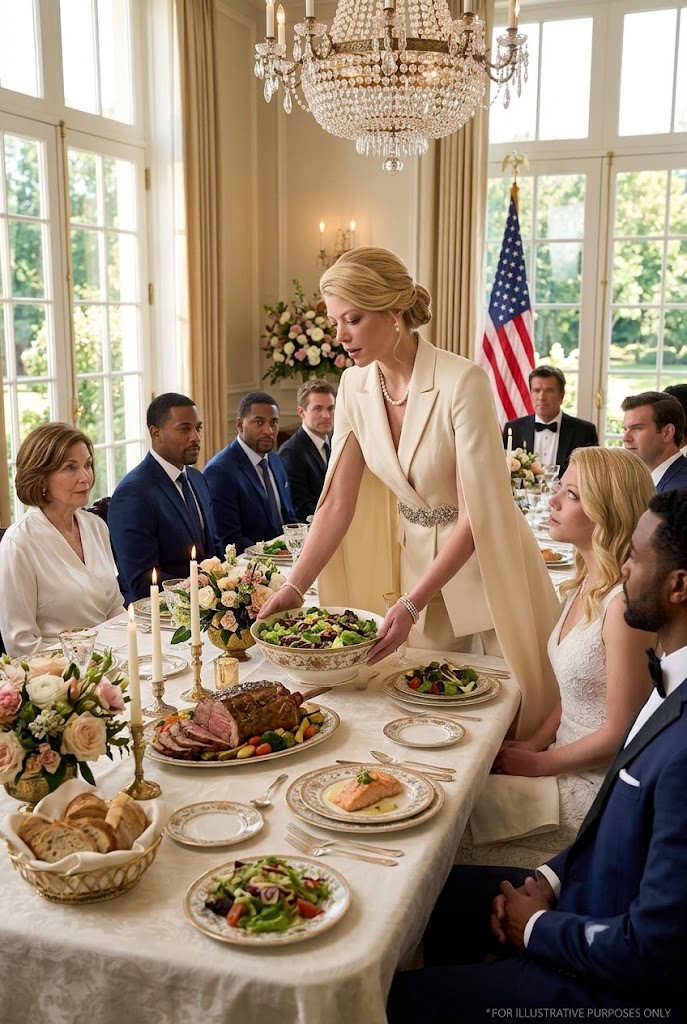
The room looked exactly as it had the night of the salad: chandelier glowing, table polished, ocean silver beyond the windows. But something had changed. The people inside it no longer belonged to Eleanor.
Richard came first, shoulders bent. Madison followed, carrying a folder. Ethan arrived with Ava.
When Eleanor saw their hands linked, her face did not change.
But her eyes did.
“You chose,” she said to Ethan.
He stepped forward. “I chose to stop pretending.”
Eleanor laughed softly. “How noble. How temporary.”
Madison placed her folder on the table. “I’m giving a statement tomorrow.”
Eleanor turned sharply. “You will do no such thing.”
“I already sent it to my attorney.”
Richard sank into a chair.
Eleanor looked at him. “And you? Will you sit there as they bury us?”
Richard’s voice was quiet. “You buried us years ago. You only object now because someone found the ground disturbed.”
The words stunned everyone.
Eleanor stared at him as if an antique chair had spoken.
He continued, voice shaking. “I let you rule because I was ashamed. Because you had proof of my mistakes. Because I told myself your cruelty was strength. But strength doesn’t poison dinner plates. It doesn’t keep files on children. It doesn’t make love feel like debt.”
Eleanor’s face hardened. “I held this family together.”
“No,” Ava said. “You held it hostage.”
For the first time, Eleanor looked tired.
Not weak. Not defeated. Tired.
“You came into my house with nothing,” she said to Ava. “Nothing but hunger.”
Ava nodded. “Yes. I was hungry for respect. For peace. For a family. You mistook that for weakness.”
Madison stepped beside Ava.
“She isn’t the reason we turned against you,” Madison said. “She’s the reason we finally saw you.”
Eleanor’s breathing changed.
She looked at her daughter for a long time. “I made you.”
Madison’s eyes filled with tears, but her voice did not tremble.
“No. You trained me. There’s a difference.”
That was the blow Eleanor could not hide from.
Her lips parted. No words came.
All her life, Eleanor Blackwell had ruled with language: compliments sharpened into knives, apologies that accused, warnings dressed as advice. But now, standing before the people she had controlled, she had no sentence powerful enough to restore fear.
Ethan moved closer to Ava.
Richard looked down.
Madison lifted her chin.
And Eleanor, the queen of La Jolla, sat.
Not dramatically. Not with collapse.
Simply sat, as if her body had finally understood what her pride refused to admit.
The room no longer answered to her.
Outside, waves struck the cliffs below the mansion.
Inside, the silence changed shape.
It was no longer obedience.
It was freedom arriving slowly, painfully, like blood returning to a limb that had been numb for years.
Eleanor whispered, “You’ll regret this.”
Ava looked at her, not with hatred but with something worse for Eleanor.
Pity.
“No,” Ava said. “We already regretted staying silent.”
Then she walked out with Ethan beside her and Madison behind her.
No one asked Eleanor’s permission.
No one looked back.
PART 5
The mansion remained standing.
That was the strange part.
After the articles, the statements, the lawyers, the canceled charity gala, the resignations, the whispered conversations in country clubs and boardrooms from San Diego to San Francisco, the Blackwell mansion still stood above the ocean in La Jolla, white and perfect under the California sun.
But it was no longer an empire.
It was only a house.
Eleanor stayed there.
Invitations disappeared. Calls slowed. Friends became acquaintances. Acquaintances became silence. The same women who once praised her taste now crossed ballrooms to avoid being photographed near her.
Every morning, Eleanor dressed beautifully. Black silk. Pearl earrings. Red lipstick. Armor for a war no one came to fight.
Richard moved into the guesthouse first, then a small apartment near Coronado. He began cooperating with attorneys. He gave interviews only through statements, admitting mistakes without blaming Eleanor entirely. It was the first honest thing he had done in years.
Madison moved temporarily into Ava and Ethan’s condo.
The first week was awkward.
She did not know how to live in a place where breakfast was just breakfast, where no one commented on posture, where laughter did not need permission. One night, Ava found her standing in the kitchen, staring at a bowl of takeout noodles.
“What’s wrong?” Ava asked.
Madison gave a small, embarrassed smile. “Nothing. I just realized I don’t have to wonder what’s in it.”
Ava’s heart broke a little.
Ethan changed more slowly.
Guilt is not a clean emotion. It arrives late, tracks mud through every room, and refuses to leave when asked. Some nights he apologized until Ava told him apologies were not a house they could live in. Other nights he said nothing and simply sat beside her, learning that presence mattered more than defense.
He quit the family investment firm.
For the first time in his adult life, Ethan Blackwell worked somewhere his last name did not open doors. A small financial office in Del Mar hired him because he was careful, smart, and willing to start again. He came home tired but lighter.
Ava returned to her work as a crisis communications consultant, though now everyone wanted to hire her for reasons she found darkly funny. She understood reputation, yes. But more than that, she understood what happened when image became more important than truth.
Madison began writing.
At first, private notes. Then essays. Then one letter she almost deleted twenty times before sending it to an online magazine.
The title was simple:
I Was Raised by a Woman Who Called Control Love.
It went viral in three days.
Messages flooded in from women in Denver, Chicago, Phoenix, Atlanta, Washington, D.C.—people who had lived inside beautiful homes that felt like prisons. People who had mistaken fear for loyalty. People who thanked Madison for naming what they had never been able to say.
One message made Madison cry.
Your story gave me the courage to leave the house where I was never free.
She showed it to Ava without speaking.
Ava hugged her.
This time Madison did not stiffen.
Weeks later, Ava visited Eleanor one final time.
The housekeeper let her in without a word. Clara looked relieved, older, almost free. Eleanor was in the greenhouse, kneeling beside a row of orchids. Dirt stained her fingers.
Ava had never seen her like that.
Not polished. Not staged. Not untouchable.
Just a woman in a garden, surrounded by fragile things she had somehow cared for better than her own family.
“I wondered when you’d come,” Eleanor said.
“I’m not here to fight.”
Eleanor laughed faintly. “How generous.”
Ava stood a few feet away. “I’m here because I don’t want the last words between us to be yours.”
Eleanor looked up.
The afternoon light softened the lines of her face. Without the dining room, the diamonds, the audience, she seemed smaller. Not innocent. Never that. But human in a way Ava had not expected.
“You took everything,” Eleanor said.
“No. I took your weapons.”
“That sounds like victory.”
“It doesn’t feel like one.”
Eleanor studied her. “Then why do it?”
“Because someone had to stop you.”
The answer settled between them.
Outside, the ocean moved endlessly against the cliffs. Inside the greenhouse, water dripped from leaves into dark soil.
“My mother taught me love was weakness,” Eleanor said at last.
Ava did not answer.
“She said tenderness made women easy to ruin. She said control was survival.” Eleanor looked down at her dirty hands. “I believed her.”
“And then you made everyone else survive you.”
Eleanor closed her eyes.
For the first time, Ava saw tears gather there without performance.
“I don’t know how to be sorry,” Eleanor whispered.
Ava believed her.
That was the saddest part.
“Then start by being quiet,” Ava said. “Let them heal without you explaining the wound.”
Eleanor nodded once.
It was not forgiveness.
It was not redemption.
But it was the closest thing to surrender Eleanor Blackwell had ever offered.
Ava left the mansion with no dramatic final glance. No thunder. No speech. No satisfaction. Just the clean ache of a woman who had survived something and refused to carry it forever.
One year later, Madison stood on a stage in Washington, D.C., speaking at a conference about coercive control within powerful families. Ethan sat in the front row beside Ava, their hands linked. Richard watched the livestream from his apartment, alone but honest.
Eleanor did not attend.
But afterward, Madison received a package.
Inside was a single white orchid, carefully packed, with no note.
Madison stared at it for a long time.
Then she placed it near the window.
Not as forgiveness.
Not as surrender.
As proof that even broken legacies could be changed by the person brave enough to stop inheriting them.
That night, Ava and Ethan walked along the harbor in San Diego. The city lights shimmered on the water. He squeezed her hand.
“Do you ever regret it?” he asked.
Ava thought of the salad, the smell, the smile, the silence. She thought of Madison laughing freely in their kitchen. She thought of Ethan choosing truth after years of fear. She thought of Eleanor kneeling in the dirt, finally smaller than her throne.
“No,” Ava said. “I regret that it took a poisoned plate for everyone to see what had been killing us all along.”
Ethan nodded.
Together, they kept walking.
Behind them, the Blackwell name remained in headlines, court records, essays, and rumors.
Ahead of them was something quieter.
Not perfect.
Not painless.
But honest.
And after years inside a family built from polished lies, honesty felt like the first real home Ava had ever known.