PART 2
Dr. Pierce did not stand over me like most doctors did.
He pulled the visitor’s chair beside the bed, sat down slowly, and placed the file across his knees. That single motion frightened me more than anything else. Men like him did not sit unless the news was too heavy to deliver from above.
My fingers tightened around the blanket.
“Is Vivian okay?” I asked automatically, because even after everything, my mind still reached for the role I had been trained to play.
Wife. Donor. Good woman. Useful woman.
Dr. Pierce’s jaw moved once.
“Vivian Calloway did not receive your kidney.”
The words entered the room and stayed there.
I looked at him, waiting for the rest of the sentence. There had to be a rest. There had to be some explanation that made the floor solid again.
“I’m sorry,” I said. “What?”
“Your kidney was not transplanted into Vivian Calloway,” he repeated. “It was redirected during final verification.”
Pain pulsed under my ribs.
“Redirected to who?”
“A seventeen-year-old girl named Nora Reyes,” he said. “She was in acute renal failure. She had been on the transplant list for twenty-six months. She was the next verified compatible emergency recipient in the regional system.”
I closed my eyes.
For one dizzy second, the betrayal, the papers, the ring, Grant’s cold voice—all of it faded behind a single image I had never seen: a teenage girl waking up somewhere in this hospital with my kidney working inside her body.
“Is she alive?”
Dr. Pierce’s expression changed. The professional wall cracked just a little.
“Yes,” he said. “She is alive. More than that, she is responding beautifully. Your kidney began functioning almost immediately.”
A sound escaped me then. Not a sob. Not a laugh. Something between shock and relief.
“But Vivian…” I whispered.
“Vivian was never a compatible recipient.”
I opened my eyes.
Dr. Pierce opened the file.
“Before any transplant, we run a final crossmatch. This morning, our lab flagged discrepancies between the compatibility records submitted by the Calloway family’s private consultant and the results from our independent testing.”
“What kind of discrepancies?”
“The kind that suggest deliberate falsification.”
I felt colder than I had when Grant stood in the room.
“They forged the records?”
“That is what the evidence indicates.”
My mind tried to move through it, but every thought cut itself on the same sharp edge. Grant had not only married me for an organ. He had built a fraud around it. He had pushed altered medical documents into a hospital system, counted on his family name to smooth the path, and planned to discard me once the surgery was over.
And he had failed.
Because somewhere in a lab, a machine had noticed the truth.
“Why didn’t anyone stop the surgery entirely?” I asked.
Dr. Pierce looked down at his hands.
“That decision will be reviewed. But once it became clear the original recipient could not legally or medically receive the organ, we had a viable organ already removed, a consented living donation, and an emergency recipient who was a confirmed match. Nora had hours, not days.” He met my eyes. “I made the call.”
“You gave it to her.”
“Yes.”
“Did I still consent?”
His face tightened.
“That is the question now. You consented to donate under circumstances that appear to involve deception. Hospital compliance has already been notified. The federal transplant authority has been notified. The state medical board will be involved. Law enforcement may be involved.”
May be.
The word sounded too weak.
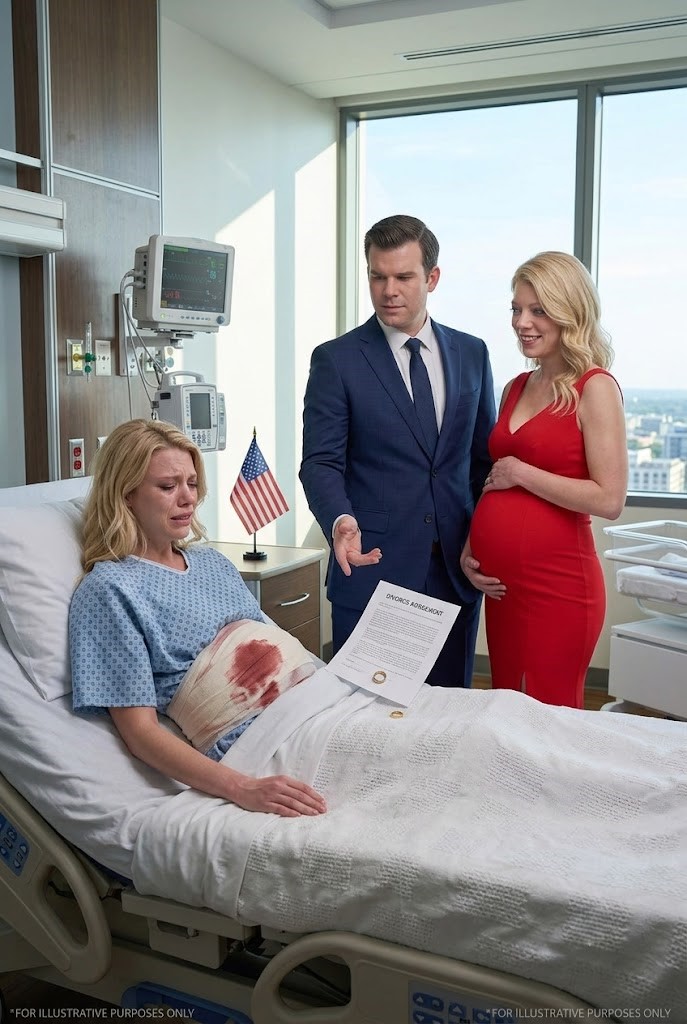
I turned my head and looked at the divorce papers. My name was typed neatly beside Grant’s. Claire Margaret Calloway. The woman he wanted erased. Under it, a line waited for my signature.
“Where is Grant now?” I asked.
“Second-floor private family lounge.”
“Vivian?”
“Still on site. She was being evaluated when I came here.”
“And Celeste?”
He hesitated. “With him, I believe.”
Of course she was.
Diamonds liked witnesses.
I swallowed hard. “I need my phone.”
“It’s in the drawer beside you.”
My hand shook as I pulled it out. The screen blurred, then sharpened. There were no messages from Grant. No missed calls. No loving husband checking on his recovering wife.
But there was one name I had not called in too long.
Maya Ellison.
My college roommate. My maid of honor. The woman Grant had slowly, politely edited out of my life by making every visit inconvenient, every phone call interrupted, every friendship feel like disloyalty.
Maya was also one of the most feared civil attorneys in Southern California.
She answered on the third ring.
“Claire?” Her voice changed instantly. “What happened?”
I tried to explain, but the words tangled. Surgery. Divorce. Kidney. Forged records. Mistress. His mother. Money. The story sounded impossible even as I lived inside it.
Maya did not interrupt.
When I finished, she said, “Do not sign anything.”
“I can barely sit up.”
“Good. Don’t. Don’t move. Don’t talk to him alone. Don’t let anyone from his family back in that room without a witness.” Her voice sharpened. “Put the doctor on.”
I handed the phone to Dr. Pierce.
He listened. His face stayed still, but his eyes grew more alert. He gave short answers. Yes. Correct. Already contacted. Yes, final crossmatch. Yes, suspected falsification. Yes, donor appears unaware.
When he handed the phone back, Maya said, “I’m twenty minutes away.”
“You’re in court.”
“I’m leaving court.”
“Maya—”
“Claire, listen to me carefully. That man did not just betray you. He may have committed fraud, coercion, medical document falsification, and attempted to pressure a post-operative patient into signing away rights while under medication. This is not a divorce anymore. This is evidence.”
Evidence.
I looked at the ring indentation on my finger. Pale skin where a promise used to sit.
“What do I do until you get here?”
“Stay alive,” she said. “Stay angry. And hide the papers somewhere nobody can take them.”
After she hung up, Dr. Pierce helped me slide the divorce envelope under my pillow. The check went inside the drawer.
For the first time since Grant had entered the room, I felt something other than pain.
Not hope exactly.
Not strength.
A small, dangerous clarity.
Dr. Pierce stood.
“I’ll send a nurse in to adjust your medication. Hospital security has been instructed not to allow the Calloways into this room without compliance approval.”
“Doctor?”
He paused.
“Nora,” I said. “Does she know?”
“Only that a donor saved her life.”
“Good.”
He nodded once and left.
I lay there, breathing shallowly, listening to footsteps pass beyond the door. Somewhere in this building, Grant was probably pouring coffee into a paper cup, telling himself everything could still be managed. Vivian was probably calling lawyers. Celeste was probably twisting that diamond around her finger, wondering if it still looked beautiful under fluorescent light.
They thought I was weak because I was in a hospital bed.
They had forgotten something simple.
Even wounded animals bite when cornered.
And by the time Maya Ellison walked through my door, wearing a black blazer and the expression of a woman ready to burn down a kingdom with paperwork, I had already decided one thing.
I would not disappear.
PART 3
Maya did not hug me when she arrived.
That was how I knew she was furious.
She came through the door fast, took in the room, the cracked cabinet, the stained ceiling, the cheap plastic chair, the IV in my arm, and the pale strip of bandage beneath the blanket. Her face went so still it looked carved.
Only then did she come to my bedside and touch my hand.
“Tell me again,” she said. “Slowly. Every word he said.”
So I did.
I told her about Grant dropping the papers onto my incision. I told her about Vivian calling gratitude “practical.” I told her about Celeste’s ring and the cashier’s check and Grant saying I had been ideal because I was lonely. I told her everything, including the part that hurt most: the fact that even after he told me the truth, some ruined part of me still searched his face for the man I had loved.
Maya listened without blinking.
When I finished, she walked to the drawer, removed the check with two fingers like it was contaminated, photographed it, and placed it back exactly where it had been.
Then she photographed the divorce papers. The envelope. The red mark on my gown where the corner had struck my bandage.
“Do you want him destroyed privately or publicly?” she asked.
I stared at her.
“Maya.”
“I’m serious.”
“I don’t know.”
“Yes, you do.”
My throat tightened.
For most of my life, I had been careful. Careful with grief. Careful with money. Careful not to need too much from people. After my parents died, careful became my religion. Grant had entered my life like permission to stop. Permission to lean. Permission to believe someone had finally chosen me without conditions.
But he had chosen me for the most conditional reason imaginable.
“I want the truth where everyone can see it,” I said.
Maya’s mouth curved, not into a smile, but into something sharper.
“Good.”
She opened her laptop on the rolling tray and began typing.
“What are you doing?”
“Preserving timeline. Sending notice to the hospital’s legal department. Requesting all records related to your donor screening, the final crossmatch, communications with the Calloway consultant, room assignment, and visitor access. Also notifying Grant’s counsel that any destruction of communications will be treated as spoliation.”
“You already know his counsel?”
“I know rich men. They all hire the same five people when they get caught.”
Despite everything, a laugh hurt its way out of me.
Maya glanced up. “There she is.”
Twenty minutes later, a hospital compliance officer named Denise Park came in with two security guards outside the door. Denise had the calm, precise energy of someone who had seen powerful people behave badly and kept receipts.
She apologized for the room first.
That almost undid me.
Not the kidney. Not the mistress. Not the divorce.
The apology.
“I was supposed to be in a recovery suite,” I said.
Denise’s eyes lowered briefly. “That request was changed last night.”
“By who?”
“According to our preliminary review, by an administrative liaison acting on instructions from the Calloway family’s private office.”
Maya stopped typing.
“Please repeat that.”
Denise did.
Maya typed faster.
The private suite had gone to Vivian, even though she had not had transplant surgery. I had been moved to an old overflow room near the service hall. Away from visitors. Away from nurses. Away from anyone who might walk in too soon and witness Grant’s little disposal ceremony.
Every detail had been planned.
The wrong room was not an accident.
It was a stage.
At 4:17 p.m., Maya stood and said, “We’re going upstairs.”
Dr. Pierce had warned me not to walk. My body agreed. Every inch of me throbbed with exhaustion. But when Maya asked for a wheelchair, I shook my head.
“No.”
“Claire.”
“I want him to see me standing.”
It took three minutes to sit up. Five to get my feet to the floor. The first step nearly blacked me out. A nurse protested, then helped anyway, her lips pressed together in silent anger. Maya held my IV pole. A security guard walked behind us.
By the time we reached the second floor, sweat had gathered at my hairline.
Grant was in the private family lounge near the west windows.
Of course he was.
That room had soft leather chairs, fresh flowers, a coffee station, and a view of downtown San Diego glowing under late-afternoon sun. Vivian sat near the window with a blanket over her knees. Celeste stood beside Grant, her diamond hand tucked now into her other palm.
Grant looked up.
For the first time that day, I saw fear touch his face.
It was small. Quick. But it was there.
“Claire,” he said. “You shouldn’t be out of bed.”
Maya stepped forward before I could answer.
“Grant Calloway, I’m Maya Ellison, counsel for Claire Whitaker Calloway. From this moment forward, you will not communicate with my client directly.”
His eyes moved over her.
Recognition dawned. So did irritation.
“This is a family matter.”
“No,” Maya said. “It was a family matter when your mother needed medical care. It became a legal matter when you allegedly forged compatibility documents, induced my client into organ donation through fraud, and attempted to coerce her into signing a divorce agreement while she was recovering from surgery.”
The lounge went silent.
A man in a gray suit near the coffee machine turned his head. A nurse at the desk stopped writing.
Vivian’s face sharpened.
“Careful,” she said. “Accusations against this family have consequences.”
Maya smiled.
“So do felonies.”
Celeste went pale.
Grant’s voice lowered. “You’re making a mistake. The donation was voluntary.”
“Consent obtained through deception is not consent,” Maya said. “Also, the organ did not go to your mother.”
For the first time, Vivian moved.
Not much.
Just her hand tightening on the wheelchair arm.
Grant stared at Maya, then at me.
“What did you say?”
I looked at him. Really looked.
The man I had loved was gone. Or maybe he had never existed. There was only the man beneath the mask, calculating how much truth had escaped containment.
“My kidney went to a teenage girl named Nora,” I said. “Your forged records failed.”
Celeste covered her mouth.
Vivian’s eyes burned with something like hatred.
Grant took one step toward me. Security took one step toward him.
“Claire,” he said, voice softening, reaching for old music. “Let’s not do this here.”
I almost admired the attempt.
He put warmth into my name. Regret into his eyes. A little tremor into his breath. The same tools he had used on me for years.
But pain has a way of clarifying sound.
“You don’t get to use that voice anymore,” I said.
His mask slipped.
Only for a second.
But everyone saw it.
Maya handed him a document.
“This is formal notice. Preserve all communications, records, financial transfers, medical consultant agreements, internal emails, text messages, and calendar entries relating to Claire, Vivian’s transplant search, donor compatibility, and your relationship with Celeste Monroe.”
Grant looked down at the paper.
Vivian said, “We will bury you.”
I turned to her.
“You already tried.”
Denise Park entered the lounge then, flanked by hospital security and two men I did not recognize. Federal investigators, I would later learn, though they did not announce it dramatically. Real consequences rarely enter with music.
They enter with badges and quiet voices.
“Mr. Calloway,” Denise said, “we need you and Mrs. Calloway senior to accompany us.”
Grant looked at me one last time.
There it was again.
Not love. Not guilt.
Disbelief.
He truly had not imagined I would still be standing.
PART 4
The investigation became public because rich people are terrible at silence when silence no longer protects them.
At first, the Calloway family tried to control the story. Their public relations team released a statement about “a private medical misunderstanding” and “an emotionally difficult marital separation.” They used words like unfortunate, complex, and confidential. Words designed to create fog.
Maya read the statement aloud in my hospital room two days later and laughed so hard she almost spilled her coffee.
“Private medical misunderstanding?” she said. “That is a bold phrase for ‘we allegedly tried to steal a kidney.’”
I was still weak, still pale, still learning how to sit without feeling like my body had been split open and rearranged. But the fog around my life was clearing. Every document Maya obtained cut through it.
There were emails.
So many emails.
Grant and Vivian had started searching for a donor long before I met him. Vivian’s blood type and antibody profile made a match difficult. They had hired a private medical consultant, Dr. Elias Vane, who had once worked in transplant coordination before being quietly pushed out of two hospitals for “ethical concerns.”
Dr. Vane had created a list.
Single women. Ages twenty-five to thirty-five. No close living family. Documented donor registration or medical volunteer history. Blood types and health markers gathered through questionable channels.
My name appeared on page seven.
Claire Whitaker. Age 29 at time of initial review. Parents deceased. Works in hospital administration. Likely empathetic. Social media indicates grief vulnerability. No siblings.
Grief vulnerability.
I read those words until they blurred.
They had not found me at a gala.
They had hunted me.
Grant had researched my favorite books, my dead father’s baseball team, my mother’s charity work, the small Ohio town where I grew up, even the rescue dog I had fostered for six months in my twenties.
Every tender moment had a source file.
The first bouquet of white tulips? My mother’s favorite flowers, pulled from a memorial post.
The tickets to a Cleveland Guardians game? My father’s team.
The weekend trip to Monterey because he “just had a feeling I needed the ocean”? I had written once, years earlier, that the ocean made grief feel smaller.
I had mistaken surveillance for intimacy.
That realization was worse than the surgery.
Physical wounds asked simple things: rest, medicine, time.
The other wound asked questions with no bottom.
How do you trust memory after learning it was manufactured? How do you mourn a marriage that never existed? How do you forgive yourself for loving a man who studied your loneliness and called it destiny?
Maya told me not to read everything.
I read everything anyway.
By the third week, the story had broken across San Diego news, then national media. Calloway Biotech stock dropped. Vivian resigned from two hospital boards. Grant took “temporary leave” from the company his grandfather had built. Celeste deleted her social media after photos surfaced of her wearing the engagement ring at events months before my surgery.
Reporters camped outside the hospital.
Maya kept them away.
“You speak when you’re ready,” she said. “Not when they’re hungry.”
Nora Reyes went home before I did.
I did not meet her. I asked not to.
Her mother sent a letter through Dr. Pierce, sealed in a yellow envelope with my first name written in careful blue ink. I waited until I was alone to open it.
Dear donor, it began.
Not Claire. Not Mrs. Calloway. Just donor.
She wrote that Nora had wanted to study sea turtles since she was eight. That she had missed prom, soccer, homecoming, and most of junior year because dialysis had swallowed her life. That when Nora woke up after surgery and learned the kidney was working, she cried because she said her body felt quiet for the first time in years.
At the bottom, Nora had added one sentence herself.
I don’t know who you are, but I’m going to live loudly for both of us.
I pressed the letter to my chest and cried until the nurse came in and pretended not to notice.
After I was discharged, I did not go back to the house in Coronado.
Maya arranged for movers. My things were packed while Grant’s attorneys complained about “access” and “marital property.” I kept my mother’s quilt, my father’s watch, my books, and the chipped blue mug I had bought at a roadside shop the year before I met Grant.
Everything else could rot.
I stayed with Maya in her guesthouse in Del Mar. It was small, bright, and full of plants she forgot to water. At night, I lay awake listening to the ocean and the distant hum of traffic, trying not to replay Grant’s voice.
You were useful.
Sometimes anger came like fire.
Sometimes grief came like weather.
Sometimes I missed him, and that made me hate myself.
Maya said that was normal.
“Your nervous system doesn’t know he was a predator yet,” she told me one morning, handing me toast. “It still thinks he was home.”
“I feel stupid.”
“You were deceived.”
“I should have seen something.”
“You saw what he designed you to see.”
The civil case began six months after the surgery.
By then, I could walk without holding my side. My scar had healed into a silver curve. I had cut my hair to my shoulders because I wanted one reflection in the mirror Grant had never touched.
The courthouse downtown was made of glass and stone. On the first morning, cameras lined the steps. Grant arrived with three attorneys and no Celeste. Vivian arrived separately, wearing dark sunglasses though the sky was cloudy.
I wore a gray dress, low heels, and my father’s watch.
Maya touched my elbow before we entered.
“You don’t have to be fearless,” she said. “You just have to tell the truth.”
Inside, Grant avoided looking at me.
That almost made me smile.
A man who had once dropped divorce papers on my surgical wound could not meet my eyes in a courtroom.
Power is strange that way.
It looks permanent until someone asks it to testify.
PART 5
Grant’s legal team made the mistake of underestimating ordinary sympathy.
They thought the jury would be dazzled by medical language, confused by transplant protocol, bored by timelines, intimidated by Calloway money. They thought if they made the story complicated enough, the simple truth would disappear.
Maya did not let it.
On the first day, she placed two photographs on the courtroom screen.
One was our wedding photo.
Grant in a black tuxedo, smiling down at me beneath a garden arch in Santa Barbara. Me in ivory lace, looking up at him like I had found shelter after years of weather.
The second photograph was taken three years later.
Me in a hospital bed, pale and swollen, with divorce papers lying across the bandage where my kidney had been removed.
The jury understood before Maya said a word.
Grant’s attorneys objected. The judge allowed it.
The trial lasted nine days.
Dr. Pierce testified first. Calm. Precise. Devastating. He explained the final crossmatch, the falsified records, the medical impossibility of Vivian receiving my kidney, and the emergency decision that sent the organ to Nora Reyes.
Under cross-examination, Grant’s attorney tried to imply Dr. Pierce had acted recklessly.
Dr. Pierce looked at him and said, “The reckless act was not saving a dying child with a viable organ. The reckless act was submitting falsified compatibility documents to a transplant center.”
The jury wrote that down.
Denise Park testified next about the room change. The administrative override. The private suite transferred to Vivian. The unusual visitor approval granted to Grant, Vivian, and Celeste minutes after I regained consciousness.
Then came the emails.
Maya read only portions, but they were enough.
Vivian: She has no siblings and limited support. That reduces resistance.
Grant: She is attached already. Testing should be easy to frame as family responsibility.
Vivian: Do not propose until compatibility is confirmed.
Grant: Understood.
I sat very still when that one appeared.
Do not propose until compatibility is confirmed.
The diamond ring he had given me had not marked love.
It had marked lab results.
The courtroom blurred. Maya’s hand found mine under the table.
Grant finally looked at me then.
For a moment, something like shame crossed his face.
I wanted it to matter.
It didn’t.
Celeste testified on the seventh day under subpoena.
She wore a cream suit and no engagement ring.
Her beauty looked thinner in court, stripped of lighting and champagne. She admitted she and Grant had maintained a romantic relationship for most of my marriage. She admitted she knew Grant planned to divorce me after the transplant. She claimed she did not know the medical records were falsified.
Maya approached the witness stand holding a printed text message.
“Ms. Monroe, did you write to Mr. Calloway, six weeks before surgery, ‘Once she signs the donor consent, your mother gets her kidney and we get our life back’?”
Celeste’s face drained.
“Yes.”
“And did Mr. Calloway respond, ‘Almost done’?”
“Yes.”
“No further questions.”
Vivian never testified.
Her attorneys claimed medical fragility. The judge allowed deposition footage instead.
On screen, Vivian sat in her mansion library beneath an oil portrait of her late husband. She denied everything in a voice that made denial sound like etiquette.
Maya played emails after each denial.
The effect was brutal.
By the time Grant took the stand, the courtroom felt different. The Calloway name had shrunk. The money, the suits, the polished manners—none of it could hide the ugliness now spread across exhibits and sworn testimony.
Grant admitted he had approached me after learning I was a possible match.
He admitted the marriage had happened after compatibility testing.
He admitted he had continued his relationship with Celeste.
But he would not admit fraud.
“My feelings for Claire became real,” he said.
A sound moved through the gallery.
I didn’t know whether it was disgust or disbelief.
Maya stood slowly.
“Mr. Calloway, did you love my client when you dropped divorce papers onto her surgical wound?”
His jaw tightened. “That was not my intention.”
“Did you love her when you offered seventy-five thousand dollars in exchange for waiving marital assets while she was under post-operative medication?”
“My attorneys prepared—”
“Did you love her when you described her in an email as ‘emotionally responsive and manageable’?”
He looked toward his lawyers.
The judge instructed him to answer.
“No,” Grant said.
“No, you didn’t love her?”
“No, that language was not loving.”
Maya moved closer.
“Did you love her when you waited until a private lab confirmed compatibility before proposing marriage?”
Grant’s face had gone gray.
“I cared about my mother.”
“That was not my question.”
Silence.
Then, quietly: “No.”
There it was.
No thunder. No gasp. No dramatic collapse.
Just one small word, plain and final.
No.
I thought it would kill me.
Instead, it set something down.
For years, I had carried the weight of wondering whether any part of him had been real. His answer hurt, but it also ended the haunting. I did not have to search the ruins anymore for a surviving room.
There had never been a house.
On the ninth day, both sides gave closing arguments.
Grant’s attorney spoke of complicated emotions, family desperation, medical urgency, and a marriage that had “deteriorated under stress.”
Maya stood with no notes.
She told the jury about choice.
Not kidney choice. Not marriage choice.
The choice to target a grieving woman.
The choice to research her losses.
The choice to court her with stolen intimacy.
The choice to falsify records.
The choice to place legal papers on a fresh wound and call it settlement.
“Power,” Maya said, “does not become innocence because it wears a suit. Fraud does not become love because it ends in a wedding album. And consent does not become valid because the victim was kind enough to believe the lie.”
The jury deliberated for seven hours.
When they returned, I held Maya’s hand so tightly she later joked I nearly ended her legal career.
They found in my favor on fraud, intentional infliction of emotional distress, coercion, and financial misconduct connected to the attempted divorce settlement.
The damages were enormous.
But the number did not make me cry.
What made me cry was the judge looking directly at Grant and saying, “The court recognizes that Mrs. Calloway was not merely deceived. She was selected, isolated, and used.”
Selected.
Isolated.
Used.
For the first time, those words did not feel like shame.
They felt like evidence.
And evidence could be survived.
PART 6
Money changes the future, but it does not repair the past.
That was the first thing I learned after winning.
News outlets called the judgment “historic.” Legal commentators called it “a landmark living-donor fraud case.” Strangers online called me brave, foolish, inspiring, dramatic, greedy, heroic, and a liar, depending on which corner of the internet they came from.
Maya told me not to read comments.
I read them for two nights, then stopped when I realized strangers could not give back what Grant had taken.
The criminal case unfolded more slowly.
Dr. Elias Vane, the private consultant, accepted a plea agreement and surrendered records that tied Vivian directly to the falsified compatibility reports. Grant was charged with fraud, conspiracy, and obstruction after investigators found deleted messages recovered from a company server.
Vivian’s attorneys fought everything.
They delayed. Appealed. Claimed confusion. Claimed grief. Claimed an old woman’s desperation had been misread as criminal intent.
But desperation does not create spreadsheets ranking potential donors by loneliness.
The spreadsheet did.
Calloway Biotech tried to separate itself from Grant. The board removed him. Investors fled. Vivian’s portrait was quietly taken down from the children’s hospital wing she had funded.
The old San Diego families stopped inviting them to dinners.
That might have wounded Vivian more deeply than the indictment.
Celeste moved to Palm Beach.
I knew because reporters told me. She became engaged to a real estate developer within a year. I wished him excellent medical records and no allergies.
As for Grant, he tried once to write me a letter.
It arrived through his attorney, sealed in a white envelope, my name written in his perfect handwriting.
I held it over Maya’s kitchen trash can for nearly a minute.
“Are you going to read it?” she asked.
“No.”
I dropped it in.
She raised an eyebrow. “Growth.”
“No,” I said. “Organ preservation.”
We laughed so hard we scared one of her cats.
Healing did not arrive like victory.
It arrived in pieces so small I almost missed them.
The first morning I woke up and did not immediately touch my scar.
The first time I bought flowers without wondering whether Grant would have approved of the color.
The first time I sat in a restaurant alone and felt peaceful instead of abandoned.
The first time a man smiled at me in a bookstore and I smiled back without panic.
Eight months after the trial, I changed my name back to Claire Whitaker.
At the courthouse window, the clerk stamped the paper and slid it back to me. Just like that, Calloway disappeared from the line where it had never truly belonged.
I celebrated by driving north with no plan.
I passed Los Angeles, then Santa Barbara, then the gold hills beyond San Luis Obispo. I stopped near Big Sur at sunset and stood by the guardrail while the Pacific crashed below me, huge and silver and indifferent.
For the first time in years, I felt small in a way that comforted me.
Grant had made me feel small inside his world.
The ocean made me feel small inside God’s.
There is a difference.
A month later, I sold the Coronado house. My half of the proceeds went into a foundation Maya helped me establish for living donor advocacy and legal support. We named it The Nora Project, though Nora never knew that at first.
The foundation helped donors get independent legal counseling before major procedures. It funded second-opinion testing. It pushed hospitals to separate family pressure from donor consent. It gave frightened people someone to call before generosity became a trap.
Work gave shape to my anger.
Not peace.
Shape.
Peace came later.
It came in a letter forwarded through Dr. Pierce almost two years after the surgery.
The envelope had a return address from Santa Cruz.
Inside was a photograph of a young woman in a wetsuit standing on a boat, wind tangling her dark hair, sunlight all over her face. Behind her, the ocean stretched bright and endless.
Dear Claire, the letter began.
I sat down before reading more.
She knew my name now. Her mother had told her after the trial became public. She wrote that she had started college. Marine biology, just like her mother had said. She wrote that she had gone diving for the first time and cried underwater because she could finally do something that had once seemed impossible.
Then she wrote:
I know you did not give your kidney to me on purpose. I know the story is painful. But I hope you know that your life touched mine in the best way. I am not your responsibility. I am not your debt. I am just alive, and grateful, and trying to make that mean something.
I read it three times.
Then I called Maya.
“I want to meet her,” I said.
Maya was quiet for a moment. “Are you sure?”
“Yes.”
Nora chose a coffee shop in Santa Cruz with blue walls and terrible parking. She was nineteen by then, bright-eyed and nervous, twisting a bracelet around her wrist when I walked in.
We recognized each other instantly, though we had never met.
She stood.
I stood.
For a strange second, neither of us moved.
Then she crossed the space between us and hugged me carefully, mindful of a scar that no longer hurt.
I thought I would feel ownership. Connection. Something dramatic.
Instead, I felt wonder.
Here was a life that had continued because mine had been interrupted. Here was proof that not everything stolen stayed stolen. Some things were redirected by grace, by science, by a surgeon’s impossible choice, by a system that failed and still somehow saved one girl in time.
Nora pulled back, crying.
“Thank you,” she said.
I shook my head.
“Live loudly,” I told her.
She laughed through tears. “I’m trying.”
We talked for three hours.
Not about Grant much. Not about Vivian. Not about the headlines.
We talked about sea turtles. Bad dorm food. My mother’s tulips. Her fear of open water before learning to love it. The absurdity of hospital socks. The way bodies can betray you and save you in the same lifetime.
When I left, Nora hugged me again.
This time, I hugged her without thinking of the kidney.
I thought only of the girl.
PART 7
Five years after the surgery, I returned to San Diego for a conference on donor ethics.
I almost said no.
Not because I was afraid of the city, but because memory has geography. Certain streets still held versions of me I did not want to meet. The La Jolla hotel where Grant first spoke to me. The courthouse steps where reporters shouted my name. The hospital where I woke up in a storage room and learned my marriage had been built around an organ.
But The Nora Project had helped write new donor protection standards being adopted by hospitals across California, and Dr. Pierce was receiving an award for ethical courage. Maya said if I skipped it, she would accept on my behalf and tell everyone embarrassing stories about my college bangs.
So I went.
The conference was held in Washington, D.C., that year, not San Diego after all, in a grand hotel near the Potomac with marble columns, navy carpets, and American flags standing behind the stage. Doctors, lawyers, ethicists, donor advocates, and transplant recipients filled the ballroom.
I wore a deep blue dress and my father’s watch.
Before my panel, I stood in a quiet hallway holding a paper cup of coffee, watching people pass. Nobody stared at my scar. Nobody knew unless they knew. That had become its own kind of freedom.
Dr. Pierce found me near the windows.
He looked older, but his eyes were the same.
“Claire Whitaker,” he said. “You look well.”
“I am well.”
Saying it surprised me.
Not because it was untrue.
Because it was.
He smiled.
“I’m glad.”
We stood together for a moment in comfortable silence.
Then he said, “Nora is here.”
I turned.
At the end of the hallway, Nora Reyes stood in a white blazer, talking animatedly with a group of medical students. She was twenty-two now, confident and glowing, her hands moving as she spoke. Around her neck hung a conference badge that read: Nora Reyes, Ocean Health Initiative.
She saw me and waved.
The girl who had almost died was now impossible to miss.
During the afternoon session, Dr. Pierce spoke about the morning of my surgery. He did not sensationalize it. He did not make himself a hero. He spoke of systems, safeguards, pressure, and the dangerous assumption that wealthy families are less likely to commit desperate crimes.
Then I spoke.
I had told the story many times by then, but never from a stage this large.
The ballroom lights were bright. The American flags behind me stood motionless. Maya sat in the front row, arms crossed, daring the room not to listen. Nora sat beside her.
I looked out at hundreds of faces and began with the truth.
“I did not know I was being used until the papers hit the wound.”
The room went still.
I told them about Grant, but I did not let him own the story. I told them about Vivian, but I did not give her the dignity of mystery. I told them about the forged records, the room change, the pressure to sign, the legal case, and the strange mercy that sent my kidney to Nora instead.
Then I told them what manipulation feels like.
Not like danger.
Like being chosen.
Like someone remembering your pain.
Like a man standing beside you at your mother’s grave and holding your hand with information he found online.
I saw people shift in their seats.
Good.
Comfort does not reform systems.
Discomfort does.
At the end, I said, “Living donation is one of the most generous acts a person can offer. That is exactly why it must be protected from coercion, romance, money, family pressure, and fraud. Kindness should never be treated as a loophole.”
The applause came slowly at first, then rose.
I stepped down shaking.
Nora met me at the side of the stage and hugged me hard.
“You were amazing,” she whispered.
“So were you,” I said, though she had not spoken.
She smiled. “I’m alive. That counts.”
Maya appeared with tears in her eyes and pretended she didn’t.
“Not bad,” she said.
“High praise.”
“Don’t get used to it.”
That evening, after the conference dinner, I walked alone along the Potomac. Washington, D.C. glowed around me, monuments lit white against the dark, traffic crossing bridges in ribbons of red and gold. The summer air was warm. Somewhere behind me, people were laughing outside the hotel bar.
My phone buzzed.
Unknown number.
For years, I had ignored unknown numbers. That night, I answered.
“Claire.”
Grant’s voice.
Older. Rougher. Smaller.
I stopped walking.
He had served time. Not as much as people online wanted, more than his lawyers promised. Vivian had died before sentencing, still denying everything. Calloway Biotech had been sold in pieces. The name had become a cautionary footnote in ethics seminars and legal journals.
I had not heard Grant’s voice in nearly four years.
“How did you get this number?” I asked.
“I’m sorry,” he said.
Two words.
Maybe he had rehearsed them for years.
Maybe he meant them.
Maybe prison had hollowed out enough arrogance to leave room for regret.
The old Claire might have needed to know.
The woman standing by the Potomac did not.
“You don’t get to call me,” I said calmly.
“I know. I just wanted—”
“No,” I said. “That is the thing you never understood. Wanting does not give you the right to take.”
He was silent.
I looked across the river. The water moved black and steady under the lights.
“I hope you become someone who understands what you did,” I said. “But you will do it without me.”
Then I ended the call.
My hand did not shake.
That was how I knew it was over.
Not the trial. Not the judgment. Not the headlines. Not the first time I laughed again or the first morning I woke without grief pressing on my ribs.
It ended there, beside the river, when his voice finally reached me and found no door.
The next morning, I flew to North Carolina.
I had moved there two years earlier, to a coastal town outside Wilmington where live oaks leaned over quiet streets and the ocean smelled like salt and second chances. I owned a small yellow house with a porch swing. I taught donor advocacy workshops online. I grew terrible tomatoes. I had friends who knew the whole story and friends who only knew I liked strong coffee and early walks.
I was not fearless.
I still startled at sudden tenderness sometimes. I still distrusted charm when it arrived too perfectly dressed. I still had nights when my scar ached in cold weather and memory walked through the room uninvited.
But my life was mine.
That matters more than people think.
A year after the D.C. conference, Nora invited me to her graduation.
She crossed the stage under a bright California sky, her cap tilted, her smile enormous. Her mother sobbed. Dr. Pierce clapped like a proud uncle. Maya wore sunglasses and denied crying while openly crying.
Afterward, Nora found me near a row of eucalyptus trees.
She held up her diploma.
“Marine biology,” she said. “Officially.”
“I never doubted you.”
She looked at me for a long moment.
“Do you ever wish it hadn’t happened?”
The question was honest enough to deserve the truth.
“Yes,” I said. “I wish Grant had never found me. I wish no one had lied. I wish I had given my kidney from a place of truth instead of deception.”
Her face fell slightly.
“But,” I continued, “I do not wish you weren’t alive.”
She cried then.
So did I.
Life is not clean. Justice is not clean. Healing is not a straight white line from pain to peace. Sometimes the worst thing that ever happened to you carries one good thing out of the fire, and you spend years learning how to hold both without letting either one erase the other.
Grant thought he chose me because I was alone.
He thought loneliness made me weak.
But loneliness had taught me how to survive silence. Grief had taught me how to keep breathing when the world ended. Love, even false love, had taught me what I was willing to give. Betrayal taught me what I would never give again.
And Nora taught me that stolen things can still become miracles when they land in the right hands.
I keep her graduation photo on my mantel now.
Beside it is a picture of my parents. A small vase of white tulips. My father’s watch when I’m not wearing it. A framed copy of the first donor protection bill The Nora Project helped pass.
Sometimes visitors ask about the scar if they see it at the beach.
I tell them I donated a kidney.
That is true.
Sometimes they say, “That’s an incredible thing to do for someone you love.”
And I say, “Yes. It is.”
I do not explain everything.
Not because I am ashamed.
Because the whole story belongs to me, and I decide who gets to hold it.
On quiet evenings, when the light turns gold over the porch and the Atlantic wind moves through the grass, I think about the woman I was in that hospital room. Pale. Betrayed. Bleeding. Told she was useful by people who had mistaken cruelty for intelligence.
I wish I could reach back and take her hand.
I would tell her the papers are not the ending.
I would tell her the wound will close.
I would tell her the girl lives.
I would tell her that one day, the man who tried to erase her will become a footnote in the story she builds from the ruins.
Most of all, I would tell her this:
They can take a piece of your body.
They can waste years of your love.
They can turn your kindness into a crime scene and still call themselves civilized.
But they cannot decide what your life means afterward.
Only you can do that.
And I did.