Part 2
Oscar Bell’s office sat on the twenty-third floor of a steel-and-glass tower in downtown Seattle, high enough that the city below looked polished and harmless. By nine o’clock Monday morning, the rain had stopped, leaving the streets silver and shining beneath a flat gray sky.
Oscar was waiting when I arrived.
He was in his late forties, precise, careful, and almost impossible to rattle. But when he saw my face, he did not offer coffee or small talk. He simply nodded toward the conference room.
“I read the email,” he said.
“That makes one of us,” I replied. “I think I stopped reading it as a sister halfway through and started reading it as a mother.”
On the long walnut table, Oscar had arranged every contract connected to Rhonda’s wedding. Venue guarantee. Catering agreement. Floral installment plan. Lighting deposit. Entertainment contract. Premium bar package. Cake balance. Security hold. Hotel room block.
My money was everywhere.
Hidden, protected, quietly powering every elegant lie.
Oscar tapped the top folder. “You understand what happens if we withdraw the guarantees?”
“I do.”
“The hotel can suspend services immediately unless another valid payment method is provided.”
“I know.”
“Some deposits are nonrefundable.”
“I don’t care.”
“Your family will likely blame you.”
I looked out at the city, at the wet rooftops and traffic moving like blood through the streets. “They already blame me for everything. At least this time they’ll be right about the money.”
He watched me for a long second. “And you want this effective Saturday morning?”
“At dawn.”
“That gives them almost no time to recover.”
“That’s the point.”
The words came out steady, but my hands were cold beneath the table. I was not cruel by nature. Cruel people enjoy suffering. I did not want chaos because it entertained me. I wanted consequence because nothing else had ever reached them.
Oscar slid the documents toward me. “Once you sign, I’ll schedule the revocation through the firm account. The hotel’s system will run the payment verification early Saturday. If the guarantees fail, they will contact the bridal party.”
“Good.”
“Jillian.”
His voice softened slightly.
“This is not a small thing.”
I picked up the pen. “Neither is telling my child she doesn’t belong among respectable people.”
That ended the discussion.
I signed every page.
My signature looked strange by the end, sharp and unfamiliar, like it had been written by a woman I had not yet become but was already learning to trust.
Afterward, I met my best friend Chloe at a small Italian restaurant in Belltown. She had known me since college, before Willow, before my business, before I got good at smiling while relatives bled me dry. I handed her my phone and let her read Rhonda’s email.
At first, Chloe was silent.
Then she placed the phone flat on the table as though it carried disease.
“She said that about Willow?”
“Yes.”
“She told you to dress like staff?”
“Yes.”
“And you’re paying for the wedding?”
“Was.”
Chloe leaned back, eyes blazing. “Good.”
I laughed once, but it came out broken. “That’s it? Just good?”
“No, not just good. Perfect. Biblical. Cinematic. Long overdue.” She pointed at me across the table. “You are not destroying her wedding, Jillian. You are removing yourself as the foundation of a building she kept spitting on.”
I wanted to believe her.
Still, guilt moved through me in small, stubborn waves. My mother’s voice lived inside my head, repeating old family commandments. Be the bigger person. Don’t embarrass us. Your sister is sensitive. Family means sacrifice.
But sitting across from Chloe, I realized every one of those sayings had always traveled in one direction. From me to them. Never back.
That afternoon, I opened a travel app and booked the Hawaii flights. Two business-class seats from Seattle to Maui. Departure: Saturday morning. Wedding day.
Willow had always wanted to see the ocean in Hawaii. She had a picture of a sea turtle taped above her desk and a jar where she saved quarters labeled “Beach Someday.” I decided someday had arrived.
When I told her, she screamed so loudly our neighbor knocked on the wall.
“Are we really going?” she asked, bouncing on her toes.
“We are really going.”
“But Aunt Rhonda’s wedding is Saturday.”
I folded a sundress into the suitcase and kept my voice light. “Plans changed.”
Willow studied me with the serious expression children get when they understand more than adults wish they did. “Did Aunt Rhonda do something mean again?”
I stopped packing.
Outside, the rain tapped softly against the windows.
“She made choices,” I said carefully. “And now we are making ours.”
Willow nodded as if that explanation made perfect sense. Maybe it did.
The rest of the week passed like a secret operation. I answered enough texts to avoid suspicion. I attended one final vendor meeting where Rhonda criticized the napkin fold for twenty minutes. I listened to my mother complain that I looked “ungrateful” whenever I got quiet.
On Friday evening, the night before the wedding, I went to The Fairmont Meridian one last time.
The bridal suite was chaos wrapped in silk.
Designer gowns hung from every door. Champagne glasses cluttered the vanity. Bridesmaids in matching robes shrieked over lipstick shades while Rhonda sat in the center like a queen preparing for coronation.
She saw me in the mirror and snapped, “Finally. Pick up those shoes before someone trips.”
Not hello.
Not thank you.
Not my sister.
Just an order.
I bent down and gathered the scattered heels, one by one, while she complained loudly about the florist, the weather, the guests, the universe. Her bridesmaids laughed whenever she said something cruel, not because it was funny, but because cruelty from a bride in a luxury hotel can sound like confidence to people who worship status.
I waited until they crowded around the wardrobe.
Then I slipped a white envelope from my coat pocket and placed it beneath a crystal vase on Rhonda’s vanity.
Inside was a handwritten note.
Not long.
Not emotional.
Just the truth.
Rhonda,
I received your six conditions. I decline all of them.
I will not hide my daughter. I will not dress as your servant. I will not fund a life built on my humiliation.
As of wedding morning, every financial guarantee I provided is withdrawn.
Enjoy the image you paid for yourself.
Jillian
When I turned to leave, Rhonda called after me, “Don’t be late tomorrow. And remember, service entrance.”
I paused with my hand on the door.
For one wild second, I almost told her everything.
Instead, I smiled.
“Don’t worry,” I said. “Tomorrow, I’ll be exactly where I’m supposed to be.”
Part 3
Our flight left Seattle before sunrise.
Willow slept beside me with her head against the airplane window, one hand curled around the stuffed sea turtle she had packed in her backpack. As the city disappeared beneath a blanket of clouds, I felt something inside my chest loosen for the first time in years.
I had expected panic.
Instead, I felt quiet.
The kind of quiet that comes after a door closes and you realize the world did not end. It only got smaller in the best possible way. Smaller meant me and Willow. Smaller meant breakfast without guilt. Smaller meant no frantic calls about unpaid invoices, no last-minute demands, no mother crying on my doorstep with someone else’s disaster in her hands.
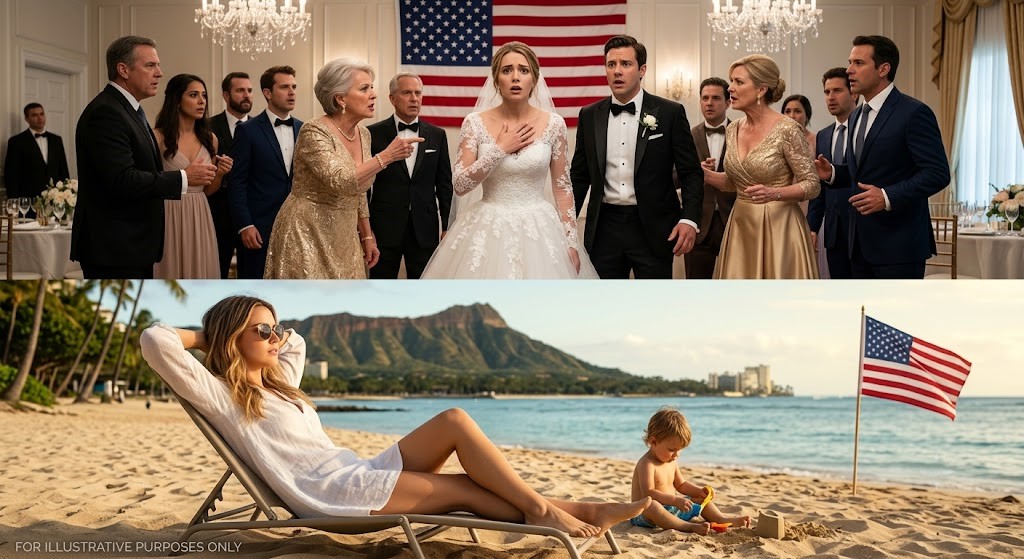
At 7:42 a.m., while our plane crossed the Pacific, Oscar’s scheduled revocation went active.
At 7:55, The Fairmont Meridian’s payment system attempted to confirm the primary financial guarantees attached to Rhonda’s wedding.
At 7:56, the guarantees failed.
At 8:01, the hotel’s event manager called Oscar’s firm.
At 8:09, Oscar replied with a formal notice confirming that the authorized funding source had been lawfully withdrawn by the account holder.
At 8:16, the hotel contacted my mother.
I know the timeline because Oscar later sent it to me in a clean, devastating report. At the time, I knew none of it. I was thirty thousand feet above the ocean, drinking orange juice while my daughter slept peacefully through the first earthquake of my sister’s perfect day.
When we landed in Maui, warm air rushed through the jet bridge, soft and fragrant with flowers. Willow woke up, pressed her face to the window, and whispered, “It looks like a postcard.”
I turned my phone off airplane mode.
It immediately began vibrating.
Not one call.
Dozens.
Text messages stacked across the screen so fast I could not read them.
JILLIAN CALL ME NOW.
Where are you?
The hotel says payment declined.
This is not funny.
Your sister is sobbing.
You need to fix this immediately.
Then came Rhonda.
You selfish witch.
What did you do?
Answer me.
ANSWER ME.
I watched the notifications multiply while Willow skipped ahead toward baggage claim, her ponytail bouncing. A strange laugh rose in my throat, not because anything was funny, but because the panic looked exactly how I had imagined it would.
For years, their emergencies had entered my life and become mine.
Now their emergency had reached my phone and stopped there.
At baggage claim, Willow spotted our suitcase and cheered. I lifted it from the carousel while my phone continued buzzing in my pocket like a trapped insect. By the time we reached the rental car counter, the missed calls had hit fifty-nine.
I did not answer.
Not yet.
In Seattle, according to Oscar’s report, the hotel manager had pulled my mother and Rhonda aside just as the first guests began arriving. Blake’s relatives were already in the lobby, dressed in dark suits and pearl necklaces, admiring the glass ceiling and the view of the bay. The string quartet was tuning. The photographers were adjusting lenses. The flowers were in place.
Everything looked expensive.
Nothing was paid for anymore.
The hotel manager, a woman named Denise Calder, was professional enough not to raise her voice. That probably made it worse.
She informed them that the primary guarantees attached to the reception had been withdrawn and that the remaining balance had to be paid immediately before services could continue.
My mother apparently stared at her as if Denise had spoken another language.
Rhonda laughed.
Not because she was amused.
Because her brain rejected reality.
“That’s impossible,” she said. “Everything is handled.”
Denise folded her hands. “The account holder has revoked authorization.”
“My mother arranged financing.”
“We are unable to discuss the account holder’s identity. We can only accept an alternate certified payment.”
“How much?” Blake asked.
Denise gave the number.
The silence that followed was, I imagine, the most honest moment my family had experienced in years.
Because the number was not a problem a regular credit card could solve. It was not a pass-the-hat emergency. It was a number that exposed the size of Rhonda’s lie.
My mother began crying first. Rhonda began shouting. Blake’s father, Charles Whitaker, asked for a private explanation in the clipped voice of a man accustomed to boardrooms and bad investments.
There was no explanation available that did not lead back to me.
That was when Rhonda ran upstairs to the bridal suite.
She tore through gift bags, makeup cases, and drawers, searching for something she could not name. Maybe money. Maybe a miracle. Maybe the version of reality where I remained obedient no matter how deeply she humiliated me.
Then she found my envelope beneath the crystal vase.
By then, Willow and I were checking into a resort where the lobby smelled like plumeria and the floor was open to the sea breeze. A woman placed orchid leis around our necks. Willow touched hers gently and looked at me with wonder.
“Mom,” she whispered, “I feel fancy.”
“You are fancy,” I said.
She smiled, missing one baby tooth.
My phone rang again.
Mom.
This time, I answered.
The sound that came through was not a voice at first. It was chaos. Crying. Shouting. Someone in the background saying, “This is unacceptable.” Another voice, probably Rhonda, screaming my name like a curse.
“Jillian!” my mother sobbed. “Where are you?”
“Maui.”
The silence lasted half a second.
“What?”
“I’m in Hawaii with my daughter.”
“You need to come back right now.”
“No.”
“The hotel won’t serve the food. Blake’s parents are furious. Rhonda found some horrible note and says you canceled everything. Tell me that is not true.”
“It is true.”
My mother made a sound like I had struck her. “How could you do this to your sister?”
I looked across the lobby at Willow, who was standing near a koi pond, delighted by orange fish moving beneath lily pads.
Then I opened the screenshot of Rhonda’s email.
“Would you like me to read rule one?” I asked.
“Jillian, this is not the time.”
“It’s exactly the time.”
“Your sister is under pressure. She didn’t mean—”
I cut her off.
“Willow is not allowed inside the hotel because a child born outside traditional circumstances would damage the sophisticated family image.”
On the other end of the line, my mother stopped breathing.
I continued, slowly.
“I was instructed to wear gray like the staff and use the service elevator. I was ordered to pay for Rhonda’s apartment, HOA fees, and honeymoon. I was told not to speak to Blake’s parents unless spoken to.”
“Please,” my mother whispered.
“No. You don’t get to please me now. Not after you handed me invoices with one hand and allowed your favorite daughter to spit on my child with the other.”
“She’s your sister.”
“And Willow is my daughter.”
That sentence ended something.
I could feel it.
Not just the call. Not just the wedding. A whole lifetime of bending.
My mother began crying again, but softer now, wounded in the way people sound when they realize their favorite weapon has finally broken.
“You’re ruining us,” she said.
“No,” I replied. “I stopped funding the performance. There’s a difference.”
Then I hung up.
Part 4
The first day in Maui felt almost illegal in its beauty.
The ocean was too blue. The sky was too open. The air smelled like salt, flowers, and sunscreen. Willow ran toward the waves in a yellow swimsuit, laughing whenever the water chased her feet. I sat beneath a striped umbrella with my phone turned face down on the table beside me.
For the first time in years, no one could reach into my peace without permission.
Still, I was human.
I wondered what was happening.
I imagined the ballroom. The rich guests. Rhonda’s dress. Blake’s face when he realized the woman he planned to marry had built their wedding on a lie funded by the sister she wanted hidden near the service elevator.
At 3:17 p.m., Oscar emailed.
Subject: Situation Update.
I opened it while Willow built a sandcastle decorated with shells.
Oscar’s message was brief but thorough. The hotel had suspended all reception services. The ceremony had been delayed twice. Catering staff had stopped food preparation. The bar remained closed. The florist demanded confirmation of payment before releasing the remaining arrangements. The string quartet left after their contracted waiting period expired.
Blake had requested a private meeting with Rhonda, my mother, his parents, and the hotel manager.
I pictured that meeting in some polished conference room behind the ballroom, everyone still dressed for a wedding that had become an audit.
Rhonda must have tried to lie at first. She always did. Lying came naturally to her because people had spent years rewarding it with rescue. She probably said there had been a banking error. A misunderstanding. A jealous sister. A temporary issue.
But money does not care about charm.
Contracts do not care about tears.
And the hotel had documents.
By late afternoon, Blake understood enough.
He called me once.
I did not answer.
Then he texted.
Jillian, this is Blake. I am not calling to attack you. I need to know whether Rhonda knew you were funding the wedding.
I stared at that message for a long time.
Blake had never been cruel to me. Distant, maybe. Polite in the way wealthy people can be when they have already categorized you as background. But he had not written the six conditions. He had not insulted Willow. He was another person trapped inside Rhonda’s theater, though he had chosen his seat willingly.
I replied with one sentence.
She knew our family could not afford it, and she chose not to ask where the money came from.
Three dots appeared.
Disappeared.
Appeared again.
Finally:
Thank you.
That was all.
I put the phone away and joined Willow in the sand.
“Who was it?” she asked.
“Someone from the wedding.”
“Are they mad?”
“Probably.”
She pressed a shell into the wall of her sandcastle. “Are we in trouble?”
The question pierced me.
I knelt beside her. “No, baby. We are not in trouble.”
“Because Aunt Rhonda said I wasn’t supposed to come, right?”
I froze.
Willow kept her eyes on the sand.
I had tried to protect her from the details, but children hear the shape of things even when words are hidden. They hear adults lowering voices. They feel tension through walls. They know when they are being discussed like a problem.
I sat down beside her.
“Aunt Rhonda said some hurtful things,” I admitted. “But those things were wrong. There is nothing embarrassing about you. Not one single thing.”
Willow nodded, but her mouth trembled.
“She doesn’t like me because I don’t have a dad?”
The ocean roared in front of us.
I pulled her into my arms so quickly the sandcastle wall collapsed.
“Listen to me,” I said, holding her face between my hands. “You are not less because our family looks different. You are not less because some people are too small-hearted to understand love unless it comes wrapped in a perfect picture. You are my greatest blessing. Anyone who cannot see that does not deserve a place near us.”
She leaned into me and cried quietly.
That was the moment I stopped feeling guilty.
Not mostly.
Completely.
Because Rhonda’s wedding was not just about money anymore. It was about the invisible injuries people expect children to absorb for the sake of adult vanity. It was about every family gathering where Willow had been treated like an awkward footnote. Every Christmas photo where Rhonda positioned her near the edge. Every birthday party where my mother reminded me not to “bring up complicated topics,” as if my daughter’s existence was a scandal instead of a miracle.
I had not destroyed a wedding.
I had defended a child.
That evening, Willow and I ate dinner at an outdoor restaurant near the beach. She ordered shrimp tacos and a pineapple smoothie with an umbrella in it. I ordered grilled fish and the first glass of wine I had allowed myself in months.
As the sun lowered into the ocean, my blocked-call folder filled silently.
Rhonda left voicemails I did not play.
My mother sent emails with subject lines that grew increasingly dramatic.
You have gone too far.
Your sister may never recover.
Please think of the family.
Then, near midnight, one message arrived from an unknown number.
It was a photo.
Someone had taken it from the back of the ballroom.
Rows of guests stood awkwardly near empty tables. The champagne tower was dry. Half the lights were off. Rhonda stood near the center in her wedding gown, veil crooked, mascara streaked down her face. Blake stood several feet away, no longer touching her.
His parents looked like they were attending a deposition.
Below the photo was a message from one of Rhonda’s bridesmaids.
I don’t know what she did to you, but this is insane.
I deleted it.
Then I looked over at Willow asleep in the hotel bed, curls spread across the pillow, sea turtle tucked under her arm.
“No,” I whispered into the dark room.
“What was insane was letting it go on this long.”
Part 5
News of the failed wedding traveled through Seattle society faster than any formal announcement could contain it.
By Sunday morning, Chloe had sent me three screenshots.
The first was from a private social media story posted by one of Blake’s cousins. It showed the hotel lobby with the caption: When the “luxury wedding” runs out of money before lunch.
The second was a blurry photo of Rhonda crying near the elevators.
The third was a message from someone Chloe knew in event planning.
Apparently the bride’s family lied about finances. Groom’s parents walked out.
I set the phone down and stared at the ocean beyond our balcony.
Part of me winced.
Not for Rhonda’s humiliation, exactly, but for the ugly public nature of it. I had known consequences would arrive. I had engineered the timing. But watching the collapse become gossip made it feel less like justice and more like fire.
Then I remembered the service elevator.
I remembered Willow asking whether she was disliked because she did not have a father.
The fire stopped bothering me.
On Monday, Oscar called.
“I have updates,” he said.
“Legal or family?”
“Both.”
I stepped onto the balcony and closed the sliding door behind me so Willow could keep watching cartoons inside.
Oscar explained that the hotel intended to pursue the outstanding penalties directly from Rhonda and my mother, whose names appeared on several event documents. Because Oscar’s firm had legally withdrawn before the final charges, my exposure was limited to the deposits I had already accepted losing. There was no fraud on my side, no breach outside the terms, no unauthorized reversal.
“And Rhonda?” I asked.
“She has been calling my office.”
“Of course she has.”
“She threatened to sue you for emotional distress.”
I laughed before I could stop myself. “Can she?”
“Anyone can threaten anything. That does not make it viable.”
“What about Blake?”
Oscar paused. “His attorney contacted me. Very professionally. They requested confirmation that no Whitaker accounts were connected to the unpaid balances.”
“And?”
“I confirmed only what I was authorized to confirm: that your funding source was separate and withdrawn legally. I did not provide unnecessary details.”
“Do you think he’ll still marry her?”
“No.”
The word landed quietly.
Final, but not surprising.
“Why do you say that?”
“Because his attorney used the phrase ‘formal disengagement from all pending marital arrangements.’”
I leaned against the balcony railing.
Below, Willow’s laughter floated through the glass.
A week earlier, Rhonda had been planning to enter one of Seattle’s wealthiest families beneath imported flowers. Now her engagement was being dismantled by legal vocabulary.
Oscar’s voice softened. “Jillian, there may be pressure from relatives. Mutual contacts. People asking you to soften the blow.”
“I’m not paying.”
“I know. I’m just preparing you.”
“I appreciate that.”
After we hung up, I opened my email. There were sixteen unread messages from my mother despite the blocked calls. I selected all of them, ready to delete, but one subject line caught my eye.
Your sister is alone.
I opened it.
Jillian,
I hope you are proud of yourself. Blake has left. His parents are disgusted. Your sister has not stopped crying. She may lose the apartment. The hotel is demanding money we do not have. I understand Rhonda hurt your feelings, but you have punished everyone beyond reason. You need to come home and fix this before the damage becomes permanent.
Mom
I read the message twice.
Hurt your feelings.
That was how she minimized it.
Not insulted your child. Not tried to hide you. Not demanded thousands more after years of taking. Hurt your feelings.
I began typing.
For once, I did not soften the truth.
Mom,
The damage became permanent when you decided Rhonda’s image mattered more than Willow’s dignity.
I am not coming home to fix anything. I will not pay the hotel. I will not pay Rhonda’s apartment deposit. I will not pay for her honeymoon, her HOA fees, her debts, or your guilt.
For years, I helped because I believed family meant showing up. You taught me that family meant being used until I had nothing left.
That lesson is over.
Do not contact Willow. Do not ask me for money again.
Jillian
I sent it before fear could edit me.
Then I took Willow snorkeling.
That afternoon, beneath clear blue water, my daughter saw a sea turtle.
She grabbed my hand so hard through the water that I laughed into my snorkel mask. The turtle moved slowly over the reef, ancient and calm, carrying its home on its back. Willow floated beside me, eyes huge with wonder.
Later, on the boat, wrapped in a towel, she said, “This is the best day of my whole life.”
I kissed the top of her head.
“Mine too.”
And I meant it.
Back in Seattle, Rhonda’s life continued unraveling.
Blake officially ended the engagement three days after the wedding disaster. He did not do it with screaming or public revenge. He did it like a businessman cutting losses. He moved out of their apartment, canceled joint plans, and had his attorney send notice regarding any shared financial obligations. His parents withdrew from every remaining arrangement.
The apartment Rhonda had bragged about keeping became impossible without Blake’s income and my support. The security deposit she had ordered me to pay never materialized. The honeymoon she demanded vanished. The hotel penalties remained.
For the first time, Rhonda had to face a bill with no sister standing behind her.
She did not face it gracefully.
Chloe later heard from a mutual friend that Rhonda had blamed me to anyone who would listen. She called me jealous. Bitter. Unstable. A bad mother. She claimed I had sabotaged her because I could not stand seeing her marry rich.
People believed parts of it. People always believe the dramatic version first.
But then someone leaked the email.
Not me.
To this day, I do not know who did it.
Maybe Blake. Maybe one of the bridesmaids. Maybe someone at the hotel who had seen too many spoiled brides mistake workers for furniture.
The six conditions began circulating quietly at first. Then loudly.
And suddenly the story changed.
Part 6
When the email became public, Rhonda discovered something she had never understood about cruelty.
It looks powerful only when the victim stays silent.
Once people saw her words in black and white, all the excuses collapsed. There was no elegant way to explain banning an eight-year-old from a wedding because her birth did not fit a social fantasy. There was no charming spin for ordering your sister to dress like staff while secretly relying on her money. There was no sympathetic version of demanding apartment fees and a luxury honeymoon from a person you planned to hide in the service elevator.
By the time Willow and I returned from Maui, Seattle was colder, brighter, and different.
Or maybe I was different.
At the airport, Willow wore a flowered hoodie and carried a stuffed sea turtle twice the size of the one she had brought. She looked tanned and happy, cheeks full from too much shaved ice and laughter. I watched her skip through arrivals and made a silent promise.
Never again.
No family peace purchased with her pain.
No obligation that required her shrinking.
No love that came with invoices.
Chloe picked us up outside baggage claim. The moment she saw me, she grinned.
“You look rested,” she said.
“I blocked twenty-three numbers.”
“That’ll do it.”
She hugged Willow, loaded our bags, and drove us home through gray Seattle traffic. On the way, she filled me in gently. The leaked email had done damage Rhonda could not control. Blake’s social circle was horrified. My mother’s friends were whispering. A few relatives who had always judged me quietly sent messages saying they “had no idea things were that bad.”
I did not respond to most of them.
Sympathy that arrives only after public proof has limited nutritional value.
Two days after returning home, I found Rhonda sitting on my porch.
She looked nothing like the woman who had commanded the bridal suite. Her hair was pulled into a messy bun. No makeup. Oversized sweatshirt. Red eyes. For a moment, I saw not the villain of the wedding, but the girl who once slept in the bunk bed above mine and cried during thunderstorms.
That memory hurt.
Then she stood.
“We need to talk.”
I kept one hand on the front gate. “Willow is at school. You have ten minutes.”
Her mouth tightened. “You really are enjoying this.”
“No. I’m protecting my peace.”
“You destroyed my life.”
“You built a life on money that wasn’t yours.”
“You agreed to help.”
“I agreed to fund a wedding quietly. I did not agree to let you humiliate my daughter.”
Rhonda looked away.
For a second, I thought shame might finally appear.
Instead, she said, “That email was taken out of context.”
I almost laughed. “Which context makes rule one acceptable?”
“I was under pressure.”
“Everyone is under pressure. Most people don’t ban children from hotels for being inconvenient to a rich family image.”
Her face twisted. “You don’t understand what it felt like. Blake’s world is different. His parents notice everything. I had one chance to become someone better.”
“Better than what?”
She did not answer.
“Better than me?” I asked. “Better than Mom? Better than the family you were so desperate to disguise?”
“You always act morally superior because you have money.”
“No, Rhonda. I act tired because everyone treats my money like community property and my feelings like a minor inconvenience.”
She hugged herself, shivering though the morning was not that cold. “Blake won’t speak to me.”
“That is between you and Blake.”
“The hotel is coming after me.”
“That is between you and the hotel.”
“Mom says you can still fix some of it.”
There it was.
The real reason she had come.
Not remorse.
Rescue.
I stepped back toward the house. “No.”
Panic flashed across her face. “Jillian, please.”
“Do you even hear yourself? You came here because you need money, not because you’re sorry.”
“I am sorry.”
“For what?”
She opened her mouth.
Closed it.
I waited.
“For the email,” she said finally.
“What part?”
“All of it.”
“Not good enough.”
Her eyes hardened. “What do you want me to do, crawl?”
“I want you to understand that Willow is a child, not a stain. I want you to understand that I am your sister, not your ATM. I want you to understand that apologies designed to unlock my bank account are not apologies.”
Rhonda began crying then, angry tears spilling down her face.
“You have no idea what it’s like to be me.”
I looked at her carefully.
Maybe that was true.
I did not know what it was like to be the golden daughter, praised so long for appearances that reality became offensive. I did not know what it was like to fear ordinary life so much that I would rather abuse someone than admit I could not afford luxury. I did not know what it was like to confuse status with survival.
But I knew what it was like to be used.
“I hope you figure your life out,” I said. “But you will do it without my money.”
Then I went inside and locked the door.
Rhonda stayed on the porch for several minutes.
Through the window, I watched her wipe her face, look at the closed door, and finally walk away.
I thought I would feel triumphant.
Instead, I felt grief.
Not because I regretted my choice, but because boundaries do not erase the sadness of needing them. Cutting off toxic family is not a clean victory. It is surgery. Necessary, painful, and followed by a long quiet recovery.
That night, Willow and I made pancakes for dinner. She told me about school, about a spelling test, about a boy named Ethan who put glue on his own sleeve by accident. I listened with my whole heart.
Halfway through dinner, she said, “Are we going to see Grandma anymore?”
I set down my fork.
“Not for a while.”
“Because she was mean too?”
“Because she forgot how to be kind to us.”
Willow thought about that. “Can people remember?”
“Sometimes.”
“Do they have to say sorry first?”
“Yes,” I said. “And they have to mean it.”
She poured too much syrup onto her pancakes.
“Then we can wait.”
I smiled.
“Yes, baby. We can wait.”
Part 7
Six months passed before my mother sent a letter that did not mention money.
It arrived in a plain white envelope, handwritten, no dramatic subject line, no guilt folded between the pages. I almost threw it away. Then I saw Willow’s name written carefully in the second paragraph and forced myself to keep reading.
Jillian,
I have rewritten this letter many times because every version sounded like an excuse. I am trying not to make excuses.
I failed you. Worse, I failed Willow.
When Rhonda sent that email, I knew parts of it were cruel. I told myself she was stressed. I told myself weddings make people irrational. I told myself you would be strong enough to ignore it because you have always been strong.
That was my mistake. I treated your strength like permission to keep hurting you.
I am sorry.
I do not expect money. I do not expect forgiveness. I only wanted to say clearly that what happened was wrong, and I should have defended you and Willow before everything collapsed.
Mom
I read the letter three times.
Then I cried.
Not the dramatic kind of crying my mother used to perform when she wanted rescue. Quiet crying. The kind that comes from finally receiving words you needed years ago, after you have already learned to live without them.
I did not invite her over immediately.
Apologies are doors, not houses. You do not have to move back in just because someone unlocked one.
But after a month of cautious messages, I agreed to meet her at a park near Green Lake. Public place. One hour. No Rhonda.
Willow wanted to come. I let her decide.
My mother looked smaller when we arrived. She stood near a bench holding a paper bag from a bakery, her hands trembling. When she saw Willow, her face crumpled.
“Hi, sweetheart,” she said softly.
Willow stayed close to me. “Hi.”
My mother did not rush her. That mattered.
We sat at a picnic table beneath bare winter trees. My mother apologized to Willow directly. Not perfectly. Not elegantly. But clearly.
“I should never have allowed anyone to make you feel unwanted,” she said. “You did nothing wrong. Adults behaved badly. I behaved badly. I am sorry.”
Willow listened, swinging her feet beneath the table.
“Are you still mad at my mom?” she asked.
My mother looked at me.
“No,” she said. “I am ashamed of how I treated her.”
That was the first honest bridge.
Not a full repair.
But a bridge.
Rhonda did not write.
Not then.
Not for a long time.
From mutual relatives, I heard fragments. She moved into a smaller apartment outside the city. She sold designer bags. She took a job managing appointments at a dental office, then another job on weekends at a boutique. The hotel settlement followed her like a storm cloud, but she made payments. Blake married someone else the following year in a small ceremony at his family’s lake house.
I expected that news to hurt her badly.
Maybe it did.
But something unexpected happened two years after the wedding-that-wasn’t.
Rhonda sent Willow a birthday card.
No money inside. No message to me hidden in it. Just a card with a watercolor turtle on the front and a short note.
Willow,
I know I hurt you with words you should never have had to hear. I was wrong. You deserved kindness from me. I am sorry.
Aunt Rhonda
Willow read it at the kitchen table.
“Do I have to forgive her?” she asked.
“No.”
“Do you?”
“No.”
She nodded, relieved. “Can I keep the turtle card anyway?”
“Of course.”
She pinned it to the corkboard above her desk, not as proof of forgiveness, but as proof that people could be wrong and eventually name the wrong out loud.
As for me, I rebuilt my life without the constant drain of family emergencies. My consulting business grew because my energy was finally mine. I added more money to Willow’s college fund. We traveled once a year, sometimes to national parks, sometimes to beaches, once to Washington, D.C., where Willow stood in front of the Lincoln Memorial and asked questions so thoughtful a tour guide stopped to listen.
I learned to let my phone ring without fear.
I learned that love without boundaries becomes labor.
I learned that peace can feel boring at first when your nervous system has mistaken chaos for connection.
On Willow’s thirteenth birthday, five years after Rhonda’s failed wedding, we returned to Maui.
Same island.
Different hotel.
Same ocean.
Different us.
Willow was taller by then, all elbows and confidence, with braces and a laugh that came easily. We walked along the beach at sunset, the sky streaked pink and gold, and she asked me something I had not expected.
“Do you ever feel bad about Aunt Rhonda’s wedding?”
I watched the water roll over our footprints.
“I feel sad it had to happen that way,” I said. “But I don’t feel bad for choosing you.”
She smiled a little.
“Good.”
“Why do you ask?”
She shrugged. “Sometimes people at school say family should forgive everything.”
I looked at my daughter, this child I had once flown across an ocean to protect from a ballroom full of people who thought image mattered more than dignity.
“Forgiveness is personal,” I said. “But access is earned. You can forgive someone and still not give them a front-row seat in your life.”
Willow thought about that.
Then she slipped her hand into mine.
The sun sank lower, turning the ocean into fire.
My phone was back in the hotel room, silent.
No missed calls.
No emergencies.
No one waiting for me to fund their fantasy.
Just my daughter beside me, the waves ahead, and the life I had finally stopped apologizing for.
I once believed walking away from my family made me ruthless.
Now I know the truth.
Ruthless was what they called me when I stopped being useful.
Free was what I became when I finally believed my daughter and I deserved better.