PART 2
The blue van came back for the boys… but they had no idea one of them had left a clue on my uniform.
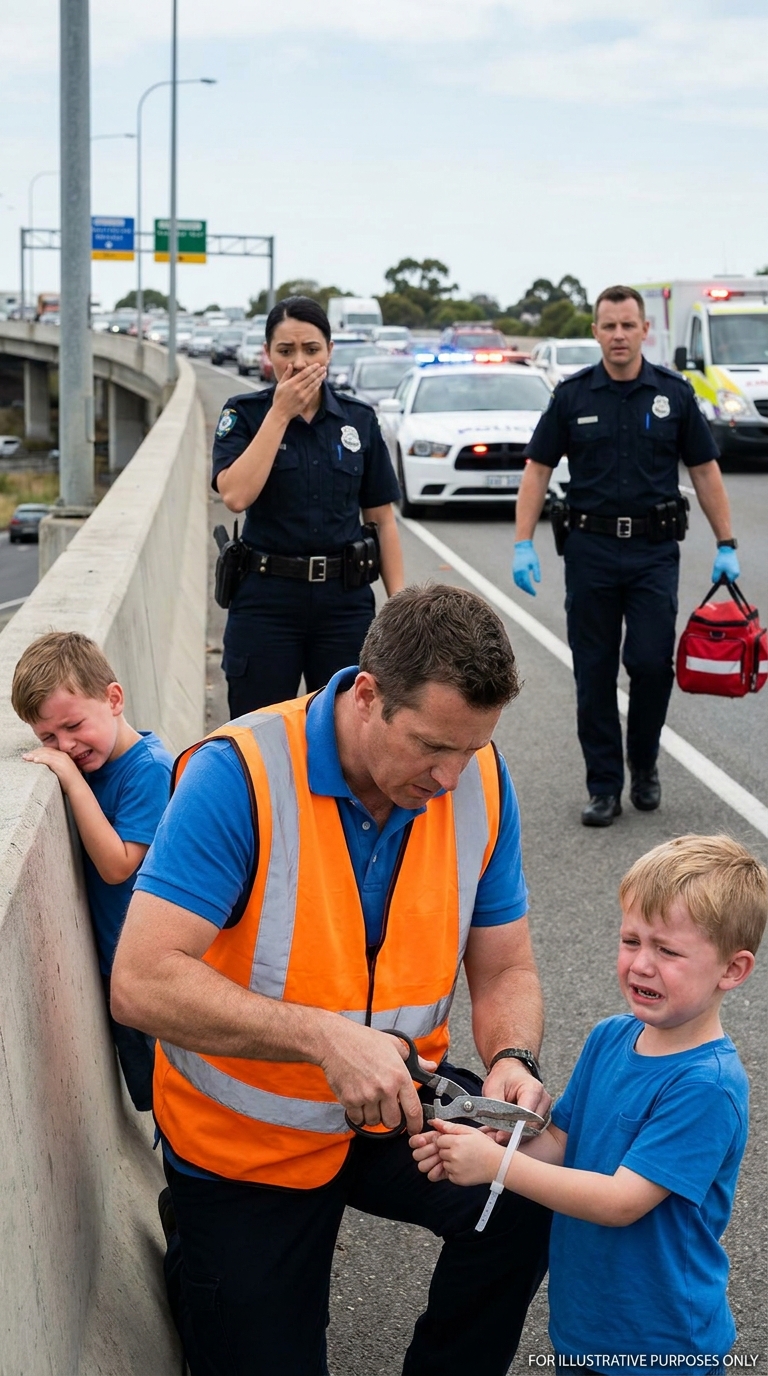
The blue van moved between the cars with a slowness that felt anything but accidental.
It did not act like a driver trapped in traffic. It did not try to switch lanes. It did not honk. It did not speed up whenever a gap opened.
It just kept coming toward us.
As if whoever was inside already knew exactly where we were.
Marissa held the second twin tight against her chest. The boy was shaking so hard that his little shirt trembled beneath her hands. I had the other one pressed against my vest, his face buried against my neck, breathing in short, broken sobs.
“Do you recognize it?” I asked.
Marissa did not answer right away.
Her eyes stayed locked on the van’s dark windshield.
“Ten minutes ago,” she finally said, “I saw a van just like that at the southbound turnaround. I thought the driver was just trying to get out of traffic.”
“Plates?”
“Covered with mud.”
That was enough.
I pressed the button on my radio.
“Unit Twelve to Dispatch. I have a possible involved vehicle approaching the overpass. Blue van, obstructed plates, northbound slow lane. I need an immediate block at the end of the overpass. Keep EMS back until we secure the scene.”
Dispatch answered through static.
“Copy, Unit Twelve. Backup is two minutes out.”
Two minutes.
On a highway, two minutes can be an entire lifetime.
I looked at the boy in my arms. His wrists were marked by the plastic. His skin was torn. His fingers were swollen. On his forearm, the black ink looked too fresh, too perfect.
The broken bird symbol.
Under it, the numbers:
417-23B.
The other boy had almost the same mark.
417-23A.
A and B.
They were not names.
They were labels.
Rage rose in my throat, hot and bitter. I forced it down because a terrified child was listening to me breathe. Because his tiny body needed me not to fall apart right there.
“Marissa,” I said. “Get them behind the cruiser.”
“Caleb—”
“Now.”
She understood. She moved fast, using my patrol car as cover where it sat angled across the lane. I stepped into the middle of the road, raised one hand, and pointed the other toward the van.
“Stop the vehicle!”
The van did not stop.
It did not speed up either.
That was the worst part.
It kept rolling forward slowly, as if the person behind the wheel was watching, measuring, deciding.
The trapped drivers around us began leaning on their horns. Some lifted their phones. Others lowered their windows, shouting questions I could not answer.
“Turn off the engine!” I shouted. “Show me your hands!”
The van stopped about fifty feet away.
For one second, nothing happened.
Then the driver’s door opened.
A man in his forties stepped out. Gray shirt. Baseball cap. Trimmed beard. His hands were raised, but he did not look scared.
That disturbed me even more.
Most innocent people panic when a police officer points a gun at them in the middle of a highway.
He didn’t.
He smiled faintly.
“Officer,” he said, “I think there’s been a misunderstanding.”
“On your knees.”
“I only came to help.”
“On your knees. Now.”
The man looked over my shoulder toward the cruiser where Marissa was shielding the children.
And then one of the twins screamed.
Not like before. Not pain.
Pure terror.
The boy I had held moments earlier twisted in Marissa’s arms and began crying with a desperation that shook his whole body.
“No! No! No!”
That was all he said.
Again and again.
The man stopped smiling.
It was only a brief change in his face, but I saw it. The mask slipped for half a second.
“Get on the ground,” I repeated.
The man obeyed slowly.
Too slowly.
As he lowered himself, his right hand moved near his pocket.
“Hands up!”
But it was already too late.
He pulled out something small.
It was not a gun.
It was a remote.
I fired my voice before I fired my weapon.
“Drop it!”
The man pressed the button.
Nothing exploded. No alarm sounded. No engine roared.
But from inside the blue van, we heard a thump.
Then another.
Like something had unlocked inside.
The side door opened a few inches.
And from that narrow opening came a sound I still hear some nights when I close my eyes.
A cry.
Not from the twins.
Another one.
Weaker.
Smaller.
Marissa looked at me from behind the cruiser.
“Caleb…”
I kept my gun on the man.
“Don’t move!”
Officer Davis arrived behind him with another unit and forced the driver down onto the pavement. As soon as the cuffs were on him, I ran to the van.
The smell hit me when I opened the side door.
Sweat. Plastic. Urine. Fear.
Inside were old blankets, water bottles, a child’s backpack, and several black zip ties exactly like the ones used on the twins.
In the back, curled behind a toolbox, was a little girl.
She could not have been more than four.
Her blond hair was stuck to her face. Her eyes were so wide they barely seemed to belong to her. In her arms, she held a teddy bear missing one ear. Her wrists were marked too, though she was not tied at that moment.
She lifted one forearm to shield herself when I moved closer.
And there it was.
The same symbol.
The broken bird.
Under it:
417-22C.
The air seemed to leave my lungs.
“She’s alive,” I said into the radio. “We have another minor. Repeat, another child inside the vehicle.”
The little girl was not crying loudly. She was making a small, repeated sound, like she was apologizing for existing.
I pulled off my stained gloves and held out my open hand.
“Hi, sweetheart. My name is Caleb. I’m not going to hurt you.”
She looked past me, toward the man handcuffed on the pavement.
Her lips moved.
I barely heard her.
“He’s not the boss.”
The entire overpass seemed to go still.
“What did you say?”
The girl squeezed the teddy bear against her chest.
“He only drives.”
I looked at Davis.
Davis looked at me.
And then we understood.
The driver had not come back to recover the children.
He had come back to see who found them.
To measure the response.
To confirm how much we knew.
The ambulance arrived with three paramedics. They checked the twins and the girl right there behind the cruisers while we shut down the entire overpass. The trapped cars were diverted one by one. The traffic cameras were secured. The driver was placed in a separate unit.
He did not say another word.
Not one.
But the girl did.
At first, she spoke in broken phrases. She said her name was Lily, though she was not sure if that was her “before name” or the one they had given her. She said the twins were named Noah and Eli. She said they had been kept in “the white house,” but it was not a real house. It was “a place with covered windows.”
She said there were more children.
Every word sank us deeper.
The paramedics wrapped all three children in thermal blankets. Noah, the twin I had carried, would not let go of a corner of my uniform. Every time someone tried to separate him from me, he cried until he could not breathe.
“It’s okay,” I told him. “I’m staying right here.”
Marissa knelt beside Eli, speaking softly, telling him simple things: that the ambulance had lights, that Lily’s bear was brave, that no one would ever put anything around his wrists again.
But I saw her face.
Marissa had two children.
One was three.
The other was five.
And there are moments in this job when you are not a police officer, not a highway patrolman, not a trained professional.
You are just a person trying not to imagine your own children’s faces on the bodies of the children you are rescuing.
At 5:18 p.m., a technician from the Special Crimes Unit arrived at the overpass. He photographed the marks, the zip ties, the van, and the exact place where we had found the twins. When he saw the codes on their arms, his expression changed.
“You’ve seen these before?” I asked.
He did not answer right away.
That told me enough.
“Six months ago,” he finally said, “we found a similar mark in a fake custody case in Nevada. We thought it was isolated.”
“Fake custody?”
“People posing as social workers. False paperwork. Fake court orders. They pick up children from vulnerable families or temporary foster placements, move them across state lines, and change their names.”
I looked at Noah.
He was asleep from exhaustion against a blanket, his lips parted and his eyelashes stuck together with dried tears.
“And the code?” I asked.
The technician swallowed.
“Inventory.”
No one said anything for several seconds.
Inventory.
A clean word.
An administrative word.
A word that should belong to boxes, tools, or furniture.
Not children.
The investigation moved fast because it had to move fast. Every hour could mean another child being moved, hidden, or sold into a new lie.
The driver’s phone was found under the seat. It was locked, but notifications appeared on the screen before it powered off.
One read:
Did you recover A and B?
Another came seconds later:
If police are there, activate bridge protocol.
And a third:
Don’t leave small witnesses.
Marissa read that last line and had to turn away.
I felt a rage so large that, for a moment, I was afraid of what I might do if I stayed near the driver.
Then Noah woke and murmured something.
I leaned closer.
“What is it, champ?”
He lifted one bandaged hand and touched my vest.
“Bad bird,” he whispered.
“What?”
He pointed to his arm.
“Bad bird is on the door.”
I froze.
“What door, Noah?”
The boy began to tremble.
“Red door.”
Red door.
White house.
Covered windows.
Broken bird.
It was not much.
But in cases like this, children do not give you maps. They give you pieces of the world that survived in their memory.
And sometimes, one piece is enough.
At 6:03 p.m., an officer reviewed footage from a nearby gas station. The blue van had passed through at 3:21. Before entering the highway, it had stopped beside a white vehicle with no front plate.
In the footage, barely visible, the rear door was open.
It was red.
The technician zoomed in.
On the door was a black symbol.
A bird with broken wings.
Twenty-two minutes later, a state police drone located the white vehicle parked behind an abandoned warehouse outside Brookhaven, Pennsylvania, less than twenty miles from the overpass.
The warrant came before nightfall.
I was not supposed to go.
My job was highway patrol. I had done my part. Technically, I was supposed to hand the case over to Special Crimes.
But Noah was still holding my sleeve.
And when a nurse tried to take him to the hospital, the boy woke up screaming:
“Cal won’t go!”
I do not know when he decided to call me Cal.
I do not know why that detail broke me so badly.
Maybe because, for the first time since I found him, he did not see me as a uniform. He saw me as something simpler.
Someone who had not left.
The commander looked at me.
“Brooks, you’re coming with us, but you stay behind.”
I nodded.
I lied with my head because we both knew that if there were children inside, I was not going to stay behind.
The warehouse stood in an old industrial part of town, where the closed factories looked like skeletons against the orange sky. There was no movement outside. The windows were boarded up. The side door was red, freshly painted, too clean for an abandoned building.
On the wood, someone had drawn the symbol.
The broken bird.
We entered at 7:12 p.m.
The first room was empty.
So was the second.
In the third room, we found backpacks.
Small ones.
Colorful ones.
One had dinosaurs. Another had stars. Another still had a school tag attached.
Then we heard a knock.
Three times.
From below.
There was a trapdoor under an old rug. They pried it open with a crowbar, and the smell that rose from it confirmed the worst before we saw anything.
We went down a narrow staircase.
Below was a basement divided with wooden panels. Mattresses on the floor. Bottles. Children’s clothes folded in boxes.
And children.
Six of them.
The oldest could not have been more than eight.
The youngest could barely walk.
For one second, none of them moved. They stared at us as if they did not know whether we were real or just another trap.
Then Marissa removed her helmet.
“We’re the police,” she said, her voice breaking halfway through the sentence. “We’re here to take you home.”
A dark-haired boy began to cry.
Then another.
Then all of them.
There is no training for that sound.
There is no academy that teaches you how to breathe when six children come out of a basement thinking that maybe, just maybe, the world still has a safe place for them.
In a back room, we found false documents, photographs, altered hospital bracelets, adoption files, lists of names, and interstate routes.
We also found a wall covered in codes.
417-19A.
417-21D.
417-22C.
417-23A.
417-23B.
And many more.
Too many.
Some had been crossed out.
Others had recent dates.
One of the agents punched the wall with his fist. No one corrected him.
At 8:46 p.m., two more people were arrested in a house connected to the warehouse: a woman who claimed to work for a family support organization and a man carrying fake child services credentials.
But someone was still missing.
“The boss,” as Lily had called him.
He did not appear that night.
Or the next day.
For three weeks, the case grew like a crack running through an entire house. Every document led to another name. Every name led to another address. Every address led to another broken family or another child who had passed through the wrong hands.
The driver of the blue van finally talked.
Not out of guilt.
Out of fear.
He said the overpass was not an abandonment. It was a test. They wanted to know how long it would take police to respond if they left two children visible during rush hour. They wanted to measure timing, cameras, patrol routes, and escape paths.
Noah and Eli had been used as bait.
When I heard that, I had to leave the room.
I leaned against a hallway wall and breathed until the world stopped tilting.
That night, I went to the hospital.
The twins were in adjoining rooms. Lily was asleep with her teddy bear repaired with medical tape. Noah had fresh bandages around his wrists. Eli had started talking a little more.
Marissa was sitting beside them with dark circles under her eyes and an untouched cup of coffee in her hands.
“They found their mother,” she told me.
I went still.
“Alive?”
Marissa nodded.
“Yes.”
Her name was Hannah Miller. She was twenty-four years old and lived in a rural county two states away. She had reported her twins missing eleven days earlier, but the report had been lost between jurisdictions, incomplete forms, and an overwhelmed office.
They had been taken from a temporary daycare placement using fake documents.
When Hannah arrived at the hospital, she wore wrinkled clothes, her hair tied back carelessly, and the face of someone who had not slept since the world ended.
When she saw Noah and Eli through the glass, she lifted both hands to her mouth.
She did not scream.
She did not run.
She simply fell to her knees.
As if her body could not hold that much hope all at once.
The boys took a few seconds to recognize her.
Trauma does that. It puts fog between love and memory.
But then Eli lifted his head.
“Mommy.”
Hannah broke.
She held them so carefully, as if she feared love might hurt them too. She kissed their hair, their foreheads, their bandaged hands. She kept repeating their names again and again.
“Noah. Eli. My babies. My babies.”
I stayed by the door and did not go in.
It was not my moment.
But Noah saw me.
With one arm still wrapped around his mother’s neck, he reached the other hand toward me.
“Cal.”
Hannah looked up.
She did not say thank you right away. Sometimes that word is too small for certain things.
She only looked at me as if she were trying to memorize my face.
And she cried.
Two months later, they caught the man the children called “the boss.”
It was not during a dramatic chase. There were no gunshots or helicopters. They found him in a clean office with white walls, an expensive suit, and family photographs on his desk.
That was the detail that made me sickest.
He had children.
They smiled in the photos.
They played on the beach.
They blew out birthday candles.
And yet he had built a system where other children were reduced to codes, routes, and marks on their skin.
The broken bird symbol turned out to be his own creation. He used it to identify “processed” children, as if pain needed a logo.
At the trial, Hannah testified.
Lily testified too, with a therapist beside her and her repaired teddy bear in her arms. She did not have to say much. She only told them about the red door, the white building, and how Noah had bitten one of the men so Eli could hide a bracelet with his real name under the mattress.
That bracelet helped connect three missing case files.
Three families got their children back because of a bracelet bitten and hidden by a two-year-old boy who still could not properly pronounce his own last name.
When it was my turn to testify, the defense attorney tried to suggest that I had exaggerated the scene on the overpass. He said officers under stress could misinterpret things. He said maybe the zip ties had been used to “keep the children from running into traffic.”
I looked at him for several seconds.
Then I described Noah’s wrists.
Eli’s purple knuckles.
The way Lily lifted her arm to protect herself before she understood that I was not going to hit her.
The jury did not look away.
The man was convicted.
I will not say that fixed everything, because that would be a lie.
There are wounds no sentence can erase. There are children who still wake up in the middle of the night. There are mothers who check the locks three times even after they are home. There are police officers who still look at every highway overpass with a knot in their stomach.
But there was life after.
Noah and Eli went home with Hannah.
Lily was reunited with an aunt who had searched for her for almost a year.
The six children from the basement found families—some by blood, some chosen—all willing to learn that rescue does not end when a door opens. Sometimes that is when the hardest work begins.
One year after the overpass, I received a letter.
The envelope had crayon drawings on it: two patrol cars, a bridge, a huge sun, and three children holding hands.
Inside was a photo.
Noah and Eli were in a park, wearing red T-shirts, their faces clean, their wrists covered with colorful bracelets. Beside them stood Lily, holding her teddy bear, now properly stitched back together.
Behind them, Hannah was smiling.
At the bottom, in crooked letters, someone had written:
“Thank you for not leaving us on the bridge.”
I sat on the edge of my desk and read that sentence many times.
Twelve years on patrol had taught me that we do not always arrive in time. Sometimes the calls come too late. Sometimes the road wins.
But that afternoon, we arrived.
Marissa arrived.
The drivers who called arrived.
The little girl who dared to say, “He’s not the boss,” arrived.
And a two-year-old boy, with injured wrists and a code on his arm, survived long enough to point the way to others.
Since then, every time I pass that stretch of I-95 and see that overpass, I do not think first about the blue van.
Or the zip ties.
Or the broken bird symbol.
I think about three children in a park beneath a sun drawn in crayon.
I think about one sentence written by small hands.
And I remember that even in places where someone tried to turn fear into a trap, a voice can still appear on the other side of the radio, saying:
“We saw them.”
“They’re there.”
“Please, somebody stop.”