
Two months ago, my wife drove to Knoxville to help our son and daughter-in-law settle into their new home.
Two months ago, my wife drove to Knoxville to help our son and daughter-in-law settle into their new home.
Maggie planned to stay for two weeks.
After only four days, she stopped answering my calls.
By the fifth morning, I climbed into my truck and made the three-hour drive myself. I had barely turned onto Kevin’s street when an elderly neighbor hurried toward me and said, “Call an ambulance before you step inside that house.”
Then my son opened the front door like I was the one causing trouble.
Maggie had always been the kind of woman who could transform chaos into comfort.Two months ago, my wife drove to Knoxville to help our son and daughter-in-law settle into their new home.
Give her a room full of unopened boxes, loose screws, tangled cords, and half-assembled furniture, and somehow she would know exactly where everything belonged. She folded towels like they came from a luxury hotel. She labeled pantry shelves. She could organize a house before anyone else realized what needed organizing.
So when Kevin called and said he and Brittany felt overwhelmed after moving into their new place in West Knoxville, Maggie packed her bags almost immediately.
“They need help,” she told me in our Nashville kitchen, adjusting the reading glasses resting on top of her head. “It’s only two weeks, Frank. I’ll unpack everything, organize the kitchen, and get them settled.”
I wasn’t happy about it.
Not because I didn’t love my son.
Because something about him had been bothering me for months.
Too many questions about our retirement savings.
Too many comments about how large our house was for just two people.
Too many jokes about family helping family before outsiders got involved.
Maggie thought I was imagining things.
“He’s stressed,” she said. “Moving does that to people.”
So I kissed her goodbye in the driveway and watched her leave with a cooler in the trunk, a casserole wrapped in towels, and enough optimism to brighten an entire neighborhood.
For the first four days, she texted every morning.
**Good morning.**
**Miss you.**
**Brittany still can’t find the silverware drawer.**
**Kevin still hangs curtains crooked.**
Then the messages stopped.
I called.
No answer.
I texted.
Nothing.
I called Kevin.
“She’s fine, Dad,” he said. “Just tired. We’ve been keeping her busy.”
Then he laughed.
Something about it felt wrong.
By day five, I stopped waiting.
The drive to Knoxville felt endless.
Every mile gave me another excuse.
Maybe her phone died.
Maybe she forgot her charger.
Maybe she was sleeping.
Maybe she was fine.
But after forty-one years of marriage, I knew the difference between silence and absence.
Kevin’s neighborhood looked perfect.
Wide lawns.
Brick mailboxes.
Mature oak trees.
Porch lights glowing beneath afternoon shade.
His house sat near the end of the block with white shutters, a broad porch, and curtains pulled tightly closed.
Too quiet.
I parked along the curb.
Before I even reached the walkway, an elderly man hurried across the street. He looked close to eighty, thin and anxious, moving like someone who had been waiting for days to speak.
“You related to the woman in that house?” he asked.
“She’s my wife,” I said. “Frank Callaway.”
“Earl Hutchins.”
He barely finished introducing himself before pointing toward Kevin’s house.
“You need to call an ambulance right now.”
My hand immediately reached for my phone.
“What happened?”
His eyes shifted toward the upstairs windows.
“Three days ago, I saw your wife through the kitchen window. She was sitting at the table and suddenly slipped right out of her chair.”
The world narrowed around me.
“I yelled over to your son,” Earl continued. “He told me she was fine. Said she’d had too much wine at dinner. But I watched for nearly an hour. Nobody helped her up.”
My stomach tightened.
“What else?”
“I called for medical help anyway. Paramedics showed up. Your son met them outside and said she’d already spoken to a doctor. Said everything was under control.”
The entire street seemed to fall silent.
I called emergency services immediately, giving the dispatcher the address and every detail I knew. Thirty years in law enforcement had taught me how to speak clearly during a crisis.
My wife had been unresponsive.
She had not answered calls in days.
I believed she needed immediate medical attention.
Then I walked to the front door.
Kevin opened it before I could knock twice.
“Dad,” he said, blinking in surprise. “I didn’t know you were coming.”
“Where’s your mother?”
“She’s upstairs resting. She’s just tired. Brittany’s been taking care of—”
I stepped past him.
“Dad, wait.”
I didn’t stop.
The house smelled like fresh paint, cardboard, and something sweet drifting from the kitchen.
Boxes lined the hallway, but nothing looked chaotic enough to explain four days of silence.
Halfway up the stairs, Brittany appeared.
She wore a soft sweater. Her hair was neatly styled. Her expression remained calm.
“Frank,” she said carefully. “You’re scaring us.”
“Where’s Maggie?”
“She’s sleeping. She asked not to be disturbed.”
I stared at her.
“My wife hasn’t answered a phone call in four days.”
Kevin appeared behind me.
“Dad, you’re making this into something bigger than it is.”
That sentence changed everything.
Because I had heard versions of it before.
Whenever Kevin needed money.
Whenever Kevin wanted forgiveness.
Whenever Kevin expected us to ignore another problem.
You’re overreacting.
You’re being dramatic.
You don’t understand how hard things are.
I kept walking.
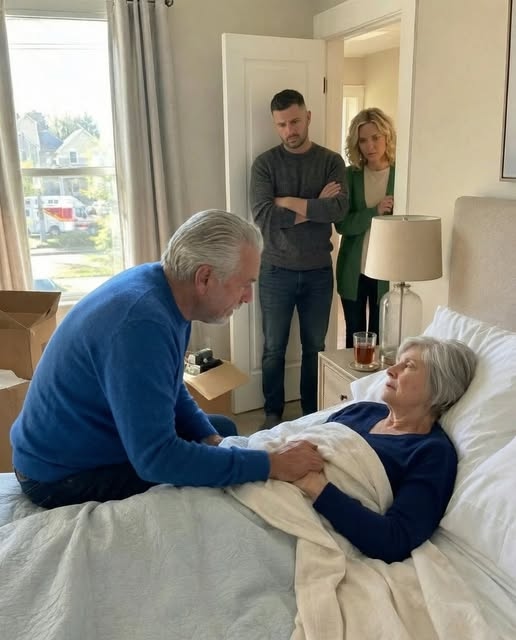
I found Maggie in the upstairs guest room.
The curtains were closed.
The air felt stale.
She lay beneath the blankets with only her face visible.
And the second I saw her, every excuse Kevin had offered disappeared.
She looked smaller.
Paler.
As though something had been slowly draining her while everyone downstairs rehearsed explanations.
When I switched on the lamp, her eyes opened.
She saw me.
“Frank,” she whispered.
The relief on her face frightened me more than anything else.
Because it meant she had been waiting.
I sat beside her and took her hand.
“I’m here,” I told her. “Help is on the way.”
Behind me, Kevin spoke from the doorway.
“She had a reaction to something. We were handling it.”
I turned toward my son.
Not angry.
Not shouting.
Just using the voice I had relied on during decades of police work whenever lies entered a room pretending to be concern.
“Don’t say another word.”
The ambulance arrived minutes later.
Kevin and Brittany stayed on the porch.
They never followed us to the hospital.
And that was when I stopped thinking only like a frightened husband and started noticing details like the investigator I used to be.
The closed curtains.
The missing phone.
The neighbor nobody wanted to listen to.
The sweet tea Brittany brought Maggie every night.
And the expression on Kevin’s face as the ambulance doors closed.