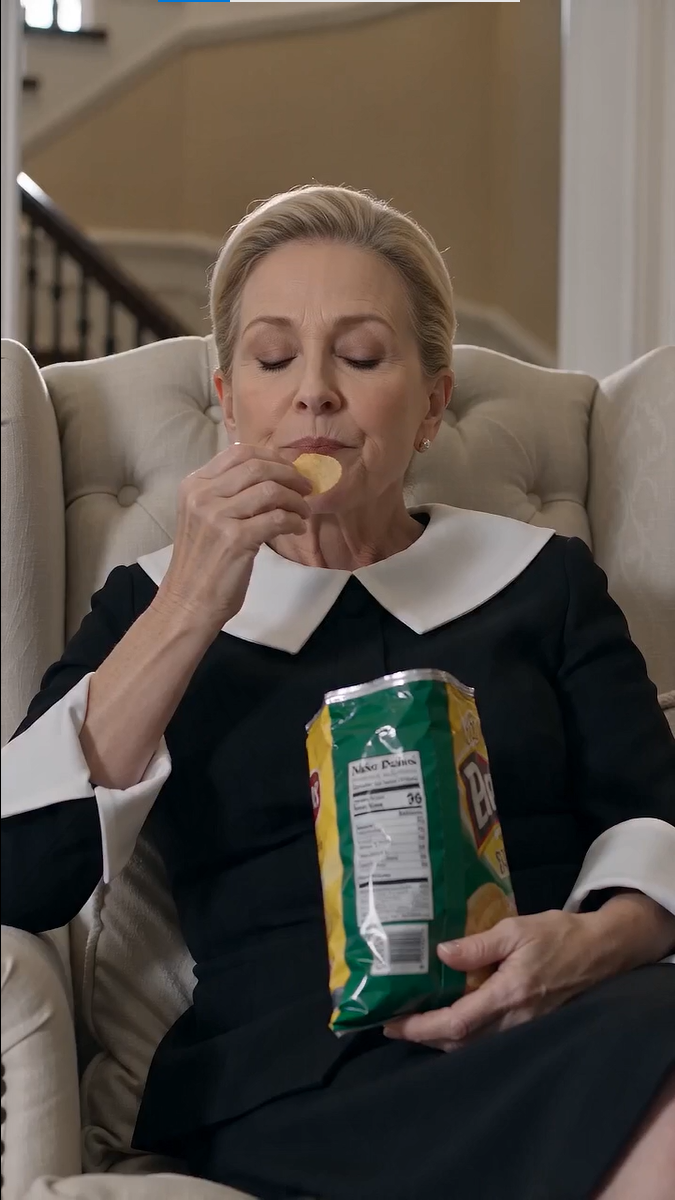
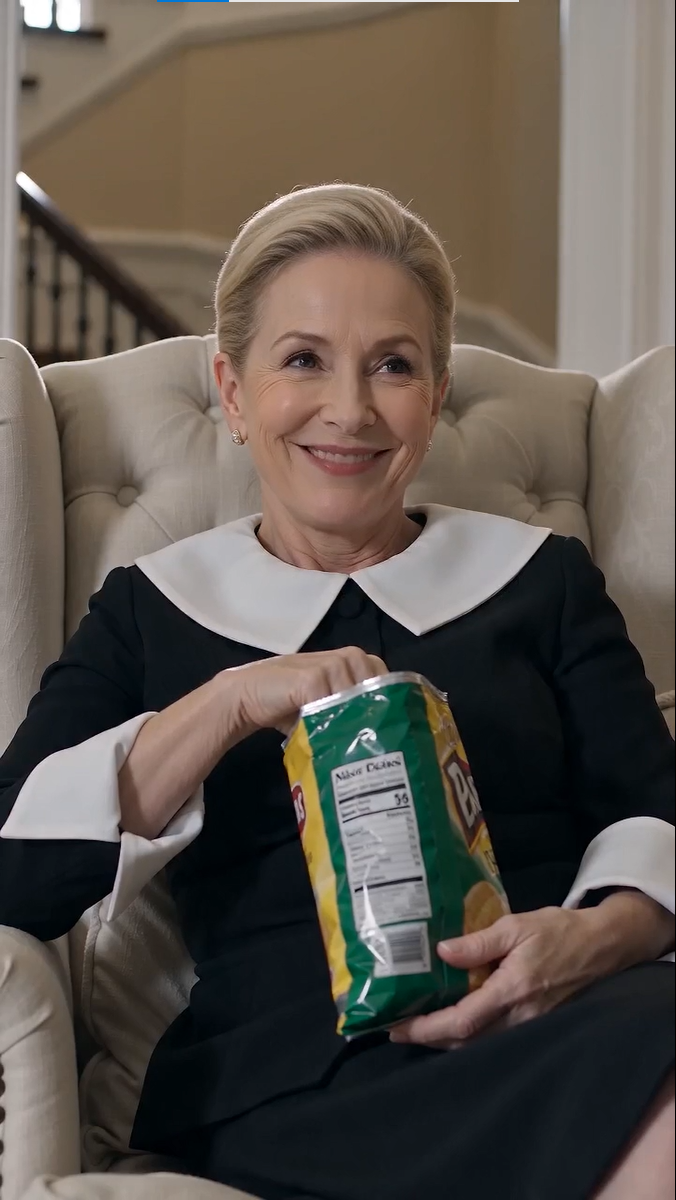
The chip stayed frozen in the housekeeper’s hand.
The little girl lifted her tearful face toward the door, afraid to hope too fast.
Then it opened.
Her father stepped inside without saying a word.
The housekeeper jumped from the chair, dropping the chip bag onto the floor.
“Sir, I can explain.”
But his eyes were not on her.
They were on his daughter’s red hands, her wet cheeks, and the mop lying beside her knees like proof of everything he had almost missed.
The girl’s voice broke.
“Daddy…”
That one word destroyed him.
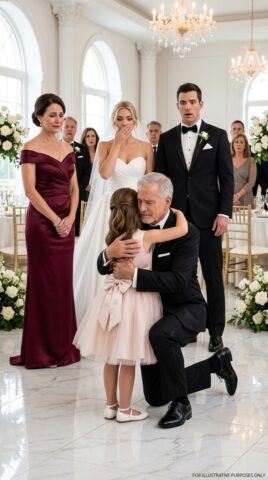
He crossed the foyer, knelt in front of her, and gently took her shaking hands in his.
“I’m here,” he whispered. “You don’t have to clean anymore.”
The housekeeper tried to step back.
The father slowly lifted his phone.
The live footage was still playing.
Every cruel word.
Every tear.
Every second.
Her face went pale.
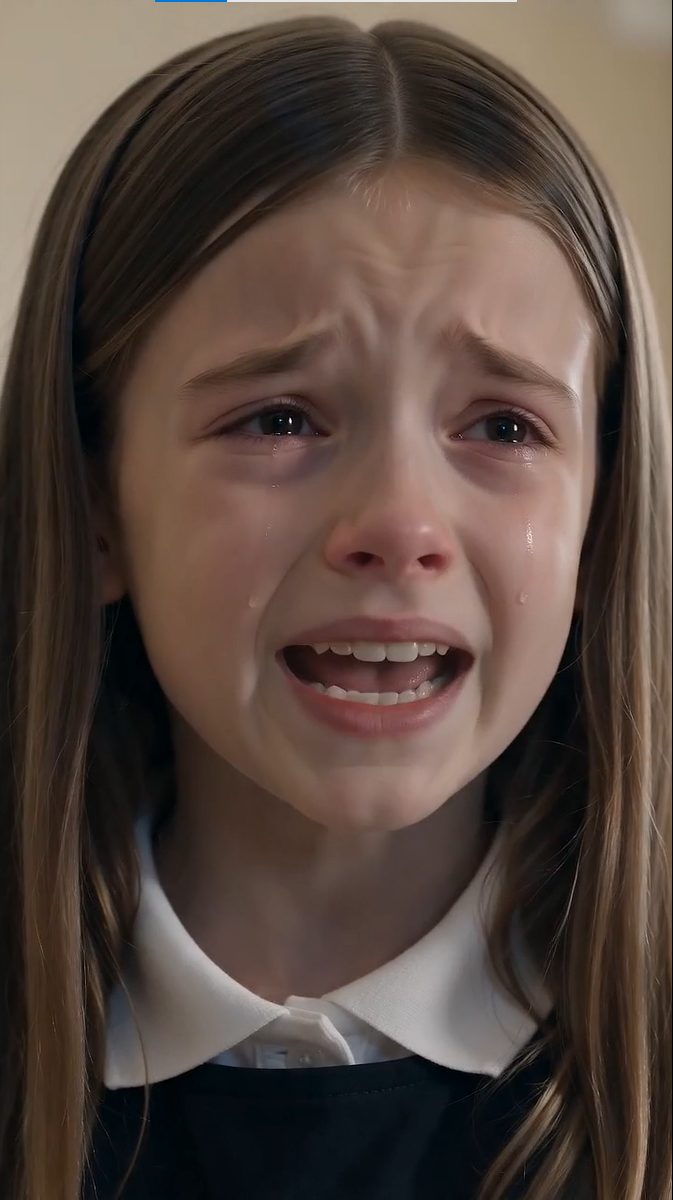
“I thought the cameras were off,” she whispered.
The father stood, holding his daughter close.
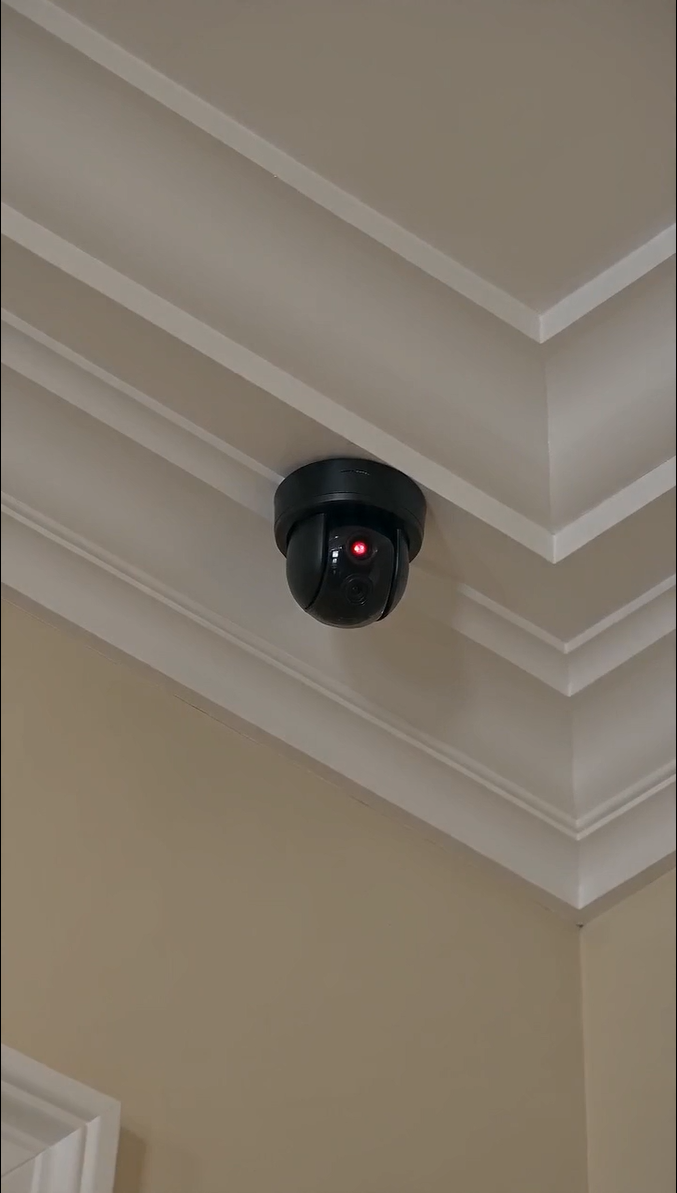
“They were never for thieves,” he said. “They were for people like you.”
The little girl buried her face in his jacket and finally cried out loud.
And for the first time, the housekeeper was the one standing helpless on the marble floor.
For a few seconds, nobody moved.
The big house, usually so quiet that even footsteps echoed, felt frozen around them.
The mop lay across the floor.
The spilled chips were scattered near the chair.
A bucket of dirty water sat beside his daughter’s knees.
And his little girl, his only child, was clinging to him like she had been waiting days, maybe weeks, for someone to finally see her.
He tightened his arms around her.
“Emily,” he whispered, pressing his cheek against her hair. “Why didn’t you tell me?”
Her small hands gripped his jacket.
“I tried,” she cried. “But you were always busy.”
The words hit harder than anything the housekeeper could have said.
He closed his eyes.
Because she was right.
He had been busy.
Meetings.
Calls.
Flights.
Deadlines.
A calendar so full he had mistaken providing for loving.
He had given his daughter a beautiful house, the best school, the safest neighborhood, expensive clothes, a room full of toys.
But somehow, inside all of that, she had still been alone.
The housekeeper quickly wiped her hands on her apron.
“Sir, she’s exaggerating. Children get emotional. I only asked her to help a little. She made a mess first. I was teaching her responsibility.”
He turned to look at her.
Slowly.
The kind of look that made every lie die before it could fully leave the mouth.
“Teaching her responsibility?” he asked quietly.
The housekeeper swallowed.
“She spilled juice.”
He looked down at the bucket.
“She spilled juice, so you made her scrub the foyer?”
“I was going to help her.”
He lifted his phone again.
On the screen, the footage showed the housekeeper sitting in the chair, eating chips while Emily cried on the floor.
Her voice came clearly through the speaker.
“Clean faster. Your father won’t believe you anyway.”
The housekeeper’s lips parted.
No excuse came.
Emily trembled against him.
Her father lowered the phone.
“You told my daughter I wouldn’t believe her?”
The housekeeper’s face twisted.
“I didn’t mean it like that.”
He stepped closer, still holding Emily with one arm.
“You told a seven-year-old child that her father would not believe her pain.”
The housekeeper looked toward the hallway, then toward the door, as if calculating how quickly she could escape.
“You’re fired,” he said.
Her face hardened.
“Sir, please. I need this job.”
“And my daughter needed kindness.”
The housekeeper’s eyes filled, but he no longer trusted tears that appeared only after consequences.
“You have ten minutes to collect your things from the staff room. You will not go upstairs. You will not speak to my daughter. And if you try to delete, touch, or take anything from this house, I will call the police before you reach the gate.”
She stared at him.
Then at Emily.
For one second, anger flashed across her face.
Not guilt.
Not shame.
Anger.
That told him everything.
He opened the front door and called for the security guard outside.
“Stay with her while she collects her belongings,” he said. “Then escort her out.”
The housekeeper’s voice shook.
“You’re making a mistake.”
He looked at Emily’s red hands.
“No,” he said. “I already made one. I’m correcting it.”
The security guard stepped in.
The housekeeper picked up her bag with stiff, angry movements. She avoided looking at Emily now, as if the child she had controlled for so long had suddenly become too powerful to face.
As she passed the spilled chips, one crushed under her shoe.
The sound was small.
But Emily flinched.
Her father felt it.
And something inside him broke again.
When the housekeeper disappeared down the hallway, he knelt back down in front of his daughter.
“Emily,” he said softly.
She wouldn’t meet his eyes.
He took her hands carefully and saw the redness across her palms.
Not terrible wounds.
But enough.
Enough to show effort.
Enough to show she had been scrubbing.
Enough to show she had obeyed because she was afraid.
“I’m so sorry,” he whispered.
Her chin trembled.
“You said she was nice.”
He looked down.
“I thought she was.”
“She was nice when you were home.”
He nodded slowly.
That was the part that hurt most.
“She said if I told you, you would send me away.”
His head snapped up.
“What?”
Emily’s voice became smaller.
“She said bad children get sent away. She said if you knew I cried too much, you would get tired of me.”
For a moment, he could not breathe.
He had negotiated with powerful men.
He had stood in rooms where millions were on the line.
He had been calm under pressure, calm in grief, calm in failure.
But nothing had ever made him feel as helpless as hearing his daughter say those words.
He pulled her into his arms again.
“Listen to me,” he said, his voice shaking. “Look at me, sweetheart.”
Emily slowly lifted her eyes.
“You are not bad.”
Her lips quivered.
“You are not too much. You are not a burden. And there is nothing, nothing in this world, that could make me send you away.”
A tear slid down her cheek.
“But you leave all the time.”
He closed his eyes.
There it was.
The truth beneath everything.
Not just the housekeeper.
Not just the mop.
Not just the cameras.
The deeper wound.
He had left her too many mornings with a kiss on the forehead and a promise to be back soon.
He had missed dinners.
Missed bedtime stories.
Missed school drawings taped to the fridge.
Missed the way her smile had become smaller over the months.
And while he was busy building a future for her, someone had been breaking her present.
“You’re right,” he whispered.
Emily blinked.
He swallowed hard.
“I have been gone too much.”
Her small face crumpled again.
“I waited for you.”
“I know.”
“I waited by the window.”
“I know, baby.”
“And sometimes I fell asleep there.”
His hand covered his mouth for a second.
He had seen her asleep by the window before.
He had thought it was cute.
He had carried her to bed, kissed her cheek, and gone back to his laptop.
He had not understood.
Or maybe he had not allowed himself to understand.
“I’m here now,” he said.
“But tomorrow?”
The question was quiet.
Terrified.
He looked at her, and for the first time in years, he knew there was only one right answer.
“Tomorrow too.”
She stared at him, unsure.
“And the day after?”
“Yes.”
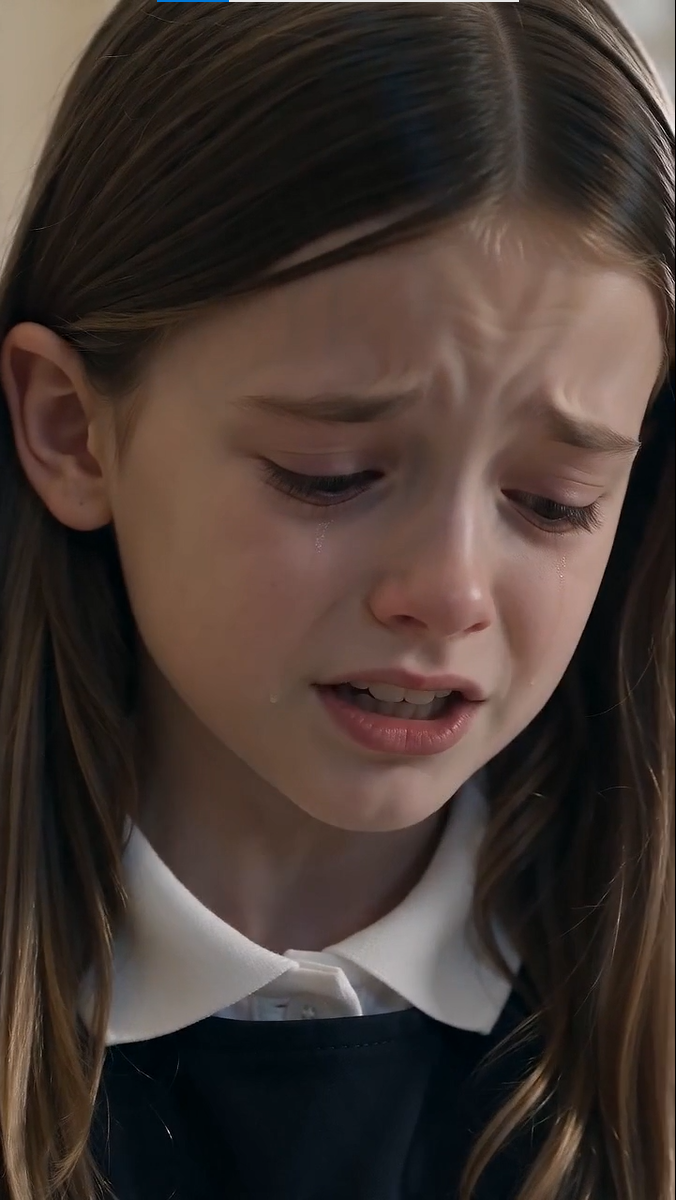
“What about your work?”
He brushed her hair back from her damp cheek.
“My work can wait.”
She looked confused, like she had never heard those words from him before.
Maybe she hadn’t.
He stood up, lifted her gently into his arms, and carried her away from the cold marble floor.
“Where are we going?” she whispered.
“To clean your hands.”
She stiffened.
“No more cleaning,” he said quickly. “I mean I’m going to wash them for you.”
In the bathroom, he turned on warm water and held her small hands under the stream.
She winced at first.
He noticed every flinch.
Every little sign he had missed before.
“I’m sorry,” he said again.
Emily looked at him through the mirror.
“You keep saying that.”
“Because I should have said it sooner.”
He dried her hands with a soft towel, then found cream in the cabinet and gently rubbed it over her palms.
She watched him carefully.
Like she was waiting for him to become busy again.
Waiting for his phone to ring.
Waiting for the moment she would lose him.
His phone did ring.
The sound cut through the bathroom.
Emily’s shoulders dropped before he even moved.
He saw it.
And this time, he understood.
He took the phone from his pocket, looked at the name on the screen, and declined the call.
Then he turned it off.
Emily stared.
“You turned it off?”
“Yes.”
“What if it’s important?”
He looked at her.
“You are important.”
Her eyes filled again, but this time the tears were different.
Not fear.
Not pain.
Something softer.
Something she almost did not trust.
He carried her to the kitchen and made her hot chocolate, even though it was afternoon. He burned the first cup because he had not made it himself in years. Emily almost smiled when he frowned at the microwave like it had betrayed him.
He made a second cup.
This one was better.
They sat at the kitchen island together.
For the first time in a long time, the house did not feel like a museum.
It felt like a home trying to remember how to breathe.
After a while, Emily whispered, “Are you still mad?”
He looked at her.
“Not at you.”
“At her?”
“Yes.”
“At yourself?”
The question was so honest, so innocent, that he had no defense against it.
He nodded.
“Yes.”
Emily looked down at her cup.
“I was mad at you too.”
He swallowed.
“You had every right to be.”
“I don’t want to be.”
“I know.”
“But I was.”
He reached across the table and held her hand.
“I can handle that.”
She looked up.
“You won’t be angry?”
“No.”
“You won’t leave?”
“No.”
She studied him, searching for the lie.
Then she asked, “Can I show you something?”
“Anything.”
She climbed down from the stool and ran upstairs.
For a moment, he heard her small feet moving across the ceiling.
Then she came back holding a purple notebook against her chest.
She placed it on the table but kept one hand over it.
“What is it?” he asked.
“My brave book.”
His chest tightened.
“Your brave book?”
She nodded.
“When I got scared, I wrote things.”
He waited.
She opened it slowly.
The pages were filled with uneven handwriting, little drawings, and dates.
Some entries were small.
Daddy came home late.
Mrs. Carter said I ask too many questions.
I miss Mommy.
He stopped breathing.
His wife.
Emily’s mother.
The grief they never talked about properly because he had been too afraid it would break both of them.
Emily turned another page.
Today I cleaned the stairs.
My hands hurt.
I didn’t cry loud.
I am trying to be good.
He looked away, but the tears came anyway.
Emily watched him nervously.
“Did I do something wrong?”
“No,” he said quickly, pulling her close. “No, sweetheart. You did nothing wrong.”
She held up the notebook.
“I wrote because Mommy said words can hold things when hearts get too full.”
He closed his eyes.
That sounded exactly like her.
His wife had been gentle in a way that made the whole world softer. After she passed, he had tried to protect Emily by not talking about her too much. He thought silence would make the pain smaller.
But silence had only made Emily lonelier.
He opened the notebook again.
Near the back was a drawing.
A little girl standing in a big house.
A woman with angry eyebrows.
And a man far away, holding a phone.
Under it, Emily had written:
I hope Daddy sees me.
He covered his face.
For the first time, he cried in front of his daughter.
Not quietly enough to hide it.
Not carefully.
He cried like a father who had finally understood what his absence had cost.
Emily climbed into his lap and wrapped her little arms around his neck.
“It’s okay, Daddy,” she whispered.
But he shook his head.
“No. It wasn’t okay.”
She went still.
“And I’m not going to pretend it was. What happened to you was wrong. What she did was wrong. And what I missed was wrong too.”
Emily leaned back.
“Are we in trouble?”
He kissed her forehead.
“No. We’re going to heal.”
That evening, he called his assistant from the kitchen phone, because his cell was still off.
“I’m taking leave,” he said.
There was a pause on the other end.
“For how long, sir?”
He looked at Emily, who was sitting on the floor drawing with crayons.
“As long as my daughter needs.”
Another pause.
“But the meeting tomorrow…”
“Cancel it.”
“The board call?”
“Move it.”
“And the trip?”
“I’m not going.”
Emily looked up.
He smiled at her.
She smiled back, small but real.
After the call, he ordered a full review of every camera recording from the past month. Not because he wanted to torture himself, but because he needed to know the truth.
That night, after Emily fell asleep in his bed with her hand wrapped around his finger, he sat alone in the study and watched.
He watched Mrs. Carter speak sharply when no one was around.
He watched Emily carry laundry baskets too heavy for her.
He watched the housekeeper take snacks from Emily’s lunchbox.
He watched his daughter stand at the window at 9:17 p.m., holding her stuffed rabbit, waiting for headlights.
He watched himself enter the house at 10:43, tired, distracted, phone against his ear.
He watched Emily run halfway down the stairs, then stop when she saw he was still talking.
He watched her turn around and go back up alone.
That was the moment that broke him most.
Not the yelling.
Not the cleaning.
Not the cruelty.
The moment his daughter decided not to bother him.
He paused the footage and sat in the dark for a long time.
The next morning, Emily woke to the smell of pancakes.
Bad pancakes.
Misshapen pancakes.
Some burned at the edges.
One looked like it had given up on being food.
She stood in the kitchen doorway, hair messy, eyes sleepy.
Her father turned with a spatula in his hand.
“I tried.”
Emily stared at the plate.
Then she laughed.
It was small at first.
Then bigger.
And suddenly, the kitchen was full of a sound he had not heard in months.
He laughed too.
Not because the pancakes were funny.
Because she was laughing.
Because the house was not silent.
Because there was still time.
After breakfast, he sat beside her at the table.
“I need to tell you something,” he said.
Emily became serious.
“Mrs. Carter won’t ever come back here.”
She nodded.
“And I made sure she can’t work with children again until people investigate what happened.”
Emily looked down.
“Will she be mad?”
“Maybe.”
“What if she says I lied?”
He held her hand.
“She can say whatever she wants. The truth is already recorded.”
Emily’s shoulders relaxed slightly.
“And even if it wasn’t,” he added, “I would believe you.”
Her eyes lifted to his.
“You would?”
“Yes.”
“What if someone says I’m making it up?”
“I’ll still believe you.”
“What if I’m scared and I don’t say it right?”
“Then I’ll listen until I understand.”
The little girl’s lips trembled.
That promise mattered more than any punishment.
More than firing the housekeeper.
More than the cameras.
Because for a child, safety is not just locked doors and big houses.
Safety is knowing your voice will not disappear when you use it.
Over the next few weeks, everything changed slowly.
Not perfectly.
Not like magic.
But honestly.
Her father moved his office into the smaller room downstairs so he could be home when Emily returned from school.
He hired help again, but only after Emily met them, spoke with them, and knew where every camera was. This time, the cameras were not a secret. This time, neither was the truth.
He learned to make dinner.
Badly at first.
Then better.
He learned which pajamas were her favorite.
He learned she hated peas unless they were mixed into rice.
He learned she still talked to her mother’s photograph every night.
One evening, he stood outside her room and heard her whisper, “Daddy listens now, Mommy.”
He leaned against the wall, one hand over his mouth, and cried silently.
But he did not walk away.
He knocked gently.
“Can I come in?”
Emily looked up from the bed.
“Yes.”
He sat beside her and looked at the framed photo on her nightstand.
Her mother smiling in a yellow dress.
Emily touched the frame.
“I miss her.”
“Me too,” he whispered.
“I thought if I talked about her, you would get sad.”
He nodded.
“I thought if I didn’t talk about her, you wouldn’t.”
Emily looked at him.
“We were both wrong.”
He let out a broken laugh.
“Yes, sweetheart. We were.”
So they talked.
For the first time in a long time, they talked about her mother.
Her laugh.
Her songs.
The way she burned toast and blamed the toaster.
The way she danced in the kitchen when it rained.
Emily asked questions.
He answered every one.
Even the ones that hurt.
Especially those.
Months passed.
The red marks on Emily’s hands disappeared.
But her father knew some marks took longer.
So he stayed patient.
On days she became scared for no reason, he did not tell her to stop.
On days she asked, “Are you coming home early?” three times before school, he answered three times.
On days she cried because a glass broke and she thought someone would shout, he knelt beside her and said, “It’s only glass. You matter more.”
Slowly, Emily began to believe him.
One Saturday morning, she found the old mop in the storage closet.
For a moment, she froze.
Her father saw her from the hallway.
He walked over but did not take it from her hands.
“What do you want to do with it?” he asked.
Emily stared at it.
Then she carried it outside.
He followed.
In the backyard, beside the trash bins, she placed it down.
“I don’t want it in our house,” she said.
He nodded.
“Then it doesn’t stay.”
Together, they threw it away.
It was such a small thing.
Just an old mop.
But Emily smiled afterward like she had thrown out a monster.
That night, her father made hot chocolate again.
This time, he did not burn it.
Emily took one sip and said, “You’re getting better.”
He smiled.
“At hot chocolate?”
She leaned against him.
“At being home.”
The words settled deep in his chest.
He looked down at his daughter, this small child he had almost failed, this brave little girl who had waited too long to be protected.
“I’m going to keep getting better,” he said.
Emily looked up.
“Promise?”
He held out his pinky.
“Promise.”
She wrapped her pinky around his.
And this time, she believed him.
Years later, Emily would not remember every cruel word the housekeeper had said.
She would not remember every tear on the marble floor.
She would not remember the exact sound of the chip bag falling or the way Mrs. Carter’s face turned pale when the footage kept playing.
But she would remember the door opening.
She would remember her father kneeling in front of her.
She would remember his hands holding hers like they were something precious.
She would remember the first time he turned off his phone for her.
And most of all, she would remember the promise he made after everything had broken.
“I’m here.”

Because sometimes a child does not need a perfect parent.
Sometimes she needs one who finally sees the truth, stops making excuses, and chooses her before the world asks for another piece of him.
The house was still big.
The floors still shined.
The rooms were still quiet sometimes.
But Emily was no longer afraid of the silence.
Because now, when she called out, her father answered.
And he never again made her feel like she had to cry quietly to be loved.