The cleaner closed her eyes the moment he said those words.
The whole wedding hall fell into a silence so heavy that no one dared to move.
The bride looked from the ring to the groom’s father, her bouquet shaking in her hands.
The groom whispered, “Dad… what is this?”
But his father couldn’t look away from the woman in front of him.
“I buried you,” he said, his voice barely holding together.
The cleaner’s lips trembled.
“No,” she whispered. “Your family buried the truth.”
A quiet gasp moved through the guests.
The groom’s father stepped back like the floor had disappeared under him.
The cleaner touched the ring at her neck.
“I came once,” she said. “With our baby in my arms. Your mother told me you had chosen another life.”
The groom’s face changed.
“Our baby?” he whispered.
The cleaner looked at him for the first time, and her eyes broke.
The groom’s father turned slowly toward his son.
The bride covered her mouth as the truth settled over the aisle.
The poor cleaning woman everyone had humiliated was not a stranger.
She was the groom’s mother.
For several seconds, the groom did not move.
He stared at the woman in the faded gray uniform, at her trembling hands, at the ring hanging from the thin chain around her neck.
The same ring his father had just recognized.
The same ring that had stopped the wedding.
His voice came out small.
“No.”
The cleaner’s face crumpled.
“I know,” she whispered. “I know it sounds impossible.”
The groom shook his head, but not in anger.
In shock.
In pain.
In the desperate hope that someone would explain this in a way that hurt less.
“My mother is dead,” he said.
The cleaner closed her eyes.
“That is what they told you.”
The groom’s father covered his mouth with one shaking hand.
The bride’s father stood from the front row.
“This is ridiculous,” he snapped. “Are we really going to let some cleaner destroy a wedding with a story?”
The bride turned toward him.
“Dad, stop.”
But he kept speaking.
“She was caught near the gift table earlier. She should have been removed before this nonsense started.”
The cleaner flinched.
The groom saw it.
For the first time, he really saw her.
Not as the woman some guests had laughed at when she dropped the tray.
Not as the cleaner his relatives had told to use the side entrance.
Not as the poor woman standing too close to a world that did not want her there.
He saw the way she had been standing at the back of the hall all morning.
Quiet.
Afraid.
Watching him like every breath cost her something.
He remembered her eyes when he had passed her near the corridor.
The way she had lowered her head.
The way her lips had moved, almost like she wanted to say his name but did not dare.
He had thought she was nervous because of the wedding crowd.
Now his chest tightened.
“Why are you here?” he asked.
The cleaner looked at him.
“To see you once,” she said. “That was all.”
His throat moved.
“You were just going to watch?”
She nodded slowly.
“I wasn’t supposed to speak. I promised myself I wouldn’t. I got the cleaning job because it was the only way inside. I only wanted to see your face on the day you began your new life.”
Tears slid down her cheeks.
“I told myself that would be enough.”
The groom looked toward the floor.
The bride reached for his hand, but he barely felt it.
His father whispered, “Why didn’t you come to me?”
The cleaner turned to him.
“I did.”
His face went pale.
She touched the ring again.
“I came after my father died. I had no money, no family, and a baby who cried all night because I couldn’t feed him properly. I came to your house. I stood outside your gate for two hours.”
The groom’s father shook his head.
“I was there. I would have seen you.”
“No,” she said. “You were not allowed to see me.”
He stopped.
The hall became even quieter.
“Your mother came out first,” she continued. “She looked at our son. She looked at me. Then she said you were engaged to someone else. She said you had already moved on. She said if I loved you, I would not ruin your life.”
The groom’s father’s eyes filled.
“No.”
“She gave me money,” the cleaner said, her voice breaking. “I didn’t take it. I only asked her to tell you I came.”
He stepped toward her.
“She never told me.”
“I know.”
“How?”
“Because I came again.”
The words hit him like a slap.
The cleaner wiped her cheek with the back of her hand.
“The second time, the guard told me not to return. He said the family had ordered it. He said if I came again, they would call the police.”
The groom’s father looked toward the front row.
An elderly woman sat frozen in pearls and silk.
His mother.
The groom’s grandmother.
Her face had turned gray.
Everyone slowly turned toward her.
She gripped the armrest of her chair.
The groom’s father stared at her.
“Mother?”
She said nothing.
“Tell me she’s lying.”
Still nothing.
The groom took one step toward his grandmother.
“Tell me,” he said, his voice shaking. “Tell me this woman is lying.”
The old woman’s lips trembled.
“I did what I had to do.”
The bride gasped.

The groom’s father staggered back.
The cleaner closed her eyes, as if those words reopened a wound she had spent years trying to keep covered.
The old woman stood slowly.
“You were young,” she said to her son. “You had a future. She had nothing. No name. No status. No family worth joining ours.”
The groom’s father looked at her like he had never seen her before.
“She was my wife.”
A murmur rushed through the hall.
The bride looked sharply at him.
“Your wife?”
The cleaner lowered her eyes.
The father reached into his jacket with trembling fingers and pulled out a small folded paper from his wallet.
Old.
Worn.
Kept for years.
He opened it.
A photograph.
Two young people standing outside a courthouse.
Smiling.
Holding hands.
The woman in the picture had the same eyes as the cleaner.
The same face, younger and softer.
And on her finger was the ring now hanging from her neck.
“We married quietly,” he said, his voice cracking. “My family didn’t approve. We were going to tell them after I finished my training. Then there was an accident. Her village flooded. Her name appeared on a list of people missing.”
He looked at the cleaner.
“They told me you were gone.”
“I nearly was,” she whispered. “But I survived.”
His mother lifted her chin.
“You were grieving. You would have destroyed yourself running after her.”
He turned on her.
“So you let me mourn a living woman?”
His mother’s face hardened.
“I protected you.”
“No,” he said. “You controlled me.”
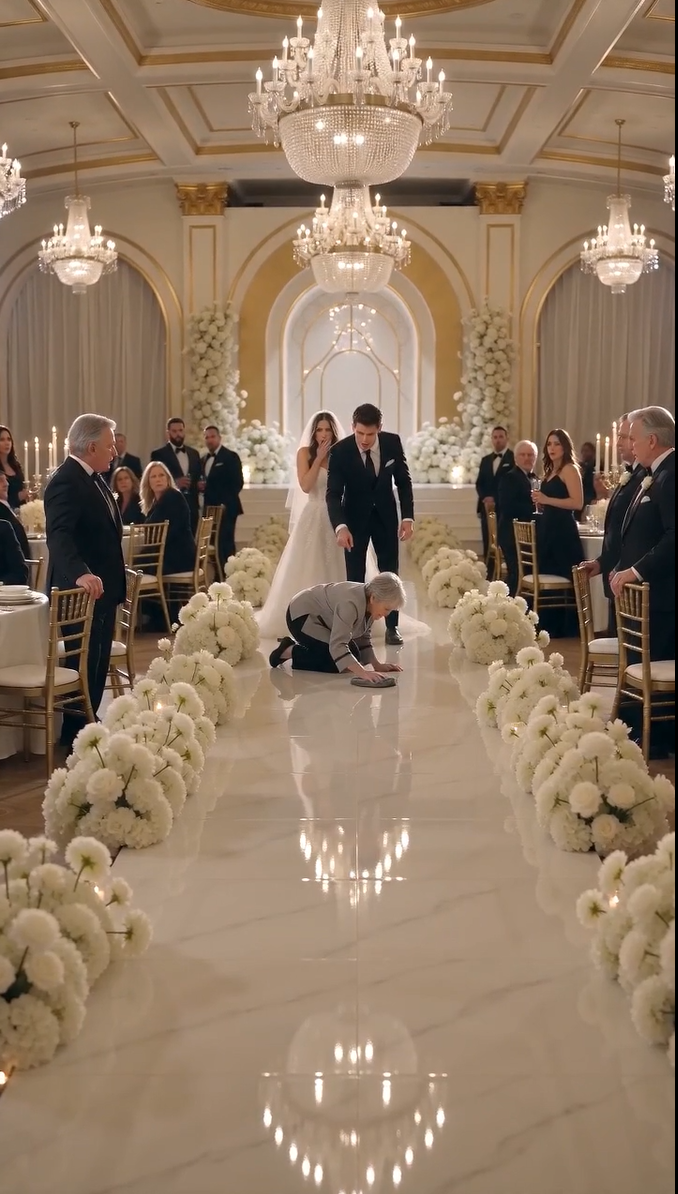
The groom stood in the center of the aisle, unable to breathe properly.
His entire life had been built on a story.
His mother died.
His father never remarried because he loved her too much.
His grandmother raised him because no one else could.
He had carried that story like truth.
Now it was falling apart in front of everyone.
He looked at the cleaner.
“What happened to me?”
Her face twisted with pain.
“You were sick,” she said. “So sick. Fever for three nights. I took you to a clinic, but I had no money for the medicine. Then a woman from your father’s family came.”
The groom’s father turned sharply.
“Who?”
The cleaner looked at the grandmother.
“She came herself.”
The old woman did not deny it.
The cleaner’s voice shook.
“She said you needed proper care. She said if I loved you, I would let your father’s family take you to a hospital. She promised I could come once you were better.”
The groom’s lips parted.
The cleaner looked at him through tears.
“I believed her.”
She pressed a hand to her chest.
“I handed you over because I thought I was saving your life.”
The bride began crying silently.
The cleaner continued.
“When I returned the next morning, the house was empty. They had taken you away. No one would tell me where. For years, I searched. I went to offices. Hospitals. Old addresses. I had no documents, no power, no one to listen.”
She looked down at her uniform.
“People like me do not get believed easily.”
The groom’s father covered his face.
The groom looked at his grandmother.
“You knew?”
The old woman’s eyes watered, but her mouth remained stiff.
“You had everything with us. The best schools. The best doctors. A future. What could she have given you?”
The cleaner whispered, “Love.”
That one word silenced the hall.
Not because it was loud.
Because it was true.
The groom stared at his grandmother.
“You told me she was dead.”
“I raised you.”
“You lied to me.”
“I protected you.”
“You stole me.”
The old woman’s face broke for the first time.
“I gave you a life.”
He stepped back from her.
“No. You took one from me.”
The groom’s father turned toward the cleaner.
He tried to speak, but nothing came out.
There were too many years between them.
Too many birthdays.
Too many nights.
Too many chances stolen by one decision and a family that believed pride mattered more than people.
Finally, he whispered, “I looked for you.”
The cleaner’s tears fell faster.
“I looked for both of you.”
“I never stopped loving you.”
She let out a broken breath.
“Then why did your heart believe I left?”
He flinched.
“I was young. I was broken. They showed me papers. They said your body was never found because the water took many people. I thought…”
His voice failed.
The cleaner looked at him.
“I used to hate you for not coming.”
He lowered his head.
“I deserve that.”
“No,” she whispered. “I hated the man they made me imagine. Not the man standing here.”
The bride gently placed her bouquet on the chair beside her.
Then she walked to the cleaner.
Everyone watched.
The cleaner stiffened, expecting another insult.
Earlier that morning, someone from the bride’s side had ordered her to mop the hallway twice because “important guests are coming.”
Someone else had laughed when her hands shook while placing glasses on the table.
One bridesmaid had whispered, “People like her should stay invisible.”
The bride had not heard it then.
But she understood now.
She stopped in front of the cleaner, tears on her face.
“I’m sorry,” she said.
The cleaner shook her head.
“You did nothing.”
“I stood here while people treated you like you were beneath them.”
The cleaner looked away.
“I am used to it.”
“That doesn’t make it right.”
The bride turned toward the guests.
Her voice trembled, but she did not lower it.
“This wedding will not continue like nothing happened.”
Her father stood again.
“Don’t be dramatic.”
She looked at him.
“No. Dramatic was watching a woman get humiliated because of her uniform and saying nothing. Dramatic is finding out the groom’s mother was standing in this hall while everyone treated her like dirt.”
Her father’s face reddened.
“This is not your concern.”
“It is exactly my concern,” she said. “Because I was about to join this family. And if this family can bury a mother, steal a child, and smile for wedding photos, then we all need to stop pretending the flowers are the problem.”
The groom looked at her with tears in his eyes.
She walked back to him and took his hand.
“I love you,” she said softly. “But today is no longer about a wedding.”
He nodded, unable to speak.
Then he turned to the cleaner.
His mother.
The word felt strange inside him.
Too big.
Too painful.
Too late.
But it was there.
He took one step toward her.
Then another.
She looked terrified.
Not because she feared him.
Because hope had hurt her too many times.
He stopped in front of her.
“What is my name?” he asked quietly.
She blinked.
The question confused everyone else.
But she understood.
A sob rose in her throat.
“When you were born,” she whispered, “I named you Aarav.”
His father closed his eyes.
The groom’s lips trembled.
His official name was different.
The name his grandmother had given him.
The name on every certificate.
Every school form.
Every invitation card.
But somewhere before all of that, before lies and silk suits and family pride, there had been another name.
A name spoken by a mother holding a newborn against her chest.
“Aarav,” he repeated.
The cleaner nodded, crying.
“You had a tiny mark near your shoulder,” she said. “Like a small brown leaf.”
The groom slowly loosened his collar and pulled the fabric aside.
There it was.
A small birthmark near his shoulder.
The cleaner covered her mouth.
The groom broke.
He stepped forward and fell into her arms.
The hall heard the sound that came out of him.
It was not a polite cry.
Not the kind people hide behind handkerchiefs.
It was the sound of a man grieving the mother he had mourned without ever knowing she was alive.
The cleaner held him with both arms.
At first carefully.
Then desperately.
Like the years had collapsed and he was a baby again.
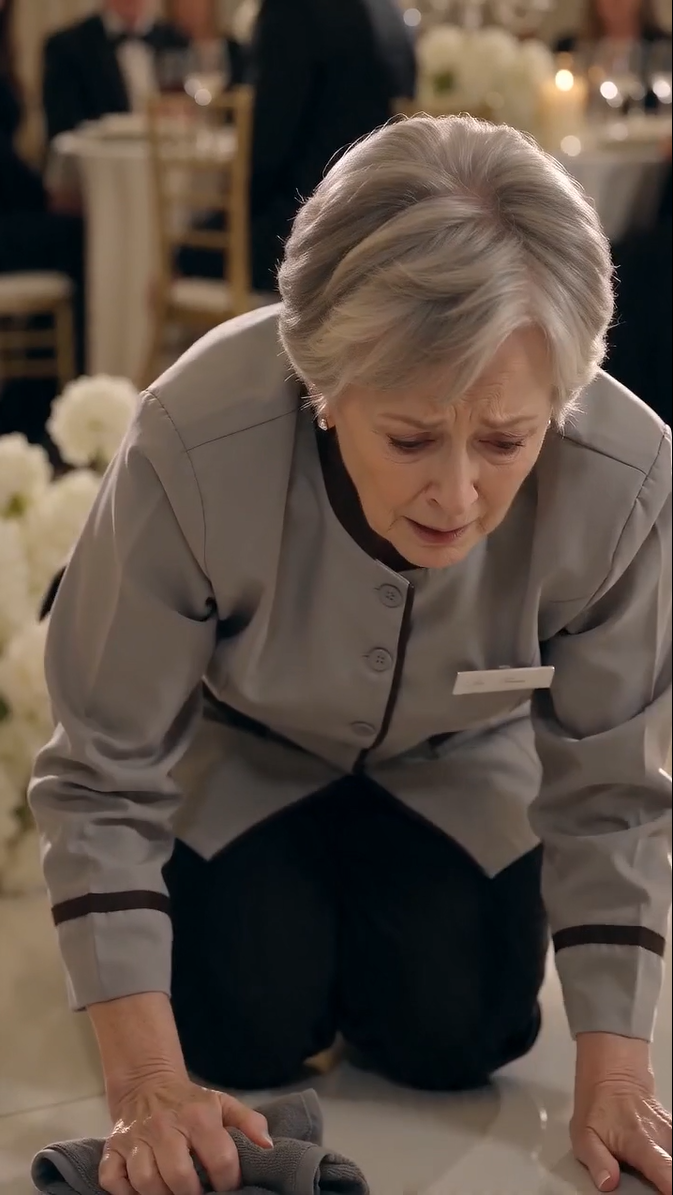
“My son,” she cried. “My son.”
The groom clung to her.
“I was here,” she sobbed. “I was always here. I never left you in my heart.”
“I didn’t know,” he cried. “I didn’t know.”
“I know. I know, my child.”
The groom’s father stood behind them, broken beyond words.
Then the cleaner looked at him over their son’s shoulder.
For a moment, the past stood between them.
Love.
Loss.
Betrayal.
Silence.
He stepped closer slowly.
“Can I?” he whispered.
The cleaner looked at him for a long second.
Then she nodded.
He wrapped his arms around them both.
And in the middle of the wedding aisle, beneath flowers, chandeliers, and stunned guests, a family that had been torn apart by pride held each other for the first time in decades.
No music played.
No one clapped.
No one dared.
Some moments do not need applause.
They need witness.
The grandmother sat down slowly, as if all the strength had left her body.
The groom looked at her.
His face was wet.
“I don’t know if I can forgive you.”
Her lips trembled.
“I did it for you.”
“No,” he said quietly. “You did it for the family name.”
She started to cry.
He looked away.
For the first time, her tears did not decide the room.
His mother’s tears did.
His father turned toward the guests.
“This ceremony is over for today.”
A loud stir moved through the hall.
The bride’s father protested.
“You cannot simply end a wedding.”
The bride faced him.
“Yes, we can.”
Then she removed the veil from her hair and handed it to her maid of honor.
She looked at the groom.
“When we marry, I want it to be with truth in the room. Not secrets.”
He held her hand tightly.
“Thank you.”
She shook her head.
“Don’t thank me. Go sit with your mother.”
The groom looked at her as if he loved her more in that moment than he had all morning.
Then he turned back to the cleaner.
“Please,” he whispered. “Don’t leave.”
She looked terrified again.
“I don’t belong here.”
He took her hands.
“You belong with me.”
The words nearly dropped her to her knees.
For so many years, doors had closed in her face.
Gates.
Offices.
Homes.
Hearts.
Now her son was standing in front of everyone, choosing her.
She pressed his hands to her forehead and cried.
The bride ordered the staff to bring chairs and water, but not as servants now.
As people helping another person breathe.
The groom sat with his mother in a side room while the guests slowly left the hall.
Some whispered.
Some cried.
Some looked ashamed.
A few of the same relatives who had ignored the cleaner earlier tried to come close and offer sympathy.
The groom stopped them at the door.
“Not now.”
His voice was calm.
But final.
Inside the room, his mother sat on a sofa with the ring still in her hand.
The groom sat on the floor in front of her like a child who had found his way home too late.
His father sat nearby, unable to take his eyes off her.
The bride sat beside the mother, holding a glass of water for her.
For the first time all day, no one cared about flowers, food, photography, or guests.
Only truth.
The groom asked questions.
She answered them all.
She told him about the night he was born during a storm.
How his father had cried louder than he did.
How they had wrapped him in a blue blanket because it was the only one they had.
How he would stop crying only when she sang.
The groom listened like every word was a lost piece of himself.
Then he asked the question that hurt the most.
“Where were you all these years?”
His mother looked down.
“Everywhere I could be close to news of you.”
She swallowed.
“I worked in homes. Hotels. Kitchens. I cleaned offices near your school once, but I only saw you from a distance. You were wearing a green sweater. You dropped your lunchbox and laughed when your friend picked it up.”
He stared at her.
“You saw me?”
She nodded.
“I wanted to run to you.”
“Why didn’t you?”
Her voice broke.
“Because your grandmother’s driver saw me first. That evening, two men came to the place where I was staying. They told me if I came near you again, they would tell the police I was trying to kidnap you.”
The groom’s father stood suddenly.
His face darkened with a pain that had become rage.
“She did this too?”
The mother nodded.
“I had nothing. No papers to prove who I was. No money for lawyers. No one to stand beside me.”
The groom gripped her hands.
“You do now.”
She looked at him.
The groom repeated it, stronger.
“You do now.”
The next few weeks were not easy.
Truth does not fix a life in one night.
It only opens the door.
The wedding was postponed.
Some relatives called it shameful.
The groom called it necessary.
His grandmother tried to explain herself many times.
Sometimes she cried.
Sometimes she blamed fear.
Sometimes she blamed class.
Sometimes she blamed the world.
But the groom no longer allowed her to hide cruelty inside concern.
“You can love me,” he told her once, “and still have done something unforgivable.”
She had no answer to that.
Legal papers were searched.
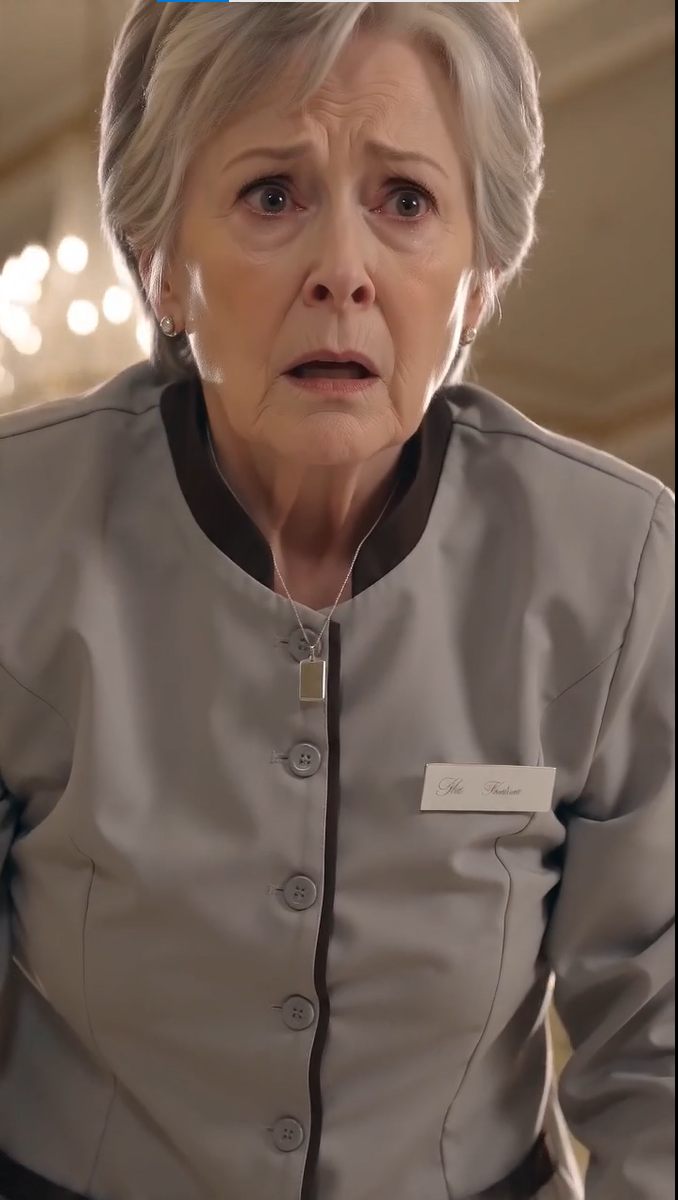
Old staff were questioned.
Documents appeared that had been hidden for years.
A marriage certificate.
Hospital notes.
A false death report.
A transfer of custody signed under a name his mother had never written.
The truth became official.
But for the groom, the truth had already become real the moment his mother said his first name.
Aarav.
At first, he could not call her Mother.
The word sat too heavily on his tongue.
He called her by her name.
Then sometimes, when he was tired, he called her Ma by accident.
Each time, she would go quiet.
Not because she was hurt.
Because she was trying not to cry.
One evening, he found her in the kitchen of his father’s house, washing a cup she had used.
He gently took it from her hands.
“You don’t have to clean here.”
She looked embarrassed.
“I don’t know how to sit still in houses like this.”
“This is your house too, if you want it to be.”
She shook her head.
“I don’t want your father’s money.”
“I know.”
“I don’t want pity.”
“I know.”
“I only wanted my son.”
His eyes filled.
“You have him.”
She touched his face with trembling fingers, as if still afraid he might disappear.
“You are so tall now,” she whispered.
He laughed through tears.
“I had time.”
The words hurt them both.
So he leaned forward and rested his head in her lap.
She froze.
Then slowly, her hand moved into his hair.
She began to hum.
A soft tune.
Old.
Broken by tears.
His eyes closed.
Something inside him remembered what his mind could not.
The next month, the bride came to visit her.
Not as a bride planning flowers.
As a daughter-in-law who wanted to know the woman who had been kept outside the family door.
She brought a simple sari, not expensive, not flashy.
“I thought this color would suit you,” she said.
The mother touched the fabric with nervous hands.
“It is too beautiful.”
The bride smiled.
“No. It’s just right.”
They sat together for hours.
They spoke about food.
About marriage.
About fear.
About how women are often asked to stay quiet so families can stay comfortable.
The mother looked at her one day and said, “You are brave.”
The bride shook her head.
“No. You are. I just stopped pretending.”
When the wedding finally happened, it was smaller.
No grand hall full of people who came to judge.
No relatives who cared more about reputation than truth.
No grandmother sitting in the front row as if nothing had happened.
It took place in a quiet garden.
Soft flowers.
Close friends.
Honest hearts.
Before the ceremony began, the groom stood alone near the entrance.
His mother approached him slowly.
This time, she was not in a cleaning uniform.
She wore the sari the bride had given her.
The ring still hung at her neck, but now it was not hidden.
The groom looked at her and smiled through tears.
“You look beautiful, Ma.”
The word came naturally this time.
Ma.
She stopped walking.
Her hand flew to her mouth.
He walked to her quickly.
“Don’t cry,” he whispered.
She laughed and cried anyway.
“I waited so long to hear that.”
He held out his arm.
“Will you walk with me?”
She stared at him.
“To the altar?”
“To my life,” he said.
Her face broke completely.
The guests stood as they entered.
Not because of tradition.
Because everyone there understood what they were seeing.
A son walking beside the mother he had lost without losing her.
A woman stepping into a place that had once pushed her out.
A family choosing truth over pride.
At the front, the bride waited with tears in her eyes.
The groom’s father stood near the first row.
Older somehow.
Humbled.
Changed.
He and the mother had not pretended the years could be erased.
They did not rush into old promises.
They spoke slowly.
Carefully.
Honestly.
Some wounds need love, but they also need time.
Still, when she passed him, he whispered, “I’m sorry.”
She looked at him.
“I know.”
“Will you ever forgive me?”
She took a breath.
“I am trying to forgive the boy who was lied to. I am not ready to forgive the man who stopped searching.”
He accepted it.
Because truth had become more important than comfort.
The ceremony was simple.
When the vows ended, the groom turned first to his bride.
Then to his mother.
He took both their hands.
“I spent my whole life thinking love was something people gave me by protecting me from pain,” he said.
He looked at his grandmother’s empty chair.
Then back at his mother.
“But real love tells the truth, even when it hurts.”
His mother cried quietly.
He continued.
“I can’t get back the years we lost. I can’t become the child you were forced to let go of. But I can be your son from today forward, in public, in private, in every place they tried to erase you from.”
The mother pressed his hand to her cheek.
“My son,” she whispered.
This time, no one gasped.
No one doubted.
No one laughed at the woman with rough hands.
They simply watched as she stood tall.
Not as a cleaner.
Not as a poor woman.
Not as someone beneath anyone.
As a mother.
And when the music began, the groom did not walk away with his bride first.
He turned to his mother.
“Dance with me?”
She laughed softly.
“I don’t know how.”
“Neither do I.”
So they moved slowly under the garden lights.
Awkwardly.
Carefully.
Beautifully.
The bride watched them with tears and a smile.
The father watched with regret in his eyes and gratitude in his silence.
And the mother held her son like she was holding every lost birthday, every missed fever, every school morning, every night she had cried into a pillow because no one believed her.
She could not get those years back.
But she had this one.
This breath.
This song.
This son.
Later that night, when the guests had gone and the garden lights were fading, the groom found his mother sitting alone near the flowers.
“Are you tired?” he asked.
She smiled.
“A little.”
He sat beside her.
For a while, they said nothing.
Then she removed the ring from the chain around her neck.
His father’s ring.
The one she had carried through poverty, humiliation, loneliness, and years of being invisible.
She placed it in her son’s palm.
He looked startled.
“I can’t take this.”
“Yes,” she said softly. “You can.”
“But it’s yours.”
“It was the proof I carried when no one believed me,” she said. “I don’t need proof anymore.”
He closed his fingers around it.
“What do you need?”
She looked at him.
“Time.”
He nodded.
“You have it.”
“And patience.”
“You have that too.”
“And sometimes,” she said, smiling through tears, “you will have to let me look at your face for too long.”
He laughed.
“You can look as long as you want.”
She reached up and touched his cheek.
“I missed your whole life.”
He covered her hand with his.
“No,” he whispered. “They took years from us. They didn’t take the rest.”
She leaned into him.
And for the first time in many years, she did not feel like a woman standing outside a locked gate.
She felt like someone had opened the door.
Years later, people would still talk about that wedding.

Some remembered the scandal.
Some remembered the silence.
Some remembered the moment the poor cleaner lifted the ring from her neck and broke a family’s lie wide open.
But those who truly understood remembered something else.
They remembered the groom stepping away from the altar to hold the woman everyone else had ignored.
They remembered the bride choosing truth over appearance.
They remembered a father realizing too late that silence can be its own betrayal.
And they remembered a mother who came only to see her son once, but left with her name, her truth, and her child restored.
Because the woman they tried to hide had not come to ruin a wedding.
She had come carrying a love no lie could bury.
And in the end, the family name everyone tried so hard to protect meant nothing.
The only name that mattered was the one she whispered through tears when her son held her hand.
“Aarav.”
This time, he answered.
“Yes, Ma.”
And that was the moment she finally stopped feeling invisible.