The Montana winter sun had barely lifted over the pine trees when my old pickup crunched into the gravel driveway.
The heater was coughing warm air against the windshield, fighting a losing battle with the frost along the edges of the glass.
The cab smelled like frozen dirt, diesel, and the paper cup of coffee I had forgotten beside the gearshift.
I was reaching for that cup when Drew stepped onto the porch.
He was fifteen.
Backpack hanging off one shoulder.
Body moving like every inch of him had to check with pain before taking the next step.
“Morning,” I said.
He nodded.
He did not smile.
That alone would have been enough to put a knot in my stomach, because Drew was a quiet kid, not a cold one.
There is a difference.
Quiet kids still look at you when the day is normal.
Drew looked at the frost on the porch rail like it had asked him a question he could answer better than I could.
When he climbed into the truck, the dome light caught the bruises along his jaw.
Yellow at the edges.
Darker near the bone.
I looked at him for one full breath before I spoke.
“What happened?”
“Practice,” he said.
His eyes stayed on the dashboard.
One word.
Too flat.
Too rehearsed.
I had heard men lie under pressure before.
I had heard boys lie because telling the truth would make them feel smaller than the thing that had happened to them.
This was the second kind.
Milwood Creek was a small town in the way people on postcards like to describe small towns.
Everybody knew which mailbox leaned after the snowplow clipped it last winter.
Everybody knew whose truck needed a muffler.
Everybody knew which booth at the diner belonged to which retired couple on Sunday after church.
And everybody knew one family you did not cross.
Gaines.
Sheriff Carl Gaines had worn that badge long enough that people talked about him like weather.
You did not like it.
You planned around it.
His son Neil was seventeen, broad across the shoulders, and loud in that polished way some boys get when every adult in the room has already decided not to correct them.
Drew had mentioned Neil once in September.
Only once.
“He’s just dumb,” Drew had said, trying to make it sound harmless.
But the way he folded his lunch bag after saying it told me the truth.
For twenty years, the Army taught me to hear what men did not say.
Fatherhood taught me that boys can go silent in the same language.
At the school drop-off, Drew’s fingers tightened around the passenger door handle before I even put the truck in park.
“Just let me out at the corner,” he muttered.
“No,” I said. “I’m walking you in.”
He swallowed, and that small movement told me more than any confession would have.
Neil Gaines was standing against the brick wall near the front entrance, laughing with two boys by the flagpole.
A small American flag snapped hard in the cold wind above them.
Neil did not look at Drew first.
He looked at me.
That was the message.
Not a mistake.
Not a joke.
A challenge.
I walked Drew inside, signed the late slip at the school office even though we were barely late, and watched the secretary glance from Drew’s bruises to Neil through the front window.
Her face changed for one second.
Then it changed back.
That was how fear worked in Milwood Creek.
It did not always make people run.
Sometimes it made them file things in the wrong drawer and call it procedure.
By pickup time, the day had turned the color of dull steel.
Drew climbed into my truck holding his arm tight against his chest.
He was trying not to breathe too deep.
His face had gone pale under the bruises.
His pride was doing everything it could to keep him upright.
“What happened?” I asked again.
He tried to say “nothing,” but the word caught somewhere in his throat.
I put the truck in drive and took him straight to urgent care.
The waiting room smelled like antiseptic, wet coats, and burnt coffee from a machine in the corner.
A toddler coughed into her mother’s sleeve.
An old man held a towel around his hand and stared at the weather channel without seeing it.
Drew sat beside me with his injured arm pressed against his ribs, staring at his shoes.
At 4:37 p.m., they took him back for X-rays.
At 5:12, the nurse returned with the film in her hand and the careful voice people use when the truth is already visible.
“Clean fracture,” she said.
The white line across the bone was sharp enough to make my stomach go quiet.
Drew did not cry.
That made me angrier than if he had.
I did not yell.
I did not punch a wall.
I did not tell him to be tough.
The boy had already been too tough for too long.
I thanked the nurse, collected the discharge papers, and helped my son back to the truck.
Outside, the cold hit us hard.
Drew’s cast was still bright and clean.
He tucked it inside his coat like it was something shameful.
That hurt worse than the X-ray.
I drove to the sheriff’s office.
The building sat on Main Street, low and plain, with a flag out front and salt crusted white along the sidewalk.
Deputy Susan Parsons was at the front desk.
She was maybe forty, tired around the eyes, the kind of woman who had probably taken the job because she believed paperwork could keep chaos in order.
When she saw Drew’s cast, her face changed before she could hide it.
“He’s in,” she said softly.
Not helpful.
Not hopeful.
A warning.
Sheriff Gaines sat behind his desk with his boots up and coffee in one hand.
He had a smirk ready before I said a word.
I laid the X-rays down.
I explained what Neil had done.
I asked to file a report.
Gaines glanced at the film, then leaned back like I had brought him a complaint about a dented mailbox.
“Boys roughhouse,” he said. “Always have.”
My hand tightened once around the edge of the chair.
Then I let go.
There are moments in a man’s life when his anger offers him the easiest road.
The easiest road is usually mined.
I repeated that my son had a fracture.
Gaines chuckled.
He called Drew thin-skinned.
He called Neil a natural leader.
He said I was making a federal case out of a schoolyard joke.
Drew stood beside me, cast held against his chest, eyes on the floor.
I could feel what that cost him.
A father knows when his child is trying not to disappear.
When I told Gaines the law did not stop at his desk, the smile slipped just enough for me to see what was under it.
“In this county,” he said, “I decide how things are handled.”
Then he leaned forward and smirked.
“What are you going to do about it?”
I did not answer.
Not because I had no answer.
Because he did not deserve the warning.
I gathered the X-rays, tucked the discharge papers under my arm, and walked out with my hands loose at my sides.
Outside, Drew waited by the truck.
He looked at the gravel like he was embarrassed for needing help.
I wanted to tell him he had nothing to be ashamed of.
I wanted to say it loud enough for the whole town to hear.
Instead, I opened the passenger door and let him get in without making him perform gratitude for being protected.
Back home, he went straight to his room.
I stood in the kitchen with the refrigerator humming and the porch light glowing yellow against the window.
Then I made coffee I did not drink.
For twenty years, the Army taught me not to charge into bad terrain just because I was angry.
You document.
You observe.
You find the channel the other side forgot existed.
So I did.
At 8:16 that night, I called Helena.
I did not make speeches.
I gave names.
I gave dates.
I gave the urgent care record number, the X-ray timestamp, and the name of the nurse who had explained the fracture.
At 9:03, I scanned the discharge papers.
At 9:28, I copied photos of Drew’s bruises into a folder labeled by date.
At 10:40, I forwarded the school incident forms marked “reviewed” but never acted on.
That word stayed with me.
Reviewed.
It was a clean word for a dirty kind of neglect.
I added names of parents who had whispered the same story in grocery aisles, church hallways, and parking lots.
They were too scared to say it at the sheriff’s office.
But fear leaves tracks if you know where to look.
One mother told me her son had quit basketball after Neil shoved him into the bleachers.
One father said his daughter stopped going to school events because Neil liked to corner younger kids near the lockers.
One school staff member would not put anything in writing, but she confirmed three incident forms had been marked “resolved” without anyone calling the families back.
I did not push her.
People who have been scared for a long time need room to decide whether truth is worth the cost.
By midnight, I had statements, medical notes, school forms, and photos.
Processed.
Copied.
Forwarded.
The next morning, Drew came into the kitchen while I was labeling the last file.
He saw his own name on the folder.
His face tightened.
“I’m sorry,” he said.
I turned from the counter.
“For what?”
“For making it a thing.”
That was the sentence that almost broke me.
Not the fracture.
Not the sheriff’s laugh.
That sentence.
Somewhere along the way, my son had learned that being hurt was less embarrassing than asking someone to care.
I walked over, slow enough not to crowd him, and put one hand on his good shoulder.
“You didn’t make it a thing,” I said. “They did.”
His eyes filled, but he blinked it back.
He was fifteen.
He should have been worrying about homework, bad haircuts, and whether the truck would start in the cold.
Not whether the sheriff’s son could break his arm and call it humor.
Three days later, the first state vehicle rolled down Main Street and turned toward the sheriff’s office.
Then another.
People saw them.
Of course they saw them.
In Milwood Creek, a new truck on Main Street was enough to start a conversation.
Two state vehicles turning toward the sheriff’s office was enough to stop one.
By Friday afternoon, “state investigation” was moving through every diner booth, gas pump, and school pickup line in town.
Nobody said it loudly at first.
They said it while pretending to stir coffee.
They said it while loading groceries into the back of an SUV.
They said it in the church hallway with their voices low and their eyes on the door.
The school called me at 2:11 p.m. and asked if Drew would be out Monday for a follow-up appointment.
The same office that had misplaced his incident forms suddenly remembered his name.
I kept my voice even.
“Yes,” I said. “And I’ll need copies of every record connected to Neil Gaines.”
There was a pause.
Then the secretary said, “I’ll have to ask the principal.”
“Do that.”
Drew sat across from me that evening at the kitchen table, picking at a sandwich with his good hand.
The porch light made his cast look too white.
“You think it’ll matter?” he asked.
I wanted to promise him it would.
Parents want to give certainty like medicine.
But false certainty is just another way adults ask kids to carry our comfort.
“I think the truth matters whether people like it or not,” I said.
He looked down.
Then, for the first time in days, he nodded like maybe he believed me.
Saturday morning came with a hard blue sky and a wind sharp enough to cut through denim.
I was in the kitchen rinsing my coffee cup when tires hit the gravel outside.
Not one vehicle.
Several.
Drew came out of the hallway with his hoodie half-zipped, cast held close.
“Dad?”
I looked through the front window.
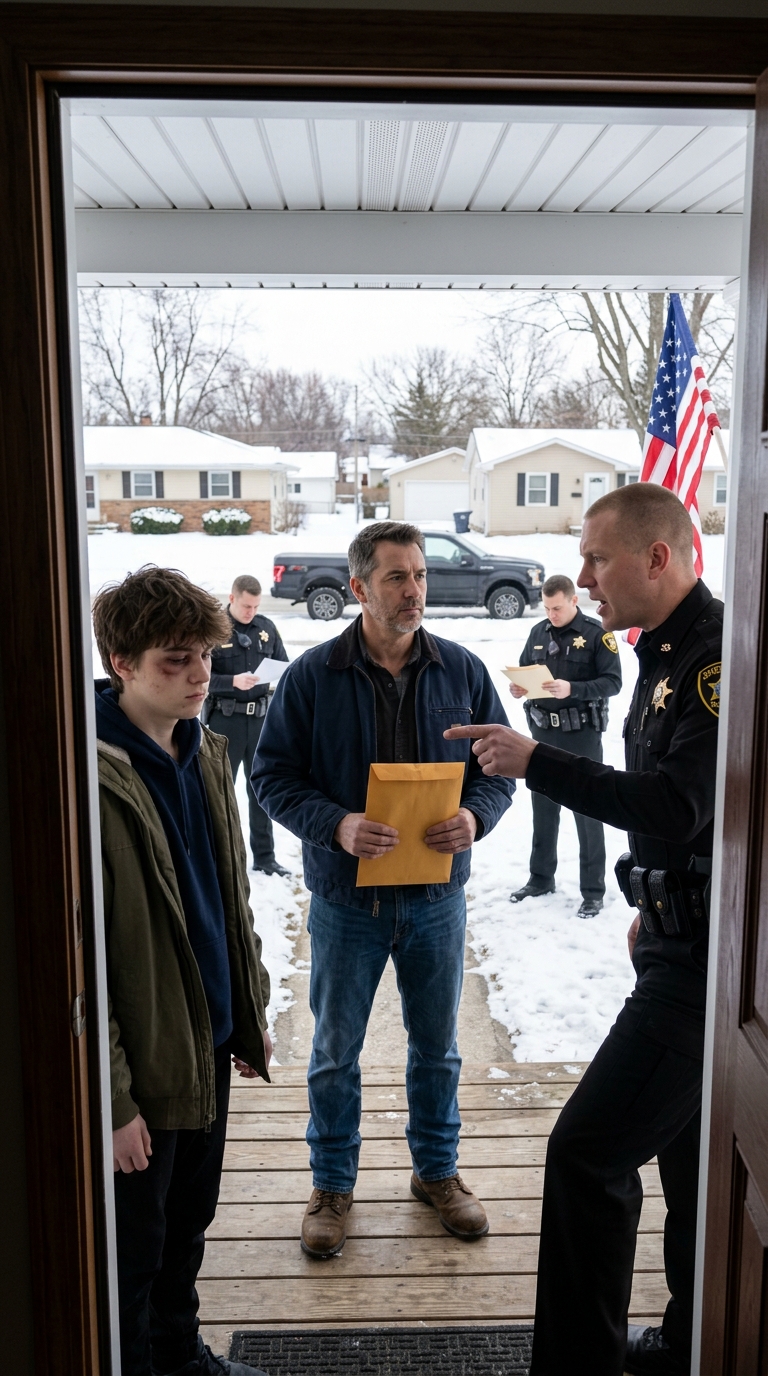
Sheriff Gaines was already getting out of his vehicle.
Three officers stood behind him.
Deputy Parsons was near the walkway, face pale, hands folded too tightly in front of her.
Gaines came up the steps like a man who had mistaken volume for authority his entire life.
I opened the door before he knocked.
“This is your doing,” he snapped.
His face was red.
His jaw was locked.
One hand stabbed the air between us.
Behind me, Drew stood in the doorway.
His cast was visible.
His shoulders were straighter than they had been in weeks.
For the first time since we moved to Milwood Creek, my son lifted his eyes from the floor.
Gaines saw it.
And for one second, the porch went quiet.
Not peaceful.
Quiet the way a room goes quiet after glass breaks.
The flag clip tapped against the little pole by my steps.
Somewhere down the road, a dog barked once and stopped.
Gaines looked at Drew’s cast, then back at me.
The anger in his face shifted.
Not to fear.
Not yet.
To recognition.
The kind a man gets when he realizes the person he tried to scare has already moved past him.
“You think some people from Helena are going to tell me how to run my county?” he said.
I kept one hand on the doorframe.
My other stayed open at my side.
That mattered to me.
I wanted Drew to see restraint, not rage.
I wanted him to understand that strength was not the same thing as making everyone flinch.
Then one of the officers behind Gaines stepped forward with a sealed envelope.
He held it out between two fingers.
Not gently.
Officially.
“Sheriff,” the officer said, “you need to read the first page before you say anything else.”
Deputy Parsons looked down at Drew’s cast.
Her mouth opened once.
Nothing came out.
Gaines snatched the envelope like grabbing it harder might make it less real.
The paper tore at the corner when he opened it.
His eyes moved across the first page.
Then the red in his face drained by degrees.
I had seen that look before.
Not in Milwood Creek.
In other places.
On men who realized the terrain had changed while they were still bragging about owning the road.
“What is this?” Gaines said.
The officer did not blink.
“Notice of state review pending formal inquiry.”
Gaines looked at me.
I said nothing.
He had asked me what I was going to do about it.
This was the answer.
Not a fist.
Not a threat.
Not a shouting match in a public office where he controlled the room.
A record.
A trail.
A door opened above his head.
Drew’s fingers tightened against the doorframe.
I could feel him beside me, still scared, still hurt, but no longer folded in on himself.
That mattered more than anything printed on that page.
Gaines tried to recover.
Men like him usually do.
He looked at the officers.
He looked at Parsons.
He looked at me.
“This is harassment,” he said.
“No,” I said.
It was the first word I had given him since his office.
His eyes snapped to mine.
I kept my voice low enough that Drew had to lean slightly to hear it.
“This is procedure.”
Deputy Parsons shut her eyes for a second.
Not long.
Just enough to tell me she understood the word.
Procedure was what they had hidden behind when children came in hurt.
Procedure was what the school had written on forms it never meant to act on.
Procedure was what Gaines thought belonged to him.
It did not.
The state officers asked him to step away from the porch.
He did not want to.
His boots stayed planted for one stubborn second.
Then he moved.
Not because I made him.
Because the paper did.
Drew watched him go down the steps.
He watched the officers speak to him beside the vehicle.
He watched Deputy Parsons wipe under one eye with the side of her thumb before she turned away.
Then Drew whispered, “Is Neil going to know?”
I looked at him.
“He probably already does.”
Drew’s throat moved.
“Is he going to come after me?”
I wanted to say no.
I wanted to make the world smaller and safer with one fatherly lie.
Instead, I said, “Then we document that too.”
He breathed out.
It sounded shaky.
But it was a breath.

By Monday, the school had a different tone.
The principal called before lunch and asked if we could come in for a meeting.
I asked who would be present.
He named himself, the counselor, and a district representative.
No sheriff.
No Neil.
I said we would be there.
Drew wore a gray hoodie and kept his cast on top of the table during the meeting.
Not hidden in his coat.
On the table.
The counselor’s eyes went to it more than once.
The principal slid a folder toward me and said they were “reviewing previous handling.”
There was that word again.
Reviewing.
I opened the folder.
Inside were incident forms, witness notes, and a printed timeline.
Some of it matched what I had sent.
Some of it did not.
I pointed to the gaps.
I did not raise my voice.
Drew sat beside me and listened.
When the principal tried to say the situation had been “complicated by community relationships,” Drew looked up.
“My arm was broken,” he said.
The room stopped.
Not dramatically.
Not like a movie.
Just stopped in the way adults stop when a child says the thing they were trying to talk around.
The counselor’s pen froze above her notepad.
The district representative folded his hands.
The principal swallowed.
“You’re right,” he said.
It was not enough.
But it was the first true sentence I had heard from that building.
In the weeks that followed, people in town changed their volume.
Some spoke louder.
Some got quieter.
A father approached me outside the gas station and said his boy had a story too.
A mother handed me three photocopied pages in the grocery store parking lot and cried because she said she should have done it sooner.
Deputy Parsons filed a statement.
I do not know what it cost her.
I know it cost something.
Gaines stopped coming into the diner for a while.
Neil was pulled from school pending review.
That phrase did not heal Drew’s arm.
It did not erase the mornings he had asked to be dropped at the corner.
But it changed the air around him.
That matters.
Healing is not always a grand thing.
Sometimes it is a boy leaving his cast uncovered.
Sometimes it is him walking through the school entrance without dropping his eyes.
Sometimes it is sitting in an old pickup while the heater coughs and hearing him say, “Can we stop for breakfast?” like the day belongs to him again.
The state investigation did what state investigations do.
It moved slowly.
It asked for records.
It made people answer questions they had spent years avoiding.
It did not turn Milwood Creek into a perfect town.
No paperwork does that.
But it reminded a few powerful people that a badge is not a fence around the truth.
Drew’s fracture healed before everything else did.
His confidence took longer.
I expected that.
Broken bones have calendars.
Broken trust does not.
One evening, months later, I found him on the porch after dinner, leaning against the railing with his hands in his hoodie pocket.
The small American flag by the steps moved lightly in the spring wind.
The gravel driveway had thawed into mud.
My old pickup still needed a new belt.
“You okay?” I asked.
He looked out toward the road.
“Yeah,” he said.
Then, after a minute, “I thought you were going to hit him.”
I knew who he meant.
I leaned beside him.
“I thought about it.”
He glanced at me.
I gave him the truth because boys know when you hand them something polished.
“For one second in his office, I thought about it hard.”
“What stopped you?”
I looked at the road, the mailbox, the thin line of sunset behind the trees.
“You.”
He did not answer.
So I kept going.
“If I hit him, the story becomes about me. If I document him, the story stays about what he allowed to happen to you.”
Drew nodded slowly.
He was quiet for a while.
Then he said, “I’m glad you didn’t answer him.”
I felt that land somewhere deep.
He meant the question in the office.
What are you going to do about it?
I had not answered with words.
I had answered with records, phone calls, timestamps, and the kind of patience angry men mistake for weakness.
For the first time since we moved to Milwood Creek, my son had lifted his eyes from the floor.
That was the part I kept.
Not Gaines’ face.
Not the envelope.
Not the state vehicles turning onto Main Street.
Drew’s eyes.
Because a child should never have to be taught that being hurt is embarrassing.
And if a town teaches him that, then somebody has to teach the town something back.