Part 1 – The Child Waiting Beside Gate B19
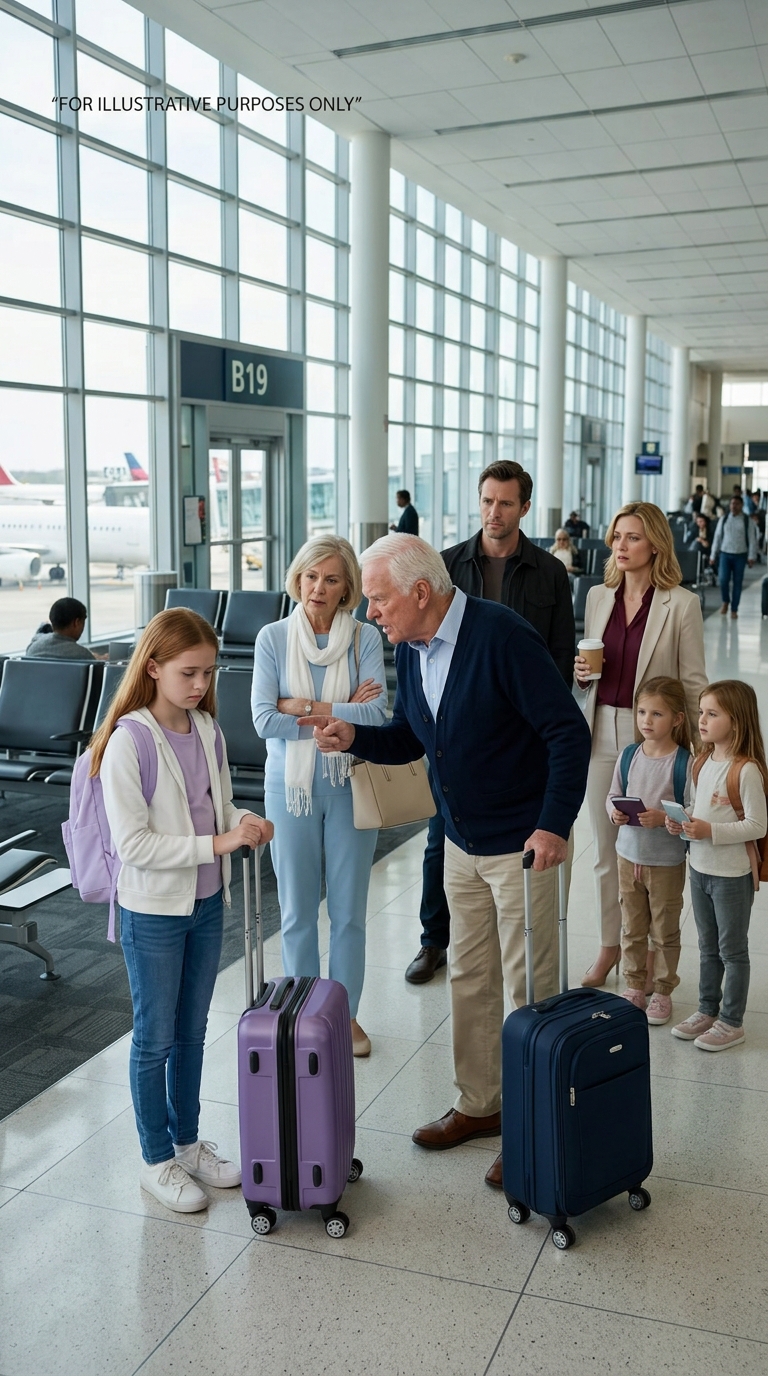
At exactly 5:42 on a Thursday afternoon, my nine-year-old daughter called me from a metal bench beside Gate B19 at Denver International Airport.
Her voice was so quiet that I initially believed the airport noise had swallowed half her words.
“Mom, Grandma and everyone else got on the plane without me.”
For several seconds, my mind refused to arrange that sentence into something possible.
I was attending a cybersecurity conference in Minneapolis, while my daughter, Emma, was supposed to fly from Denver to San Diego with my parents, my younger brother, his wife, and their two daughters.
I had paid for Emma’s ticket, hotel room, meals, aquarium admission, and every other expense connected to the family vacation. My parents had promised to treat her exactly like the other grandchildren.
Behind Emma, a boarding announcement echoed through the terminal. Wheels rolled across the floor, strangers hurried past, and my child sat alone in one of the busiest airports in the country.
“Where is the gate agent?” I asked.
“I do not know. Aunt Lauren told me to sit here because somebody would come back.”
My phone displayed a message from Lauren before I could ask another question.
The airline had offered five discounted first-class upgrades after another passenger group missed its connection. Six people were traveling with Emma.
Rather than refuse the offer or leave one adult in economy with her, my parents, my brother, Lauren, and their two children accepted every available upgrade.
Lauren’s message read:
Do not overreact. There were only five seats, and Emma was the easiest person to leave because you can arrange another flight for her. Dad said this might teach her not to expect special treatment.
A second message came from my father.
She is safe inside the terminal. Airport employees deal with children every day.
Emma began crying during our video call.
“Did I do something wrong?”
“No, sweetheart. Every adult with you made the wrong decision. You did nothing wrong.”
I contacted airport police, the airline’s operations manager, and my attorney. Then I forwarded Emma’s reservation, the family itinerary, and every message showing that five adults had accepted responsibility for her.
My company’s travel-security department also contacted the airport because my executive travel profile included emergency assistance for immediate family members.
Until an officer reached Emma, I remained on video and asked her to describe every person near the gate.
When a uniformed airport officer finally sat beside her, I saw Emma’s shoulders relax slightly beneath her purple backpack.
Only then did I permit myself to breathe.
While my daughter waited with strangers, photographs appeared inside our family group chat from the first-class cabin.
My mother wore a sleep mask above her forehead and held a glass of champagne. My nieces smiled beside plated desserts. Lauren posted a photograph of her shoes stretched beneath a wide seat with the caption:
The family vacation has officially begun.
I saved every image.
Then my mother wrote:
Rachel always fixes whatever Emma turns into a crisis. The child needs to learn that plans sometimes change.
I booked the first flight from Minneapolis to Denver and signed a formal abandonment report before leaving the conference center.
When I finally reached Emma, she was wearing an airport-police sweatshirt over her clothes and holding a paper cup of hot chocolate.
She ran toward me so quickly that I dropped my handbag.
The airline operations manager waited until she stopped crying before speaking.
“Ms. Dawson, this was not a seating misunderstanding. Your daughter was deliberately separated from the adults responsible for her and left without an approved unaccompanied-minor arrangement.”
I looked down at Emma.
For years, I had quietly repaired my family’s mistakes because confrontation seemed more exhausting than payment.
That evening, I understood that every rescue had taught them the wrong lesson.
They believed I would always clean up the damage, even when the damage was my child.
I signed the complaint.
Then I made three additional calls.
The first canceled the travel card connected to the vacation. The second removed my corporate discount and payment authorization from the San Diego resort. The third notified the attorney handling my parents’ planned townhouse purchase that I was withdrawing as loan guarantor before closing.
My family landed in California believing they had secured five excellent seats.
They had no idea how expensive those seats were about to become.
Part 2 – The Vacation Paid For By Someone Else
The first problem arrived at the rental-car counter.
My father handed the agent the premium travel card I had provided for Emma’s transportation, meals, and medical emergencies. The transaction failed twice.
When he called the bank, the representative informed him that the primary cardholder had frozen the account and disputed several unauthorized charges.
The upgrades had cost more than thirty-seven hundred dollars.
My parents had charged the entire amount to my account without permission.
Money had always worked this way inside our family. When my parents paid for anything, it became evidence of sacrifice. When I paid, it was treated as a natural resource available to everyone.
Lauren used her own credit card to rent a large SUV, pushing the balance dangerously close to its limit.
At the resort, the desk manager explained that their reservation had been canceled after my company withdrew authorization. Rooms remained available, but the corporate rate of two hundred twenty dollars had disappeared.
The standard rate exceeded eight hundred dollars per night.
My father called sixteen times. My mother called nine times. Lauren sent message after message.
You are ruining the children’s vacation.
The girls had nothing to do with this.
Dad’s blood pressure is dangerously high.
Call before you destroy the entire family.
I replied once.
All future communication must go through counsel. Emma is safe. Do not contact her.
That night, Emma and I stayed at an airport hotel because a pediatrician documented symptoms of acute panic and advised against another immediate flight.
She insisted that every light remain on.
At two in the morning, she woke crying after dreaming that I had boarded a plane while she watched through the window.
I sat on the floor beside her bed until sunrise.
The following day, airport police requested separate statements from every adult in California.
My parents described the incident as a misunderstanding. Lauren claimed they believed an airline employee had agreed to supervise Emma. My brother, Scott, said he assumed someone else had completed the necessary paperwork.
Security footage contradicted them.
It showed Emma standing near the boarding line with her backpack. My mother pointed toward a row of seats. Lauren bent down and spoke to her for seventeen seconds. Then every adult scanned a boarding pass and entered the jet bridge.
Scott paused and looked back.
He saw Emma alone.
After three seconds, he boarded anyway.
A gate agent later remembered Emma asking when her grandmother would return. That question revealed the abandonment, although the aircraft door had already closed.
Investigators also recovered the family chat.
One message from Lauren became especially important.
Only five upgrades are available. Emma is easiest to leave because Rachel can fly in and collect her.
My father replied:
We should vote so nobody can be blamed individually.
Even the children participated in that so-called vote.
Lauren told her eleven-year-old daughter that Emma would travel later with an airline employee. Her seven-year-old did not understand the choice and selected the option her grandfather suggested after being promised another dessert.
By the third day, my family abandoned the resort and moved into a roadside motel.
By the fourth, Lauren’s card failed at a restaurant.
By the fifth, the attorney handling my parents’ property purchase confirmed that I had withdrawn my guarantee. Without my income and credit supporting the mortgage application, the lender suspended closing.
My parents risked losing their forty-five-thousand-dollar deposit.
My mother left a voicemail that began with crying and ended in accusation.
“We may lose our retirement home because of your childish revenge.”
I forwarded the message to my attorney.
By the sixth day, everyone returned home to Arizona, where investigators were waiting to schedule formal interviews.
By the seventh, all four adults arrived outside my house without warning.
They still believed the central problem was money.
Part 3 – The Door They Expected Me To Open
I watched them through the security camera while Emma remained upstairs with our neighbor, Diane.