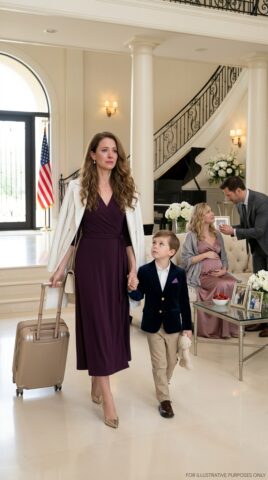
My mother-in-law ordered me to leave our Manhattan apartment before her great-grandchild arrived.
I didn’t argue with her.
I didn’t plead with my husband.
I didn’t even ask for another night.
I simply nodded and said, “All right.”
By the following morning, movers had stripped nearly every room of the furniture, artwork, electronics, and expensive comforts my husband’s family had enjoyed for years.
Then I placed an envelope on the bare dining-room floor and looked at them calmly.
“Beginning next month,” I said, “the $9,800 rent is your responsibility.”
It was the first time I had ever seen Eleanor speechless.
The night before, she had sat at the head of my dining table as though she owned everything around her.
Outside the windows, darkness was settling over Manhattan’s Upper East Side. The city glowed far below us, indifferent to the fact that my twelve-year marriage was being dismantled over dessert.
“You need to be gone by tomorrow,” Eleanor announced. “Leo and Valerie will need the apartment once the baby is born. There simply isn’t room for you anymore.”
I stared at her.

“You’re telling me to leave my own home?”
“This apartment belongs to the family,” she replied. “Leo’s child deserves to be raised here. It should finally become a home for a real family.”
A real family.
Those two words landed exactly where she intended them to.
I had been married to Eleanor’s son, Arthur, for twelve years. For eight of those years, I had shared a home with his mother.
Eight years of polished insults disguised as advice.
Eight years of criticism about my clothes, my work, my cooking, and the long hours I spent at the hospital.
Most painful of all were her constant reminders that an illness at twenty-seven had left me unable to have children.
“You never gave Arthur a child,” Eleanor continued. “At least we allowed you to play mother to Leo for a while. You should be grateful for that.”
Leo was Arthur’s son from his first marriage.
He had been eleven when I met him—quiet, wary, and protective of the small world he shared with his father.
I never tried to replace his mother.
I never asked him to call me Mom.
I simply showed up.
I helped him study for exams. I sat through school concerts and soccer games. I remembered the books he wanted, the foods he hated, and the fact that he preferred chocolate cake without frosting.
When he had nightmares, I was the one who sat outside his bedroom until he fell asleep again.
When he was seventeen and crashed Arthur’s car, I was the one he called first.
For years, I believed we were slowly building something honest.
But Eleanor worked just as patiently to destroy it.
“His family is his father and me,” she would say. “Don’t confuse the boy.”
Later, I discovered what she had told him when I wasn’t around.
She claimed I resented him.
She said I wanted Arthur to send him away.
She told him I blamed him for our unhappy marriage and my inability to have the family I wanted.
None of it was true.
I had loved Leo without conditions, titles, or expectations.
But Eleanor had repeated her lies so often that eventually he stopped questioning them.
By the time he met Valerie, he had become distant and formally polite with me. He invited Arthur and Eleanor to dinners while pretending to forget my name on the reservation.
I endured it because I believed patience might eventually repair what cruelty had broken.
That evening, however, as Eleanor ordered me out of the apartment, I finally understood that patience had only taught them there would never be consequences.
There was something else Eleanor did not understand.
Arthur was not paying for the apartment.
I was.
Four years earlier, Arthur’s consulting company had begun to collapse. He lost two major clients within a month and borrowed heavily to keep the business alive.
At first, he told me the trouble was temporary.
Then the missed payments began.
Because Eleanor watched our lifestyle closely, Arthur begged me not to tell her.
“She already thinks I’m a disappointment,” he said. “I can’t let her know I’m failing.”
So I agreed to protect his pride.
Arthur continued paying for groceries, utilities, and restaurant meals—the visible expenses that allowed him to look like the provider.
I quietly covered everything that actually kept us secure.
The rent.
The insurance.
The car lease.
The furniture.
Even Eleanor’s private health plan.
I was a pharmaceutical chemist with a senior position at a private hospital. I also accepted emergency laboratory shifts whenever additional specialists were needed.
The work was exhausting, but it paid well.
Much better than Eleanor imagined.
She assumed I spent long hours away from home because I was insignificant at work. In reality, those hours financed nearly everything she displayed to her friends.
“Does Arthur know you’re throwing me out?” I asked.
Eleanor smiled.
“My son is exhausted from supporting you. Perhaps he has finally met someone who makes him feel like a man again.”
I felt the room become strangely still.
Suddenly, all the details I had been refusing to examine connected.
Arthur’s unexplained business trips.
His phone always turned facedown.
The deleted messages.
The unfamiliar perfume clinging to his shirts.
Eleanor’s unusual affection for Valerie.
And the baby Leo supposedly expected with her.
“Valerie is Leo’s partner?” I asked carefully.
Eleanor’s smile deepened.
“Valerie is going to give this family what it needs. That is all you need to understand.”
She wanted me to believe I was foolish.
Instead, she had revealed too much.
I picked up my handbag and stood.
“All right,” I said. “I’ll leave tomorrow.”
Eleanor raised her chin, pleased by how easily she thought I had surrendered.
She did not know that the woman she had expelled was the only reason any of them could afford another month in that home.
Arthur did not return that night.
According to his message, his flight had been delayed in Chicago.
I no longer believed he was in Chicago.
I went into the bedroom, locked the door, and began making calls.
The apartment lease was in my name alone.
So were the furniture receipts, service contracts, and insurance documents.
Every valuable object in the apartment had been purchased from my personal account.
By midnight, I had booked a moving company, reserved a storage unit, redirected my mail, and arranged temporary accommodations near the hospital.
Then I called my lawyer.
Her name was Priya Shah, and she had warned me two years earlier to protect myself after reviewing Arthur’s business debts.
“Are you finally ready?” she asked.
“Yes,” I said. “Prepare everything.”
The movers arrived at seven the next morning.
Eleanor came out of her bedroom wearing a silk robe and a look of outrage.
“What is happening?”
“I’m leaving, just as you requested.”
“You cannot take the furniture.”
“I purchased it.”
“That dining table belongs in this apartment.”
“It belongs to me.”
She followed the movers from room to room as they removed the cream-colored sofas, Persian rugs, lamps, televisions, paintings, and bedroom furniture.
The espresso machine disappeared from the kitchen.
So did the expensive cookware, crystal glasses, and wine refrigerator.
I left the built-in appliances because they belonged to the property owner. Almost everything else left with me.
Within three hours, the elegant home Eleanor had proudly shown to friends looked abandoned.
All that remained were pale rectangles on the walls and dents in the carpet where my belongings had once stood.
Leo and Valerie arrived shortly before noon.
Valerie was visibly pregnant.
Leo looked around the empty apartment in disbelief.
“What did you do?”
“I moved out.”
“You took everything.”
“I took what belongs to me.”
“My grandmother said you were leaving the apartment for us.”
“I am.”
“Then why would you strip it?”
“Because leaving you an apartment does not mean furnishing your life.”
His face hardened.
“You always hated me.”
The accusation still hurt, even after everything.
“No, Leo,” I said quietly. “I loved you. Eleanor simply made sure you never trusted it.”
“Don’t blame Grandma.”
“I’m not asking you to believe me today.”
I pointed to a smaller envelope on the floor with his name on it.
“But someday, you should read that.”
Before he could pick it up, Arthur burst through the front door.
His shirt was wrinkled, his face flushed, and there was no luggage in his hand.
He had not flown in from Chicago.
“What the hell is going on?” he demanded.
“Your mother told me to leave.”
“I didn’t tell her she could do this.”
“No. You just gave her enough information to believe she could.”
He glanced at Valerie.
It lasted less than a second, but it was enough.
Not the glance of a father looking at his son’s partner.
It was intimate.
Frightened.
Guilty.
Leo noticed it too.
“What information?” he asked.
No one answered.
I picked up the envelope bearing Arthur’s name and handed it to him.
His fingers shook as he opened it.
Inside were copies of the apartment lease, notices terminating every payment I had been making on his behalf, divorce papers, and a collection of photographs my lawyer’s investigator had obtained overnight.
Arthur leaving a hotel with Valerie.
Arthur kissing her inside his car.
Arthur entering an apartment he claimed belonged to a client.
The dates covered almost nine months.
Leo took the photographs from his father’s hands.
For several seconds, he did not seem to understand what he was seeing.
Then he looked at Valerie.
“Tell me these aren’t real.”
She began to cry.
“Leo, please.”
“Is the baby mine?”
Silence answered him.
Arthur stepped forward.
“We can discuss this privately.”
Leo struck him.
The sound echoed through the empty apartment.
Eleanor screamed, but Leo barely seemed to hear her.
He looked from his father to Valerie, then down at the photographs again.
“My own father?”
“It wasn’t supposed to happen this way,” Valerie whispered.
“How was it supposed to happen?”
She covered her face.
Arthur tried to place a hand on his son’s shoulder, but Leo shoved him away.
Then Eleanor said the sentence that destroyed whatever remained of the family she claimed to protect.
“The child is still an Ellison,” she said. “That is what matters.”
Everyone turned toward her.
I had suspected Eleanor knew about the affair.
I had not known she understood the baby could be Arthur’s.
Leo stared at his grandmother.
“You knew?”
Eleanor’s composure finally cracked.
“I knew there was uncertainty. But this baby is our family’s future. Sarah could never give us that.”
Even Arthur looked horrified.
“You knew?” he asked.
“I was protecting this family.”
“No,” I said. “You were protecting the appearance of one.”
Leo walked toward the door.
I expected him to leave without another word.
Instead, he stopped beside the envelope bearing his name.
He picked it up and opened it.
Inside were copies of old emails I had recovered years earlier but never shown him—messages Eleanor had sent to Arthur discussing how to keep Leo “properly aligned” against me.
There were also school receipts, medical invoices, photographs from birthdays, and a letter I had written but never intended to send.
Leo read only the first page.
Then he lowered it.
“You paid my college deposit?” he asked.
I nodded.
“Dad said he did.”
“I know.”
“My first car?”
“Partly.”
“And the summer program in London?”
“Yes.”
He looked at Arthur.
His father said nothing.
“I never told you because I didn’t want gratitude,” I explained. “I wanted you to have those opportunities.”
Leo’s anger disappeared, replaced by something more painful.
“Why didn’t you defend yourself?”
“I thought love didn’t need to keep score.”
I glanced around the empty apartment.
“I was wrong. When people rewrite your kindness as weakness, silence helps them.”
Leo left without looking at his father or grandmother.
Valerie followed several minutes later, but he would not let her enter the elevator with him.
I picked up my suitcase.
Arthur moved in front of the door.
“Sarah, wait. We can fix this.”
“What exactly would we fix?”
“I made a mistake.”
“A mistake is forgetting an anniversary. You built a second life while I financed the first one.”
“I never wanted to lose you.”
“You weren’t afraid of losing me. You were afraid of losing what I paid for.”
He began to cry.
Twelve years earlier, that might have broken me.
That morning, it only made me tired.
“The landlord has been notified that I will not renew the lease,” I said. “You have thirty days to make other arrangements. All future payments for your mother’s insurance and your car have also been canceled.”
Eleanor gripped the back of a chair that was no longer there.
“You cannot abandon me without medical coverage.”
“I didn’t abandon you. You removed me from the family. I am simply respecting your decision.”
“Where are we supposed to go?”
I looked at Arthur.
“That sounds like something a real family should discuss.”
Then I walked out.
The divorce took eleven months.
Arthur tried to claim that the apartment and furniture were marital property, but the financial records were clear. He had hidden business debts, transferred money without my knowledge, and spent thousands maintaining his affair.
The court did not reward him for any of it.
A paternity test confirmed that Arthur was Valerie’s baby’s father.
Leo ended his relationship with her and cut off contact with Arthur for several months.
Eleanor moved into a smaller apartment in Queens. Arthur paid what he could, though his company finally closed before the divorce was complete.
The grand Upper East Side life Eleanor had treated as proof of her family’s importance disappeared almost overnight.
I moved into a sunlit two-bedroom apartment fifteen minutes from the hospital.
It was smaller than the home I had left behind, but it was peaceful.
No one criticized the flowers I placed by the windows.
No one questioned how late I worked.
No one used my grief over infertility as a weapon.
For the first time in years, every room felt like mine.
Six months after I left, Leo contacted me.
His message contained only one sentence.
Can we talk?
We met at a quiet café near Central Park.
He looked older than I remembered, as though the truth had forced several years onto his face.
“I read everything in the envelope,” he said.
I waited.
“I don’t expect you to forgive me.”
“I never blamed you for what you were told as a child.”
“But I kept believing it after I was old enough to ask questions.”
“That part was your responsibility.”
He nodded.
“I know.”
He apologized without excuses.
Not only for the day I was forced out, but for every dinner invitation that excluded me, every cold remark, and every moment he had chosen Eleanor’s version of me because it was easier than seeing the truth.
Then he reached into his coat and placed a small, worn photograph on the table.
It showed the two of us at his high-school graduation.
His arm was around my shoulders.
We were both laughing.
“I found this inside the letter,” he said. “I had forgotten that I used to be happy with you.”
“So had I.”
He looked down at his hands.
“You were more of a mother to me than anyone.”
For years, I had imagined how those words might feel.
When they finally came, they did not erase the hurt.
But they opened a door.
We began slowly.
Coffee once a month.
Then occasional dinners.
When he started therapy, he told me about it—not to earn praise, but because he wanted me to know he was trying to become someone who questioned cruelty instead of inheriting it.
I never returned to Arthur.
He wrote letters. He sent flowers. He waited outside the hospital twice until security asked him to leave.
He insisted he still loved me.
Perhaps, in his way, he did.
But love without respect is only dependence wearing a beautiful name.
A year after the divorce was finalized, I bought my own apartment.
It was not on the Upper East Side.
It had no doorman, no marble lobby, and no view that impressed strangers.
But the deed carried only my name.
On the day I moved in, Leo helped assemble my dining table.
When we finished, he stepped back and smiled.
“This one belongs here,” he said.
“Yes,” I replied. “It does.”
I sometimes think about the night Eleanor ordered me out because she believed I had contributed nothing to her family.
She thought my quietness meant I had no power.
She mistook generosity for dependence and patience for weakness.
But when I walked away, I did more than remove the furniture and stop paying the rent.
I took back every part of myself I had surrendered to keep other people comfortable.
The apartment had cost me $9,800 each month.
Staying in that family had cost far more.
Leaving was the first decision that made me rich again.