A 67-Year-Old Bus Driver Left After Her Family Ridiculed Her Handmade Quilt—By Monday Morning, They Finally Understood Who Had Been Holding Their Lives Together
I set the birthday cake on the kitchen counter, removed my apron, folded it neatly beside the plate, and slipped the spare key to my son’s house into his hand.
Caleb stared at it.
“What is this?”
“The final thing you’ll need from me tonight,” I answered.
Silence settled over the room.
The only sound came from the tinny electronic music playing through the two brand-new phones in my grandchildren’s hands.
My name is Marlene Voss. I’m sixty-seven, and for almost thirty years, I’ve driven a school bus along the rural roads of northern Missouri.
Before daylight reaches the fields, I put on my worn brown jacket, pour coffee into an old thermos, and climb behind the wheel. Through freezing rain, thick fog, winter snow, and slow-moving harvest machinery, I carry forty children safely to school.
But for the last five years, finishing my bus route never meant my workday was over.
It only meant my second shift was about to begin.
After parking the bus each afternoon, I drove directly to my son Caleb’s home to care for his children—Sadie, who was eleven, and Owen, who was eight.
Caleb’s wife had walked away when Owen was only three.
My son spent long days fixing farm equipment, and I knew he was struggling to keep everything together. So when his family needed help, I stepped forward without waiting to be asked again.
I prepared school lunches.
I completed permission slips.
I stayed awake washing muddy soccer clothes long after midnight.
When thunder shook the windows and frightened Owen, I sat beside his bed until the storm passed.
I showed Sadie how to replace a missing button, bake biscuits without scorching them, and say she was sorry even when her pride begged her to remain silent.
None of it felt like a burden.
I believed that was what loving a family meant.
It was certainly how I had been raised.
My mother never possessed much, but she knew how to turn one chicken into three dinners. On summer evenings, she could hand a child a glass jar filled with fireflies and somehow make that child feel wealthier than anyone alive.
She often told me, “Marlene, people notice whatever sparkles. You should watch what remains after the shine disappears.”
For years, I thought I knew exactly what she meant.
Then Sadie turned eleven.
I had spent weeks sewing a quilt for her from fabric that carried pieces of our family’s history.
One yellow square came from the dress she wore on her first morning of kindergarten.
A narrow strip had been cut from Caleb’s old work shirt from high school.
Another patch came from the faded blue curtains that once framed the window above my mother’s kitchen sink.
At the heart of the quilt, I embroidered a tiny red school bus.
The stitches weren’t flawless.
Age had made my fingers stiff, and several seams wandered instead of running perfectly straight. But every scrap held a story. Every thread had been pulled through the fabric with love.
Sadie’s party was on Saturday afternoon.
I arrived before breakfast so I could tidy the house, decorate the rooms, ice the cake, and cook enough food for fifteen children.
At three that afternoon, Caleb’s younger sister, Brielle, arrived in a gleaming white SUV.
Brielle lived in Kansas City and came home only a handful of times each year. She wore designer sunglasses, spoke endlessly about fashionable restaurants none of us recognized, and rarely entered a room without expensive shopping bags hanging from her arms.
The children worshiped her.
“Aunt Brielle!” Sadie shrieked.
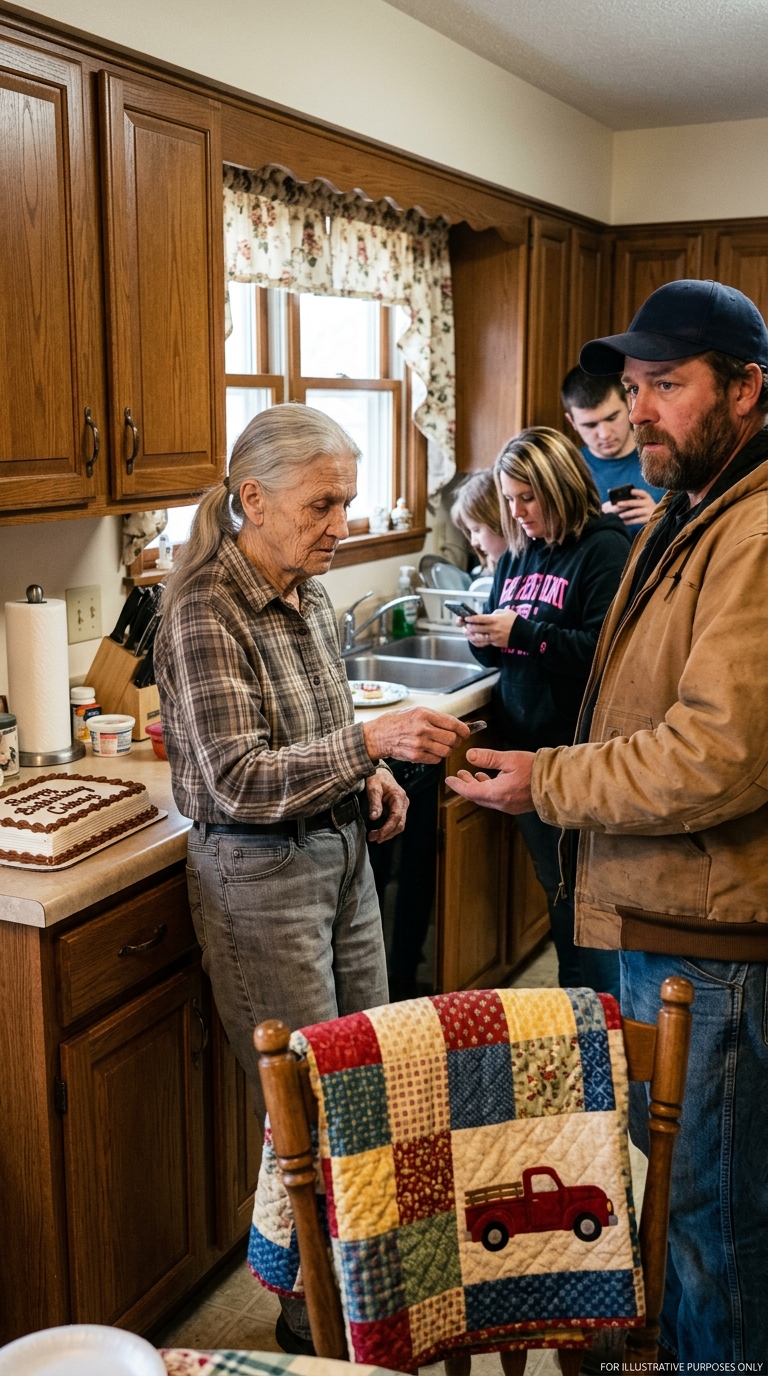
Brielle grinned and lifted two slim boxes into the air.
“I had no idea what children your age like anymore,” she said, “so I told the salesperson to give me the latest model.”
Each box held a costly new phone.
There wasn’t only one for Sadie, whose birthday we were celebrating.
Owen received one too because Brielle said she couldn’t bear for him to feel excluded.
Their screams of excitement sent the dog scrambling beneath the dining table.
Caleb examined the boxes with wide eyes.
“Brielle, these had to be incredibly expensive.”
She dismissed his concern with a casual flick of her wrist.
“Buying outrageous presents is part of being the exciting aunt.”
Then her attention moved to me.
I stood near the kitchen island with the folded quilt resting across my arms.
“And what did you bring her, Mom?” she asked.
Before I had the chance to reply, Sadie glanced away from her bright new screen.
“Probably another homemade thing.”
There was no cruelty in her voice.
Somehow, that made the words cut deeper.
Still, I approached her and opened the quilt.
“I made it from fabric connected to our family,” I said. “This yellow piece came from the dress you wore when you started kindergarten. And the blue fabric used to hang in Great-Grandma’s kitchen—”
Brielle gave a quiet laugh.
“Oh, Mom. You’re always saving those ancient scraps.”
Sadie touched the material for no more than a moment.
“Thank you, Grandma,” she said, her gaze already returning to the phone. “Can I leave it in my bedroom?”
Caleb filled his glass and offered me a smile that was meant to be sympathetic.
“You know how children are,” he said. “They’re interested in new technology. Try not to make it personal.”
I surveyed the room.
I saw every paper decoration I had taped to the walls.
I saw the growing pile of plates that everyone assumed I would clean.
I watched Owen devour a cupcake I had baked while staring at a phone Brielle had purchased during a ten-minute shopping trip.
Then one of Sadie’s friends asked who took them to school each morning.
Sadie barely looked up.
“My grandma,” she said with a shrug. “She’s pretty much our chauffeur.”
Pretty much our chauffeur.
Not the grandmother who had remained beside her hospital bed through pneumonia.
Not the woman who had practiced every spelling word until Sadie knew them all.
Not the person who had preserved fragments of her childhood because she believed those small memories deserved to survive.
I was simply the driver.
I carried the quilt into the kitchen and folded it with deliberate care.
Caleb came after me.
“Mom, would you slice the cake? The children are getting impatient.”
I looked down at the knife.
Then I raised my eyes to my son.
“No.”
His forehead tightened.
“What do you mean, no?”
“For five years, I’ve worked so hard to hide my exhaustion that none of you ever had to notice it.”
“Mom, please. This is not the right moment.”
“That’s exactly the trouble,” I replied. “According to all of you, there is never a right moment.”
I untied the apron Sadie had given me for Christmas.
Printed across it were the words:
GRANDMA’S KITCHEN NEVER CLOSES.
I folded the apron and placed it beside the untouched cake.
Then I removed Caleb’s spare key from my key ring.
“I love you,” I told him. “But at some point, everything I offered out of love stopped feeling like a gift to this family. It became something you believed you were entitled to receive.”
Alarm flickered across his face.
“Mom, don’t do this. Of course we’re grateful for you.”
“Tell me the last time you thanked me without following it with another favor.”
Caleb parted his lips.
He couldn’t produce an answer.
Brielle stepped into the doorway behind him.
“Isn’t this reaction a little excessive over an old quilt?”
I turned toward her.
“This has nothing to do with one quilt. It’s about deciding a person’s value according to what she can purchase instead of recognizing everything she has been quietly giving away.”
I closed Caleb’s fingers around the key.
Then I left the house.
For the first time in years, I was home before the sun went down.
No one called on Sunday.
I spent the morning on my porch, sipping coffee before it had a chance to grow cold. At the bird feeder, two cardinals squabbled noisily over the seeds.
At 6:12 on Monday morning, my phone rang.
Caleb’s name appeared on the screen.
I allowed it to ring twice before I answered.
“Mom,” he gasped, “I woke up late. The children missed their bus. Owen has lost his homework, Sadie’s school uniform hasn’t been washed, and I’m supposed to be at the repair shop in twenty minutes.”
Across the fields, the rising sun spread warm color through the sky.
“I’m sorry your morning is difficult,” I said.
“Will you come over?”
“No.”
The line went quiet.
It wasn’t the silence of anger.
It was fear.
Caleb phoned again that evening.
When he spoke this time, his voice had lost its urgency.
“I had no idea you were doing so much.”
“Yes, you did,” I replied. “You simply never had a reason to stop and consider it.”
Then my son cried.
This grown man, capable of taking apart a tractor engine and rebuilding it with his bare hands, wept into the telephone with the helplessness of the exhausted little boy he used to be.
“I’m sorry, Mom.”
I shut my eyes.
“I know you are.”
Three days later, there was a knock at my front door.
When I opened it, Sadie stood on the porch clutching the quilt.
Caleb and Owen waited behind her.
Her eyes were swollen and red.
“Dad explained where all the fabric came from,” she said. “I didn’t understand.”
“You never asked.”
Her gaze dropped toward her shoes.
“No, ma’am.”
She opened the quilt between us.
Near the embroidered red bus, a new piece of cloth had been sewn into the center. The patch was uneven and crooked, cut from the pocket of Sadie’s favorite sweatshirt.
“I hoped we could add this piece too,” she whispered. “I want to remember the day I nearly discarded something that mattered.”
I wrapped my arms around her.
Caleb never asked me to resume the life I had been living before.
Instead, he rearranged his hours at the repair shop. He paid a college student to assist with the children twice each week. Sadie and Owen began taking the school bus I drove rather than treating me as their personal transportation.
I continued helping my family.
But they asked first.
And afterward, they said thank you.
Every Friday evening, Sadie curled up beneath the quilt.
Eventually, the expensive phone slipped from her hand and shattered against the school parking lot.
The quilt only became softer with time.
When Sadie is older, she may not even remember the name or model of the phone she opened on her eleventh birthday.
But she will remember the yellow fabric from her first kindergarten dress.
She will remember the blue patch from her great-grandmother’s kitchen curtains.
And she will remember the grandmother who believed every small piece of her life was worth preserving.
People often measure a life by whatever glitters where everyone can see it.
But what holds a family together is rarely polished or perfect.
More often, it is handmade.
It is imperfect.
And it is given quietly by faithful hands that never ask to be admired.
The brightest presents may capture our attention for a moment, but the hands that remain beside us are the ones that carry us safely home.
Find more heartfelt short stories.