
My husband died in his girlfriend’s apartment, and his family told me to pay for everything. His mother tried to use my card without asking. So I removed every name but mine. I sold the house, cut them off, and never looked back.
The dinner I made sat untouched on the counter, still warm under the glass lid.
I had set two plates out of habit. 12 years of habit, actually.
I stood by the kitchen window, watching the street lights flicker on one by one as the neighborhood settled into evening.
My husband hadn’t texted, hadn’t called.
That wasn’t unusual anymore.
What was unusual was the hollow feeling in my chest that had stopped hurting months ago and turned into something quieter, something I could no longer name.
I was 32 years old, a senior project manager at a logistics firm, and I paid every single bill in this house.
The mortgage, the utilities, the grocery delivery my mother-in-law ordered twice a week, the insurance on my father-in-law’s truck, which he drove maybe four times a year.
I had stopped feeling resentful about it.
I had stopped feeling much of anything about it.
That, I would later understand, was the most dangerous sign of all.
My phone rang at 9:47 p.m.
I remember the exact time because I had just turned off the kitchen light and was heading upstairs.
The number on the screen was unfamiliar, a local area code, but not a contact I recognized.
I answered.
“Is this the wife of Daniel Marsh?”
The way the woman said “wife,” not “his wife,” not “Mrs. Marsh.”
Something about that phrasing made my hand tighten around the phone.
“Yes,” I said. “This is she. Who’s calling?”
“This is Nurse Caldwell at Riverside General. I’m calling because your husband was brought in by ambulance about an hour ago. He suffered a cardiac event. I need you to come in as soon as possible.”
I was already reaching for my keys before she finished the sentence.
I drove to the hospital in 11 minutes.
I know because I kept watching the clock on the dashboard, telling myself that as long as I kept moving, everything would be okay.
Daniel was 41. He ran every morning. He had just had a physical in March.
A cardiac event.
The words didn’t fit the image I had of him, even the version of him I had grown distant from.
When I got to the ER entrance and told the front desk who I was there for, the nurse looked at me with an expression I couldn’t quite read.
Not sympathy exactly, more like she was measuring something.
She led me down a hallway and stopped outside a set of double doors.
“Mrs. Marsh,” she said carefully. “Before I bring you in, I want you to know that the doctor will explain everything, but I also want to prepare you. Your husband was not brought in alone.”
I stared at her.
“What do you mean?”
She opened the door.
The room had a curtained partition. A doctor stood near a monitor writing something on a clipboard.
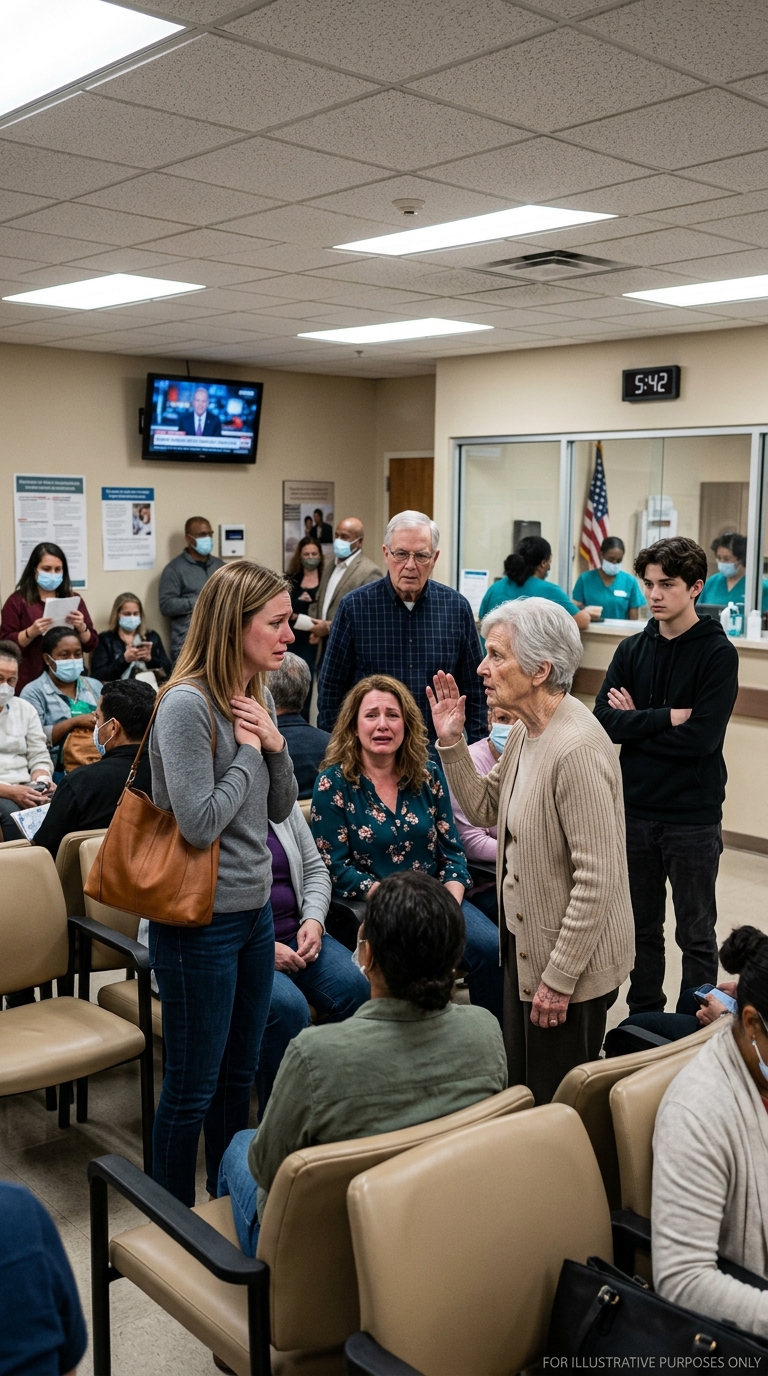
And on the chairs along the far wall sat my mother-in-law, my father-in-law, my husband’s younger brother, and a woman I had never seen before in my life.
Mid-30s, dark hair pulled back, wearing what looked like a silk blouse, wrinkled in a way that suggested she had thrown it on in a hurry.
My mother-in-law stood immediately when she saw me.
“Finally,” she said. “We’ve been here over an hour.”
I ignored her.
I looked at the doctor.
“I’m his wife,” I said. “Can you please tell me what happened?”
The doctor set down the clipboard.
He was kind about it.
He told me that Daniel had been found unresponsive at a private residence on the east side of town. The woman who lived there had called 911. He had gone into cardiac arrest, and the paramedics had stabilized him in the ambulance.
He was in the ICU now, sedated, and the next 24 hours would be critical.
I processed each word slowly, like reading a sentence in a language I was still learning.
The woman who lived there.
I turned and looked at the woman in the silk blouse.
She looked back at me.
There was no apology in her expression.
There was something closer to challenge.
“You must be his wife,” she said.
“I am,” I said. “And you are?”
She didn’t answer that.
Instead, she looked away toward the window.
My mother-in-law put her hand on my arm.
“This isn’t the time,” she said, though her voice carried no warmth. “We need to focus on Daniel.”
I took a step back.
I needed the wall behind me for a moment. I needed to feel something solid.
The doctor excused himself quietly, and a nurse guided us into a small family waiting room.
It smelled like stale coffee and hand sanitizer. The fluorescent lights buzzed faintly overhead.
I sat down. I placed my purse on my lap and held it with both hands.
My father-in-law cleared his throat.
“He’s going to need round-the-clock care when he comes home,” he said. “We should start thinking about who—”
“I just found out my husband had a heart attack at another woman’s house,” I said.
My voice came out quieter than I intended.
“Can we please wait 5 minutes before we start planning logistics?”
Silence.
Then my mother-in-law said, “She’s been his friend for years. It doesn’t mean anything.”
I looked at the woman in the silk blouse, who was studying her own hands now.
“Years,” I repeated.
Nobody said anything.
Daniel died at 4:16 in the morning.
The doctor came into the waiting room and said they had done everything they could, but the second episode had been too severe.
I sat in that plastic chair and heard the words and felt something inside me go very still.
The way a room goes still after a door slams shut and the echo finally fades.
I called my sister.
I asked her to come.
She arrived within the hour, and she held my hand in the parking garage while I stood next to my car and breathed the cold night air and tried to locate my own grief somewhere in the numbness.
By 7:00 in the morning, my mother-in-law had already told me three things.
That Daniel had always wanted to be buried in the family plot upstate, that the funeral home her family had used for generations required a significant deposit, and that she assumed I would be handling the financial arrangements.
“He was your son,” my sister said flatly.
My mother-in-law looked at her as if she had spoken out of turn.
“She is his wife. She has access to the accounts. We don’t.”
That was true.
I did have access to the accounts.
I had built those accounts.
Every direct deposit, every automatic transfer, every carefully maintained emergency fund that was mine.
Daniel had worked freelance for the last four years.
Design, consulting, inconsistent income.
I had never complained.
I had simply structured our finances to function on my salary alone and treated anything he contributed as a bonus.
“I’ll take care of what needs to be taken care of,” I said. “Give me some time.”
They gave me until noon.
Over the next three days, I learned things I had not known.
I learned that Daniel and the woman in the silk blouse, whose name I eventually discovered was Renee, had been together for 2 and 1/2 years.
I learned this not from anyone volunteering the information, but from the things I found when I finally went through his home office.
Emails, a shared photo album on a cloud account he had forgotten was still linked to our family iPad, receipts for dinners, weekends, a bracelet I had never seen and never given him.
I sat on the floor of that office for a long time.
I also learned that my in-laws had known.
Not the whole picture maybe, but they had known there was someone.
My mother-in-law had met Renee at a barbecue at my brother-in-law’s house two summers ago.
They had introduced her as a colleague.
I remembered that barbecue.
I had been working that weekend, a client deadline, and had sent my apologies.
I had sent a pasta salad with Daniel and told him to tell everyone I was sorry to miss it.
He had come home that evening and told me it was a nice time.
Nothing special.
On the fourth day, Renee called my cell phone.
I don’t know how she got the number.
I answered because I didn’t recognize it.
“I think we should meet,” she said. “There are things you should know about what Daniel wanted.”
“I know what Daniel wanted,” I said. “I was his wife.”
“He talked about changing his beneficiary designations,” she said. “He talked about it seriously. I think you should know that before you start making decisions about assets.”
I hung up.
Then I called my attorney.
My attorney’s name is Patricia, and she has represented me on contract matters for 4 years.
She is precise and calm, and she does not alarm easily.
When I explained the situation to her, she was quiet for a moment.
“Has anyone filed anything?” she asked.
“Not that I know of.”
“Good. Then we move first.”
She paused.
“Did he actually change any designations?”
I had already checked.
He had not.
The life insurance, the retirement accounts, the investment portfolio, everything still listed me as primary beneficiary.
Whatever he had talked about wanting to do, he had not done it.
“He talked,” I said. “He didn’t act.”
“Then you’re in a strong position,” Patricia said. “Let’s keep it that way.”
The funeral conversation came to a head on a Thursday evening.
My mother-in-law called and told me the deposit for the funeral home was due by Friday.
The number she quoted was substantial, more than I had expected, for a service I had not chosen, at a location I had never visited, arranged by people who had spent the last decade treating my financial support of their family as something they were entitled to rather than something I chose to give.
I sat with the phone against my ear, and I thought about the past 12 years.
I thought about the mortgage I had carried alone when Daniel’s work dried up the first time.
I thought about the month I quietly paid my in-laws’ heating bill in January because they called Daniel and told him they were cold, and Daniel came to me, and I wrote the check without comment because that’s what you do for family.
I thought about every birthday, every holiday, and every quiet sacrifice I had made for people who were at this exact moment asking me to fund a funeral for a man who had spent 2 and 1/2 years lying to my face.
“I need a few days,” I said.
“The deadline is tomorrow,” my mother-in-law said.
“Then you’ll need to cover it, and I’ll reimburse you,” I said.
Silence.
“You know, we don’t have that kind of money available,” she said.
“I know,” I said. “I’m sorry. I need a few days.”
I hung up and sat in the quiet of my living room, the living room of the house I had purchased, in the neighborhood I had chosen, with the furniture I had picked out and paid for.
And I made a decision.
Not out of cruelty, not out of anger exactly, though the anger was there underneath, steady and clean.
I made it out of clarity.
Something had come into focus that had been blurred for a very long time.
I called Patricia again the next morning.
I told her I wanted to review everything.
The joint accounts, the house title, the car registrations, the credit cards.
I wanted to understand exactly what was mine, what was ours, and what was his.
I wanted that picture completely clear before I made any further decisions about the funeral or anything else.
She had the summary to me by end of day.
The house was in my name.
I had insisted on that when we bought it, a small instinct I had never fully examined, but had followed anyway.
The joint checking account had about $6,000 in it.
The savings, substantial, accumulated carefully over 10 years, was a solo account in my name.
The credit cards were mine.
Daniel had been an authorized user on two of them, but the accounts were mine.
I read through the summary twice.
Then I removed Daniel’s name from the authorized user accounts.
It took about 4 minutes on the bank’s website.
I sat there waiting for something dramatic to happen, some alarm, some resistance.
There was none, just a confirmation screen, just a change in a database somewhere.
I closed the laptop and went to make coffee.
My brother-in-law called that afternoon, angrier than I had ever heard him.
“She tried to use the card,” he said. “My mother tried to pay a deposit and the card was declined.”
“She’s not an authorized user,” I said.
“She’s been using that card for years.”
“As a courtesy,” I said. “A courtesy that I extended and have now ended.”
“You can’t just—”
He stopped, restarted.
“Daniel just died. You’re doing this right now.”
“I’m protecting my financial assets during a period of legal uncertainty,” I said, which was what Patricia had told me to say. “If your family wants to make funeral arrangements, they’re welcome to use their own funds, and I will contribute what I determine is appropriate once I have a clearer picture of the estate.”
He called me several things after that.
I let him finish.
Then I said, “I’ll be in touch,” and ended the call.
My hands were shaking slightly when I put the phone down, but it was the kind of shaking that comes after you do something hard, not the kind that comes from fear.
There’s a difference, and I was just beginning to learn it.
Renee sent a certified letter 2 weeks later, her attorney’s letterhead.
It stated that she had been in a long-term committed relationship with Daniel Marsh and that she had a reasonable expectation of certain considerations given representations he had made to her during their time together.
I read it three times.
Then I forwarded it to Patricia with a single sentence.
Please respond accordingly.
Patricia’s response, which I was copied on, was three paragraphs of very precise legal language that essentially communicated: there is no legal basis for any claim, and any further correspondence of this nature will be treated as harassment.
I never heard from Renee again.
I sold the house four months later.
It wasn’t a snap decision.
I had lived in that house for 7 years.
I had painted every room myself, one summer weekend at a time.
I knew which floorboard creaked near the top of the stairs and which window stuck in humid weather and where the light fell in the kitchen on Sunday mornings in a way that made everything look softer than it was.
But I also knew what had happened inside those walls.
I knew the conversations we’d had in that kitchen that had felt like intimacy but were, I now understood, performance.
I knew the bedroom where I had slept next to someone who was living a second life.
And I knew that no amount of repainting or rearranging would make me forget that.
The market was good.
I sold for well above what I had paid.
After costs, I walked away with enough to start over in a way that felt intentional rather than desperate.
I found an apartment on the west side of the city.
Smaller, quieter, a building where nobody knew my name or my story or the specific shape of the year I had just survived.
I painted the bedroom a color I had always wanted and never chosen because Daniel said it was too bold.
It’s a deep greenish blue, the color of deep water, and every morning I wake up to it and something in me settles.
My in-laws moved in with my brother-in-law.
I understand it was an adjustment for everyone.
I did not contribute to the moving costs.
I did not field the calls asking me to reconsider.
Patricia handled one strongly worded letter from their side, and that was the end of it.
What I did do was write my mother-in-law a personal check for 3 months of what I calculated I had been contributing to their expenses annually, divided by four.
It was less than she expected.
It was more than I was legally obligated to give.
I sent it with a brief note that said I hoped they would use it to establish more stable footing.
She never thanked me.
That was fine.
I didn’t send it for the thanks.
I went to therapy.
I want to say that plainly because I think people sometimes treat it as an aside, something you mention quickly and move past.
I don’t want to do that.
I sat across from a woman named Dr. Okafor every Tuesday for seven months, and I told her things I had never said out loud.
And she helped me understand something that I think is important.
The betrayal wasn’t only that Daniel had been unfaithful.
The betrayal was also that I had arranged my entire life to support and protect a situation that was not what I thought it was.
And in doing so, I had made myself smaller in ways I hadn’t noticed until there was space to look.
The financial dependence my in-laws had developed wasn’t something Daniel had built accidentally.
He had allowed it, encouraged it even, because it kept me obligated.
It kept me too busy, too responsible, too needed to look too closely at anything else.
When you take away the structure built to keep you from seeing, you have to decide what to do with the view.
I kept my job.
I got a promotion, actually, 8 months after Daniel died.
I had been passed over for it twice before.
Once when I took a reduced schedule during a difficult quarter to manage some of his family obligations.
Once when I had to decline a travel opportunity for similar reasons.
This time, there was nothing in the way.
I took the role.
I took the travel.
I sat in meetings in cities I had never visited, and I made decisions, and I was good at it.
And I let myself know that I was good at it, which is a smaller and harder thing than it sounds.
My sister calls me every Sunday.
My friends, the ones I had slowly let drift during the years of managing everything, have mostly drifted back.
It turns out that when you stop being exhausted, you become someone people want to spend time with again.
I am not a cautionary tale.
I don’t want to be one anyway.
What I want to say, what I keep coming back to, is something simpler than that.
Know what is yours, not just financially, though that matters enormously.
Know what is yours in terms of time, energy, attention, care.
Know when you are giving those things freely and when you have been arranged into giving them.
Know the difference between love and infrastructure.
I know the difference now.
I learned it the hard way in a hospital waiting room at 4 in the morning, watching my husband’s other life rearrange itself around his absence and expecting me to pay for the arrangements.
I didn’t pay.
I built something new instead.
That, I think, is the better investment.
Disclaimer : This content may be created by AI for entertainment purposes. Any resemblance to real persons, events, or places is coincidental.