A Terminally Ill Mother Endured Every Broken Promise—Until Her Long-Haul Trucker Son Arrived and Opened the Lunchbox She Had Refused to Release
“I wasn’t holding on because I wanted extra days,” my mother murmured. “I was holding on for you.”
Those were the first words she spoke when I entered her hospice room near Albuquerque moments before dawn.
They were nearly the final words she ever said.
My mother, Maribel Cruz, was seventy-three. By then, she weighed less than some of the duffel bags I hauled into truck stops each week.
For thirty-one years, she had worked behind the serving counter in an elementary school cafeteria.
Thousands of former students remembered her as the lunch lady who quietly placed an extra biscuit or spoonful of potatoes on a child’s tray whenever she noticed hunger in their eyes.
But to me, she was just Mom.
And for far too many years, I lived as though she would always be waiting whenever I finally chose to come home.
My name is Darius. I’m forty-five years old, divorced, and employed as a long-haul truck driver across the Southwest.
I spent years convincing myself that my endless hours on the road were necessary.
There were fuel expenses.
Child-support payments.
A mortgage on a house I rarely spent enough time in to call home.
Whenever Mom phoned, my answer was almost always the same.
“I’m behind the wheel, Ma. Can I call you on Sunday?”
Sometimes I kept that promise.
Other times, Sunday slipped into Wednesday.
And sometimes an entire week vanished before I remembered that I had never called.
Mom never made me feel guilty.
She never demanded an explanation or reminded me of what I had promised.
She simply said, “Stay safe out there, sweetheart.”
Then she ended the call before I had to sit with the hurt hidden beneath her voice.
Even when she became ill, she tried to make the diagnosis sound unimportant.
“The doctors found something,” she told me one evening.
“How bad is it?” I asked.
Silence filled the line for several seconds.
Then she answered, “Bad enough that I would really like to see you.”
I promised I would visit as soon as I completed one final delivery.
But that delivery was followed by another.
Then one of our drivers became sick, and the dispatcher asked me to take his Oklahoma run.
After that, a winter storm shut down the interstate.
None of my reasons were invented.
Every delay had actually happened.
That was what made it so easy to forgive myself.
But a genuine excuse can still become an unforgivable decision.
Eventually, Mom was transferred to a small hospice facility with faded green walls. Outside her window was a quiet courtyard where sparrows gathered beside a cracked fountain made of stone.
One of the nurses, a woman named Celeste, called me more than once.
“Your mother asks whether you’re coming every morning,” she told me.
“I’m doing everything I can to reach her,” I said.
Celeste did not respond immediately.
When she finally spoke, her voice was careful.
“I believe that, Darius. But your mother may have less time than you believe.”
At the next rest area, I guided the truck off the highway and parked.
For ten straight minutes, I remained behind the steering wheel, staring at the photograph taped across my dashboard.
Mom had been standing beside the first truck I ever owned. I was twenty-six when the picture was taken.
The truck towered over her. She was smiling with unmistakable pride, one hand lifted to shield her eyes from the bright sun.
On the reverse side, she had written a message.
“Go and see the world. Just remember which road brings you home.”
Even after reading those words again, I did not turn the truck around.
I finished the delivery.
At 2:14 the following morning, Celeste called once more.
This time, I heard the truth before she said a word.
Her voice no longer sounded patient.
“Darius, come now.”
I canceled the next assignment, turned west, and drove through the night with my hands clenched tightly around the wheel.
Each passing mile seemed to accuse me.
Every postponed moment returned at once.
I remembered the enchiladas Mom kept warm whenever I arrived late.
The birthday cards she mailed early because she was terrified one might reach me after my birthday.
The way she remained on the porch, waving with one small hand until my truck vanished beyond the road.
I had confused her patience with permanence.
Because she never complained, I had allowed myself to believe another opportunity would always appear.
By the time I reached the hospice, darkness had begun fading from the sky.
Celeste was waiting in the corridor.
There were deep circles beneath her eyes.
“She’s been gripping something all night,” she explained. “She wouldn’t allow any of us to take it away.”
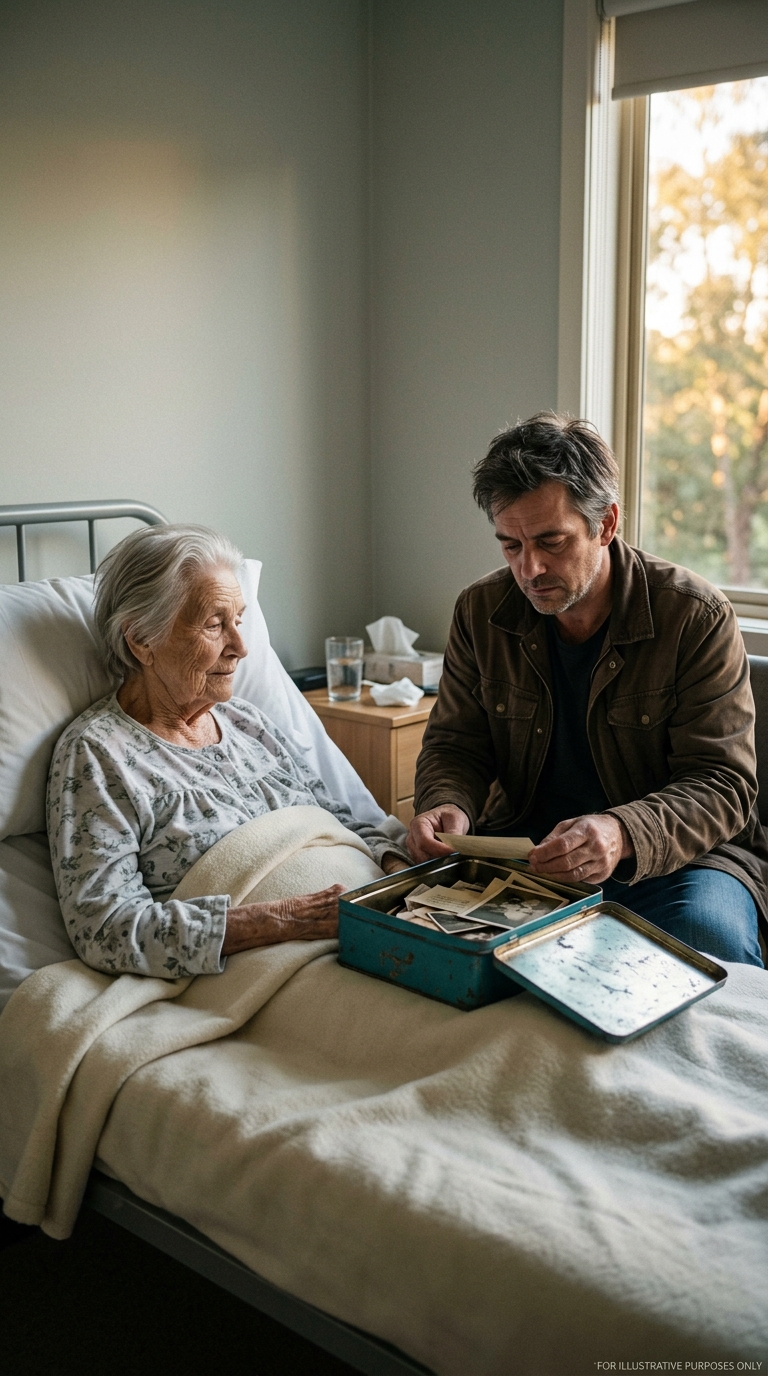
Mom rested beneath a clean white blanket. Her silver hair had been gently combed away from her face, and each breath came softly and unevenly.
Pressed tightly against her chest was the blue metal lunchbox she had carried to the cafeteria for decades.
Its corners were dented. The paint was scratched and faded where someone had once written her name with a black marker.
I lowered myself into the chair beside her bed and wrapped my hand around hers.
“Ma, I made it. I’m here.”
Her eyelids slowly lifted.
For a brief moment, confusion clouded her face.
Then she recognized me.
A faint smile touched her lips.
It was barely there, but it was enough to break something open inside me.
“I knew you would remember how to get home,” she whispered.
I bowed my head.
“I’m so sorry, Ma.”
With the little strength she still possessed, she pressed her fingers around mine.
“I wasn’t holding on because I needed extra days,” she said. “I was holding on for you.”
Then she nudged the lunchbox toward me.
“Look inside.”
I opened it.
Dozens of postcards filled the top.
They were all the cards I had mailed during my years on the road.
Desert sunsets from Arizona.
Long stretches of highway across Texas.
Colorado mountains buried under snow.
Cheap postcards purchased from gas stations in towns I could no longer remember passing through.
Mom had kept every single one.
Beneath them were childhood drawings folded at the edges, faded family photographs, and even a paper napkin from the day I purchased my first truck.
At the very bottom rested several envelopes bound together with an old red ribbon.
My name had been carefully written across each one.
“What are these letters?” I asked.
“Words I wanted you to have,” she replied.
I untied the ribbon and opened the first envelope.
The date showed that she had written it six years earlier.
“Darius,” it began, “I know you are busy creating your own life. I only hope you understand one day that you were never something that interrupted mine.”
The page disappeared behind my tears.
In the next letter, she wrote about how proud she felt whenever a large truck passed her on the highway.
Another said she had already forgiven me for not coming home at Christmas.
One envelope contained a recipe I had once requested, then forgotten I had asked for.
The final letter had no date.
There were only three lines inside.
“You owe me nothing for being your mother.
But love needs a place where it can arrive.
Give it that place while the people you love are still here.”
No words came when I tried to speak.
I rested my head beside her hand and wept with the helplessness of the little boy I had once been.
Mom gently ran her fingers through my hair.
Even as her own life slipped away, she was still the one comforting me.
We spent that morning speaking in small pieces whenever she had enough strength.
She asked whether I was still drinking that awful coffee sold at gas stations.
I asked if she remembered the afternoon I shattered her kitchen window with a baseball.
A smile appeared on her face.
“You said the dog did it.”
“We never owned a dog,” I reminded her.
“Exactly,” she said. “That’s why nobody believed you.”
For a few precious minutes, the hospice room disappeared.
We were back in her kitchen.
Tortillas warmed over the stove.
Music played softly from the radio.
Mom laughed while I denied eating the final slice of cake even though the crumbs were still on my shirt.
Near noon, her strength began to fade.
I held her hand and promised I was not going anywhere.
Her gaze drifted toward the window. Sunlight had reached the stone fountain in the courtyard.
“You could never sit still,” she whispered.
“I can today.”
She gave one slow nod.
“Good.”
Mom died that evening with her hand inside mine.
The blue lunchbox remained on the chair beside her bed.
After we buried her, I took three weeks away from work.
For the first time in years, I did not drive anywhere.
I stayed inside her small house and listened to the quiet she had endured while I kept assuring her I would visit soon.
Beside the kitchen sink, I discovered two coffee mugs.
One had belonged to her.
The other had been placed there for me.
Every Sunday afternoon now, I telephone my daughter.
She is twenty-one, busy, and beginning a life that belongs to her.
If she only has a few minutes, I do not punish her with guilt.
I listen for as long as she wants to speak.
Before ending every call, I tell her the words my mother had waited years to give me.
“You will never be an interruption.”
Once each month, I also visit a retirement home located close to one of my regular routes.
I bring postcards and sit beside anyone who would like some company.
I listen while they tell me about childhood farms, distant wars, long marriages, grown children, and the roads that once led them home.
Most of them are not asking for anything complicated.
A warm cup of coffee.
Ten minutes that do not feel rushed.
Someone willing to learn and remember their name.
For most of my life, I believed loving someone meant working as hard as possible to provide for them.
Now I understand that love is also revealed by whether you are willing to stop working and take the empty chair beside them.
We reassure ourselves that our parents know we care.
We assume another Sunday will come.
Another birthday.
Another holiday.
Another opportunity to walk up the familiar steps and knock on their door.
Sometimes we are given that opportunity.
Sometimes we are not.
Mom’s old blue lunchbox still travels in my truck.
Whenever the highway seems endless and my phone begins to ring, I glance at the scratches and dents covering its metal sides.
I remember the woman who waited for me without ever making a demand.
And I pick up the phone.
Because the people who devote their entire lives to loving us should never reach their final days wondering whether we can spare a moment for them.
Love does not demand that we freeze time.
It only asks that we arrive before silence fills the room.