At two seventeen on a cold November morning, my five-year-old daughter appeared in my bedroom doorway, clutching her stomach with both hands and trembling beneath her yellow pajamas.
“Mommy, the little fish are pinching me.”
At first, I thought Maisie had awakened from a bad dream. She had always possessed a vivid imagination, the kind that turned clouds into castles and shadows into animals, so I pushed back the covers and opened my arms, expecting her to climb into bed beside me. Instead, she took one step forward and folded against the doorframe, her face pale beneath the hallway light.
I lifted her carefully and asked where she hurt. She pressed one hand below her ribs.
“They’re swimming around in here,” she whispered. “They won’t stop.”
My husband, Owen, was attending an insurance conference in Minneapolis, nearly five hours from our home outside Madison, Wisconsin. I called him twice while pulling on sweatpants and wrapping Maisie in a winter coat, but both calls went to voicemail. By the time I carried her to the car, she was no longer speaking. She lay curled beneath a blanket in the back seat while I drove through streets glazed with frost, listening to every small sound she made and promising her that we were almost there.
At Lakeshore Children’s Hospital, a nurse took one look at her and hurried us through the waiting room. The emergency physician ordered imaging, and although everyone remained calm and professional, I noticed how the technician’s expression changed as bright, circular shapes appeared on the monitor.
She excused herself without offering an explanation.
A pediatric specialist entered several minutes later, accompanied by another physician. He pulled a stool beside me and spoke gently.
“Mrs. Hale, the images show numerous small magnetic objects inside Maisie’s digestive system. Several appear to have connected across different areas, and she needs immediate surgery.”
I stared at him, unable to understand how his words could belong to my daughter.
“Magnets? We don’t have magnets like that in our house.”
The doctor paused before asking the question that changed the atmosphere in the room.
“Is there any possibility someone gave them to her?”
The Mother Everyone Suspected
While the surgical team prepared Maisie, two police officers arrived. Officer Leah Mercer asked who spent the most time with my daughter, and I answered honestly: I did. I worked from home as a proofreader, arranged my schedule around preschool, and rarely left Maisie with anyone except Owen or his mother, Judith.
My answer seemed to settle over the room like a shadow.
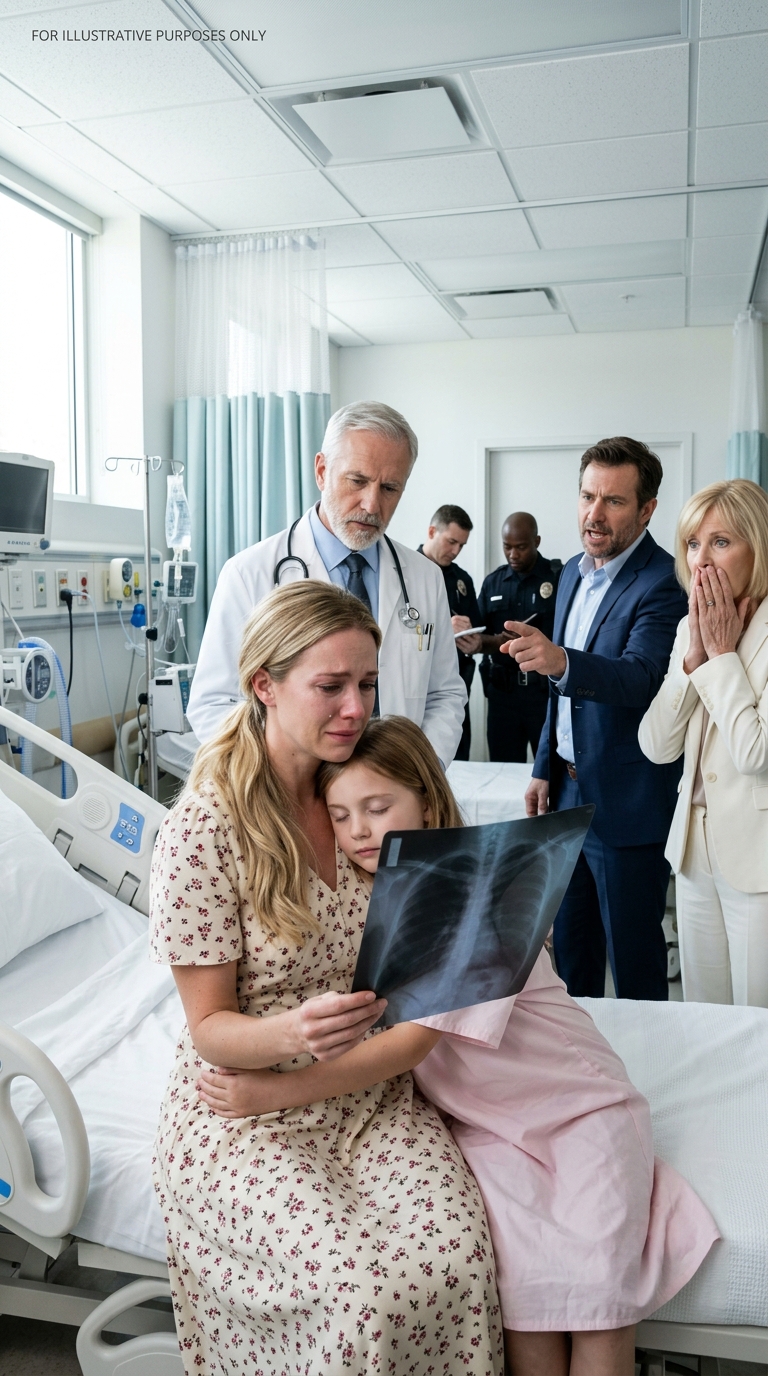
Officer Mercer placed a printed image on the table. Thirty-six bright pieces appeared in several clusters.
“A child her age would be unlikely to swallow this many without encouragement,” she explained. “We need to understand who had access to her during the last two days.”
I listed every person I could remember. Her teacher. Two classmates at a playdate. Owen. Judith. Me.
Owen arrived before sunrise with Judith beside him. He crossed the hallway quickly, but instead of embracing me, he stopped several feet away and demanded to know how I could have missed something so serious.
“You’re with her all day, Nora. How could she swallow thirty-six objects without you noticing?”
Judith began weeping into a tissue.
“I’ve been worried about this for months,” she told the officers. “Nora is always working on that computer. She says she can watch Maisie and meet her deadlines, but no one can do both properly.”
I looked at my husband, waiting for him to defend me. He remained beside his mother.
The surgeon came out nearly three hours later and told us Maisie was stable. The magnets had caused serious internal damage, but the medical team had removed them and repaired what they could. Her recovery would require time, careful meals, and regular appointments.
Relief passed through me so sharply that my knees weakened. Owen, however, turned back toward me.
“They were inside her for more than a day. Didn’t you notice anything?”
The surgeon answered before I could.
“Early symptoms can be subtle. Once her condition became clear, Mrs. Hale brought her here promptly.”
I asked whether Maisie could have taken all thirty-six magnets on her own.
“It’s highly improbable,” he said. “Someone likely presented them as harmless and gave them to her one at a time.”
Owen fell silent. So did Judith.
Then I remembered the small camera in our dining room.
We had installed it after packages began disappearing from neighboring porches. Its angle covered the front windows, the dining table, and part of the staircase. I rarely checked it, but the recordings were stored for seven days.
“There may be video from yesterday afternoon,” I said.
Judith’s crying stopped.
“You shouldn’t leave Maisie now,” she replied quickly. “What kind of mother walks away while her child is in surgery?”
When I stood, Owen blocked the doorway.
“The police should handle this. You can’t go home and start moving things around.”
His accusation finally made something painfully clear. He did not merely wonder whether I had failed to notice a danger. He believed I might have caused it.
I called Officer Mercer.
“We have a dining-room camera, and I believe yesterday’s recording may show what happened. My husband and his mother are trying to prevent me from retrieving it.”
Owen reached toward my phone.
“Please don’t touch me,” I said, loudly enough for the officer to hear.
She instructed all of us to remain at the hospital until another officer arrived.
The Secret at the Dining Table
Two officers accompanied us home later that morning. Maisie’s coloring book still lay open on the dining table, with a purple crayon resting beside an unfinished picture of an ocean.
The camera was mounted on a shelf across the room. I opened its application on my laptop and found the recording from the previous afternoon.
At 4:18, Maisie sat coloring while I carried folded towels upstairs. Two minutes later, Judith entered wearing the same gray cardigan she still had on at the hospital.
She sat beside Maisie and removed a small container from her handbag.
On the recording, my daughter leaned closer.
“What are those, Grandma?”
“They’re tiny ocean pearls,” Judith replied. “If you swallow them, friendly fish will visit your tummy.”
“Did Mommy say I can?”
Judith glanced toward the staircase.
“This is our special game. You don’t need to tell her.”
She placed one small object in Maisie’s hand. My daughter swallowed it, then made a face.
“It tastes funny.”
“That means it’s working. Be brave and try another.”
No one in the room spoke as the recording continued. Judith offered them slowly, praising Maisie after each one and reminding her that good granddaughters knew how to keep special secrets. When the container was empty, she returned it to her purse and wiped the table.
Before leaving the room, she bent close to Maisie.
“If you tell Mommy, she’ll be upset with you.”
Officer Mercer stopped the video.
“How many did you give her?”
Judith’s hands began to shake.
“I didn’t realize all thirty-six would hurt her.”
The officer had not mentioned the number.
Owen stepped away from his mother as though the floor between them had opened.
“Why would you do this?”
Judith reached for him.
“I did it for you. Nora was pushing us out, and you were going to lose your little girl. I thought Maisie would get a stomachache, and everyone would finally see that Nora wasn’t watching her properly.”
The officers searched her handbag and found the empty container, a receipt, and her phone. One notification visible on the screen came from Judith’s sister, responding to a message Judith had sent the previous evening.
Her original message read: “Tomorrow Owen will finally have proof that Nora is careless. Then he can bring Maisie home where she belongs.”
As Judith was escorted outside, she shouted that I had divided the family.
I stood in the dining room looking at the blue fish Maisie had drawn. She had tried to explain everything in the only language she possessed. The fish were not imaginary. She simply did not know what else to call the things a trusted adult had persuaded her to swallow.
The Plan Behind the Smiles
Maisie awakened shortly before dawn the following day. I was sitting beside her hospital bed when her eyes opened.
“Are the little fish gone?”
“Yes, sweetheart. The doctors took them all away.”
Tears gathered in her eyes.
“Grandma said you’d be mad if I told.”
“I’m not mad at you. None of this was your fault.”
Owen stood in the doorway. When he approached, Maisie pressed herself against the pillow and reached for my hand. He stopped immediately.
Later that morning, Officer Mercer informed me that I had been cleared. The video, the items found in Judith’s possession, and the messages on her phone established what had happened.
I expected relief, yet relief never came. My daughter was still recovering, my husband had accused me before asking a single careful question, and a woman we had trusted had treated Maisie’s innocence as a tool.
The investigation revealed that Judith’s actions had not been impulsive. For months, she had described me to relatives, neighbors, and members of her church as inattentive and controlling. She kept notes about my routine, including the afternoons when I carried laundry upstairs, and searched online for household objects that might create delayed medical problems.
One calendar entry contained only a few words: “Wednesday, 4:15. Nora upstairs.”
The message that hurt Owen most had been sent to his older sister.
“When Maisie gets sick, Owen will finally act. Nora will lose control, and he’ll need me again.”
Two days later, Owen and I sat across from each other in a prosecutor’s office.
“I had no idea my mother could do something like this,” he said.
“But you thought I could.”
“I was scared.”
“So was I. I tried to protect our daughter. You tried to protect your mother.”
He apologized, but his words could not erase the moment he had blocked the hospital doorway. Before Maisie was released, I hired a family-law attorney and requested temporary sole custody, full authority over her medical care, and supervised visits for Owen.
When he received the papers, he called me.
“Nora, I’m still her father.”
“Then become the father she needs. Right now, she doesn’t feel safe with you.”
“I didn’t know the truth.”
“You didn’t need every answer before treating me like your wife. You only needed to remember my character.”
Maisie remained in the hospital for two weeks. My mother came from Ohio to help, while my friend Elise brought soup, clean clothes, and children’s books. Recovery came slowly, measured in spoonfuls of food, short walks, peaceful nights, and the gradual return of Maisie’s laughter.
Owen’s first visit was supervised. He arrived carrying balloons and an enormous stuffed rabbit, but Maisie stayed beside me.
“She doesn’t need a performance,” I told him quietly. “She needs patience.”
He left the gifts in a corner, sat on the floor, and asked whether she wanted him to read. Maisie selected a book but remained several feet away. Owen respected the distance. He did not ask for a hug or expect forgiveness. It was the first wise choice he had made since the hospital called him.
Judith insisted that she had misunderstood the danger and acted only because she felt excluded from Maisie’s life. Her explanation collapsed beneath the recording, her search history, and months of messages describing her plan.
Several relatives asked me to show compassion by withdrawing my cooperation from the case.
One aunt said, “Judith is nearly seventy. Years behind bars will take everything from her.”
“She did not forget an appointment or make one careless choice,” I replied. “She planned this, involved a child, and told that child to hide the truth. I won’t pretend it was a simple mistake.”
No one asked me again.
The trial began eight months later. Maisie stayed home because I refused to let a courtroom become another frightening memory. The medical team explained the lasting effects of her injuries, while Officer Mercer described how I had identified and preserved the camera recording.
Owen was asked whom he had chosen to defend while Maisie was in surgery.
After a long silence, he answered, “My mother.”
Judith claimed she loved her granddaughter and had only wanted Owen to recognize what she believed was happening in his home.
The judge asked one direct question.
“If you believed those objects were harmless, why did you tell Maisie to keep them secret?”
Judith offered no answer.
She was convicted on several serious charges and permanently prohibited from contacting Maisie. As officers led her away, she called Owen’s name and begged him to explain that she loved her granddaughter.
He remained where he was.
Our divorce became final several months later. I received primary custody, while Owen continued supervised visits with the possibility of earning more time through counseling and consistent respect for every court order.
Outside the courthouse, he told me he still loved me and believed he could change.
“You may become a better father,” I said. “But while our daughter needed us, you made me defend myself against you. I cannot build a marriage on that memory.”
This time, he did not argue.
Where the Fish Belonged
A year later, Maisie and I moved into a modest house near Lake Michigan. The kitchen had pale yellow curtains, and the backyard offered enough sunlight for the paper cups in which she planted basil and marigolds.
She still attended medical appointments, and certain foods remained difficult for her, but good days gradually outnumbered the hard ones.
One evening, she asked me whether dangerous secrets could return if someone opened the door.
I knelt beside her chair.
“Secrets that frighten or hurt you lose their power when you tell a safe adult.”
“What if somebody says I’m not allowed to tell you?”
“A safe person will never ask you to hide something that causes pain or fear.”
She considered this carefully.
“Are we safe now?”
“Yes.”
“How do you know?”
“Because I will listen to you, and I will believe you.”
Owen slowly earned longer visits. He learned her meal plan and medication schedule, stopped demanding affection, and allowed Maisie to decide when she wanted to sit near him. Some days she hugged him. Other days she waved from the doorway. He learned to respect both answers.
I did not confuse his regret with repair. He could still rebuild parts of his relationship with his daughter, but our marriage belonged to a life I had closed behind me.
One afternoon, I found Maisie drawing at the kitchen table. When I noticed the fish on her paper, my hands became still.
She held up the picture. The fish were pink, green, gold, and blue, floating beneath a bright orange sun.
“Look, Mommy. These are good fish.”
I sat beside her.
“They’re beautiful.”
“They don’t pinch anymore,” she said. “Now they stay on the paper.”
She taped the picture to the refrigerator and ran outside to check her flowers.
Judith had tried to use a child’s trust to prove I was an unfit mother. Owen had trusted an accusation before he trusted the woman he had built a home with. Even the officers had first looked at me and seen the most convenient explanation.
But Maisie had told the truth from the beginning. She called them little fish because she was five years old and had no word for betrayal.
I knew that word well.
Over time, however, I learned another: freedom.
Freedom was no longer begging people to believe what I knew to be true. It was understanding that shared names could not turn an unsafe home into a family. It was closing a door without guilt when everything precious stood safely on my side of it.
The colorful fish remained on our refrigerator for years, exactly where they belonged—far from secrecy, far from fear, and visible beneath the warm kitchen light.