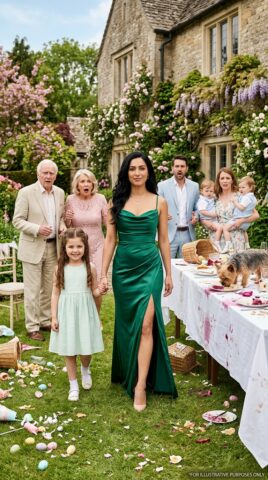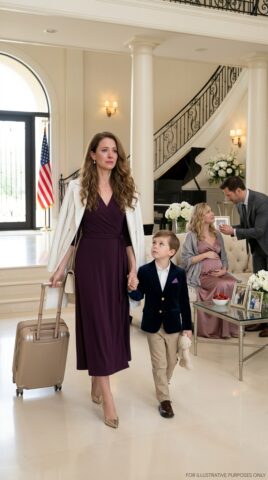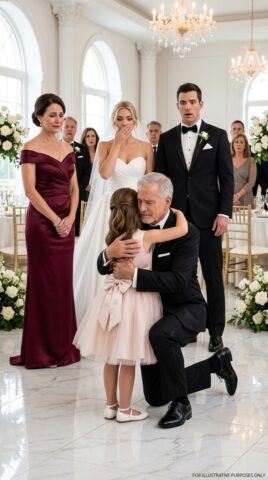
By the time my mother-in-law struck my five-year-old son across the cheek, he had been awake for nearly eight hours and had eaten half a peanut-butter sandwich.
The cupcake in his hand fell onto the polished marble floor of the wedding hall, landing upside down in a small burst of chocolate frosting. Owen stumbled and dropped to his knees. For a moment, the string quartet continued playing, but the sound seemed to fade beneath the sudden quiet spreading through the room.
“Those desserts are for the guests, not for greedy children who grab whatever they see,” Lorraine snapped.
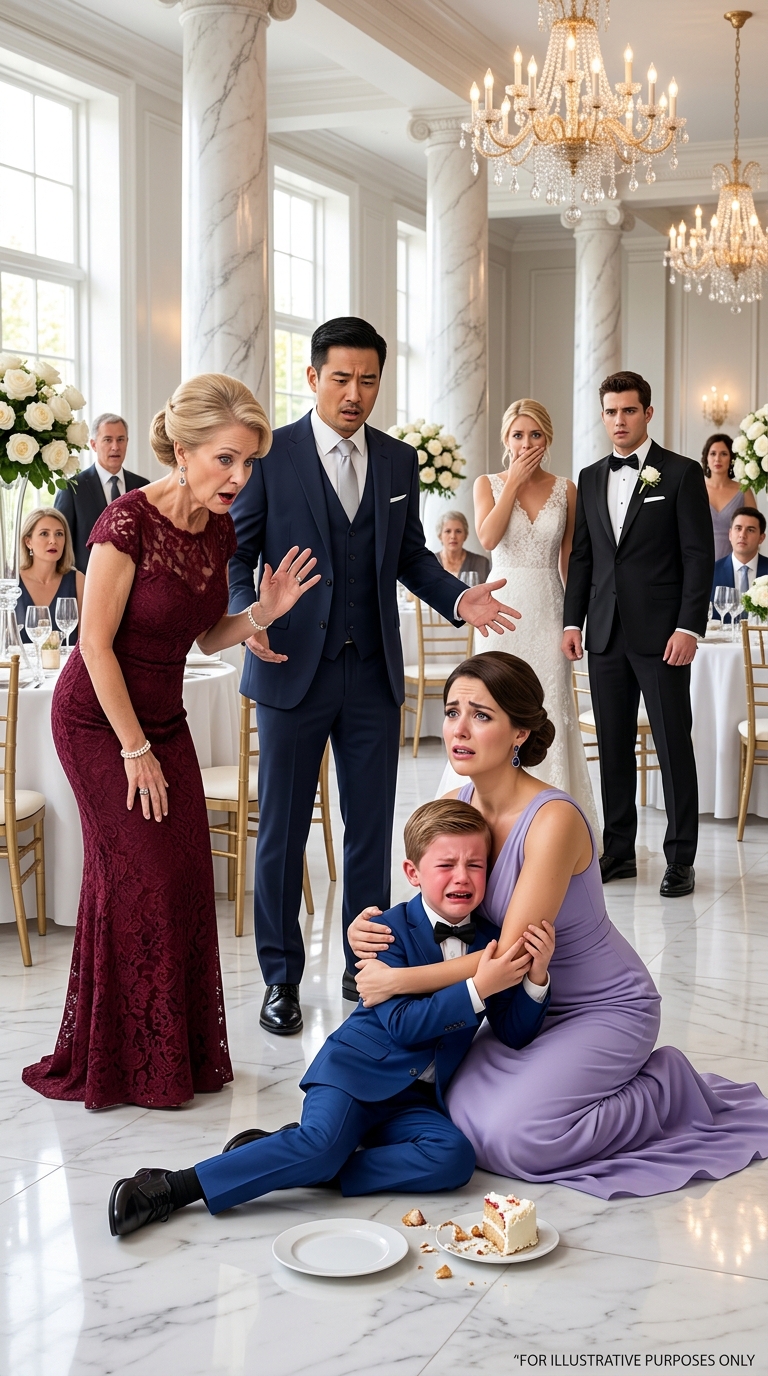
I hurried across the foyer and gathered my son into my arms. His bow tie hung crooked, his knees were scraped, and his gray eyes had filled with tears he was trying hard not to release.
“Mom, the server said I could have it,” he whispered.
I looked at Lorraine, waiting for even the smallest sign of regret. She merely straightened the sleeve of her beaded navy dress.
“Someone has to teach him manners, Megan. You let him get away with everything.”
The wedding was being held at an elegant private estate outside Asheville, North Carolina, the kind of place with stone terraces, high arched windows, and enough white roses to decorate a dozen ceremonies. Nearly two hundred guests had come to watch Lorraine’s daughter, Bethany, marry Luke Holloway, whose parents owned several successful home-building companies across the state.
For six months, Lorraine had told anyone willing to listen that she was paying for the entire celebration herself.
What she never mentioned was that $42,000 of the wedding expenses had come from me.
I worked as a purchasing coordinator for a regional hospital network, and for years I had saved every bonus and tax refund I could. My husband, Scott, our son, and I were living in Lorraine’s basement apartment while trying to gather enough money for a down payment on a modest townhouse. It was not glamorous, but it represented independence, something I had wanted more urgently with every passing month under Lorraine’s roof.
Eight weeks before the wedding, she had called a family meeting at her kitchen table.
“Bethany’s final bills are higher than expected,” she had announced. “Scott is her brother. Families step in when one of their own needs help.”
Scott had squeezed my hand beneath the table.
“Just this once,” he said. “Mom and Bethany will pay us back after the wedding.”
I transferred the money without a contract because I trusted my husband, and because Lorraine had a way of making every refusal sound like a betrayal. She never thanked me. Instead, she asked me to review vendor invoices, correct the seating chart, confirm deliveries, and arrive at the estate before sunrise on the wedding day.
Owen had been patient through all of it. Whenever he told me he was hungry, I tried to take him to the kitchen, but another small emergency always pulled me away. A florist needed approval. The photographer had the wrong schedule. One of the place cards was missing.
Finally, a server noticed Owen standing near the dessert table and offered him an extra cupcake left over from the children’s trays.
That simple act of kindness had brought Lorraine’s hand down across his face.
Scott appeared while I was still holding our son.
“Your mother struck him because a server gave him something to eat,” I said.
He looked at Owen’s reddened cheek, then at Lorraine, and finally at the guests beginning to gather around us. His first concern was written plainly across his face: not his child, but the scene we were creating.
“Megan, this is Bethany’s wedding,” he murmured, taking my arm. “We’ll talk about it later. Please let it go for now.”
Something inside me, something I had bent and folded for years to keep his family comfortable, finally stopped yielding.
Owen buried his face against my shoulder.
“I’m sorry, Dad. I won’t eat anything else.”
Scott lowered his eyes but offered no answer.
What Owen Had Heard
I carried Owen into a quiet hallway and cleaned his knees with a damp cloth. He sat on a velvet bench, still holding the napkin the server had given him.
“Mom,” he asked, “does telling the truth make grown-ups mad?”
I paused.
“Sometimes the truth makes people uncomfortable, but you should never be frightened to tell me something important.”
He glanced toward the ballroom.
“Then I need to tell you what Grandma and Aunt Bethany said. They were talking about your house money and a yellow envelope.”
Before I could ask another question, an announcement came over the speakers requesting that both families gather near the ceremony platform.
The civil ceremony began as though nothing unusual had happened. Bethany entered beneath an arch of white roses wearing a sparkling gown with a train long enough to cover the aisle. Lorraine stood in the front row, dabbing her eyes and smiling proudly for the photographer.
Luke’s mother, Ellen, noticed Owen’s cheek almost immediately.
“Sweetheart, what happened?” she asked.
Lorraine answered before he could.
“He was misbehaving near the dessert table. I had to correct him after he tried to take food that wasn’t his.”
Owen stood a little straighter.
“I didn’t take it. The lady said I could have it.”
Ellen’s expression changed. She picked up a dinner roll from a nearby basket and offered it to him.
“Then you may have this. A hungry child should be fed, not embarrassed.”
Owen accepted it but did not take a bite.
“Are you sure? Grandma said the cupcakes cost too much and there isn’t any money left at home.”
Lorraine’s face lost its color.
“Owen, that is enough.”
Her sharp voice reached farther than she intended. Conversations stopped, and even the musicians lowered their instruments.
Ellen knelt so that she was level with him.
“Why do you think there isn’t any money?”
Owen looked at me. I gave him a small nod.
“I heard Grandma tell Aunt Bethany that they couldn’t pay for this place unless they got Mom’s savings. She said your family thought Grandma had plenty of money, so nobody should tell you the truth.”
A murmur moved across the room.
Luke’s father, Richard, turned toward Lorraine.
“You told us you covered the wedding from your own retirement account.”
“He misunderstood,” Lorraine replied quickly. “He’s five. Children confuse things.”
I took out my phone.
“He understood correctly. I transferred $42,000 from the account I had created for our home.”
I opened the banking records and showed Richard three payments: the estate deposit, the florist, and the photography package. Each payment had been sent to an account controlled by Lorraine.
Luke stared at Bethany.
“Did you know about this?”
“I knew Scott helped,” she said, twisting her bouquet ribbon. “Mom called it family money. I didn’t know Megan had given her everything.”
Owen raised his hand as if he were sitting in kindergarten.
“There’s still the yellow envelope.”
Lorraine moved toward him, but I stepped between them.
“What envelope?” I asked.
“The one Grandma put in her red purse. She told Aunt Bethany not to give all of it to Luke because they could use some for other bills.”
Richard’s expression hardened. Several weeks earlier, he and Ellen had given the couple $30,000 toward the down payment on their first home. The money had been sealed inside a yellow envelope bearing Luke’s and Bethany’s names.
Only Bethany and Lorraine had known where it was being kept.
“That was a gift to my son and his future wife,” Richard said. “Why would it be in your purse?”
Lorraine clutched the red handbag resting behind the head table.
“It isn’t.”
Owen pointed.
“Yes, it is. I saw it when you took out your perfume.”
Luke walked over, lifted the purse, and placed it on the table in front of Lorraine.
“Open it.”
Her fingers trembled as she reached inside. A moment later, the corner of an opened yellow envelope appeared.
The List Inside the Envelope
Only $18,000 remained.
There was also a folded sheet of paper written in Lorraine’s careful handwriting. It listed a late vehicle payment for Bethany, alterations to the wedding gown, an overdue credit-card balance, and several personal expenses. Ten thousand dollars had been accounted for. Another $2,000 was simply missing.
“Where is the rest?” Luke asked.
Lorraine glanced around the room as though one of the guests might offer her an escape.
“It all went toward the wedding.”
“The wedding was paid for with Megan’s savings,” Richard replied. “You accepted her money, claimed the credit for it, and then opened a gift that did not belong to you.”
Bethany covered her mouth.
“Mom, you said the envelope was untouched.”
“I was helping you,” Lorraine insisted. “Your car payments were behind, and you had bills you couldn’t manage. What was I supposed to do?”
Bethany looked at her mother with a sadness deeper than anger.
“You were supposed to tell me the truth.”
Owen tightened his fingers around mine. The dinner roll still sat untouched in his other hand.
“Grandma, is that why you got mad at me? Because you thought I would tell?”
Lorraine could not answer.
For the first time that day, she truly looked at her grandson—not as an inconvenience threatening her perfect event, but as a small child she had frightened while trying to protect her own image.
Richard asked for the microphone.
“Our family never demanded an expensive wedding,” he said calmly. “We did not choose Luke’s wife based on her family’s bank account. We asked only for honesty.”
Ellen joined him.
“And the money is no longer the most troubling part. A woman was pressured into surrendering the savings meant for her child, and when that child spoke honestly, the adults around him tried to silence him so the photographs would still look beautiful.”
Tears ran down Lorraine’s face.
“I made a mistake. I’ll repay everyone.”
“This was not one careless moment,” I said. “It was a long series of choices. You knew why I had saved that money. You let people praise you for paying these bills. You opened someone else’s gift, and when Owen spoke, you tried to quiet him again.”
Scott finally stepped forward.
“Mom, apologize.”
She stared at him in disbelief.
“Now you’re taking her side?”
He drew a slow breath.
“I should have been on her side from the beginning. Megan is my wife, and Owen is my son.”
It was the first time in our marriage that he had challenged Lorraine in front of anyone. Yet I felt no relief, only the weariness that comes when the right words arrive years too late.
Luke turned toward Bethany.
“Did you know your mother opened the envelope?”
Bethany lowered her head.
“Yes, but she said she was only keeping it safe.”
“Did you know Megan helped pay for the wedding?”
“I knew she contributed. I never asked how much.”
Luke closed his eyes briefly.
“That is what I can’t overlook. You may not have planned any of this, but you chose not to ask questions while you benefited from the answers being hidden.”
Bethany reached for his hand.
“We can fix everything after the ceremony.”
He stepped back gently.
“If we go forward today, I’ll spend years wondering what else will be hidden until later.”
The officiant waited beside the signing table. The cake stood untouched, and the meals prepared for two hundred people cooled behind the kitchen doors.
Luke looked at Bethany for a long time. The affection in his face made his decision even harder to witness.
“I don’t believe you’re a bad person,” he said. “But I can’t begin a marriage today when honesty entered this room only because a little boy happened to overhear it.”
He placed the ring on the table.
“The wedding is canceled.”
The Price of Staying Silent
Luke’s family did not insult anyone or create another scene. Richard counted the remaining money in front of two witnesses and told Lorraine that she had forty-eight hours to return the missing amount before he considered formal action.
Ellen approached me before leaving.
“I’m sorry you and Owen were put through this.”