The mob king was dying in a mansion full of famous doctors, and none of them could save him.
That was the rumor whispered across Chicago in private clubs, law offices, and kitchens where people lowered their voices when they said the name Moretti.
Vincent Moretti had spent twenty years building the kind of empire respectable men publicly condemned and secretly negotiated with.
He owned restaurants, shipping companies, real estate, and the loyalty—or fear—of men who had survived because he had.
Now he was dying in a lakefront mansion with heated floors, museum-grade art, and enough medical equipment to outfit a small private clinic.
And the thing killing him had no gun, no face, and no witnesses willing to name it.
At first it looked like an infection.
Then an autoimmune condition.
Then a rare neurological disorder.
The symptoms never held still long enough for certainty.
Fever.
Then chills so intense his teeth cracked together.
Weakness.
Sweats.
Irregular pulse.
Hands that trembled when he lifted a glass.
Some mornings he seemed almost improved.
By nightfall he could barely sit upright.
Specialists came and went.
They walked through the mansion with the authority of people used to being listened to.
They studied scans until dawn.
They ordered esoteric blood work.
They debated toxins, cancers, tropical diseases, cardiac syndromes, endocrine failures.
Every theory faded.
Every treatment failed.
Yet one pattern remained: Vincent worsened after midnight, and most violently at 2:17 a.m.
His fiancée, Vanessa Vale, called it a cruel coincidence.
Vanessa was elegant enough to make grief look expensive.
She had entered Vincent’s life two years earlier through a charity board and moved through his world with astonishing ease.
She was beautiful, self-possessed, and socially flawless.
She knew how to host judges, flatter donors, charm old money, and silence a room without raising her voice.
To everyone watching from outside, she looked like the final polish on Vincent Moretti’s transformation from feared street legend into legitimate power broker.
But inside the mansion, Vincent had begun to notice something he could not explain.
Vanessa was never frightened.
The nurses were frightened.
The cooks were frightened.
The bodyguards, though they hid it better, were frightened too.
Vanessa alone remained smooth and composed.
She touched his forehead and said, “You’ll be all right,” with the calm of someone describing weather she had already checked.
The first person to say something truly dangerous was Dr.
Leonard Harris, Vincent’s lead physician.
He had been brought in from Boston and paid more in a week than most people earned in a year, but unlike several others, he had not allowed the money to turn him into a coward.
One rain-heavy evening in July, he stood in Vincent’s bedroom surrounded by antique furniture and quiet machines and said, “This isn’t behaving like a disease that comes and goes on its own.
Something is interacting with his body repeatedly.”
Vanessa turned from the window.
“That is a serious thing to imply.”
“I’m aware,” Harris said.
Vincent studied him through the waves of cold passing through his bones.
“You saying someone’s feeding me poison?”
Harris chose his next words carefully.
“I’m saying ongoing exposure is the only pattern that still makes sense.”
The room had gone silent when a housekeeper entered carrying fresh towels.
three weeks earlier, and the decision had unsettled him ever since.
Elena had come to the mansion desperate, recently displaced, with references thin enough to make the head housekeeper hesitate.
Vincent had approved her anyway because her name struck something old in him, and seeing her face confirmed it.
Years before the money, the polish, and the controlled image, there had been a single reckless night on the South Side with a young woman named Elena.
He had been young enough to mistake charm for absolution and arrogant enough to believe leaving before sunrise meant consequences would never follow.
He had not seen her again.
Until now.
She was thinner than he remembered, sadder around the eyes, and careful in the way people become careful after too many years of being disappointed.
She had a daughter named Lily.
Lily was eight.
Lily had Elena’s eyes.
And Vincent’s chin.
The resemblance was not loud.
It was worse than that.
It was undeniable in flashes—a turn of the head, a wary silence, the way the girl studied a room before trusting it.
Vincent had not yet said a word to Elena.
He had not earned the right.
But the sight of that child moving quietly through his house had cracked open something he had kept sealed for years.
That same night, after Elena left the room with lowered eyes and Vanessa resumed her practiced concern, the storm over the lake deepened.
Wind battered the glass.
Thunder moved over the mansion like furniture dragged across a ceiling.
Dr.
Harris refused to leave the house.
He set up in a nearby sitting room with a nurse and stacks of lab notes.
At 2:17, Vincent’s body seized into another vicious cycle.
He woke choking on cold.
His pillow had shifted crooked beneath him, his breathing turned ragged, and his heart monitor exploded into sound.
The nurse leapt up, Harris came running, and Vanessa appeared almost instantly from the adjoining dressing room.
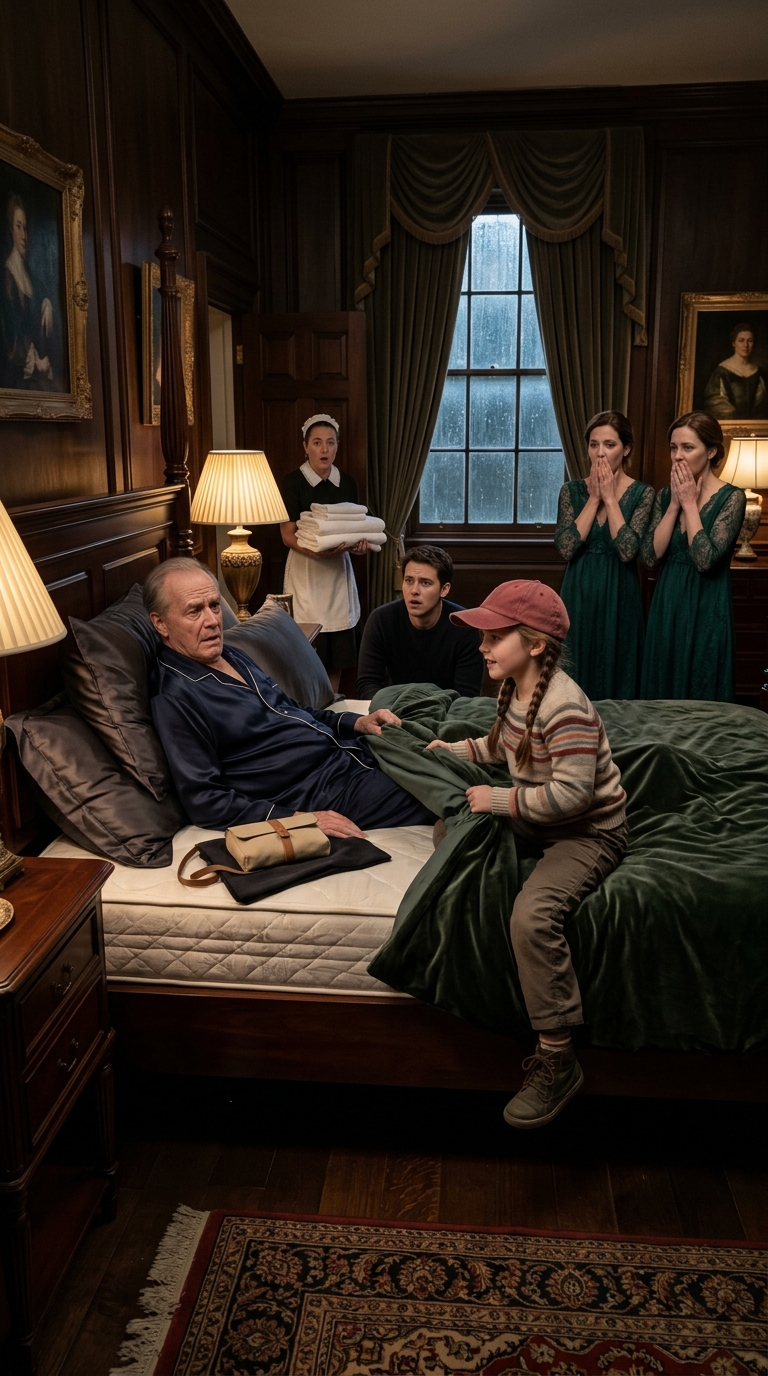
Behind them all, before anyone could stop her, came Lily.
She had heard the alarm and followed the noise in her socks, her Cubs cap clutched in her hand.
The adults were moving fast but not cleanly; panic does that even in rich houses.
Vincent clawed weakly at the blankets.
The pillow had slipped.
Lily reached the bed first because children sometimes cross a dangerous room simply because they think someone needs help.
“Wait,” she whispered.
“His head’s wrong.”
Vanessa’s response was immediate and too sharp.
“Don’t touch that.”
Every adult in the room heard the fear hiding inside those four words.
But Lily’s hand was already beneath the pillow.
Her fingers found something flat and tied.
She lifted the pillow and pulled free a small ivory sachet embroidered with tiny gold flowers.
“It’s this,” she said.
For a second nobody moved.
Then Lily looked at Vincent, then at the others, and said with the innocent certainty that only makes lies more obvious, “Miss Vanessa puts it there every night.”
Dr.
Harris took the sachet.
The top scent was lavender.
Beneath it was something bitter, medicinal, wrong.
Vanessa recovered quickly enough to try a story.
“It’s a sleep pouch.
From Paris.
Herbal.”
Lily shook her head.
“No.
There are two.
The nice one stays in your purse.