Part 1
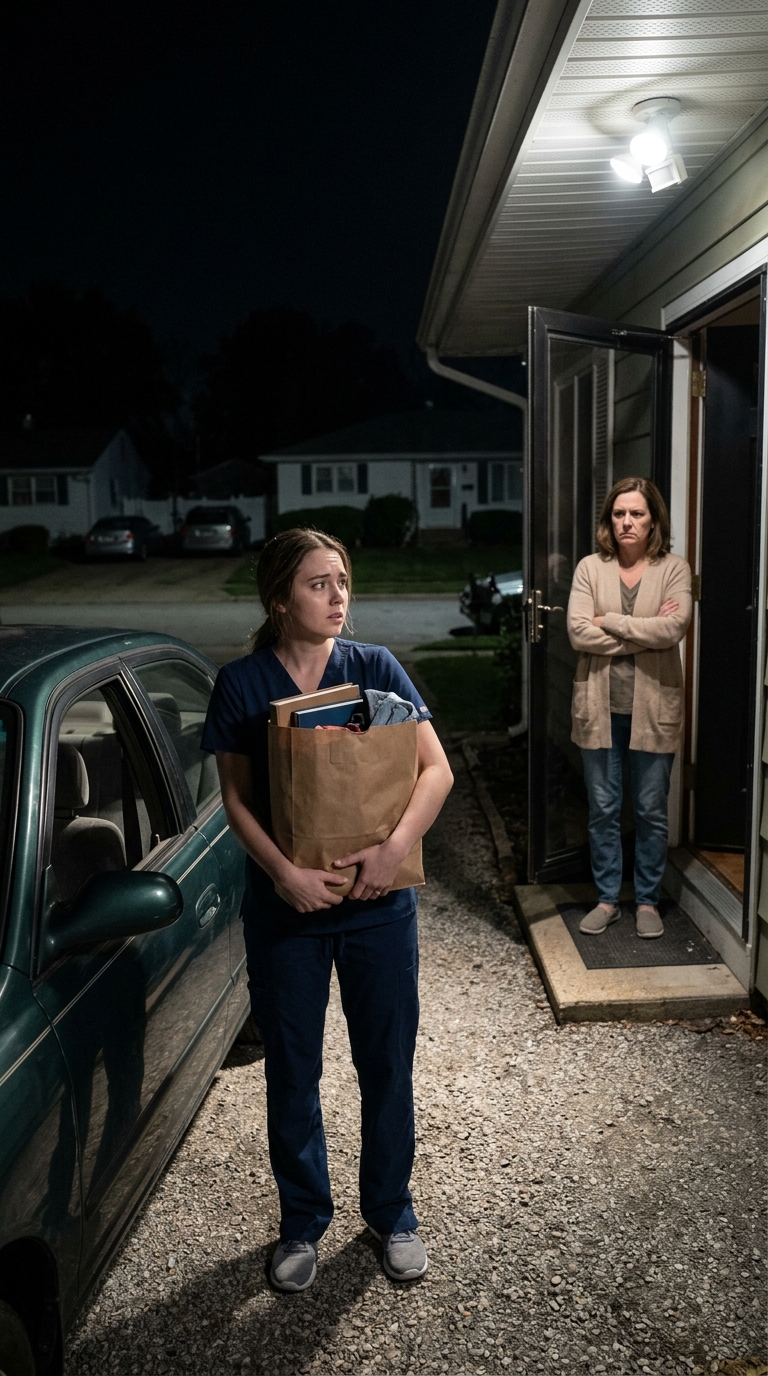
The morning my sister changed the locks, I was standing in the driveway in my nursing scrubs, holding everything I owned in a brown paper grocery bag.
Three uniforms.
A phone charger.
A toothbrush.
My mother’s old Bible that nobody else wanted.
That was it.
Twenty-eight years of belonging to a family, reduced to one paper bag with a torn handle.
My sister Vanessa stood in the doorway of the only home I had ever known, arms crossed, hair perfectly curled, wearing the same soft smile she used in photographs.
She did not look sorry.
“This is better for everyone, Lena,” she said. “You understand, don’t you?”
No.
I did not understand.
I did not understand how a person could spend four years working double shifts at Mercy General, sending half her paycheck home every month, buying groceries, paying utilities, scheduling cardiology appointments, cleaning up after everyone, sleeping three hours between shifts, and still be the one standing outside like a guest who had overstayed.
But I said nothing.
That was what they had trained me to do.
Be capable.
Be quiet.
Be useful.
I picked up my bag, walked to my car, and drove away.
Behind me, Vanessa closed the door.
I heard the new lock click.
That sound stayed with me longer than the crying did.
Three days before that morning, a healthcare startup I had quietly co-founded during night shifts had been acquired for thirty-eight million dollars.
My share had been deposited into an account my family did not know existed.
I found out in the parking lot of a gas station after a twelve-hour shift, eating a granola bar for dinner because I was too tired to sit in a restaurant. My attorney, Paul, sent the email with the wire confirmation and a short message.
Funds received. Call me when you’re safe to talk.
I stared at the number on my phone until the screen went black.
Then I tapped it awake and stared again.
38.2 million dollars.
I did not scream.
I did not cry.
I did not call my mother.
Something in my gut told me to stay quiet.
That instinct saved me.
To understand why, you have to understand my family.
Not the version they showed at church or birthdays or hospital waiting rooms when people brought casseroles and asked how we were holding up.
The real version.
My sister Vanessa was three years older than me. Growing up, she was the beautiful one, the social one, the one introduced first at every family gathering.
“This is Vanessa,” Mom would say proudly. “And this is Lena.”
I was the quiet one.
The one with good grades.
The one who did not ask for much.
When Dad’s construction business started failing, I was fifteen. I babysat neighbors’ kids on weekends and slipped grocery money into Mom’s purse because I had overheard her crying over the electric bill.
Vanessa was at the mall.
No one asked her to help.
No one expected her to.
By college, I had loans, two part-time jobs, and enough exhaustion to make my bones feel old. I kept my grades high enough to get into nursing school. Vanessa dropped out of business classes after one semester.
Mom said, “She’ll find her path.”
When I mentioned tuition was getting hard, Mom said, “You’ve always been so capable. You’ll figure it out.”
Capable.
They said it like praise.
It took me years to realize it was a sentence.
I figured it out.
I always figured it out.
When I graduated nursing school and passed my boards, my family threw Vanessa a party the same weekend because she had been promoted to shift supervisor at the boutique where she worked.
Nobody mentioned my graduation at dinner.
I moved home after nursing school because rent near the hospital was brutal on a first-year nurse’s salary, and my parents said it made sense.
What they meant was that they needed another adult in the house.
I paid a third of the mortgage. Then half. I bought groceries. I drove Dad to cardiology appointments after his heart got worse. I organized his prescriptions in little plastic boxes by day. I sat with Mom on nights when her anxiety got bad and she needed someone nearby.
Vanessa visited Sundays.
She brought pastries.
She got the hugs.
Her husband, Derek, moved in two years after they married because their apartment lease ended and they were, according to him, “in between situations.”
Derek had a lot of situations.
He also had opinions.
About the kitchen.
About the living room.
About my parking spot.
About whether the den where I did charting after shifts could become his “office-slash-media space.”
Small things.
Death by a thousand small things.
Then Dad’s health declined sharply in winter.
More appointments. More medications. More nights waiting for lab results while Mom panicked and Vanessa cried beautifully on the phone from wherever she happened to be having dinner.
One morning after a night shift, I came home and found Derek’s golf clubs in my bedroom closet.
I stood there in scrubs with blood on one sleeve, looking at a set of irons where my winter coat used to hang.
Vanessa appeared behind me.
“Oh, we’re just reorganizing,” she said. “Derek needs more space now that we’re helping full-time.”
Helping.
I started sleeping on the fold-out couch in the den.
I told myself it was temporary.
Six months later, Dad died.
Grief arrived like a wave, but I had no time to drown.
There were arrangements to make. Insurance forms. Medical equipment to return. Bills to sort. Mom to monitor. People to call.
I did most of it.
Vanessa selected flowers for the service and cried so beautifully that relatives hugged her first.
Three weeks after the funeral, she came to the den where I was folding my blanket.
“Derek and I have been talking,” she said.
That phrase never ended well.
“We’re going to renovate this space. Make it a proper room for when we have kids.”
I looked at her.
“Where am I supposed to sleep?”
She smiled gently.
“I think this is a good opportunity for you to get your own place. You’re established now. You’ve always been so independent.”
Independent.
There it was.
The pretty sister word for abandoned.
I had two weeks.
Then the locks changed early.
So I stood in the driveway with my paper bag while Vanessa told me it was better for everyone.
I drove to an extended-stay hotel and checked into room 114.
The air conditioner rattled. Parking lot light came through the curtains. The bedspread smelled faintly of bleach and old smoke.
I sat on the edge of the bed and finally cried.
Not just for the eviction.
For all of it.
The years.
The mortgage payments.
The fold-out couch.
The birthday cards I bought for everyone and the graduation nobody noticed.
The family built on my labor, then renovated me out.
I cried until I could not produce another sound.
Then I stopped.
Because I had thirty-eight million dollars.
And absolutely nothing left to lose.
Part 2
My attorney, Paul, speaks slowly and means every word.
That is rarer than people think.
I met him two years earlier through a nurse I worked with whose brother needed startup legal advice. At the time, the company I co-founded was barely more than a working prototype, a messy pitch deck, and three exhausted nurses who were furious at how often patients fell through administrative cracks because hospital departments could not share information properly.
We built a healthcare data platform.
Nights.
Weekends.
Days off.
Sometimes from break rooms, sometimes from my car, sometimes from my father’s kitchen table while Mom slept upstairs and Dad’s heart monitor blinked in the living room.
My co-founders, Rachel and Mina, were nurses too. We knew the problem because we lived inside it. We watched discharge instructions get lost, medication updates fail to transfer, specialists miss crucial notes, and patients suffer because systems that were supposed to communicate behaved like strangers.
So we built something better.
I never told my family.
Not because it was secret exactly.
Because it was mine.
And in my family, anything mine became available for commentary, correction, or use.
Derek would have opinions.
Vanessa would tell people.
Mom would ask whether I was making money yet and then immediately mention the mortgage.
So I kept the company quiet.
Paul helped structure my equity properly. He made sure my stake could not be diluted easily, that my agreements were clean, and that if the company ever sold, I would not be the nurse who “helped out” while other people collected the money.
When the acquisition went through, Paul told me to tell no one.
“People change when money is involved,” he said.
I almost laughed.
“Paul, my family changed when there wasn’t money.”
“Then imagine what they’ll do with the scent of it.”
After taxes, fees, and everything else Paul walked me through over four dense phone calls, I had more money than my brain could hold.
At first, I did nothing.
That was the smartest thing I could do.
I kept going to work at Mercy General. I slept in the extended-stay hotel for three weeks. I found a quiet condominium downtown and bought it through an LLC Paul created so my name would not show publicly. I furnished it simply.
A real bed.
A real closet.
A couch that did not fold into anyone’s backup plan.
I kept wearing my old scrubs.
My colleagues noticed I seemed less exhausted.
“New sleep schedule?” one asked.
“Something like that,” I said.
For two months, only Paul, Rachel, and Mina knew.
The acquisition was eventually announced in a health technology newsletter, but it named the company, not the founders individually. I thought I had time.
I had not accounted for Derek.
Derek fancied himself a savvy investor. He spent hours on financial forums looking for what he called “angles,” which usually meant losing money with vocabulary.
He found the acquisition announcement.
He remembered, apparently, that I once mentioned a healthcare side project years ago before learning not to share anything around him.
He put it together faster than I expected.
Then the calls began.
Seventeen in one morning while I was on shift.
Vanessa.
Mom.
Derek.
Vanessa again.
Unknown number.
Mom again.
I did not answer.
I texted Paul.
They know. It’s starting.
His reply came quickly.
Good. We’re ready.
Vanessa left a voicemail first.
“Lena, hey. I’ve been thinking about you so much. I feel terrible about how the housing situation happened. I hope you know it was never personal. Family is everything. I’d love to take you to dinner, just us sisters, and catch up properly. I love you.”
She used the soft voice.
The voice she used when she wanted something to feel like forgiveness before anyone admitted harm.
I saved the voicemail.
Mom called twice.
She said she was worried about me.
She said she heard I had done something “remarkable with a company.”
She asked if I was eating well.
She did not mention the fold-out couch.
She did not mention the driveway.
She did not mention the paper bag.
I saved those voicemails too.
Derek sent an email with an attachment.
Subject line: Family Opportunity.
The PDF was four pages long.
He had created a logo for an LLC he registered three weeks earlier, before he had even confirmed I was involved in the acquisition. The proposal described a “diversified family holdings vehicle,” which, after reading twice, appeared to be a fund controlled entirely by Derek.
He would manage it.
He would receive a fee.
I would make an initial contribution of four million dollars.
I forwarded it to Paul.
He called within ten minutes.
I could hear him almost laughing.
“Do nothing,” he said.
“That’s your legal advice?”
“That is my strategic advice. Let them come to you.”
So I waited.
The dinner request became lunch.
Lunch became coffee.
Coffee became Vanessa showing up in the Mercy General lobby during what she thought was my shift change.
The front desk called.
“Your sister is here asking for you.”
I was thirty feet away behind a partition.
“Please tell her I’m unavailable.”
I watched through the glass as Vanessa’s face shifted from warm expectation to confusion, then into something harder.
She left after eleven minutes.
I timed it.
Then Mom made her move.
A handwritten letter arrived on floral stationery she had kept in the kitchen drawer for years.
Three pages.
The first page was about Dad. How much she missed him. How hard the house felt without him. How grief changed people.
The second page was about family. How short life was. How heavy grudges could become. How she had always tried her best.
The third page was the point.
Derek had taken out a home equity line of credit against the house six months earlier.
It was now in default.
Foreclosure was possible.
Mom wondered whether I might be “in a position to help.”
There was no acknowledgment of the mortgage payments I made for four years.
No mention of the fold-out couch.
No apology for changing the locks.
Just the ask, dressed in flowers.
I read the letter three times.
Then I called Paul.
“What do you want to do?” he asked.
Not what is legally safest.
Not what will make this go away.
What do you want?
That question gave me room to be honest.
“I want Mom safe,” I said. “I do not want Vanessa and Derek rewarded.”
“Good,” Paul said. “Then we have options.”
The first move was quiet.
We purchased the defaulted home equity note from the lender through one of my LLCs. Perfectly legal, if uncommon. A third party can buy distressed debt and assume creditor rights.
My family had no idea.
That meant I now held the debt against the house.
Not the house itself.
The debt.
The right to foreclose if unresolved.
I had no intention of foreclosing.
This was not revenge.
It was leverage.
And leverage, I was learning, is what boundaries look like when people refuse to respect words.
Two weeks later, I called Vanessa.
She answered on the first ring.
“Lena,” she said, warm and relieved. “Oh my God, I’m so glad you called.”
“Vanessa.”
“How are you? How’s work? Are you happy? I’ve been so worried.”
I let her speak for two minutes.
Then I said, “I know about the home equity default. I know about Derek’s LLC proposal. I have your voicemail, Mom’s letter, and Derek’s PDF. I’d like to meet with all three of you Saturday. I’ll text the address.”
Silence.
Then, cautiously, “Of course.”
We met at Paul’s office.
Not a restaurant.
Not Mom’s kitchen.
Not anywhere they could turn a business conversation into family theater.
A conference room with glass walls, a long table, and Paul at the head of it.
I wore my good blazer.
Mom arrived first and hugged me too long in the lobby.
Vanessa smiled like she was arriving at brunch.
Derek scanned the office quickly, assessing value, exits, and probably whether the chairs were expensive.
When everyone sat, I spoke first.
“I’m not angry,” I said.
That surprised them.
It surprised me too, because it was true.
Anger had burned itself out in room 114 with the rattling air conditioner.
What remained was clarity.
And clarity is quieter than anger.
Much more dangerous too.
Part 3
I placed three folders on the table.
One in front of Mom.
One in front of Vanessa.
One in front of Derek.
Derek reached for his immediately.
Paul said, “Please wait.”
Just two words.
Derek’s hand stopped.
I almost smiled.
I had forgotten what it felt like to be in a room where someone else enforced the boundary before I had to beg for it.
“I’ve reviewed the situation,” I began. “The voicemail. Mom’s letter. Derek’s investment proposal. The home equity default.”
Vanessa folded her hands.
“Lena, before we get into all that, I just want to say—”
“No.”
Her mouth closed.
“I’m speaking first.”
Mom looked down at the table.
Derek leaned back, annoyed.
“The debt against the house is no longer held by the bank,” I said. “It was purchased by one of my companies.”
Derek sat forward.
“What?”
“The home equity note. I own it now.”
Mom’s hand went to her chest.
“You bought our debt?”
“I bought the debt attached to the house.”
Vanessa looked at Derek.
He did not look back.
Paul slid a document toward them.
“As the note holder, Lena has the right to enforce the existing default, restructure the debt, or negotiate alternative settlement terms.”
Derek’s face had gone very still.
He understood the mechanics.
Maybe not all of them, but enough.
I continued.
“I have three options. I can foreclose. I can forgive the debt entirely. Or I can restructure.”
Mom began crying quietly.
“Lena…”
“I am not foreclosing,” I said.
Her shoulders sagged.
“But I am not forgiving the debt without conditions.”
Vanessa’s expression sharpened.
“What conditions?”
I opened my folder.
“The house will be transferred into a family trust. Mom will be the sole lifetime beneficiary. She may live there as long as she chooses. She will not pay rent. I will fund a monthly living allowance through a separate account for utilities, groceries, medical expenses, insurance, and modest personal spending.”
Mom’s crying changed.
Less fear.
More confusion.
“You’d do that?”
“Yes.”
Vanessa exhaled.
“Okay, good. Then—”
“I’m not finished.”
Her lips pressed together.
“Vanessa and Derek will not be on the title. They will have no access to the trust. They will not borrow against the house, sell the house, pledge the house, or use it as collateral. They may visit Mom as family members. That is all.”
Derek laughed once.
Short and ugly.
“That’s insane.”
I looked at him.
“You took out debt against a house you couldn’t protect.”
“It was for the family.”
“It was in default.”
“Temporary cash flow issue.”
“Derek,” Paul said calmly, “this room will go much faster if you stop naming problems like a man pitching investors.”
Vanessa’s face flushed.
Mom whispered, “Please don’t fight.”
I looked at my mother.
“I’m doing this so you don’t lose your home.”
Tears rolled down her face.
“I know.”
“Do you?”
She did not answer.
I turned to Vanessa.
“In exchange, you and Derek will sign a release confirming that you have received no personal financial contribution from me toward any asset, investment, business, or household expense. You release any potential claim against my estate, businesses, trusts, or holdings. You acknowledge that the arrangement for Mom’s care is final and complete.”
Vanessa stared.
“You mean we get nothing.”
“You get certainty that Mom has a place to live.”
“That’s not what I mean.”
“I know.”
Derek grabbed his folder and flipped through the pages.
“This is six pages.”
“Yes.”
“This says we can’t contest any future estate planning.”
“Correct.”
“You think we’re trying to steal from you?”
I looked at him for a long second.
“You sent me a four-million-dollar investment proposal three days after learning I had money.”
“That was an opportunity.”
“For whom?”
His jaw clenched.
Vanessa leaned forward.
“You’re punishing us.”
“No. I’m removing your access.”
“To family?”
“To my finances.”
“That’s the same thing to you now?”
The words left my mouth before I could soften them.
Vanessa flinched.
Good.
Some truths deserve to land.
Mom wiped her eyes.
“Lena, I never wanted this.”
I turned to her.
“What did you want?”
“I wanted everyone okay.”
“No. You wanted me to make everyone okay.”
The room went quiet.
Mom looked as if I had slapped her.
Maybe I had, with the sentence she had avoided for years.
I kept my voice steady.
“I made mortgage payments while Vanessa and Derek lived in my room. I slept on the fold-out couch. I took Dad to appointments. I sat with you at night. I left with a paper bag. And now that I have money, everyone wants to call that family again.”
Vanessa looked down.
Derek didn’t.
He was angry. Not ashamed. That told me enough.
Paul spoke.
“If the terms are declined, the note may be transferred back to a conventional lender, and foreclosure will proceed on the original timeline. Lena is not obligated to intervene further.”
Mom let out a broken sound.
Vanessa turned to Derek.
“Sign it.”
He looked at her.
“What?”
“Sign it.”
“You’re okay with this?”
“No,” she snapped. “But I’m not losing Mom’s house because your plan was stupid.”
There it was.
Not remorse.
Self-preservation.
Still useful.
Derek signed first.
His signature was hard, almost carved into the page.
Vanessa signed next, tight and small.
Mom signed last with shaking hands.
When she put the pen down, she looked at me with an expression I could not fully name.
Grief.
Gratitude.
Maybe the beginning of understanding.
Maybe not.
After they left, I sat in the conference room for several minutes.
Paul did not rush me.
Finally, he said, “You did well.”
“I feel terrible.”
“That does not mean you did wrong.”
I looked at the signed documents.
“What happens now?”
“Now your mother is protected. Your sister and Derek are blocked. And your money remains yours.”
My money.
My life.
My bed.
My closet.
My future.
For so long, everything I had was treated as available to whoever needed it more loudly.
That day, something shifted.
Not in them.
In me.
Part 4
The first few months were quiet in a way that felt unnatural.
No midnight texts from Mom asking if I could pick up prescriptions because Vanessa was busy.
No calls from Derek that began with “quick question” and ended with me explaining basic math to a man who believed he was an investor.
No guilt-laced messages from Vanessa about family dinners I was expected to attend and help pay for.
The trust was set up within three weeks.
Mom remained in the house. Her utilities were paid. Her groceries were covered. Her medical appointments were arranged through a home care coordinator I hired, not through me.
That distinction mattered.
I was not abandoning her.
I was resigning from the position of unpaid household infrastructure.
Vanessa and Derek moved out after it became clear there would be no access to equity, no refinancing, no management fee, no back door.
They rented a townhouse forty minutes away.
Vanessa kept her job at the boutique.
Derek started a podcast about personal finance.
It had seventeen listeners the last time Paul checked, and I told him never to check again unless legally required.
Mom and I began talking on Sundays.
At first, the calls were awkward.
She would start to ask something practical, stop herself, and then say, “Never mind, the coordinator can handle that.”
The first time she did it, I cried after hanging up.
Not because it was sad.
Because it was proof that a boundary could hold.
One Sunday, Mom said, “Your father would be proud of what you built.”
I did not answer immediately.
Dad had loved me. I believe that. But love does not automatically make people fair. He had accepted my labor as naturally as everyone else did. He thanked me sometimes, yes. But he never stopped the structure that kept me carrying so much.
“I hope he would be,” I said.
Mom was quiet.
Then she said, “He should have said it when he was alive.”
That was the first truly honest thing she had said about him.
About us.
About the house.
I kept working at Mercy General for eight months after the acquisition.
People kept asking why I stayed.
The answer was simple.
I liked being a nurse.
I liked the realness of it. The way a patient’s hand in yours does not care about venture capital, tax planning, or family trusts. The way skill matters. The way exhaustion, though brutal, is honest.
But eventually, the scope of what I was building pulled me away from bedside work.
The acquiring company wanted me as an advisor. Rachel and Mina were exploring another platform idea focused on patient navigation after discharge. A nonprofit working on healthcare access asked me to join its board. My nursing school needed scholarship funding.
For the first time in my life, I had options that did not begin with survival.
I gave notice at Mercy General in early spring.
My manager cried.
I cried too.
Then I funded two anonymous scholarships for nursing students who were working while caring for family members.
The scholarship committee asked what name I wanted attached.
I said, “No name.”
But privately, I called them the Paper Bag Scholarships.
For the capable ones.
The ones who figured it out.
The ones everyone praised while leaving them alone with the weight.
Vanessa reached out once after the trust documents were finalized.
A text.
I hope someday you understand we were all grieving.
I stared at that sentence for a long time.
Grief had become the family laundromat.
Everything went in dirty and came out excused.
I replied once.
I was grieving too. You changed the locks.
She did not answer.
Good.
My new condo became a kind of sanctuary.
The first night I slept there, I left every closet door open.
It sounds strange, but I needed to see them.
Empty spaces.
Mine.
No golf clubs.
No boxes of someone else’s things.
No folded blankets waiting on a couch.
A bedroom with a door that locked from the inside.
A bathroom where my shampoo stayed where I left it.
A kitchen where groceries did not disappear into other people’s plans.
I bought a dining table with four chairs.
For months, only one chair was used.
That did not bother me.
Solitude and loneliness are not the same thing.
One is chosen.
The other is assigned.
I had lived with assigned loneliness inside a full house for years.
This was different.
This was peace.
Then one afternoon, almost a year after I left the driveway, Mom asked if I would come to the house.
“Just for tea,” she said quickly. “No Vanessa. No Derek. I promise.”
I almost said no.
Then I realized the house no longer had power over me.
So I went.
The new lock was still on the door.
Mom opened it before I knocked.
She looked smaller. Older. Not weak exactly, but less certain of her role in the world. The living room had changed. Derek’s television was gone. Vanessa’s decorative pillows were gone. Dad’s chair remained by the window.
The den door was open.
The fold-out couch was gone.
In its place was a small table with plants.
Mom saw me looking.
“I couldn’t stand it there anymore,” she said.
We sat in the kitchen.
She poured tea.
For ten minutes, we talked about weather and the neighbor’s dog and her new blood pressure medication.
Then she said, “I owe you more than one apology.”
I held the cup with both hands.
“Yes.”
She closed her eyes briefly.
“I let you become the person everyone depended on because it made my life easier.”
That sentence entered the room like a window opening.
“I told myself you were strong,” she continued. “I told myself Vanessa was fragile and you were capable. I didn’t see that I was rewarding her helplessness and punishing your strength.”
I looked at her.
“I saw it.”
Her eyes filled.
“I know.”
The apology did not erase anything.
But for once, it named the correct wound.
That mattered.
When I left, Mom did not ask for money.
She did not ask me to forgive Vanessa.
She hugged me at the door and let go first.
That mattered too.
Part 5
I was thirty-one when my second company launched.
This one was different.
The first had been born from frustration, built between shifts by three nurses running on caffeine and fury. The second had money, structure, legal support, and a team that did not need to meet in hospital parking lots.
But the purpose was the same.
Fix what everyone pretends is too complicated to fix.
We focused on patient follow-up after discharge, especially for low-income patients with multiple providers. The platform flagged medication conflicts, missed appointments, transportation barriers, and insurance gaps before they became emergencies.
This time, I took a public role.
Not celebrity public.
Just visible.
Founder.
Former nurse.
Healthcare systems advisor.
The first interview felt strange. The reporter asked about my journey from bedside nursing to entrepreneurship, and I gave the clean version. Long shifts. Broken systems. Co-founders with experience. A gap in the market.
I did not mention the fold-out couch.
Some stories are true and still not public property.
After the interview aired online, Vanessa texted.
Saw your article. Proud of you.
Two years earlier, I would have stared at those words until I found a way to believe them.
Now I simply wrote back:
Thank you.
No opening.
No invitation.
No emotional door left unlocked.
She tried again.
Maybe we could get coffee.
I did not respond.
Mom and I continued speaking on Sundays.
Carefully.
Honestly, sometimes.
Not always.
She was still my mother. That meant history lived in every pause. But she was learning, and I was no longer available for the old arrangement.
One Sunday, she asked, “Do you ever think you’ll forgive your sister?”
“I don’t know.”
“She misses you.”
“She misses access to who I used to be.”
Mom was quiet.
Then, softly, “Maybe.”
That was progress too.
Derek’s podcast ended after fourteen episodes.
His LLC was dissolved quietly.
Vanessa eventually separated from him, though she did not tell me directly. Mom mentioned it in a careful voice during one of our calls.
“She’s staying with a friend,” Mom said.
“Is she safe?”
“Yes.”
“Good.”
I meant it.
I did not hate Vanessa.
That would have required too much daily involvement.
Mostly, I had stopped organizing my life around her.
A year later, Vanessa wrote me a letter.
Not an email.
A real letter.
Her handwriting was neater than I remembered.
Lena,
I have started this six times. I keep trying to explain, and every explanation becomes an excuse.
I was jealous of you.
Not because you had money. I didn’t know that then. Because you were useful in a way I never was. Everyone trusted you to handle things. I acted like that made you lucky, but really I was relieved it wasn’t me.
When Derek wanted the house, I let myself believe you’d be fine because that’s what everyone always said about you. She’ll be fine. Lena figures things out.
I used that sentence like permission.
I am sorry.
I don’t expect anything from you. I just wanted to say it without asking you for something.
Vanessa
I read it twice.
Then I put it in a drawer.
Not evidence.
Not trash.
A drawer.
Somewhere between.
I did not answer for three weeks.
When I did, I wrote:
Thank you for saying this. I’m not ready for contact beyond letters. Please respect that.
She did.
That mattered.
By then, I had learned that a boundary respected once is worth more than an apology repeated badly.
The paper bag stayed in my storage closet for a long time.
I don’t know why I kept it.
Maybe as proof.
Maybe as a warning.
Maybe because part of me was still the woman in scrubs standing in the driveway, trying not to cry in front of her sister.
One evening, after a long board meeting for the nonprofit, I came home and found it folded on the top shelf.
The handle had torn further. The bottom was soft from age. It looked pathetic.
I took it down and placed it on my kitchen table.
Then I filled it with old receipts, dead pens, and a stack of documents I no longer needed.
I carried it downstairs and threw it into the recycling bin.
No ceremony.
No tears.
Just a quiet end.
That night, I slept better than I had in years.
Part 6
There is a certain kind of family system that loves the capable one.
Not as a person.
As infrastructure.
You are praised for being strong because strength is convenient.
You are called independent because no one wants to feel guilty for leaving you alone.
You are told you always figure things out because that sentence excuses everyone else from helping.
For a long time, I thought capability was my identity.
Now I understand it is a resource.
And resources must be protected.
I still talk to Mom on Sundays.
Not every Sunday. Not if I am tired. Not if I do not want to. That choice alone feels revolutionary.
She lives in the house, safe and comfortable under the trust. She has a monthly allowance, medical care, and a coordinator who handles practical needs. She also has something she never had before: a clear understanding that my help has boundaries.
Our relationship is smaller now.
But more honest.
Vanessa and I exchange letters sometimes.
She is no longer with Derek. She works full-time now and is taking accounting classes at night. I do not know whether we will ever be close. I do know she has not asked me for money once since the conference room.
That is not everything.
It is not nothing.
Derek emailed me last year with an exciting opportunity in “AI-powered retail arbitrage.”
Paul replied on my behalf with one sentence:
Do not contact my client again.
That remains one of my favorite legal documents.
My second company is growing steadily. Not explosively. I do not need every venture to become a headline. We have hospital pilots in four states, grants supporting rural implementation, and a team of people who understand that healthcare innovation should make nurses’ lives easier, not just investors’ decks prettier.
I fund scholarships every year now.
Still anonymously.
The Paper Bag Scholarships have helped twelve nursing students so far. Students working nights. Students caring for parents. Students who write essays about being tired but determined.
Every time I read one, I want to tell them:
Being capable does not mean being alone.
But I do not write that in the award letters.
I write:
Your work matters. Your future matters. This support is yours without obligation.
Because that is what I once needed to hear.
Last month, I drove past the extended-stay hotel where I lived after Vanessa changed the locks.
Room 114 faced the parking lot.
The curtains were different.
The AC unit still looked terrible.
I parked across the street and sat there for a while.
Not because I was sad.
Because I wanted to honor the woman who survived that room.
She did not know what would happen next.
She did not feel powerful.
She did not feel wise.
She felt discarded.
But she had enough instinct left to stay quiet. Enough self-respect left to call Paul. Enough discipline left not to hand her future to people who had mistaken her labor for their inheritance.
I wish I could tell her:
You will have a real bed.
You will have closets no one else fills.
You will build companies.
You will help people.
You will stop answering calls that only ring when someone wants something.
You will not be a guest in your own life forever.
But maybe she knew.
Not fully.
Just enough.
That is how most survival begins.
Not with confidence.
With enough.
I drove home to my condo downtown. The city lights reflected in the windows. My kitchen was clean. My phone was quiet. My bedroom door was open because no one else was there to invade it.
On my nightstand sat my mother’s old Bible, the one nobody else wanted.
I had kept that from the paper bag.
Not because I am especially religious.
Because it reminds me that even on the morning they thought they were sending me away with nothing, I carried proof that unwanted things can still be sacred.
My family handed me a paper bag and called it opportunity.
They were cruel.
They were also accidentally right.
Because leaving that house gave me the one thing I had never been allowed to have inside it.