My Father Forgot My Name At The Lake House Dinner
“To my three daughters, Clare, Becca, and Sasha.”
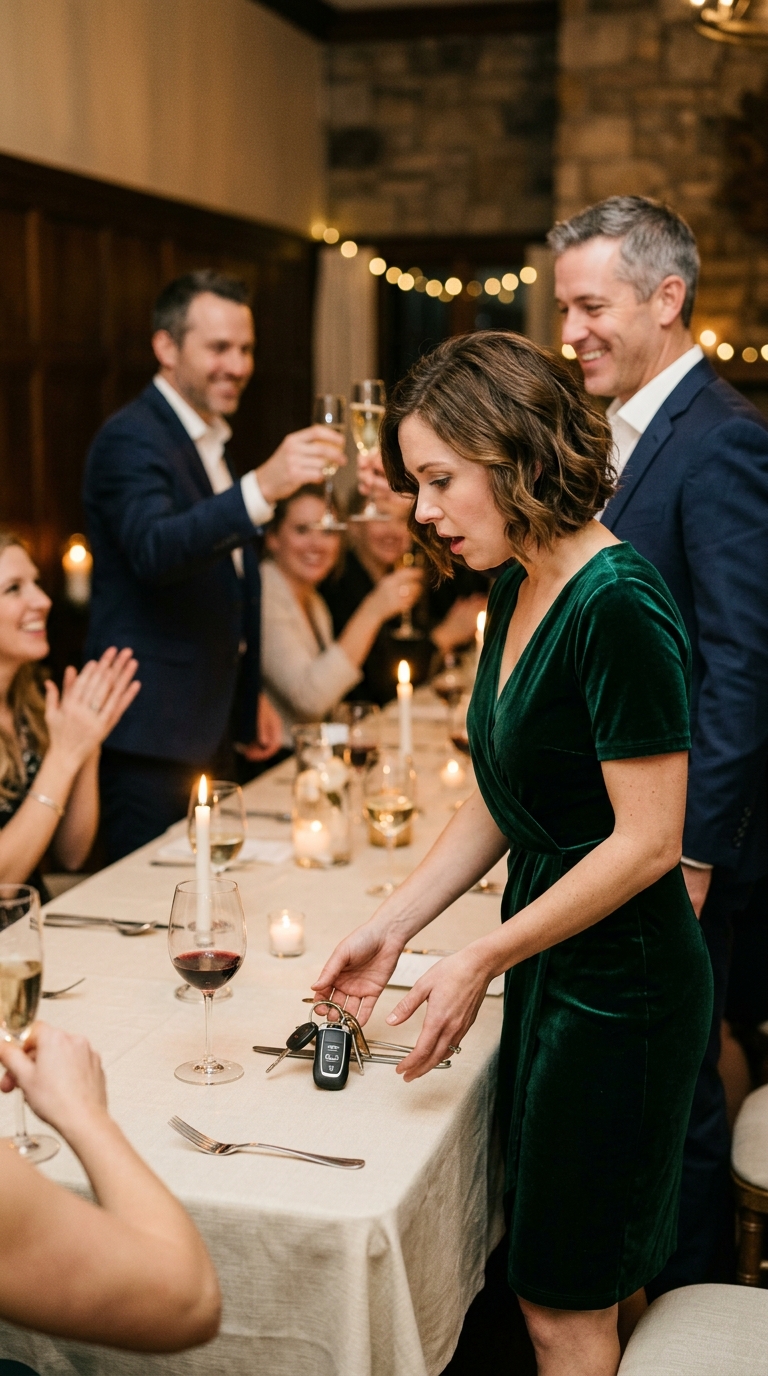
My father said it with a wine glass raised, forty people watching, and every candle on the table lit.
I was sitting two seats to his left.
I had driven six hours to be there. I had left my house at 9:40 that morning, stopped once for gas and once for coffee, and arrived at the lake house at 3:52 in the afternoon. I had helped my mother arrange the centerpieces and fold the cloth napkins into the upright shape she liked, the one that took three folds and a tuck.
Then I sat down at dinner and heard my sisters’ names.
Clare.
Becca.
And then a name that was not mine.
Sasha.
I sat very still and waited for the correction.
It did not come.
My father lowered his glass. He smiled. He sat down.
People clapped.
My Aunt Renata, seated directly across from me, looked at me for one full second and then looked down at her plate.
I looked at my glass. It was white wine, a Riesling my mother had bought at a shop called Vineyard Select in Waterford for fourteen dollars a bottle. I looked at it for a long moment.
Then I set it down on the white tablecloth.
Not hard. Carefully.
The way you set something down when you have made a decision and you do not want anyone to see the moment you made it.
My name is Nadia Voss. I am thirty-four years old. I have been the oldest of four children my entire life, though you would not know it from the way my family tells the story of itself.
I want to be precise about what happened that night because precision is the only thing that keeps a story honest.
My father’s name is Gerald Voss. He is sixty-seven years old. He is a retired civil engineer who spent thirty-one years at a municipal planning firm called Allegheny Regional Planning Associates in western Pennsylvania.
He coached youth soccer for eleven of those years under a program run through the Connellsville Parks and Recreation Department. He is, by every external measure, a good man.
He coached.
He showed up to games.
He remembered birthdays with cards that he signed himself, not just with his name, but with a full sentence, sometimes two.
He is the kind of father other people’s children liked.
He just forgot mine.
He stood up at a dinner with forty witnesses, raised a glass, and said he had three daughters when there were four of us. Then he sat down, finished his wine, and talked to the man on his right about a road resurfacing project in Erie County.
He did not notice that the chair two seats to his left was empty until dessert was already on the table.
I want to be honest about the name Sasha.
Sasha is not a cousin. She is not a family friend’s daughter. She is not a neighbor’s child whom my father had unofficially folded into his internal count.
Sasha is a name my father produced from somewhere inside himself at a dinner with forty witnesses and placed in the spot where my name was supposed to go.
There is no Sasha in our family.
There has never been a Sasha in our family.
I have looked at every photograph from every Christmas, every Easter, and every birthday since 1991, and I cannot find a Sasha anywhere.
She does not exist.
And yet she was in the toast.
I was not.
I grew up in a four-bedroom house on Morningside Drive in Connellsville, Pennsylvania, a small city in Fayette County about fifty miles southeast of Pittsburgh.
The house had a concrete front step that cracked in 1997 and was never fully repaired, only patched once with a bag of quick-set cement that my father mixed on a Saturday morning and applied with a trowel he borrowed from our neighbor, Mr. Basil, and never returned.
We had a maple tree in the backyard that dropped leaves every October. I raked them every year from the time I was eight until the time I left for college.
Not because anyone assigned it to me.
Because it needed doing, and I was there.
My mother, Patricia Voss, née Kowalek, is sixty-four years old. She managed the house and the children and the calendar with the focused efficiency of someone who had decided very early that love was a logistics problem.
She is good at logistics.
She is less reliable with the other thing.
I was a quiet child. My second-grade teacher, Mrs. Frances Alderton, wrote on my report card, “Nadia works independently and rarely requires redirection. She is a pleasure to have in class.”
My fifth-grade teacher, Mr. Douglas Repp, noted in a parent-teacher conference that I had the strongest reading comprehension scores in my cohort and that my written work showed unusual care for my age.
My pediatrician, Dr. Alan Marsh, wrote in my file at my twelve-year checkup that I demonstrated advanced verbal comprehension and appeared to have strong internal regulation for my age.
I remember reading that over his shoulder and thinking, Yes, that is correct.
Because no one was going to do it for me.
I was the first one up every morning. I made my own lunch from the time I was eight, usually a peanut butter sandwich on wheat bread, a piece of fruit, and a small bag of crackers. I set it in the refrigerator the night before so the morning would be easier.
I helped my sister Becca with her reading homework before I did my own.
I kept track of the school calendar on a handwritten chart taped to the inside of my closet door so I would not miss picture day, a library book return, or the field trip permission slip my mother often forgot to sign until I reminded her twice.
My father coached Clare’s soccer team for three seasons, from 2000 to 2002, when Clare was eight through ten and I was eleven through thirteen. He drove her to practice on Tuesday and Thursday evenings and to games on Saturday mornings.
He bought a Sony Handycam, silver with a pull-out screen, specifically to record her games.
He went to every one of Becca’s piano recitals, eleven total between 2003 and 2009, and recorded nine of them on that same camera. He stored the tapes in a shoebox labeled “Becca’s Recitals” in black marker, in his handwriting.
When Tom was hospitalized at age four with a ruptured appendix, my father took emergency leave from Allegheny Regional and slept in the chair beside his bed in the pediatric ward at Uniontown Hospital for four nights.
My mother told that story at Christmas dinner for years afterward.
She told it as evidence.
I was on the honor roll from sixth grade through my senior year of high school, fourteen semesters without interruption. I received a merit scholarship of $6,400 per year to study accounting at the University of Pittsburgh.
My father did not attend my graduation in May of 2012.
He had a planning board meeting for a highway drainage project that he said he could not reschedule.
My mother came. She drove alone and sat in the upper bleachers of the Petersen Events Center. She took three photographs on a disposable camera she had bought at a Rite Aid on the way.
After the ceremony, she took me to lunch at a diner called the Golden Griddle on Forbes Avenue. We ordered soup and sandwiches. She told me she was proud of me.
Then she said she needed to leave by two o’clock to get back to Connellsville for Becca’s regional volleyball tournament.
I sat in the diner after she left and drank the rest of my coffee. Then I drove myself back to my apartment and packed three boxes to take to my first real job.
I do not tell you any of this to generate sympathy.
I tell you this because the toast was not an accident.
It was a summary.
It was thirty-four years arriving at a single point in a room lit with candles, with my father feeling satisfied with the count, sitting down, and moving on.
The night of the lake house dinner, after I set my glass down, I did three things in this order.
First, I went to the bedroom at the end of the upstairs hallway where I had put my coat and my overnight bag.
The room had two twin beds with white quilts and a window facing the water. I had slept in that room since I was a child. I had slept there so many times that I knew the exact sound the second floorboard made when you stepped on it and which window latch required two hands to close properly.
I picked up my bag.
I had not unpacked it. I had set it on the floor when I arrived at 3:52, gone straight to the kitchen to help with the centerpieces, and never gone back.
It was still fully zipped.
Then I went to find Marin.
She was in the sunroom at the back of the house with my cousin’s daughter, a six-year-old named Poppy, playing a card game on the floor.
Marin looked up at me.
She was seven years old then, with her father Daniel’s dark eyes and my habit of going very still when she was paying close attention to something.
She looked at my face.
Then she looked at my bag.
Then she looked at my face again.
I said quietly, “We’re going to say good night and head home, Bug.”
She studied me for one more second.
Then she said, “Okay,” and began collecting the cards.
Then I went through the kitchen.
The lake house kitchen had a green subway tile backsplash and copper pots my mother had ordered from a Williams Sonoma catalog in 1998, pots that had never been used for cooking, only display.
There was a clock above the stove, a round wooden clock with black numerals. It read 8:47 when I walked through.
My brother-in-law Dex was standing at the counter eating a piece of cake.
He said, “Leaving already?”
I said, “Yes.”
He said, “Drive safe.”
That was everything.
I went out the side door. The porch light was on. The air smelled like lake water and pine, the scent I associated with every summer of my childhood and every holiday trip my mother insisted on because the lake house was, in her words, “the one place this family actually comes together.”
I buckled Marin into her booster seat. I put my bag in the trunk. I got in the driver’s seat, backed out of the gravel driveway, and drove away.
I did not say goodbye to my father.
I did not say goodbye to my mother.
The last thing I did in that house was fold a cloth napkin in the shape my mother liked, three folds and a tuck, and set it on a table for a dinner where my name was not said.
I drove for two hours before I stopped.
I pulled into a rest area on Route 30 near Irwin at 11:04 p.m. Marin was asleep. The parking lot was nearly empty, with two trucks at the far end, a minivan near the building, and a light flickering by the restroom entrance.
I sat in the quiet and opened the notes application on my phone.
I made a list.
I do this when something has happened that I am not ready to feel yet. The list is not therapy. It is accounting. It is how I keep the facts separate from the interpretation until I am ready to look at both at once.
The list had seven items.
One: he said three names.
Two: he did not correct himself.
Three: forty people were present.
Four: Aunt Renata looked at her plate.
Five: no one at the table said anything.
Six: I did not cry.
Seven: I am not going back.
I looked at item seven for a long time.
I did not delete it.
I closed the app and drove the remaining two hours home.
At 1:17 in the morning, I carried Marin to her bed and stood in the doorway of her room for a moment before going to my own.
My name is Nadia Voss, and I have a therapist named Dr. Lorraine Heck, whom I see every other Thursday at 5:00 p.m. in an office on Shady Avenue in Squirrel Hill.
Dr. Heck is fifty-two years old. She has been practicing for twenty-four years, twelve of them in her current location, a second-floor suite in a building that also contains a dental practice and a small immigration law firm.
Her office has two chairs, a low table, a lamp in the corner that produces warm light, and a small bookshelf with a rotating selection of titles she sometimes loans to patients.
I have been her patient for six years, since I was twenty-eight and my marriage to Daniel was beginning to show the particular kind of quiet strain that precedes collapse.
Three days after the lake house dinner, my phone showed eleven missed calls.
I counted them standing in my kitchen at 7:09 on a Tuesday morning.
Four from my mother.
Three from Clare.
Two from Aunt Renata.
One from my father.
One from a number in the 724 area code that I did not recognize.
There were also nine text messages.
I did not read the texts first.
I made coffee. I toasted bread. I sat at my kitchen table and listened to the voicemails in chronological order.
My mother’s first message arrived at 9:22 p.m. on the night I left.
“Nadia, call me when you get this. We didn’t realize you’d gone. I hope the drive was okay.”
Her voice was calm.
Logistics.
Her second message arrived at 11:47 p.m.
“Nadia, I don’t understand why you left without saying goodbye. Your father is confused, and I think you need to explain what happened.”
The word confused was doing a specific kind of work in that sentence.
Her third message arrived at 8:14 the following morning.
“Nadia, I need you to call me back today. This is becoming a thing, and it doesn’t need to be a thing. We have a lot coming up, and I need to know you’re going to be present for this family.”
Her fourth message arrived at 3:30 that same afternoon.
“I don’t know what you want from us.”
I listened to all four in sequence without pausing.
Then I sat for a while with my coffee, which had gone cool.
I thought about the phrase “I don’t know what you want from us.”
I thought about how the question assumed I wanted something, that I had left because of a desire rather than a conclusion.
Clare’s messages were shorter.
The first said, “Hey, it’s me. Call me back when you can.”
The second said, “Okay, Dad feels really bad, so if you can just, I don’t know, call someone back.”
The third was nothing. Just a four-second pause and then the sound of her hanging up.
Aunt Renata’s message said, “Nadia, sweetheart, I saw your face. I want you to know I saw it. Call me if you want to talk. If you don’t, I understand that, too.”
My father’s message said, “Nadia, it’s Dad. I’m not sure what happened the other night, but your mother says you left upset.”
He paused for almost five seconds.
“I want to make sure you’re all right. Call when you can.”
I did not call my mother.
I did not call Clare.
I did not call my father back.
I called Aunt Renata.
Renata Voss Haber is my father’s older sister. She is seventy-one years old. She taught high school English at Uniontown Area High School for thirty-three years and retired in 2017.
She lives in Greensburg in a two-story colonial she has owned since 1987, with a front garden she tends herself and a kitchen that always smells like something baked that morning.
She was married for thirty-eight years to a man named Howard Haber, who worked in industrial procurement and passed away in March of 2019 at the age of seventy-three.
She has two adult sons. Marcus is forty-four, lives in Denver, and works in commercial real estate. Joel is forty-one, lives in Philadelphia, and teaches middle school science.
She is the only person in my extended family who has ever said my name like it was a complete sentence rather than a placeholder.
We talked for forty-seven minutes.
I sat on my back porch with a second cup of coffee and watched my neighbor’s dog moving around the yard through the fence slats. I listened to Renata not make excuses for my father.
I had expected her to.
She is his sister. She loves him.
But she said, “I have watched this for a long time, longer than you probably know. I didn’t say enough, and I’m sorry for that.”
I said, “You don’t owe me an apology.”
She said, “I think I do. I think I’ve been quiet at a table for thirty years, and that’s its own kind of choice.”
She asked if I was going to call my father.
I said, “I don’t know yet.”
She said, “Whatever you decide, I want you to know one thing.”
I said, “What?”
She said, “You’re not imagining it.”
I wrote that on the notepad I kept on the porch railing, in the margin below a grocery list.
You’re not imagining it.
I looked at it for a moment after I wrote it.
Then I drew a small box around it.
On day eleven, a letter arrived.
It was handwritten on my mother’s pale yellow stationery. She had used the same brand, Crane & Co. Classic Laid, since before I was born. It arrived in a business envelope with her return address printed in small capitals.
The letter was two pages, front and back, written in her compact, upright handwriting that had not changed since her forties.
I read it standing at my kitchen counter because I did not want to sit down for it.
The letter contained the phrase “we love you very much” four times.
It contained the phrase “your father meant no harm” twice.
It did not contain the word Sasha.
It did not contain the phrase “I am sorry.”
It did not contain “I apologize.”
It did not contain “I understand why you left.”
It did not contain “I want to understand why you left.”
It contained the sentence, “Your father has no memory of saying anything wrong.”
It contained the sentence, “You have always been the sensitive one in this family, even as a little girl.”
It contained the sentence, “We need you at Clare’s birthday in October.”
And it contained the sentence, “I hope you will think about what your absence is doing to the people who love you.”
I read it twice.
I folded it along its original crease lines.
I placed it in a manila folder that I labeled in pencil, in my own handwriting: lake house.
I put the folder on the left side of my desk, where I keep active files.
I had my next session with Dr. Heck the following Thursday. I brought the letter. I read her the sentence about being the sensitive one.
She asked me how old I was the first time someone in my family said that to me.
I thought about it.
I said, “Seven, maybe eight.”
She wrote something in her notebook.
She asked, “And what did being sensitive mean in your family?”
I said, “It meant that when something hurt, the problem was my reaction, not the thing that caused it.”
She said, “Yes.”
She did not say anything else for a moment.
Then she said, “How long have you known that?”
I said, “I’ve known it for a long time. I just didn’t have the distance to say it out loud.”
She said, “And now?”
I said, “I have some distance now.”
I should explain what was structurally at stake with Clare’s birthday because the birthday was not simply a birthday.
It was a transaction.
And I was the bank.
Clare Voss is thirty-one years old. She is a dental hygienist at Riverside Family Dentistry in Connellsville, run by a dentist named Dr. Frank Borcowski, who has been in that office since 1994.
Clare earns approximately $52,000 per year before taxes. She is careful with money in some ways and not careful in others.
In 2022, she went through a painful breakup with a man she had dated for four years. His name was Marcus Leary. He sold commercial insurance.
The relationship ended badly, and during the eight months she moved back to Connellsville and lived in my parents’ house, she depleted most of her savings account.
By the time she moved back to Pittsburgh in the spring of 2023, she had approximately $4,200 in savings, which was not enough to absorb an unexpected expense and also fund a milestone birthday.
My mother had been planning the party since March.
She had booked a private dining room at a restaurant in Pittsburgh called Garfield Social, on Penn Avenue in the Garfield neighborhood, a place that specialized in contemporary American food and weekend events.
The contact there was an events coordinator named Jesse Tamura.
The deposit was $1,400, paid by my mother in March using a personal check that I later learned cleared her account and left her with $340 until my father’s next pension deposit.
The estimated total for a party of thirty-two guests, dinner, the first two hours of open bar, and a custom cake from a bakery called Sugar and Thread in Lawrenceville was between $5,400 and $6,800, depending on selections.
My mother did not have $6,800.
She did not have $5,400.
My father’s pension from Allegheny Regional Planning Associates paid $2,240 per month. His Social Security added $1,180.
Their fixed monthly expenses, mortgage, utilities, car insurance, Patricia’s prescription medications, and general household costs totaled approximately $3,100 by my estimate.
That was not a guess.
My mother had shared her household budget with me in 2021, when she needed help restructuring after an unexpected HVAC replacement that cost $4,700.
I had spent a Saturday afternoon at their kitchen table with a legal pad and a calculator, building a new monthly budget with her.
I knew the numbers.
I had always known the numbers because someone in the family needed to.
What they had was me.
Or, more precisely, they had the assumption that they had me.
I had paid for three significant family events in the four years before the lake house dinner.
In September of 2021, I contributed $1,800 toward my parents’ thirty-fifth anniversary dinner at a restaurant called The Stone House in Ligonier. The contribution was requested by my mother nine days before the event, when the original budget proved insufficient, and I wired the money to her checking account within two hours of the call.
In July of 2022, I paid $2,200 to cover the balance of a rented lake cabin in Ohiopyle for a family reunion weekend when my uncle Dennis backed out of his share of the rental fee four days before the trip.
In February of 2023, I paid $900 to a venue called the Magnolia Room in Uniontown for Becca’s bridal shower deposit when my mother called me at work on a Tuesday morning and told me the venue had not received the deposit and would release the date by end of business if payment was not confirmed.
I had never been asked formally.
There was never a sit-down conversation.
There was never a request with advance notice.
There was never a plan that included me as a line item.
There was always a call, usually in the evening, always with a deadline, always framed as a logistical emergency that had somehow materialized without warning.
And I had always said yes.
Because saying yes was what I did.
Because saying yes was what I had been trained to understand as the correct response when your family needed something and you were the one with the means to provide it.
After the lake house, I sat at my desk on a Saturday morning in September with my personal finance spreadsheet open and added up every payment I had made to or on behalf of my family since 2018.
I spent forty minutes doing this carefully, cross-referencing my bank statements, which I keep archived in a folder on my laptop, organized by year.
The total across sixteen separate transactions over six years was $9,840.
I looked at that number for a while.
I had not known it was that much.
I had known about each individual payment. I had not added them together before.
I created a new column in the spreadsheet.
I labeled it “received in return.”
I left it empty.
My session with Dr. Heck in late September, the Thursday before the October 1 deadline my mother had referenced in her letter regarding Clare’s birthday headcount, ran eleven minutes over our standard fifty minutes.
Dr. Heck’s next patient was apparently not waiting, or she chose to continue anyway.
She did not signal the end of the session.
I did not look at the clock.
We talked about what the spreadsheet had clarified.
She asked, “What did you feel when you saw the total?”
I said, “I felt like I finally understood the job description.”
She said, “Say more.”
I said, “I have been functioning as the financial infrastructure for a family that does not include me in its headcount.”
Dr. Heck looked at me for a moment.
She said, “That’s a very precise way to say it.”
I said, “I’m a tax analyst. Precision is what I have.”
She asked what I was going to do about Clare’s birthday.