
PART 2: THE SECRET UNDER THE BRIDGE
The next morning, Marcus did not go to Rachel’s luxury apartment.
He did not call her.
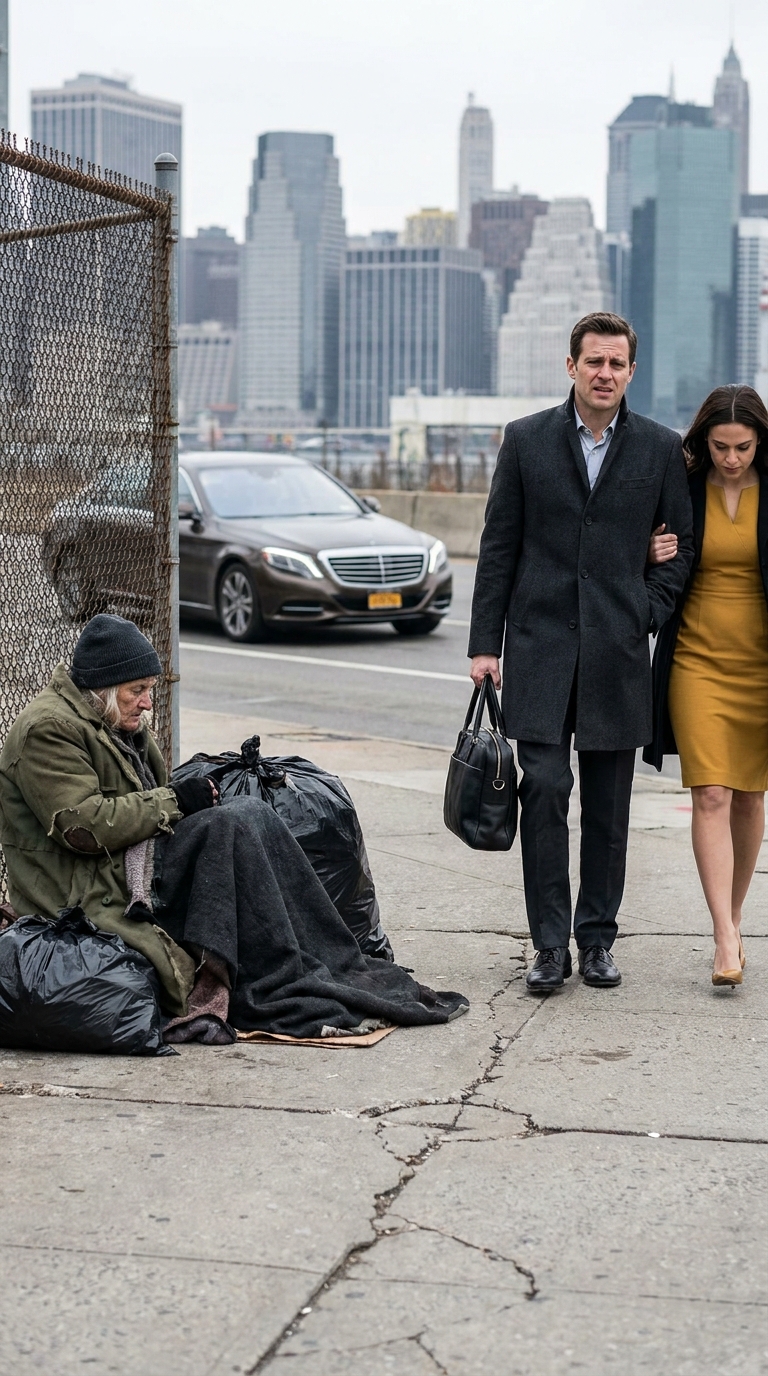
He did not send an angry message or demand an explanation over the phone.
After what he had discovered beneath the overpass the night before, he knew that anything Rachel told him from a safe distance would be carefully prepared. She would cry. She would claim there had been a misunderstanding. She would twist every fact until he began questioning his own memory.
Rachel had always been good at that.
Instead, Marcus drove straight to the old brick house he had bought for his mother five years earlier.
The house stood on a quiet street in the western part of Atlanta, surrounded by modest homes with clean porches and small front gardens. When Marcus had first handed his mother the keys, she had covered her mouth and cried so hard she could barely speak.
She had spent most of her life moving from one rented apartment to another, working double shifts in hospital laundry rooms and school cafeterias to keep Marcus and his older brother, Thomas, fed.
That house had been Marcus’s promise to her.
No more landlords.
No more eviction notices.
No more choosing between electricity and groceries.
A safe place for the woman who had sacrificed everything for her sons.
But as Marcus turned onto the familiar street, a cold heaviness settled in his chest.
The garden his mother had once tended with almost religious devotion was dead.
The white roses she planted beneath the front windows had withered into thorny brown branches. Weeds pushed through the cracks in the walkway. One shutter hung loose, knocking softly against the brick whenever the wind moved.
A pile of empty beer bottles stood beside the porch steps.
The sight made Marcus grip the steering wheel tighter.
His mother would never have allowed the house to look like this.
She used to wake before sunrise on Saturdays to sweep the porch. She polished the windows with vinegar and old newspapers. She knew every flower in the garden and spoke to them as though they were her children.
This was not neglect caused by age.
Someone had erased her presence.
Marcus pulled into the driveway and switched off the engine.
For several seconds, he remained behind the wheel, staring through the windshield.
A man stood on the porch smoking a cigarette.
Thomas.
His older brother wore loose sweatpants and a stained white undershirt. His hair was uncombed, but the gold watch on his wrist looked expensive. He leaned casually against the porch railing as if he had been expecting company.
Beside him, resting against the doorframe in a pale silk robe, was Rachel.
Marcus felt something inside him go still.
Not break.
Not explode.
Just become completely still.
Rachel’s hair was pulled into a careless knot. Her feet were bare. She held a coffee cup Marcus recognized from his mother’s kitchen—the blue ceramic mug with the tiny painted sunflowers.
She looked comfortable.
She looked at home.
Then she saw Marcus’s car.
The mug trembled in her hand.
Her face lost all its color.
Thomas followed her gaze and smiled.
Not a nervous smile.
Not the expression of a man caught doing something shameful.
It was a slow, satisfied smirk.
Marcus opened the car door and stepped out.
Rachel immediately moved forward.
“Marcus,” she stammered. “You’re… you’re early.”
He stopped at the bottom of the porch steps.
“Early for what?”
Rachel tightened the silk robe around herself.
“I can explain.”
“Explain what, Rachel?”
His voice was quiet, but his fists were clenched so tightly that his knuckles had turned white.
“Explain why my mother has been sleeping on cardboard beneath an overpass while you’ve been living in the house I bought for her?”
Rachel opened her mouth, but no sound came out.
Marcus looked from her to Thomas.
“With my brother.”
Thomas took one last drag from his cigarette, dropped it onto the porch floor, and crushed it beneath his bare heel.
“It’s my house too, little brother,” he said. “Or did dear old Mom forget to tell you about the inheritance?”
Marcus stared at him.
“What inheritance?”
Thomas’s smile widened.
“There it is,” he said. “That look. The great Marcus Reed finally realizing he doesn’t know everything.”
“Where is Mom?”
Thomas shrugged.
“You already found her, didn’t you?”
Marcus took one step toward the porch.
Rachel quickly came between them.
“Marcus, please. Don’t do this.”
He looked down at her.
“Move.”
“Just let us explain.”
“Us?”
The word came out colder than he intended.
Rachel glanced back at Thomas, and in that small movement Marcus saw something that hurt more than the silk robe or the bare feet.
Familiarity.
Loyalty.
Rachel was not frightened of Thomas.
She was frightened of what Marcus now knew.
“How long?” Marcus asked.
Rachel shook her head. “It isn’t what you think.”
“How long have you been sleeping with him?”
Thomas laughed.
Rachel’s eyes filled with tears.
“Marcus—”
“How long?”
“Eight months,” Thomas said.
Rachel spun toward him. “Thomas!”
“What?” he replied. “We’re explaining.”
Marcus felt the world tilt beneath his feet.
Eight months.
For eight months, Rachel had kissed him goodbye before his business trips. She had called him from hotel rooms, saying she missed him. She had complained that his mother was becoming difficult and confused. She had told him Thomas was unstable and should not be trusted.
All while she had been coming here.
To his mother’s house.
To his brother.
Marcus looked through the open doorway.
The living room had changed.
His mother’s lace curtains were gone. A large television now covered one wall. Beer cans and food containers littered the coffee table. A leather jacket Rachel had bought during their trip to Milan hung over the back of his mother’s favorite chair.
The framed photograph of Marcus’s father, which had always stood on the mantel, was missing.
“So that’s what this was?” Marcus asked. “You got Mom out of the house so the two of you could move in?”
Rachel stepped closer.
“No. It didn’t happen like that.”
“How did it happen?”
“She was becoming impossible,” Rachel said. “She was paranoid. She accused people of stealing from her. She wandered outside at night. She refused help.”
Marcus’s jaw tightened.
“She was not confused when I spoke to her last night.”
Rachel’s expression changed.
Just for a second.
Fear.
“You spoke to her?”
Marcus noticed Thomas watching Rachel carefully.
“Yes,” Marcus said. “She told me you took her phone. She said you made her sign documents she couldn’t read.”
“That’s a lie,” Thomas snapped.
Marcus looked at him.
“Then show me the documents.”
Silence.
A car passed slowly along the street. Somewhere nearby, a lawn mower started. The ordinary sounds of the neighborhood made the scene feel even more unreal.
Rachel lowered her voice.
“Marcus, your mother signed the house over willingly.”
“To whom?”
“To Thomas.”
Marcus laughed once, but there was no humor in it.
“My mother would never give this house to Thomas.”
Thomas stepped forward.
“You mean she would never give it to the son she actually raised?”
Marcus’s eyes narrowed.
“What is that supposed to mean?”
Thomas’s smirk disappeared.
For the first time, real anger moved across his face.
“It means you left,” he said. “You went to college. You built your company. You sent checks and called on Sundays when it fit your schedule. I was the one here when she got sick.”
“You were here because you needed somewhere to stay.”
“I took care of her.”
“You borrowed money from her. You stole her jewelry. You disappeared for months whenever she asked you to get a job.”
Thomas came down one step.
“At least I didn’t treat her like a charity project.”
Marcus felt the accusation land harder than he expected.
Rachel watched the brothers in silence.
“You think buying this house made you the perfect son?” Thomas continued. “You think paying taxes means you know what happened inside these walls?”
“I know she ended up homeless.”
“She left.”
“You expect me to believe that?”
“She walked out after accusing us of trying to kill her.”
Rachel flinched.
Marcus saw it.
He turned toward her.
“What did he just say?”
“Your mother was upset,” Rachel answered quickly. “She was saying strange things.”
“What things?”
Rachel looked at Thomas again.
Marcus stepped closer until only a few feet separated them.
“What did my mother accuse you of?”
Rachel’s eyes dropped to the porch boards.
“She thought we were putting something in her medication.”
The air seemed to disappear.
Marcus stared at her.
“Were you?”
“No!”
The answer came too fast.
Rachel pressed a hand against her chest.
“No, Marcus. Of course not. She became suspicious after her fall. The doctor prescribed new pills, and she started forgetting things. She thought the medicine was poisoning her.”
“What doctor?”
Rachel hesitated.
“I don’t remember his name.”
“You drove her to the appointments.”
“There were several doctors.”
Marcus looked toward Thomas.
“What was the doctor’s name?”
Thomas leaned against the railing again.
“I don’t keep track of old people’s prescriptions.”
Marcus started up the steps.
Thomas straightened.
For one heated second, the brothers stood face-to-face.
Marcus had always been the quieter one. Thomas had been larger, louder, quicker to use his fists. Growing up, Marcus had learned to survive by remaining calm.
But he was no longer the frightened boy who locked himself in the bathroom while Thomas broke furniture during drunken rages.
“Get out of my way,” Marcus said.
“You don’t own this place anymore.”
“Then call the police.”
Thomas studied him.
Marcus continued, “Call them. Tell them I’m trespassing. And while they’re here, we can ask them to investigate how an elderly woman’s signature appeared on a property transfer while she was being medicated by people now occupying her home.”
Rachel’s breathing became shallow.
Thomas did not move.
Marcus pushed past him and entered the house.
The smell hit him first.
Smoke, alcohol, stale food, and something sweetly chemical.
His mother’s house had once smelled of lemon polish, cinnamon, and the lavender sachets she tucked inside drawers.
Now it smelled like strangers.
Marcus moved through the living room, taking in every detail. His mother’s Bible was no longer on the side table. The family photographs had been removed from the wall. Several pale rectangles marked where the frames had once hung.
He walked toward the hallway.
Rachel followed him.
“Marcus, you can’t just search the house.”
He ignored her.
The door to his mother’s bedroom was closed.
When he reached for the handle, Rachel grabbed his arm.
“Don’t.”
Marcus looked at her hand until she let go.
“Why not?”
“There’s nothing in there.”
“Then you have nothing to worry about.”
He opened the door.
The room had been stripped.
The antique bed his mother inherited from her own mother was gone. So was the quilt she had sewn by hand. Boxes were stacked along one wall. Women’s clothes spilled from an open suitcase near the closet.
Rachel’s clothes.
On the nightstand was a framed photograph of Rachel and Thomas standing on a beach.
Marcus picked it up.
The photograph had been taken in Miami.
He recognized the hotel in the background because Rachel had told him she was attending a professional conference there six months earlier.
He turned toward her.
“You sent me photographs from that hotel.”
Rachel’s face crumpled.
“I was going to tell you.”
“When?”
“I didn’t know how.”
“So you waited until my mother was living beneath a bridge?”
“It wasn’t connected.”
“Everything is connected now.”
Thomas appeared in the doorway.
“Stop acting wounded,” he said. “Your marriage was over long before Rachel came to me.”
Marcus set the photograph down.
“This isn’t about my marriage.”
“It should be. She chose me.”
Rachel closed her eyes.
Marcus looked at his brother and suddenly understood.
Thomas wanted him angry.
He wanted a fight.
If Marcus struck him, Thomas could call the police. He could make Marcus look unstable. Perhaps that had been part of the plan all along.
Marcus turned away and began checking the boxes.
Most contained old clothes, kitchenware, and books. In the third box, he found his mother’s documents.
Bank statements.
Medical bills.
Insurance forms.
A notarized property transfer.
Marcus pulled it out.
The signature at the bottom resembled his mother’s, but the letters were uneven, as though written by a trembling hand.
The transfer had been signed four months earlier.
Marcus examined the witness section.
Rachel’s name appeared beneath the signature.
His stomach tightened.
“You witnessed this?”
Rachel swallowed.
“She understood what she was signing.”
“Where was it signed?”
“At the house.”
“Who was the notary?”
Thomas folded his arms.
“Everything was legal.”
Marcus looked at the notary’s name.
Daniel Pierce.
The name meant nothing to him, but the address beneath it did.
The office was located two buildings away from Rachel’s apartment.
Marcus folded the paper and placed it inside his jacket.
Thomas stepped forward.
“You’re not taking that.”
“It concerns my mother.”
“It belongs to me.”
“Then sue me.”
Thomas reached for Marcus’s jacket, but Marcus caught his wrist.
The two brothers stared at each other.
For the first time, Thomas seemed uncertain.
Marcus released him.
Then he noticed another document at the bottom of the box.
A life insurance policy.
His mother was the insured party.
Thomas was listed as the primary beneficiary.
Rachel was listed as the secondary beneficiary.
The policy had been opened nine months earlier.
One month before Rachel claimed her affair with Thomas had begun.
Marcus felt cold spread through his body.
He raised the document.
“What is this?”
Rachel stepped backward.
Thomas’s face hardened.
“It’s insurance.”
“I can see that.”
“Mom wanted us protected.”
“Us?”
Marcus looked at Rachel.
“Why would my wife be named as a beneficiary on my mother’s life insurance policy?”
Rachel shook her head.
“I didn’t know about that.”
Thomas gave a short laugh.
Marcus turned toward him.
“You find this funny?”
“I find you predictable.”
Marcus read further.
The policy was worth eight hundred thousand dollars.
His mother, who had survived on a small pension and the monthly allowance Marcus deposited into her account, had somehow qualified for a policy with payments far beyond what she could afford.
Unless someone else had been paying the premiums.
Marcus looked at the attached bank authorization.
The payments had come from an account belonging to Reed Development Holdings.
His company.
Someone had used one of his corporate accounts.
He suddenly remembered the irregular transfers his accountant had flagged several months earlier. Rachel had access to some business records because she occasionally handled charitable donations for the company. When Marcus asked about the withdrawals, she told him they were expenses connected to a housing foundation.
“Rachel,” he said slowly, “you used my company to pay for this.”
She began to cry.
“I didn’t understand what Thomas was doing.”
Thomas’s head snapped toward her.
“Don’t.”
“You told me it was temporary,” she said. “You said it was for tax purposes.”
“Shut up, Rachel.”
“No,” Marcus said. “Let her speak.”
Thomas moved into the room.
“She has nothing to say.”
Marcus positioned himself between them.
Rachel stared at Thomas as if she were seeing him clearly for the first time.
“You said his mother was dying,” she whispered. “You said the doctors told you she had less than six months.”
Marcus’s pulse pounded in his ears.
“What doctors?”
Rachel wiped tears from her face.
“I never met them. Thomas showed me reports.”
“They were real,” Thomas said.
Marcus turned on him.
“My mother is not dying.”
“You don’t know that.”
“I spoke to the doctor at the shelter last night. She was dehydrated and malnourished, but there was no terminal diagnosis.”
Thomas’s confidence flickered.
Marcus saw it.
He placed the policy beside the property transfer and continued searching the box.
Beneath a stack of medical receipts, he found a small plastic bag containing prescription bottles.
The labels had been peeled away.
One bottle still held three pale blue tablets.
Marcus lifted it toward the light.
Rachel stared at the pills.
“I’ve seen those before,” she said.
Thomas shot her a warning look.
“Where?” Marcus asked.
“In the kitchen. Thomas crushed them into her tea.”
The room fell silent.
Thomas lunged toward Rachel.
Marcus intercepted him, shoving him hard against the wall. A picture frame crashed to the floor.
“You lying little—” Thomas shouted.
Marcus pinned him there.
“Don’t touch her.”
Thomas laughed breathlessly.
“Still protecting your cheating wife?”
“I’m protecting a witness.”
That silenced him.
Marcus released Thomas and stepped back.
He took out his phone.
Rachel’s eyes widened.
“Who are you calling?”
“The police.”
Thomas laughed again, but this time it sounded forced.
“And what are you going to tell them? That you found some pills in my house?”
“My mother’s house.”
“Not anymore.”
Marcus held up the documents.
“I’ll tell them my elderly mother was removed from her home after signing over her property while under the influence of unknown medication. I’ll tell them an unauthorized life insurance policy was opened using money stolen from my company. And I’ll tell them you were seen crushing unidentified pills into her drinks.”
Rachel covered her mouth.
Thomas stared at Marcus.
Then his expression changed.
The anger disappeared.
In its place came something colder.
“You really think Mom is innocent in all this?”
Marcus stopped dialing.
“What does that mean?”
Thomas slowly straightened his shirt.
“It means you should ask her why she was living under that particular bridge.”
“She had nowhere else to go.”
“There are shelters closer to this neighborhood. Churches too. But she walked nearly seven miles to sleep beneath that overpass.”
Marcus said nothing.
Thomas stepped closer.
“She wasn’t hiding from us, Marcus.”
“Then who was she hiding from?”
Thomas looked toward the bedroom window.
“Ask her what happened there twenty-eight years ago.”
Marcus felt a chill move across his skin.
Twenty-eight years earlier, he had been six years old.
Their father had still been alive.
“What happened under the bridge?”
Thomas smiled faintly.
“That’s the problem with being the favorite son. Everyone works so hard to protect you that you never learn the truth.”
Marcus grabbed him by the collar.
“What truth?”
Thomas looked directly into his eyes.
“You were never supposed to be part of this family.”
Marcus loosened his grip.
Rachel stared between them.
“What are you talking about?” she asked.
Thomas ignored her.
“You think Mom worked all those jobs because she loved you more?” he asked Marcus. “She was paying a debt.”
Marcus felt the room narrowing around him.
“Say what you mean.”
“Our father didn’t bring you home from the hospital.”
Thomas’s voice dropped almost to a whisper.
“He found you beneath that bridge.”
Marcus stared at him.
For a moment, the words did not make sense.
Then memories began rising in broken pieces.
His mother refusing to show him baby photographs.
The missing birth certificate that she claimed had been destroyed in a courthouse fire.
The scar beneath his left shoulder that no one could explain.
The recurring childhood nightmare of rain striking metal and a woman screaming somewhere in the darkness.
Marcus stepped backward.
“You’re lying.”
Thomas nodded toward the hallway.
“Check the attic.”
“What’s in the attic?”
“The box Mom kept hidden from you.”
Marcus looked at Rachel.
She appeared as shocked as he felt.
Thomas continued, “She made me swear never to tell you. But after everything she did to me, I don’t owe her silence anymore.”
Marcus left the bedroom and moved toward the attic stairs.
Thomas called after him.
“You might want to prepare yourself.”
Marcus pulled down the folding ladder.
Dust fell from the ceiling.
He climbed into the dark attic and switched on the hanging bulb. Weak yellow light spread across old furniture, broken lamps, and boxes covered with years of dust.
At the far end, beneath a wool blanket, he found a small metal trunk.
A rusted padlock hung from the latch, but it had already been broken.
Marcus knelt and opened the lid.
Inside were newspaper clippings, police reports, and a bloodstained child’s blanket sealed in plastic.
His hands began to shake.
The first newspaper headline was dated October 12, twenty-eight years earlier.
YOUNG WOMAN FOUND DEAD NEAR RIVER—INFANT MISSING
Marcus stopped breathing.
A faded photograph appeared beneath the headline.
The woman in the picture could not have been more than twenty years old.
She had dark eyes.
A narrow face.
And the same small dimple Marcus saw every morning when he looked in the mirror.
Beneath the photograph was her name.
Elena Vasquez.
Marcus lowered himself onto the attic floor.
Attached to the clipping was a handwritten note in his mother’s unmistakable handwriting.
I tried to save them both. I could only carry the baby. God forgive me for what I left beneath the bridge.
Marcus read the sentence again.
Then again.
Footsteps creaked on the ladder behind him.
Thomas climbed into the attic.
Marcus held up the clipping.
“Who was she?”
Thomas’s face was unreadable.
“Your mother.”
“No. My mother is at the shelter.”
“The woman at the shelter raised you,” Thomas said. “But Elena Vasquez gave birth to you.”
Marcus looked down at the police report.
The case had never been solved.
Elena had been found near the river with evidence of a violent struggle. Her newborn child had vanished. Police suspected the baby had been swept away during a storm.
But the child had not been swept away.
He had been taken.
Raised under another name.
Marcus reached for the next document.
It was a statement signed by his father.
He had told investigators he had been working a night shift and had seen nothing unusual.
A handwritten line had been added at the bottom.
Witness later withdrew cooperation. Possible connection to victim.
Marcus looked at Thomas.
“Dad knew Elena?”
Thomas nodded.
“He knew her very well.”
“How?”
Thomas glanced toward the attic entrance, checking that Rachel was not close enough to hear.
Then he crouched beside Marcus.
“Because Elena came to the bridge that night to meet him.”
Marcus felt sick.
“Why?”
Thomas’s voice became almost gentle.
“She was going to tell him that the baby was his.”
Marcus could not move.
The man he had called his father had not simply found him.
He had been his biological father.
And the woman who raised him had known.
“What happened to Elena?” Marcus asked.
Thomas looked at the bloodstained blanket.
“That’s the question Mom has spent twenty-eight years running from.”
Marcus’s phone vibrated in his pocket.
It was a call from the shelter.
He answered immediately.
“Mr. Reed?” a woman said urgently. “This is Dr. Harris. Your mother is missing.”
Marcus stood so quickly that the newspaper clippings scattered across the floor.
“What do you mean, missing?”
“She disappeared from her room less than twenty minutes ago. A nurse found the rear exit open.”
“Was she alone?”
“We don’t think so. Security footage shows a man entering the building shortly before she vanished.”
Marcus looked at Thomas.
“What man?”
“We can’t see his face clearly,” Dr. Harris replied. “But your mother left something on the bed. A note addressed to you.”
“What does it say?”
There was a pause.
Then the doctor read the words slowly.
Marcus, do not believe Thomas. He was under the bridge that night too.
Marcus lowered the phone.
Thomas was watching him from across the attic.
“What did she say?” he asked.
Marcus stared at his brother, seeing not the arrogant man on the porch, but a frightened older boy from a memory he had never understood.
A boy standing in the rain.
Mud on his shoes.
Blood on the sleeve of his jacket.
Marcus folded the note in his mind around the one impossible fact Thomas had carefully avoided mentioning.
Twenty-eight years ago, Thomas had been only eleven.
Old enough to remember what happened.
Old enough to lie about it.
And perhaps old enough to have helped someone hide the truth.
Marcus slipped the newspaper clipping into his jacket.
“Where is she, Thomas?”
Thomas’s expression remained calm.
“I don’t know.”
Marcus moved toward him.
“My mother disappeared minutes after I arrived here. Someone entered the shelter and took her. You knew about the bridge. You knew about Elena. So I’m going to ask you one more time.”
Thomas glanced down at the open trunk.
Then he smiled.
It was not the mocking smile from the porch.
It was the smile of a man who had been waiting decades for a secret to finally become useful.
“You’re asking the wrong question, little brother.”
Marcus’s voice dropped.
“What question should I be asking?”
Thomas looked toward the bloodstained blanket.
“You should be asking why the police never found Elena’s body.”
Marcus frowned.
“The newspaper says she was found near the river.”
“The newspaper lied.”
Thomas leaned closer.
“So did Mom.”
A sound came from inside the metal trunk.
A faint vibration.
Marcus and Thomas both froze.
Marcus removed the remaining files and found an old mobile phone hidden beneath them. The screen was cracked, but it was powered on.
An incoming call lit the display.
The caller’s name contained only one word.
MOTHER.
Marcus answered.
For several seconds, he heard nothing except rushing water.
Then his mother’s frightened voice came through the speaker.
“Marcus,” she whispered, “I’m back beneath the bridge.”
The line crackled.
“Mom, stay where you are. I’m coming.”
“No,” she said. “You have to listen to me. Thomas has not told you everything.”
Marcus looked at his brother.
Thomas’s face had turned pale.
“What hasn’t he told me?”
His mother began to cry.
“That Elena was still alive when we left her.”
A man’s voice spoke faintly in the background.
Marcus could not make out the words.
“Who is with you?” he demanded.
His mother gasped.
The phone struck something hard.
Then, before the call ended, Marcus heard her scream one final sentence.
“Your father is alive.”