Part One: The Woman in the Crimson Dress
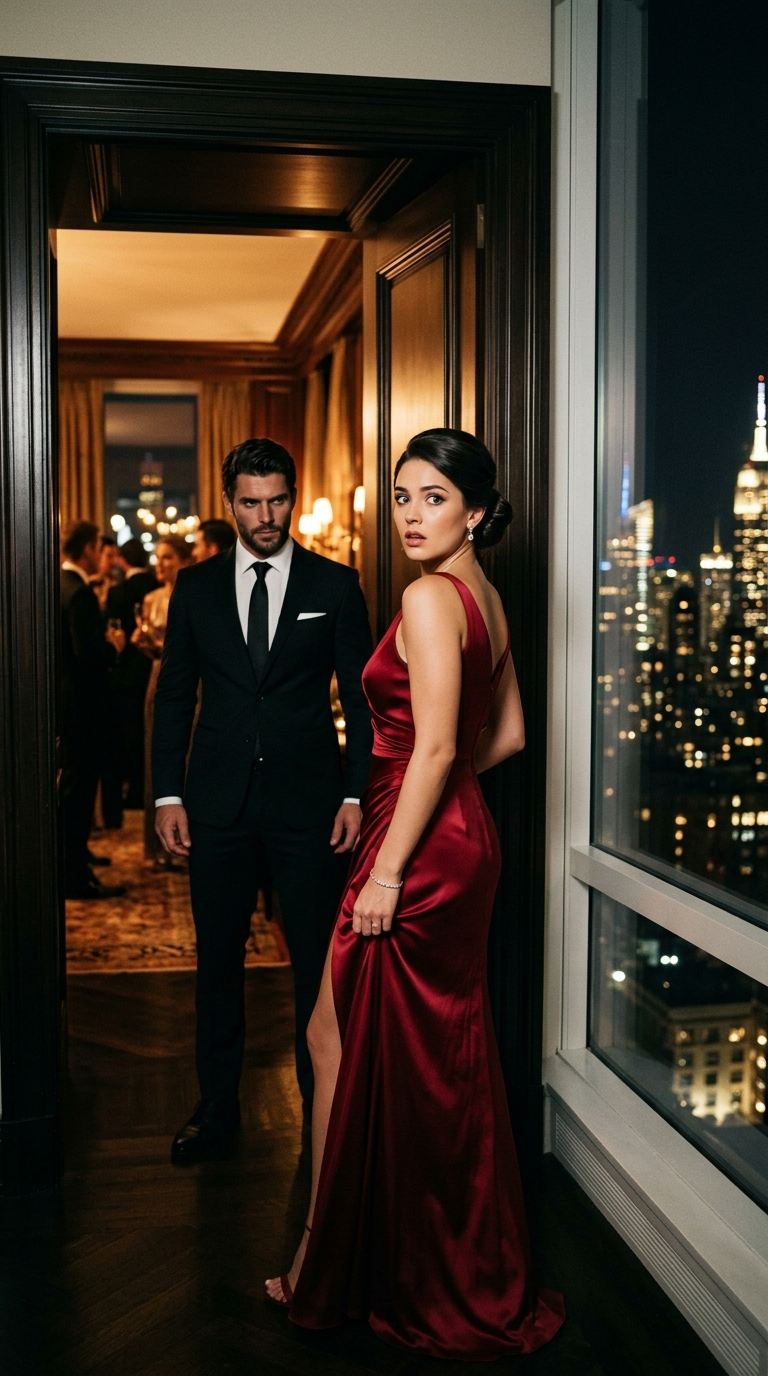
**The first time Ella Parker wore red, a dangerous man looked at her as if she had walked out of a grave.**
Until that night, Ella had spent fifty-eight years mastering the gentle art of not disturbing anyone.
She knew how to laugh without being too loud, how to enter a room without causing heads to turn, how to leave before anyone noticed she had gone. She could sit through dinners where people interrupted her three times in one sentence and still make them feel forgiven. She sent thank-you notes, remembered birthdays, carried tissues, and kept peppermint candies in her purse because someone, somewhere, always needed one.
People called her sweet.
Ella had learned long ago that **sweet** was what people said when they meant harmless.
So when Lila Bennett thrust the crimson silk dress into her arms three nights before the engagement party, Ella nearly dropped it as if it were alive.
“I can’t wear this,” Ella said.
They were standing in a boutique on Fifth Avenue where the mirrors were cruel, the lighting was flattering only to women who already believed in themselves, and the saleswoman had cheekbones sharp enough to cut ribbon. Outside, taxis hissed past in the late March rain. Inside, everything smelled of perfume, money, and decisions Ella was not brave enough to make.
Lila crossed her arms. Her diamond engagement ring flashed beneath the boutique lights like a beautiful warning.
“You are wearing it to my engagement party,” Lila said, “or I am uninviting you from my entire life.”
“Lila.”
“No.”
“It has a slit.”
“It has two seams and a future.”
“It barely has a bodice.”
“Good. You’ve been hiding in cardigans since the Clinton administration.”
Ella stared at the dress. It was not merely red. It was **crimson**, the color of wine spilled on white linen, of lipstick left on a forbidden glass, of every feeling Ella had folded carefully and placed in the back of a drawer.
“I’m too old for this,” Ella whispered.
Lila’s expression changed.
At fifty-seven, Lila Bennett was still the sort of woman who made rooms rearrange themselves around her. She had silver threaded beautifully through her dark hair, a laugh that could charm waiters into bringing extra dessert, and the confidence of someone who had never once apologized for wanting the larger slice of cake. But in that moment, standing between racks of silk and satin, she looked at Ella not as a glamorous bride-to-be, but as the girl who had once held Ella’s hand in a hospital hallway when Ella’s husband died.
“You are not too old,” Lila said quietly. “You are too practiced at disappearing.”
Ella looked away.
There it was.
The word.
**Hiding.**
Lila said it again, softer this time.
“You’re hiding, Ella.”
That word followed Ella for three nights.
It followed her into her apartment in Queens, where her cat, Agatha, judged the garment bag with clear suspicion. It followed her through cups of tea she did not finish, through sleep she did not keep, through memories she preferred not to invite. It followed her into Lila’s Manhattan penthouse on the night of the party, into the guest bathroom with the heated marble floors, and finally into the mirror.
There, a stranger stared back.
Her soft brown hair, streaked with silver, had been pinned loosely at her neck. Her cheeks were flushed. Dark rose lipstick made her mouth look braver than she felt. And the red silk clung to her body like it knew every secret she had never dared to say aloud.
Ella touched the neckline with trembling fingers.
“I feel naked,” she whispered.
The door opened behind her.
Lila appeared in ivory satin and diamonds, radiant and restless, the kind of bride who looked not young but luminous. She held two champagne flutes in one hand and a lipstick in the other.
“You look expensive,” Lila said.
“I look like I’ve made questionable choices.”
“Finally.”
Ella laughed despite herself, then tugged at the slit where the dress revealed more leg than she had shown since a Fourth of July picnic in 1989.
Lila stepped closer and took both her hands.
“Listen to me,” she said. “Tonight, Ella Parker, you stop apologizing for existing.”
Ella wanted to believe her.
For Lila, she walked out.
The penthouse was crowded with men in dark suits and women in sleek gowns. Champagne glasses caught the chandelier light. A pianist played Cole Porter near windows that opened onto a glittering Manhattan skyline. The room smelled of lilies, citrus, and money old enough to have lost its manners.
Marco Santini, Lila’s fiancé, crossed the room as soon as he saw them.
He was in his early sixties, handsome in the polished way of men who had paid attention to their suits, their teeth, and their secrets. His hair was silver, his skin olive, his smile slow. He kissed Lila’s cheek and held her a second too long, one hand spread across the back of her waist like possession pretending to be tenderness.
Then he turned to Ella.
“Miss Parker,” he said, and his eyes moved over her in a way that made her feel both admired and assessed. “You look beautiful.”
Ella blushed so hard she nearly apologized for it.
“Thank you,” she murmured.
Marco smiled.
“Lila never exaggerates.”
“Only when necessary,” Lila said lightly, but Ella felt her friend’s fingers tighten briefly around her wrist.
The moment passed. Marco was pulled toward older men at the bar. Lila was swallowed by cousins, donors, board members, and women who kissed the air near her cheeks. Within twenty minutes, Ella stood alone at the edge of the room, holding a glass of champagne she had no intention of drinking.
That was when she saw him.
He stood near the floor-to-ceiling windows with the city blazing behind him.
Tall. Broad-shouldered. Dressed in a tailored black suit that looked less like fashion and more like armor. His hair was black with silver at the temples, slightly too long, combed back carelessly as if vanity had surrendered to fatigue. Three men stood near him, all watchful, all silent, but he was the one everyone avoided looking at too long.
His face was not handsome in the usual way. It was too stern for that, too deeply marked by life. But it was impossible to ignore. He had the calm of a man who had survived violence and learned to speak softly afterward.
When someone spoke to him, he smiled as if he already knew what the other man was about to lose.
Ella looked away fast.
Men like that did not notice women like her.
And if they did, pretending otherwise was usually safer.
The room suddenly felt too warm. Too loud. Too full of eyes.
Ella slipped toward the hallway leading to the balcony, lowering her head, falling back into the old habit of vanishing. She passed close to the man by the window without meaning to, close enough to catch the scent of smoke, whiskey, expensive cologne, and something colder underneath—rain on stone, perhaps, or winter metal.
Then one quiet word cut through the music.
“Stop.”
Ella froze with one hand near the hallway wall.
Her heart beat so hard she thought everyone could hear it.
Slowly, she turned.
He was looking directly at her.
His dark eyes were terrifyingly calm and completely focused.
“Come here,” he said.
The way he said it made the room feel suddenly dangerous.
Ella glanced behind her, praying some other woman in red silk had made the mistake of existing nearby.
No one had.
“I was just going to get some air,” she managed.
Her voice sounded small even to herself.
The man stepped closer.
His gaze moved over her not lazily, not crudely, but like he was memorizing evidence.
“What’s your name?” he asked.
“Ella,” she said. “Ella Parker.”
Something flickered in his face.
Not surprise.
Recognition.
He came nearer, and the three silent men behind him shifted as if his movement had pulled invisible strings.
“Full name.”
“Eleanor Mae Parker.”
His jaw tightened.
“Who gave you that dress?”
The question was so strange that she almost laughed. But his expression made laughter impossible.
“My friend,” she said. “Lila.”
“Lila Bennett?”
“Yes. This is her engagement party.”
“I know what it is.”
The piano music stumbled, then recovered. Somewhere behind Ella, a woman laughed too brightly. Glass chimed against glass.
The man leaned closer, lowering his voice.
“Did you drink anything?”
Ella looked down at the champagne glass in her hand.
“No.”
“Good.”
“What is going on?”
Before he could answer, Marco appeared at Ella’s shoulder as smoothly as a knife being drawn from a sleeve.
“Dante,” Marco said. “You found our guest of honor.”
Ella blinked.
Guest of honor?
The dangerous man—Dante—did not look away from her.
“She says her name is Eleanor Parker.”
Marco smiled.
“So she does.”
Ella’s stomach tightened.
Something was wrong. Not merely awkward. Not merely rich-people-strange.
Wrong.
Lila hurried toward them through the crowd, ivory satin whispering around her ankles. Her face was still smiling, but her eyes had lost their sparkle.
“There you are,” she said to Ella. “I’ve been looking everywhere.”
“She was trying to leave,” Dante said.
“Just for air,” Ella said quickly.
Dante reached out and took the champagne glass from her hand.
“Don’t,” Marco said.
But Dante had already lifted it.
He smelled it.
Then, with one sharp motion, he hurled it into the fireplace.
The glass shattered against the marble. Champagne hissed across the flames.
The room fell silent.
Every conversation stopped.
Lila’s hand flew to her mouth.
Marco’s smile disappeared.
Dante looked at Ella and said, very softly, **“Now you’re in it.”**
## Part Two: The Letter Lila Never Meant to Show Her
For one suspended moment, Ella Parker felt the entire penthouse turn toward her.
People stared over champagne glasses and diamond necklaces. The pianist removed his hands from the keys. A waiter froze with a tray of crab tartlets. The city lights beyond the windows glittered with cruel indifference.
Ella wanted to disappear so badly her bones ached.
But the red dress would not let her.
It held her in the center of the room like a flame.
Marco recovered first. Men like Marco always did. He gave a low, amused laugh and lifted both palms.
“My apologies,” he said to the room. “Dante has never trusted California champagne.”
A few guests laughed uncertainly.
Dante did not.
Lila moved quickly, stepping between Ella and the watching crowd.
“Ella spilled something earlier,” she said, too brightly. “She was worried about the dress. We’ll just freshen up.”
Ella stared at her friend.
Freshen up?
A man had just smashed her drink into a fireplace.
Marco’s hand closed gently around Lila’s elbow.
“You should stay,” he said.
The words were mild.
The pressure of his fingers was not.
Ella saw Lila wince.
Something cold and clear moved through her fear.
“Let go of her,” Ella said.
She did not say it loudly. She did not say it bravely. But she said it.
Lila looked at her as if she had never heard Ella’s voice before.
Marco’s eyes shifted to Ella.
“Excuse me?”
Ella swallowed.
“You’re hurting her.”
The silence around them deepened.
Dante’s mouth curved, almost imperceptibly.
Marco released Lila.
“Of course,” he said. “Forgive me.”
Lila took Ella’s hand and practically pulled her down the hallway.
They passed a powder room, a guest bedroom, a wall of black-and-white photographs, then entered Lila’s private dressing room. As soon as the door closed, Lila locked it, leaned against it, and exhaled like a woman who had been holding her breath for months.
Ella rounded on her.
“What is happening?”
Lila pressed her fingers to her temples.
“I need you not to panic.”
“That sentence has never stopped anyone from panicking.”
“I know.”
“Why did Dante ask who gave me this dress?”
Lila’s face changed.
There are moments when a friendship decades old becomes suddenly unfamiliar, when the person across from you is still the person who brought soup when you had the flu and cried with you through a funeral, yet something in her expression tells you she has been walking through rooms you never knew existed.
This was one of those moments.
Lila crossed to a lacquered writing desk, opened the top drawer, and removed an envelope.
The paper was old, yellowed at the edges.
Ella saw her own name written across the front.
**Eleanor Parker.**
Not Ella.
Eleanor.
Her skin prickled.
“What is that?”
“My mother left it,” Lila said. “She died seven years ago. I didn’t find it until last month, when I was clearing the house in Connecticut.”
“You never told me.”
“I didn’t understand it.”
“Understand what?”
Lila handed her the envelope.
Ella did not take it.
“Lila.”
“Please.”
Ella took it.
The seal had already been broken. Her fingers trembled as she unfolded the letter inside.
The handwriting was elegant and old-fashioned.
Dear Lila,
If Marco Santini ever comes close to you, or if anyone connected to the Santini family asks about a woman named Eleanor Parker, you must do exactly as I say.
Find Eleanor.
Bring her into a crowded room.
Put her in red.
Make sure Dante Moretti sees her before Marco has her alone.
Do not trust charm. Do not trust apologies. Do not trust champagne.
And if Eleanor asks who she is, tell her I am sorry.
Ella read the last line three times.
The letters blurred.
“What is this?” she whispered.
Lila’s eyes filled.
“I don’t know all of it.”
“That’s not good enough.”
“I know.”
“You put me in this dress because of a dead woman’s letter?”
“I put you in that dress because Marco asked about you.”
Ella looked up.
“What?”
Lila wrapped her arms around herself.
“At first it was little things. How long had we been friends? Where were you from? Did you have family? Did you ever talk about your father? He said he was making conversation. I believed him.”
Ella remembered Marco’s smooth voice, his polished smile.
“Then he asked if you had a scar,” Lila said.
Ella’s hand flew unconsciously to her collarbone.
There, just beneath the left strap of the red dress, lay a small crescent scar, pale against her skin. She had had it as long as she could remember. Her mother had said she fell against a radiator as a toddler.
Lila’s voice broke.
“He asked if it was shaped like a moon.”
The room tilted.
Ella sat down hard on a velvet bench.
“No.”
“I’m sorry.”
“No.”
“I was scared, Ella. I didn’t know what he wanted from you, and then I remembered my mother’s letter. I thought if I could get you here, get Dante to see you—”
“Who is Dante?”
Lila looked toward the locked door.
“A man Marco fears.”
“That is not an answer.”
“It’s the only one I had.”
Ella rose again, anger beginning to burn through shock.
“You used me.”
“I tried to protect you.”
“You dressed me up like a signal flare!”
“Yes,” Lila said, and for the first time that night, her glamour cracked completely. “Yes, I did. Because I love you, and because I think Marco would have killed you if I hadn’t.”
The words landed like stones.
Killed.
Ella thought of the champagne glass shattering in Dante’s hand.
Do not trust champagne.
The letter slipped from her fingers.
A knock sounded at the door.
Both women froze.
“Lila,” Marco called gently. “Open the door.”
Lila did not move.
The handle turned.
Locked.
Marco gave a soft laugh from the other side.
“Darling, don’t make a scene.”
Ella looked at Lila.
Lila looked back.
For all her diamonds, all her satin, all her practiced confidence, Lila suddenly looked very much like the girl Ella had met thirty years earlier in a community theater basement, crying because her father had forgotten opening night.
“What does he want?” Ella whispered.
Lila shook her head.
“I don’t know.”
Another voice spoke from the hallway.
Dante’s.
“She doesn’t have to open anything for you.”
Silence.
Then Marco said, still gently, “This is a private matter.”
“Not anymore.”
A pause.
Ella heard the faint shift of men outside the door.
Then Dante said, “Miss Parker, step away from the door.”
Lila grabbed Ella’s hand and pulled her back.
A second later, the lock exploded inward.
Ella screamed.
The door swung open.
Dante stood in the hallway holding a small black pistol pointed not at them, but past them, toward Marco and two men Ella had not noticed before. Marco’s face was expressionless. His guests, mercifully, could not see down the hall.
Dante glanced at Ella.
“Can you run?”
Ella looked down at the crimson silk, the slit, the ridiculous heels Lila had insisted she wear.
“No.”
“Then walk fast.”
Marco chuckled.
“You always were dramatic.”
Dante’s eyes did not leave him.
“And you always talked too much before a crime.”
Marco’s smile thinned.
“Careful.”
“No,” Dante said. “I was careful for thirty-nine years. Look where it got us.”
Ella heard the pain beneath the steel in his voice.
Thirty-nine years.
Dante turned to her.
“Eleanor, your mother’s name was not Margaret Parker.”
Ella stopped breathing.
Marco’s face changed.
Lila whispered, “Oh my God.”
Dante’s voice lowered.
“Your mother’s name was Rose Moretti Santini. And everyone in this room has been waiting for you to die.”
## Part Three: The Life That Had Been Stolen
There are truths the mind refuses because accepting them would collapse the house it has lived in.
Ella Parker’s mind refused Dante’s words with the desperation of a body refusing drowning water.
Your mother’s name was not Margaret Parker.
No.
Your mother’s name was Rose Moretti Santini.
No.
Everyone in this room has been waiting for you to die.
No.
She thought of her mother—not Rose, not Santini, but Margaret Parker, who had worn sensible shoes, kept coupons in a tin box, and hummed while ironing pillowcases. Margaret, who had taught Ella to stir soup clockwise and write sympathy cards promptly. Margaret, who had smelled of Ivory soap and lavender hand lotion. Margaret, who had cried quietly in the kitchen on Ella’s tenth birthday when she thought Ella was asleep.
That woman was her mother.
Wasn’t she?
Ella gripped the back of the velvet bench.
“I don’t believe you,” she said.
Dante’s expression softened in a way that frightened her more than his anger had.
“I know.”
“I had a mother.”
“Yes.”
“Her name was Margaret.”
“Yes.”
“You just said—”
“I said she wasn’t the woman who gave birth to you.”
Ella laughed once, sharply.
It sounded nothing like her.
“This is insane.”
Marco sighed.
“Dante has always preferred melodrama.”
Dante turned the gun slightly toward him.
“Be quiet.”
Marco looked amused, but he obeyed.
Lila moved to Ella’s side.
“Ella,” she whispered.
“Don’t,” Ella said.
She could not bear kindness yet.
Dante reached into his jacket with his free hand and removed a small photograph, creased at the corners. He placed it on Lila’s dressing table.
Ella did not want to look.
Of course she looked.
The photograph showed a young woman in a red dress standing beside a piano. She had dark hair pinned loosely at her neck, a crescent scar near her left collarbone, and eyes that seemed to hold both music and warning.
Ella’s own face looked back at her from forty years ago.
Only younger.
Brighter.
Doomed.
“That’s Rose,” Dante said. “My sister.”
Ella stared until the photograph blurred.
“She looks like me.”
“You look like her.”
“No.”
“Eleanor—”
“Don’t call me that.”
Dante nodded once, accepting the boundary.
“Ella, then.”
Outside the room, the party had resumed in a nervous, wounded way. Music again. Conversation again. People were very good at pretending nothing was happening if the champagne was expensive enough.
Dante tucked the gun out of sight.
“We need to move.”
Marco laughed softly.
“To where? You think you can walk her out? Half the men in this building are mine.”
“And the other half?” Dante asked.
“Cowards.”
“Useful distinction.”
Lila stepped forward.
“Marco, tell me this isn’t true.”
For the first time, Marco looked at her with something like regret. Not remorse. Regret. The difference was terrible.
“Lila, darling, you should have stayed out of old business.”
“You asked me to find out about her.”
“I asked questions.”
“You used me.”
Marco’s smile returned, faint and poisonous.
“I admired your loyalty. I simply redirected it.”
Lila recoiled as if struck.
Ella’s anger rose again, but this time it had roots.
Not the hot, brief anger of embarrassment. Something older. Something that had been waiting beneath years of please and sorry and don’t worry about me.
“Why?” Ella asked.
Marco turned toward her.
“Why what?”
“Why me?”
Marco studied her.
Then he smiled as if she had finally become interesting.
“Because, Eleanor, dead women can be managed. Missing women can be mythologized. But living heirs create paperwork.”
The word heir hit the room with absurd force.
Ella almost laughed again.
“I’m a part-time archivist at a historical society in Queens. I drive a twelve-year-old Subaru. I have a cat who resents me. I am not an heir to anything except my mother’s casserole dishes.”
Dante’s mouth twitched.
Marco did not laugh.
“Your biological father was Vincent Santini.”
Ella felt Lila flinch beside her.
Dante said, “Rose married him when she was twenty-two. She was a singer. Brilliant. Stubborn. Too trusting.”
“And he was a criminal,” Ella said.
“Among other things.”
Marco’s eyes cooled.
“Careful how you speak of my father.”
Ella looked at him.
“Your father?”
“My father,” Marco said. “Your father. Though I was born first, which should have simplified things.”
The room seemed to shrink around Ella.
“My brother,” she whispered.
“Half-brother,” Marco corrected. “Let us not overstate intimacy.”
Lila covered her mouth.
Dante moved closer to Ella.
“Vincent kept assets hidden for decades. Real estate, shell companies, offshore accounts. He placed a portion of it in a trust for Rose’s child after she threatened to expose him. When Rose disappeared, the trust became untouchable without proof her child was dead.”
Marco spread his hands.
“And no proof appeared.”
“Because Margaret ran,” Dante said.
Ella turned to him.
“Margaret?”
Dante nodded.
“Margaret Parker was a nurse at St. Agnes Hospital in Newark. Rose came in after the car crash. She was dying. You were two years old. Margaret had lost a child the year before. Rose begged her to take you.”
Ella’s legs weakened.
She sank onto the bench again.
Dante continued gently.
“Margaret took you out through the laundry entrance wrapped in hospital blankets. She changed your name. She raised you. And she kept you alive.”
Ella pressed both hands to her mouth.
The memory came without invitation.
A kitchen. Rain on windows. Margaret kneeling before her, holding her face.
If anyone ever asks about before, you don’t remember. Do you hear me, baby? You don’t remember.
Ella had thought it was a dream.
“She lied to me,” Ella whispered.
“She saved you,” Dante said.
Both could be true.
The cruelty of that nearly broke her.
Marco checked his watch.
“This family reunion is touching, but I have guests.”
Dante turned.
“What do you want, Marco?”
Marco’s expression became almost tender.
“What I have always wanted. Order.”
“You mean money.”
“Money is simply order with better manners.”
He looked at Ella.
“There is a safe deposit arrangement in Geneva, renewed every ten years. It requires a living signature and a blood confirmation. You are going to provide both.”
“And then?” Ella asked.
Marco did not answer.
He did not need to.
Lila made a sound, small and wounded.
Dante said, “You’ll never get her out of here.”
Marco smiled.
“No. But she will walk out with me.”
“I won’t,” Ella said.
Marco’s gaze settled on her.
There was no rage in him. That was worse. Rage might have meant she mattered.
This was calculation.
“You will,” he said, “because I have Lila’s brother downstairs with two men who do not enjoy waiting.”
Lila went white.
“Peter?”
Marco ignored her.
“And because I have enough documents to make Ella Parker vanish from the world by morning. A woman with no close family, no children, no husband, no one expecting her home except a cat. It would be painfully easy.”
Ella felt those words pierce exactly where he intended.
No close family.
No children.
No husband.
A cat.
The summary of her life as a disposal plan.
For a moment, the old shame rose in her. The familiar ache. The lifelong suspicion that perhaps she had indeed lived too quietly, mattered too little, left too faint a mark.
Then she felt Lila’s hand find hers.
And Dante, who had searched for a dead sister’s child for nearly four decades, said in a voice like stone, **“She is expected.”**
Marco’s eyes flicked toward him.
“By whom?”
Dante smiled then.
It was not cold.
It was dangerous.
“By the people who love women you overlook.”
For the first time, Marco looked uncertain.
Only for a second.
But Ella saw it.
Because Ella Parker, overlooked all her life, had become very good at seeing what other people missed.
## Part Four: What Quiet Women Remember
They moved through the service hallway as the party swelled again behind the walls.
Dante led. Ella followed. Lila walked behind her, one hand pressed against Ella’s back as if afraid she might vanish. The hallway smelled of lemon polish, hot food, and electrical dust. Somewhere nearby, staff whispered urgently into radios.
Ella’s mind worked in jagged pieces.
Rose Moretti Santini.
Vincent Santini.
Marco, her half-brother.
Margaret Parker, who had lied.
Margaret Parker, who had saved her.
Lila, who had placed her in red.
Dante, who looked at her like a promise he had failed to keep.
They reached a narrow stairwell.
Dante stopped.
“We need to get to the freight elevator.”
Lila shook her head.
“Marco controls the elevators.”
“That’s why we’re taking the stairs down two floors first.”
Ella looked at the steps, then at her heels.
“I knew I should have worn the black flats.”
Dante glanced back at her.
Despite everything, his mouth curved.
“My sister said the same thing the night she ran.”
Ella froze.
The words hurt, but not cruelly.
They stitched her to a woman she did not remember.
Lila touched her shoulder.
“Ella?”
Ella took off the heels.
The marble floor was cold beneath her bare feet.
“I’m ready.”
They descended.
One floor.
Then another.
On the landing, Dante stopped so abruptly that Ella nearly collided with him.
Voices below.
Men.
Dante raised a finger to his lips.
Ella held her breath.
The voices came nearer.
Lila gripped the railing.
Ella looked around desperately. A supply closet stood half-open on the landing. She pushed Lila inside, then followed. Dante slipped in last, pulling the door almost shut.
The closet was narrow, packed with folded linens and cleaning supplies. Ella found herself pressed between Lila and Dante, the red silk crushed against buckets and bleach bottles.
Footsteps passed outside.
“Mr. Santini wants the woman alive,” one man said.
“The red one?”
“Yeah. But Moretti doesn’t matter.”
The footsteps faded.
Lila began to tremble.
Ella took her hand.
“Peter will be all right,” Ella whispered.
“You don’t know that.”
“No,” Ella said. “But I’m saying it anyway.”
Dante waited another moment, then opened the door.
“We go now.”
They made it one more floor before Marco’s voice came over the building’s speaker system.
“My friends,” he said, warm and elegant, “forgive the interruption. Lila and I would like everyone to gather in the main room. There is someone very special I wish to introduce.”
Lila whispered a word Ella had never heard her use in thirty years.
Dante’s face hardened.
“He’s flushing us back up.”
“Then we don’t go back,” Ella said.
Both of them looked at her.
She was as surprised as they were.
But the words had come from somewhere steady.
Ella looked down at her bare feet, at the crimson silk, at her own hands. Hands that had folded laundry, held grief, typed labels for museum exhibits, fed soup to sick friends, signed condolence cards. Ordinary hands. Invisible hands.
**But invisible hands could carry matches.**
“What happens if I sign what he wants?” she asked.
Dante’s answer was immediate.
“He kills you.”
“What happens if I don’t?”
“He kills someone else first.”
Lila whispered, “Ella, no.”
Ella turned to Dante.
“Does he need my signature in front of a notary?”
Dante narrowed his eyes.
“Likely.”
“And blood confirmation?”
“Yes.”
“Then he needs me alive and publicly calm for at least a little while.”
“No.”
“You don’t know what I’m going to say.”
“I know that tone,” Dante said. “Rose had it before she broke a whiskey bottle over Vincent’s head.”
Ella almost smiled.
“I’m going back.”
Lila grabbed her arm.
“No.”
Ella turned to her friend.
For years, Lila had been the bold one. Lila ordered the wine, challenged the rude manager, asked the personal questions, wore the good jewelry. Ella had loved her for it. Envied her for it. Hidden behind her when the world became too sharp.
But now Lila was terrified, and Ella understood something so simple it felt like revelation.
Courage was not a personality.
It was a decision made one breath at a time.
“I’m going back,” Ella said, “because he thinks I’m still the woman he described.”
Lila shook her head, crying now.
“A woman with no one.”
Ella squeezed her hand.
“He was wrong.”
Dante studied her for a long moment.
“What are you planning?”
Ella looked toward the stairwell door.
“To let him underestimate me.”
“That is not a plan.”
“It has worked for fifty-eight years.”
Dante’s eyes softened.
Then he reached into his pocket and handed her a tiny object no bigger than a coat button.
“What is it?”
“A microphone.”
Ella looked at him.
“You carry microphones to engagement parties?”
“I carry many things to Santini parties.”
“Where do I put it?”
“In the dress.”
Ella glanced down.
“This dress has already done more work tonight than most elected officials.”
Lila gave a strangled laugh through her tears.
Ella slipped the microphone beneath the folded edge near her neckline. Her fingers shook, but she secured it.
Dante leaned closer.
“If you can get him to say Rose’s name, Vincent’s name, the crash, the trust—anything—do it. But if he moves you toward an exit, you scream.”
“I’m not good at screaming.”
“Learn quickly.”
Ella nodded.
Then she turned and walked barefoot back toward the penthouse.
The main room was waiting.
Every guest stood facing Marco, who had positioned himself near the piano. The city gleamed behind him. The champagne had been refilled. The broken glass at the fireplace was gone. Rich rooms were efficient at removing evidence.
Marco smiled when he saw her.
There was triumph in it.
“Eleanor,” he said. “There you are.”
Every head turned.
Ella felt the weight of all those eyes.
Her instinct screamed: apologize.
Instead, she lifted her chin.
“It’s Ella.”
Marco’s smile tightened.
“Of course.”
Lila appeared behind her, pale but composed. Dante stayed near the hallway, partly shadowed, watching the room like a battlefield.
Marco extended his hand.
“Come.”
Ella did not take it.
“What do you want to introduce me as?” she asked.
The room stirred.
Marco gave a soft laugh.
“My dear, after tonight, I think honesty may be refreshing.”
“Then try some.”
A few people gasped.
Lila’s lips parted.
Dante’s eyes sharpened with something like pride.
Marco stepped closer.
“You have spirit. How unexpected.”
“People often miss things they don’t value.”
His expression darkened.
Then he leaned in, speaking low enough that only the microphone, Ella, and perhaps Dante could hear.
“Do not mistake this performance for power. Your friend’s brother is in my hands.”
Ella’s knees nearly weakened.
She thought of Peter Bennett, a gentle man with Parkinson’s who still sent Christmas cards with stamps placed crookedly. She thought of Lila’s face.
“What did Rose do to you?” Ella asked quietly.
Marco froze.
It was tiny.
But she saw it.
“What did you say?”
“Rose,” Ella said. “My mother.”
His eyes flashed.
“Rose was a foolish woman.”
Behind Marco, the pianist looked down at his keys, pretending not to hear.
Ella stepped closer.
“What did she know?”
Marco smiled, but his lips had gone pale.
“Enough to die.”
The words entered the room like poison.
Not everyone heard them.
But Dante did.
Lila did.
The microphone did.
Ella felt something inside her break open—not fear, not grief, but a vast and steady fury.
“You killed her.”
Marco’s voice lowered further.
“I was twenty-five. My father was ill. Rose was threatening to hand over ledgers that would have destroyed all of us. She ran with you. The road was wet. Accidents happen.”
“Margaret saved me.”
“Margaret stole you.”
“She saved me.”
“She delayed me.”
Ella stared at him.
There, finally, was the truth of him.
Not passion. Not even hatred.
Inconvenience.
Her life had been an inconvenience to him.
Margaret’s love had been an inconvenience.
Rose’s courage had been an inconvenience.
Lila’s loyalty had been an inconvenience.
Ella turned slightly so the room could see her face.
“My mother’s name was Rose,” she said clearly.
Marco’s hand shot out and gripped her wrist.
“Enough.”
Ella looked at his fingers.
“You’re hurting me.”
No one moved.
The old Ella would have made herself small enough to excuse him.
The woman in red raised her voice.
“You’re hurting me, Marco.”
Now people heard.
Dante stepped forward.
Marco released her and smiled at the room.
“A family misunderstanding,” he said.
Ella looked around at the guests—wealthy, polished, frightened. Some knew. She could see it now. The lowered eyes. The stiff shoulders. The way certain older men avoided Dante’s gaze.
How many people had spent decades knowing pieces of this story?
How many had chosen comfort?
Marco lifted a champagne glass.
“To family,” he said. “Even when it returns unexpectedly.”
No one drank.
Then a woman near the bar spoke.
She was small, white-haired, draped in pearls, and until that moment Ella had assumed she was someone’s aunt.
“Marco,” the woman said, “let her go.”
Marco turned slowly.
“Mrs. Alvarez.”
Ella blinked.
She knew that name.
Mrs. Alvarez was the seamstress from Queens who had hemmed the red dress two days earlier. Ella remembered her bent silver head, her measuring tape, her warm hands. She had said, You have a good friend. A dress like this is not meant for hiding.
What was she doing here?
The old woman stepped forward.
“I said let her go.”
Marco stared.
Then he laughed.
And that was when the elevator doors opened.
Men and women in dark jackets entered the penthouse.
Not Marco’s men.
Federal agents.
The room erupted.
Lila sobbed once, a sound of relief so raw it hurt to hear.
Dante did not look surprised.
Marco did.
He looked at Ella.
For the first time that night, truly looked at her.
Not as bait. Not as an heir. Not as a problem.
As an enemy.
Ella smiled then, small and trembling.
**He had recognized her too late.**
## Part Five: The Woman Everyone Had Underestimated
Later, people would say Dante Moretti saved Ella Parker.
People preferred stories with dangerous men and dramatic entrances. They liked guns in hallways, shattered champagne glasses, secrets spoken beneath chandeliers. They liked the idea that a woman in a red dress had been rescued from a family monster by a man who had spent thirty-nine years searching for her.
There was truth in that story.
But it was not the whole truth.
The whole truth began three months earlier, in Ella’s apartment in Queens, when Margaret Parker’s cedar chest finally gave up its secret.
Margaret had been dead for nine years. Ella had kept the chest at the foot of her bed because grief turns ordinary objects into shrines. Inside were quilts, old recipes, hospital pins, a rosary Margaret never used but never threw away, and beneath the lining, wrapped in wax paper, a packet of letters.
Ella had found them on a Sunday afternoon while looking for a clean tablecloth.
The first letter was addressed to her.
My dearest Ella,
If you are reading this, then I was either too cowardly to tell you while living or wise enough to wait until you were ready. I pray it was wisdom, but I know myself too well.
You were born Eleanor Rose Santini.
Your mother was Rose Moretti Santini.
She was brave. I was frightened. She died asking me to save you. I did.
Forgive me for the lie. Do not waste time forgiving me before you are angry. Anger is honest. I loved you with my whole borrowed life.
There had been documents. A photograph. A newspaper clipping about a fatal car crash in New Jersey. A birth record. A locket containing a curl of dark baby hair. And a list of names written by Rose herself.
Marco Santini was at the top.
Dante Moretti was beneath it.
Trust him only after he proves he still remembers the song.
Ella had sat on the floor until the winter light faded from the windows and Agatha, impatient for dinner, climbed into her lap.
She did not call Lila that night.
She did not call anyone.
Instead, for the first time in her life, Ella Parker made a plan without asking permission.
She did what quiet women do best.
She gathered.
She gathered documents. She gathered dates. She gathered names from museum archives, newspaper databases, court filings, property records, obituary columns, and old photographs with men standing too close together at charity galas. She gathered lies by comparing them to other lies. She gathered courage in teaspoons.
And every morning, she ordered the same oat milk latte at the same café near her apartment.
What no one knew was that the café was not simply a café.
The barista named Sam, who always drew a leaf in her foam and asked about Agatha, was Special Agent Samuel Ruiz.
By the third week, Ella had given the FBI copies of everything Margaret had hidden.
By the fifth, she knew Lila’s fiancé was Marco Santini.
By the sixth, she understood that Lila was in danger.
By the seventh, she told Sam, “He won’t confess to agents. He won’t confess to lawyers. He’ll confess to a woman he thinks doesn’t count.”
Sam had looked at her across the café table.
“Mrs. Parker, that would be dangerous.”
Ella had stirred her latte.
“I have spent my life being careful,” she said. “It did not make me safe. It only made me quiet.”
When Lila brought the crimson dress into the boutique, Ella had not known about Lila’s mother’s letter.
That part was real.
Her shock had been real. Her fear had been real. Her trembling hands in the mirror had been real.
But after Lila left her apartment that day, Ella took the dress to Mrs. Alvarez.
Mrs. Alvarez, who had once sewn costumes for Rose Moretti in a Newark theater.
Mrs. Alvarez, whose name was third on Rose’s list.
Mrs. Alvarez, who wept when she saw Ella standing in crimson silk.
“You look like her,” the old seamstress had whispered.
Then she had sewn into the dress not one microphone, but three.
One beneath the neckline.
One in the hem Ella kept nervously touching.
One inside the left strap, close to the crescent scar Marco had asked about.
**Every time Ella tugged at the slit, she was checking the wire.**
**Every time she touched her collarbone, she was steadying the recorder.**
**Every apology she almost made became a breath she saved for the truth.**
The federal agents in the penthouse already had Marco’s threats.
They had his words about Rose.
They had his confession: Enough to die.
But Ella had not known whether the plan would work.
That was the part stories often forgot.
Courage did not feel like triumph while it was happening.
It felt like nausea. Like cold hands. Like wanting your mother. Like walking barefoot across a room full of people who might watch you die and still worry about the carpet.
Marco Santini was arrested near the piano.
He did not shout. He did not lunge. Men like Marco trusted systems because they had spent their lives purchasing them. He looked first at the agents, then at Dante, then at Lila.
Finally, he looked at Ella.
“You?” he said.
There was disbelief in his voice.
Not because he had been caught.
Because she had caught him.
Ella stepped closer, close enough to see the fine lines around his mouth, the sweat at his temple, the ruined dignity of a man discovering too late that the furniture had been listening.
“Yes,” she said. “Me.”
His face twisted.
“You’re nothing.”
Ella thought of Margaret’s hands folding blankets. Rose’s voice, lost before Ella could remember it. Lila’s fingers tightening around hers. Dante carrying a photograph for thirty-nine years. Mrs. Alvarez sewing microphones into silk with hands bent by age and devotion. Sam making lattes while building a federal case.
Nothing?
No.
Not anymore.
“I am the woman you forgot to fear,” Ella said.
Marco was taken away.
Lila’s brother Peter was found in a downstairs office, frightened but alive. Lila ran to him barefoot, her ivory satin dragging behind her, diamonds flashing under fluorescent hall lights as she held him and sobbed into his shoulder.
Dante stood near the windows, alone.
Ella approached him after the agents had finished their first questions. Dawn had begun to pale the sky beyond Manhattan. The party was gone. The flowers drooped. Half-empty champagne glasses stood everywhere like abandoned alibis.
Dante held the old photograph of Rose.
For the first time, he looked his age.
“I should have found you,” he said.
Ella stood beside him.
“Yes.”
He closed his eyes.
The honesty cost him something.
“I searched.”
“I know.”
“I gave up.”
“I know that too.”
He opened his eyes, wet with grief.
“She sang to you,” he said. “When you were a baby. There was a song.”
Ella looked at him.
“Sing it.”
His breath caught.
“I haven’t sung in forty years.”
“Neither have I.”
So Dante sang softly, badly, beautifully, in a voice roughened by smoke and sorrow.
It was an old Italian lullaby.
Ella did not know the words.
But her body knew the melody.
Before she could stop herself, she hummed the second line.
Dante covered his mouth.
Ella began to cry.
Not delicately. Not prettily. She cried like a woman whose life had cracked open and found, beneath the lies, not emptiness but roots.
Dante did not touch her until she reached for him.
Then he held her as an uncle holds a niece he had loved as a ghost and found, impossibly, alive.
“I’m sorry,” he whispered.
Ella leaned against him.
“I’m angry.”
“Good.”
She laughed through tears.
“Everyone keeps saying that.”
“Because it’s true.”
Months passed before the courts untangled the trust.
The newspapers called it the Santini Scandal. They printed photographs of Marco in handcuffs, Dante entering federal court, Lila behind large sunglasses, Ella in the crimson dress looking stunned beneath the chandelier light.
They got much of it wrong.
They called Ella a reclusive heiress.
She was not reclusive. She had simply been ignored.
They called Lila a society bride betrayed by crime.
She was that, but she was also the woman who had risked everything because a dead mother’s letter told her to protect a friend.
They called Dante a mysterious underworld figure.
He was a retired investigator with bad knees, an excellent tailor, and a heart so loyal it had almost destroyed him.
They called Marco brilliant.
Ella clipped that article only to write one word across it in black marker:
No.
Six months after the party, Ella stood in the small historical society where she worked, looking at a new exhibit.
Not Santini treasures.
Not jewels.
Not portraits of powerful men.
The exhibit was called **The Women Who Carried the Truth**.
There was Margaret Parker’s nurse pin.
There was Rose Moretti’s sheet music.
There was Mrs. Alvarez’s measuring tape.
There was Lila’s mother’s letter.
And in the center, behind glass, was the crimson dress.
Not because it was beautiful, though it was.
Because it had listened.
Because it had witnessed.
Because on one terrible night in Manhattan, it had helped a woman who had spent her life overlooked become impossible to ignore.
Lila came to the opening wearing a black pantsuit and no engagement ring. She brought Peter, who walked slowly with a cane and insisted the cookies were too dry. Dante came with flowers and pretended not to cry. Special Agent Ruiz came off duty and brought Ella an oat milk latte.
“You’re famous now,” Sam said.
Ella took the cup.
“I’m still charging you admission.”
He laughed.
Lila slipped her arm through Ella’s.
“Do you ever miss being invisible?”
Ella looked around the room.
People were reading the letters. Whispering. Wiping their eyes. Remembering women whose names had nearly been erased.
“No,” Ella said at last. “But I understand why I chose it.”
Lila rested her head briefly on Ella’s shoulder.
“I’m sorry I put you in danger.”
Ella smiled.
“You put me in red.”
“That too.”
Ella looked at the dress.
For most of her life, she had believed bravery belonged to other women. Louder women. Younger women. Women with sharper cheekbones, higher heels, better instincts, cleaner histories. She had believed her own life was too ordinary to contain revelation.
But now she understood.
**Some lives do not look dramatic because the battle is fought in silence.**
**Some women are not weak because they bend; they are gathering force.**
**And sometimes, the person everyone forgets to notice has been noticing everything.**
At the end of the evening, after the guests had gone and the lights were being dimmed, Ella found Dante standing before the dress.
He said, “Rose would have wanted you to keep the money.”
Ella shook her head.
The Santini trust had been larger than anyone expected. Large enough to corrupt. Large enough to tempt. Large enough to bury a hundred sins beneath philanthropy.
“I’m keeping enough to fix my roof,” Ella said.
Dante smiled.
“And the rest?”
“A foundation. For women who need new names, safe rooms, train tickets, lawyers, locksmiths, therapy, time.”
He looked at her for a long moment.
Then he nodded.
“She would like that.”
Ella touched the glass case lightly.
“What was she like?”
Dante looked at the dress, but his eyes were far away.
“Rose?”
“Yes.”
He smiled.
“She was impossible.”
Ella laughed softly.
“I wish I knew her.”
“You do,” he said.
Ella turned to him.
Dante tapped the glass, just above the red silk.
“She was the kind of woman who would wear a dress like that into a room full of men who wanted her silent, then make sure the dress told the truth after she was gone.”
Ella felt tears rise again, but they were gentler this time.
Outside, evening settled over Queens. Cars passed. Someone shouted for a child to hurry up. A dog barked. Ordinary life continued, blessedly indifferent and full of small mercies.
Ella locked the exhibit doors.
Lila waited by the curb, waving impatiently.
“Come on,” she called. “We’re getting dinner. And don’t you dare say you’re not hungry.”
Ella smiled.
For once, she did not apologize for making someone wait.
She walked into the night with her head up, her silver-threaded hair loose around her face, her red lipstick still bright after all these hours.
Behind her, the crimson dress stood in the darkened room, holding its secrets no longer.
And somewhere, in the hush between memory and justice, Rose Moretti Santini was no longer a ghost.
She was a song.
She was a warning.
She was a mother.
And Ella Parker, who had spent her whole life being easy to overlook, finally understood the truth that had been sewn into every hidden seam of her existence:
**She had never been invisible.**
**She had been waiting for the right room to burn.**