The Strangest Job Offer I’d Ever Seen
The flyer looked ridiculous.
It was taped crookedly to the bulletin board outside a pharmacy, half-covered by advertisements for piano lessons and lost cats.
WANTED: A GRANDDAUGHTER FOR SUNDAYS. $400 PER VISIT. NO QUESTIONS.
I stared at it for almost a minute.
Then I laughed.
Then I took a picture.
By the time I got home to my tiny apartment, I couldn’t stop thinking about it.
I was twenty-seven years old.
No family.
No emergency contacts.
No holiday invitations.
No one who would notice if I disappeared for a week.
I had aged out of foster care at eighteen and spent the next nine years surviving rather than living.
Four hundred dollars for a few hours every Sunday sounded too good to ignore.
So I called.
A woman’s voice answered on the second ring.
“Come Sunday at one,” she said.
No interview.
No explanation.
Just an address.
Then she hung up.
Marianne
The house was old but beautiful.
Not mansion-beautiful.
Loved-beautiful.
Flower boxes sat beneath every window.
Wind chimes swayed gently on the porch.
The front door opened before I could knock.
An elderly woman stood there, one hand gripping the frame for balance.
She was tiny.
Eighty-four, I would later learn.
Her silver hair was pinned neatly into a bun.
Sharp blue eyes studied me.
“You’re younger than I expected.”
“You’re shorter than I expected.”
For a moment, neither of us moved.
Then she laughed.
A real laugh.
The kind that starts in the heart.
“Good,” she said. “Come in.”
Her name was Marianne.
The house smelled like cinnamon, tea, and old books.
She led me to a dining table set for two.
After pouring tea into delicate china cups, she folded her hands.
“I don’t need a nurse.”
“Okay.”
“I don’t need a caretaker.”
“Okay.”
She looked directly at me.
“I need someone to sit at this table and pretend this house still has a family.”
I blinked.
“Pretending costs extra.”
Her lips twitched.
“Then you’re honest.”
That was the beginning.
For illustrative purposes only
Sundays
Every Sunday became the same.
And somehow, completely different.
I arrived at one.
Marianne made tea that tasted terrible.
I drank it anyway.
She told stories.
Thousands of them.
About growing up during difficult years.
About dancing with her husband, Robert.
About learning to sew from her mother.
About creating wedding gowns for wealthy women who paid more for lace than most people paid for cars.
Sometimes she showed me photographs.
Sometimes she cried.
Sometimes she laughed until she had tears in her eyes.
And every Sunday, when I left, she slipped four hundred dollars into my purse.
I always pretended not to notice.
She always pretended I hadn’t.
The arrangement should have felt fake.
But somehow it didn’t.
Not after a while.
The Things She Noticed
Marianne saw things.
Tiny things.
Things nobody else ever noticed.
One afternoon she pointed at my coat.
“You’re missing a button.”
I looked down.
She was right.
Another Sunday she gently touched my wrist.
“Burn.”
I shrugged.
“Cooking accident.”
“Or working too hard.”
A different day she asked, very casually, “Did your mother sew?”
My entire body froze.
I hadn’t told her anything about my childhood.
Not really.
She noticed anyway.
The way my shoulders tightened.
The way my jaw locked.
The way I immediately changed the subject.
Marianne didn’t press.
She simply nodded.
As if she understood.
Weeks passed.
Then months.
Somewhere along the way, something shifted.
I stopped watching the clock.
I stopped calculating the money.
I stopped thinking of Sundays as work.
Eventually I stopped taking her payments altogether.
The first time I refused the envelope, she frowned.
“The arrangement was four hundred dollars.”
“The arrangement changed.”
“Who decided that?”
“I did.”
Marianne stared at me.
Then her eyes softened.
“Good.”
Family
The truth was simple.
Marianne had become family.
The only family I’d ever really known.
We celebrated my birthday together.
She baked a crooked cake.
I pretended it was perfect.
She taught me how to sew a button properly.
I taught her how to use video calls.
Neither lesson went especially well.
We laughed anyway.
For the first time in my life, I knew what it felt like to belong somewhere.
Not because I had earned it.
Not because I was useful.
Just because someone wanted me there.
One snowy afternoon she handed me a photo album.
Inside were pictures spanning sixty years.
Children.
Grandchildren.
Family gatherings.
Birthdays.
Christmases.
I noticed something.
No recent photographs.
The last family picture was nearly a decade old.
“You don’t see them anymore?”
Marianne closed the album.
“No.”
“Why?”
A sad smile crossed her face.
“Some people only remember family when they need something.”
I understood more than she realized.
For illustrative purposes only
The Sewing Box
One rainy Sunday, Marianne called me into her sewing room.
The room looked frozen in time.
Spools of thread.
Pattern books.
Fabric samples.
Old sketches.
Dreams stitched into cloth.
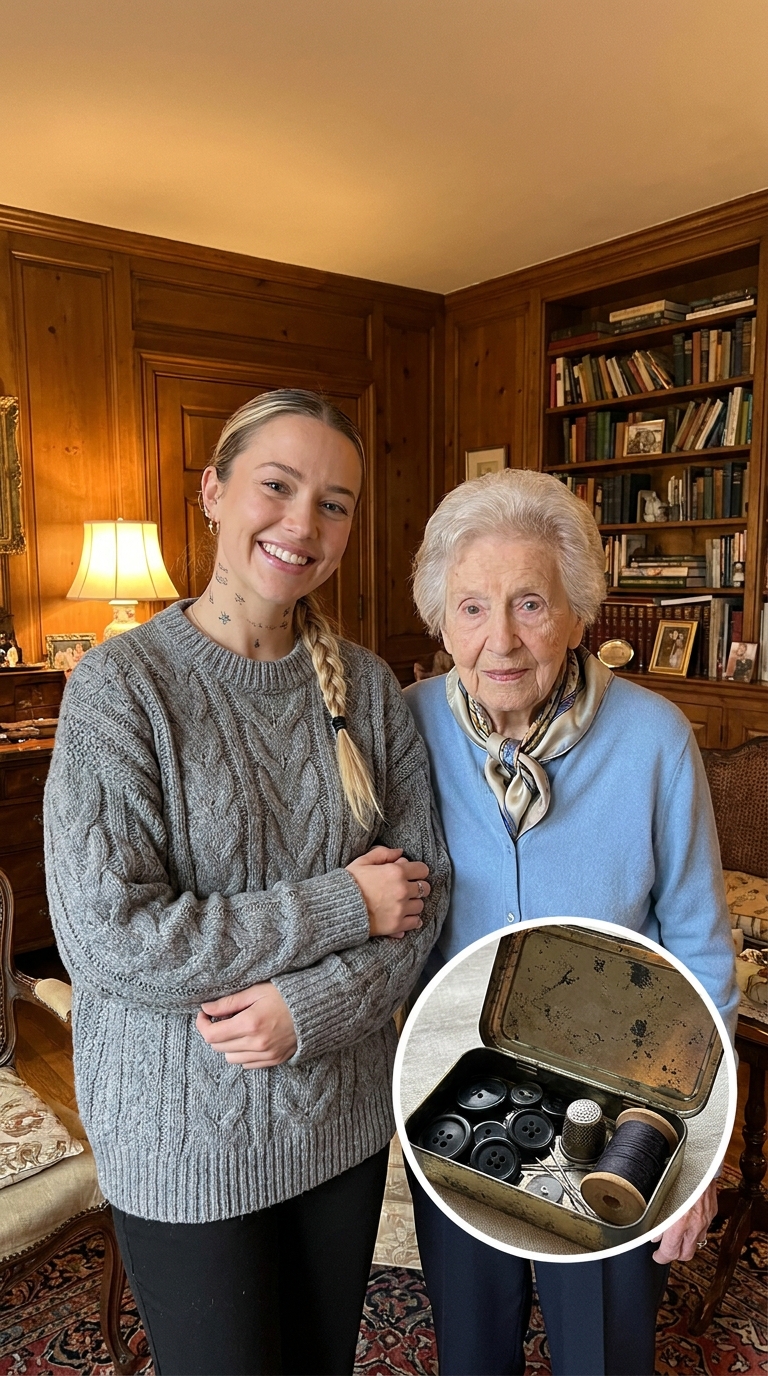
She reached for a battered tin sewing box.
The paint was chipped.
The hinges squeaked.
It looked worthless.
She pushed it toward me.
“You think I’ve lost my mind.”
“I would never say that.”
“You definitely think it.”
I laughed.
“Maybe a little.”
She pointed at the box.
“One day, this box will save you.”
I glanced inside.
Needles.
Buttons.
Thread.
A thimble.
Nothing special.
“Marianne…”
“I’m serious.”
I smiled politely.
She smiled back.
Neither of us argued.
But I secretly thought age had finally caught up with her.
I took the box home anyway.
The Phone Call
The following Sunday, Marianne didn’t answer the door.
I knocked again.
Nothing.
Called her phone.
No answer.
A terrible feeling settled in my stomach.
Hours later I called again.
This time someone answered.
A man.
“Hello?”
“Where’s Marianne?”
Silence.
Then a sharp laugh.
“So you’re the little con artist.”
My heart dropped.
“What?”
“The woman pretending to be her granddaughter.”
“I’m not—”
“Well, congratulations.”
His voice became colder.
“She’s dead.”
The room spun.
I sat down before my legs gave out.
“What?”
“My aunt passed away three days ago.”
Three days.
Three days and nobody told me.
Nobody called.
Nobody sent a message.
Nothing.
The man continued.
“She left you absolutely nothing, by the way.”
“I never asked for anything.”
“Sure.”
Then he hung up.
Just like that.
Gone.
I stared at my phone.
Unable to breathe.
Unable to think.
Marianne was gone.
And I had never told her.
Never told her she mattered.
Never told her she had changed my life.
Never told her she was family.
The regret hurt more than grief.
The Hidden Compartment
That night I couldn’t sleep.
Around midnight I opened my closet.
The sewing box sat on a shelf.
Exactly where I’d left it.
I carried it to my couch and held it against my chest.
The metal felt cold.
I ran my fingers across the lid.
Then—
CLICK.
Something shifted.
I frowned.
The box sprang open.
Buttons and thread rolled across my lap.
“What?”
I examined it more closely.
The bottom looked different.
Thicker.
I pressed gently.
A hidden panel slid sideways.
My breath caught.
Inside was an envelope.
My name written across the front.
In Marianne’s handwriting.
My hands trembled as I opened it.
The note began:
“I told you this box would save you. Because you haven’t received the real gift yet.”
Tears immediately blurred the page.
I kept reading.
The Truth Marianne Had Been Searching For
The letter was several pages long.
Marianne explained everything.
Years earlier, while volunteering at a children’s shelter, she had met a frightened little girl.
Me.
I barely remembered it.
She did.
Apparently I had been nine years old.
Angry.
Silent.
Alone.
She wrote that I reminded her of herself after losing her husband.
Broken people recognize broken people.
Over the years she had occasionally checked on my case through social workers.
Not enough to interfere.
Just enough to care.
When she saw the flyer response come through months earlier, she recognized my name immediately.
She knew exactly who I was before I ever walked through her door.
I burst into tears.
She had known all along.
Every Sunday.
Every conversation.
Every cup of tea.
She hadn’t hired a stranger.
She had found me.
Again.
Then came the final page.
The page that changed everything.
For illustrative purposes only
The Real Gift
Marianne wrote:
“My nephew believes inheritance means money.”
“He is wrong.”
Attached to the letter was a small key.
And an address.
The address belonged to a building downtown.
A place called the Marianne Rose Sewing Academy.
I had never heard of it.
The letter explained why.
Because it didn’t exist yet.
Marianne had spent years secretly funding a project.
A nonprofit sewing and design school for young adults leaving foster care.
People like me.
People with nowhere to go.
People who needed skills, community, and a chance.
The building had already been purchased.
The renovation money had already been secured.
The legal paperwork had already been completed.
Only one thing remained unfinished.
The director.
Me.
I stared at the page.
Certain I had misunderstood.
But the words didn’t change.
She had left me responsibility.
Purpose.
A future.
Not because I was qualified.
But because she believed I would care.
And for the first time in my life, someone else’s belief felt stronger than my fear.
Learning to Believe
Three months later, I unlocked the academy’s front door for the first time.
The same key Marianne had left behind fit perfectly.
The building wasn’t glamorous.
The walls needed paint.
The floors needed work.
Half the machines were older than I was.
But it was real.
Volunteers arrived.
Former students arrived.
Donors arrived.
Slowly, life filled the rooms.
By the end of the first year, twenty-two young adults had completed training programs.
Some found jobs.
Some started businesses.
Some simply found confidence.
Every success felt like Marianne smiling somewhere nearby.
I kept her sewing box in my office.
Right on my desk.
Whenever things became difficult, I looked at it.
And remembered.
The Gift I Never Expected
Two years later, during graduation for our newest class, a young woman approached me.
She looked nervous.
Like I once had.
“Can I ask you something?”
“Of course.”
She hesitated.
“Why did you start this place?”
I looked around the room.
At the students laughing together.
At the families cheering.
At the futures being built.
Then I thought about a lonely old woman drinking terrible tea in a quiet house.
And a flyer taped to a pharmacy wall.
I smiled.
“Because someone once pretended to be my family.”
The young woman laughed.
“Pretended?”
I shook my head.
“No.”
My voice caught slightly.
“At first, that’s what we thought.”
I glanced at the sewing box sitting nearby.
The box that had seemed worthless.
The box that contained a secret.
The box that truly had saved me.
Then I finished the sentence.
“Turns out, we were family all along.”
And for the first time since Marianne died, the sadness didn’t hurt.
Because I finally understood her real gift.
It was never the academy.
It was never the building.
It wasn’t even the hidden inheritance.
The real gift was something far more valuable.
She gave an orphan a place to belong.
And then she made sure that gift would continue long after she was gone.