She did not answer.
Her fingers rose to the metal near the hatch. There, under primer and dust, was a crescent-shaped scratch about three inches long.
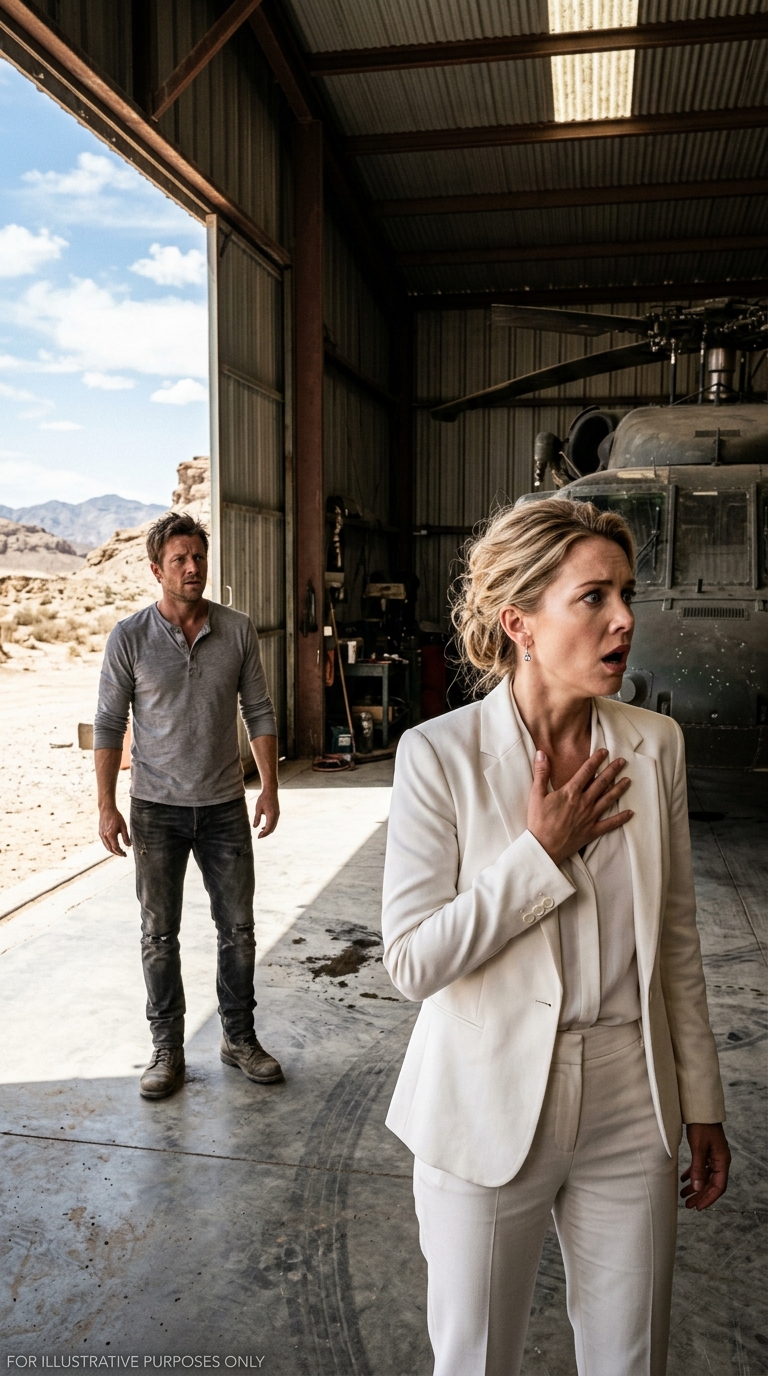
Seraphina touched it with two fingertips.
“I did this,” she whispered.
Clay remained still.
“When I was seven, I rode my bike through my father’s private hangar. I was not supposed to. I clipped the fuselage with the handlebar.” Her breath trembled. “I cried because I thought he would be angry.”
“What did he do?”
“He crouched beside me and said he would never repaint it because now the helicopter belonged to our family, not just the company.”
Clay looked at the scratch.
Seraphina turned to him, eyes shining with something fiercer than tears.
“This aircraft burned with my father inside it seventeen years ago.”
Clay said, “No, ma’am. It didn’t.”
The silence after that sentence seemed to spread through the entire hangar.
Seraphina stepped into the cockpit. Clay followed but stayed outside the hatch.
She ran her gaze over the pilot seat, the compass, the instrument panel. Her hand froze near the forward bulkhead.
“What is it?” Clay asked.
She stared at nine words written in permanent marker on the bare aluminum behind the co-pilot instruments.
The machine flies honest when the builder was honest.
“My father wrote that,” she said.
“Are you sure?”
She laughed once, broken and bitter. “I spent seventeen years reading birthday cards from a dead man. Yes, I’m sure.”
Clay opened the maintenance log he had found beneath the co-pilot seat.
“Then you need to see this.”
He spread the book on the cowling. The final entries were dated three days before the crash. A rotor assembly replacement. A batch number. A work order issued from Wickliffe engineering.
No second inspection signature.
Seraphina read the page twice.
“That signature should be there,” she said.
“Yes.”
“Rotor work requires independent clearance.”
“Yes.”
She looked up. “Who else has seen this?”
“My attorney. Nobody else yet.”
“Good. Keep it that way.”
Clay closed the log. “With respect, Ms. Wickliffe, I’m not keeping anything quiet for your company.”
“I did not say for my company.”
Her voice hardened.
“I said keep it quiet until we know who tried to bury my father twice.”
Part 2
The independent forensic engineer arrived two days later in a dusty white Subaru with a cracked coffee mug in the cup holder and a toolbox worth more than the car.
Laurel Ames was fifty-one, sharp-eyed, sunburned, and unimpressed by wealth. She had reconstructed aviation accidents for insurance carriers, federal agencies, and families who could not sleep until metal told the truth. Clay liked her immediately because she spoke to machines first and people second.
She walked around the silver helicopter for four hours without offering a conclusion.
Seraphina waited near the open hangar door, arms folded tightly, as if holding herself together by force.
Clay watched Laurel measure corrosion patterns, remove access panels, photograph fasteners, test paint layers, and inspect internal framing.
At last, Laurel stepped back.
“This airframe has never burned,” she said.
Seraphina closed her eyes.
Laurel continued, “No thermal distortion. No fire damage to structural members. No replacement pattern consistent with post-crash reconstruction. This is not a replica. This is the original aircraft registered to Augustus Wickliffe.”
The words struck Seraphina harder than Clay expected. She turned away, one hand covering her mouth.
For seventeen years, she had lived with a story.
Her father flew alone into bad weather. Her father made an error. Her father died in flames. His aircraft burned beyond recognition.
Now the aircraft was standing in front of her, intact.
Which meant the thing that burned in the desert had been something else.
And someone had known.
Laurel tapped the maintenance log with one gloved finger. “I was on the original investigation panel.”
Seraphina turned back sharply. “What?”
“For three weeks. Then I was removed before final report.”
“Why?”
“They said scheduling conflict. There was no conflict.” Laurel’s mouth tightened. “I requested secondary verification on the recovered tail number because the metal looked stenciled, not stamped. My request disappeared. My dissenting note never made the final report.”
Clay felt the atmosphere change.
This was no longer a mystery.
It was a cover-up with names waiting under dust.
They began with the cars.
Over the next three days, the hangar transformed from abandoned property into a crime scene made of engines and old secrets. Each vehicle revealed something different. Three Vesper prototypes contained suspension control modules tied to Northstar Dynamics, a supplier Clay knew only by reputation. Two race-configured cars carried logging systems that still held stress data from high-speed testing. One narrow roadster, hand-built and beautiful in a way that felt personal, sat at the center like a locked diary.
Seraphina touched the roadster’s roof with reverence.
“My father built this for himself,” she said. “My uncle Hollis told me it was dismantled after the accident because Mother could not bear to see it.”
Clay looked at her. “Seems your uncle told you a lot of things.”
“Hollis raised me after my mother died,” she said coldly.
Clay heard the warning in her voice. He did not push.
Hollis Wickliffe was Augustus’s younger brother, former interim chairman, current senior board member, and still one of the most powerful men in the company. His public image was polished granite. Family protector. Legacy guardian. The steady hand after tragedy.
Clay had known men like that.
Sometimes steady hands were steady because they had no conscience shaking them.
Inside the roadster, Clay noticed something strange. Three gauges had been rotated slightly from normal alignment. Not randomly. They pointed at angles like numbers on a safe.
He sat in the driver’s seat and studied them.
Seraphina stood beside the open door.
“What are you doing?”
“Your father was an engineer?”
“The best.”
“Then he didn’t rotate gauges because he liked crooked dashboards.”
Clay tried the angles as a sequence on the small mechanical dial hidden beneath the console.
Nothing.
He tried reversing them.
Nothing.
He tried reading them not as degrees, but as clock positions.
A soft click came from under the center console.
Seraphina went completely still.
Clay opened a recessed panel.
Inside was a sealed envelope.
No one spoke.
Laurel photographed it before they touched it. Dana was called. A neutral notary drove out from town. The envelope was opened on video.
Inside were test photos, supplier batch records, and a handwritten summary in Augustus Wickliffe’s precise block lettering.
Northstar Dynamics had substituted a lower-grade alloy compound in rotor insert manufacturing while keeping original certification markings.
The defective components could pass visual inspection.
Under stress, they could fracture.
The same batch number appeared in the maintenance log of the aircraft prepared the night Augustus died.
Seraphina read the final page and went pale.
“What?” Clay asked.
She handed him the note.
Hollis reviewed supplier audit findings and approved continued use pending fiscal impact review.
Clay read it once.
Then again.
Seraphina said, “That does not prove he understood the safety consequence.”
“No,” Clay said carefully. “It proves your father thought he did.”
Her eyes flashed.
“My uncle loved my father.”
“Maybe he did.”
“Do not patronize me.”
“I’m not. I’m telling you the evidence doesn’t care what we need people to be.”
She looked as if he had slapped her.
Then she looked back at the note, and anger gave way to something worse.
Fear.
Because somewhere inside her, a loyal niece was beginning to lose an argument with a grieving daughter.
That evening, Clay called Paige from outside the hangar while sunset turned the desert copper-red.
“How’s the airplane graveyard?” Paige asked.
“Complicated.”
“Your voice sounds like when Aunt Rachel makes meatloaf and pretends it’s good.”
Clay laughed despite himself. “I miss you, kid.”
“I miss you too. Are we still moving out there?”
Clay looked back through the open hangar door. Seraphina stood beside the silver helicopter, alone, reading her father’s handwriting under a work lamp.
“I’m trying to make it safe first.”
“Safe from rusty metal or safe from rich people?”
Clay smiled faintly. “Both.”
Paige was quiet for a moment. “Dad?”
“Yeah?”
“Don’t sell your soul just because someone offers enough money to pay rent.”
His throat tightened.
“I wasn’t planning to.”
“You always say that before doing something noble and financially stupid.”
“I love you too.”
The offer came the next morning.
Not directly from Hollis. Men like Hollis did not make offers themselves when there were lawyers, intermediaries, and plausible deniability available.
A representative called Dana with a settlement package. Enough money to clear Clay’s debt, buy a modest house, fund Paige’s college account, and let him start over anywhere outside Nevada.
In exchange, he would transfer all contents of the hangar, sign a confidentiality agreement, and withdraw from all claims.
Dana read the number aloud.
Clay sat on the hangar office floor, because the chair had a broken leg.
For one terrible second, he pictured Paige in her own bedroom. A real home. No more apologies. No more pretending cereal for dinner was a fun tradition. No more waking at 3 a.m. doing math with bills he could not pay.
Then he looked through the office window at the silver helicopter.
He thought of a little girl making a scratch with her bicycle and a father choosing not to repaint it.
“No,” Clay said.
Dana sighed, but not with disappointment.
“I figured.”
“File my refusal with the court.”
“Reason?”
“Potential material evidence in a fatality investigation should not be transferred to a party with potential liability exposure.”
“That is the lawyer answer.”
“The real answer is I want my daughter to know hunger can scare a man without owning him.”
Dana was silent.
Then she said, “I’ll write the lawyer answer.”
By the end of the week, Clay became a villain.
Several business outlets ran stories framing him as a failed mechanic exploiting a grieving family. Anonymous sources described him as desperate, opportunistic, unstable. One headline suggested he was holding American innovation hostage inside a desert junkyard.
Paige called crying after seeing comments online.
Clay sat in his truck and listened while she tried to pretend she was not scared.
“Are they going to take everything?” she asked.
“I don’t know.”
“That’s not comforting.”
“I know. I’m sorry.”
“What does the CEO say?”
Clay glanced toward the hangar. Seraphina had not made any public statement. She had retreated behind company walls, and he could not blame her. She had shareholders, employees, contracts, and a family name cracking open in her hands.
“She’s quiet,” he said.
“Does that mean she’s against you?”
“It means she’s CEO.”
The next morning, Seraphina proved him wrong.
She filed a motion through her personal attorney, paid from her own funds, requesting that the court appoint a neutral forensic examiner, preserve all evidence, and block any transfer of assets until the review was complete.
Clay read the filing in a hardware store parking lot, new locks sitting beside him in a plastic bag.
For the first time in days, he exhaled fully.
That night, someone tried to burn down the hangar.
Clay smelled aviation fuel before he saw anything. It was thin, sharp, and unmistakable.
He had been sleeping in the office on an old cot, boots still on, when the scent snapped him awake. He grabbed a flashlight and ran into the dark.
The main power had been cut.
Emergency battery lights glowed red along the walls.
Near the silver helicopter, fuel spread in a glistening line across the concrete.
Clay dropped to his knees, found the severed connection by touch, and shut the isolation valve. His hands slipped. Fuel soaked his sleeves. One spark would have turned the hangar, the cars, the helicopters, and maybe him into a fireball.
He moved faster than fear.
He pushed the nearest vehicle away from the vapor path. Then another. Then dragged a ground cable clear of the wet floor. Only after the immediate danger passed did he call the sheriff.
By dawn, the hangar was filled with evidence markers.
Seraphina arrived just after sunrise, hair loose, face bare of makeup, looking less like a CEO than a woman who had driven too fast through the night.
“Were you hurt?” she asked.
“No.”
She looked at the fuel line. At the cut power. At the disabled security panel.
Her expression hardened into something Clay would not want aimed at him.
“This system used an override sequence.”
“I know.”
“That sequence was installed by Wickliffe Security seventeen years ago.”
“I figured.”
Near the secondary door, Laurel crouched beside a boot print.
“Maintenance department tread,” she said. “Not proof by itself. But interesting.”
Clay looked at Seraphina.
She looked back.
Neither said Hollis’s name.
They did not need to.
Part 3
The truth came from a device hidden behind insulation in the silver helicopter.
Clay found it by accident while helping Laurel photograph the forward compartment. A rectangular position logging unit had been secured against the airframe with aged industrial adhesive, its memory card still intact.
Laurel extracted the data under camera.
The map appeared on her laptop in pale blue lines across the Nevada desert.
For the final weeks before the official crash, the silver helicopter had flown maintenance routes, then stopped. Six hours before Augustus Wickliffe supposedly died in it, the aircraft had not been in the air at all.
It had been loaded onto a truck, transported eighty miles away, and secured inside a private facility.
The authorization code attached to that transfer belonged to the executive office of Hollis Wickliffe.
Seraphina stared at the screen.
Clay watched the CEO disappear.
What remained was the daughter.
“He moved it,” she said.
“Yes.”
“Then my father died in another aircraft.”
“Yes.”
She gripped the edge of the table. “And Hollis knew before the crash report was ever written.”
Clay did not answer.
Sometimes silence was the only mercy left.
Seraphina went to Hollis’s house that afternoon without warning.
Later, she told Clay only parts of the conversation, but he could imagine the room. Dark wood. Old money. Framed photographs. Hollis Wickliffe behind a desk, calm because men who had survived seventeen years of lies did not panic quickly.
“He admitted moving the Silver Ren,” Seraphina said when she returned.
They stood outside the hangar under a sky crowded with stars.
“What reason did he give?” Clay asked.
“He said he had heard someone might tamper with it. He said he moved it to protect my father. He said my father agreed to fly the substitute aircraft.”
“Do you believe him?”
For a moment, she looked younger than Paige.
“I don’t know what I believe anymore.”
Clay leaned against the truck. “When I lost my wife, people told me grief came in stages. That was nonsense. Grief came like weather. Some days clear. Some days it tore the roof off. But the worst part was when I realized memory could become a house you’re afraid to inspect because one wrong door might change everything.”
Seraphina looked at him.
“My father was the only person in that family who made me feel safe,” she said. “Hollis was the person who helped me survive losing him.”
“Both things can be true.”
“And if both are true, what am I supposed to do with that?”
Clay’s voice was gentle. “You follow the evidence until it stops asking for permission.”
The next piece of evidence was a voice recording.
Laurel found it inside the roadster’s communications module, stored on a separate chip beneath the factory unit. Augustus had recorded it several days before his death, apparently while sitting inside the car he had built for himself.
They played it in the hangar office with Dana, Laurel, Clay, and Seraphina present.
At first, there was only static.
Then a man’s voice filled the small room.
Calm. Educated. Tired.
“Cyrus, if you are hearing this, then I have either failed to persuade the board or I have underestimated what fear can make men justify.”
Seraphina pressed both hands to her mouth.
Clay lowered his eyes.
Augustus spoke of Northstar Dynamics. Of substituted alloy. Of rotor inserts marked as certified when they did not meet specification. He said he had commissioned independent testing. He said Hollis had reviewed the findings and urged him to sign a certification document to avoid contract losses.
“I will not sign my name to a lie that can put pilots, passengers, and crews in the ground,” Augustus said.
The recording crackled.
“The meeting tomorrow is my final attempt to force this into daylight. If I do not come back, protect the machines. Protect the documents. And for God’s sake, protect Sera from anyone who tells her love means silence.”
Seraphina broke then.
Not loudly.
She bent forward as if something inside her had folded, and Clay caught her before she hit the floor.
For seventeen years, she had been protected from the truth.
And that protection had been another kind of theft.
The court hearing that followed drew reporters, federal observers, shareholders, attorneys, and enough security to make the desert access road look like a government checkpoint. The hangar, once mocked as a dead asset, became the center of a national corporate scandal.
Hollis’s attorneys argued that the vehicles were stolen trade secrets and that any evidence found inside them was inadmissible because ownership remained disputed.
Dana answered with the sealed envelope.
It had been sitting in the bankruptcy archive all along, filed under a subcode nobody had checked until she requested a complete physical audit. The envelope had been sealed three days before Augustus died.
Inside were three pages.
The first transferred custody of twelve specified vehicles and aircraft to Cyrus Vain for independent safety analysis.
The second authorized Cyrus to maintain possession if anyone connected to Wickliffe Aerospace interfered with the investigation.
The third was a personal note from Augustus.
A man who takes precautions he never needs has lost nothing, while a man who needed precautions and did not take them loses everything.
Augustus had signed in his authority as CEO.
Cyrus Vain had not stolen the machines.
He had preserved evidence.
And when Cyrus died with no heirs, the assets passed into the bankruptcy sale that Clay had legally won.
Hollis’s entire claim began to collapse.
But cornered powerful men did not surrender. They reframed.
Hollis contacted shareholders and warned that Seraphina was letting emotion endanger a company worth billions. He painted Clay as a desperate single father hungry for leverage. He painted Laurel as a disgruntled engineer. He painted the dead Augustus as brilliant but paranoid.
At the emergency board session, Seraphina wore a navy suit and no jewelry except her father’s old watch.
Clay sat in the back with Laurel. He had no place among billionaires, institutional investors, and corporate attorneys, but Seraphina had asked him to attend because the machines were still technically under his custody.
Before the meeting began, she turned to him.
“I need to ask you something.”
“Okay.”
“If this destroys the company for a while, people will blame you too.”
“People already blame me.”
“This could get worse.”
Clay thought of Paige. Of bills. Of the offer he had refused. Of the house he still did not have.
Then he thought of fuel spreading across concrete in the dark.
“Seraphina, my daughter is going to grow up in a world where she has to decide whether truth is worth trouble. I’d like her to have at least one example.”
Her eyes softened.
“Your daughter must be proud of you.”
“Mostly she thinks I need better food habits.”
For the first time in days, Seraphina smiled.
Then she walked to the front of the room and took control of her father’s company.
Laurel presented the rotor analysis first. The defective alloy composition in the Falcon test bed matched preserved accident-site samples. The failure mode was consistent with progressive fracture under load. The defect would not be visible in a standard pre-flight inspection. Multiple aircraft and vehicle systems using Northstar components could be affected.
Clay presented the movement logs next.
He was not polished. He did not speak like a CEO. But he knew machines, and the room understood him because truth often sounded strongest when it stopped trying to impress anyone.
He showed that the Silver Ren had been transported away before the crash. He showed that the substitute aircraft had been configured as a passenger flight, not a test flight. Full interior. Standard fuel load. Normal routing. Nothing matched Hollis’s claim that Augustus knowingly flew a risky evaluation aircraft.
Then Augustus’s recording played.
The room changed.
Hollis sat motionless, hands folded, eyes fixed on the table.
When the recording ended, nobody spoke for several seconds.
Then Merritt Vale, the chief legal officer who had first threatened Clay over the phone, stood.
Her voice shook, but she did not sit down.
“I need to make a statement of clarification.”
Hollis turned sharply.
She did not look at him.
Merritt told the board she had received instructions over several years to restrict access to certain documents, prevent analytical requests from becoming formal reports, and preserve communications outside normal archive channels. She said she had believed she was managing regulatory exposure.
Then she placed a secured drive on the table.
“I no longer believe that.”
Hollis said, “Merritt.”
One word.
A warning.
She looked at him at last.
“No,” she said. “I have spent too many years mistaking fear for loyalty.”
The board voted before sunset.
Hollis Wickliffe was suspended from all positions, stripped of voting authority pending investigation, and referred to federal authorities along with the full evidence record. Northstar contracts were frozen. A voluntary recall notice was prepared. Wickliffe Aerospace would disclose everything.
Not the careful version.
Not the market-friendly version.
Everything.
The stock dropped hard the following Monday.
Cable panels shouted. Commentators argued. Competitors circled. Lawsuits began.
But aircraft operators thanked the company for the recall. Pilots’ families wrote letters. Engineers came forward with concerns they had been afraid to raise. And slowly, painfully, Wickliffe Aerospace did not collapse.
It changed.
Months passed in paperwork, hearings, technical reviews, and quiet exhaustion.
A supplemental accident report formally cleared Augustus Wickliffe of pilot error. The crash had been caused by a defective rotor component installed in the substitute aircraft under a chain of decisions that had prioritized financial exposure over human life.
Hollis was indicted on charges that filled more pages than Clay cared to read.
Seraphina never celebrated.
When the corrected report arrived, she read it in Clay’s hangar office while afternoon light fell across the desk.
Clay said nothing.
She set the pages down and touched the crescent scratch on the silver helicopter’s hatch.
“My father did not kill himself with arrogance,” she whispered.
“No,” Clay said. “He died trying to stop other people from being killed by greed.”
Her eyes filled, but she did not cry.
Maybe some grief was too old for tears.
A year after the auction, the hangar no longer looked abandoned.
A new sign hung above the main door.
Arden Desert Aviation and Motors.
The access road had been graded. The roof repaired. The office painted. Paige had her own room in the little house behind the hangar, where she complained about dust constantly and secretly loved the open sky.
Laurel became the shop’s independent certification consultant. Two former Wickliffe mechanics who had raised safety concerns in writing came to work for Clay. The Falcon test bed went to an aviation safety museum. One old rescue helicopter was rebuilt and donated to a search-and-rescue group.
The Vesper prototypes were purchased by Wickliffe Aerospace at court-assessed fair value, giving Clay enough money to clear his debts, fund Paige’s education, and build the business properly.
The remaining cars were titled and sold through reputable channels, their strange history making them more valuable, not less.
Clay did not become flashy.
He still drove the old Ford.
Paige said this was embarrassing.
Clay said character was cheaper than a new truck.
Paige said character did not have a cracked windshield.
On a clear Saturday in late April, Seraphina came alone to collect the Silver Ren.
No convoy. No attorneys. No cameras.
Just her, a leather flight jacket, and her father’s watch on her wrist.
The paperwork took twenty minutes.
Afterward, she and Clay stood beside the helicopter in the quiet hangar.
“I used to think legacy meant what people built,” Seraphina said.
Clay looked at the aircraft. “I think it means what people refuse to destroy.”
She nodded.
“My father hid the truth in machines because he trusted metal more than people.”
“He trusted Cyrus.”
“And somehow Cyrus’s evidence ended up with you.”
Clay smiled faintly. “That part still feels like a clerical error by God.”
Seraphina laughed softly.
Then she looked toward the house behind the hangar, where Paige was pretending not to watch from the porch.
“You got your daughter back.”
Clay’s expression changed.
“Yeah,” he said. “That was the only thing I was ever really trying to fix.”
Seraphina extended her hand.
Clay shook it.
“Thank you,” she said.
“For what?”
“For not selling the truth when it would have been reasonable to.”
Clay thought about the night he had almost said yes to the money. He thought about how close desperation could bring a man to becoming someone else.
“It wasn’t as easy as people will make it sound,” he admitted.
“The important choices rarely are.”
Seraphina climbed into the Silver Ren.
The engine turned. The rotors began to move, slow at first, then faster, stirring dust across the hangar floor. Clay backed away and stood beside Paige as the helicopter lifted into the Nevada afternoon.
Paige slipped her hand into his.
“Is that the one?”
Clay nodded.
“That’s the one.”
“The one that made us not poor?”
He looked down at her.
“No,” he said. “That one made us honest when it would have paid better not to be.”
Paige considered that.
“Still glad we’re less poor.”
Clay laughed and pulled her close.
The Silver Ren rose over the desert, silver body flashing in the sun, carrying a daughter through the sky her father had loved and feared and fought to make safer.
Clay watched until the helicopter became a bright speck above the mountains.
A year earlier, he had walked into that hangar as a broke single dad with one last chance and no room left for failure. He thought he had bought nine supercars and three helicopters.
He thought treasure meant engines, metal, titles, and money.
But the most valuable thing in that desert hangar had never been the machines.
It had been the truth.
And the truth, once found, had flown home.