She smiled nervously. “These last two weeks changed something for me.”
Ethan’s heart pounded. “Changed how?”
“I loved you before,” she said. “When I thought you were successful and busy and always running between meetings. But now I’ve seen you tired. Scared. Frustrated. I’ve seen you mess up fence posts and burn toast and still get up before sunrise to help my dad.”
He looked away.
Maya touched his face and turned him back toward her.
“I don’t love you because of what you have,” she said. “I love you because of who you are when life strips everything else away.”
Ethan almost confessed.
The truth rose up in him like a confession at the edge of death. He wanted to tell her he had not lost a penny. He wanted to tell her he was sorry. He wanted to fall at her feet and beg forgiveness before the lie became too large to survive.
But fear, old and poisonous, whispered one more time.
Be sure.
Maya reached into her pocket and pulled out a little silver ring. It was plain, old, and slightly bent.
“It was my mom’s,” she said softly. “Dad gave it to me after she died. I know you already proposed, but everything is different now. So I’m asking you again, knowing what I know.”
Her eyes filled with tears.
“Ethan Caldwell, broke or not, scared or not, will you still marry me?”
He stared at the ring.
The woman he was testing had just offered him her dead mother’s wedding band.
“Yes,” he whispered.
Maya laughed through tears and slipped the ring onto his finger.
They married nine days later in the little white church at the edge of town.
Maya wore her mother’s wedding dress, altered by Lily and Grace at the kitchen table. Ethan wore a borrowed navy suit from Frank’s closet. The reception was held behind the farmhouse under string lights, with fried chicken, potato salad, lemonade, and pies Maya had baked herself because she insisted no one else could make the crust right.
During the father-daughter dance, Frank held Maya close and cried silently.
Later, he found Ethan near the barn.
“My girl believes in you,” Frank said.
“I know.”
Frank looked toward the lights, where Maya was laughing with her sisters. “Maya’s mother used to say love can survive poverty, sickness, bad harvests, and bad luck. But it cannot survive contempt.”
Ethan frowned. “Contempt?”
“Treating someone like they’re too foolish to deserve the truth.” Frank looked at him then, and for one terrible second Ethan wondered if the old man knew. “Don’t ever do that to her.”
Ethan could not breathe.
“I won’t,” he said.
But he already had.
Part 2
A month after the wedding, Ethan convinced Maya to move to Chicago.
He did it gently, almost nobly, which made the lie worse.
“You’re too talented to stay hidden here,” he told her one night as they lay in the little upstairs bedroom at the farmhouse. “You could finish your culinary degree in the city. Sell your pies to coffee shops. Work in real restaurants. Build something that’s yours.”
Maya rested her head on his chest. “Dad needs help.”
“Lily and Grace are here. We’ll visit. And I’ll find work.” He hated how easily the lie came now. “Maybe not much at first, but enough.”
Maya was quiet for a long time.
“I used to dream about opening a bakery,” she said. “Not fancy. Just warm. The kind of place where people come when they’re lonely.”
Ethan kissed her forehead. “Then let’s build it.”
The Whitakers gave them everything they could spare. Lily handed over an envelope of cash from her emergency fund. Grace gave Maya a box of kitchen supplies she had been saving for her own apartment. Frank sold two old calves and pressed the money into Ethan’s hand with a look that made Ethan feel smaller than he had ever felt.
“This is not charity,” Frank said. “This is family.”
Ethan wanted to refuse, but refusing would expose him. So he accepted money he did not need from people who did.
On the morning they left, Maya cried so hard she could barely climb into the old pickup truck. Frank held her for a long time and whispered something Ethan could not hear.
When Frank turned to Ethan, his eyes were wet but stern.
“Take care of her.”
“With my life,” Ethan said.
He meant it.
That was the cruelest part. He meant every loving word. He just kept burying them under lies.
In Chicago, Ethan rented a small one-bedroom apartment in Logan Square, far from his penthouse, far from Caldwell Analytics, far from anyone who might recognize him. The building smelled of old radiator heat and someone else’s garlic. The kitchen had two burners, one cracked tile, and a window that stuck halfway open.
Maya walked in, turned in a slow circle, and beamed.
“It’s perfect,” she said.
Ethan stared at her.
“You’re serious?”
She laughed. “This is our first home. Of course I’m serious.”
He had bought buildings larger than this apartment. He owned a vacation house in Aspen he had visited twice. He had once spent more on a charity gala table than a year of rent here.
But when Maya set a chipped mug on the counter, hung her apron on a hook, and kissed him beside the sink, Ethan understood something frightening.
A home had never been about square footage.
His double life began the next morning.
He left the apartment in cheap slacks and a wrinkled shirt, kissed Maya goodbye, and told her he was going to look for work. Three blocks away, he stepped into a private car Daniel had arranged, changed into a charcoal suit, switched phones, and rode downtown to the mirrored tower that carried his name.
Caldwell Analytics was in crisis.
His unexplained absence had terrified the board. A ruthless investor named Grant Voss had bought up shares and was pushing for control. Rumors spread that Ethan had become unstable. That he had disappeared. That he had lost interest in the company.
Daniel met him outside the executive elevator with a face like thunder.
“You look terrible,” Daniel said.
“I got married.”
Daniel blinked. “You what?”
“I’ll explain later.”
“You’d better. Because while you were playing whatever game this is, Voss got within eight percent of a controlling position.”
Ethan’s blood went cold.
For twelve hours, he became the man the business world knew. Decisive. Brilliant. Untouchable. He led emergency meetings, calmed investors, reviewed legal strategy, approved a product launch, and gave orders with the clean authority of someone used to being obeyed.
Then he changed clothes in the back of a car and went home to Maya, who was rolling pie dough on their tiny counter.
“How was the job search?” she asked.
“I found something,” he said.
Her face lit up. “You did?”
“Administrative work. Nothing glamorous. The pay isn’t great, but it’s a start.”
Maya threw flour-covered arms around him. “I’m proud of you.”
The words nearly knocked him down.
Weeks passed.
Maya transferred into a culinary program in the city. She woke before dawn to bake muffins and hand pies, then carried sample boxes to neighborhood cafés between classes. Some people dismissed her. Some bought out of pity. Others tasted her apple-bourbon hand pies and immediately asked for a business card.
She made those cards herself on cheap paper.
Maya Caldwell, small-batch desserts and custom pies.
Ethan kept one in his wallet like a holy thing.
At night, they sat on the floor and counted cash. Maya celebrated every small order as if they had won the lottery. Ethan contributed a modest paycheck from his fake assistant job, carefully calculated to look real.
“We’re doing it,” Maya would say. “Little by little.”
“Yes,” Ethan would answer, and hate himself.
Her culinary school was harder than she admitted. The program was full of students from wealthy families, students who wore designer shoes into kitchen labs and discussed internships in Paris like summer camp. One of them, Sloane Mercer, daughter of a famous restaurant critic, chose Maya as her favorite target.
“Careful,” Sloane said one afternoon as Maya unpacked a container of homemade caramel. “Farm girl brought county fair food.”
Two girls laughed.
Maya kept working.
Another day, when their instructor praised Maya’s salted honey cake, Sloane smiled sweetly and said, “It’s amazing what poverty does for creativity.”
Maya went into the bathroom after class, locked herself in a stall, and cried without making a sound.
Then she washed her face, looked in the mirror, and heard Frank’s voice.
Never be ashamed of honest work.
So she kept going.
One Thursday afternoon, Maya came home glowing.
“I have an idea,” she said, dropping her backpack beside the couch. “Corporate dessert boxes.”
Ethan looked up too fast. “What?”
“Office events. Meetings. Product launches. People in big buildings eat dessert too, right? I could make sample boxes and leave them with receptionists.”
Ethan’s stomach tightened. “That’s a tough market.”
“I know.” She opened her notebook, pages filled with sketches and prices. “But if I get even one regular client, it could help us save for the bakery.”
“Maya—”
She looked at him, and her excitement faded. “You don’t think I can do it?”
The hurt in her voice cut him.
“No,” he said quickly. “I think you can do anything. I just don’t want people in those places making you feel small.”
She smiled softly. “They can try.”
The next week, while Ethan prepared for a major press event at Caldwell Analytics, Maya prepared sample boxes in their apartment kitchen.
She made lemon-blueberry tea cakes, salted caramel brownies, mini apple hand pies, and slices of her mother’s cinnamon cream cake. She wore a navy dress Lily had given her and the only pair of heels she owned. She printed labels at the library and tied each box with string.
By noon, she was downtown.
The first office lobby turned her away.
The second let her leave a card.
At the third, a receptionist tasted the cinnamon cake and whispered, “Honey, my boss is going to lose his mind over this.”
By late afternoon, Maya’s feet ached and her confidence was bruised but alive. She had one box left.
Then she saw the tower.
Caldwell Analytics was written in brushed steel letters above revolving glass doors.
Maya stood on the sidewalk and stared.
Something about the name stirred faintly in her mind, but Ethan had told her his company had been small and gone. Caldwell was not an uncommon name, she reasoned. Chicago was huge. Rich people loved putting their names on buildings.
She stepped inside.
The lobby was breathtaking, all white marble, glass, and living green walls. People moved through it with badges and expensive shoes. Maya suddenly felt every cheap stitch in her dress.
Still, she approached the front desk.
“Hi,” she said, forcing brightness into her voice. “My name is Maya Caldwell. I’m a culinary student and I’m starting a small dessert business. I brought samples for corporate events, if anyone might be interested.”
The receptionist, a silver-haired woman with kind eyes, smiled. “That’s brave of you.”
Maya laughed nervously. “Brave or desperate.”
The woman opened the box and tried a bite of cinnamon cream cake.
Her eyes widened.
“Oh, sweetheart,” she said. “This is not desperate. This is dangerous.”
Maya laughed for real.
Then a burst of applause echoed from the far end of the lobby.
A group of reporters and executives emerged from a conference space. Cameras flashed. Men and women in suits clustered around someone at the center.
Maya turned.
And saw her husband.
Not the Ethan who came home tired from a low-paying assistant job.
This Ethan wore a dark tailored suit, a silk tie, polished shoes, and a watch that flashed under the lobby lights. He stood tall, composed, commanding. People leaned toward him when he spoke. A man with a press badge called out, “Mr. Caldwell, one more question about the Voss takeover attempt!”
Ethan smiled, calm and controlled.
“Caldwell Analytics is not for sale,” he said. “Not today. Not ever.”
Maya stopped breathing.
The sample box slid from her hands.
Cakes hit the marble floor.
The receptionist said something, but Maya heard nothing. Her ears filled with a rushing sound like water breaking through a dam.
Mr. Caldwell.
Caldwell Analytics.
Not broke.
Not ruined.
Not an assistant.
Her husband was not rebuilding his life.
He had built a stage and placed her in the middle of it.
Before Ethan could turn far enough to see her, Maya crouched, gathered the ruined cakes with shaking hands, apologized to the receptionist, and walked out of the building as if her bones had disappeared.
She took the bus home with frosting on her dress and betrayal sitting in her lap like a dead thing.
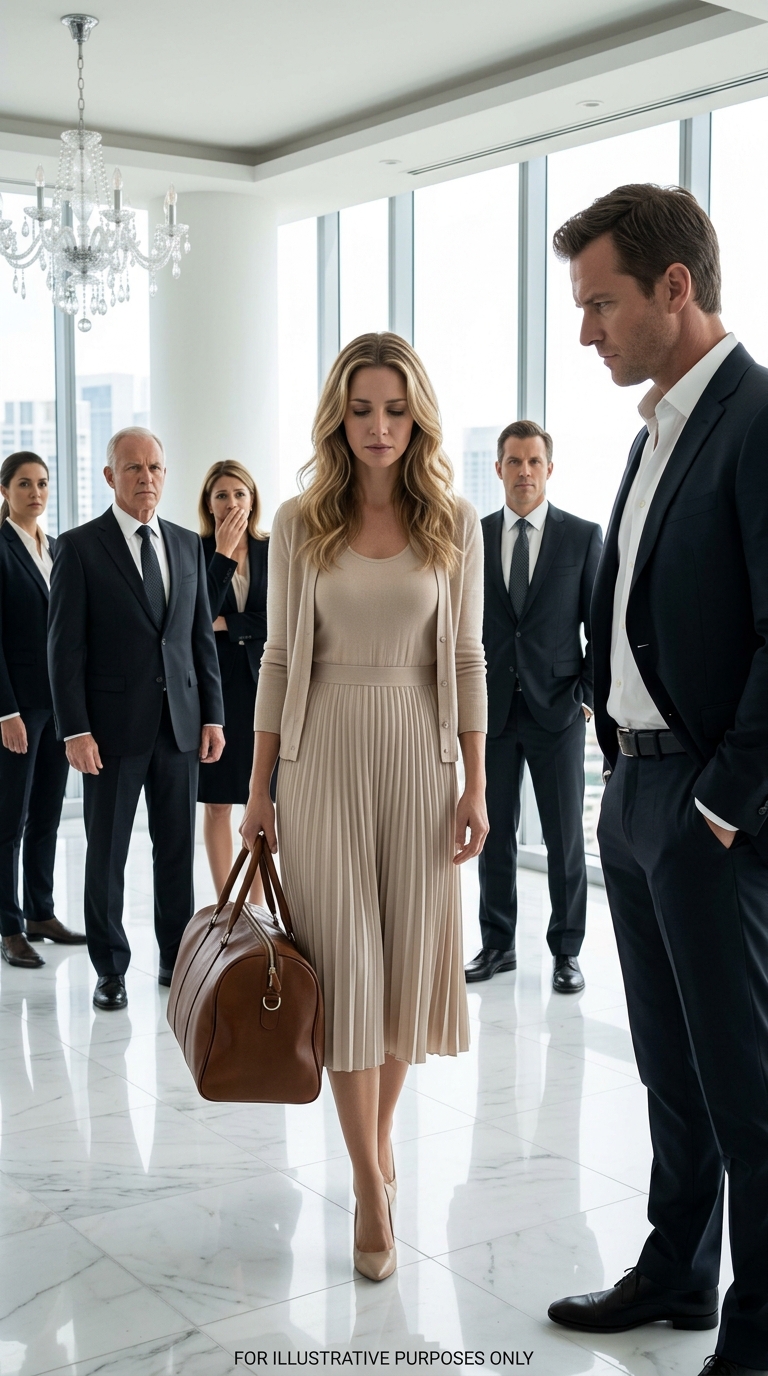
By the time Ethan came home near midnight, Maya had packed one suitcase.
He stepped inside quietly. “Maya? You’re still awake?”
She sat at the kitchen table, her mother’s wedding ring on her finger, his borrowed poverty all around her.
“Who are you?” she asked.
Ethan went still.
“What?”
“Who are you really?”
His face drained of color.
“Maya, I can explain.”
She laughed once, and it sounded broken. “That seems to be the one thing rich men always say when the truth finally walks in.”
He closed the door behind him. “Where were you today?”
“At your building.” Her voice shook. “Your building, Ethan. With your name on the wall.”
He sank into the chair across from her.
For the first time since she had known him, he looked afraid.
“I didn’t lose the company,” he said.
“No.”
“I own Caldwell Analytics.”
“Yes.”
“It’s worth a lot.”
“How much?”
He hesitated.
“How much?” she repeated.
“Close to nine hundred million.”
Maya stared at him. She thought of Lily’s emergency cash. Grace’s kitchen supplies. Frank selling calves. The envelope pressed into Ethan’s hand. The apartment. The fake paycheck. The way she had comforted him while he mourned money he had never lost.
Her eyes filled with tears, but her voice was steady.
“Why?”
Ethan rubbed his hands over his face. “Because I was scared.”
“Of what? That I would love you?”
“That you would love the money.”
She flinched.
He began talking then, fast and desperate. He told her about Vanessa. About the phone call. About the humiliation. About years of women who wanted access, status, houses, cars, a last name. He told her he had trusted no one until Maya.
“So you punished me for what someone else did,” she said.
“No. I tested you.”
“That is worse.”
“Maya, my feelings were real. Every moment with you was real.”
She stood so quickly the chair scraped the floor.
“Do you know what was real?” she demanded. “My father opening his home to you. My sisters giving you money they needed. Me asking you to marry me with my mother’s ring because I thought you had nothing and I wanted you anyway.”
Ethan’s eyes filled. “I know.”
“No, you don’t. Because if you knew, you would have stopped. You would have told the truth before the wedding. Before Chicago. Before I sat on this floor counting dollar bills while you played poor.”
“I wanted to tell you.”
“But you didn’t.”
Silence.
Maya removed the ring from her finger and placed it on the table.
Ethan stared at it as if she had cut out his heart.
“Maya, please.”
“Love is not a trap, Ethan. It is not an exam. It is not something you set up to see if someone passes.”
“I love you.”
“You don’t trust me.”
“I do now.”
“Now?” She shook her head. “Now that I bled enough proof for you?”
He reached for her hand, but she stepped back.
“I’m going home,” she said.
“I’ll drive you.”
“No.” She grabbed her suitcase. “You have done enough pretending to be a good man.”
Ethan followed her down to the sidewalk, pleading, crying, offering everything too late. The penthouse. The truth.
Therapy. A public apology. A real wedding. Anything.
Maya stood beside the cab she had called and looked at him one last time.
“You had everything,” she said softly. “And somehow you were still too poor to give me honesty.”
Then she got in and closed the door.
Part 3
Maya returned to Willow Creek before sunrise.
Frank found her on the porch with her suitcase beside her, her face pale and empty, her wedding ring gone from her hand.
He did not ask questions.
He opened his arms.
Maya stepped into them and fell apart.
For three days, she barely spoke. Lily wanted to drive to Chicago and “teach that millionaire liar what fear looks like.” Grace cried every time Maya cried. Frank moved through the house quietly, making coffee, fixing fences, and checking on his daughter with the helpless tenderness of a father who would rather break his own bones than watch his child suffer.
On the fourth night, Maya told them everything.
When she finished, the kitchen was silent.
Lily’s face was white with anger. “He used all of us.”
Grace held Maya’s hand. “He needs help. Serious help.”
Frank stared into his coffee.
“I knew something was wrong,” he said finally. “Not what. Just something. A man who has lost everything doesn’t study hardship like a tourist.”
Maya looked down. “I feel stupid.”
Frank’s head snapped up. “Don’t you dare.”
Her eyes filled.
“You loved honestly,” he said. “That is never stupidity. The shame belongs to the person who used it.”
Maya tried to rebuild.
She returned to the farmers’ market. She helped Frank with chores. She enrolled in online culinary classes until she could figure out whether to return to Chicago. She smiled at neighbors who had no idea her marriage had lasted less than three months before collapsing under the weight of a lie.
Then the nausea started.
At first, she blamed grief. Then exhaustion. Then bad coffee.
Grace noticed before anyone else.
“Maya,” she said one morning, watching her sister grip the sink. “When was your last period?”
Maya went still.
The pregnancy test showed two pink lines in less than a minute.
Maya sat on the bathroom floor and stared at it.
“No,” she whispered.
Grace knelt beside her. “Oh, honey.”
Maya pressed a hand to her mouth.
She was carrying Ethan’s child.
Two weeks later, an ultrasound revealed she was carrying two.
Twins.
The doctor smiled gently, but her expression turned serious when she checked Maya’s blood pressure.
“You need rest,” she said. “Twin pregnancies can be complicated, and your numbers are high. Stress is not your friend right now.”
Maya almost laughed.
Stress had moved into her life, unpacked its bags, and started paying rent.
Summer brought drought. The fields browned. The well ran low. Frank worked until his hands trembled. Lily picked up tutoring hours. Grace took extra shifts at the clinic. Medical bills began arriving in thin white envelopes that looked harmless until opened.
One night, Maya found Frank at the kitchen table with a stack of bills and his head in his hands.
He looked up quickly. “Couldn’t sleep?”
“Don’t hide them from me, Dad.”
He sighed.
She sat across from him. “How bad?”
“Bad is a word.” He tried to smile. “Not the end of the world.”
“Dad.”
His smile faded. “The crop loss is worse than I thought. Insurance will help some, not enough. We’ll manage.”
Maya looked at the bills. Then at her belly, already rounding.
For the first time, pride felt like a luxury she could not afford.
“Ethan should know,” Frank said quietly.
Maya closed her eyes.
“He is their father,” Frank continued. “You don’t have to forgive him. You don’t have to take him back. But those babies have rights, and so do you.”
“I don’t want his money.”
“This isn’t about wanting. It’s about responsibility.”
She hated that he was right.
The next morning, Maya picked up the phone and stared at Ethan’s number.
She could not press call.
In Chicago, Ethan was already falling apart.
After Maya left, he stayed in the Logan Square apartment for a week, sleeping on the couch because the bed smelled like her shampoo. He ignored his penthouse. He ignored invitations. He ignored every comfort money could buy.
But he could not ignore the company forever.
Grant Voss was still circling Caldwell Analytics. Investors were nervous. Employees were frightened. Ethan had endangered thousands of jobs because he had vanished to conduct a cruel personal experiment.
Daniel confronted him in his office one evening.
“You want to lose the woman you love and the company your parents helped you start?” he snapped. “Keep drinking and staring at walls.”
Ethan looked at him with bloodshot eyes. “She’ll never forgive me.”
“Maybe not. But becoming exactly as selfish as she thinks you are won’t help.”
Those words struck something still alive in Ethan.
He began therapy the next week.
Not for appearances. Not to win Maya back. For the first time in his life, Ethan told the truth to someone paid to hear it. He spoke about his mother’s death, his father’s emotional distance, Vanessa’s betrayal, the loneliness of wealth, the disgust he felt toward himself for turning Maya’s love into a trial.
His therapist listened and finally said, “You tested her loyalty because you believed love must be proven through suffering. That is not love. That is fear asking someone else to bleed.”
Ethan cried in a way he had not cried since he was seventeen.
Then he began making repairs he had no guarantee would matter.
He paid back the Whitakers anonymously through a local agricultural relief fund, then canceled the transfer when Daniel told him anonymity was just another form of control. Instead, he wrote Frank a letter.
Mr. Whitaker,
I accepted money from your family under false pretenses. I cannot undo that. Enclosed is repayment with interest, not as charity, not as an attempt to buy forgiveness, but because it was wrong for me to take what you gave in good faith. I am sorry.
Frank mailed the check back.
On the back of the envelope, he wrote one sentence.
Money is not the debt you owe.
Ethan kept that envelope in his desk.
Three months passed.
Maya did not call.
Ethan did not go to Willow Creek because she had asked him not to come after her. He respected that, though it tore at him daily.
Then Grace called.
Her voice was cold. “I am not calling for you.”
Ethan stood so fast his chair hit the wall. “Is Maya okay?”
“She fainted at the market. Her blood pressure spiked. She’s at Mercy Hospital in Springfield.”
His heart stopped. “What?”
“She’s stable,” Grace said. “The babies are stable.”
The world tilted.
“Babies?” Ethan whispered.
Grace was silent for a moment.
“She didn’t want you to know like this,” she said. “But she’s pregnant with twins, Ethan. Your twins.”
Ethan gripped the desk.
For several seconds, he could not speak.
Then he said, “Can I come?”
“That’s not my decision.”
“Ask her.”
“I did.”
His chest tightened. “And?”
Grace exhaled. “She said you can come to the hospital. She did not say she wants to see you.”
Ethan was in Springfield before midnight.
He found Frank in the waiting room, looking older than Ethan remembered. Lily stood beside him with crossed arms. Grace was still in scrubs.
No one greeted him kindly.
He deserved that.
Frank looked at him for a long time. “If you upset her, I will have security remove you.”
“Yes, sir.”
“And if you make one promise you don’t intend to keep, I will forget I’m a peaceful man.”
“Yes, sir.”
Maya was awake when Ethan entered.
She looked smaller in the hospital bed, her hair loose around her face, one hand resting protectively on her belly. But her eyes were clear.
Ethan stopped near the door.
“Hi,” he said, and hated how useless it sounded.
Maya looked at him without smiling. “Grace told you.”
“Yes.”
“They’re okay.”
His eyes filled. “Twins.”
“Two girls, the doctor thinks.”
A broken laugh escaped him, half joy and half grief. “Girls.”
Maya’s expression softened for one second, then closed again. “I didn’t call you here to restart anything.”
“I know.”
“I don’t trust you.”
“I know.”
“I may never trust you again.”
His voice shook. “I know.”
She studied him. “Then why are you here?”
Ethan stepped closer, but not too close.
“Because I am their father. Because I hurt their mother. Because whether you forgive me or not, I owe all three of you honesty for the rest of my life.” He swallowed. “I don’t want to buy my way back. I don’t want to pressure you. I don’t want to perform some grand gesture and call it growth. I just want to do what I should have done from the start. Tell the truth and show up.”
Maya looked away.
He reached into his coat pocket and pulled out a folder, placing it on the tray table.
“What is that?”
“Legal documents. Daniel prepared them, but nothing is filed. Full financial support for the babies. Medical expenses. A trust for each child. Your choice of doctors. Your choice of where to live. No custody pressure. No conditions.”
Maya’s eyes flashed. “So money.”
“Responsibility,” he said quietly. “Not forgiveness.”
That answer stopped her.
She opened the folder with cautious fingers. The documents were clear. No trap. No demand. No hidden clause requiring her to return to him.
For the first time, Ethan had offered something without making himself the center of it.
Maya closed the folder.
“I’ll have a lawyer look at it.”
“You should.”
“And Ethan?”
“Yes?”
“If you ever lie to me again, even about something small, you will not get close enough to disappoint these children.”
He nodded, tears slipping down his face. “I understand.”
The twins were born six weeks early during a thunderstorm in November.
Ethan was in the waiting room when Grace came running out and said, “They’re here.”
He stood, trembling.
“Are they—”
“They’re tiny,” Grace said, crying. “But they’re fighting.”
Maya named them Rose and Hannah.
Ethan met his daughters through the glass of the NICU, two impossibly small babies under warm lights, their fists curled like secrets. He put one hand against the glass and wept silently.
Maya watched from her wheelchair.
For once, he did not ask for anything.
Over the next year, Ethan drove to Willow Creek every weekend. At first, he stayed at the town motel. He brought diapers, formula, groceries, and medical supplies, but he never entered the house unless Maya invited him. He changed diapers badly, learned lullabies off-key, and sat through pediatric appointments without touching Maya’s hand even when he wanted to.
He kept going to therapy.
He sold his Aspen house and used part of the money to create a rural small-business grant for women in food service. Maya refused to apply until Lily said, “Do not punish your bakery because your ex-husband is an idiot.”
Maya applied under a blind review process.
She won.
Eighteen months after leaving Chicago, Maya opened Honey & Hearth Bakery on Main Street in Willow Creek. It had yellow walls, mismatched chairs, a children’s corner, and a framed photo of her mother near the register. On opening day, people lined up down the block.
Ethan came late, after the crowd thinned.
Maya was behind the counter, flour on her cheek, Rose on Lily’s hip and Hannah asleep in Frank’s arms.
Ethan looked around the bakery and smiled softly.
“This is exactly what you described,” he said. “A warm place for lonely people.”
Maya wiped her hands on her apron. “Not just lonely people.”
“No?”
She looked at him for a long moment. “People trying to become better, too.”
His breath caught.
She poured him coffee.
They sat at a corner table while the twins babbled nearby.
“I don’t know if I can love you the same way again,” Maya said.
Ethan nodded. “I don’t expect you to.”
“I don’t want the old marriage back. It was built on a lie.”
“I know.”
“But the girls love you.” She looked toward their daughters. “And I’ve watched you change when no one was applauding. That matters.”
Ethan’s eyes filled, but he stayed quiet.
Maya reached across the table and placed her hand over his.
Not forgiveness entire. Not trust fully restored. Not a fairy-tale ending wrapped in a bow.
But a beginning.
“We go slowly,” she said. “No secrets. No tests. No games.”
“No games,” he promised.
“And if this ever becomes about your fear again, I walk.”
“I know.”
Maya looked at him, searching for the man beneath the money, beneath the guilt, beneath the damage.
This time, Ethan did not perform.
He simply sat there, honest and humbled, holding the hand of the woman he had almost lost forever.
Two years later, on a bright spring morning, Ethan and Maya stood under the same oak tree where he had first proposed. Rose and Hannah toddled in the grass wearing flower crowns. Frank held a small Bible. Lily cried before anyone said a word. Grace recorded everything on her phone and threatened to delete any angle that made her look emotional.
There were no reporters.
No rich guests.
No test.
Ethan wore a simple navy suit. Maya wore a cream dress she had bought with bakery money. On her finger was not a diamond from a vault, but her mother’s ring, repaired and polished, shining softly in the sun.
Ethan spoke his vows first.
“I once believed love had to prove itself to me,” he said, voice trembling. “I was wrong. Love was never the thing on trial. I was. You showed me what loyalty looked like, and I answered it with fear. I cannot erase that. But I can spend my life honoring the truth you deserved from the beginning.”
Maya’s eyes filled with tears.
Then she spoke.
“I loved you once without knowing all of you,” she said. “Then I lost you when I learned the truth. Today, I choose the man who stopped hiding. Not because he is perfect. Not because pain disappeared. But because he learned that trust is not something you demand. It is something you build, one honest day at a time.”
Frank pronounced them husband and wife again, though Lily whispered that she was keeping one eye on Ethan forever.
Everyone laughed.
Ethan kissed Maya gently, like a man touching a miracle he knew he had not earned but had been given the chance to protect.
Afterward, as the family gathered around picnic tables covered in pies from Honey & Hearth, Frank pulled Ethan aside.
“You understand now?” he asked.
Ethan looked toward Maya, who was lifting Rose into her arms while Hannah tugged at her dress.
“Yes, sir,” he said. “Money can build walls. Truth builds homes.”
Frank studied him, then nodded.
It was not a dramatic blessing. It was better.
It was trust, small but real.
That evening, Ethan stood in the bakery kitchen beside Maya, washing dishes while she packed leftover cake. Outside, their daughters laughed with their aunts under the string lights. The world smelled of sugar, rain, and second chances.
Maya bumped his shoulder. “You missed a spot.”
Ethan looked at the plate. “Where?”
She smiled. “Made you look.”
He laughed, and the sound was easy.
No empire had ever given him that.
No penthouse. No private jet. No deal closed in a room full of men trying to become kings.
Only this.
A woman who had loved him when she thought he had nothing. A family who had taught him that dignity was not measured in dollars. Two daughters who would never have to wonder whether their father’s love came with conditions. A home built not from wealth, but from truth hard-earned and kept.
Ethan had pretended to be broke to test Maya’s heart.
In the end, Maya had revealed the real poverty was his own.
And only when he stopped hiding behind money did he finally become rich enough to love her right.