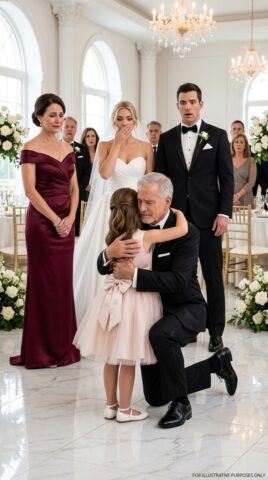
“… So tell me, Miss Donnelly, what exactly do you think you can do?”
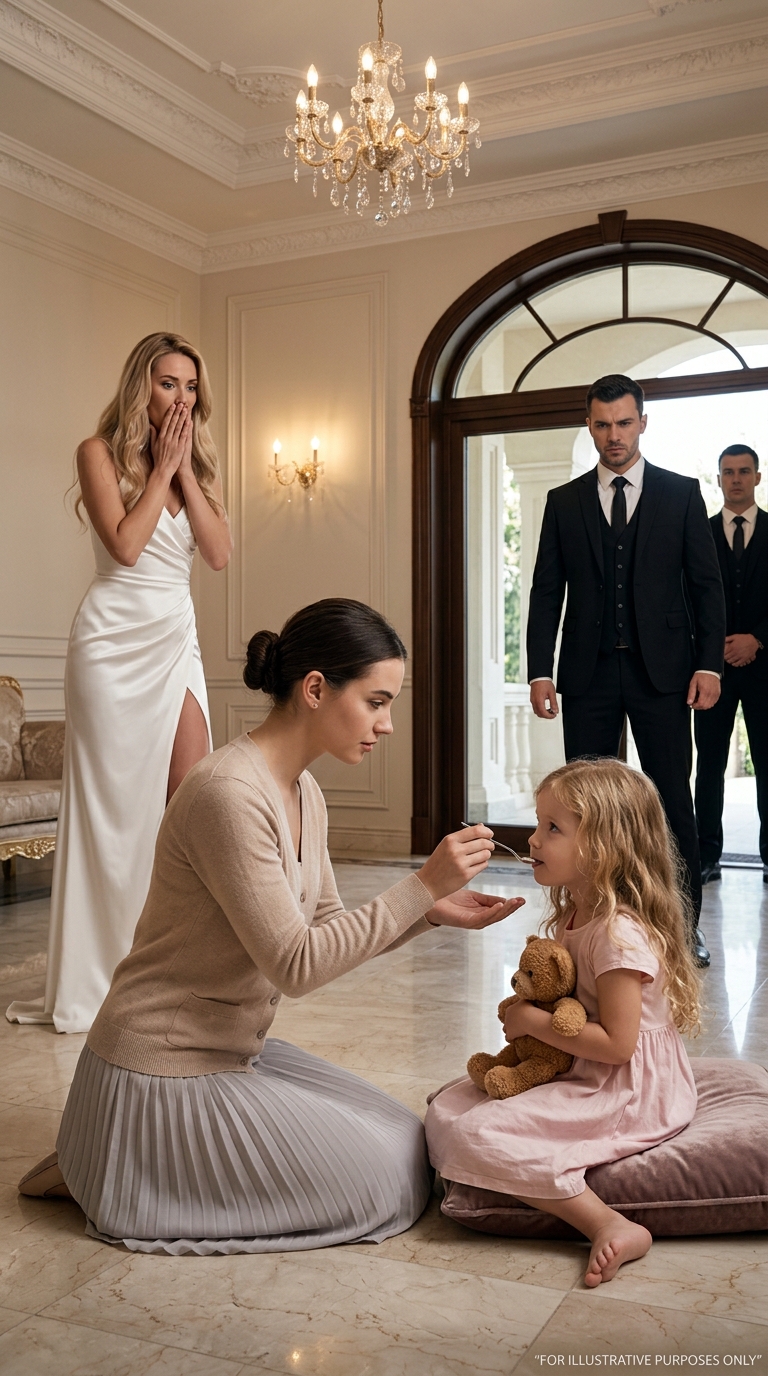
Claire should have been afraid. She was afraid. But behind the fear, something steadier stirred. She had seen children hide under desks after active shooter drills. She had held a five-year-old whose father had overdosed in the next room. She knew the look of a child trapped in a moment adults kept calling “over.”
“I can stop treating her like a problem to solve,” Claire said. “Children don’t come back because adults demand it. They come back when something feels safe enough to reach for.”
Gabriel stared at her.
Then, from somewhere down the hall, a scream tore through the penthouse.
It was so raw that Claire felt it in her teeth.
A crash followed. Glass or ceramic. A man shouted. Gabriel’s whiskey hit the table untouched, and he moved with startling speed toward the sound. Claire ran after him before anyone could stop her.
The master suite was chaos.
Dr. Price stood near the bed, one sleeve torn, blood dripping from a cut on his forearm. A water glass lay shattered across the floor. Lily was pressed against the headboard, her IV line half-ripped from her hand, red blooming through the tape. Her eyes were wide and empty, fixed on her father with pure terror.
“Lily,” Gabriel said, and his voice broke around the name. “Baby, stop. You’re hurting yourself.”
He stepped toward her.
Lily shrieked again and kicked at the air, scrambling backward like he was carrying fire.
Claire saw it at once. The child was not rejecting him. She was not seeing him. Gabriel’s voice, his size, the panic in the room, the smell of antiseptic and blood—it had all become the car again.
“Everyone out,” Claire said.
Dr. Price turned. “What?”
“I said everyone out.”
Gabriel’s head moved slowly toward her. The room seemed to lose ten degrees. “Careful.”
Claire kept her eyes on Lily. “She feels trapped. You’re all standing over her. She can’t breathe in this room.”
Dr. Price snapped, “This is a severe dissociative panic episode. She needs sedation before she damages the line further.”
“If you sedate her again, her body gets weaker, and she learns that every time she panics, adults overpower her,” Claire said. “Give me five minutes.”
Gabriel’s voice was deadly soft. “You want me to leave my bleeding child alone with a woman I met three minutes ago?”
“No,” Claire said. “I want you to give your daughter one room where nobody is touching her, grabbing her, begging her, or looking at her like she is dying.”
For a moment, Gabriel looked capable of ordering her thrown through the window. Then Lily made another small, strangled sound and curled tighter into herself.
His face changed.
“Five minutes,” he said. “If her monitor spikes, I come back in.”
He grabbed Dr. Price by the back of the coat and hauled him toward the door. The guards followed. The door closed.
Silence fell like snow.
Claire did not go to the bed. She did not reach for the IV. She did not say everything was fine, because children who had seen blood on their mother’s shirt knew when adults were lying.
Instead, she sat on the floor near the wall, leaving half the room between them.
“Hi, Lily,” she whispered. “My name is Claire. I’m not going to touch you.”
The child’s breathing came in short, sharp bursts.
Claire eased her tote closer and took out the old songbook, not because she needed the words but because she needed something to do with her hands. Her grandmother’s handwriting still lived in the margins, small and slanted. Claire opened to the lullaby she knew best.
Then she sang.
It was not sweet in the polished way nursery songs were sweet. It was low, old, and worn smooth by women who had rocked babies through storms in houses where the roof leaked and winter came through the walls. The melody rose slowly, carrying sorrow without surrendering to it.
“Sleep, little sparrow, the night has teeth,
But I’ll keep watch while the wolves run beneath.
Rain on the window, wind at the door,
You are not lost anymore.”
Outside the door, Gabriel stood with his hand on the knob.
He had meant to wait thirty seconds, perhaps less. But the song slipped through the oak, and something in him went still.
It did not deny the darkness. That was what caught him. It did not chirp or sparkle or pretend the world was kind. It knew there were wolves. It simply promised they would not get through the door.
He opened the door a crack.
Claire sat on the floor, eyes lowered, singing to no one and to Lily all at once. On the bed, his daughter had stopped kicking. Her fingers still clutched the torn IV tape, but her breathing was slowing. The heart monitor, which had been racing, began to settle.
Claire reached carefully into her bag and removed a small thermos. Gabriel’s hand tightened on the doorframe.
She did not approach Lily. She poured a little warm broth into the thermos cap and slid it slowly across the floor. It stopped near the foot of the bed.
The song ended.
“It’s just chicken broth,” Claire whispered. “You don’t have to drink it. It’s only there in case your throat feels tired.”
For nearly a minute, nothing happened.
Gabriel did not move. He was no longer a crime boss, no longer a king, no longer anything but a man bargaining silently with God in the doorway.
Lily’s gaze shifted to the cap.
Then to Claire.
Claire gave one tiny nod.
Slowly, as if every inch cost her, Lily uncurled. She crawled to the edge of the bed, reached down, and took the cap with both trembling hands. Her lips touched the broth. She paused.
Then she swallowed.
Gabriel turned his face away before anyone could see what happened to him.
Inside the room, Claire pressed a hand to her own chest and kept perfectly still, afraid that even joy might scare the child. Lily drank another sip. Her eyelids fluttered. The cap slipped from her hands, spilling broth across the rug, and she collapsed sideways into the first natural sleep she had had since the ambush.
Claire rose quietly and tucked the duvet around her.
When she turned, Gabriel stood in the doorway.
The violence had gone out of his face. Not disappeared, exactly. Nothing like that ever truly left a man like him. But it had cracked, and grief showed through.
“You stay,” he said.
Claire’s stomach tightened. “Mr. Varrick—”
“Fifteen thousand for the week. Seventy-five for the month. Your mother’s balance at Memorial Sloan Kettering will be cleared before sunrise.”
Claire went cold. “How do you know about my mother?”
“I know everything I need to know about people who come near my child.”
“That doesn’t mean you own me.”
His eyes held hers. “No. But it means I understand leverage.”
The honesty was uglier than a lie.
Claire looked back at Lily, asleep and fragile beneath a blanket stitched with silver stars. Then she thought of her mother, of the bill on the table, of Vivian’s desperate call and the number that had sounded like salvation.
“I’ll stay for Lily,” Claire said. “Not because you bought me.”
Gabriel watched her for a long moment. Then, quietly, “Fair enough.”
But fair had very little to do with what came next.
Three days later, Claire had learned the penthouse had its own weather.
In the mornings, it was gray and silent, filled with doctors whispering outside doorways and guards pretending not to watch a four-year-old eat toast. By afternoon, if Lily had slept and eaten, light returned. Not happiness exactly, but something that might become it if no one frightened it away.
Lily still did not speak much. She communicated with nods, small gestures, and the fierce grip of her fingers around Claire’s hand. She accepted oatmeal with cinnamon, half a banana, broth, and once, after a long negotiation involving a stuffed lamb named Button, three bites of scrambled egg.
Gabriel noticed everything.
He never thanked Claire in ordinary ways. Instead, her mother was moved to a private oncology suite with round-the-clock care. Claire’s old apartment building received a sudden repair order from a landlord who had ignored leaks for years. A wardrobe appeared in the penthouse guest room—soft sweaters, practical shoes, coats that fit. Her cheap phone was replaced with an encrypted one, which she hated until Gabriel explained that anyone connected to Lily was now a target.
“You say that like it’s supposed to comfort me,” Claire said one morning in the kitchen.
Gabriel stood beside the island, reading something on his phone. He wore a dark navy suit and looked as if sleep had become a rumor.
“It’s not comfort. It’s information.”
“You should try comfort sometime. Children respond well to it.”
A faint curve touched his mouth. “Do crime bosses?”
“I wouldn’t know. I avoid them whenever possible.”
His eyes lifted. “You live in my house.”
“Under protest.”
“That protest ate my chef’s pancakes this morning.”
“I’m traumatized, not stupid.”
For one second, the kitchen felt almost normal.
Then Gabriel’s underboss entered and destroyed it.
Marcus Vale was a heavily scarred man with a shaved head, broad hands, and the quiet manner of someone who could remove a threat without raising his voice. He placed a small pink lamb on the counter. The toy had been professionally cleaned, but one ear still bore a faint rust-colored stain.
“Recovered from the Escalade,” Marcus said. “Boss said you should decide if the kid sees it.”
Claire picked it up carefully. “This was with her during the shooting?”
“In her lap.”
Gabriel’s jaw tightened.
Claire stroked the lamb’s ear. “Not yet. Maybe later. Trauma objects can either ground a child or pull them back into the moment. I need to see which this is.”
Marcus nodded as though Claire had just given instructions on weapons placement. “Understood.”
The absurdity nearly made her laugh. Men the FBI considered dangerous waited for her judgment on stuffed animals.
After Marcus left, Gabriel moved closer. “You’re not afraid of him.”
“I’m afraid of all of you,” Claire said. “I’ve just learned fear is not always useful.”
His gaze stayed on her. “That’s something people usually learn the hard way.”
“I did.”
He looked as if he wanted to ask, but the phone in his hand vibrated. Whatever message appeared there erased the almost-human warmth from his face.
“We’re leaving,” he said.
Claire stiffened. “Where?”
“East Hampton. Now.”
“What happened?”
“A breach at the Red Hook docks. Same enemy who hit the FDR. They knew the camera blind spots and the shift change. That means I have a rat.”
“Gabriel—”
He looked at her sharply. It was the first time she had used his name.
Claire did not take it back. “Lily is just starting to feel safe here.”
“She is not safe here.”
“And my mother?”
“Already guarded.”
The answer came too quickly. It frightened her that he had thought of everything before she could even ask.
Within twenty minutes, Lily was wrapped in a blanket and carried to a private helicopter under a black umbrella. She clung to Claire the entire flight, her face pressed into Claire’s sweater while Manhattan fell away beneath them like a broken circuit board.
The East Hampton estate was not a house. It was a declaration of war disguised as architecture.
Glass walls rose from the dunes. Steel beams cut clean lines against the gray ocean. Pines surrounded the property, and gates stood at the long driveway like something designed to keep out armies. Inside, the air smelled of cedar, salt, and money.
Lily fell asleep in the guest wing with Button the lamb tucked under her chin. Claire sat beside her until the child’s breathing became deep and even.
Downstairs, men argued in low, dangerous voices.
Claire had no intention of listening. She only wanted water. But as she reached the bottom of the floating staircase, Gabriel’s voice cut through the partially open dining room doors.
“Give me a name, Marcus. I don’t want suspicion. I want proof.”
“We’re close,” Marcus said. “The docks hit confirms the FDR ambush came from inside. Someone sold your route, your armor specs, and your daughter’s location.”
Another man spoke, younger and sharper. “What about the nanny?”
Claire froze.
Gabriel’s reply was immediate. “Choose your next words carefully.”
“I’m saying she shows up out of nowhere. The kid eats. Suddenly she’s living with us. Her mother’s hospital bill gets paid, and she has every reason to do whatever anyone tells her. Maybe Rosner planted her.”
Rosner.
Claire had heard the name in news reports connected to racketeering trials and bodies in the river. Victor Rosner, Gabriel’s old rival.
“She is not Rosner’s,” Gabriel said.
“You don’t know that.”
A chair scraped violently. Claire imagined Gabriel standing.
“I know she sat on a floor while my daughter bled and did what six experts could not. I know she has had every chance to hurt Lily and has only protected her. And I know if you say her name like an accusation again, I will personally make sure you never say anything clearly again.”
Silence followed.
Claire stepped backward, shaken, but her heel caught the bottom stair. The sound echoed.
The dining room doors opened.
Gabriel stood there, hand near his holster. When he saw Claire, his expression shifted from lethal to focused.
“You were listening,” he said.
“I was getting water.”
“That isn’t an answer.”
“No,” she said. “It’s the truth. I heard enough to know your people think I’m a loaded gun.”
He crossed the foyer, stopping one step below her. “My people are trained to see loaded guns.”
“And you?”
His eyes searched her face. “I see a woman who walked into my house with nothing but a song and made my daughter want to live.”
Claire’s breath caught.
The sentence should have sounded like strategy, manipulation, another way to bind her to his world. It did not. It sounded like confession.
“I didn’t come here for you,” she said softly.
“I know.”
“I came for Lily.”
“I know that too.”
“And for my mother.”
His gaze lowered for half a second, as if the reminder hurt him. “Yes.”
“Then don’t turn my desperation into loyalty.”
Gabriel was quiet. When he spoke, his voice had lost its edge. “I don’t want loyalty bought that way.”
“You buy everything that way.”
“Not everything.”
The space between them tightened. Rain moved against the glass. Somewhere upstairs, Lily stirred and settled again.
Before Claire could answer, alarms screamed through the house.
Red light washed over the walls.
Marcus appeared at the end of the hall with a rifle in his hands. “North gate breach. Three SUVs. Armed.”
Gabriel moved instantly, pulling Claire behind him with one arm. His body became a wall.
“Get Lily,” he ordered. “Panic room. Bookcase in the master suite. Third shelf. Push the red copy of The Federalist Papers. Code is Lily’s birthday. Do not open until you hear my voice through the intercom.”
Gunfire shattered the night.
Claire ran.
Bullets cracked through glass somewhere below, followed by shouting and the deep bark of guard dogs. Claire reached Lily’s room to find the child awake but silent, her eyes enormous, Button clutched to her chest.
“I’ve got you,” Claire said, scooping her up. “We’re going to the castle room.”
Lily’s arms locked around her neck.
Claire found the bookcase with shaking hands. The red volume gave beneath her palm. A hidden panel opened to reveal a steel vault door and blue keypad. She punched in 0914, Lily’s birthday, and dragged the door open.
The panic room sealed behind them with a heavy metallic thud.
Silence swallowed the gunfire.
It was a narrow room lined with screens, emergency supplies, water, medical kits, and a small cot. Claire sank to the floor with Lily in her lap.
For several minutes, Lily made no sound.
Then, in a voice rasped raw from disuse, she whispered, “Are the bad men here again?”
Claire’s eyes burned. It was the first full sentence she had heard from the child.
“No,” Claire said, holding her tighter. “They’re outside the castle. They can’t get in.”
“Daddy?”
“Daddy is keeping them outside.”
Lily’s lower lip trembled. “Daddy was loud in the car.”
Claire understood. Gabriel shouting. Gabriel covered in blood. Gabriel trying to save them while becoming part of the horror in his daughter’s mind.
“He was scared,” Claire said gently. “Sometimes grown-ups sound angry when their hearts are scared.”
On the monitors, violence moved in fragments: men in black crossing the lawn, muzzle flashes near the driveway, Marcus tackling an intruder behind a stone wall, Gabriel in the foyer with a pistol in both hands, terrifying and precise.
Claire turned Lily’s face away from the screen and began to hum.
The old lullaby filled the small room.
“Sleep, little sparrow, the night has teeth…”
Lily pressed her ear to Claire’s chest and listened.
Nearly an hour passed before the intercom crackled.
“Claire.” Gabriel’s voice came through rough and breathless. “It’s over. Open.”
She released the locks.
Gabriel stood outside, suit torn, hair wet from rain, a bandage improvised around one forearm. Blood dotted his shirt, not all of it his. But his eyes found Lily first.
The child stared at him.
For one endless second, Claire feared the sight of him would send her back into silence.
Then Lily slid from Claire’s arms and ran.
“Daddy!”
Gabriel dropped to his knees as if shot. Lily crashed into his chest, and he folded around her with a sound that did not belong to any feared man in New York. He buried his face in her hair and shook.
Claire stepped back to give them space.
Gabriel reached for her without looking, catching her wrist. His grip was firm but careful. He drew her down beside them, into the circle of his arms, and held both of them like the house was still falling.
“I’ve got you,” he whispered, though Claire could not tell which of them he meant. “I’ve got you both.”
That night, after Lily finally slept, Gabriel found Claire in the library.
She sat curled in a leather chair, wearing borrowed sweatpants and one of his old sweaters because her own clothes smelled of smoke. A cup of tea cooled beside her. She looked smaller than she had in the penthouse, but not weaker. Never weaker.
Gabriel closed the door behind him.
“We took one alive,” he said.
Claire looked up. “I don’t want details.”
“You need one detail.”
His voice made her sit straighter.
He handed her his phone. On the screen was a bank transfer from an offshore account. The recipient name struck her like ice water.
Vivian Chase.
Pembrook Domestic Staffing.
Amount: $2,500,000.
Claire read it twice, hoping the letters would rearrange into something else.
“No,” she whispered.
“Yes.”
“She sent me to you.”
“She was paid to send the least qualified person she could justify. Someone desperate. Someone expendable. Rosner wanted Lily to die slowly while doctors failed and the press circled. He didn’t need another bullet. He wanted grief to finish what the ambush started.”
Claire felt sick. Vivian’s voice echoed in her memory. Because you care. Because everyone else refused.
“She thought I would fail,” Claire said.
Gabriel took the phone back. “She counted on it.”
“And you?”
“I counted on credentials,” he said. “Experts. Reputation. Control. All useless.”
Claire looked toward the dark windows. The ocean beyond them was invisible, but she could hear it striking the cliffs.
“I was sent as a mistake.”
Gabriel came closer and crouched in front of her chair. “No. You were sent as a weapon aimed at my daughter. You chose to become a shield.”
Her eyes filled, and she hated that. She had been brave for too long that day. Brave with Lily. Brave in the vault. Brave when bullets were moving through the house. Now one gentle sentence nearly undid her.
“What happens to Vivian?”
“She will lose the agency, her accounts, her license, and every friend who liked her money. She will also live long enough to answer federal questions.”
Claire studied him. “Federal?”
Gabriel’s mouth tightened. “Rosner made a mistake tonight. He attacked my home while I had a federal prosecutor waiting for evidence on him. I was not planning to cooperate. Now I am reconsidering.”
“That sounds less like mercy and more like strategy.”
“It can be both.”
“Can it?”
He looked at her for a long moment. “I don’t know yet.”
That answer mattered because it was not polished. It was not charming. It was not a promise wrapped in silk. It was a man standing at the edge of the only life he knew and admitting he could not see the next step.
Claire leaned back. “What do you want from me, Gabriel?”
The question changed the air.
He did not touch her. “Two weeks.”
“For what?”
“To end Rosner’s reach. To move Lily somewhere safe. To dismantle enough of my illegal holdings that the men loyal to violence cannot follow us into whatever comes after.”
“Whatever comes after,” she repeated. “You say that like a man can just walk out of the dark because he’s tired.”
“I’m not tired.”
“Then why?”
His eyes moved to the ceiling, toward the room where Lily slept. “Because today my daughter ran to me.”
Claire’s throat tightened.
“She ran to me,” Gabriel said again, quieter. “Not away. And when she did, I understood something I should have understood years ago. I built an empire so nobody could touch what I loved. But the empire is the reason they came.”
Claire did not know what to say.
Gabriel stood. “Stay for two weeks. For Lily. Your mother remains protected. After that, if you want to leave, I will not stop you.”
The old Gabriel might have said nobody leaves my family. This one did not.
That was why Claire answered, “Two weeks.”
He closed his eyes briefly, as if the words hurt with relief.
Two weeks became thirteen days of guarded routines and dangerous tenderness.
Gabriel returned to Manhattan by day and came back after midnight looking more human each time his empire lost another piece. Warehouses changed ownership. Shell companies dissolved. Union men who had feared him for years received severance packages instead of threats. Lawyers flew in. Accountants stopped sleeping. Federal agents who had once built cases against him began receiving sealed documents that pointed not only to Victor Rosner, but to judges, brokers, and politicians who had fed on the same corruption while pretending cleanliness.
Inside the estate, Lily healed in smaller ways.
She ate pancakes with blueberries. She spoke in whispers, then sentences. She asked if her mother was in heaven and whether heaven had seat belts. Claire answered as truthfully as she could, holding Lily when the grief came sideways.
Gabriel learned to knock before entering his daughter’s room.
He learned not to stand over her bed.
He learned to sit on the floor while Claire sang, letting Lily come to him if she wanted. Sometimes she did. Sometimes she did not. He accepted both with the discipline of a man learning a foreign language.
On the thirteenth day, Lily laughed.
It happened in the kitchen when Button the lamb “accidentally” fell into a bowl of flour. The sound was small, surprised, and bright. Gabriel stood in the doorway, frozen. Claire looked up and saw his face change.
Not soften.
Break open.
Later that afternoon, he kissed Claire for the first time.
It was not dramatic. No thunder, no gunfire, no confession spoken over a body. They were in the library, and she had been arguing with him about donating one of his empty buildings in Queens for a trauma care center.
“You can’t launder your conscience with charity,” she said.
“I was thinking of funding it transparently.”
“With blood money?”
“With whatever remains after restitution.”
That stopped her. “Restitution to whom?”
“Families harmed by my operations. Workers coerced. Businesses burned out. Widows. Children.” His jaw flexed. “I have a list.”
Claire stared at him, then whispered, “You really mean it.”
“I don’t know if meaning it is enough.”
“It isn’t,” she said. “But it is where people start.”
Gabriel looked at her then, with such rawness that she forgot every clever defense she had prepared. He stepped closer slowly, giving her time to move away. She did not.
When he kissed her, it was careful. Almost humble. A question from a man who had spent his life taking answers by force.
Claire kissed him back because she wanted to, and because wanting something in the middle of fear was not the same as surrendering to fear.
The fourteenth day arrived with rain.
Gabriel was in Manhattan finalizing the transfer of documents to federal authorities. Marcus patrolled the estate perimeter. Lily sat in the living room coloring a picture of a house with too many windows and a sun the size of the page.
Claire was slicing apples in the kitchen when her encrypted phone rang.
The number was blocked.
She answered because only a handful of people had that phone, and all of them were supposed to be safe.
“Miss Donnelly,” a man said. “Your mother looks peaceful when she sleeps.”
The knife slipped from Claire’s hand and struck the cutting board.
The voice continued, smooth and old and amused. “The private oncology wing is impressive. Expensive nurses. Quiet halls. But men who believe they are guarding against guns often forget how easy it is to wear a white coat.”
Claire gripped the counter. “Who is this?”
“Victor Rosner.”
Her mouth went dry.
“My associate is standing beside your mother’s IV line. Potassium chloride is a simple thing, medically speaking. A tragic cardiac event. These things happen to sick women.”
“Please,” Claire whispered.
“I want the girl.”
“No.”
“Do not perform morality for me. You are alive because Gabriel Varrick finds you useful. Your mother is alive because he paid a bill. Bring Lily to Bethesda Terrace in Central Park in two hours. Come alone. If you call Gabriel, your mother dies. If you warn Marcus, your mother dies. If there is a tracker, a guard, or a clever little signal, your mother dies.”
Claire could barely breathe. “She is four years old.”
“And Gabriel’s bloodline. Bring her.”
The line went dead.
Claire stood in the kitchen with one hand pressed over her mouth, terror moving through her so violently she thought she might vomit.
In the living room, Lily looked up. “Claire?”
Claire forced her face into something human. “I’m okay, sweetheart. Just cut my finger a little.”
“You need a Band-Aid?”
That nearly broke her.
She could not give Lily to Rosner. She could not let her mother be murdered in a bed. She could not call Gabriel. She could not warn Marcus. Every road ended with someone innocent dead.
Then her gaze fell on the old songbook sitting on the kitchen shelf where she kept it for Lily.
The lullaby.
The wolves.
The sparrow.
Claire moved.
She found Marcus in the east hall and lied with the steadiness of terror. “Gabriel ordered a lockdown drill. Lily in the panic room until he returns. He said no radio chatter unless he initiates.”
Marcus studied her for a second. “He told you that?”
“Yes.”
Maybe he believed her because Gabriel trusted her. Maybe because the estate had lived on drills and threats for two weeks. Maybe because the best lies are built from fear people already share.
He nodded. “I’ll take her.”
Claire knelt in front of Lily. “Castle room, brave girl. Just for practice.”
Lily frowned. “Are you coming?”
“In a little while. I have to get something for Grandma Maggie.”
Lily hugged her. Claire held on one second too long.
After Marcus led Lily away, Claire ran to Gabriel’s desk. She opened the songbook to the lullaby and circled a stanza her grandmother had once written in the margin:
When wolves demand the sparrow’s wing,
The mother walks where dark bells ring.
She leaves the nest beneath the stone,
And faces teeth and night alone.
Beside it, Claire wrote one word in red pen.
Bethesda.
Then she took Button the lamb from Lily’s toy basket, wrapped it in a blanket, and placed it inside a stroller with the shade pulled low.
The service gate opened to the rain.
Claire walked out alone.
Bethesda Terrace was nearly empty beneath the storm.
Rain sheeted down the stone steps and turned the arcade floor slick. The famous tiled ceiling glowed dimly overhead. Tourists had vanished. Musicians had packed away their violins. Central Park felt abandoned, as if the whole city had decided not to witness what was about to happen.
Claire pushed the stroller to the center of the terrace and stopped.
Footsteps echoed behind her.
Victor Rosner emerged from the shadow of the arches flanked by two men in dark raincoats. He was older than Gabriel, thinner, with silver hair combed back from a face that looked carved by resentment. His smile held no warmth, only appetite.
“Punctual,” he said. “Desperation is a reliable clock.”
Claire kept both hands on the stroller. “Call your man at the hospital. Let me hear him leave.”
Rosner chuckled. “You think this is a negotiation.”
“I think if my mother dies, you get nothing.”
His eyes sharpened with annoyance. Then he took out his phone, dialed, and put it on speaker.
“Stand down,” Rosner said. “Leave the hospital.”
A man’s voice replied, “Done.”
Rosner hung up. “There. Now step away.”
Claire did not move.
One of his men shoved her so hard she fell to the wet stone, pain shooting through her hip. He ripped back the stroller shade.
His hand plunged inside.
He found only blankets and a pink stuffed lamb.
For one stunned second, even the rain seemed silent.
Then Rosner turned.
Claire sat on the ground, soaked, shaking, but she lifted her chin.
“She was never yours to take,” she said.
Rosner’s face twisted. He pulled a pistol from beneath his coat and pointed it at her forehead.
“You stupid girl.”
Claire stared at the barrel and thought of her mother’s hands, Lily’s laugh, Gabriel standing in a doorway as his daughter drank broth. She was afraid, but beneath the fear was something stronger. She had not saved a child from starvation to hand her to wolves.
Rosner cocked the gun.
A voice rolled through the terrace like thunder.
“Put it down, Victor.”
Rosner froze.
At the top of the stone stairs, Gabriel Varrick stood in the rain.
He was not alone.
Federal tactical agents filled the terrace entrances with weapons raised. Marcus stood to the left, face grim, rifle trained on Rosner’s men. Behind Gabriel, a woman in a dark FBI windbreaker stepped forward, her badge hanging at her chest.
Gabriel descended the stairs slowly, his eyes not on Rosner, but on Claire.
“I found the book,” he said, voice rough enough to break. “I found your verse.”
Rosner’s pistol wavered.
“Drop the weapon,” the FBI agent ordered. “Victor Rosner, you are under arrest for conspiracy to commit murder, racketeering, extortion, witness tampering, and attempted kidnapping of a minor.”
Rosner laughed, but it came out thin. “You brought cops, Gabriel? After all these years, you crawl to the government?”
Gabriel stepped closer. Rain ran down his face. “No. I brought consequences.”
“You think they’ll spare you?”
“No,” Gabriel said. “I think my daughter deserves a father who stops making monsters necessary.”
The words hit Claire harder than the rain.
Rosner’s eyes flicked toward her. Hatred flashed. His hand tightened.
Before he could move, a shot cracked—not from Gabriel, but from an FBI marksman hidden along the terrace line. The bullet struck Rosner’s gun hand. The pistol clattered across the stone. Agents surged forward, forcing him down, cuffing him as he cursed into the rain.
Gabriel reached Claire and dropped to his knees.
For a moment, he did not speak. He pulled her into his arms with such force that she felt his fear in every breath.
“You came here to die,” he said against her hair.
“My mother—”
“Safe. My people reached the hospital three minutes after you left. Your mother is safe.”
Claire broke then. Not elegantly. Not softly. She sobbed into his wet coat while Gabriel held her on the floor of Bethesda Terrace and shook like a man who had nearly watched his second chance vanish.
“I couldn’t give him Lily,” she cried. “I couldn’t.”
“You saved them both,” Gabriel said. He pulled back and framed her face in his hands. “You saved both of them. You saved me too, though I do not deserve that part.”
Claire looked past him. Federal agents dragged Rosner to his feet. Marcus handed Button the lamb to Gabriel, and Gabriel tucked it carefully beneath his coat as if it were more precious than any ledger he had ever owned.
“What happens now?” Claire whispered.
Gabriel looked toward the FBI agent. Then back at her.
“Now I keep my promise.”
The next months were not simple.
Men like Gabriel Varrick did not step out of crime as cleanly as men stepped out of rain. There were hearings, sealed depositions, asset seizures, threats, relocations, and nights when Claire woke from dreams of Bethesda Terrace with Gabriel already awake beside the window, watching the street like the old world might crawl back through it.
He cooperated with federal prosecutors. Not as a saint. Never that. He gave names, ledgers, routes, accounts, judges, shell companies, and enough proof to collapse three criminal networks that had fed on the city for decades. In exchange, he avoided prison time through a controversial agreement that stripped him of most of his empire, placed his legitimate businesses under oversight, and forced hundreds of millions into restitution funds.
The newspapers called it betrayal.
The podcasts called it strategy.
Claire called it a beginning, and she made sure Gabriel knew a beginning was not redemption.
“Redemption is what you do after nobody is applauding,” she told him.
So he did the work when cameras were gone.
A Varrick warehouse in Queens became the Maggie Donnelly Center for Childhood Trauma and Family Recovery. Claire finished her degree. Her mother, weaker but alive, sat in the front row at graduation wearing a blue scarf and crying through the whole ceremony.
Lily began kindergarten with two security guards who dressed like boring uncles and waited outside the classroom. She still had bad nights. She still sometimes crawled into Claire’s lap when rain hit the windows too hard. But she ate. She laughed. She spoke of her mother with sadness instead of silence.
One year after Bethesda Terrace, Gabriel stood in the doorway of the trauma center while Claire watched a little boy paint yellow suns across black paper.
“You’re hovering,” she said without turning.
“I’m observing.”
“You’re hovering in an expensive suit.”
“I funded the building.”
“You funded the building so children could heal in it, not so you could intimidate the finger-painting table.”
He came beside her, hands in his pockets. “Lily wants pancakes for dinner.”
“Lily always wants pancakes for dinner.”
“She said Button requested them.”
“Button is a manipulator.”
Gabriel smiled, and this time nothing about it was cruel.
Claire looked at him then, really looked. The darkness had not vanished from his face. Lives leave marks. Choices leave shadows. But there was light there now too, not because she had saved him like women in foolish stories saved dangerous men, but because he had chosen, day after day, to become someone his daughter could run toward.
“Are you ready to go home?” he asked.
Claire glanced around the center: the painted walls, the therapy rooms, the tired parents waiting with coffee in paper cups, the children learning that terror did not have to be the end of their story.
Home.
It was no longer a penthouse cage or a fortress by the sea. It was not money, protection, or a man powerful enough to scare enemies. Home was Lily’s laughter in the kitchen. Her mother’s knitting on the couch. Gabriel learning to make pancakes badly because Lily insisted he try. It was a lullaby sung not to hide from wolves, but to remind the sparrow it had survived them.
Claire took his hand.
“Yes,” she said. “Let’s go home.”
That night, rain tapped softly against the windows.
Lily fell asleep between them on the sofa, Button tucked beneath her chin, one small hand wrapped around Gabriel’s finger and the other curled in Claire’s sweater. Gabriel looked down at his daughter, then at Claire, and his eyes held the same wonder they had the first night Lily swallowed broth.
Claire sang quietly.
“Sleep, little sparrow, the night has teeth,
But I’ll keep watch while the wolves run beneath…”
This time, the song did not sound like a warning.
It sounded like a promise already kept.