Evelyn slipped her coat on. “I read the footnotes.”
He grabbed her wrist—not hard enough to bruise, but hard enough to remind her he was used to being obeyed.
“Don’t do this.”
She looked at his hand, then back into his face. “Let go.”
For one beat, he didn’t.
Then he did.
Evelyn smoothed her sleeve. “You should call finance,” she said. “They may have questions.”
She walked out before he could answer.
By the time Adrian made it to the office, the questions were already there.
His CFO, Martin Kessler, stood in the executive suite with two lawyers, one compliance officer, and an expression that suggested death might be preferable to this meeting.
A notice sat on Adrian’s desk.
Northstar Meridian had initiated a covenant breach inquiry.
Adrian skimmed it once and then again.
“This is absurd.”
Martin cleared his throat. “The transfer from the Marseilles reserve was flagged automatically. It required dual certification.”
“I can certify it now.”
“You can’t retroactively classify a jewelry purchase as a port acquisition.”
Adrian’s face darkened. “Watch your tone.”
The general counsel, pale and tight-lipped, slid another sheet forward. “Northstar is requesting preservation of all related communications, expense authorizations, and compensation records tied to Ms. Lawson.”
Adrienne slammed the paper down.
“Northstar does not run my company.”
Martin looked like he wanted to disappear. “If the breach is confirmed, their convertible instruments may activate.”
Adrian went still.
That clause had always seemed theoretical. A threat used to make lenders feel serious and operators feel cooperative. In clean circumstances, it was one of those footnotes rich men believed lived only in ugly companies.
He had never thought it would matter.
“Where is Evelyn?” he asked quietly.
No one answered.
His phone rang. Then rang again.
Downstairs, Evelyn was in a conference room with Rowan Pierce, Julia Mercer, and two Northstar attorneys. On the screen behind them was a structure chart of Vale International.
It looked less like an empire and more like a machine built from debt, voting rights, and desperation.
Rowan tapped the table.
“We have three paths,” he said. “Cure demand, conversion, or pre-arranged sale.”
“Start with cure,” Evelyn said.
“Adrian returns the funds, accepts oversight, and remains CEO under restrictions.”
Julia gave a tiny, humorless smile. “He will love that.”
Rowan continued. “Second, we convert. Northstar activates breach rights, takes effective control, and removes him directly.”
“And the third?”
“We push the breach into a board process and sell the core assets to a strategic buyer before Adrian strips value or mounts a counterattack.”
Evelyn didn’t answer immediately.
Rowan clicked again. A name appeared on the screen.
Hawthorne Global Infrastructure.
CEO: Malcolm Reyes.
Evelyn knew Malcolm by reputation. Everyone in infrastructure did. He was patient, hard to impress, and ruthless only in the clean way that people respected. He paid well for assets he wanted, and he had no patience for vanity.
“He’s been interested for years,” Rowan said. “Long before this.”
“You didn’t tell me.”
“You were still trying to save Adrian from himself.”
The truth landed gently, which made it worse.
Julia slid a folder across the table.
“There’s more.”
The documents inside were ugly in a very human way. Camille’s apartment. The car service. The jewelry insurance. The travel. The donor events. The private medical concierge. The stylist billed as “brand cultivation.”
Total cost: just over thirty-one million dollars.
That was not enough to sink Vale International on its own.
It was enough to prove Adrian had lost every instinct for discipline.
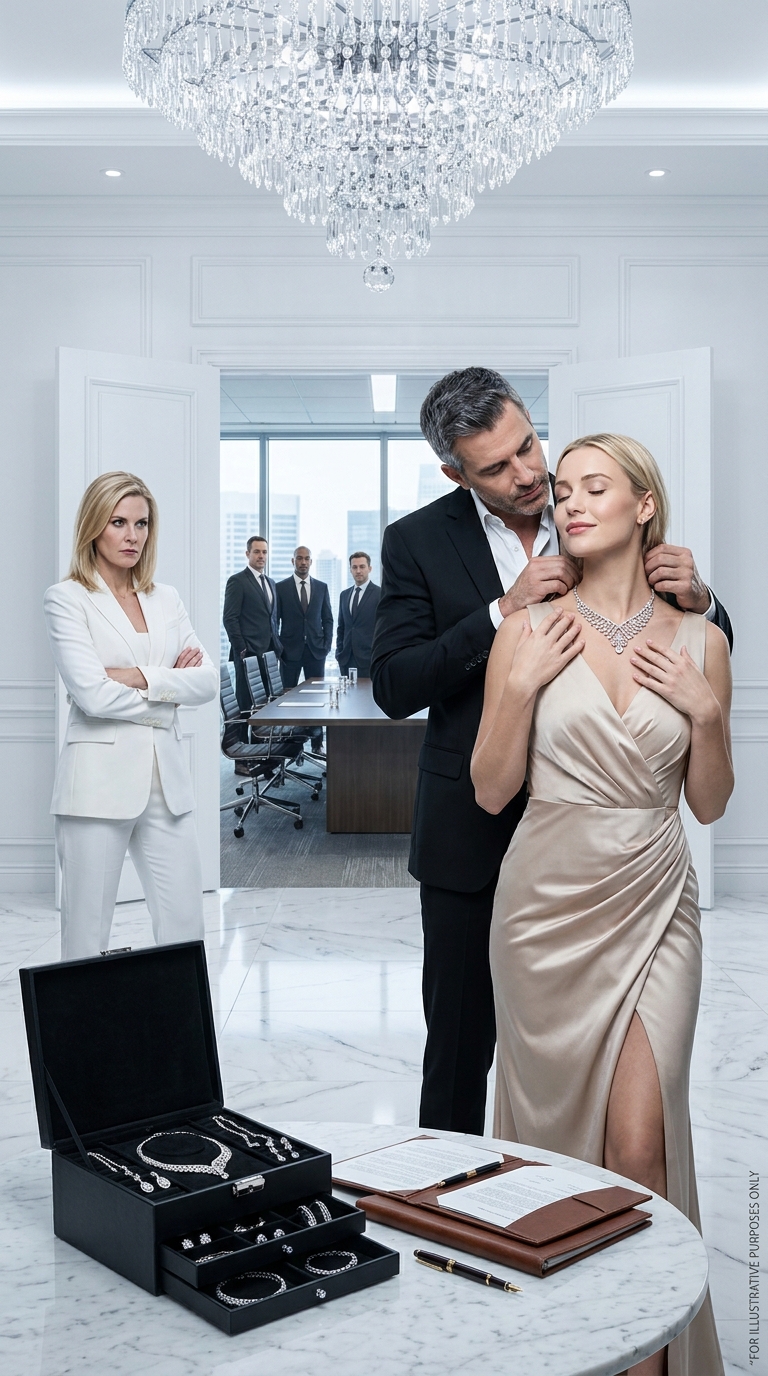
Evelyn turned a page and found the gala photo: Adrian fastening the necklace on Camille, Camille smiling like she’d been crowned, Evelyn in the background holding a glass that never reached her lips.
At that moment, she did not feel heartbreak.
She felt precision.
“Proceed,” she said.
No one in the room asked if she was sure.
Because she was the only person in the building who had been sure for years.
By three o’clock, the weather at Vale Tower had changed.
Camille arrived wearing sunglasses and a cream coat with the diamond necklace hidden beneath a silk scarf. In the lobby, the guards who had once rushed to greet her now made her wait.
That was when she understood.
The ground had moved.
She removed the sunglasses slowly and asked to see Adrian.
“He’s in meetings,” the guard said.
“I’m expected.”
Not anymore, was what everyone in the room was thinking.
Before the tension could harden, Evelyn walked through the lobby with Julia beside her.
She wore an ivory suit, carried no diamonds, and looked exactly like a woman who already knew how this ended.
Camille straightened instinctively.
“You think you’re better than me,” Camille said.
Evelyn looked at her the way a surgeon looks at a patient who has mistaken panic for a diagnosis.
“No,” she said. “You do.”
Camille’s face flushed. “Adrian loves me.”
“Then he shouldn’t have spent company reserves on you.”
“He said our marriage was already a business arrangement.”
Evelyn’s expression didn’t change. “He says many convenient things.”
Camille’s voice lowered. “He said you never made him happy.”
Evelyn’s eyes moved over the scarf at Camille’s throat.
“Happiness is not a service wives provide while husbands misuse restricted capital.”
Camille went still.
For the first time, she looked less like a rival and more like a woman standing on the edge of a hole she had helped dig.
“I didn’t know,” she said.
“I believe you didn’t know the account name.”
Camille swallowed.
The elevator opened.
Adrian stepped out with two lawyers and one look that could have curdled milk.
“Camille,” he said sharply. “I told you to stay home.”
Home.
He corrected himself too late. Upstairs.
That was worse.
Camille looked between them, then whispered, “What is happening?”
Adrian ignored her and turned to Evelyn.
“This is enough.”
“We agree on something.”
He lowered his voice. “If you go through with this, every private thing in our marriage becomes public.”
Evelyn met his gaze without blinking.
“You made the private public when you put diamonds on your mistress in front of two hundred people.”
Something ugly flashed across his face.
“You’ll regret making me your enemy.”
She held the stare another beat.
“Adrian,” she said, “you became my enemy while I was still behaving like your wife.”
Then she stepped into the elevator with Julia and let the doors close.
Part 3
The boardroom at Vale International was built to make men feel immortal.
Black marble walls. A table long enough for a treaty. A skyline view that made even debt look elegant.
Adrian loved that room.
At five o’clock, he sat in it looking like a man who had just discovered that his reflection could bleed.
The directors were already seated. Celeste occupied an observer chair by the wall, her pearls rigid at her throat. Julian, Adrian’s younger brother, stared at the table like a child who had wandered into a funeral by mistake. Rowan Pierce sat with Northstar’s counsel. Evelyn sat across from Adrian, calm and unreadable.
Camille was not invited.
That absence said more than any announcement could have.
Helena Ward, the independent chair, opened the meeting with all the warmth of a legal summons.
“We are here to address the covenant breach notice issued by Northstar Meridian and the related governance concerns.”
Adrian leaned back. “Before we begin, I want to object to Evelyn’s presence. She is my spouse and is acting out of personal anger.”
Evelyn did not look at him.
Rowan opened a folder.
“Mrs. Vale is present as a beneficial controller of Larkser Holdings, a principal backer of Northstar Meridian.”
The room went silent.
Adrian frowned. “What?”
Helena removed her glasses. “Mr. Pierce, are you saying Mrs. Vale controls Larkser?”
“Yes.”
“And Larkser is a principal investor behind Northstar?”
“That is correct.”
Martin Kessler looked faint.
Adrienne stared at Evelyn. “That’s impossible.”
“No,” she said evenly. “It was private. You just never read what you signed.”
His hand struck the table. “You deceived me.”
Helena cut in sharply. “Adrian.”
He didn’t hear her.
“All these years,” he said, voice rising, “you sat in my house and held a knife to my company.”
Evelyn’s answer was quiet.
“I sat in our house and kept your company alive.”
That sentence moved through the room like a verdict.
Rowan continued before anyone could turn emotion into theater.
“The breach concerns twelve million dollars moved from the Marseilles reserve to fund a necklace for Ms. Camille Lawson. Additional company-funded benefits total approximately thirty-one million.”
Martin, looking miserable, confirmed the figures.
Adrian turned on him. “Don’t confirm anything.”
“I’m confirming the records,” Martin said, finally tired enough to be honest.
Helena looked at Adrian. “Did you authorize the transfer?”
“It was temporary.”
“Did you authorize it for a personal gift?”
His jaw worked.
“Yes.”
There was no way to make that sound noble now.
Evelyn tapped her tablet once. The screen behind them lit up with the gala photograph.
Adrian fastening the necklace.
Camille smiling.
Evelyn in the background, still and pale.
Under the image appeared the insurance record, the source of funds, the approval trail.
No one spoke.
Rowan placed another document on the table.
“Hawthorne Global Infrastructure has submitted a conditional acquisition proposal for Vale International’s core operating assets.”
Celeste stiffened. Julian made a soft noise that might have been a prayer.
Rowan continued. “Debt settlement. Employee protections. Shareholder premium. Governance reset. Removal of conflicted leadership.”
“Sale?” Celeste said, horrified.
Evelyn answered before Rowan could.
“I am proposing you save what Adrian has not yet broken.”
Adrian laughed once, sharply. “You would sell my company?”
“Your grandfather’s company,” Evelyn said. “Your father’s burden. Your employees’ livelihood. Not your jewelry account.”
He flinched.
“You vindictive little lawyer.”
The words were supposed to sting. Instead they exposed him.
Evelyn did not blink.
“That little lawyer wrote the rescue terms that kept you in that chair.”
The vote did not happen that night. Powerful people prefer the illusion of deliberation even when the outcome has already started walking toward them.
But by sunrise, the market had found out.
Reporters lined the front of Vale Tower. Employees stared at security screens. The stock moved in ugly, nervous increments. The company had become, in a single evening, less of an empire and more of a headline.
Adrian left through the garage. Evelyn entered through the front doors.
That was not accidental.
She wore navy, carried a leather folder, and walked past the cameras like a woman who had already buried the version of herself they were expecting to see.
Inside, Camille had resigned from the foundation under counsel and returned the necklace. The legal department had confirmed the funding trail. More messages surfaced. Not enough to destroy her, but enough to show she had known more than she admitted.
The next day, Adrian came to Evelyn’s temporary office without knocking.
Julia started to rise.
“Should I stay?” she asked.
“No,” Evelyn said. “He’ll behave.”
Adrian gave a thin smile. “Will I?”
Julia left anyway, but slowly.
As soon as the door shut, Adrian exhaled and looked around the room like a man measuring what remained of his territory.
“You made me look like a fool.”
“You made it easy.”
His laugh was tired now. “Do you know what people are saying?”
“Many things, I’m sure.”
“That my wife secretly controlled my lender. That I bought jewelry with restricted funds. That a mistress cost me my empire.”
Evelyn folded her hands.
“Which part is false?”
He looked toward the window, toward the city that had always seemed to belong to men like him.
Then he asked the question that might once have saved them.
“Did you ever love me?”
Evelyn’s answer was immediate.
“Yes.”
He turned as if the word hurt more than denial would have.
“Then how can you do this?”
“Because I loved you,” she said, “not the throne you kept confusing with yourself.”
For a moment, the room went very still.
Then Adrian said, “If you sell the company, I’ll fight everything.”
“You should.”
He stared.
Evelyn opened another folder.
“My disclosures to Northstar and independent counsel are complete. My beneficial interest was never yours to audit. Discovery will include Camille’s apartment, her benefits, your messages, the necklace purchase, and every attempt to classify personal gifts as corporate expenses.”
His face changed slowly as the scale of the trap became clear.
“You built a cage.”
“No,” Evelyn said. “I built an exit. You walked us both toward the cage and called it freedom.”
She stood.
“The sale will protect jobs and value. You can oppose it if you want. Just don’t pretend you’re defending anyone except yourself.”
There was one beat of silence before he said, quietly, “There is no us now.”
Evelyn looked at him for a long moment.
“There hasn’t been one for a while,” she said.
The shareholder vote happened in the ballroom of the old Grand Meridian Hotel, one of the company’s first trophy properties. Adrian had picked the venue years earlier because it made investors feel like heirs to something grand.
Now it was packed with shareholders, reporters, lawyers, employees, and security.
Evelyn entered from the side with Rowan and Julia.
Black suit. Hair pulled back. No diamonds.
Adrian took the podium first and gave the speech he had spent his whole life practicing.
Legacy. Family. Duty. Misunderstanding. Temporary turbulence.
He was good at it. That was the problem.
Then he made the mistake of looking directly at Evelyn.
“I ask you not to let a private marital grievance decide the fate of a public company.”
The room sharpened with interest.
Reporters leaned in.
Evelyn stood.
Helena invited her to the microphone.
She looked out at the shareholders and spoke without raising her voice.
“Adrian is right about one thing. Vale International is not just a balance sheet. It is thousands of employees. It is pensions. It is ports that move medicine and food. It is hotels staffed by people whose names never appear in society pages. It is people who do not get to pretend mistakes are romantic.”
The room went very still.
“This sale is not about revenge. It is about containment. The restricted reserve was not moved by a jealous wife. It was moved by Adrian Vale. The necklace was not fastened by rumor. It was fastened by Adrian Vale. The benefits, the apartment, the travel, the concealment, all of it was approved through his office.”
She turned slightly toward him.
“When a man cannot separate an empire from his appetite, the empire deserves another steward.”
That landed like a hammer.
A low murmur moved through the room.
Then one employee in the back started clapping.
Then another.
Then enough people to make the room impossible to control.
The vote passed.
Vale International would be sold, protected, restructured, and continued under new ownership.
Adrian stood frozen as the result appeared on the screen.
For the first time since Evelyn had known him, he looked small.
The divorce was quieter.
It had to be.
Evelyn kept what was hers. Adrian kept what wasn’t tied to misconduct. The penthouse went. The estate went. Celeste moved somewhere smaller and told people she preferred simplicity, though no one believed her. Julian stayed out of the headlines and discovered, much too late, that being charming is not the same as being useful.
Camille left New York.
Six months later, Evelyn received a letter in a plain envelope.
I thought being chosen by him would make me real. It only made me smaller. I am sorry I enjoyed hurting you. I know I don’t deserve forgiveness. I just wanted to say I am trying to become someone who would never stand under those chandeliers again.
Evelyn read it once and put it in a drawer.
Not every apology earns a reply.
A year later, she stood on the terrace of the first children’s hospital wing funded by the restructured Vale Foundation.
It had been renamed.
The walls were bright white. Sunlight filled the corridors. Children painted stars on paper in the activity room while nurses moved with the calm competence of people doing work no gala speech could ever honor properly.
Julia stood beside Evelyn with two paper cups of coffee.
“For the record,” Julia said, “this coffee is still a crime.”
Evelyn took a sip and made a face. “Document it.”
Rowan joined them near the railing.
“Integration’s complete,” he said. “Employee retention is better than projected.”
“Good.”
“The Marseilles acquisition closed too.”
Evelyn turned. “Under Hawthorne?”
“Yes. Properly used this time.”
She looked out through the glass at a little boy in a yellow sweater pressing both hands to the window to see the city.
Below them, people were buying things, losing things, apologizing, lying, rebuilding.
The world kept moving.
“No,” she said at last. “I don’t miss the empire.”
Julia glanced at her. “What do you miss?”
Evelyn watched the children inside, their paper stars catching the light.
“Who I was before I believed love required constant rescue,” she said.
Then she smiled, faint and real.
“Now I want to build things no one has to be humiliated to save.”
Late that autumn, Adrian asked to see her one last time.
They met in a public garden near the East River. No chandeliers. No reporters. No one performing wealth.
He looked older, not ruined, just touched by reality at last. He thanked her for coming. They walked slowly under bare trees while the wind moved the leaves around their feet.
He told her he had sold the last of his personal stake.
He told her he had entered a governance program in London.
He told her, in the way men do when they are finally out of excuses, that he understood too late what he had done.
“I thought you took everything from me,” he said.
Evelyn watched the river move beneath the gray sky.
“You lost what you thought you owned.”
He nodded, absorbing the distinction.
Then, after a long silence, he asked, “Do you forgive me?”
She thought about the younger man he had been. Frightened. Brilliant. Not yet cruel.
She thought about the wife she had been, trying to save a house until it stopped feeling like one.
And she answered honestly.
“Some days.”
His eyes filled, but she did not reach for him.
“Not because you earned it,” she said. “Because I don’t want to carry you every day.”
He gave a quiet, broken laugh. “You always did know how to end a conversation.”
“I learned from contracts.”
For the first time, he smiled without strategy.
At the gate, he asked one final question.
“The necklace. What happened to it?”
Evelyn’s expression softened just slightly.
“It was sold,” she said.
He closed his eyes, ashamed or relieved. Maybe both.
“And the money?”
“It funded pediatric oncology art rooms.”
He nodded once.
“Good.”
Evelyn turned to leave, then stopped when he said her name.
She looked back.
“You were never cold,” he said.
The words reached her gently.
Too late to matter.
Not too late to be true.
“I know,” she said.
Then she walked away.
Two years after the gala, Evelyn stood under another chandelier.
This one was smaller, warmer, and filled with people who mattered for reasons money couldn’t fake. Doctors. Social workers. Teachers. Former employees. Families. Donors who had come because they believed in the work, not the spectacle.
She wore a dark green dress and her father’s watch.
No diamonds.
When the evening ended, the auctioneer announced the last item: architectural drawings from the restored hospital wing, framed with a plaque honoring the workers who built it.
The bidding rose quickly.
Evelyn watched people compete not for ownership of beauty, but for participation in something useful.
That, more than anything, felt like peace.