Vivian removed three glasses from a cabinet, then paused. “You know, Marshall, there are questions that reveal more about the person asking than the answer ever could.”
Tessa recovered first, because insecurity often moves faster than intelligence. “It’s probably staged,” she said, looking around too quickly. “Like a rental for photo shoots. People do that all the time.”
Vivian turned toward her. “Do they?”
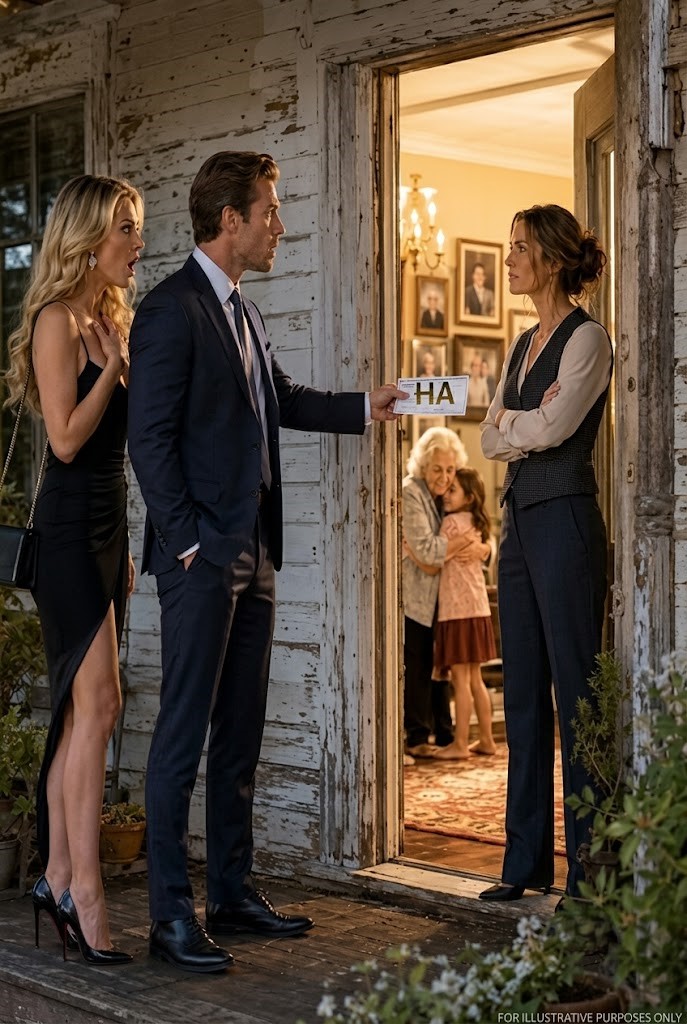
Tessa flushed. “I’m just saying, appearances can be misleading.”
“Exactly,” Vivian said.
Marshall forced himself to move. He crossed the room to the dining table, an enormous slab of walnut set on black steel legs, and dropped the leather folder onto it. He needed gravity. He needed procedure. He needed paper and signatures and the old rhythm of making people feel smaller than him until they complied.
Tessa sat beside him, though more carefully now. Her bracelets clinked against the table, suddenly loud in the calm room.
Vivian placed a glass of water in front of each of them and sat opposite Marshall. She did not ask why he had come again. She waited.
That annoyed him more than panic would have.
“As you know,” Marshall began, opening the folder, “Cain Meridian is entering a transformative stage.”
“I read the financial press.”
“Then you know Northstar Atlas has made a very substantial acquisition offer.”
“I know they made one.”
He ignored the past tense. “During routine due diligence, their lawyers found a technical gap in the original intellectual property transfer from our divorce. It’s meaningless, but they want everything perfectly clean before closing.”
“A technical gap,” Vivian said.
“A paperwork issue.”
“Those are different things.”
“Not materially.” He pulled out the release and turned it toward her. “You signed away your equity, claims, and any interest in Cain Meridian five years ago. This simply confirms that you have no residual rights to any legacy code, architecture, tooling, or derivative systems, including the old predictive routing model.”
“The Lantern Model,” she said softly.
Marshall stiffened. He hated hearing her name for it. The company had renamed it Meridian Core, then Meridian Intelligence, then M-Core after a branding agency charged seven figures to make theft sound inevitable.
“Yes,” he said. “That.”
Vivian looked at the document but did not touch it.
Marshall produced the check. He placed it beside the pen with deliberate care, then slid both across the table. “Fifty thousand dollars. Today. No court, no delay, no stress. I assume it would be useful.”
Tessa leaned forward, eager to play her part now that a number had appeared. “It’s incredibly generous,” she said. “Honestly, most women in your position would be grateful he even remembered them. You can fix the front of the house. Maybe buy clothes that don’t look like they came from a museum gift shop.”
Vivian’s eyes moved from the check to Tessa’s face.
There was no anger in them. That made it worse.
“Tessa,” Vivian said, “when a man brings you to insult the woman who built the life he sold you, pay attention. You’re not watching his past. You’re seeing your preview.”
Tessa recoiled as if slapped. “Excuse me?”
Marshall snapped, “Enough.”
“No,” Vivian said. “Not yet.”
She reached for the check. For one wild second, Marshall thought she was taking it. Relief rose in him so fast it was almost painful.
Then Vivian folded the check once, neatly, and placed it beneath her water glass like a coaster.
Marshall’s relief died.
“Vivian,” he warned.
“You always did offer insulting numbers when you were frightened,” she said.
His face hardened. “I am not frightened.”
“You parked outside my house with a mistress, a driver, a fifty-thousand-dollar check, and a document your general counsel should have sent through proper channels. You are not here because things are fine.”
Tessa looked at Marshall. “Mistress?”
“Fiancée,” he said quickly.
Vivian’s mouth curved slightly. “A promotion without security.”
Tessa stood halfway from her chair. “I don’t have to sit here and be disrespected by some bitter ex-wife in a fake rich house.”
“Sit down,” Marshall said, too sharply.
The command startled Tessa into silence. Vivian noticed. Marshall noticed Vivian noticing, and hated her for it.
He leaned forward, lowering his voice. “Sign the document.”
“No.”
The word was small. It landed like a steel door closing.
Marshall stared at her. “No?”
“No.”
“You don’t understand the consequences.”
“I wrote the consequences.”
His fingers tightened around the pen. “Vivian, listen to me carefully. You are playing with forces bigger than you. Northstar wants clean title. If you create a nuisance claim, my lawyers will drag you through federal court for years. Whatever this house is, whatever debt you took on to impress your neighbors, it will be gone. I will make sure of it.”
Vivian took a sip of water. “There he is.”
His pulse thudded in his ears. “Who?”
“The man I divorced.”
Tessa whispered, “Marshall, what’s going on?”
He ignored her. “You think because you wrote some early code in a freezing apartment that you can extort me?”
Vivian’s expression changed then. It did not become cruel. It became exact.
“No,” she said. “I think because I wrote the Lantern Model eight months before Cain Meridian existed, patented the architecture through Ashford Instruments, licensed it to your company under a revocable development agreement, and watched you spend a decade pretending you invented it, I can revoke what was always mine.”
Marshall went still.
Tessa frowned. “What does that mean?”
The room seemed to grow quieter around them. Outside, the reflecting pool moved with a soft trickle. A leaf scraped against the glass doors. Marshall’s mind reached backward through years of contracts, signatures, rushed launch meetings, investor decks, late nights when Vivian had said, “I need you to sign this vendor packet before tomorrow,” and he had signed because he trusted her competence the way arrogant men trust elevators. He remembered the name Ashford Instruments, vaguely. A shell vendor, he had thought. A tool library. Something technical. Beneath his attention.
His phone began vibrating in his pocket.
Vivian glanced at it. “That will be Gordon.”
Marshall did not move.
“It’s your general counsel,” she said. “You should answer.”
Slowly, he took out his phone. Gordon Pell’s name flashed across the screen. Marshall answered and put it to his ear.
“What?” he barked.
Gordon’s voice was hoarse. “Tell me you are not with Vivian Ashford.”
Marshall’s throat tightened. “I am with Vivian Ashford.”
A long silence followed.
“Marshall,” Gordon said, “do not speak. Do not ask her for anything. Do not threaten her. Leave immediately.”
Marshall put the phone on speaker with a shaking thumb and set it on the table. “Explain.”
Gordon exhaled. In the background, voices shouted, phones rang, and someone said something about emergency counsel. “Northstar withdrew the acquisition at noon. Their audit confirmed Cain Meridian never owned the underlying Lantern architecture. We found the original 2014 license agreement. It is valid. It is revocable. Ashford Instruments retained all core IP.”
Tessa sank slowly back into her chair.
Marshall stared at Vivian. She was perfectly still.
“No,” he said.
“I’m sorry,” Gordon replied. “At midnight, Ashford Instruments triggered a lawful termination protocol. We received cease-and-desist notices at six this morning. The board was served ten minutes ago. We are legally barred from using Lantern or any derivative components until ownership is resolved.”
“Then resolve it,” Marshall said. His voice rose. “Pay her. Injunct her. Challenge the patent. Build around it.”
“We can’t build around it quickly. Engineering says the platform architecture depends on Lantern at the routing layer, the compression layer, and the predictive failover layer. Without it, the enterprise product is crippled.”
“That’s impossible.”
“It’s your own technical dependency map, Marshall.”
Tessa pressed both hands over her mouth.
Marshall leaned closer to the phone. “Gordon, listen to me. Tell the board this is a negotiation tactic. Tell Northstar we can cure it.”
“The board has retained independent counsel.”
Marshall’s eyes widened. “They did what?”
“They are preparing to remove you for cause.”
Tessa made a small, frightened sound.
Gordon’s voice dropped. “The SEC has been notified of potential material misrepresentation in the acquisition filings. I have to recuse myself from advising you personally. Marshall, get your own lawyer. Now.”
The call ended.
For several seconds, the only sound in the room was Tessa’s uneven breathing.
Marshall looked at the dead screen. Then at Vivian. Then at the check under the water glass.
“You planned this,” he said.
Vivian folded her hands on the table. “Yes.”
His face twisted. “For five years?”
“No. Longer. For five years, I simply waited for you to become careless enough in public that no one could pretend it was an accident.”
“You let me build the company.”
“I let you build your brand. The technology was already built.”
His chair scraped back as he stood. “You vindictive—”
“Finish that sentence,” Vivian said quietly, “and remember there are six cameras recording in this room.”
Marshall froze.
Tessa’s head snapped toward the ceiling.
Vivian did not look up. “There are also microphones. After the divorce, I learned to document rooms where powerful men might lie about what happened inside them.”
Marshall’s hands curled into fists, then opened.
He sat.
The defeat of that movement seemed to age him. In the doorway, he had been a conqueror. At the table, he looked like a man whose map had caught fire.
Tessa turned to him slowly. “You told me she was poor.”
Marshall said nothing.
“You told me she got a house because you felt sorry for her.”
He rubbed both hands over his face. “Tessa, not now.”
“You told me she never understood business.”
Vivian’s gaze flicked to Tessa, and for the first time that afternoon, her expression softened by a degree. “He told himself that first. You were just the echo.”
Tessa looked at her, mascara shining at the corners of her eyes. “Don’t act like you care about me.”
“I don’t know you well enough to care,” Vivian said. “But I know enough to warn you. Men like Marshall never love witnesses. They love mirrors.”
Marshall slammed his palm on the table. “Stop talking about me like I’m dead.”
Vivian turned back to him. “Professionally, that depends on the next ten minutes.”
Hope, ugly and desperate, flared in his face. “So there is a deal.”
“There was always a deal. Just not the one you brought.”
He leaned forward. “Name it.”
Vivian looked toward the courtyard, where wind moved through the native grasses. When she spoke, her voice no longer carried the surgical chill of revenge. It carried the weight of memory.
“Five years ago, I sat across from you in a Midtown conference room while your lawyers slid stacks of paper at me as if volume could replace justice. I asked for a fair settlement. Not half. Not control. Not revenge. Fair recognition of what I had built. You laughed. You said the market rewards winners. You said sentiment was for people who lacked leverage. You told me I was technically gifted but socially useless, and that history did not remember the person who soldered the engine. It remembered the man who sold the car.”
Marshall looked away.
“You remember,” she said.
He swallowed. “People say things during divorce.”
“No,” Vivian replied. “People reveal things during divorce.”
The words settled over him.
She continued, “I could have revoked the license then. Cain Meridian would have collapsed at a fifty-million-dollar valuation. You would have called yourself a victim, raised new money, blamed me, and found another quiet woman to strip for parts. Instead, I waited. I let you speak at conferences about innovation you did not understand. I let you tell investors you had built a proprietary architecture your own engineers treated like scripture. I let you walk higher and higher onto a platform you never inspected.”
Marshall’s voice came out thin. “To watch me fall.”
“To make sure everyone could see why.”
Tessa whispered, “Oh my God.”
Marshall turned on her. “You’re not helping.”
“I’m not trying to,” she shot back.
The ring on her finger flashed as she stood. “What happens to your money?”
“Tessa,” he said, warning and pleading at once.
“What happens to the penthouse? The Aspen wedding? My cards?”
Vivian did not answer. Marshall could not.
Tessa understood.
Her face changed with startling speed. The sweetness vanished first, then the panic, then the affection. What remained was calculation stripped bare.
“You said I’d be taken care of,” she said.
Marshall’s shoulders sagged. “I can fix this.”
“You just lost a billion-dollar company because your ex-wife had a better filing cabinet.”
“Tessa.”
“No.” She backed away from him. “No, don’t say my name like I’m being shallow. You brought me here to laugh at her. You wanted me to watch you crush her. And now you want loyalty because the crushing went the other way?”
Vivian watched without satisfaction. There had been a time when she might have enjoyed it. But the sight of Tessa, young and terrified beneath all that polish, mostly made her tired.
Marshall reached for Tessa’s hand. She pulled away.
“I’m twenty-four,” she said. “I am not spending my life in depositions because you couldn’t read what you signed.”
“You loved me yesterday.”
“I loved what you promised.”
The sentence was cruel, but at least it was honest.
Tessa grabbed her purse, nearly knocking over her water. She looked at Vivian once, not with respect exactly, but with the stunned resentment of someone forced to recognize a predator larger than the one she arrived with.
Then she hurried down the dim front hallway. The old door slammed a moment later.
Marshall flinched.
For a long time, he said nothing.
When he finally spoke, his voice had lost its boardroom polish. “Are you happy?”
Vivian looked at the empty doorway. “No.”
That answer unsettled him more than triumph would have.
“You destroyed me,” he said.
“I stopped carrying you.”
He let out a broken laugh. “That’s what you call this?”
“That is what it is.”
“My board will sue me. Northstar is gone. The SEC will open me up with knives. My shares are worthless. Tessa just left. My driver probably followed her. I may not be able to get back to Manhattan.”
“Probably not in the Maybach,” Vivian said.
He gave her a wounded look so absurdly human that, for one brief moment, she saw the young man from Boston: ambitious, hungry, wearing a secondhand coat and talking about changing the world because he had not yet learned to monetize every person who loved him. The memory hurt, not because she wanted him back, but because it reminded her that monsters were rarely born finished. They were assembled, choice by choice, applause by applause, unchecked hunger by unchecked hunger.
He lowered his head. “Please.”
Vivian waited.
“I was wrong,” he said. The words seemed to scrape his throat raw. “About you. About the company. About all of it.”
“You’re sorry because you lost.”
“Yes,” he said, surprising her. He looked up, eyes red. “Right now, yes. I’m sorry because I lost. I don’t know how to be noble in a burning building. Is that what you want to hear? I’m terrified. I’m humiliated. I don’t know who I am without the company. But somewhere under that, I know I did this. I know I treated you like a tool that stopped being useful. I know I let people call me a genius while the genius was sitting beside me eating vending machine crackers at three in the morning and keeping our servers alive.”
Vivian’s fingers tightened once around her glass.
Marshall saw it. Hope flickered again, smaller this time. Less arrogant. “Give me something. Not control. Not the company. Something I can take to the board so they don’t bury me completely.”
Vivian studied him.
This was the moment she had imagined many times over five years. In those fantasies, she had been colder. She had delivered a final line sharp enough to draw blood, watched him leave with nothing, then closed the door on his ruin. But real life had a way of refusing the clean geometry of revenge. Real life contained employees who had mortgages, junior engineers who believed in the work, clients whose hospitals and power grids used Cain Meridian tools because no one had told them the empire rested on a lie. Real life contained Tessa, ridiculous and grasping, but young enough that a better warning might still matter. Real life even contained Marshall, who deserved consequences, but not necessarily annihilation so complete it turned him into a cautionary corpse for other men to ignore.
Vivian stood and walked to a cabinet near the fireplace. From a drawer, she removed a second folder. Unlike Marshall’s, hers was plain gray and unbranded. She placed it on the table between them.
“What is that?” he asked.
“The offer you should have made five years ago.”
His hand hovered over it but did not touch.
Vivian sat again. “Northstar is acquiring Ashford Instruments, including Lantern. As part of that acquisition, they will create a transition division to stabilize Cain Meridian’s client systems. Your engineers will receive employment offers. Client contracts tied to hospitals, utilities, and municipal emergency services will be migrated first. No essential system will be allowed to fail because you lied.”
Marshall stared at her.
She continued, “I negotiated a severance protection pool for non-executive employees funded from my initial payout. People who had no part in your fraud will not lose health insurance because your ego was expensive.”
His mouth opened. No sound came out.
“The board will still remove you,” she said. “Regulators will still investigate. Shareholders will still sue. I will not lie for you, and I will not reinstate the old license. But I am willing to provide one statement to regulators confirming that, to my knowledge, the original misrepresentation began as your negligence and later became concealment at the executive level. That distinction may matter criminally if you cooperate fully.”
Marshall understood slowly. She was not saving him. She was giving him a rope that could either pull him out of a pit or hang him, depending on whether he told the truth.
“What do you want in return?” he whispered.
“Three things.”
He nodded once.
“First, you will sign a sworn statement acknowledging that I authored the Lantern architecture, that Cain Meridian used it under license, and that you publicly misrepresented your role in its creation.”
His face tightened, but he nodded.
“Second, you will waive any claim to Ashford Instruments, this house, or my future work. Permanently.”
“Yes.”
“Third, you will establish, from whatever personal assets remain after litigation, a restitution fund for the early employees whose equity you diluted through shell grants and executive repricing.”
He looked up sharply. “That will leave me with almost nothing.”
Vivian’s gaze was steady. “No. It will leave you with more than you left most people.”
He breathed through his nose, fighting some final reflex of entitlement. Then his shoulders dropped.
“All right,” he said.
Vivian slid a pen toward him. Not his titanium pen. A simple black fountain pen worn smooth from use.
Marshall almost laughed. “You had this ready.”
“Yes.”
“You knew I would beg.”
“I knew you would bargain. Begging was not guaranteed.”
He looked at her, then down at the gray folder. “Did you ever love me?”
The question came so quietly Vivian almost wished he had not asked it. It was easier to punish a villain than answer a ghost.
“Yes,” she said. “Very much.”
He closed his eyes.
“That woman is gone,” Vivian added. “Not dead. Gone. There’s a difference.”
Marshall nodded as if the words had struck somewhere beneath the legal disaster, somewhere older and more tender than he deserved.
He opened the folder.
For twenty minutes, he read. His eyes moved slowly, carefully, perhaps for the first time in his adult life. Vivian did not rush him. She made coffee, not for him, but for herself, because the house was hers and calm was hers and she no longer had to perform discomfort to make a man feel powerful. When Marshall asked a question, she answered precisely. When he tried once to soften a phrase, she said, “No.” He accepted it.
At last, he signed.
The signature looked smaller than she remembered.
Vivian gathered the documents and placed them in a scanning tray hidden beneath the sideboard. The machine hummed softly, sending copies to three law firms, one regulatory office, and Northstar’s transition counsel.
Marshall watched the papers disappear into the system. “That’s it?”
“That’s the beginning of consequences.”
He gave a dull nod.
His phone, which had not stopped vibrating, flashed again. He looked at it and winced. “My cards are frozen.”
“I assumed.”
“Tessa took the car?”
“I also assumed.”
He looked embarrassed by the smallness of the problem after the scale of the ruin. “I don’t suppose you’d call me a car.”
Vivian considered him for a long moment. Then she stood and walked to the kitchen island, where she picked up her phone.
Marshall looked almost ashamed. “Thank you.”
“I’m not calling you a black car,” she said. “You can take the subway. Franklin Avenue station is four blocks west. It will be good for you to stand among people whose labor you can’t reprice.”
Despite everything, a short, broken laugh escaped him. It sounded painful.
Vivian opened the drawer again and removed a MetroCard. She set it on the table.
He stared at it.
“I keep that for contractors,” she said.
He picked it up slowly, as if it weighed more than the check.
At the front door, Marshall paused. The dim hallway no longer looked like decay. It looked like camouflage. Vivian stood several feet behind him, framed by the light from the hidden house. He turned back.
“I don’t know how to be nobody,” he said.
Vivian’s expression did not soften, but her voice did. “Then learn how to be somebody without requiring everyone else to be less.”
He held her gaze for a moment. Then he opened the door and stepped out into the Brooklyn afternoon.
The street had not changed. The bodega sign still buzzed. A kid on a scooter cut around a delivery man. Someone laughed from an upstairs window. Life, Vivian had learned, was merciless in that way. It continued through triumph and humiliation with the same traffic lights, the same weather, the same indifferent sky.
Marshall descended the cracked stoop carefully. At the curb, the Maybach was gone. He looked up and down the block once, then gave a small nod as if accepting a verdict. His phone rang again. He ignored it. He put the MetroCard in his pocket and began walking west.
Vivian watched until he turned the corner.
Then she closed the door.
For a while, she remained in the unfinished hallway, listening to the silence settle back into the walls. The house felt different after he left. Not happier exactly. Cleaner. The air no longer had to make room for his performance.
She returned to the living room and stopped beside the walnut table. Marshall’s fifty-thousand-dollar check was gone. He had taken it, perhaps because humiliation still had practical uses. The water glass had left a damp ring where it had pinned the check down. Vivian wiped it away with a cloth.
Her phone chimed.
The message was from Helena Pierce, CEO of Northstar Atlas.
Contracts filed. Board approval complete. Initial transfer scheduled for 9:00 a.m. tomorrow. Also, your employee protection terms are included exactly as requested. For what it’s worth, Vivian, the room is already calling you ruthless. I’m calling you responsible. Dinner Tuesday?
Vivian read it twice.
The money should have made her feel something dramatic. One point six billion dollars in liquid payout, with the rest in equity and board compensation, was a number large enough to distort gravity around most people. To Vivian, it felt like proof of measurement. The world had finally assigned a market value to what she had known in the freezing apartment, in the mediation room, in every silent year afterward: her mind had not been a footnote to Marshall Cain’s story. It had been the engine.
She typed back: Tuesday works. Please make sure the transition offers go out before the press cycle peaks. Engineers first. Support staff next. No one should learn their future from cable news.
Helena replied almost immediately: Agreed.
Vivian set the phone down.
Outside, wind moved over the reflecting pool, breaking the surface into small silver lines. She opened the glass doors and stepped into the courtyard. The native grasses bent and rose again. Water slid over slate with a low, patient sound. This garden had been the first thing she designed after the divorce, before the skylight, before the kitchen, before the art, before anyone looking from the street could imagine what the ruined shell contained. She had wanted a place where movement did not mean panic. A place where quiet did not mean surrender.
For five years, people had mistaken her silence for defeat.
That had been their error.
Vivian stood beneath the pale sky and let the cold air fill her lungs. She thought of Marshall walking toward the subway in a suit made for boardrooms, carrying a MetroCard and the first honest fear of his adult life. She thought of Tessa racing toward an airport with a diamond on her finger and perhaps, someday, a memory sharp enough to save her from the next man who mistook her reflection for love. She thought of the engineers who would wake tomorrow to chaos and still have jobs because revenge, if left undisciplined, could become another form of vanity.
Then she thought of the young woman she had been in Boston, hunched over a failing laptop while snow pressed against the windows and Marshall slept beside a stack of pitch decks. That younger Vivian had believed love meant building something together and not caring whose name appeared larger on the slide. She had been naïve. She had also been brilliant. Vivian wished she could reach back through time and tell her that kindness was not stupidity, that trust was not weakness, and that one day the code she wrote in silence would become the key that unlocked her own life.
She went inside and made herself a latte.
The espresso machine hissed. Milk warmed in the steel pitcher. The ordinary sounds comforted her more than applause ever could. She poured the foam slowly, shaping a clean white heart in the dark coffee, and smiled at the accidental symbolism.
By evening, every financial network in America would be saying Marshall Cain’s name.
By morning, they would be saying hers.
But in that hour, before the world rushed in, Vivian Ashford stood alone in the house everyone had misjudged, wrapped both hands around a warm mug, and enjoyed the rarest luxury she had ever earned.
Peace.