PART 2 — The Marriage Everyone Envied
Before Madison Hale returned to Chicago, people used to say Daniel and I had the kind of marriage that made other couples believe in love again.
He was an architect with calm hands and quiet ambition. I was a gynecologist who spent my days bringing babies into other people’s arms while secretly wondering why one had never come into mine. We met at Northwestern Memorial when Daniel was visiting a contractor who had injured his leg on a building site. I was a resident then, exhausted and living on vending-machine coffee. Daniel saw me arguing with a jammed snack machine at two in the morning and bought me a cup of chamomile tea from the hospital café.
“You look like someone who saves lives but forgets to eat,” he said.
It was not a glamorous beginning. But it was Daniel—gentle, observant, steady.
He courted me with small kindnesses. He remembered that I hated lilies because the smell gave me headaches. He showed up outside the hospital after my overnight shifts with soup in a thermos. He learned the names of my patients when I was too tired to talk about anything else. When he proposed under an old oak tree near Lake Michigan, he didn’t promise diamonds or yachts or a perfect life.
“I can’t promise you the world,” he told me, holding a modest ring between us. “But I promise you peace. I promise you that whatever happens, you won’t face it alone.”
I believed him.
For the first two years, that promise seemed true. We bought a townhouse in Lincoln Park with tall windows, creaky stairs, and a tiny garden Daniel insisted he could turn into something beautiful. Margaret, his mother, was reserved but polite. She praised my career. She told her friends her son had married a brilliant doctor. At Christmas, she gave me a pearl bracelet and said, “Welcome to the Pierce family.”
Then the baby did not come.
The first year, people said we were young. The second year, they said not to worry. By the third year, Margaret stopped pretending patience.
At Sunday dinners, she made comments that landed softly in the room but cut deeply in my chest.
“Daniel’s cousin already has twins.”
“Your clinic must be full of babies. Doesn’t that make you want one even more?”
“Maybe if you worked less, your body would know how to be a wife.”
Daniel always defended me.
“Mom, enough,” he would say, placing his hand over mine. “Claire is not a machine. We’ll have a child when we’re meant to.”
At night, when I cried into my pillow, he pulled me against him and whispered, “You are enough. Baby or no baby, you are enough.”
Those words kept me alive.
I went through treatments anyway. Because I wanted a child too. Because every birth I assisted felt like a miracle I could witness but not touch. Because every negative test made me feel like my body had betrayed not only me, but everyone who loved me.
After five years, hope became something I handled carefully, like glass.
Then, one ordinary morning, two pink lines appeared.
I remember sitting alone in my office, staring at that test while sunlight poured through the blinds. My hands trembled so badly I nearly dropped it. I was a doctor; I knew early pregnancies were fragile. I knew not to celebrate too loudly. But joy rose in me anyway, wild and blinding.
I was pregnant.
Finally.
I decided to surprise Daniel and Margaret at dinner. I bought tiny white booties from a boutique near Michigan Avenue. I placed them in a silver gift box with the test and a handwritten note: “Our miracle is here.”
Then Madison arrived.
Her return changed the air in our home immediately. Margaret became girlish around her, laughing louder, moving faster, touching Madison’s arm like she had recovered a lost treasure.
Daniel became careful.
Too careful.
He stopped leaving his phone on the kitchen counter. He took calls on the balcony. He began saying he had client meetings across town, late design revisions, sudden site visits. When he came home, there was Madison’s perfume on his sleeves.
I asked once, “Are you seeing her?”
He looked offended. “Claire, don’t do this. She’s an old friend.”
Old friend.
The oldest lie in marriage.
Margaret did not help. She mentioned Madison constantly.
“Madison is doing so well. She got a senior position at a design firm.”
“Madison brought me this face cream from California. Isn’t she thoughtful?”
“Madison always had such natural warmth. Some women just know how to make a house feel alive.”
Every sentence was a needle.
I still did not tell them about the baby. At first I told myself I was waiting for the right moment. Then I admitted the truth: I was afraid.
Afraid Daniel’s joy would be smaller than I needed.
Afraid a baby would become a bargaining chip instead of a blessing.
Afraid that if I revealed my miracle too soon, Madison would find a way to poison even that.
Three weeks passed like a fever.
Then came the morning Madison appeared at my clinic.
When I entered Exam Room Three, she was sitting on the edge of the exam table, legs crossed, scarf draped around her shoulders. She looked around the room with amused curiosity.
“So this is where you spend your life,” she said. “Helping other women become mothers.”
I closed the door behind me.
“What do you need, Madison?”
She placed a hand over her stomach.
“I think I’m pregnant.”
The room seemed to tilt.
For one second, I heard nothing but the blood rushing in my ears.
Then the doctor in me took control, because the wife in me would have screamed.
“Date of your last period?”
She told me.
“Symptoms?”
“Late period. Nausea. Fatigue. Two positive home tests.”
I typed everything into the system with hands that did not feel like mine.
“Why come to me?”
Madison smiled.
“Because Daniel trusts you.”
I looked at her then, really looked at her. Beneath the beauty, beneath the polish, there was something vicious and hungry. She wanted me to ask. She wanted me to break first.
Instead, I said, “Lie back.”
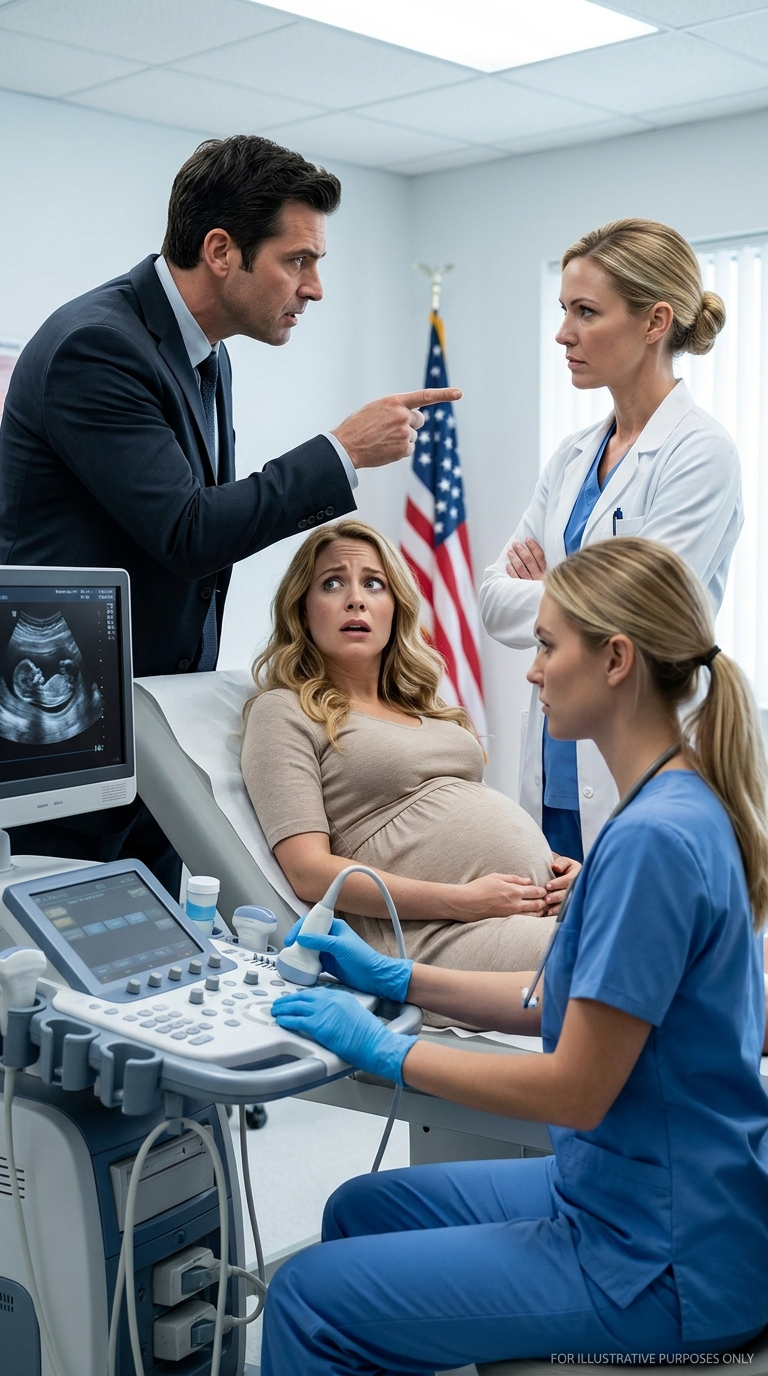
The ultrasound room became silent except for the machine’s low hum. I moved the transducer with practiced precision. On the screen, a small dark sac appeared.
A gestational sac.
Approximately three weeks.
Exactly when Daniel had told me he was flying to Washington, D.C. for a hotel project.
Exactly when he had come home two days later with Madison’s perfume on his shirt.
Madison lifted her head. “Well?”
My throat tightened.
“You’re pregnant.”
Her face transformed.
The false worry vanished. A victorious smile spread across her lips.
“Oh,” she breathed. “Daniel is going to be so happy.”
I said nothing.
She sat up slowly, not bothering to wipe the gel from her abdomen.
“You know, Claire,” she said sweetly, “I guess this proves the problem was never Daniel.”
The words hit the oldest wound in me.
I gripped the counter.
She leaned closer.
“Maybe you should be grateful. At least now the Pierce family will finally have a baby.”
Before I could answer, the exam-room door burst open.
Daniel stood there, breathless, panicked, and already looking at Madison first.
Not me.
Madison gasped and flew into his arms.
“Daniel, I was so scared,” she sobbed into his chest. “Claire got so angry.”
He held her.
He held her while I stood there in my white coat, shaking.
Then he looked at me with a face I barely recognized.
“Claire,” he said, cold and furious, “what did you do?”
PART 3 — The Push
“What did I do?” I repeated.
My voice came out low, almost unrecognizable. “Your mistress walks into my clinic, asks me to confirm her pregnancy, insults me in my own exam room, and you ask what I did?”
Madison clutched Daniel’s shirt as if I were dangerous. “I didn’t mean to upset her. I only wanted help.”
I laughed. It was a sharp, broken sound.
“Help? You came here to humiliate me.”
Daniel’s jaw tightened. “Enough.”
Enough.
That word detonated something inside me.
For five years, I had swallowed Margaret’s comments. I had swallowed the pitying looks from relatives. I had swallowed the shame of each failed treatment, each test, each needle, each prayer that ended in blood. I had swallowed Daniel’s late nights, his lies, his perfume-stained shirts, because I was still trying to protect the fragile dream inside me.
But I could not swallow this.
Not while he stood in my clinic holding her.
“Let her go,” I said.
Daniel’s arms tightened around Madison.
“She’s pregnant, Claire.”
The way he said it made something in me collapse.
Not “I’m sorry.”
Not “Let me explain.”
Not even “I made a mistake.”
Just: She’s pregnant.
As if pregnancy made betrayal sacred.
As if the child in her womb mattered because he believed it was his, while the child in mine did not exist because I had not yet given him the chance to care.
I touched my stomach instinctively. Daniel noticed the movement but misunderstood it as anger.
“You need to calm down,” he said. “This is not good for anyone.”
“For anyone?” My eyes burned. “Do you hear yourself?”
Madison whispered, “Daniel, maybe we should leave. I don’t want the baby exposed to this stress.”
The baby.
Her baby.
The room narrowed around those words.
“You don’t get to walk into my clinic and play victim,” I said, stepping toward her. “You don’t get to mock five years of pain and then hide behind tears.”
Daniel moved in front of her. “Claire, stop.”
“I will not stop.”
“Claire.”
“She told me the problem was never you,” I said. “She said the Pierce family would finally have a baby. Did you know she was going to say that? Did you plan this together?”
Daniel flinched.
Madison’s eyes flickered.
There it was.
Not guilt, exactly. Recognition.
Maybe he hadn’t planned the details. Maybe he had not known she would come here. But he knew enough. He knew what they were. He knew what he had done. And still he had run here to protect her from the consequences of her cruelty.
“I made a mistake,” he said at last, lowering his voice. “But she is carrying my child. I have responsibilities.”
A mistake.
A child.
Responsibilities.
Those three words became the funeral bells of my marriage.
“And what was I?” I asked. “A waiting room? A placeholder? A woman you loved until someone more fertile came back?”
“Don’t twist this.”
“Don’t twist this?” I stepped around him, looking straight at Madison. “You wanted a reaction? Congratulations. You got one.”
Madison’s mouth trembled, but her eyes were bright with satisfaction.
Daniel saw only the trembling mouth.
“Back away from her,” he ordered.
I did not.
I moved one more step, not to strike her, not to harm her, but because every cell in my body demanded that she stop performing.
That was when Daniel pushed me.
It happened fast.
His hand landed against my shoulder with more force than he intended—or maybe exactly as much as his panic allowed. My heel caught on the base of the rolling stool. I stumbled backward. The metal exam table crashed against my hip. My lower back struck the sharp edge of the instrument counter.
Pain exploded through me.
Not only in my back.
Lower.
Deeper.
A cramping pain twisted through my abdomen with such violence that my knees buckled.
For one second, the room went silent.
Then I felt warmth running down my thighs.
I looked down.
Blood.
Bright red against my pale blue dress.
My hand flew to my stomach.
“No,” I whispered.
Daniel stared at the blood, his face draining of color.
Madison took a step back.
“No, no, no,” I said, folding over myself. “My baby.”
Daniel’s eyes snapped to mine.
“What?”
I looked at him through a haze of pain. “I was pregnant.”
The sentence did not sound real.
It floated between us like something dead.
“I was pregnant,” I repeated, louder, breaking. “Your baby, Daniel.”
He staggered.
Madison covered her mouth.
For the first time since she had entered my life, she looked afraid.
Not remorseful.
Afraid.
“Claire,” Daniel whispered.
I reached for the counter, but my fingers slipped. The blood was spreading. Olivia burst into the room behind Daniel and screamed for help. Nurses rushed in. Someone lowered me to the floor. Someone called emergency transport. Someone said my pulse was dropping.
Daniel tried to come near me.
“Don’t touch me,” I gasped.
His face crumpled. “Claire, I didn’t know.”
I stared at him, and in that moment, pain sharpened into something colder than hatred.
“You didn’t ask.”
The ceiling lights blurred.
Olivia pressed a towel between my legs. Her voice shook as she told me to stay awake. I heard Madison crying somewhere near the door. I heard Daniel repeating my name as though saying it enough times could reverse what he had done.
But the last clear image I saw before darkness swallowed me was Daniel standing frozen beside Madison, one hand still hovering protectively in front of her stomach.
Even then.
Even with my blood on the floor.
He was still protecting her.
PART 4 — The House I Left Behind
I woke up in a private room at Northwestern Memorial, the same hospital where I had spent years telling other women to breathe through pain.
The room smelled of antiseptic and lilies.
I hated lilies.
A nurse must have placed them there without knowing.
For a moment, I did not remember. I only felt the heaviness in my body, the soreness in my back, the strange hollow ache below my ribs. Then my hand moved to my stomach.
Flat.
Empty.
The memory returned like a blade.
Blood on my dress.
Daniel’s hand.
My baby.
Olivia was sitting beside my bed. Her eyes were red. When she saw me wake, she stood quickly.
“Claire.”
I looked at her.
She did not need to say it.
I was a doctor. I knew.
Still, I asked, because grief demands the words that destroy it.
“Did we lose the baby?”
Olivia covered her mouth. Tears slipped down her face.
“I’m so sorry.”
Something inside me made a sound that was not human.
The child I had prayed for through five years of loneliness was gone before I had ever heard a heartbeat. Gone before I had told the father. Gone because the father had chosen another woman’s womb over mine.
I turned my face into the pillow and screamed until my throat tore.
Later, Margaret came.
Not with tears.
Not with apology.
She entered wearing pearls and a dark coat, her mouth pressed into the thin line she used when embarrassed in public.
“You’re awake,” she said. “Good. Daniel has been worried sick.”
I stared at her.
“That’s what you came to tell me?”
She sighed. “Claire, what happened was tragic, but you must understand how difficult this has been for him. There are rumors at the clinic already. People saying he pushed you. Saying Madison caused a scene. Do you know what this could do to his reputation?”
His reputation.
I almost laughed.
“My baby is dead.”
Margaret looked away.
Her silence told me everything.
To her, Madison’s pregnancy was still a future. Mine was already an inconvenience.
“You shouldn’t have confronted her like that,” she said finally. “A pregnant woman must be protected.”
I closed my eyes.
“And what was I?”
She did not answer.
Daniel came that evening.
He looked terrible—unshaven, pale, shaking. For one brief, foolish second, I thought remorse might save some human piece of him.
Then he spoke.
“Why didn’t you tell me?”
I turned my head slowly.
“That is your first question?”
His eyes filled. “If I had known—”
“If you had known, what? You would have pushed me more gently?”
He flinched as if slapped.
“I didn’t mean to hurt you.”
“But you did.”
“I was trying to protect Madison.”
“Yes,” I said. “I saw.”
He sat heavily in the chair. “Claire, everything happened so fast. Madison called me crying. She said you were unstable. I panicked.”
“You believed her.”
“I didn’t know what to believe.”
“You knew me for seven years.”
He had no answer.
The silence grew until it became the final wall between us.
At last he whispered, “Maybe… maybe this was fate.”
Fate.
That word killed whatever remained.
Not guilt. Not responsibility. Fate.
I looked at him, and the love I had carried for years went still. It did not explode. It did not burn. It simply stopped breathing.
“I want a divorce,” I said.
His head snapped up. “Claire—”
“I want you out of my room.”
He reached for my hand. I moved it away.
“Get out.”
Two days later, I returned to the Lincoln Park townhouse for the last time.
Margaret was not there. Daniel followed me silently from room to room as I packed. I took my clothes, medical books, old journals, my grandmother’s necklace, and nothing else. Not the jewelry Daniel had given me. Not the pearl bracelet Margaret had presented like a medal for tolerating her family. Not the framed wedding portrait over the mantel.
In the bedroom, I found the silver gift box hidden behind sweaters.
Inside were the tiny white booties.
The pregnancy test.
The note.
Our miracle is here.
I sat on the floor holding that box until the grief became so large I could no longer cry.
Daniel stood in the doorway.
“Claire,” he said hoarsely. “Please. Tell me how to fix this.”
I looked at him.
There had been a time when I would have given anything to hear that sentence.
Now it sounded like a man asking how to rebuild a house after setting fire to a child inside it.
“You can’t.”
“I loved you.”
“No,” I said. “You loved who I was when I made your life peaceful. You loved the wife who cooked, worked, endured your mother, and forgave your distance. But the moment you thought another woman could give you what I couldn’t, you threw me away.”
Tears slipped down his face. “I’m sorry.”
I closed the gift box.
“So am I.”
On his desk, I placed the signed divorce papers. Beside them, I placed the ultrasound photo taken in the emergency room before everything ended. There was almost nothing to see—only the faint evidence of a life that had existed, briefly, inside me.
Under it, I wrote one sentence in red ink.
You killed our child.
Then I picked up my suitcase and walked out.
Daniel said my name once.
I did not turn around.
By sunset, I was no longer Mrs. Daniel Pierce.
I was Dr. Claire Whitaker again.
Broken, empty, and alive.
PART 5 — A New Coast, a False Son
I left Chicago before winter ended.
The city had become a museum of pain. Every street held a memory. Every restaurant had a ghost. Lake Michigan, which had once seemed romantic beneath Daniel’s proposal, now looked like a sheet of cold steel.
I sold my car, donated most of my furniture, and accepted a position at a women’s hospital in San Diego, California. I chose the city because it was as far from Chicago as I could go without leaving the country. I rented a small apartment in La Jolla with a balcony that faced the ocean. Every morning, I woke to waves. Every night, I walked the beach until my legs ached and the salt air dried tears I refused to name.
At work, I became excellent in the way wounded people become excellent: with obsession.
I volunteered for difficult cases. I took extra shifts. I sat with frightened mothers. I held the hands of women through labor and loss. Patients called me calm. Nurses called me tireless. No one knew that my calm was numbness and my tirelessness was escape.
Then I met Ethan Calloway.
His sister, Grace, arrived at our hospital thirty-three weeks pregnant and hemorrhaging. The operating room became a battlefield of blood, commands, and urgency. I led the team through an emergency procedure that saved both mother and baby. When it was over, I stepped into the hallway still wearing surgical scrubs, my hair damp beneath my cap.
Ethan was waiting there.
He was tall, composed, and quietly terrified. Not like rich men I had met at hospital fundraisers, men who confused money with authority. Ethan’s family owned Calloway Medical Group, one of the hospital’s biggest donors, but when he spoke to me, his voice carried only gratitude.
“Dr. Whitaker,” he said, “you saved my sister’s life.”
“I did my job.”
“No,” he said softly. “You did more than that.”
After that, he appeared often. Officially, he was visiting Grace and the premature baby in the NICU. Unofficially, he always managed to bring sunflowers and chamomile tea.
I never told him those were my favorites.
Somehow, he learned.
At first, I rejected every invitation.
Dinner? No.
Coffee? I was busy.
A walk by the bay? I had charts.
He never pushed. He simply remained kind. He asked about books, hospital policy, the ocean, anything except the past he clearly sensed but did not demand. His patience frightened me more than pressure would have. Pressure I could resist. Tenderness seeped through cracks.
Months passed.
I began smiling again.
Not often. Not easily. But truthfully.
One evening after a hospital charity event, Ethan walked me to my car beneath strings of white lights. San Diego Bay shimmered behind him.
“Claire,” he said, “I know someone hurt you badly. I don’t need the details until you want to give them. But I need to tell you something honestly. I love you.”
I froze.
The word love opened a door in my mind, and behind it stood Daniel, Madison, blood, and the dead silence of an empty hospital bed.
“I can’t,” I said.
Ethan nodded, though pain crossed his face. “I understand.”
“No, you don’t. My heart is not bruised. It is dead.”
“Then I won’t ask it to wake before it’s ready.”
I left him standing there.
For two weeks, I avoided him.
Still, the sunflowers appeared on my desk. The tea arrived during late shifts. No notes. No demands. Only presence.
While my life in San Diego slowly thawed, Daniel’s life in Chicago began to rot.
He married Madison six months after our divorce.
Margaret hosted a grand reception and told everyone Madison was “the blessing this family had been waiting for.” Madison gave birth to a boy named Carter, and Daniel, desperate to believe his betrayal had produced something meaningful, became an almost frantic father.
Photos reached me through mutual acquaintances before I asked them to stop. Daniel holding the baby. Margaret smiling like royalty. Madison glowing beside a cradle.
I felt pain, yes.
But also distance.
Their life no longer belonged to me.
Then, a year later, rumors began.
Carter did not look like Daniel.
Daniel had dark hair, dark eyes, and the strong Pierce jaw. Carter had pale blond curls and gray-blue eyes. At first people said genetics were unpredictable. Then they whispered. Then Daniel heard the whispers.
He took a DNA test in secret.
The result came in a white envelope.
Probability of paternity: 0%.
Madison had returned to Chicago already pregnant by a man she had met in California. She had used Daniel’s guilt, his longing for a child, and Margaret’s obsession with bloodline to trap him. She had staged the clinic appointment to force his hand and destroy me before the dates could be questioned.
When Daniel confronted her, she confessed.
By then, the house he had chosen over me had become a stage for public humiliation.
Madison left with settlement money and no shame. Margaret collapsed under the weight of what she had helped destroy. Daniel lost not only his false son but the memory of the real child he had never held.
And that was when he began searching for me.
PART 6 — The Man From My Past
Daniel found me outside a café in La Jolla on a bright Saturday morning.
I had just finished breakfast with Ethan. We were walking toward the beach, his hand close to mine but not quite touching, because he still waited for me to choose him first. The sky was impossibly blue. A street musician played guitar near the corner. For once, I felt light.
Then I saw Daniel.
He stood across the sidewalk like a ghost wearing my past.
He had aged years in one. His face was thinner, his eyes hollow, his suit wrinkled from travel. For a few seconds, I could not breathe. My body remembered fear before my mind found words.
Ethan noticed.
“Claire?” he asked quietly.
Daniel stepped forward.
“Claire.”
My name in his mouth no longer sounded like home.
“What are you doing here?” I asked.
His eyes filled. “I needed to see you.”
“I don’t want to see you.”
“I know. I know I have no right.” He looked at Ethan, then back at me. “But I found out the truth. Madison lied. Carter wasn’t mine. She was already pregnant when she came back. She used me.”
There it was.
The punishment life had written for him.
Once, hearing it might have satisfied me. Once, I might have imagined Madison exposed, Margaret shattered, Daniel broken. But standing there under the California sun, I felt no triumph.
Only exhaustion.
“I know,” I said.
His face changed. “You know?”
“People talk.”
He swallowed hard. “Then you know I lost everything.”
I looked at him carefully.
“No, Daniel. You threw everything away. There’s a difference.”
He flinched.
Ethan stood beside me in silence, steady and watchful.
Daniel wiped his eyes with the back of his hand. “Claire, I was blind. I was weak. I let my mother’s pressure and my own selfishness destroy us. I think about our baby every day. I think about what I did to you every day.”
“Our baby deserved more than your regret.”
“I know.”
“No,” I said. “You don’t know. You never will. You can suffer for the rest of your life, and you still won’t know what it felt like to wake up with an empty body because the man you loved pushed you while protecting another woman.”
Daniel bent as if the words physically struck him.
“I’m sorry,” he whispered. “I am so sorry.”
For the first time, I believed him.
And it changed nothing.
He took one desperate step closer. “Could we talk? Just once? I’m not asking for everything. I just—maybe we could start with forgiveness.”
Ethan’s hand moved slightly, not possessive, not controlling. An offer.
This time, I took it.
I placed my hand in his.
Daniel saw.
The last hope in his face cracked.
“Is he the reason?” Daniel asked, voice breaking. “Is he why you won’t even try?”
I almost pitied him then, because he still thought love worked like replacement. Madison replaced me. Ethan replaced him. A woman’s heart, in his mind, was a chair a man could occupy if he arrived at the right moment.
“No,” I said. “He is not the reason I won’t try. You are.”
Daniel closed his eyes.
“I loved you, Claire.”
“You loved me when loving me cost you nothing.”
“That’s not fair.”
“Fair?” I laughed softly. “You want fair? Our child never saw daylight. I spent months learning how to breathe without screaming. I rebuilt my life from ashes while you married the woman who came to my clinic to mock me. And now that she has betrayed you, you come here asking me to make your pain smaller.”
His lips trembled.
“I don’t know how to live with it.”
“That is not my burden anymore.”
A long silence fell.
Waves crashed in the distance.
Finally Daniel whispered, “Do you hate me?”
I thought about it.
For a long time, hatred had been the only thing warm inside me. It had kept me alive after grief emptied everything else. But hatred is a room with no windows, and somewhere between the ocean, the patients I saved, Ethan’s sunflowers, and my own stubborn survival, I had walked out of it.
“No,” I said. “I don’t hate you.”
His eyes lifted with dangerous hope.
“I nothing you.”
That hurt him more than hate would have.
Because hate still reaches backward.
Nothing closes the door.
Daniel stepped aside slowly.
Ethan squeezed my hand once.
We walked past him.
Daniel called after me, “Claire, please.”
I stopped but did not turn.
“I hope you become someone our child would have been proud of,” I said. “But you will not do it near me.”
Then I left him standing there.
That evening, Ethan drove me home in silence. He did not ask for the story. He did not claim victory. He did not say Daniel deserved it. When we reached my apartment, he turned off the engine.
“Are you okay?”
I looked at him, truly looked at him.
This man had never demanded the healed version of me. He had sat patiently beside the broken one.
“No,” I said. “But I want to be.”
His eyes softened.
The next morning, I called him.
We met at the same café beneath blooming bougainvillea. My hands shook as I told him everything. The infertility. Madison. The clinic. Daniel’s push. The miscarriage. The divorce. The red-ink note. I cried so hard I could barely speak.
Ethan listened without interruption.
When I finished, he reached across the table and took my hands.
“Thank you for trusting me with your pain,” he said.
No one had ever phrased it that way.
Not as baggage.
Not as damage.
As trust.
Something inside me broke open, but this time it was not destruction.
It was release.
“I’m scared,” I admitted.
“I know.”
“I don’t know if I can love normally.”
“Then we won’t love normally,” Ethan said. “We’ll love honestly.”
For the first time in years, I leaned forward instead of pulling away.
And when he held me, I did not feel trapped.
I felt safe.
PART 7 — The Life I Chose
Ethan and I married one year later on a yacht in San Diego Bay.
It was not a wedding designed to impress society. There were no thousand-dollar ice sculptures, no magazine photographers, no banquet hall full of strangers pretending to care. There was only the ocean, a small circle of people who had loved us well, and the golden California sunset spilling across the water like a blessing.
I wore a simple white gown. My hair was pinned loosely, and tucked into my bouquet was one tiny pair of white baby booties.
Not the original pair.
Those had been buried in a small memory box beneath a cypress tree at a quiet seaside chapel where Ethan had taken me months earlier. He had arranged a private ceremony for the child I lost. No speeches. No spectacle. Just flowers, prayer, and the sound of waves.
“Our baby existed,” he told me that day. “And love does not become meaningless because life was brief.”
That was when I knew I would marry him.
On our wedding day, Ethan’s mother walked into the bridal suite and fastened a delicate bracelet around my wrist.
“This belonged to my grandmother,” she said. “She wore it when she crossed the country to start over after losing everything. I think it belongs with you now.”
I cried before the ceremony even began.
When I walked toward Ethan, he looked at me like I was not a woman rescued from tragedy, but a woman who had survived fire and still carried light. At the altar, he did not promise me a life without pain. He promised something better.
“I will never ask you to erase your past,” he said. “I will honor every scar that made you who you are. I will stand beside you in joy, in grief, in silence, and in every new beginning you choose.”
I promised him the same.
When we kissed, the guests applauded, the yacht horn sounded, and somewhere beyond the harbor, the sun disappeared into the Pacific.
For the first time, I did not feel like my life was divided between before and after Daniel.
I felt like my life belonged to me.
A year later, I became pregnant again.
I found out in the hospital bathroom after a twelve-hour shift. Two pink lines appeared, and instead of wild joy, I felt terror first. My knees weakened. My breath shortened. Memories rushed back: blood, pain, loss.
I called Ethan.
He arrived in fifteen minutes, still wearing a suit from a board meeting, his tie crooked from running.
I opened the door and held up the test.
His eyes filled with tears.
Then he lowered himself to his knees in front of me, wrapped his arms gently around my waist, and pressed his forehead against my stomach.
“Hello, little one,” he whispered. “We’ve been waiting for you.”
This pregnancy was not easy emotionally. Every appointment frightened me. Every cramp sent panic through my body. But Ethan came to every ultrasound. He read every book. He learned which foods helped my nausea. He slept badly because he kept waking to make sure I was comfortable.
When our daughter was born, the delivery room filled with the sharp, furious cry of new life.
I sobbed before I even saw her.
The nurse placed her on my chest, warm and pink and impossibly real. She had Ethan’s mouth and my dark hair. Her tiny fingers curled around mine with astonishing strength.
We named her Hope.
Not because pain had never happened.
Because it had.
And still, there she was.
Years passed.
I continued practicing medicine. Ethan supported every conference, every research project, every late-night emergency call. He never asked me to shrink so he could feel important. He loved me most when I was fully myself.
Hope grew into a bright, stubborn little girl who loved seashells, pancakes, and announcing medical facts she barely understood to strangers at grocery stores.
“My mommy helps babies come out,” she once told a cashier proudly.
I nearly died of embarrassment.
Ethan laughed until he cried.
News of Daniel reached me occasionally, though I never sought it. He had left Chicago after selling the townhouse. Margaret moved into assisted living, quieter and frailer after the truth about Madison destroyed the pride she had worshipped. Madison drifted from one wealthy man to another, forever chasing the life she thought beauty entitled her to.
Daniel, I heard, moved to a small town in Oregon and worked for a nonprofit designing affordable housing. He never remarried. Each year, on the anniversary of the day we lost our child, a donation appeared anonymously at a foundation for pregnancy-loss support.
I knew it was him.
I never contacted him.
Forgiveness, I learned, does not always mean reunion. Sometimes forgiveness is simply putting down the knife you carried in your own heart. It is releasing yourself from the need to watch someone else suffer.
I did forgive Daniel eventually.
Not because he deserved it.
Because I deserved peace.
One summer evening, when Hope was five, she found me sitting on the balcony watching the ocean. She climbed into my lap and placed a tiny hand on my cheek.
“Mommy, why are you crying?”
I had not realized I was.
I looked at the sunset, at Ethan in the kitchen making dinner, at my daughter’s small bare feet against my dress, and I thought of the child who came before her. The one who had existed briefly, silently, and changed me forever.
“Because sometimes,” I told Hope, kissing her hair, “people cry when their hearts remember something important.”
“Is it sad?”
“Yes,” I said. “But it’s also love.”
She considered this with the solemn wisdom of a child.
Then she wrapped both arms around my neck.
“I’ll hug the sad.”
And she did.
That night, after Hope fell asleep, Ethan found me in the doorway of her room.
“You okay?” he asked, the same question he had asked me years before after Daniel appeared outside the café.
This time, I smiled.
“Yes,” I said. “I really am.”
He slipped his hand into mine.
Together, we stood watching our daughter sleep, the soft nightlight glowing over her peaceful face.
Once, I thought happiness meant never being betrayed, never losing, never breaking.
I was wrong.
Happiness is not a perfect life.
It is the life you rebuild after the world you trusted collapses.
It is leaving the house where you were not valued.
It is crossing a continent with one suitcase and a ruined heart.
It is choosing not to become cruel after cruelty.
It is letting love return when fear tells you to lock the door.
And sometimes, it is a little girl named Hope sleeping under a moonlit window while the man who truly loves you holds your hand in the dark.
As for the woman I used to be—the woman who stood in that Chicago clinic, bleeding, betrayed, and certain her life was over—I wish I could go back and hold her.
I would tell her: This is not the end.
This is the fire.
Walk through it.
On the other side, you will not find the life you lost.
You will find the woman you were always meant to become.