The Autopsy of a Lie
Part 1: The Golden Cage
My husband fundamentally misunderstood the nature of my silence. He looked at me and saw a fragile, pliable housewife—a woman he could easily intimidate, perpetually silence, and weave a tapestry of lies around until the day I died. He believed my quiet demeanor was born of surrender.
He forgot, or perhaps arrogantly chose to ignore, that before I became Mrs. Evan Mercer, I was Dr. Clara Vance. And for the better part of a decade, my sole profession was making the dead speak.
For seven suffocating years, Evan curated an image of me that suited his grand narrative. In the glittering ballrooms of charity galas, he would introduce me as his delicate flower, his hand resting possessively on the small of my back as he flashed his practiced, blinding smile for the society photographers. But the moment the heavy oak doors of our estate clicked shut, the performance ended. In the stifling privacy of our home, his hand morphed from a comforting weight into a sudden warning. His voice, smooth as velvet to the public, became the iron bars of my daily cage. Every cruel outburst, every sudden, terrifying escalation, was eventually followed by a massive, ostentatious delivery of white lilies—apologies wrapped in cellophane that I was expected to dutifully arrange in crystal vases on the mahogany dining table.
“You’re unimaginably lucky I chose you, Clara,” he would murmur, his breath smelling of expensive scotch as he leaned in close. “Without my name shielding you, you are absolutely nothing.”
His mother, Vivian Mercer, was the architect of his arrogance. She was a woman who wore her heirloom pearls like a bandolier of ammunition, inspecting me with the disdain of a collector evaluating a counterfeit painting.
“She possessed a certain quaint charm when you first acquired her,” Vivian remarked one Sunday afternoon. I was standing less than three feet away, my hands gripping a silver tray of espresso cups so tightly my knuckles ached. “But women of her lacking pedigree age so terribly fast when they have no real purpose in life.”
I offered no rebuttal. I kept my eyes lowered and poured the coffee.
That calculated silence was exactly what they misdiagnosed as weakness.
When I officially resigned from my position as a forensic pathologist shortly after our honeymoon, our social circle easily swallowed the fiction Evan fed them. He whispered to his golf partners and board members that the gruesome nature of the morgue was simply too taxing for my fragile nerves, that the sight of trauma made me faint, that I craved the peaceful sanctuary of domestic life.
The reality of my resignation was far more insidious. Evan despised the fact that I possessed a doctoral title that preceded the surname he had given me. He writhed with quiet fury when superior court judges would spot me at his fundraisers and greet me with deep, genuine respect. He loathed watching hardened police captains recall my precise, case-winning testimonies. And so, with the patience of a predator, he began a campaign of systematic isolation. He separated me from my grueling shifts, then from my supportive colleagues, and finally, piece by piece, from my own identity.
The illusion shattered entirely on a freezing Tuesday night. Evan stumbled through the front door, reeking of juniper gin and expensive perfume, fresh from a supposed late-night strategy session with his executive assistant, Marissa Locke. A smear of crimson lipstick was boldly stamped across his crisp white collar.
For the first time in years, I didn’t look away. I asked him a single, direct question about his whereabouts.
The air in the kitchen turned instantly volatile. He lunged, his fingers twisting into the heavy wool of my winter coat, and drove me backward with terrifying force. My spine collided violently with the sharp granite edge of the kitchen island. As I gasped for the breath knocked from my lungs, he leaned in, his eyes dark and empty.
“Go ahead and cry, Clara,” he sneered, releasing me so suddenly I slumped to the floor. “No one in this city will ever believe a word you say.”
By 8:00 AM the following morning, his legal team had preemptively filed for divorce.
When I received the petition, reading it felt like dissecting an alien organism. In the meticulously typed legal document, Evan painted me as deeply unstable, prone to violent hysterics, entirely dependent on his wealth, and suffering from severe delusions. He aggressively petitioned the court for sole possession of the estate, frozen access to all joint financial accounts, and, most audaciously, an emergency restraining order against me.
Attached to the filing was a sworn affidavit from Vivian, claiming she had personally witnessed me “engaging in disturbing acts of self-harm in a desperate bid for her son’s attention.” Right below it was a formal complaint from Marissa, alleging I had cornered her in a parking garage and threatened her life.
It was a masterclass in coercive control and character assassination. They had built a perfect, impenetrable fortress of lies.
Or so they thought.
As I sat on the cold floor of my temporary apartment reading the documents, a strange, profound calm washed over me. I reached into the lining of my leather tote bag and pulled out a small, encrypted hard drive. I looked at the flashing blue light of the device, a cold smile finally touching my lips. Let them think they had buried me. They were about to learn what happens when you try to bury a woman who knows exactly how to dig up the truth.
Part 2: The Theatre of Lies
The grand courtroom of the municipal courthouse smelled of lemon polish, old paper, and impending doom. The morning of the preliminary hearing, Evan sat at the petitioner’s table draped in a flawlessly tailored navy-blue suit. He was clean-shaven, exuding the relaxed confidence of a man holding a winning lottery ticket, flanked by three high-priced litigators.
As I walked down the center aisle, he caught my eye and offered a microscopic, condescending smirk. He looked at me as if the judge’s verdict had already been etched in stone.
My attorney, Julian Hayes—a man chosen specifically for his unassuming demeanor and razor-sharp intellect—leaned over as I took my seat. “Are you prepared for the circus, Clara?”
I carefully adjusted the collar of my high-necked blouse, ensuring the fabric remained securely buttoned over the faded, curved marks on my collarbone.
“Yes, Julian,” I murmured, my voice steady. “For the first time in a very long time, I am perfectly ready.”
Evan’s lead counsel, a theatrical man named Arthur Sterling, launched into his opening statement with the booming cadence of an actor delivering a Shakespearean monologue.
“Your Honor, my client is a pillar of this community, a respected businessman who has endured unimaginable emotional turmoil,” Sterling proclaimed, pacing methodically before the judge’s bench. “His wife, tragically, suffers from a profound and documented history of psychological instability. She abandoned a highly promising medical career simply because her fragile constitution could not endure the pressure. Now, facing the unfortunate dissolution of her marriage, she has maliciously fabricated these horrific allegations of abuse as a tool of financial extortion and vindictive punishment.”
At precisely the right moment, Evan lowered his head, pinching the bridge of his nose as if overwhelmed by sorrow. In the gallery directly behind him, Vivian Mercer dramatically dabbed at her perfectly dry eyes with a monogrammed silk handkerchief. Beside her sat Marissa, wearing a demure pastel dress, though the heavy diamond tennis bracelet catching the fluorescent lights betrayed her newfound status.
Then, Sterling introduced the exhibits. The fabricated evidence.
A large, glossy photograph of a shattered Ming vase. A close-up of deeply scratched mahogany on the master bedroom door. Finally, an image of an ugly, mottled contusion on Evan’s muscular left forearm.
Evan took the stand. “My wife attacked me in a blind rage,” he testified, his voice trembling with an Oscar-worthy mixture of fear and reluctance. “I merely raised my arms to restrain her and protect myself. That is all I ever did. I loved her. I never, ever wanted our private tragedies dragged into the public light.”
The judge, a stern woman with a reputation for zero tolerance, watched Evan with sympathetic eyes.
I, however, watched his hands.
During our marriage, I had mapped every micro-expression, every involuntary twitch of the man who terrorized me. I knew his tells better than I knew my own heartbeat. Right now, his left thumb was rhythmically stroking his platinum cufflink. It was the exact soothing mechanism he used whenever he was lying through his teeth.
Julian stood up for a remarkably brief cross-examination. He adjusted his glasses, looking almost bored.
“Mr. Mercer,” Julian began, his tone conversational. “Did you violently strike your wife on the evening of March the ninth?”
“No. Never,” Evan replied, his eyes wide with feigned shock.
“Did you, on any occasion, physically force her into the granite kitchen counter?”
“Absolutely not. The very idea is abhorrent to me.”
Julian looked down at his notes, pausing for a beat. “Did you ever utilize a leather belt, a wooden walking cane, or any heavy metallic object as a weapon against Clara?”
Evan’s jaw clenched, a fleeting flash of real anger breaking through his sorrowful mask. “That is a disgusting, baseless accusation.”
From the gallery, Vivian leaned toward Marissa, her stage whisper intentionally loud enough to carry across the quiet room. “She always possessed a flair for the dramatic. Pure hysteria.”
I remained perfectly motionless. My hands were folded neatly in my lap.
Because while Evan and his mother spent the last month rehearsing their theatrical performance, I had spent the last three months executing a forensic protocol.
Long before the night he threw me against the counter, I had recognized the fatal trajectory of my marriage. I knew fleeing without proof would leave me destitute and discredited. So, I became a ghost haunting my own life. I transformed my suffering into an active crime scene investigation.
In the dead of night, while Evan slept off his scotch, I would lock myself in the guest bathroom. I photographed every new contusion, laceration, and swelling. To establish an undeniable timeline, I placed the daily newspaper beside the injuries. I paid in cash for clandestine visits to out-of-state urgent care clinics, registering under my maiden name. I backed up his terrifying, whispered voicemail threats onto three separate, encrypted cloud drives. And most crucially, I meticulously compiled sealed dossiers of my clinical notes and secretly mailed them to my former mentor, Dr. Helen Park, who currently served as the Chief Medical Examiner for the entire metropolitan county.
I had treated my own body as the primary evidence. I charted every scar, calculated the geometry of every impact, and documented the cellular evolution of every bruise. The human body is brutally honest. It does not flatter egos. It does not respect old money or corporate reputations. It simply records blunt force trauma with mathematical precision.
The first subtle indicator that Evan had grossly underestimated his opponent arrived when Sterling smugly introduced the medical record from my supposed “mental breakdown.”
“Your Honor, we submit this hospital intake form,” Sterling announced, waving a piece of paper. “It clearly documents Mrs. Mercer’s admission following an episode of severe hysteria, during which she threw herself down a flight of stairs to manipulate my client.”
Julian stood up slowly. “Objection, Your Honor. Counsel is mischaracterizing the medical document. If you read the attending emergency physician’s actual notes, it explicitly states: ‘Injuries present are highly indicative of possible blunt force trauma, inconsistent with a standard tumbling fall.’”
Sterling waved his hand dismissively. “A vague, overcautious note from a tired resident. It proves nothing.”
“Perhaps,” Julian said softly. “Which is why we have called an expert witness to clarify the medical terminology.”
Before Sterling could utter a word of protest, the heavy oak doors at the back of the courtroom swung open with a definitive thud.
The temperature in the room seemed to drop ten degrees. Striding down the aisle was Dr. Helen Park. She wore a severe charcoal suit, her silver hair pulled back into a tight, unforgiving bun. Her eyes, sharp and cold as surgical steel, locked immediately onto Evan.
Evan’s tragic, confident smile vanished instantly. His hand dropped from his cufflink.
In the gallery, Vivian clutched her pearls, her carefully powdered face losing its color. “Who on earth is that woman?” she hissed to Marissa.
For the first time all morning, I turned my head and looked directly into my mother-in-law’s eyes.
“That, Vivian,” I whispered, my voice carrying just enough to reach her ears, “is someone who remembers exactly who I was before your son tried to erase me from the earth.”
But a witness was only as good as the foundation they stood upon. And as I watched Evan’s lawyers hurriedly whispering to each other, panic creeping into their posture, I knew it was time to step into the light and lay the final stones of his tomb.
Part 3: The Geometry of Truth
By the time the bailiff called my name to take the stand, a visible sheen of sweat had broken out across Evan’s forehead, dampening the crisp collar of his custom shirt.
I rose from my chair, my spine perfectly straight. I walked to the witness box, placed my right hand firmly on the leather-bound Bible, and swore the oath. My voice did not waver. The trembling, terrified housewife was gone. The doctor had arrived.
Sensing the shifting tide, Arthur Sterling leapt to his feet before Julian could ask the first question.
“Objection, Your Honor!” Sterling barked, his face flushed. “I must protest this entirely. Mrs. Mercer is the petitioner in a divorce proceeding, not a qualified medical expert in this courtroom. Any attempt she makes to medically analyze her own alleged injuries is purely anecdotal and highly prejudicial!”
I didn’t look at Sterling. I turned my gaze upward to meet the eyes of the judge.
“Objection to my qualifications, Your Honor?” I asked, my tone cool and completely devoid of emotion. “I am a board-certified forensic pathologist. I hold degrees from Johns Hopkins and completed my residency at the State Medical Examiner’s office. I have provided expert testimony in over forty felony convictions in this very state. If opposing counsel wishes to challenge my credentials, let us do so. Otherwise, let me testify.”
A low, electrified murmur rolled through the gallery. The judge peered over her reading glasses, a flicker of profound respect crossing her features.
“The objection is overruled,” the judge stated firmly. “The witness may proceed. Let’s hear your analysis, Dr. Vance.”
Dr. Vance. Hearing my proper title in a courtroom again felt like oxygen rushing into starving lungs.
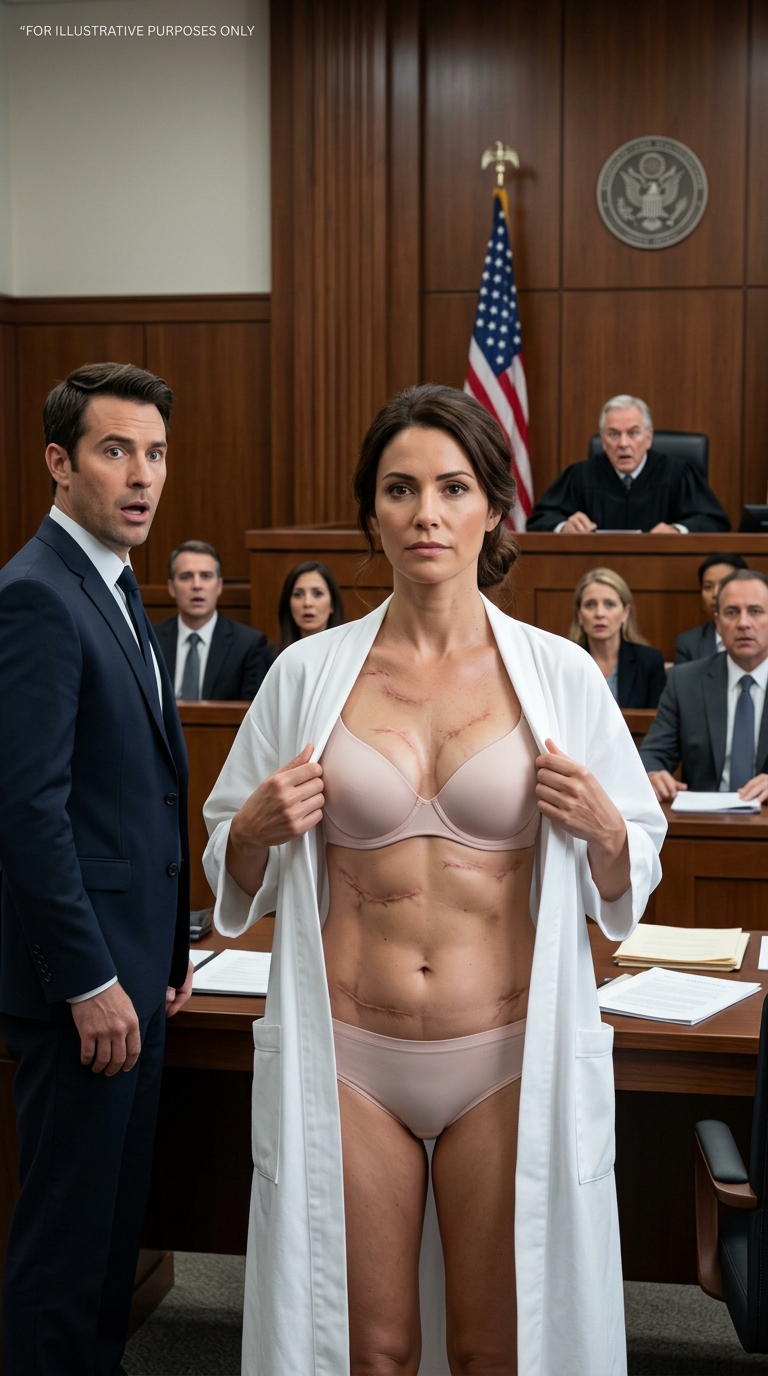
I stood up. Slowly, methodically, I unbuttoned the front of my high-necked silk blouse. I slipped it off my shoulders, letting it drape over the back of the chair, leaving me in a simple camisole.
The silence in the courtroom became absolute, ringing in my ears.
Revealed under the harsh, unforgiving fluorescent lights was the topography of my survival. Pale, crescent-shaped scars mapped my shoulders. A jagged, poorly healed laceration sat above my collarbone. Faded, yellowish-brown shadows of deep tissue contusions mottled my upper arms.
A sharp gasp echoed from the gallery. It wasn’t a gasp of sympathetic horror—it was a gasp of sheer terror. It came from Vivian. Marissa clamped a hand over her mouth, her eyes wide with sudden realization of the perjury trap she had walked into. Evan stared fixedly at the polished wooden floor, looking as though he wished it would open and swallow him whole.
I turned slightly, offering my shoulder to the judge, and pointed with clinical detachment to a specific, linear scar.
“I direct the court’s attention to this particular injury,” I began, my voice ringing with academic authority. “This laceration was caused by a narrow, cylindrical object, swung with extreme velocity from an elevated position, slightly behind the victim. The impact geometry indicates a downward strike angle of approximately forty-five degrees. Biomechanically, it is entirely impossible for a human body to sustain this specific striation pattern by falling forward down a carpeted staircase.”
Julian pressed a button on his podium, and a massive monitor flickered to life, displaying the high-resolution, time-stamped photographs I had taken over the months.
“Let us examine the contusion evolution,” I continued, using a laser pointer on the screen. “Notice the hemoglobin degradation in this photograph. The yellow-green border surrounding the central purple mass indicates the injury was between seven to ten days old when documented. Now, look at the adjacent photograph, featuring a deep red-blue contusion. This injury is fresh, under forty-eight hours old. These are distinctly different healing stages, representing distinctly separate traumatic events. This is not the result of a single, isolated accident or an ‘episode of hysteria.’ This is a documented, chronic pattern of repeated physical battery.”
Sterling jumped up again, desperately trying to stop the bleeding. “Objection! This is pure speculation designed to manipulate the court’s emotions!”
I snapped my gaze toward him, cutting him off before the judge could speak. “Forensic pathology is never speculation, Mr. Sterling. It is the rigid application of physics, biology, and geometric measurement. I am not giving you a theory; I am giving you the mathematical autopsy of a violent assault.”
The judge leaned forward, utterly captivated. “Overruled. Proceed, Doctor.”
And so, I dismantled Evan’s life, piece by bloody piece.
I matched the distinct buckle of his favorite Ferragamo belt to the twin indentations on my lower back. I correlated the heavy brass handle of the walking cane Vivian kept in the foyer to the blunt force trauma on my shoulder blade. I demonstrated how the crescent-shaped scar near my ribs perfectly mirrored the architectural beveling of our kitchen granite island.
Then, Julian played the audio file.
The courtroom speakers crackled, and Evan’s drunken, venomous voice filled the air.
“You think anyone in this city will believe you, Clara? You’re just a pathetic housewife. I’ll tell the judge you’re clinically crazy, and my mother will swear on a Bible to it. You are nothing without me.”
When the audio ended, the silence in the room was heavy enough to crush bone.
Helen Park was called next. In less than twenty minutes, my former mentor corroborated my analysis point by devastating point. But Dr. Park didn’t stop there. She requested to view the photograph of Evan’s so-called “defensive bruise.”
“This contusion,” Dr. Park noted with a dismissive wave, “lacks the central point of impact typical of a strike. Furthermore, the angle and lividity strongly suggest it was self-inflicted, likely by forcefully pressing the forearm against a hard, stationary edge. It is completely inconsistent with an attack by a secondary party. It is, quite simply, staged.”
Evan’s carefully constructed world was incinerating in real time. But the fire was about to spread to the gallery.
Julian presented the subpoenaed digital footprint. Marissa’s sworn affidavit collapsed first. Julian displayed security camera footage from our neighbor’s estate, proving Marissa was physically entering my home with Evan on the exact day and time she claimed I was threatening her across town in a parking garage.
Then came Vivian’s turn. Julian submitted cellular geolocation records obtained from the telecom company. They proved that on the night Vivian swore she witnessed me “harming myself,” her phone was pinging a cell tower in Aspen, Colorado, where she was attending a spa retreat.
Cornered, stripped of his lies, and facing total ruin, Evan snapped. The polished veneer cracked, revealing the monster underneath.
He bolted upward, knocking his heavy wooden chair backward with a violent crash. “She orchestrated this!” he screamed, pointing a shaking finger at me, his face contorted in uncontrollable rage. “She planned all of this! She trapped me! She’s a manipulative, calculating bitch!”
The bailiffs instinctively reached for their belts, stepping toward him.
I didn’t flinch. I slowly buttoned my blouse, securing the collar back in place, and looked directly into the eyes of the man who had tried to break my spirit.
“No, Evan,” I said, my voice echoing clearly in the stunned courtroom. “I didn’t trap you. I merely applied the scientific method to the choices you freely made.”
The gavel fell, but the reverberations of that strike would change the trajectory of five lives forever.
Part 4: The Autopsy of a Marriage
The judge’s ruling was swift, merciless, and absolute.
She immediately granted my request for a permanent, maximum-distance restraining order. She froze all of Evan’s personal and corporate accounts, pending a thorough forensic accounting of our marital assets. But she didn’t stop at the bounds of family court. Outraged by the brazen deception, the judge formally referred Evan’s case to the District Attorney’s office for immediate criminal investigation regarding domestic battery and witness tampering.
Furthermore, she issued severe judicial sanctions against Arthur Sterling and his legal team for willfully presenting falsified evidence.
The collateral damage to Evan’s accomplices was equally devastating. Vivian Mercer, the woman who believed her wealth placed her above the law, was formally indicted for felony perjury. When the police arrived at her country club to serve the warrant, her precious pearls offered no protection.
Marissa Locke found herself unceremoniously terminated from the firm. An internal corporate investigation, spurred by the public scandal, revealed she had not only committed perjury but had actively assisted Evan in illegally shuffling marital funds into offshore shell accounts.
Six months later, the chilling winds of winter had surrendered to the bright, hopeful warmth of spring.
I walked up the wide stone steps of the municipal courthouse. I wasn’t there as a terrified victim seeking protection, nor as a desperate wife fighting for her freedom.
I was there as an expert witness for the prosecution in a high-profile homicide case.
As I passed through the security checkpoint, I caught my reflection in the glass doors. I was wearing a crisp, perfectly tailored white laboratory coat. Underneath it, my scars were still there, of course. They would always be there. But they no longer felt like brands of ownership or symbols of shame. They were the hard-won medals of my survival.
After delivering a flawless two-hour testimony that secured a conviction, I stepped out into the afternoon sunlight. I took a deep, unobstructed breath of fresh air.
My new apartment was modest compared to the sprawling Mercer estate. It was small, it was incredibly quiet, and the dining table was cluttered with medical journals instead of forced apologies. The only flowers in the rooms were the bright, vibrant orchids I bought for myself simply because I found them beautiful.
Evan was currently sitting in a county holding cell, his bail revoked after attempting to contact me, awaiting his criminal trial. The grand Mercer mansion, the golden cage that had held me for seven years, was listed on the market, its price slashed twice to attract buyers.
I adjusted the collar of my coat and walked down the street, my heels clicking a steady, confident rhythm against the pavement. For the first time in seven long years, my body no longer felt like a crime scene waiting to be discovered. It no longer felt like a piece of evidence to be debated by lawyers.
It felt, unequivocally and entirely, like mine.
Disclaimer: This story is a work of fiction created for entertainment purposes. Any resemblance to real persons, events, or places is entirely coincidental.