PART 2
They were already seated in the dining room like customers waiting for service.
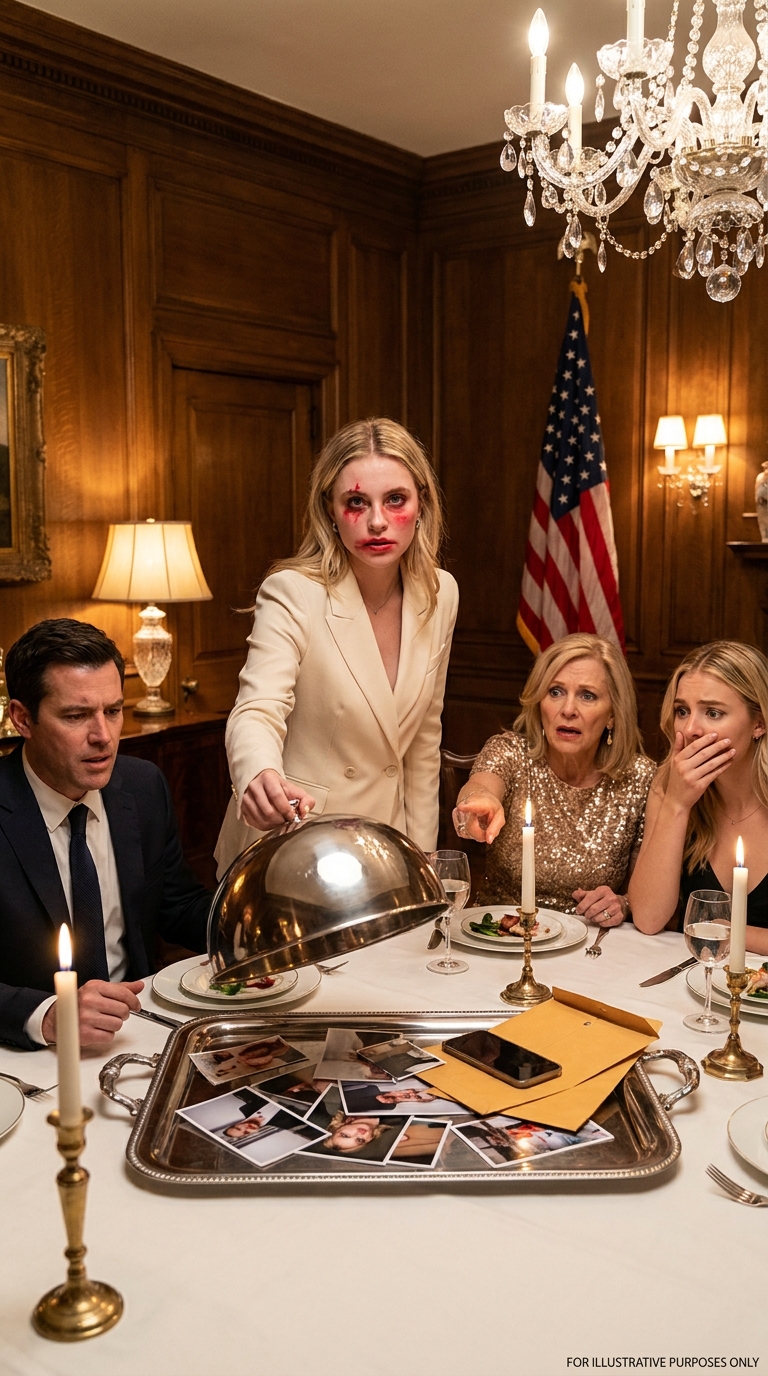
Carter sat at the head of the table, one hand curled around an empty wineglass, his patience clearly exhausted by the terrible burden of doing nothing all day. Patricia sat to his right with a cloth napkin spread over her lap. Lauren sat to his left, filming the table setting with her phone as if she expected to post some caption about “late-night family dinner.”
The rain had started outside. It streaked down the tall windows overlooking the backyard, turning the reflection of the dining room into something cold and distorted.
Carter’s eyes fixed on the covered platter.
“Finally,” he said. “It better be worth the wait.”
Patricia sniffed. “I don’t smell anything.”
“You will,” I said. “Just not food.”
Lauren frowned. “What’s that supposed to mean?”
I set the platter in the center of the table. The silver dome reflected their faces: Carter’s irritation, Patricia’s suspicion, Lauren’s boredom. For one perfect second, they still believed they were in control.
Carter reached forward and lifted the lid.
The dining room fell dead silent.
No steam rose.
No roasted chicken.
No mashed potatoes.
No steak.
No casserole.
Only documents.
Carter stared at the papers as if they were written in another language. His eyes moved over the deed first, then the divorce papers, then the highlighted bank statements. His face slowly changed from anger to confusion, then from confusion to something close to fear.
“What the hell is this?” he asked.
“Dinner,” I said. “Reality, served cold.”
Patricia grabbed the bank statements first. “Why are you putting paperwork on the table? Have you lost your mind?”
Then she saw the numbers.
The monthly transfers.
The credit card payments.
The spa charges.
The country club lunches.
Her face tightened.
Lauren snatched the divorce papers and scanned them quickly. Her mouth dropped open.
“Carter,” she whispered. “She’s divorcing you.”
Carter rose so fast his chair slammed into the wall.
“You filed for divorce?” he shouted.
“I did.”
“You don’t get to divorce me.”
“I already started.”
His eyes dropped to the deed. He grabbed it, scanned the page, then looked up with a face gone pale.
“Why is only your name on this?”
“Because the house is mine.”
“This is my house.”
“No, Carter. This is the house you lived in while I paid for it.”
Patricia’s voice rose. “How dare you talk to my son that way? He is the man of this home.”
“The man of this home hit me because I came home late from paying for it.”
Carter rounded the table.
His fists were clenched.
For a second, the old fear moved through me. My body remembered what my heart had decided to reject. But I did not step back.
Instead, I pointed to the corner of the living room ceiling.
A small black camera blinked red.
Carter followed my finger.
He stopped.
“The slap is recorded,” I said. “So is everything you said afterward. The footage is already backed up and shared with my attorney in Chicago. Touch me again, and this divorce becomes a police matter before sunrise.”
His face twisted with rage, but beneath it I saw panic.
“You planned this,” he said.
“No,” I replied. “You created this. I documented it.”
Patricia clutched the bank statements like they were poison.
Lauren looked from Carter to me, finally understanding that the money behind her entire lifestyle was standing at the head of the table with a swollen cheek and no intention of feeding her again.
“You can’t kick us out,” Lauren said.
I took out my phone.
“I already packed your things.”
Carter blinked. “You what?”
I walked to the foyer closet and pulled out three heavy black contractor bags. They scraped across the marble floor as I dragged them into view.
Thud.
Thud.
Thud.
I dropped one in front of each of them.
“Clothes, shoes, personal items,” I said. “Anything I bought that I chose to keep stays here. Anything I considered trash is already in the garbage bins.”
Lauren screamed and tore open her bag. Sweaters, jeans, shoes, and makeup spilled onto the floor in a wrinkled mess. “These are expensive!”
“Then you should have paid for them.”
Patricia staggered back. “You wicked woman. You planned to throw an old woman into the street?”
“You are not old when you’re ordering champagne at brunch,” I said. “You’re only old when accountability arrives.”
Carter’s voice dropped into a fake softness I knew too well.
“Maddie,” he said, stepping closer. “Come on. We’re all tired. I lost my temper. You know I didn’t mean it.”
I looked at him.
Five years of excuses stood between us like ghosts.
“You meant to hurt me,” I said. “You just didn’t think I would stop letting you.”
Outside, thunder rolled over the quiet Illinois suburb.
I opened the front door. Cold rain-scented air swept into the foyer.
“Leave,” I said.
Nobody moved.
So I began counting.
“One.”
Lauren sobbed.
“Two.”
Patricia cursed me.
“Three.”
Carter grabbed the first trash bag.
PART 3
The storm hit them the moment they stepped outside.
Rain poured over the front steps, soaked the driveway, and turned the carefully trimmed lawn into dark shining glass. Naperville’s quiet streets were empty except for the blurred glow of porch lights and the occasional passing car hissing through puddles.
Carter dragged his bag behind him, his wet shirt sticking to his back. Lauren struggled with hers, crying every time the plastic scraped against the stone path. Patricia refused to carry anything. She stood beneath the porch light with her chin raised, pretending dignity could keep her dry.
“Give me the SUV keys,” Carter demanded.
“No.”
“It’s my car.”
“It’s titled in my name.”
“I drive it.”
“You drove it because I allowed you to.”
His jaw tightened. “My wallet is upstairs.”
“I know.”
“My ID is in there.”
“I know that too.”
“You can’t keep my wallet.”
“It will be delivered to my lawyer’s office tomorrow. Along with a copy of the police report if you keep threatening me.”
He looked at me as if he had never seen me before.
Maybe he hadn’t.
Maybe all those years, he had only seen the woman who cooked, paid, cleaned, excused, endured, and apologized. He had never seen the woman underneath.
The front door of our neighbor’s house opened. Then another. Curtains moved across the street.
Patricia noticed first.
Her expression changed.
Suddenly, she pressed a hand to her chest and sank dramatically onto the wet porch.
“Carter,” she gasped. “My heart.”
Lauren dropped to her knees beside her. “Mom! Mom, are you okay?”
Carter turned toward the neighbors.
“Help!” he shouted. “My wife has gone crazy! She’s throwing my sick mother out in the rain!”
There it was.
The performance.
The poor husband.
The cruel wife.
The fragile mother.
The innocent sister.
For years, I had feared what people would think. That fear had kept me polite while Patricia insulted me, quiet while Lauren drained my accounts, and patient while Carter trained me to confuse abuse with marriage.
Not tonight.
I called the security office for our gated subdivision.
“Mr. Reynolds,” I said when the night supervisor answered, “this is Madison Whitman at 77 Briar Hollow Lane. I have three people refusing to leave my property after a domestic assault. Please send security immediately.”
Carter heard the word assault and lunged toward the door.
I stepped inside and held it half-closed.
“You wouldn’t dare,” he said.
“I already did.”
Within minutes, two security vehicles pulled up, lights flashing blue against the rain.
Tom Reynolds stepped out with two guards behind him. He had worked the subdivision gate for years. He knew who paid the HOA fees on time. He knew whose name appeared on the property file. He had also been called more than once after Carter’s late-night poker parties disturbed the neighbors.
“Mrs. Whitman,” he said, looking at me first. “Are you safe?”
“Yes. I want them removed from my property.”
Carter pointed at me. “This is a family argument.”
Tom looked at the papers I handed him in a waterproof folder: the deed copy, the attorney letter, the temporary protective filing.
His face hardened.
“Mr. Whitman,” he said, “you need to leave.”
Carter laughed in disbelief. “You’re taking orders from her?”
“I’m following documentation.”
Patricia suddenly recovered enough to sit up. “This is my son’s home.”
“The deed says otherwise,” Tom replied.
Lauren stared at the neighbors watching from porches and windows. Her humiliation was finally stronger than her anger.
The guards escorted them down the driveway. Carter twisted once to look back at the house, the SUV, the warm light spilling from the doorway, the life he had mistaken as his own.
“You’ll regret this!” he shouted. “You think you can survive without me?”
I stood in the doorway, my cheek still burning.
“I’ve been surviving without you for years.”
He flinched as if I had slapped him back.
The guards led them through the rain toward the gate. Their trash bags dragged behind them like evidence.
I closed the front door.
Locked it.
Fastened the chain.
Reset the alarm.
And for the first time in five years, the house became quiet.
Not lonely.
Quiet.
I went upstairs and collected Carter’s wallet from the nightstand. I removed every credit card connected to my accounts and cut them in half. His driver’s license went into an envelope for my attorney. His gym membership card, my Costco card, my gas card, my business lounge card—all of it went into a small plastic bag marked “property to return.”
No cruelty.
Just procedure.
At 1:16 a.m., my phone buzzed.
Carter: Open the gate. Mom is freezing.
I blocked his number.
At 1:24, Lauren called.
I blocked hers.
At 1:31, an unknown number texted: You are evil.
I blocked that too.
Then I took the longest shower of my adult life.
The hot water ran over my face, over the red mark on my cheek, over the invisible bruises no one had ever seen. I did not cry at first. Then I did. Not because I regretted anything, but because my body was finally safe enough to shake.
When I climbed into bed, rain still battered the windows.
But inside, nobody shouted.
Nobody demanded dinner.
Nobody called me useless.
I slept like a woman who had escaped a burning house and finally stopped smelling smoke.
PART 4
Carter later decided the worst part of that night was being embarrassed in front of the neighbors.
He was wrong.
The worst part was discovering how expensive the world became without my money paying for it.
By the time the security guards escorted Carter, Patricia, and Lauren outside the subdivision gate, the storm had soaked through their clothes. They stood beneath the dim glow of a streetlamp near the entrance road, shivering and furious, surrounded by trash bags that now looked like abandoned garbage.
Carter checked his pockets again and again.
No wallet.
No cash.
No car keys.
No credit cards.
No power.
Patricia’s makeup had run in black streaks beneath her eyes. Her silk robe clung to her knees. “This is your fault,” she snapped at Carter through chattering teeth. “You let her become too independent.”
Lauren hugged her wet bag to her chest. “I’m calling an Uber.”
She tried three times.
Each time, the payment failed.
Every card attached to her account had been canceled.
She called friends next.
One sent the call to voicemail.
One answered, listened for thirty seconds, then claimed she was “out of town.”
Another said, “Oh my God, Lauren, that sounds awful,” and then hung up when Lauren asked for money.
By 3:00 a.m., they were huddled beneath the awning of a closed pharmacy on a road outside Naperville. Mosquitoes found them. Passing cars slowed, then sped away. Carter’s stomach growled so loudly Lauren told him to stop breathing near her.
At sunrise, an employee arrived to open the pharmacy and told them to leave before she called the police.
So they walked.
Carter decided he still had one option: work.
He was a regional operations manager at Great Lakes Office Supply, though the title sounded more impressive than the job. His salary was modest, but it was something. If he could get an advance, borrow from a coworker, or convince his boss that he had a temporary emergency, he could rent a cheap motel room.
He left Patricia and Lauren on a park bench near a strip mall and walked two miles to the office.
He washed his face in the restroom of a gas station, tried to flatten his wet hair, and used paper towels to wipe mud from his shoes. Still, when he reached the office lobby, the receptionist stared at him as if he had wandered in from under a bridge.
“Rough night?” she asked.
“Car trouble,” he muttered.
In the elevator, two employees from accounting stepped in, took one look at him, and stopped talking.
When Carter reached his desk, a woman from HR was already waiting.
“Carter,” she said, avoiding his eyes, “Mr. Jenkins and Ms. Howard need you in Conference Room C.”
His stomach dropped.
Conference Room C was where people got fired.
Inside, the general manager sat with the HR director and an internal auditor. A thick folder rested on the table.
“Sit down,” Mr. Jenkins said.
Carter tried to smile. “Is this about last quarter’s reports? Because I know there were some clerical issues—”
The auditor opened the folder.
Fake mileage.
Inflated hotel reimbursements.
Personal meals billed as client meetings.
Duplicate vendor invoices.
Company funds redirected to gambling platforms.
Forty-nine thousand dollars missing over nine months.
For a long time, I had quietly cleaned up Carter’s mistakes. I had corrected reports, covered small shortages, and told myself I was protecting our marriage. Then I understood the truth: I was protecting a man who would never protect me.
So I stopped.
And without me, his lies collapsed almost immediately.
“You are terminated for cause,” Mr. Jenkins said. “Effective now. No severance. If restitution is not arranged within forty-eight hours, this will be referred to law enforcement.”
Carter begged.
He said his mother was sick.
He said his wife had thrown him out.
He said he had made mistakes.
He said he could fix everything.
But men like Carter never mean fix as in accept consequences.
They mean find another woman to carry them.
Security escorted him out with a cardboard box containing a framed photo, a few pens, a phone charger, and a fake leadership award he had bought online.
Outside, downtown Chicago’s commuter traffic roared past him.
Then he saw me.
A black car pulled up outside a glass office tower across the street. I stepped out wearing a cream-colored suit, my hair neatly pinned, sunglasses hiding the bruise on my cheek. Two assistants followed me with files.
I was there to present the final audit report from the case that had kept me late the night before.
Carter froze.
Our eyes met across the sidewalk.
For one second, his face said everything: shock, humiliation, anger, disbelief.
I did not wave.
I did not smile.
I turned and walked into the tower.
By noon, Carter returned to Patricia and Lauren with no money, no job, no plan, and a cardboard box full of failure.
That was when the family began eating itself alive.
PART 5
Patricia spotted Carter first from the park bench.
Her face lifted with hope. “Did you get money?”
Lauren stood quickly. “Please tell me you booked a hotel.”
Carter dropped the cardboard box at their feet.
The sound answered for him.
“I got fired,” he said.
Patricia stared. “What?”
“They audited me. They found the reports. They said I owe almost fifty thousand dollars.”
For a long moment, neither woman spoke.
Then Patricia slapped him.
It was not as hard as the slap he had given me, but it shocked him more. His mother, who had excused every failure and inflated every mediocre achievement, struck him in public.
“You stupid boy,” she hissed. “You useless, stupid boy.”
Carter’s face twisted. “Don’t talk to me like that.”
“Then don’t ruin my life!”
Lauren laughed bitterly. “Your life? What about mine? I’m homeless because my brother was stealing from his job.”
“You were spending stolen money just fine last week,” Carter snapped.
“At least I didn’t commit a crime!”
“No, you just lived off Madison like the rest of us.”
The truth fell between them like a dropped knife.
Patricia began crying, but her tears were full of blame. “I gave everything to my children, and this is how I end up? Hungry? Wet? Sitting on a public bench like some nobody?”
Carter looked at her with sudden hatred. “You gave everything? You gave criticism. Madison gave money.”
Patricia gasped.
The family they had defended so fiercely in my dining room cracked in the open air.
By evening, desperation forced them to pawn what little they had. Carter sold his watch for far less than it was worth. Lauren surrendered her gold earrings only after screaming in the parking lot until a police officer told them to move along. The money bought burgers, bottled water, and one week in a motel outside Joliet.
The motel room smelled of mildew and cigarettes.
One bed.
A thin blanket.
A flickering lamp.
A bathroom door that did not lock.
Patricia cried into a towel. Lauren stood in the center of the room, horrified.
“I can’t stay here,” she said.
Carter collapsed into the chair. “Then sleep outside.”
“I mean it.”
“So do I.”
That night, Carter tucked the remaining cash under his pillow.
Patricia eventually fell asleep, whispering prayers that sounded more like complaints. Carter snored with one arm over his face.
Lauren stayed awake.
She stared at the cracked ceiling and understood something simple: if she stayed, the money would run out, Carter would be arrested or unemployed forever, and she would become Patricia’s nurse in a motel room that smelled like mold.
But Lauren was young. Pretty. Selfish. Trained by Patricia to believe survival meant attaching herself to whoever had the most money.
So before dawn, she slipped her hand beneath Carter’s pillow.
He moved.
She froze.
He kept sleeping.
Lauren removed the envelope, packed the best clothes from her trash bag, and left without a note.
When Carter woke up, his scream shook the room.
“The money’s gone!”
Patricia sat up in confusion. “What?”
“Lauren’s gone!”
Patricia refused to believe it at first. She searched the bathroom, the hallway, the parking lot. But Lauren’s bag was missing. Her phone was off. The cash was gone.
Patricia sank onto the bed.
“My baby wouldn’t do that.”
Carter laughed in a way that sounded almost insane. “Your baby did exactly what we taught her to do. Take what you can and leave someone else to starve.”
The motel owner evicted them before noon after they failed to pay the added deposit and after other guests complained about shouting.
This time, Carter and Patricia had nothing.
No money.
No food.
No Lauren.
No plan.
Patricia’s health began to fail in a way that was not theatrical. Her legs swelled. Her breathing became shallow. Her eyes looked empty.
Carter borrowed a stranger’s phone outside a grocery store and sent me a message from an unknown number.
Madison, please. It’s Carter. Mom is sick. Lauren ran away with our money. We’re sleeping outside. I know I hurt you. I swear I’ll change. Please let us come home. I still love you.
I read the message in my new office in downtown Chicago.
My cheek had healed.
My memory had not.
I remembered every dinner thrown in the trash because Patricia said it was bland. Every bill Carter promised to pay and never did. Every time Lauren laughed while I cleaned a house she dirtied. Every apology I gave just to survive another evening.
Then I deleted the message.
Blocked the number.
And returned to a fraud report worth more than Carter had ever earned honestly.
Within two weeks, I listed the Naperville house.
Within three, it sold above asking.
I bought a penthouse in Chicago with a view of Lake Michigan, secure elevators, quiet neighbors, and a kitchen where nobody ordered me to cook.
The first morning there, I made oatmeal with blueberries and poured coffee into a white mug.
I sat by the window as the city turned gold beneath the sunrise.
Then I posted one photo.
Caption: Peace is the best meal I’ve ever made.
After that, I turned off my phone and ate breakfast slowly.
Not as revenge.
As freedom.
PART 6
Divorce court was quieter than I expected.
No screaming. No dramatic confession. No Carter bursting through the doors begging for another chance.
He did not appear.
My attorney, Rebecca Hayes, sat beside me in a navy suit, calm and prepared. She had warned me that men like Carter often disappeared when evidence replaced emotion.
The judge reviewed the file.
Documented domestic assault.
Financial abandonment.
Separate property.
Signed divorce petition.
Security footage.
Carter’s failure to respond.
The gavel came down.
Five years of marriage ended in less than fifteen minutes.
Outside the courthouse, an American flag moved in the cold Chicago wind.
Rebecca touched my shoulder. “How do you feel?”
I inhaled.
“Like I finally own my own life.”
And I did.
The energy I had once spent managing Carter’s temper went into my work. The money I had wasted supporting Patricia and Lauren went into therapy, savings, investments, travel, and sleep. I hired a trainer. I changed my hair. I bought clothes Carter would have mocked. I reconnected with friends I had neglected because I was too ashamed to tell them the truth.
My career rose fast.
Six months after the divorce, I became a partner at my firm.
Nine months after, I launched a financial investigation division focused on corporate fraud and asset tracing. Companies flew me to New York, Washington, D.C., Miami, Dallas, and Los Angeles to find the numbers powerful men tried to bury.
But success did not erase everything.
I still flinched when someone moved too quickly near my face.
I still apologized too often.
I still woke some nights hearing Carter’s voice say cook.
So I went to therapy every Thursday at 6:00 p.m.
I sat on a gray sofa in an office near Lincoln Park and told the truth to a woman who did not interrupt me, excuse him, or ask why I had stayed.
The truth was complicated.
Leaving did not instantly make me fearless.
It made me free enough to learn fear was not my natural state.
One year after the night of the covered platter, I founded The Madison Cole Foundation, a nonprofit helping women rebuild after domestic abuse and financial control. We provided emergency legal consultations, short-term housing grants, financial literacy workshops, and counseling.
The launch event was held in a bright hall near the Chicago River.
White flowers lined the stage. A string quartet played near the entrance. Attorneys, business leaders, survivors, donors, and city officials filled the room. Behind the podium hung a large American flag.
When I stepped onstage, applause rose around me.
For a second, I saw myself as I had been at 11:10 p.m.—tired, slapped, silent, carrying a platter of evidence through my own dining room.
Then I saw myself now.
Standing in the light.
Voice steady.
Name restored.
“My name is Madison Cole,” I said. “For years, I believed keeping the peace meant keeping my marriage alive. Now I know peace built on fear is not peace. It is a prison with nice furniture.”
The room went still.
I did not tell every detail. I did not need to. The women listening understood the spaces between my words. They understood the dinners cooked through exhaustion, the bank accounts drained in the name of family, the apologies made only to avoid an explosion.
“Tonight,” I continued, “we open a door for women who have been told they have nowhere to go. There is somewhere to go. There is life after fear. And sometimes the first step is not forgiveness. Sometimes the first step is locking the door.”
The applause came louder this time.
After the ceremony, we held a community outreach event outside beneath white tents. Food boxes, grocery cards, hygiene kits, and legal information packets were stacked on long tables. I insisted on handing them out personally.
The line moved slowly.
A young mother with two children.
An elderly veteran.
A college student living in her car.
A woman hiding bruises beneath heavy makeup.
I gave each person a package, looked them in the eye, and said something human.
Then a man stepped forward pushing an old wheelchair.
His clothes were torn and dirty. His beard was uneven. His face was thin in a way that made him look much older than he was. In the wheelchair sat an older woman wrapped in a stained blanket, her eyes cloudy, her mouth slack with exhaustion.
The man kept his head down.
I reached for a food box.
“Here you go, sir,” I said. “There’s a grocery card inside.”
His trembling hand reached for it.
Then he looked up.
Recognition did not hit me like lightning.
It arrived cold and quiet.
Carter Whitman stared at me with sunken eyes.
“Madison,” he whispered.
PART 7
For a moment, the noise of the event blurred around us.
Not because I loved him.
Not because I hated him.
Because the past sometimes returns wearing a face you once feared, and your body needs a second to understand it no longer has power over you.
Carter’s eyes filled with tears.
Patricia sat in the wheelchair behind him, thinner now, smaller, stripped of silk and superiority. She looked at me with cloudy recognition, then shame, then something almost like need.
“Madison,” Carter said again. “I didn’t know this was yours.”
“I believe you.”
His hands tightened around the handles of the wheelchair. “I’ve wanted to talk to you.”
“There’s a line behind you.”
He looked back at the people waiting, then lowered his voice. “Please. Just one minute.”
A security volunteer stepped closer, but I gave a small shake of my head.
Carter swallowed hard. “I’m sorry.”
The words hung in the air between us.
Once, I would have given anything to hear them.
Once, I would have mistaken them for healing.
“I’m sorry for hitting you,” he said. “For letting Mom and Lauren treat you like that. For using you. For hating you because you were better than me. I was ashamed, and I took it out on you.”
Patricia made a faint sound, as if even now she wanted to correct the story.
Carter ignored her.
“I lost everything,” he continued. “The company pressed charges. I served time. Not long, but enough. Lauren disappeared. Mom got worse. I tried shelters, day labor, anything. I kept thinking if I could just see you, maybe you would know I changed.”
I studied him.
Maybe he had changed.
Maybe hunger had carved humility into him. Maybe shame had finally done what comfort never could. Maybe regret had followed him through nights on concrete and mornings without coffee.
But change did not create a debt in my name.
His suffering was not a bill I owed.
“I hope you have changed,” I said.
Hope flickered in his eyes.
I placed the food box and grocery card in his hands.
“But not for me.”
The hope disappeared.
He looked down at the box as if it were both mercy and punishment.
“Is there any forgiveness left?” he asked.
The question did not hurt.
That was how I knew I was free.
“Forgiveness is not a door back into my life,” I said. “It is a lock I removed from my own heart. I don’t hate you, Carter. I don’t think about you enough for that.”
His face broke.
Anger would have been easier for him. Hatred would have meant he still mattered. My indifference left him nowhere to stand.
Patricia lifted a shaking hand. “We were family.”
“No,” I said softly. “You were people I survived.”
The volunteer gently guided Carter aside. “Sir, please keep moving.”
Carter pushed Patricia’s wheelchair toward the edge of the plaza. Halfway there, he looked back.
I was already handing a package to the next woman in line.
She had a little boy clinging to her coat and fear in her eyes.
“You’re safe here,” I told her.
That mattered.
Carter did not.
Later, after the event ended and the sunset turned the Chicago River copper, I stood outside the hall while volunteers packed the tables. A cold wind moved between the buildings. City lights flickered on one by one.
Rebecca came to stand beside me.
“Are you okay?” she asked.
“Yes.”
“Seeing him like that must have been difficult.”
I looked across the street.
Carter sat on a low concrete wall, feeding Patricia from the charity meal. His shoulders shook. Maybe he was crying. Maybe he was laughing bitterly at the life he had built from his own cruelty. Maybe he finally understood that the woman he once ordered to cook had served him the only meal he truly earned.
Consequences.
“I’m grateful,” I said.
Rebecca looked at me. “For what?”
“That I didn’t wait for him to become sorry before I became free.”
A black car pulled up to the curb. My driver opened the door. The next morning, I had a flight to Washington, D.C., to speak at a financial independence conference for survivors. Next month, the foundation would open an emergency housing unit in San Diego. After that, maybe Dallas. Maybe Boston. Maybe every city where women were still whispering to themselves that they could endure one more night.
My life was not perfect.
But it was mine.
Before stepping into the car, I looked once more at the plaza.
Carter and Patricia were small beneath the streetlights.
For years, I had imagined revenge as fire. I thought it would feel like watching them suffer, watching them lose, watching them crawl back.
But real revenge was quieter.
It was sleeping without fear.
Eating breakfast in peace.
Owning my money.
Choosing my name.
Helping women who still needed the door opened.
The best revenge was becoming so whole that the people who broke me became irrelevant.
I got into the car.
As we drove away, the city opened before me, bright and endless.
In the rear window, Carter disappeared into traffic, shadows, and distance.
I did not look back again.